


Data Governance Framework – A Comprehensive Guide
As enterprise data continues to grow exponentially and GDPR enforcement fines rise significantly, prioritizing data governance investments has become a pressing strategic imperative for data-reliant businesses. In 2023, the data governance market is valued at approximately $2.73 billion, with projections indicating it will reach $6.71 billion by 2028.

If your organization has not yet implemented a data governance framework, now is the time to act. This blog post outlines the steps to establish a forward-looking data governance framework that can enhance revenue generation.
What is a Data Governance Framework?
A data governance framework includes regulations, processes, and responsibilities designed to ensure privacy and regulatory compliance in how an organization manages enterprise data. Even as the volume of data continues to grow, a data governance framework facilitates the following:
- Efficiently expand and standardize core data governance practices.
- Sustain compliance with policies and regulations.
- Enable wider access to data.
- Foster collaboration among stakeholders.
This framework offers a clear roadmap for ensuring the quality, integrity, security, discoverability, accessibility, and usability of an organization’s data assets. By implementing the right framework, businesses can turn their data into a valuable asset that can meet and potentially surpass their business objectives.
Components of Data Governance Framework
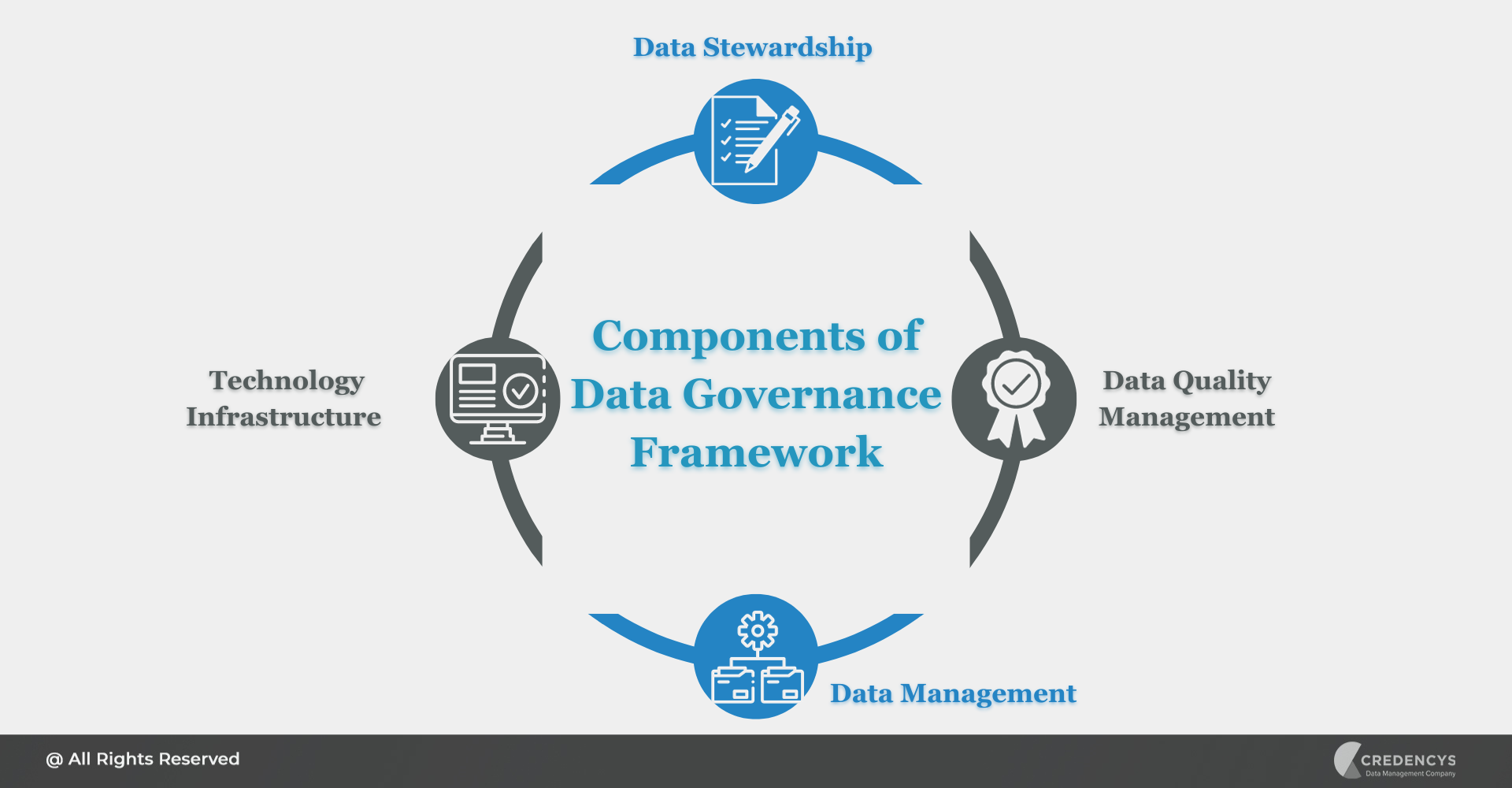
A data governance framework consists of four key elements:
Data Stewardship
Data stewards play a crucial role in ensuring that an organization’s data assets remain accurate, consistent, and compliant with relevant regulations, particularly during company projects.
Data Quality Management
Data quality management encompasses the processes and procedures employed to maintain the integrity of an organization’s data assets, ensuring they are free from errors and inaccuracies. It also involves techniques for identifying and correcting errors or inaccuracies as they arise.
Data Management
Data management processes establish how an organization’s data assets are generated, stored, accessed, and utilized. These processes also set the guidelines for sharing these assets with both internal and external stakeholders.
Technology Infrastructure
This component pertains to the hardware and software systems used for data collection, storage, and management. It includes databases, enterprise resource planning systems, data warehouses, and network connections that facilitate information exchange among stakeholders.
Importance of Data Governance Framework
Without a data governance framework, businesses cannot ensure data quality or comply with privacy regulations. This leaves them vulnerable to mishandling customer data, which can lead to severe legal consequences such as substantial fines and reputational harm.
Without a data governance framework, departments within an organization tend to follow their own standards and procedures, which ultimately creates data silos. These silos, over time, lead to operational inefficiencies.
Without access to a centralized, reliable source of information, employees are limited to the data within their respective tools and systems. This creates gaps in understanding and, at times, discrepancies in reporting across databases.
Consequently, it erodes trust in the data as a whole.

Ready to Strengthen Your Data Governance?
Data Governance Framework Models
Before we dive into specific data governance framework examples, we should first cover the five main data governance models. These models depend on how data governance decisions flow through your organization.
- Top-down: Company leadership implements data governance policies, then passes them down to individual business units and shares them with the rest of the company.
- Bottom-up: Employees at the lower levels implement data governance practices, such as standardizing naming conventions, which spread to the higher levels of the organization.
- Center-out: The team or individual responsible for data governance sets data standards that the entire organization follows.
- Silo-in: Various departments come together to align on data governance while keeping in mind the needs of each group.
- Hybrid: Data governance decisions involve different levels of the organization. For example, a company uses a center-out model to suggest a course of action but employs a top-down model to make the final decision.
Benchmark of a Good Data Governance Framework
An effective enterprise data governance framework should:
- Enhance decision-making capabilities.
- Minimize operational obstacles.
- Safeguard the interests of data stakeholders.
- Educate management and employees in adopting uniform strategies for addressing data-related challenges.
- Establish consistent and replicable procedures.
- Drive cost reduction and enhanced efficiency by orchestrating collaborative efforts.
- Assure transparency in processes
Advantages of Data Governance Framework
A data governance framework facilitates cross-organizational collaboration in overseeing all data assets, aligning them with your company’s overarching corporate goals. The benefits of such a framework include:
- Enhanced clarity in coordinating data governance initiatives
- A structured strategy for overseeing and gaining insight into your complete data portfolio
- Inherent transparency in data management practices
- Efficient monitoring of data usage, guided by the established blueprint
- A robust foundation for compliance with regulatory requirements
How to Create a Data Governance Framework?
Here are five steps to guide you in establishing an enterprise data governance framework:
Reevaluate Your Data Governance Definition
As data volumes expand and new data sources and access points emerge, it’s crucial to periodically review your data governance structure, essentially governing the process itself. Ask questions like:
- What is the core purpose of our data governance?
- Does it encompass all data assets across the entire organization?
- Does our governance framework encourage widespread data sharing and collaboration within the organization?
Identify and Define Data Domains
Since your data management framework should encompass all data assets, the next step is to identify and standardize data domains across the organization. These domains can correspond to functions that generate data, such as finance, marketing, and sales. Consider questions like:
- Which data domains are prominent within our organization?
- What types of data do these domains generate?
- Where is this data currently located?
- Who are the primary consumers of this data?
Identify Domain Data Owners and Consumers
Modern data governance emphasizes shared responsibility for data. Assign data owners to each domain and understand data consumption patterns to ensure the right parties have appropriate access.
Begin by asking questions such as:
- Who is responsible for generating data within each domain?
- How do data consumers within these domains utilize the data in their daily workflows?
- What are the current access dependencies for domain-specific data?
Ready to Embark on Your Journey to a Robust Data Governance Framework Tailored to Your Organization’s Needs?
Validate and Document Data Details
At this stage, you should clearly understand data flow within your organization. Standardize definitions for data domains, establish data flow rules and workflows, outline access policies, and document these aspects thoroughly.
Your documentation should address questions like:
- Where does data originate?
- What is its significance?
- How does it traverse through the organization?
- Does it contribute to each domain’s goals?
- Does it align with the organization’s broader business objectives?
Consider setting up a modern data workspace that utilizes active metadata to maintain relevant, up-to-date, and useful documentation.
Conduct Data Security and Risk Assessments for Each Domain
The final step is to implement processes for regular data security and risk assessments for each domain. Recognize that enabling data governance is an ongoing journey, not a one-time project. Start by inquiring about:
- Existing data access policies and security measures for each domain.
- Data access permissions and their justifications.
- Whether these policies effectively mitigate risks without hindering data discovery, access, and collaboration.

By following these steps, you can begin developing a decentralized, community-driven data governance framework that meets the needs of everyone in your organization.
Pillars of Data Governance Frameworks
Data governance frameworks rest on four fundamental pillars that help ensure efficient management and use of data across an organization. These pillars ensure data accuracy, enable seamless integration from diverse sources, enforce data protection and regulatory compliance, and oversee data storage and management tailored to the organization’s requirements.
Data Quality
Data quality serves as the bedrock of any data governance framework. It ensures the precision, consistency, and reliability of data used in decision-making. Data quality management also includes establishing guidelines and procedures for data validation, cleansing, and profiling.
Data Integration
Data integration involves harmonizing data from various sources to create a unified perspective. This pillar ensures effective merging of data from different departments, business units, or external partners, enabling its use in analysis and decision-making.
Data Privacy and Security
Data privacy and security hold paramount significance in the contemporary digital landscape. This pillar involves implementing policies and procedures to safeguard sensitive data and comply with data protection laws and regulations. It encompasses measures such as data encryption, access control, and data anonymization techniques.
Data Architecture
The fourth pillar, data architecture, pertains to the design and structure of data systems. It includes planning and designing data systems to align with the organization’s specific needs. This includes designing databases, data warehouses, and data lakes to meet the organization’s requirements effectively.
Ready to Fortify Your Organization’s Data Governance Framework and Harness the Full Potential of Your Data Assets?
Data Governance Framework – Best Practices
Every organization aspires to harness the advantages of becoming more data-driven. However, achieving this goal takes more than data collection; it requires a well-structured data governance framework to ensure effective data management while staying aligned with applicable laws and regulations.
No single data governance framework fits every organization, as the best approach depends on its unique requirements and objectives. By following data governance best practices, organizations can build a framework tailored to their needs and industry requirements, helping them achieve their business outcomes.
Define the Framework’s Purpose
The first step in building a data governance framework is defining its purpose. A clear understanding of enterprise-wide data management goals is a critical first step in developing the framework.
Understand the Current Organizational State
Before formulating the framework, it is imperative to understand the current state of an organization’s data management processes and technological infrastructure. Using a data maturity model as a benchmark and improvement guide helps identify gaps the framework must address.
Engage Stakeholders Early and Continuously
When creating a governance framework, a vital consideration is engaging stakeholders from the outset and maintaining ongoing involvement throughout the process. This ensures that everyone comprehends the framework’s objectives and commits to its successful implementation.
Additionally, it ensures that all prevailing data usage and management best practices are considered and optimized for integration into the new framework, regardless of the department using the data.
Maintain Simplicity
While the temptation to add numerous rules and procedures to a governance framework may arise, it is crucial to keep it simple. A straightforward approach fosters enterprise-wide adoption and compliance.
Plan for Adaptability
Regardless of how meticulously a governance framework is crafted, unforeseen circumstances may arise. Consequently, it is essential to design a flexible framework that can adapt to evolving organizational needs over time.
Credencys – Your Trusted Data Governance Partner
Building an effective governance framework requires more than defining policies. Credencys’ data governance consulting helps enterprises assess governance maturity, define ownership and stewardship, design the operating model, and create an actionable roadmap for enterprise-wide governance.
With a deep understanding of the intricacies involved in crafting effective data governance frameworks, Credencys brings a wealth of expertise to the table. Our track record of successful implementations and commitment to staying at the forefront of industry best practices ensures that clients receive tailored solutions that not only meet but exceed their unique data governance needs.
Credencys’ dedication to simplicity, adaptability, and stakeholder engagement aligns perfectly with the core principles outlined in this blog post, making us a valuable resource for organizations looking to unlock the full potential of their data assets and drive strategic success in the digital era.
Closing Thoughts
The journey toward becoming a more data-driven organization is a path paved with immense potential for growth and success. However, this transformation demands more than collecting data; it requires a well-structured data governance framework aligned with your specific objectives and industry requirements.
As we explored in this blog post, no single data governance framework fits every organization. The process begins with clearly defining your framework’s purpose, understanding your organization’s current data landscape, and continuously engaging stakeholders.
Simplicity in design and flexible planning are essential to ensure the framework’s effectiveness. Remember, data governance is not a one-time project; it’s a journey of continuous improvement and adaptation to meet evolving needs.
By following these best practices and tailoring your data governance framework to your organization’s unique needs, you can unlock the true potential of your data assets, foster a culture of data-driven decision-making, and ultimately achieve your desired business outcomes. So, as you embark on your data governance journey, keep these principles in mind, and watch as your organization transforms into a data-driven powerhouse poised for success in the digital age.






Tags: