

The era of intelligent automation is here, and it’s moving fast. As enterprises race to stay competitive in a digital-first world, traditional automation tools are falling short of delivering the agility, intelligence, and adaptability that modern business environments demand.
Enter AI Agents for Enterprise: autonomous, AI-powered systems designed to make decisions, interact intelligently with humans and systems, and drive measurable business outcomes across departments. These intelligent agents are not just glorified chatbots or robotic process automation (RPA) tools.
They represent a significant leap forward capable of context-aware decision-making, real-time learning, and seamless integration into enterprise ecosystems. Let’s start by understanding what exactly these agents are.
What Are AI Agents for Enterprise?
Enterprise AI Agents are intelligent, autonomous software entities that can perform tasks, make decisions, and interact with humans or systems, all with minimal human intervention. These agents are designed to operate within complex business environments, supporting or even independently handling workflows across departments like IT, customer service, finance, supply chain, and more.
Unlike traditional bots or automation scripts, AI agents don’t just follow predefined rules; they understand context, learn from interactions, and adapt over time to deliver smarter, more efficient outcomes.
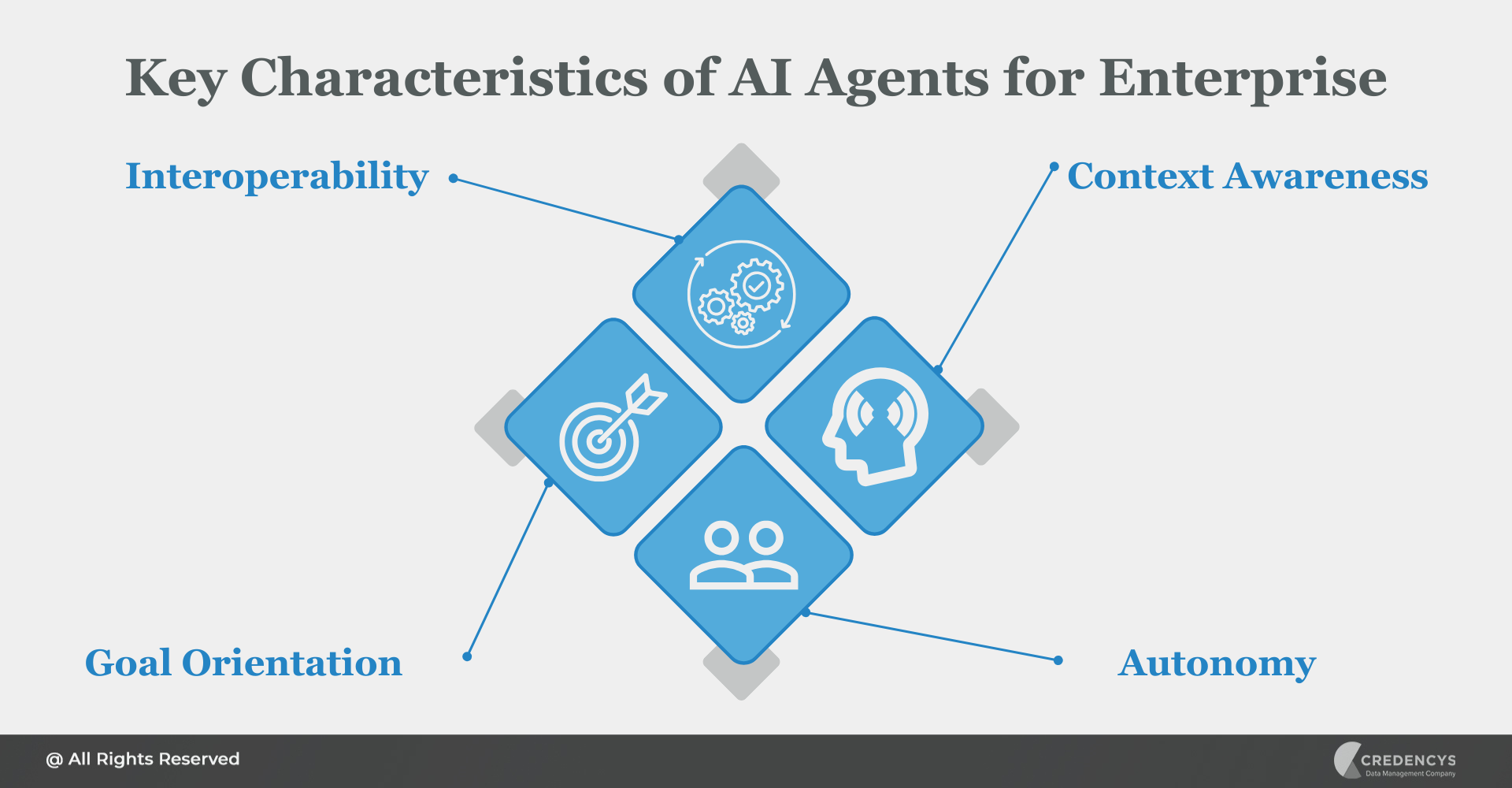
Key Characteristics of AI Agents for Enterprise
- Interoperability: Seamlessly integrate with enterprise systems like CRMs, ERPs, helpdesk platforms, and data warehouses to gather and act on real-time insights.
- Goal Orientation: Focus on achieving specific business objectives such as resolving a support ticket, processing an invoice, or optimizing resource allocation.
- Context Awareness: Understand business processes, user intent, and historical data to make intelligent decisions.
- Autonomy: Operate independently once goals and guardrails are set without constant supervision.
How Are They Different from Traditional Automation or Chatbots?
| Feature | Traditional Automation | Chatbots | Enterprise AI Agents |
|---|---|---|---|
| Logic | Rule-Based | Scripted Conversations | Reasoning + Learning |
| Scope | Single Task or Process | Limited to Customer Service | Cross-functional, multi-domain |
| Adaptability | Static | Static | Continuously learns and evolves |
| Integrations | Limited | Front-end Only | Deep system-level integration |
In short, Enterprise AI Agents are dynamic, intelligent collaborators and not just task executors.
Core Capabilities of AI Agents for Enterprise
Enterprise AI agents are built to go beyond automation; they’re designed to think, learn, and act intelligently across business functions. These are not pre-scripted bots; they are sophisticated systems equipped with a broad set of AI capabilities that enable them to deliver real-time value in complex enterprise environments.
Here are the core capabilities that make enterprise AI agents so powerful:
1. Multi-Modal Input & Output
These agents can interact using multiple modes: text, voice, APIs, dashboards, or even visual interfaces, allowing them to serve users across channels and platforms.
Example: A finance agent can respond via email, Slack, or a voice interface, depending on the user’s preference.
2. Continuous Learning & Optimization
Modern AI agents incorporate machine learning to improve over time. They learn from interactions, user feedback, and business outcomes to become smarter and more efficient.
Example: A customer service agent might improve its ability to classify tickets or detect sentiment based on previous interactions.

Ready to Build AI Agents that Get Smarter with Every Interaction? Let’s Turn your Data into Continuous Business Value
3. Real-Time Data Processing
AI agents connect with enterprise systems and data streams to access and analyze information in real time. This enables:
- On-the-fly decision-making,
- Context-aware responses,
- Instant updates to databases or dashboards.
Example: A supply chain agent can monitor stock levels in real time and reorder inventory automatically when thresholds are crossed.
4. Reasoning & Decision-Making
Enterprise agents use machine reasoning and logic frameworks to analyze data, weigh options, and make intelligent decisions aligned with business goals. They can:
- Prioritize tasks,
- Apply rules or policies contextually,
- Resolve issues based on learned patterns.
Example: An IT support agent can decide whether to reset a password automatically or escalate based on security policies.
5. Natural Language Understanding (NLU)
AI agents can understand human language, both written and spoken, and extract meaning, intent, and context from it. This allows them to:
- Interpret user queries accurately,
- Carry on dynamic, multi-turn conversations,
- Support multiple languages and tones.
Example: An AI agent in HR can interpret a vague query like “How many leaves do I have left?” and respond based on real-time employee data.
These capabilities empower enterprise AI agents to handle tasks that previously required multiple tools and human oversight with greater speed, accuracy, and scale.
Key Use Cases of AI Agents for Enterprise
Enterprise AI Agents are versatile; they can be tailored to solve challenges across departments, industries, and workflows. From enhancing customer service to optimizing backend operations, their impact is both wide-reaching and measurable.
Let’s explore how organizations are leveraging AI agents in real-world scenarios:
1. Finance & Accounting
- Invoice Validation Agents extract, verify, and process financial documents.
- Compliance Checkers ensure regulatory alignment by scanning large datasets.
- Fraud Detection through anomaly analysis in transaction patterns
Impact: Increased accuracy, fraud prevention, and faster financial cycles.
2. Supply Chain & Logistics
- Inventory Optimization Agents predict demand and suggest replenishment strategies.
- Vendor Interaction Bots for automating procurement queries and negotiations.
- Logistics Tracking with real-time updates and rerouting based on conditions.
Impact: Reduced stockouts, improved supplier coordination, better logistics control.
3. Human Resources
- Onboarding Agents guide new hires through processes, forms, and training.
- Policy Q&A Bots answer employee questions on leaves, reimbursements, etc.
- Recruitment Assistants screen resumes and coordinate interviews.
Impact: Streamlined HR operations, improved employee experience, and reduced manual effort.
4. IT Operations
- Automated Incident Management agents triage, classify, and resolve Level 1 & 2 IT tickets.
- Monitoring & Alerts triggered by anomalies or performance drops across the infrastructure.
- Self-Healing Systems that execute predefined corrective actions without human input.
Impact: Lower downtime, reduced workload for IT staff, faster MTTD and MTTR.
5. Customer Support
- AI-Powered Virtual Assistants handle high volumes of support queries, providing instant responses and escalating only complex cases to humans.
- Contextual Resolutions by tapping into CRM and order history to personalize responses.
- Multilingual Support for global audiences without expanding support teams.
Impact: Reduced ticket volume, faster resolution times, and improved CSAT.

No matter the department, AI agents introduce efficiency, accuracy, and intelligence into everyday operations.
Unlock the Full Potential of AI Across Every Function in Your Enterprise. Start Building Intelligent Agents Tailored to Your Business Needs
Why Enterprises Should Act Now
The question is no longer if AI agents will transform enterprise operations, but when. And for forward-thinking organizations, the time to act is now. Here’s why:
1. Cost Efficiency and ROI
Enterprise AI agents:
- Reduce operational costs by automating high-volume processes
- Minimize manual errors and rework
- Accelerate decision cycles and time to value
These agents can deliver measurable ROI within months, not years.
2. Unlock the Value of Your Data
Enterprises are sitting on massive volumes of untapped data. AI agents make it actionable:
- By connecting the dots between siloed systems
- Surfacing relevant insights in real time
- Acting on those insights autonomously
It’s a smarter way to turn data into decisions.
3. Competitive Advantage Is Shrinking
Early adopters are already using AI agents to:
- Resolve customer issues faster
- Automate internal operations
- Free up human teams for strategic work
Delaying adoption can lead to operational inefficiencies, lost revenue, and customer churn, especially as competitors move faster with AI-driven solutions.
4. AI Readiness Has Reached a Tipping Point
Advancements in large language models (LLMs), generative AI, cloud platforms, and APIs have removed technical roadblocks. Enterprises now have access to:
- Pre-trained foundational models
- Scalable cloud infrastructure
- Secure integrations with existing enterprise tools
This means launching AI agents is more practical and cost-effective than ever before.
5. Workforce Augmentation, Not Replacement
AI agents aren’t here to replace employees; they augment them. They take over repetitive, rule-based tasks, allowing human teams to:
- Focus on creative problem-solving
- Make faster decisions with data-driven insights
- Scale their impact across departments
In an era of talent shortages and rising expectations, this is a critical edge.
In short, the conditions are ideal. The tech is ready.
Your competitors are moving. And your data is waiting to be activated.
Why Partner with Credencys
Implementing enterprise-grade AI agents is a high-stakes initiative that demands deep expertise, domain knowledge, and seamless integration with your existing tech stack. That’s where Credencys stands out.
As a trusted technology partner, Credencys offers end-to-end Enterprise AI Agent Development Services, helping enterprises move from ideation to implementation with confidence.
What Sets Credencys Apart
- Custom-Built AI Agents for Enterprise Needs
- Full-Stack AI Engineering Expertise
- Industry-Specific Intelligence
- Continuous Support & Optimization
By partnering with Credencys, you gain a strategic innovation ally to drive AI-powered transformation across your enterprise.
Conclusion
As businesses face increasing pressure to do more with less, these intelligent, autonomous systems offer a powerful way to enhance efficiency, improve decision-making, and deliver superior customer and employee experiences. Whether it’s streamlining support, accelerating internal operations, or making better use of enterprise data, AI agents bring agility and intelligence to the core of your business.
But success with AI agents depends on more than just deploying the right technology; it requires the right strategy, the proper data foundation, and the right partner. At Credencys, we help enterprises go from idea to execution with custom AI agent development that’s tailored, scalable, and results-driven.
Let AI Agents Take on the Complexity, so Your Teams can Focus on What Matters Most






Tags: