


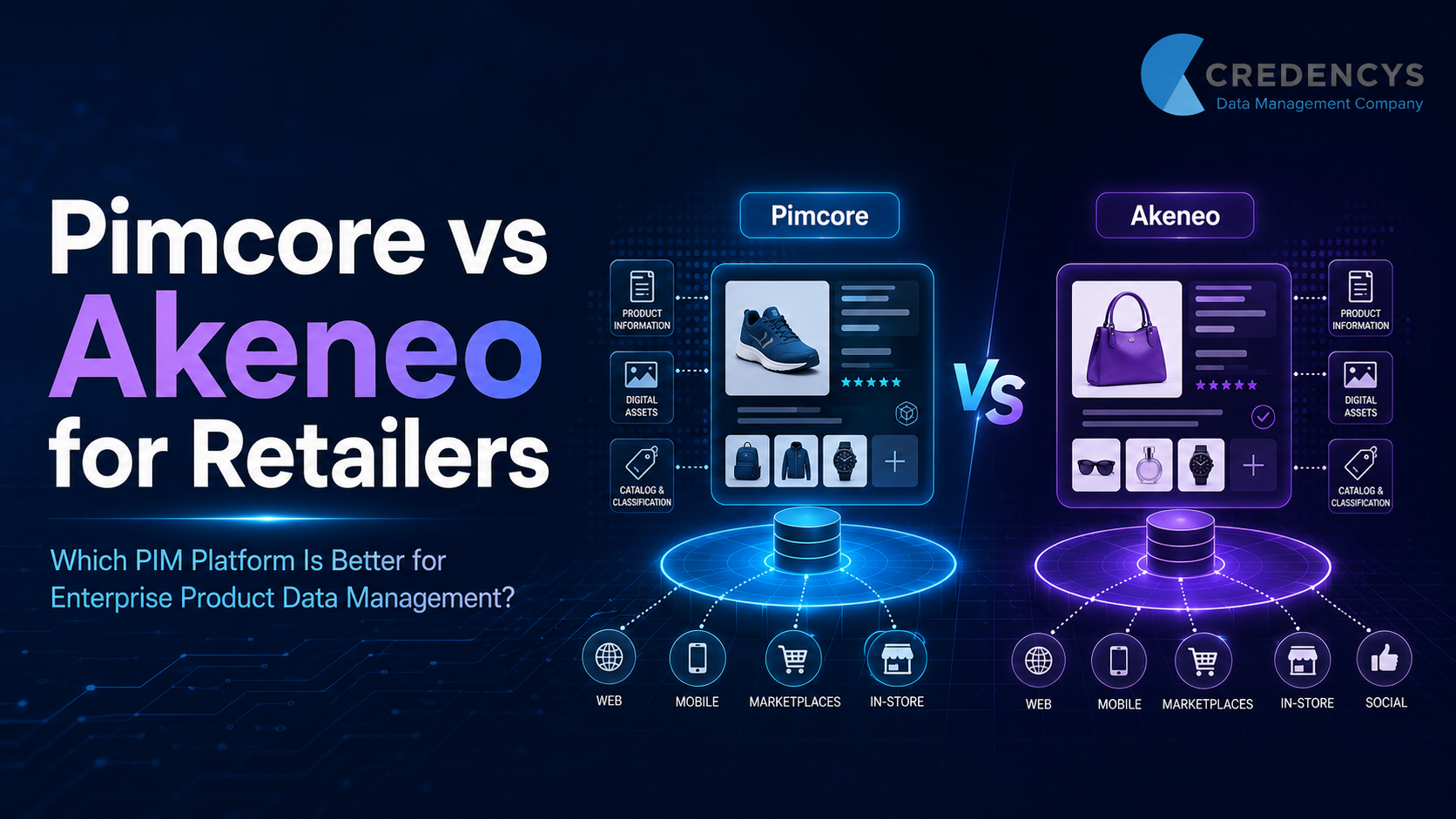
Pimcore vs Akeneo for Retailers: Which PIM Platform is Better for Product Data Management?
Retailers today manage thousands of SKUs, product variants, digital assets, pricing updates, supplier data, localized content, and channel-specific product information across websites, marketplaces, mobile apps, social commerce, stores, and distributor networks.
As product data complexity grows, spreadsheets, ERP-led product records, and disconnected content systems are no longer enough. Retailers need a dedicated PIM platform that can centralize product information, improve data quality, accelerate catalog enrichment, and deliver consistent product experiences across every sales channel.
Two popular options in the PIM market are Pimcore and Akeneo.
Akeneo focuses on helping businesses centralize, enrich, optimize, and activate product information across sales channels. Its Product Cloud is positioned as a SaaS solution for managing and optimizing product information across channels.
Pimcore, on the other hand, offers a broader data and experience management platform that includes PIM, DAM, MDM, DXP/CMS, Commerce, portals, and data syndication capabilities. Pimcore’s PIM helps businesses centralize and manage product data across channels, while its DAM connects product information with digital assets in the same ecosystem.
For retailers, the question is not simply which PIM is popular. The real question is: Which platform better supports enterprise retail product data management at scale?
Pimcore vs Akeneo: Quick Comparison for Retailers
| Comparison Area | Pimcore | Akeneo |
|---|---|---|
| Core Focus | Data and experience management platform with PIM, DAM, MDM, DXP/CMS, Commerce, portals, and syndication | Product information and product experience management focused on product data enrichment and activation |
| Best Fit | Enterprise retailers with complex product data, multiple systems, digital assets, and omnichannel delivery needs | Retailers that need a focused, user-friendly PIM for product enrichment and channel activation |
| Data Modeling | Highly flexible for complex product hierarchies, variants, relationships, master data, and custom data structures | Strong for product families, categories, attributes, channels, completeness, and catalog enrichment |
| DAM Capabilities | Built-in DAM capabilities connected with product data and experience management | Supports product assets and enrichment workflows, with asset management capabilities depending on edition and setup |
| MDM Capabilities | Strong fit for retailers that need to manage product, supplier, customer, location, and other master data domains | Primarily focused on product information and product experience management |
| Customization | Highly customizable and flexible for enterprise-specific workflows, portals, integrations, and business logic | More standardized and business-user-friendly for PIM workflows and product data enrichment |
| Enterprise Integrations | Strong fit for complex ERP, CRM, eCommerce, marketplace, DAM, analytics, and internal system integrations | Strong ecosystem for connecting product data with commerce and channel systems |
| Retail Use Case Strength | Best when retailers need a unified data foundation beyond PIM | Best when retailers need a focused PIM for product enrichment and activation |
What is Pimcore?
Pimcore is a flexible data and experience management platform that helps businesses centralize product information, digital assets, master data, content, commerce, and data syndication within one ecosystem.
For retailers, Pimcore can support:
- Product Information Management
- Digital Asset Management
- Master Data Management
- Product Experience Management
- Supplier data management
- Product and digital asset portals
- Marketplace and channel syndication
- eCommerce data management
- Workflow automation
- Data quality and governance
Pimcore’s PIM helps businesses make product data ready for market by enriching, validating, translating, and publishing it in a channel-specific manner. Pimcore also explains that ERP and PIM systems complement each other, with ERP managing operational facts and PIM managing consistent product truth for customer touchpoints.
What is Akeneo?
Akeneo is a PIM and product experience platform designed to help businesses centralize, enrich, optimize, and activate product information across sales channels. Its platform focuses on improving product data quality, team collaboration, product enrichment, and omnichannel product experiences.
Akeneo PIM supports important product data management capabilities such as product families, categories, channels, data quality tracking, user roles, permissions, validation workflows, catalog completeness, versions, and publication scheduling.
For retailers, Akeneo can be a strong fit when the main requirement is to improve product data enrichment, simplify catalog management, and activate product information across commerce channels.
Pimcore vs Akeneo for Retailers: Key Differences
Pimcore and Akeneo both help retailers manage product information, but they are built with different levels of scope and flexibility. Akeneo is more focused on product enrichment and product experience management, while Pimcore offers a broader data and experience management ecosystem that can support PIM, DAM, MDM, commerce, content, portals, and syndication.
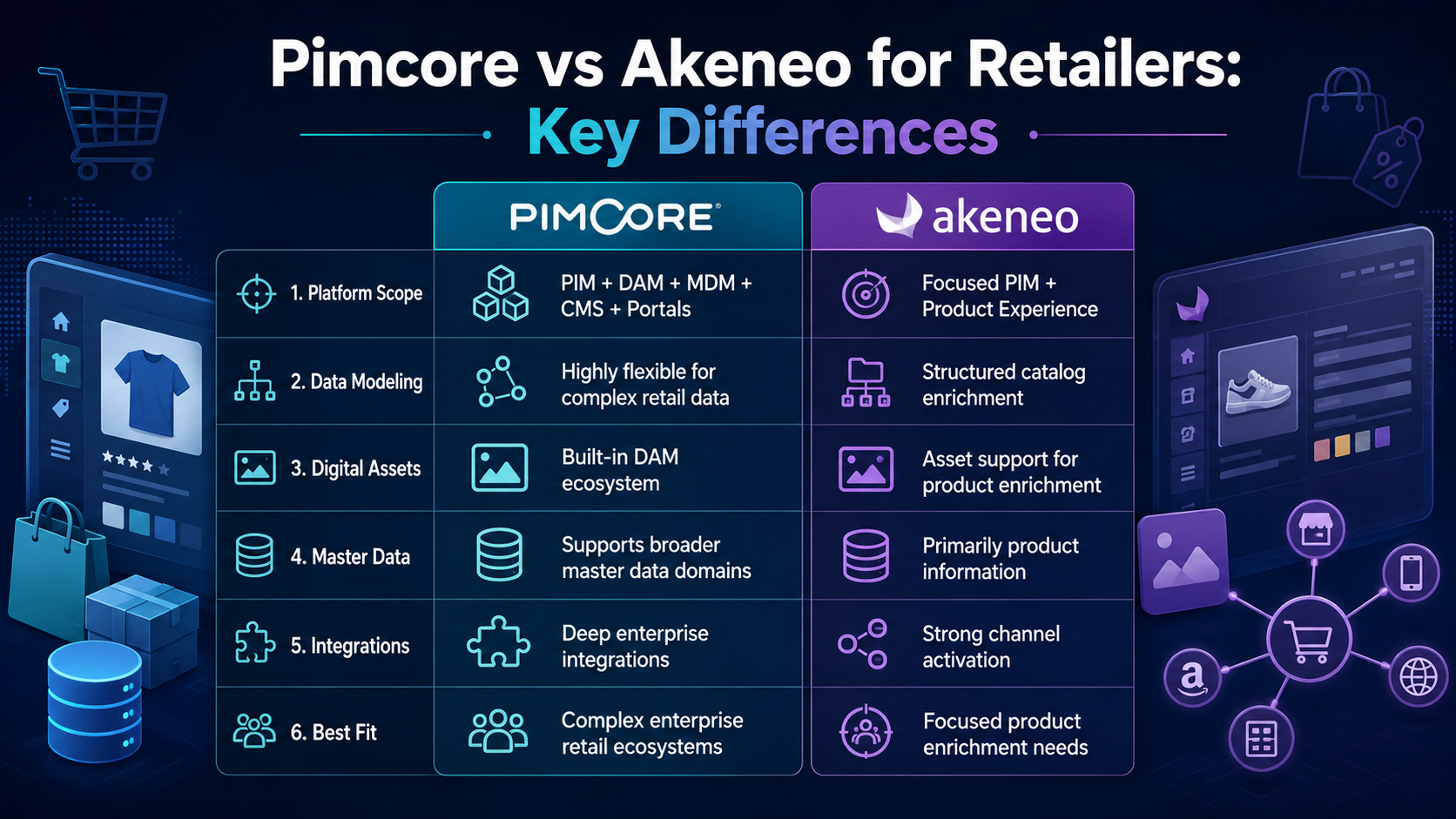
For retailers, the difference becomes clear when product data needs to move beyond basic catalog enrichment and connect with digital assets, supplier information, ERP data, marketplaces, eCommerce platforms, and omnichannel workflows.
1. Platform Scope
Akeneo is primarily designed as a PIM and product experience management platform. It helps retailers centralize product information, enrich product content, track completeness, and prepare product data for different sales channels.
Pimcore offers a broader platform. Along with PIM, it supports digital asset management, master data management, digital experience management, commerce, portals, and data syndication. This makes Pimcore more suitable for retailers that want to manage product data, product media, supplier data, workflows, and customer-facing experiences within one connected ecosystem.
Choose Akeneo if you need a focused PIM. Choose Pimcore if you need a wider retail data foundation beyond PIM.
2. Product Data Modeling Flexibility
Retail product data can be complex. A single product may have multiple sizes, colors, styles, bundles, categories, regional descriptions, marketplace attributes, pricing rules, and related digital assets.
Akeneo supports structured product data management through product families, attributes, categories, channels, locales, and completeness rules. It works well for retailers that need a clean and organized way to enrich product catalogs.
Pimcore gives retailers more flexibility to design complex product hierarchies, relationships, object structures, variants, classifications, and custom data models. This is useful for enterprise retailers managing large catalogs, multi-brand assortments, supplier data, store-level data, private labels, and complex product relationships.
Akeneo is strong for standard catalog enrichment. Pimcore is stronger for complex and highly customized retail data models.
3. Digital Asset Management
Retailers depend heavily on digital assets such as product images, lifestyle photos, videos, size charts, user manuals, certificates, packaging files, campaign banners, and marketplace-specific media.
Akeneo supports product asset management as part of the enrichment process, helping teams associate assets with product records and prepare them for channel distribution.
Pimcore includes DAM capabilities that allow retailers to manage digital assets more deeply within the same ecosystem as product data. Teams can organize, tag, version, reuse, and connect digital assets with products, categories, campaigns, and digital experiences.
Akeneo works well when assets are mainly needed for product enrichment. Pimcore is a better fit when digital asset management is a major enterprise requirement.
4. Master Data Management
For large retailers, product data is only one part of the data landscape. They may also need to manage supplier data, brand data, category data, store data, location data, customer-related data, and other master data domains.
Akeneo is mainly focused on product information and product experience workflows. It is useful when the main goal is to manage and enrich product data.
Pimcore is better suited for retailers that want to connect product information with broader master data. For example, product records can be linked with supplier profiles, brand hierarchies, location data, category structures, or other business-critical data domains.
Akeneo is a strong PIM. Pimcore is a stronger choice when retailers need PIM and MDM together.
5. Workflow and Governance
Both platforms support workflows and collaboration, but the depth of governance required depends on the retailer’s operating model.
Akeneo helps teams manage product enrichment, completeness, quality, and approvals in a structured way. This is useful for retailers that want product, marketing, and eCommerce teams to collaborate on product content.
Pimcore can support more complex workflows across product data, assets, master data, localization, approvals, supplier onboarding, content publishing, and channel syndication. Retailers can create business-specific workflows that reflect how their teams actually work.
Akeneo is suitable for product enrichment workflows. Pimcore is better for enterprise-wide governance across data, assets, workflows, and channels.
6. Integration with Retail Systems
Retailers usually need their PIM to connect with ERP, CRM, eCommerce platforms, marketplaces, DAM systems, supplier portals, POS systems, analytics tools, and internal applications.
Akeneo offers strong commerce-focused connectivity and is useful for retailers that need to activate product data across digital channels.
Pimcore is highly flexible for complex enterprise integrations. It can act as a central data hub between ERP, eCommerce, marketplaces, DAM, MDM, analytics, and custom retail systems. This is especially valuable when retailers want to reduce data silos and build a connected technology ecosystem.
Akeneo is strong for product data activation. Pimcore is stronger when retailers need deep, custom, and multi-system integration.
7. Customization and Scalability
Akeneo is often easier to adopt for business users because it is focused on PIM processes and product enrichment. This can help retailers move faster when requirements are straightforward.
Pimcore offers deeper customization and scalability for retailers with unique business models, custom workflows, complex catalogs, supplier portals, marketplace rules, and multi-region data operations. It may require more planning and implementation expertise, but it gives enterprises greater flexibility in the long run.
Akeneo is simpler for focused PIM needs. Pimcore is more adaptable for enterprise-scale transformation.
8. Best-Fit Use Cases for Retailers
Akeneo is a good fit for retailers that want to improve product enrichment, catalog completeness, and product activation across channels without building a highly customized data ecosystem.
Pimcore is a better fit for retailers that want to centralize product data, digital assets, supplier data, master data, workflows, and omnichannel delivery in one flexible platform.
Akeneo helps retailers improve product content operations. Pimcore helps retailers build a broader product data and digital experience foundation.
When Should Retailers Choose Akeneo?
Akeneo can be a strong choice for retailers that want a focused, business-user-friendly PIM platform to manage product enrichment, product completeness, and channel activation.
For many retail teams, the biggest challenge is not building a highly customized data ecosystem. It is getting accurate, complete, and consistent product content ready for sales channels as quickly as possible. Akeneo is well suited for this type of requirement because it focuses strongly on product information management, enrichment workflows, data quality, and product experience activation.
Retailers should consider Akeneo when their primary need is to centralize product information, improve catalog completeness, simplify product enrichment, and enable commerce teams to prepare product data for websites, marketplaces, mobile apps, and other digital channels.
Akeneo can be a good fit when retailers need:
- A focused PIM platform for managing product information
- A user-friendly interface for product, marketing, and eCommerce teams
- Faster product enrichment and catalog completion workflows
- Better visibility into product data completeness and quality
- Structured management of product families, categories, attributes, and channels
- A simpler way to prepare product content for multiple sales channels
- Product activation and syndication capabilities for commerce experiences
- A SaaS-first product experience management approach
- A relatively straightforward PIM rollout focused mainly on product data
Akeneo is especially useful for retailers that want to empower business users to manage product content with less dependency on IT. It helps teams identify missing product information, improve enrichment quality, and prepare product data for different channels more efficiently.
However, Akeneo may be less suitable when the retailer needs deep customization, multi-domain master data management, complex digital asset workflows, custom portals, or a broader data and experience management ecosystem beyond product information.
When Should Retailers Choose Pimcore?
Pimcore is a better fit for retailers that need a broader, more flexible, and enterprise-grade data management foundation. While Akeneo focuses mainly on product information and product experience workflows, Pimcore goes beyond PIM by bringing together product information, digital assets, master data, content, commerce, portals, and data syndication in one ecosystem.
For enterprise retailers, this matters because product data rarely exists in isolation. Product information must connect with digital assets, supplier data, brand data, category data, store data, ERP data, eCommerce platforms, marketplaces, analytics systems, and customer-facing digital experiences.
Pimcore can be a stronger choice when retailers need:
- PIM, DAM, MDM, DXP/CMS, Commerce, and portals in one platform
- Highly flexible product data modeling
- Large catalog management with complex variants and product relationships
- Product data connected with supplier, brand, category, location, or other master data
- Centralized digital asset management for images, videos, documents, and brand assets
- Custom approval workflows for product enrichment, validation, localization, and publishing
- Integration with ERP, CRM, eCommerce, marketplaces, DAM, analytics, and internal systems
- Product and digital asset portals for suppliers, partners, distributors, or internal teams
- Flexible data syndication for multiple channels and marketplaces
- Enterprise-grade customization for unique retail processes
- A scalable foundation for long-term digital transformation
Pimcore is particularly valuable for retailers that manage complex product structures, multi-brand catalogs, regional assortments, localized content, private labels, supplier onboarding, and multiple customer touchpoints. It allows retailers to design product data models around their actual business requirements instead of forcing their processes into a rigid structure.
Another important advantage is Pimcore’s ability to combine product data with digital assets and master data. For example, a retailer can connect a product record with images, videos, manuals, size charts, compliance documents, supplier details, category hierarchies, and channel-specific content. This creates a more complete product data foundation for omnichannel retail.
Pimcore is also a strong choice for retailers that want to reduce the number of disconnected systems. Instead of using separate tools for PIM, DAM, MDM, content management, portals, and syndication, Pimcore can help consolidate these capabilities into a unified platform.
Pimcore vs Akeneo: Which PIM is Better for Enterprise Retailers?
There is no single winner for every retail business. The right choice depends on the retailer’s catalog size, product data complexity, operating model, number of channels, digital maturity, integration landscape, and long-term transformation goals.
Akeneo is a strong option for retailers that want a focused PIM platform for product enrichment and product activation. It works well when the primary goal is to help business teams manage product content, improve completeness, track data quality, and prepare product information for commerce channels.
Pimcore is a stronger option for enterprise retailers that need a wider data and experience management platform. It is better suited when product information needs to connect with digital assets, supplier data, master data, content, commerce systems, workflows, and complex integrations.
Choose Akeneo if your priority is:
- A specialized PIM platform
- Business-user-friendly product enrichment
- Product completeness and data quality tracking
- Faster channel activation
- A SaaS-first product experience management approach
- A simpler rollout focused mainly on product data
Choose Pimcore if your priority is:
- A broader data and experience management ecosystem
- PIM, DAM, MDM, DXP/CMS, Commerce, portals, and syndication in one platform
- Complex retail product data modeling
- Enterprise integrations across ERP, CRM, eCommerce, marketplaces, and analytics
- Centralized digital asset and master data management
- Custom workflows, portals, and business rules
- Long-term scalability for digital transformation
For mid-sized retailers with straightforward PIM needs, Akeneo may be a practical choice. For enterprise retailers with complex data ecosystems, multiple brands, large catalogs, supplier networks, and omnichannel requirements, Pimcore is often the stronger fit.
The key question is not only “Which PIM platform is easier to use?” The better question is “Which platform can support our retail product data strategy as the business grows?”
If the goal is product enrichment and channel activation, Akeneo can work well. If the goal is enterprise-wide product data management, connected digital assets, master data governance, and scalable omnichannel delivery, Pimcore offers a broader foundation.
How Credencys Helps Retailers Implement Pimcore
For retailers evaluating Pimcore vs Akeneo, the platform decision should be based on business goals, product data complexity, integration needs, and long-term scalability. This is where the right implementation partner can make a major difference.
As a Pimcore Strategic Partner, Credencys helps retailers design and implement Pimcore solutions that centralize product data, improve data quality, connect digital assets, streamline workflows, and deliver consistent product experiences across channels.
Credencys works with retailers to understand their current product data challenges, existing systems, catalog structure, channel strategy, and operational bottlenecks. Based on this assessment, the team designs a Pimcore roadmap that aligns with business priorities and avoids unnecessary complexity.
Credencys supports retailers with:
- Pimcore consulting and roadmap planning
- Pimcore PIM implementation
- DAM and MDM implementation
- Retail-specific product data modeling
- Product hierarchy, attribute, variant, and category design
- Supplier data onboarding and management
- ERP, CRM, eCommerce, marketplace, and analytics integrations
- Data migration, cleansing, and validation
- Workflow automation for enrichment, review, approval, and publishing
- Data quality rules and governance frameworks
- Product and digital asset portals
- Marketplace and omnichannel data syndication
- Post-launch support, optimization, and enhancements
Credencys also helps retailers avoid common PIM implementation challenges such as poor data modeling, incomplete migration, weak governance, disconnected digital assets, and over-customization.
For retailers comparing Pimcore and Akeneo, Credencys can help evaluate the right platform based on practical business factors such as:
- Catalog size and SKU complexity
- Number of product variants and attributes
- Digital asset volume
- Supplier and vendor data requirements
- Number of sales channels and marketplaces
- ERP and eCommerce integration needs
- Workflow and approval complexity
- Localization and regional content needs
- Long-term digital transformation goals
With deep experience in product data management, master data management, digital asset management, integrations, and retail technology, Credencys helps retailers turn Pimcore into a scalable foundation for enterprise product data management.
Final Thoughts
Both Pimcore and Akeneo are strong PIM platforms, but they are designed for different levels of business complexity.
Akeneo is a strong choice for retailers that need a focused, user-friendly PIM platform for product enrichment, product completeness, data quality tracking, and channel activation. It is well suited for teams that want to manage product content efficiently and improve how product information is prepared for commerce channels.
Pimcore is a stronger fit for enterprise retailers that need a broader and more flexible data management ecosystem. It is ideal when product information must connect with digital assets, supplier data, master data, content, commerce workflows, portals, and multiple enterprise systems.
For retailers planning long-term digital transformation, the decision should go beyond the immediate PIM requirement. The platform should support how product data will be managed, governed, enriched, distributed, and scaled over the next several years.
If your retail business mainly needs structured product enrichment and faster channel activation, Akeneo can be a good fit. If your business needs a connected foundation for PIM, DAM, MDM, workflows, integrations, portals, and omnichannel growth, Pimcore is often the better choice.
For many enterprise retailers, Pimcore offers the flexibility, scalability, and connected data foundation needed to manage complex product data at scale and support long-term digital transformation.






Tags: