


Semarchy Entity Definition: What It Means and Why It Matters in MDM
What makes a Master Data Management initiative successful?
It is not only the technology, workflows, or integrations. It starts with how clearly an organization defines its core business data.
Before a company can create trusted customer records, standardize supplier information, manage product data, or build a single source of truth, it must first define the business objects that need to be governed. In Semarchy, these business objects are represented as entities.
A Semarchy Entity Definition describes what a specific business object means within the Semarchy MDM model. It defines how that object is structured, which attributes describe it, how records are identified, how relationships are created, and how data quality, matching, merging, and governance rules are applied.
For example, if an organization is managing customer master data, it may define entities such as Customer, Address, Contact, Account, and Region. If the focus is supplier MDM, the model may include Supplier, Supplier Site, Contract, Bank Details, Compliance Status, and Materials. For product MDM, entities may include Product, SKU, Category, Brand, Digital Asset, and Supplier.
This may sound like a technical configuration step, but it has a direct business impact. A poorly defined entity can lead to duplicate records, incomplete data, unclear ownership, weak governance, and unreliable golden records. On the other hand, a well-defined entity helps Semarchy create trusted, governed, and reusable master data that can support operations, analytics, AI, compliance, and enterprise decision-making.
That is why understanding Semarchy Entity Definition is important for data leaders, MDM architects, data stewards, and business teams involved in master data programs.
In this blog, we will explain what Semarchy Entity Definition means, where entities fit in the Semarchy xDM data model, what components make up an entity, the different types of entities in Semarchy, and why entity definition plays such a critical role in MDM success.
Understanding Semarchy Entity Definition
A Semarchy Entity Definition is the way a business object is structured and managed inside the Semarchy MDM model. It defines what the object represents, what information should be captured about it, how each record should be identified, and how it should connect with other business objects.
In simple terms, an entity is a core object that an organization wants to manage as master data. This can be a customer, product, supplier, employee, location, asset, material, contract, or any other important business object.
For example, a manufacturing company may define entities such as Supplier, Material, Plant, Product, and Customer. A retail business may define entities such as Product, Brand, Category, Store, Supplier, and Customer. A financial services company may define entities such as Customer, Account, Branch, Product, and Risk Profile.
However, a Semarchy entity is not just a table that stores data. It is a governed data object that defines how master data should behave across its lifecycle. It helps determine how records are created, validated, enriched, matched, merged, approved, and shared with other systems. A Semarchy Entity Definition typically answers questions such as:
- What does this entity represent?
- Which attributes describe this entity?
- Which fields are mandatory?
- How should each record be uniquely identified?
- Does this entity need matching and merging?
- How does this entity relate to other entities?
- Which validation rules should be applied?
- Who owns and manages this data?
- Which systems provide and consume this data?
For instance, a Customer entity may include attributes such as customer name, email address, phone number, customer type, status, and billing address. It may also connect with related entities such as Address, Account, Contact, and Region. If the same customer exists in multiple systems, the entity definition can also support matching, survivorship, and golden record creation.
Why Entity Definition is Critical for Master Data Management
Entity definition is one of the most important decisions in any Master Data Management program because it determines how business-critical data will be structured, governed, matched, merged, and consumed across the enterprise.
MDM is not just about bringing data from different systems into one place. It is about creating a trusted version of business data that teams can rely on for operations, reporting, analytics, compliance, and decision-making. To achieve this, organizations need a clear understanding of the master data objects they are managing.
That clarity starts with entity definition.
When entities are defined correctly in Semarchy, business and technical teams can clearly understand what each object represents, which attributes are required, how records should be identified, and how relationships should be maintained. This helps reduce ambiguity and creates a strong foundation for data quality and governance.
For example, if a company does not clearly define what a “Customer” means, different departments may interpret it differently. Sales may consider a customer as an active account. Finance may define a customer as a billing entity. Marketing may include prospects and subscribers in the same group. Without a clear Customer entity definition, the organization may end up with duplicate records, inconsistent segmentation, inaccurate reports, and poor customer experiences.
The same challenge applies to other domains.
In supplier MDM, weak entity definition can affect supplier onboarding, compliance checks, payment accuracy, risk management, and procurement visibility. In product MDM, unclear Product, SKU, Category, or Brand definitions can lead to incomplete catalogs, inconsistent product information, delayed launches, and poor omnichannel experiences.
A strong Semarchy Entity Definition helps avoid these issues by creating a governed structure for master data. It ensures that every entity has a clear business meaning, defined attributes, reliable identifiers, valid relationships, and the right rules for quality, matching, survivorship, and stewardship. This directly improves MDM outcomes such as:
- Reduced duplicate records
- Better data quality and completeness
- More accurate golden records
- Stronger data governance
- Clearer ownership and stewardship
- Easier integration with source and downstream systems
- More reliable analytics and reporting
- Greater business trust in master data
Where Entities Fit in the Semarchy xDM Data Model
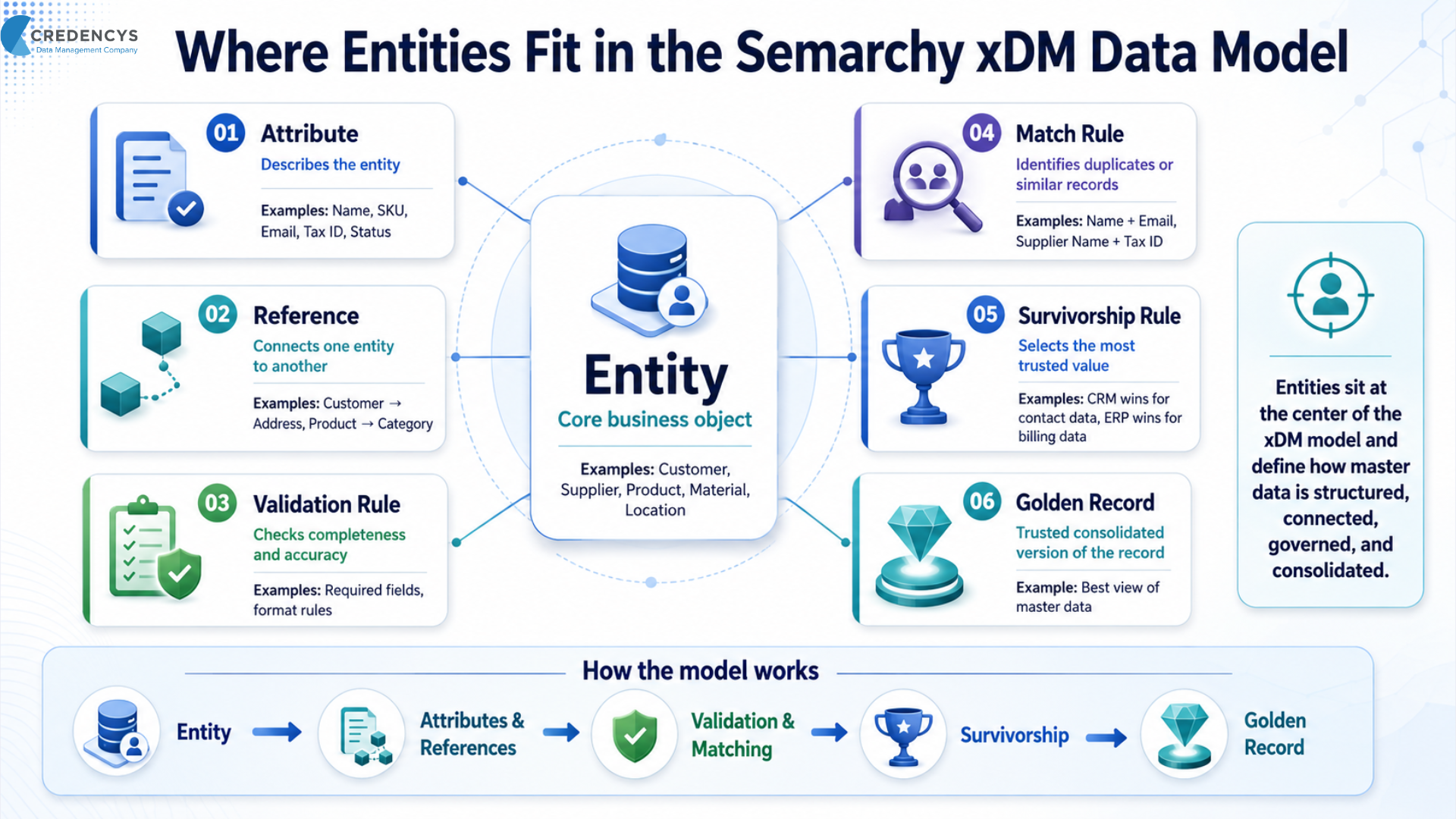
Entities sit at the center of the Semarchy xDM data model. They define the main business objects that need to be managed, while other modeling elements such as attributes, references, validations, match rules, and survivorship rules define how those objects are described, connected, governed, and consolidated.
A Semarchy xDM model is not just a collection of isolated records. It is a connected data structure that helps organizations represent how master data works in the real world. Entities provide the foundation for that structure.
For example, if the entity is Customer, the attributes may describe customer name, email, phone number, status, and customer type. References may connect the Customer entity to Address, Account, Region, or Contact. Validation rules may ensure that required fields are complete and correctly formatted. Match rules may identify duplicate customer records. Survivorship rules may decide which source system provides the most trusted value for the golden record.
In this way, the entity acts as the core object, while the other components add business meaning, quality control, governance, and relationship context.
A simple way to understand the Semarchy xDM data model is:
- Entity: The main business object, such as Customer, Supplier, Product, Material, or Location
- Attribute: A data field that describes the entity, such as name, email, SKU, tax ID, or status
- Reference: A relationship that connects one entity to another
- Validation Rule: A rule that checks whether the data is complete, accurate, or compliant
- Match Rule: Logic used to identify duplicate or similar records
- Survivorship Rule: Logic used to determine the most trusted value when multiple sources provide different data
- Golden Record: The trusted, consolidated version of a master data record
For instance, in a supplier MDM model, Supplier may be the main entity. Supplier Site, Bank Details, Contract, Compliance Status, and Material may be related entities. Together, these entities create a complete view of the supplier and support business processes such as onboarding, compliance review, procurement, payment, and risk management.
Similarly, in a product MDM model, Product may connect with Category, Brand, Supplier, Digital Asset, Variant, and Channel. These relationships help teams manage product information more accurately across ERP, PIM, eCommerce, marketplaces, and analytics platforms.
This is why entity definition is not an isolated design task. It influences the entire Semarchy xDM model. The way entities are defined determines how data is organized, how relationships are maintained, how governance is applied, how users interact with records, and how trusted data is delivered to downstream systems.
Key Components of a Semarchy Entity Definition
A Semarchy Entity Definition is made up of several components that together define how a business object is modeled, governed, and managed inside the MDM platform. These components help teams move beyond basic data storage and create a structured foundation for data quality, matching, relationships, stewardship, and golden record creation.
When defining an entity in Semarchy, organizations should not only think about what fields need to be captured. They should also consider how the entity will be used by business users, how it will connect with other entities, how it will receive data from source systems, and how trusted records will be created and shared across the enterprise.
Below are the key components that make up a strong Semarchy Entity Definition.
1. Entity Name and Business Label
The entity name is the technical name used inside the Semarchy model. It should be clear, consistent, and easy to understand for technical teams. The business label is the user-friendly name that appears to business users in the application.
For example:
- Technical name:
SupplierSite - Business label: Supplier Site
A good naming convention helps avoid confusion as the MDM model grows. If entities are named inconsistently, users may struggle to understand what each object represents. Clear names also make the model easier to maintain, integrate, and scale.
The entity name and label should reflect the business meaning of the object. For example, if the business uses the term “Supplier,” the entity should not be called “Vendor” unless there is a specific reason to separate those concepts.
2. Entity Description
Every entity should have a clear description that explains what the entity represents. This description helps business users, data stewards, architects, and developers understand the purpose of the entity.
A strong entity description should answer:
- What does this entity represent?
- What type of records are included?
- What records are excluded?
- Which business process uses this entity?
- Who owns or manages this data?
For example, a Supplier entity description may state that it represents organizations or individuals that provide goods or services to the company. It may also clarify whether one-time vendors, payment-only vendors, and inactive suppliers are included.
This level of clarity is important because different departments may use the same term differently. A well-written description reduces ambiguity and supports better governance.
3. Attributes
Attributes are the data fields that describe an entity. They define what information will be captured, stored, validated, matched, displayed, and shared. For example, a Customer entity may include attributes such as:
- Customer ID
- Customer Name
- Email Address
- Phone Number
- Customer Type
- Status
- Billing Address
- Source System
A Product entity may include attributes such as:
- SKU
- Product Name
- Brand
- Category
- Unit of Measure
- Product Status
- Launch Date
- Description
Attributes should be selected carefully. Adding too many unnecessary attributes can make the model complex and difficult to manage. Missing important attributes can affect data quality, reporting, integration, and business adoption.
Each attribute should have a clear purpose. Teams should define whether the attribute is mandatory, optional, searchable, matchable, governed, sensitive, or required by downstream systems.
4. Primary Key or Identifier
The primary key or identifier helps distinguish one record from another. It plays an important role in record identification, integration, matching, and golden record creation.
In some cases, the identifier may come from a trusted source system. For example, an ERP system may provide a unique Supplier ID or Material Number. In other cases, records from multiple systems may have different IDs, and Semarchy may need to create a consolidated golden record identifier.
A clear identifier strategy helps answer questions such as:
- Which field uniquely identifies the record?
- Is the identifier generated internally or received from a source system?
- Is the identifier reliable across systems?
- Can the same business object have multiple source IDs?
- How will downstream systems consume the identifier?
For example, if CRM and ERP use different Customer IDs for the same customer, the entity definition must support source identifiers and golden record consolidation. Without this clarity, integration and duplicate management can become difficult.
5. References and Relationships
Entities in Semarchy are often connected through references and relationships. These connections show how one business object relates to another.
For example:
- Customer has Address
- Supplier has Supplier Site
- Product belongs to Category
- Material is supplied by Supplier
- Employee belongs to Department
- Location belongs to Region
References help maintain business context and data integrity. They also make it easier for users to navigate related information.
For instance, a Supplier record may need to show related supplier sites, contracts, bank details, compliance documents, and materials supplied. A Product record may need to connect with category, brand, supplier, digital assets, and channel-specific information.
If relationships are not defined properly, the MDM model may become disconnected. Users may see individual records but miss the full business context required for decision-making.
6. Validation Rules
Validation rules help ensure that data entered or loaded into Semarchy meets business and quality requirements. They prevent incomplete, incorrect, or non-compliant data from becoming part of the trusted master data foundation.
Examples of validation rules include:
- Email address must follow a valid format.
- Product category cannot be blank.
- Supplier tax ID is mandatory for specific countries.
- Launch date cannot be later than discontinued date.
- Phone number must follow country-specific formatting.
- Status must be selected from an approved list.
Validation rules are important because data quality issues often begin at the point of entry. If invalid data is allowed into the system, it can spread to downstream applications such as ERP, CRM, eCommerce, analytics, procurement, and reporting tools.
By defining validation rules at the entity level, organizations can improve completeness, accuracy, consistency, and compliance.
7. Match Rules
Match rules are used to identify duplicate or similar records. They are especially important for entities that receive data from multiple systems where the same real-world object may appear with different identifiers or slightly different values.
For example, the same supplier may appear as:
- ABC Manufacturing Ltd.
- ABC Mfg Limited
- A.B.C. Manufacturing
- ABC Manufacturing Private Limited
A match rule can help Semarchy determine whether these records may represent the same supplier.
Customer match rules may use a combination of:
- Name
- Phone number
- Address
- Date of birth
- Account number
Supplier match rules may use:
- Supplier name
- Tax ID
- Country
- Registration number
- Address
- Bank details
Match rules should be designed carefully and tested with real data. If the rules are too strict, duplicates may be missed. If they are too loose, records may be merged incorrectly. The goal is to find the right balance between automation and stewardship review.
8. Survivorship Rules
Survivorship rules define which value should be trusted when multiple source systems provide different values for the same golden record.
For example, a customer’s name may come from CRM, billing address from ERP, email address from eCommerce, and consent preference from a marketing platform. Survivorship rules determine which source should win for each attribute.
Examples:
- CRM wins for customer contact information.
- ERP wins for billing address.
- PIM wins for product descriptions.
- PLM wins for technical product specifications.
- Procurement system wins for supplier status.
- Compliance system wins for risk and certification data.
Survivorship rules help create a transparent and repeatable process for golden record creation. They also improve user trust because business teams can understand why a specific value appears in the trusted record.
Without survivorship logic, teams may not know which system value to rely on. This can create confusion, manual corrections, and lack of confidence in the MDM platform.
Together, these components define how a Semarchy entity works. A strong entity definition brings business meaning, data structure, validation, matching, relationships, and governance into one model. This makes it easier for organizations to create trusted master data and use it confidently across business processes, systems, analytics, and AI initiatives.
Main Types of Entities in Semarchy
When creating a Semarchy Entity Definition, one of the most important decisions is selecting the right entity type. The entity type defines how records will be stored, identified, matched, merged, and consolidated inside the MDM model.
Semarchy supports three main entity types: Basic, ID-matched, and Fuzzy-matched. Each type is designed for a different master data scenario. According to Semarchy’s documentation, a Basic entity stores records from a single source without matching or merging, an ID-matched entity consolidates records using a shared identifier, and a Fuzzy-matched entity merges records based on content similarity when shared IDs are not available.
Choosing the right entity type is critical because it directly affects the complexity of the model, the matching strategy, the golden record creation process, and the level of governance required.
1. Basic Entity
A Basic entity is used when records do not require matching and merging. It is suitable for data that comes from a single trusted source or for business objects where duplicate detection is not needed.
In a Basic entity, each record is managed as it is. Semarchy does not need to compare it with records from other systems to determine whether it represents the same real-world object.
Basic entities are often used for:
- Reference data
- Lookup values
- Controlled lists
- Simple business objects
- Single-source records
- Data that does not require consolidation
Examples of Basic entities may include:
- Country
- Currency
- Region
- Department
- Industry
- Product Category
- Status Code
For example, if an organization maintains a standard list of countries, there is usually no need to match and merge country records from multiple systems. The list can be managed as a Basic entity.
A Basic entity is usually simpler to design and maintain because it does not require match rules, survivorship logic, or duplicate management workflows. However, teams should still define attributes, validations, relationships, and governance rules carefully to maintain data quality.
2. ID-Matched Entity
An ID-matched entity is used when records from multiple systems can be consolidated using a common identifier. This means that different source systems share a reliable ID for the same business object.
For example, if CRM, ERP, and eCommerce systems all use the same Customer ID, Semarchy can use that shared identifier to bring records together and create a single golden record.
ID-matched entities are useful when organizations already have a strong enterprise identifier or business key across systems.
They are commonly used for:
- Customer records with a shared Customer ID
- Supplier records with a common Supplier Code
- Product records with a shared SKU or Material Number
- Employee records with a common Employee ID
- Account records with a shared Account Number
For example, a manufacturing company may have a Material entity where ERP, PLM, and procurement systems all use the same Material Number. In this case, an ID-matched entity can help consolidate material records using that shared identifier.
ID matching is generally more predictable than fuzzy matching because it relies on a known identifier rather than similarity logic. However, it still requires careful design. Even when records share the same ID, different systems may provide different values for attributes such as address, status, description, payment terms, or product specifications.
That is where survivorship rules become important. Survivorship logic helps determine which source should provide the trusted value for each attribute in the golden record.
For example:
- ERP may win for billing address.
- CRM may win for customer contact details.
- PLM may win for technical product data.
- Procurement may win for supplier status.
An ID-matched entity works best when the identifier is reliable, stable, and consistently used across systems.
3. Fuzzy-Matched Entity
A Fuzzy-matched entity is used when records from different systems do not share a common identifier but may still represent the same real-world object.
This is common in enterprise environments where data comes from legacy applications, regional systems, third-party feeds, spreadsheets, acquired companies, or disconnected business units.
For example, the same supplier may appear in different systems as:
- ABC Manufacturing Ltd.
- ABC Mfg Limited
- A.B.C. Manufacturing
- ABC Manufacturing Private Limited
These records may not share the same Supplier ID, but they may still refer to the same supplier. A Fuzzy-matched entity helps identify such records based on the similarity of their content.
Fuzzy-matched entities are commonly used for:
- Customer deduplication
- Supplier deduplication
- Patient or member matching
- Party or organization matching
- Legacy data consolidation
- Data migration and system consolidation
- Multi-source MDM where shared IDs are not available
Fuzzy matching may use attributes such as:
- Name
- Email address
- Phone number
- Address
- Tax ID
- Registration number
- Date of birth
- Country
- Postal code
For example, a Customer entity may use a combination of name, email, phone number, and address to detect possible duplicates. A Supplier entity may use supplier name, country, tax ID, registration number, and address.
Fuzzy-matched entities are powerful because they help organizations resolve duplicate and inconsistent records even when source systems are not aligned. However, they also require more careful planning than Basic or ID-matched entities.
Teams need to define match rules, thresholds, survivorship logic, stewardship review processes, and exception handling. If match rules are too strict, duplicates may remain undetected. If they are too loose, unrelated records may be merged incorrectly.
This is why fuzzy matching should always be tested with real data before it is finalized.
4. Choosing the Right Entity Type
The right entity type depends on the nature of the data and the business outcome the organization wants to achieve.
A simple way to decide is:
- Use a Basic entity when records come from one trusted source and do not need matching or merging.
- Use an ID-matched entity when records come from multiple systems but share a reliable identifier.
- Use a Fuzzy-matched entity when records come from multiple systems and need to be matched based on similarity because a shared identifier is not available.
For example, Country or Currency may work well as Basic entities. Customer or Supplier may work as ID-matched entities if a shared enterprise ID exists. But if customer or supplier records are scattered across disconnected systems with inconsistent names, addresses, and IDs, a Fuzzy-matched entity may be the better choice.
Selecting the right entity type at the beginning helps reduce complexity later. It ensures that the Semarchy MDM model supports the right level of matching, governance, data quality, and golden record creation for each business object.
Semarchy Entity Definition and Golden Records
One of the main goals of Master Data Management is to create a trusted version of business data, often called a golden record. A golden record brings together data from multiple systems, identifies duplicate or related records, resolves conflicts, and creates the most accurate version of a master data record.
A strong Semarchy Entity Definition plays a key role in this process. It defines what business object is being managed, how records are identified, which attributes belong to the entity, and which rules should be used to create the trusted record.
- Defines the structure of the master data object
- Identifies which fields are used for matching records
- Applies validation rules to improve data quality
- Uses survivorship rules to select the most trusted values
- Connects golden records with related entities such as addresses, contracts, categories, suppliers, or digital assets
- Creates governed, repeatable, and transparent golden records
- Supports trusted data sharing across ERP, CRM, PIM, procurement, eCommerce, analytics, AI, and reporting systems
Semarchy Entity Definition and Data Governance
A well-defined entity in Semarchy does more than organize data. It also helps establish governance rules around how master data is created, updated, validated, approved, and consumed. Since each entity represents a critical business object, its definition becomes the foundation for assigning ownership, maintaining quality, and controlling how data flows across the organization.
For example, a Supplier entity may require governance around onboarding, tax information, bank details, payment terms, and compliance documents. A Product entity may require approvals for descriptions, categories, technical specifications, regulatory attributes, and digital assets. By defining these rules at the entity level, organizations can make governance more consistent and easier to manage.
- Defines who owns and manages each master data object
- Helps assign data stewardship responsibilities
- Supports approval workflows for sensitive or business-critical attributes
- Enforces mandatory fields and validation rules
- Controls how users create, update, and approve records
- Improves auditability by tracking changes and approvals
- Reduces duplicate, incomplete, and inconsistent records
- Supports compliance for customer, supplier, product, financial, or regulatory data
- Helps business and IT teams follow the same data governance standards
- Builds trust in master data across systems, teams, and processes
Semarchy Entity Definition and Data Quality
Data quality depends heavily on how entities are defined in Semarchy. When an entity has a clear structure, required attributes, validation rules, relationships, and matching logic, it becomes easier to prevent inaccurate, incomplete, duplicate, or inconsistent data from entering the MDM system.
For example, a Customer entity can include rules to validate email format, phone number, address, and customer status. A Supplier entity can require tax ID, country, payment terms, and compliance status. A Product entity can enforce mandatory fields such as SKU, product name, category, unit of measure, and lifecycle status.
- Reduces duplicate customer, supplier, product, or material records
- Prevents incomplete records by enforcing mandatory attributes
- Improves consistency through approved formats and standard values
- Maintains valid relationships between connected entities
- Supports accurate matching and merging of records
- Helps identify missing, invalid, or conflicting data
- Improves trust in golden records
- Reduces manual data correction and rework
- Supports reliable analytics, reporting, and AI initiatives
- Helps downstream systems consume cleaner and more consistent master data
Practical Examples of Semarchy Entity Definition
To understand Semarchy Entity Definition better, it helps to look at how entities may be defined across different MDM domains. Each entity represents a specific business object, but the attributes, relationships, match rules, and survivorship logic change based on the domain and business use case.
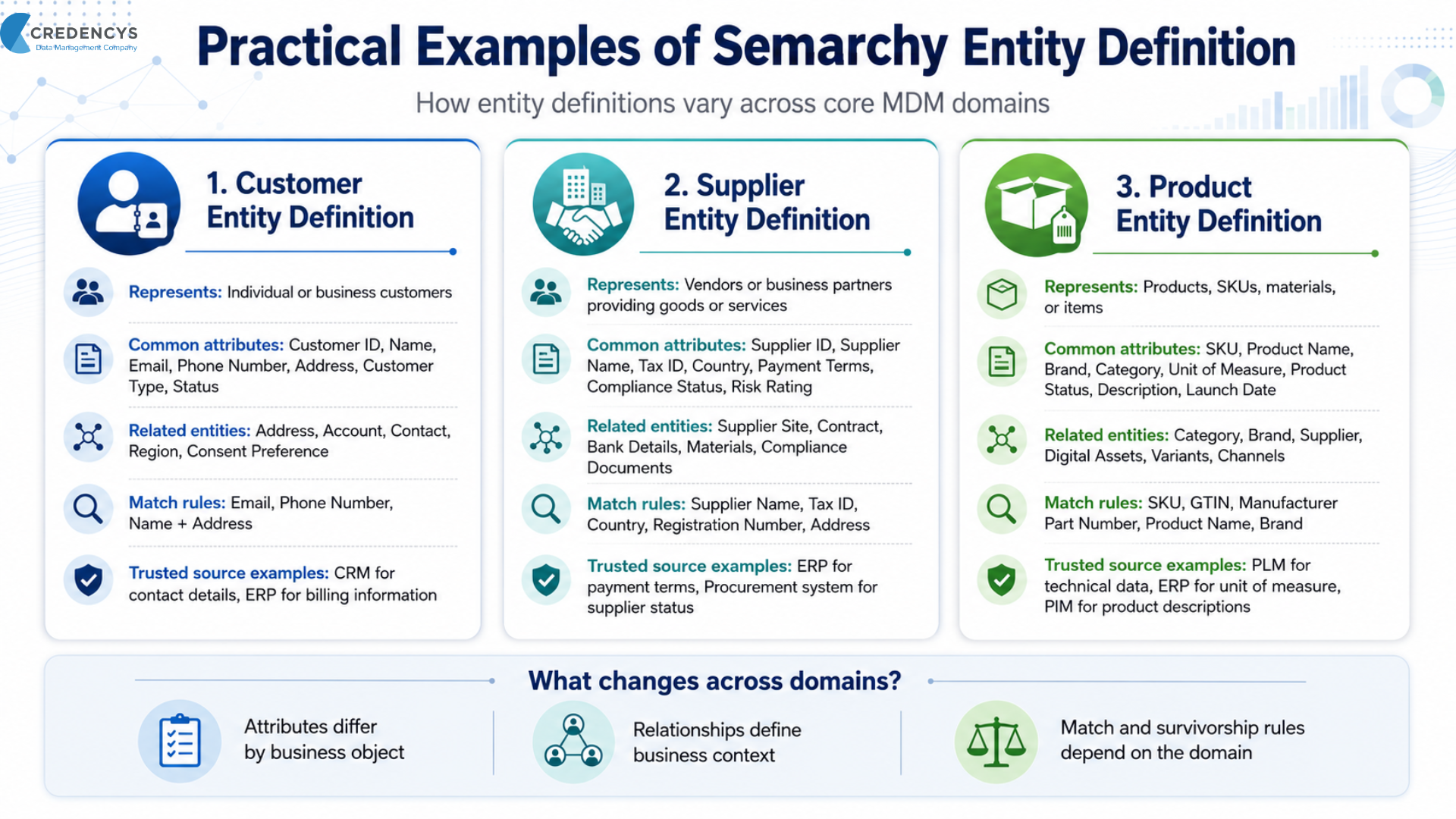
For example, a Customer entity may focus on contact details and account relationships, while a Supplier entity may focus on compliance, tax information, and payment terms. A Product entity may focus on SKU, category, specifications, digital assets, and channel readiness.
1. Customer Entity Definition
- Represents individual or business customers
- Common attributes: Customer ID, name, email, phone number, address, customer type, and status
- Related entities: Address, Account, Contact, Region, Consent Preference
- Match rules may use email, phone number, name, and address
- Survivorship rules may define CRM as the trusted source for contact details and ERP as the trusted source for billing information
2. Supplier Entity Definition
- Represents vendors, suppliers, or business partners providing goods or services
- Common attributes: Supplier ID, supplier name, tax ID, country, payment terms, compliance status, and risk rating
- Related entities: Supplier Site, Contract, Bank Details, Materials, Compliance Documents
- Match rules may use supplier name, tax ID, country, registration number, and address
- Survivorship rules may define ERP as the trusted source for payment terms and procurement systems as the trusted source for supplier status
3. Product Entity Definition
- Represents products, SKUs, materials, or items managed across business systems
- Common attributes: SKU, product name, brand, category, unit of measure, product status, description, and launch date
- Related entities: Category, Brand, Supplier, Digital Assets, Variants, Channels
- Match rules may use SKU, GTIN, manufacturer part number, product name, and brand
- Survivorship rules may define PLM as the trusted source for technical data, ERP for unit of measure, and PIM for product descriptions
Common Mistakes to Avoid While Defining Entities in Semarchy
Defining entities in Semarchy requires both business clarity and technical accuracy. If entities are created only from a system or database perspective, the MDM model may become difficult to govern, scale, and use. A weak entity definition can lead to duplicate records, confusing relationships, poor data quality, and unreliable golden records.
To build a strong Semarchy MDM foundation, teams should avoid these common mistakes:
1. Treating Entities Like Database Tables
One of the biggest mistakes is treating entities as simple database tables. In Semarchy, an entity should represent a meaningful business object, not just a copy of a source system table.
For example, copying every ERP vendor table into Semarchy may create technical complexity without improving supplier governance. Instead, teams should define what the business means by Supplier, Supplier Site, Contract, Bank Details, and Compliance Status.
2. Creating Too Many Entities Too Early
Over-modeling can make the MDM implementation complex and slow. If too many entities are created in the first phase, teams may spend more time managing the model than solving the core business problem.
A better approach is to start with high-value entities that directly support the MDM use case. Additional entities can be added as the model matures.
3. Ignoring Business Users
Entity definition should not be handled by technical teams alone. Business users understand how data is used in real processes, what each object means, and which attributes are truly important.
Without business involvement, entities may be technically correct but difficult for users to understand, govern, or adopt.
4. Choosing the Wrong Entity Type
Selecting the wrong entity type can affect matching, merging, governance, and golden record creation.
- A Basic entity may not be enough when records need deduplication.
- An ID-matched entity may fail if the shared identifier is not reliable.
- A Fuzzy-matched entity may create unnecessary complexity if matching is not required.
The entity type should be selected based on the data source, identifier availability, duplicate risk, and business outcome.
5. Poor Attribute Design
Attributes should not be added just because they exist in source systems. Too many unnecessary attributes can make the model difficult to manage, while missing critical attributes can affect data quality and downstream usage.
Each attribute should have a clear purpose, owner, validation rule, and usage context.
6. Weak Match and Survivorship Rules
For matched entities, poor match and survivorship rules can reduce trust in golden records. If match rules are too strict, duplicates may remain unresolved. If they are too loose, unrelated records may be merged incorrectly.
Survivorship rules should also be transparent. Business users should know why one source value is selected over another in the golden record.
7. Not Defining Relationships Clearly
Entities rarely work in isolation. Customer, Supplier, Product, Location, and Material records often depend on relationships with other entities.
If relationships are not defined clearly, users may see fragmented data without full business context. This can affect reporting, workflows, compliance, and decision-making.
8. Missing Governance Ownership
Every entity should have clear ownership. If no one is responsible for maintaining data quality, reviewing duplicates, approving changes, or resolving exceptions, the MDM model can quickly become unreliable.
Data owners and stewards should be identified early for each major entity.
Avoiding these mistakes helps organizations create a Semarchy Entity Definition that is easier to govern, easier to scale, and more useful for business teams.
Best Practices for Semarchy Entity Definition
A strong Semarchy Entity Definition should be clear, business-driven, governed, and scalable. It should not simply copy source system tables. Instead, it should define how important business objects such as Customer, Supplier, Product, Material, or Location should be structured, connected, validated, matched, and trusted across the enterprise.
To create effective entity definitions in Semarchy, teams should involve business users, data stewards, architects, and integration teams from the beginning. This helps ensure that every entity is meaningful for the business and practical for implementation.
- Start with business meaning: Define what the entity represents before mapping it to ERP, CRM, PIM, procurement, or legacy system structures.
- Define one clear object per entity: Avoid mixing multiple concepts. For example, Supplier, Supplier Site, Contract, and Bank Details may need separate entity definitions.
- Use consistent naming conventions: Keep entity names simple, business-friendly, and easy to maintain.
- Keep attributes purposeful: Include attributes that support governance, validation, matching, survivorship, reporting, or integration.
- Select the right entity type: Use Basic entities when matching is not required, ID-matched entities when a reliable identifier exists, and Fuzzy-matched entities when similarity-based matching is needed.
- Define relationships early: Connect entities such as Customer to Address, Product to Category, or Supplier to Supplier Site to preserve business context.
- Test match rules with real data: Validate matching logic using actual source data to avoid missed duplicates or incorrect merges.
- Make survivorship logic transparent: Clearly define which source system is trusted for each attribute, such as CRM for contact details or ERP for billing information.
- Document every entity: Capture the business definition, attributes, owners, source systems, relationships, validation rules, match rules, and survivorship logic.
Final Thoughts
Semarchy Entity Definition is one of the most important building blocks of a successful MDM implementation. It defines how core business objects such as Customer, Supplier, Product, Material, Location, or Asset are structured, governed, matched, merged, and trusted across the enterprise.
A strong entity definition helps organizations improve data quality, create accurate golden records, maintain relationships between data objects, and apply governance rules consistently. It also makes it easier to integrate trusted data with ERP, CRM, PIM, procurement, eCommerce, analytics, reporting, and AI systems.
When entities are poorly defined, MDM programs can struggle with duplicate records, unclear ownership, weak governance, unreliable golden records, and low user trust. But when entity definitions are designed with business meaning, the right attributes, clear relationships, validation rules, match logic, and survivorship rules, Semarchy becomes a stronger foundation for enterprise-wide master data management.
For organizations planning a Semarchy MDM implementation or improving an existing model, entity definition should not be treated as a minor configuration step. It should be approached as a strategic design activity that connects business needs with technical execution.
A well-defined entity model helps Semarchy deliver what every MDM program aims for: trusted, governed, connected, and business-ready master data.
FAQs for Semarchy Entity Definition
1. What is Semarchy Entity Definition?
Semarchy Entity Definition refers to the way a business object is structured and managed inside the Semarchy MDM model. It defines what the entity represents, which attributes describe it, how records are identified, how relationships are created, and how data quality, matching, survivorship, and governance rules are applied.
2. Why is entity definition important in Semarchy MDM?
Entity definition is important in Semarchy MDM because it creates the foundation for trusted master data. A clear entity definition helps reduce duplicate records, improve data quality, support governance, create accurate golden records, and make master data easier to share across ERP, CRM, PIM, procurement, analytics, and AI systems.
3. What are the main types of entities in Semarchy?
The main types of entities in Semarchy are Basic entities, ID-matched entities, and Fuzzy-matched entities. A Basic entity is used when matching is not required, an ID-matched entity is used when records share a reliable identifier, and a Fuzzy-matched entity is used when records need to be matched based on similarity.




Tags: