


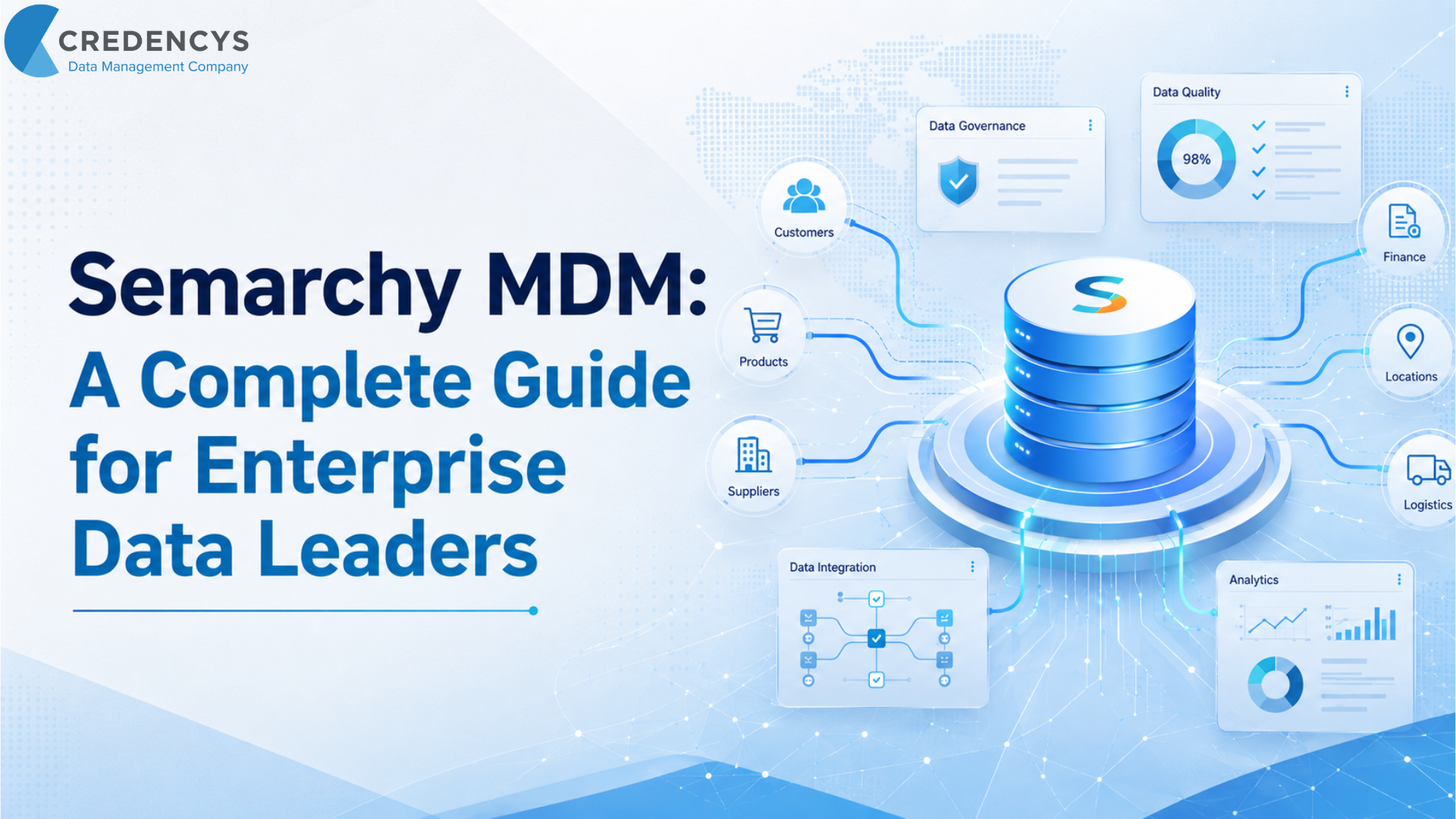
Semarchy MDM: A Complete Guide for Enterprise Data Leaders
Enterprise data is growing across systems, departments, regions, and channels. Customer data lives in CRM and commerce platforms.
Product data sits across ERP, PIM, DAM, PLM, and spreadsheets. Supplier data is spread across procurement, finance, manufacturing, and compliance systems.
For CIOs and CDOs, this creates a serious challenge. The business needs trusted data for analytics, AI, customer experience, supply chain visibility, compliance, and operational decision-making.
But disconnected systems often create duplicate records, conflicting information, inconsistent hierarchies, and poor data ownership. This is where master data management becomes critical.
Semarchy MDM helps enterprises consolidate, govern, enrich, and distribute trusted master data across business domains. It enables organizations to create reliable golden records for customers, products, suppliers, locations, assets, and other critical entities.
For enterprise data leaders, Semarchy MDM is not just a technology investment. It is a foundation for better data quality, stronger governance, faster decisions, and AI-ready enterprise data.
What is Semarchy MDM?
Semarchy MDM is a master data management solution that helps organizations manage critical business data across systems and domains. It is designed to help enterprises create a single, governed, and trusted version of master data.
This trusted data can then be shared across operational systems, analytics platforms, business applications, and AI initiatives. In simple terms, Semarchy MDM helps enterprises answer questions such as:
- Which customer record is accurate?
- Which supplier record should be trusted?
- Which product attributes should flow to eCommerce?
- Which part, material, or asset data is complete?
- Which business system owns which data field?
- How should master data be governed, approved, and distributed?
Semarchy MDM is often used for master data on customers, products, suppliers, locations, references, parts, materials, and assets. The platform helps enterprises bring together data from different systems, validate it, remove duplicates, apply business rules, create golden records, and publish trusted information back to downstream systems.
For CIOs, Semarchy MDM supports enterprise architecture modernization. For CDOs, it strengthens data quality, governance, stewardship, and accountability.
For business teams, it improves trust in the data used for operations, reporting, and decision-making.
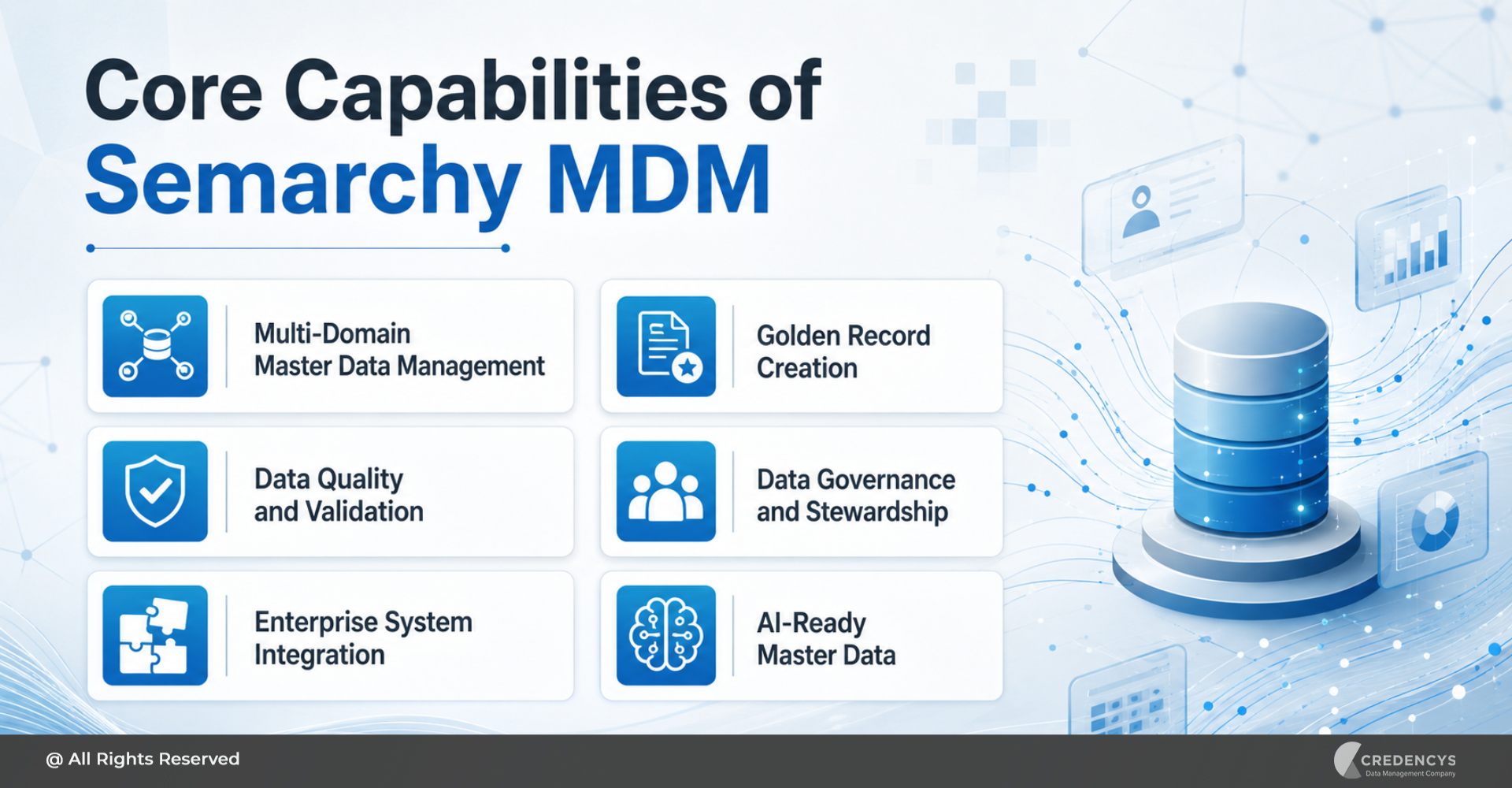
Core Capabilities of Semarchy MDM
Semarchy MDM provides several capabilities that help enterprises manage master data across business domains.
Multi-Domain Master Data Management
Many enterprises do not have a single master data problem. They have several.
A retailer may need to manage product, customer, supplier, location, and pricing data. A manufacturer may need to manage supplier, material, plant, asset, and parts data.
An automotive company may need to manage vehicle, parts, fitment, supplier, dealer, and aftermarket product data. Semarchy MDM supports multi-domain MDM, enabling organizations to manage different data domains through a governed, scalable approach.
This is especially useful for enterprises that want to start with one domain and then expand over time.
For example, a company may begin with supplier master data to improve procurement visibility. Later, it may extend MDM to product, customer, or asset data.
Golden Record Creation
One of the most important outcomes of MDM is the creation of golden records. A golden record is the most accurate, complete, and trusted version of a business entity.
It may represent a customer, supplier, product, material, location, part, or asset. Semarchy MDM helps create golden records by integrating data from different systems, identifying duplicates, applying match-and-merge logic, validating fields, enriching information, and applying survivorship rules.
For example, customer data may exist in CRM, billing, support, and eCommerce systems. Each system may have slightly different information.
Semarchy MDM helps consolidate these records into a single, reliable customer profile. This improves customer experience, reporting accuracy, compliance, and business decision-making.
Data Quality and Validation
Poor data quality is one of the biggest barriers to digital transformation. Incomplete product attributes, duplicate suppliers, inconsistent customer names, incorrect location codes, and outdated reference data can create operational inefficiencies across the enterprise.
Semarchy MDM helps improve data quality through validation rules, standardization, cleansing, duplicate detection, monitoring, and workflow-based correction. Organizations can define business rules for required fields, accepted formats, approved values, data completeness, and domain-specific validation.
This helps reduce downstream errors and improves the reliability of enterprise data.
Data Governance and Stewardship
MDM is not just about technology. It also requires ownership, accountability, and governance.
Semarchy MDM supports stewardship processes that allow business and data teams to review, approve, correct, and manage master data. This is important because master data is used across many departments.
Customer data may be used by sales, marketing, finance, support, and analytics teams. Product data may be used by merchandising, eCommerce, supply chain, compliance, and manufacturing teams.
Without governance, data ownership becomes unclear. Semarchy MDM helps organizations define who owns the data, who approves changes, which rules apply, and how updates move through the workflow.
This creates better accountability and control.
Enterprise System Integration
Master data is only valuable when it moves across the enterprise. Semarchy MDM can be integrated with ERP, CRM, PIM, DAM, PLM, eCommerce, procurement, data warehouses, cloud data platforms, analytics tools, and business applications.
This allows trusted master data to flow back into the systems that depend on it. For example, a clean supplier record can be distributed to procurement, ERP, finance, and compliance platforms.
A governed product record can flow to eCommerce, marketplaces, PIM, DAM, and analytics systems. This helps ensure that different teams are working with consistent and trusted information.
AI-Ready Master Data
Enterprises are increasingly investing in AI, machine learning, automation, and advanced analytics. However, AI outcomes depend heavily on data quality.
If the underlying customer, product, supplier, or operational data is inaccurate, fragmented, or poorly governed, AI initiatives can fail to deliver reliable results. Semarchy MDM helps create AI-ready data by improving consistency, accuracy, completeness, and governance across master data domains.
This gives data science, analytics, and business teams a more reliable foundation for AI-driven insights and automation.
How Semarchy MDM Works
Semarchy MDM works by connecting data sources, applying governance and quality rules, creating trusted master records, and distributing those records across the enterprise. A typical Semarchy MDM process includes the following steps:
- Connect source systems: The first step is to connect relevant systems, including ERP, CRM, PIM, DAM, PLM, eCommerce, procurement platforms, databases, spreadsheets, and cloud data platforms.
- Ingest master data: Data from different systems is brought into the MDM environment for analysis, validation, and consolidation.
- Profile and validate data: The data is checked for completeness, accuracy, consistency, formatting issues, duplicate values, and missing attributes.
- Match and merge duplicate records: Duplicate records are identified using matching rules. The system then helps merge records based on defined survivorship logic.
- Apply governance rules: Business rules, ownership models, stewardship workflows, approval processes, and validation logic are applied to the data.
- Create golden records: The most trusted version of each entity is created. This becomes the golden record.
- Publish trusted data: The golden records are distributed to downstream systems, including ERP, CRM, analytics tools, eCommerce platforms, BI dashboards, data warehouses, and AI systems.
- Monitor and improve continuously: Data quality, governance, and stewardship processes continue after implementation. MDM is an ongoing program, not a one-time project.
This process helps enterprises move from fragmented, inconsistent data to governed, reusable master data.
Semarchy MDM Use Cases by Industry
Semarchy MDM can support several use cases across industries. The most common use cases involve customer, product, supplier, location, parts, materials, and reference data.
Semarchy MDM for Retail
Retail enterprises operate across stores, eCommerce platforms, marketplaces, mobile apps, loyalty programs, and customer service channels. This creates data complexity across product, customer, location, pricing, promotion, and supplier records.
Semarchy MDM can help retailers create a trusted view of customer and product data across channels. Key retail use cases include:
- Customer 360
- Product data governance
- Omnichannel catalog consistency
- Store and location master data
- Supplier and vendor data management
- Loyalty and personalization data readiness
- Pricing and promotion data consistency
For example, a retailer may have the same customer appearing across loyalty, eCommerce, CRM, and support systems. Semarchy MDM can help create a unified customer profile that supports better personalization and customer experience.
Similarly, product data can be standardized and governed before being published to websites, marketplaces, mobile apps, and in-store systems.
Semarchy MDM for CPG
CPG companies manage complex product portfolios, packaging data, ingredients, suppliers, regulatory information, distributor records, and retailer relationships. Data inconsistency can slow product launches, create compliance risks, and impact channel performance.
Semarchy MDM can help CPG companies centralize and govern product, supplier, ingredient, packaging, and customer data. Key CPG use cases include:
- Product hierarchy management
- Ingredient and packaging data governance
- Supplier and vendor master data
- Retailer and distributor data alignment
- Compliance-related data management
- New product introduction support
- Channel data consistency
For CPG brands, accurate product and packaging data is critical. Semarchy MDM helps ensure that internal teams, distributors, retailers, and digital channels use consistent and trusted product information.
Semarchy MDM for Manufacturing
Manufacturing enterprises depend on accurate data on suppliers, materials, parts, plants, assets, and production. However, this data is often spread across ERP systems, procurement tools, engineering systems, spreadsheets, and legacy applications.
Semarchy MDM can help manufacturers improve operational visibility by creating governed master records for suppliers, materials, parts, assets, and locations. Key manufacturing use cases include:
- Supplier master data management
- Material and parts data governance
- Plant and asset data management
- Procurement data consistency
- ERP data quality improvement
- Supply chain visibility
- Compliance and risk management
For manufacturers, poor supplier or material data can affect procurement, production planning, inventory management, and reporting. Semarchy MDM helps improve data reliability across these functions.
Semarchy MDM for Automotive
Automotive companies deal with complex data across OEMs, suppliers, dealers, distributors, parts, vehicles, fitment, service networks, and aftermarket channels. Data accuracy is especially important for parts compatibility, supplier management, compliance, and customer experience.
Semarchy MDM can help automotive enterprises manage trusted records of parts, suppliers, vehicles, locations, and aftermarket products. Key automotive use cases include:
- Parts master data management
- Vehicle and component hierarchy management
- Supplier and vendor data governance
- Dealer and distributor data management
- Aftermarket product data consistency
- Fitment and compatibility data support
- Supply chain and compliance visibility
For automotive aftermarket companies, accurate product and parts data is essential for search, compatibility, fulfillment, and customer trust. Semarchy MDM can help centralize and govern this data across systems and channels.
Business Benefits of Semarchy MDM
Semarchy MDM helps enterprises move from fragmented data to trusted enterprise data. The business benefits are significant for CIOs, CDOs, IT teams, data teams, and business users.
| Business Challenge | How Semarchy MDM Helps |
|---|---|
| Duplicate customer records | Creates trusted golden customer records |
| Inconsistent product data | Standardizes and governs product attributes |
| Supplier data errors | Centralizes and validates vendor information |
| Poor data governance | Enables stewardship, ownership, and workflows |
| Conflicting reports | Improves data consistency across systems |
| Slow product launches | Improves data readiness and approval workflows |
| Weak AI readiness | Builds a trusted data foundation for AI |
| Manual data correction | Reduces repetitive cleanup and rework |
The key benefits include:
- Better data quality
- Stronger governance
- Reduced duplicate records
- Improved customer, product, and supplier visibility
- Faster reporting and analytics
- Better compliance readiness
- Lower manual data correction effort
- Stronger enterprise decision-making
- Improved AI and automation readiness
For enterprise leaders, the biggest value is confidence. When teams trust the data, they can make faster and better decisions.
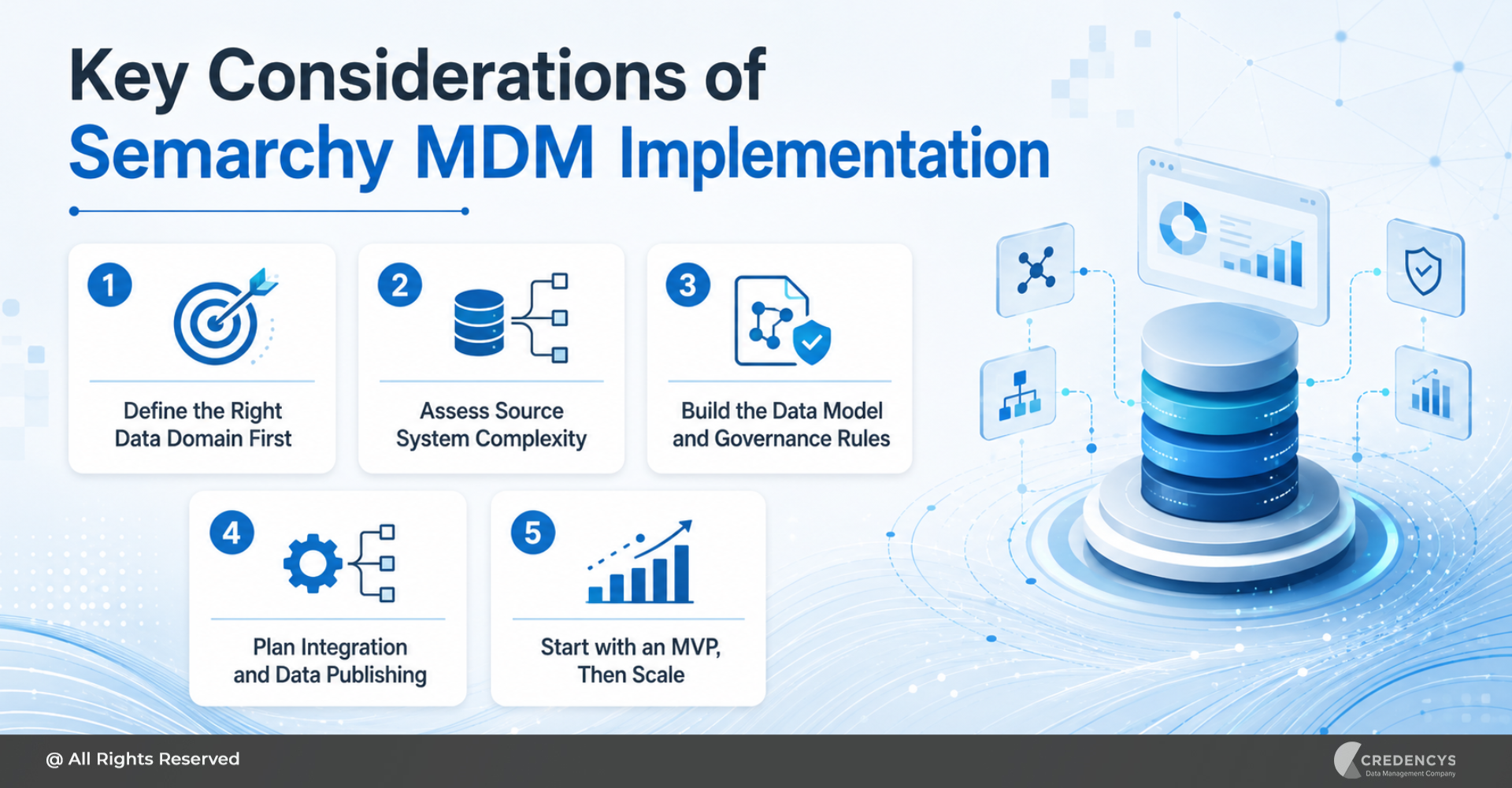
Semarchy MDM Implementation: Key Considerations
A successful Semarchy MDM implementation requires more than software configuration. It requires strategy, governance design, data modeling, integration planning, and business adoption.
Here are the key considerations enterprise leaders should focus on.
Define the Right Data Domain First
Start with the data domain that creates the highest business impact. For some companies, this may be customer data.
For others, it may be product, supplier, material, part, location, or asset data. The right starting point depends on business priorities.
For example:
- Retailers may begin with product or customer data.
- Manufacturers may begin with supplier or material data.
- Automotive companies may begin with parts or supplier data.
- CPG companies may begin with product and packaging data.
Starting with a single clear domain helps teams prove value more quickly before scaling the MDM program.
Assess Source System Complexity
Before implementation, enterprises need to understand where master data currently lives. This may include ERP, CRM, PIM, DAM, PLM, procurement systems, eCommerce platforms, data warehouses, spreadsheets, and legacy databases.
Source system assessment helps identify:
- Duplicate records
- Missing fields
- Inconsistent formats
- Conflicting values
- Data ownership gaps
- Integration dependencies
- Data quality issues
This step is critical for designing the right MDM architecture.
Build the Data Model and Governance Rules
The data model defines how master data will be structured. It includes entities, attributes, relationships, hierarchies, taxonomies, reference values, and business rules.
Governance rules define how data will be created, reviewed, approved, changed, and distributed. This includes:
- Data ownership
- Stewardship roles
- Validation rules
- Approval workflows
- Matching rules
- Survivorship logic
- Audit requirements
- Data access controls
Strong governance design helps ensure that MDM becomes a business-driven program, not just an IT project.
Plan Integration and Data Publishing
Semarchy MDM must connect with the enterprise systems that create and consume master data. This requires careful integration planning.
Enterprises should define:
- Which systems provide source data
- Which systems consume golden records
- How often should data sync
- Which fields should flow to each system
- Which system owns which attributes
- How errors and exceptions will be handled
Integration planning is especially important for organizations using ERP, CRM, eCommerce, PIM, DAM, procurement, analytics, and cloud platforms.
Start with an MVP, Then Scale
A successful MDM initiative does not need to start with every domain. In many cases, the best approach is to start with a focused MVP.
This allows the enterprise to prove value, refine governance, improve data quality, and build stakeholder confidence. Once the first domain is successful, the organization can expand to additional domains and use cases.
This phased approach reduces risk and improves adoption.
Common Challenges in Semarchy MDM Projects
Semarchy MDM can deliver strong business value, but implementation success depends on the right strategy and execution. Common challenges include:
- Poorly defined data ownership
- Weak governance model
- Incomplete source system assessment
- Complex matching and survivorship rules
- Lack of business stakeholder involvement
- Resistance from users
- Underestimating integration complexity
- Trying to solve too many domains at once
- Poor data quality in legacy systems
- Limited post-go-live support
The biggest mistake enterprises make is treating MDM as only a tool implementation. MDM is a business transformation program.
It needs the right data strategy, governance structure, technology configuration, and change management. When these elements come together, Semarchy MDM can become a strong foundation for trusted enterprise data.
When Should Enterprises Consider Semarchy MDM?
Enterprises should consider Semarchy MDM when data inconsistency begins to impact business performance. Common signs include:
- Customer records are duplicated across systems.
- Product data is inconsistent across channels.
- Supplier records are incomplete or outdated.
- Business teams do not trust reports.
- ERP, CRM, and analytics platforms show conflicting data.
- Manual data correction is consuming too much time.
- Data governance is inconsistent across departments.
- Product launches are delayed due to data issues.
- Compliance teams struggle to track trusted information.
- AI and analytics initiatives lack reliable master data.
Semarchy MDM is especially useful for organizations that need multi-domain data governance across complex technology environments. For CIOs, it supports modernization and system integration.
For CDOs, it supports governance, quality, stewardship, and data trust. For business teams, it improves the reliability of the data used in daily operations.
How Credencys Helps with Semarchy MDM Implementation
Implementing Semarchy MDM successfully requires the right mix of data strategy, platform expertise, governance design, and integration experience. Credencys helps enterprises design, implement, and scale Semarchy MDM solutions across business-critical data domains.
Our Semarchy MDM services include:
- MDM strategy and roadmap development
- Data domain assessment
- Source system analysis
- Data model design
- Semarchy MDM implementation
- Data quality rule configuration
- Matching and survivorship logic
- Governance and stewardship workflow setup
- ERP, CRM, PIM, DAM, eCommerce, and analytics integration
- Data migration and validation
- Testing and deployment
- Post-go-live support and optimization
We help enterprises create trusted master data across customer, product, supplier, material, parts, location, and operational data domains. Whether you are modernizing legacy MDM, starting a new master data program, or preparing data for AI and analytics, Credencys can help you build a scalable, governed MDM foundation using Semarchy.
Conclusion
Semarchy MDM helps enterprises turn fragmented master data into trusted, governed, and reusable business information. For CIOs, it provides a scalable foundation for connected enterprise architecture.
For CDOs, it strengthens governance, quality, stewardship, and data trust. For business teams, it improves the reliability of customer, product, supplier, and operational data.
As enterprises invest more in analytics, automation, AI, and digital transformation, trusted master data becomes essential. Semarchy MDM enables organizations to create golden records, improve data quality, govern critical domains, and distribute reliable data across enterprise systems.
With the right implementation strategy, Semarchy MDM can help enterprises improve operational efficiency, decision-making, compliance readiness, and AI-driven innovation.
FAQs
What is Semarchy MDM?
Semarchy MDM is a master data management solution that helps enterprises consolidate, govern, clean, enrich, and share trusted master data across business systems.
It helps organizations create golden records for critical data domains, including customer, product, supplier, location, asset, material, and reference data.
What data domains does Semarchy MDM support?
Semarchy MDM can support multiple data domains, including customer, product, supplier, location, asset, material, parts, vendor, and reference data. This makes it useful for industries such as retail, CPG, manufacturing, automotive, healthcare, financial services, and distribution.
Is Semarchy MDM suitable for large enterprises?
Yes. Semarchy MDM is suitable for enterprises that manage complex data across multiple systems, business units, regions, and domains. It is especially useful for organizations that need data quality, governance, stewardship, integration, and trusted master data at scale.
Why is Semarchy MDM important for AI-ready data?
AI initiatives need accurate, complete, consistent, and governed data. Semarchy MDM helps create a trusted data foundation by improving the quality and consistency of master data.
This supports more reliable analytics, automation, machine learning, and AI-driven decision-making.
Which industries can benefit from Semarchy MDM?
Retail, CPG, manufacturing, and automotive enterprises can benefit significantly from Semarchy MDM. Retailers can improve customer and product data.
CPG companies can govern product, packaging, supplier, and compliance data. Manufacturers can improve supplier, material, asset, and plant data.
Automotive companies can manage parts, suppliers, dealers, and aftermarket product data more effectively.





Tags: