


How ERP Modernization Supports AI-Driven Business Operations
Artificial intelligence is becoming central to forecasting, procurement, finance, supply chain, and customer operations. Yet AI cannot produce reliable results when core ERP data is fragmented, delayed, or difficult to access.
ERP modernization services create the connected data, scalable integrations, governed workflows, and real-time visibility that turn AI from a standalone experiment into a practical business capability.
What is ERP Modernization?
ERP modernization is the process of upgrading enterprise resource planning systems, data models, integrations, workflows, and user experiences to support connected, scalable, and data-driven operations. It does not always mean replacing the entire ERP platform.
An organization may modernize gradually by migrating to an ERP cloud, replacing outdated modules, exposing data through APIs, improving integrations, automating workflows, or creating a modern data layer around its existing ERP. Strong data integration services help connect ERP data with customer systems, analytics platforms, operational applications, and AI models.
The objective is not simply to make an ERP system newer. It is to make business information easier to access, more reliable to use, and faster to act on.
A modern ERP environment can connect finance, procurement, inventory, manufacturing, sales, supplier, and customer data across the enterprise. It can also provide a stronger foundation for analytics, AI models, generative AI applications, and intelligent workflows.
Why Legacy ERP Systems Limit AI Adoption
Legacy ERP systems often hold essential business data, but that data may be scattered across modules, heavily customized, or available only through manual extracts. Teams may rely on spreadsheets, periodic reports, point-to-point integrations, and manual reconciliations to understand what is happening across the business.
These limitations affect AI readiness in several ways. First, AI needs complete context.
A demand forecast cannot be reliable when sales, inventory, promotion, supplier, and product data are disconnected. A procurement recommendation will be weak when purchase history, supplier performance, contract terms, and inventory requirements are not linked.
Second, delayed data limits operational value. When reports are generated weekly or monthly, teams can identify what happened but may not have enough time to prevent an issue.
AI-driven operations require current, reliable information to support decisions as conditions change. Third, inconsistent Master Data Management creates unreliable inputs.
Duplicate supplier records, incomplete product attributes, conflicting customer data, and outdated location information can affect model performance, reporting accuracy, and business confidence. Finally, legacy systems can make integration difficult.
When ERP data cannot flow securely through scalable data engineering services to analytics platforms, customer systems, warehouse applications, or AI tools, teams are forced to build workarounds that are hard to govern and maintain. ERP modernization addresses these challenges by improving data accessibility, integration, quality, and workflow design.
Legacy ERP vs AI-Ready ERP
| Capability | Legacy ERP Environment | AI-Ready Modern ERP Environment |
|---|---|---|
| Data Access | Data is siloed across modules and systems | Connected data through APIs, pipelines, and shared platforms |
| Reporting | Periodic reports and manual exports | Near-real-time dashboards and operational insights |
| Integrations | Point-to-point or custom integrations | API-led, scalable, and reusable integrations |
| Data Quality | Duplicates, inconsistencies, and incomplete records | Governed master data and automated quality controls |
| Workflows | Manual approvals and fragmented processes | Automated, intelligent, and exception-based workflows |
| AI Readiness | Limited access to trusted business context | AI can use governed, contextual operational data |
| Scalability | Difficult to adapt to new business needs | Cloud-ready, modular, and easier to evolve |
| User Experience | Complex screens and slow adoption | Role-based, intuitive, and insight-driven experiences |
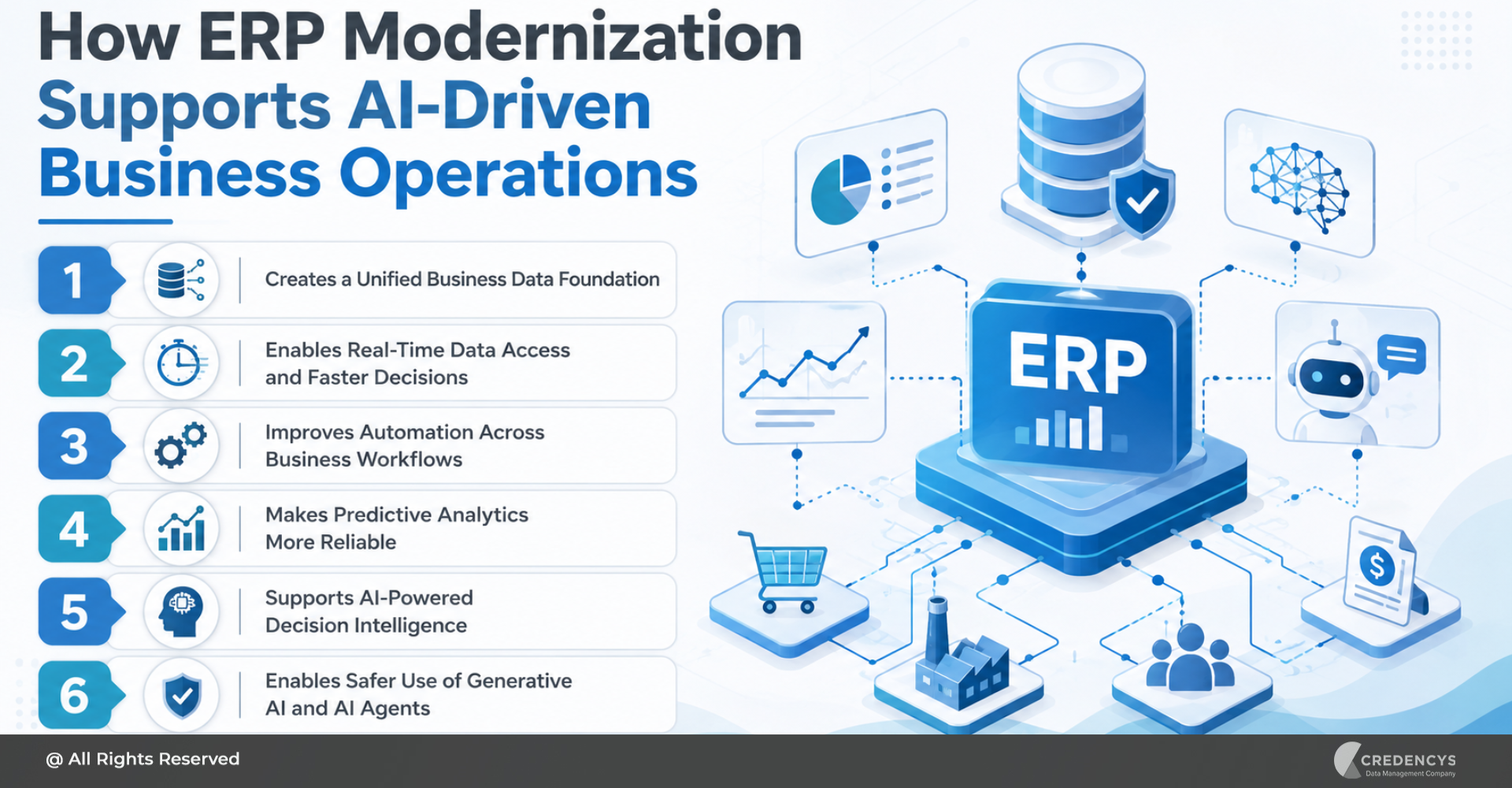
How ERP Modernization Supports AI-Driven Business Operations
1. Creates a Unified Business Data Foundation
AI needs more than large volumes of data. It needs a connected view of the business.
ERP modernization brings together financial, customer, product, supplier, inventory, order, manufacturing, and operational data that may currently be isolated in different modules or applications. This gives AI systems more context and reduces the manual effort required to reconcile data before a decision can be made.
For example, an inventory planning model can be more useful when it sees current demand, on-hand stock, open purchase orders, lead times, supplier reliability, and production requirements together. A finance model can better identify cash-flow risks when receivables, payables, orders, and inventory movements are connected.
This foundation also depends on data quality and Master Data Management. Enterprises need clear ownership, common definitions, standard formats, and quality rules for critical entities such as products, customers, suppliers, locations, and materials.
For product-intensive businesses, Product Information Management helps ensure that specifications, attributes, classifications, and availability data are reliable before AI uses them. When this data is reliable, AI can produce more consistent insights and recommendations.
2. Enables Real-Time Data Access and Faster Decisions
Traditional ERP environments often rely on batch updates and scheduled reporting. This creates a gap between an operational event and the time it takes a team to respond.
Modern ERP architectures use APIs, event streams, change data capture, and real-time data pipelines to move information across systems more quickly. This helps AI detect changes, highlight exceptions, and recommend actions while there is still time to influence the outcome.
A supply chain team can identify a potential stockout as inventory conditions change. A procurement team can receive an alert when a supplier delay could affect production.
A finance team can flag unusual transactions or escalating payment exceptions. A customer operations team can prioritize urgent orders based on current order, inventory, and account data.
Real-time access does not mean every process must respond instantly. It means the data and architecture can support the latency required for each business decision.
3. Improves Automation Across Business Workflows
ERP modernization helps enterprises move beyond manual follow-ups, spreadsheet tracking, and disconnected approval chains. Once workflows are standardized and connected, AI can support repetitive tasks, exception management, and decision routing.
This allows employees to spend less time searching for information or moving data between systems and more time resolving high-value issues. Common examples include invoice matching, purchase order approval routing, supplier risk alerts, inventory replenishment recommendations, order prioritization, service ticket classification, and financial reconciliation support.
The goal is not to automate every decision. A strong design distinguishes between low-risk tasks that can be automated and high-impact decisions that require review.
For example, an AI system may identify an invoice mismatch and route it to the right team, while a finance leader retains approval authority for payment decisions.
4. Makes Predictive Analytics More Reliable
Forecasts and predictions are only as useful as the operational data behind them. Modernizing ERP data, integrations, and workflows improves the accuracy and availability of information used for AI demand forecasting, inventory optimization, production planning, cash flow forecasting, supplier performance analysis, AI-driven pricing, and maintenance planning.
Consider demand forecasting. A model needs more than historical sales.
It may need current inventory, planned promotions, product hierarchies, seasonal trends, supplier lead times, and regional demand patterns. When these signals are disconnected or delayed, the forecast becomes less useful.
The same principle applies to AI-driven pricing. Pricing recommendations depend on clean product data, inventory availability, demand signals, cost information, customer segments, and margin requirements.
ERP modernization helps make these inputs accessible, governed, and usable at the right time.
5. Supports AI-Powered Decision Intelligence
AI does not need to replace managers or analysts. It can help them understand what is changing, why it matters, and what action may be appropriate.
A modern ERP environment gives AI the operational context needed to identify patterns, surface anomalies, compare scenarios, and recommend next steps. The result is decision intelligence: a combination of data, AI, business rules, and human judgment.
For example, a finance leader may use AI to understand the drivers of a change in working capital. A procurement manager may use it to identify suppliers that are creating risk across multiple categories.
An operations team may use it to prioritize orders when material availability is constrained. The strongest results come when AI recommendations are delivered within the workflows where people already work.
An insight is more actionable when it appears with the relevant data, owner, approval path, and business context.
6. Enables Safer Use of Generative AI and AI Agents
Generative AI and AI agents can make ERP information easier to search, understand, and use. An employee may ask a finance assistant to explain a monthly variance.
A procurement user may ask an agent to summarize open purchase-order risks. A customer service representative may retrieve order status and product availability through a conversational interface.
An operations assistant may flag production delays and suggest possible next actions. However, these use cases require strong AI data governance controls.
AI applications need secure APIs, permission-aware data access, audit trails, workflow boundaries, and clear human-approval rules. An agent should retrieve only the data a user is authorized to access.
It should not approve payments, alter contracts, modify configurations, or make external commitments without explicit controls in place. ERP modernization creates the integration and governance foundation that allows generative AI to be useful without becoming uncontrolled.
High-Impact AI Use Cases Enabled by ERP Modernization
Finance and Accounting
Modern ERP data can support cash-flow forecasting, automated reconciliations, expense anomaly detection, payment-exception management, financial-close support, and margin analysis. These use cases help teams identify issues earlier and focus attention on material exceptions.
Supply Chain and Inventory
AI can help predict stockouts, optimize inventory, monitor supplier risk, flag shipment delays, and improve warehouse planning. These capabilities depend on connected inventory, demand, supplier, logistics, and order data.
Procurement
Procurement teams can use AI for spend analysis, supplier performance insights, purchase order automation, contract risk identification, invoice matching, and sourcing recommendations. The quality of supplier and purchasing data is critical to each use case.
Manufacturing and Operations
AI can support production planning, capacity analysis, material availability monitoring, predictive maintenance, quality issue detection, and operational exception management. Modern ERP integration helps connect manufacturing events with inventory, procurement, and finance data.
Customer Operations
Customer-facing teams can use AI for order-status support, returns analysis, service prioritization, account-level insights, and personalized recommendations. A connected ERP environment and a governed Customer 360 solution help ensure AI has current order, product, and account context.
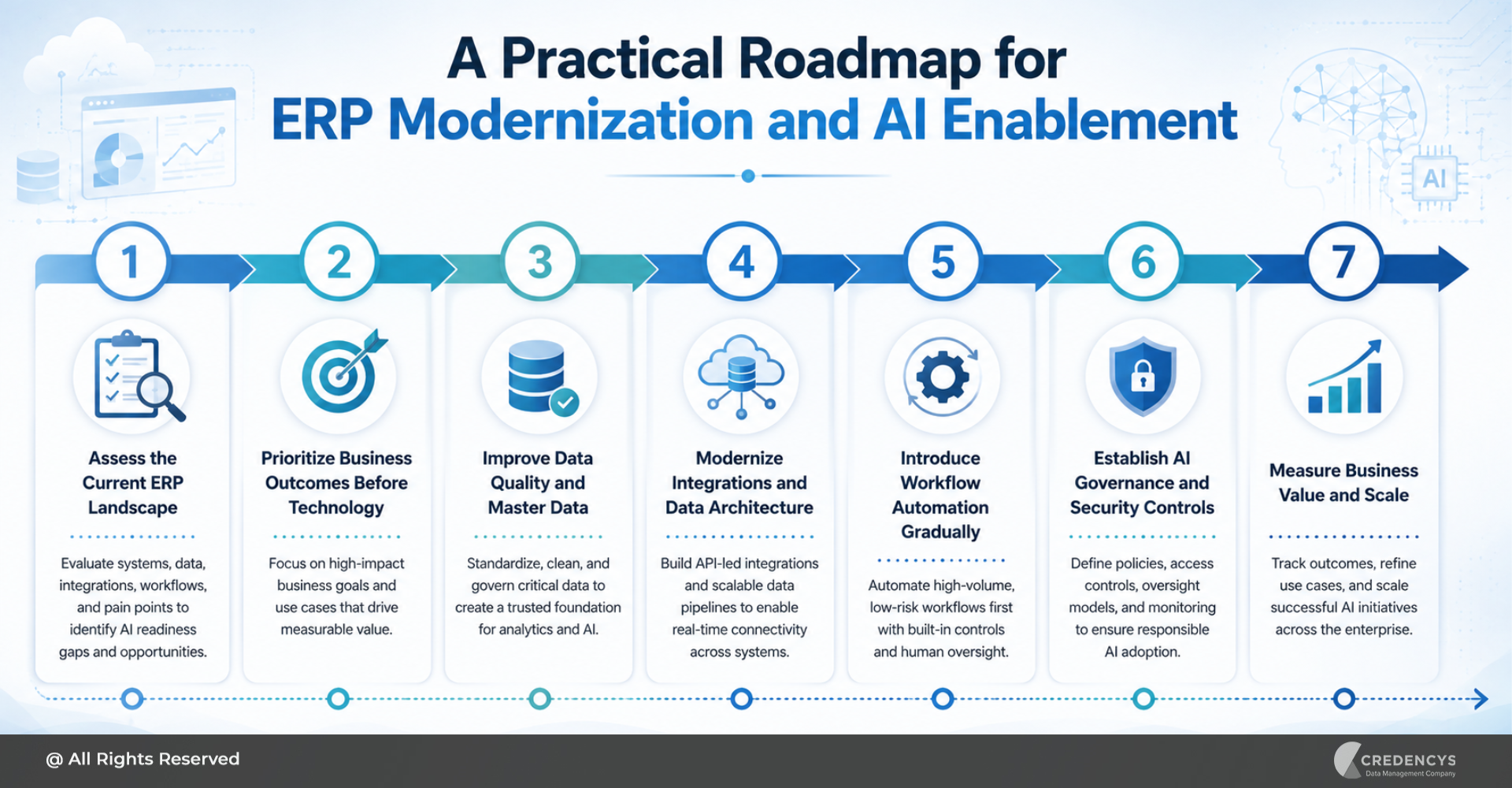
A Practical Roadmap for ERP Modernization and AI Enablement
1. Assess the Current ERP Landscape
Review current modules, integrations, data quality, reporting delays, manual workflows, security controls, and business pain points. Identify where disconnected data or outdated processes are slowing decisions, increasing effort, or limiting visibility.
2. Prioritize Business Outcomes Before Technology
Avoid modernizing everything at once. Start with a small number of outcomes that matter to the business, such as improving demand forecasting, reducing invoice exceptions, increasing inventory visibility, or strengthening supplier performance management.
3. Improve Data Quality and Master Data
Standardize customer, product, supplier, location, material, and financial data. Resolve duplicates, define ownership, establish quality rules, and improve lineage. This step is essential before scaling AI use cases.
4. Modernize Integrations and Data Architecture
Replace brittle point-to-point connections with APIs, integration platforms, event-driven patterns, and reusable data pipelines. Create a secure environment that enables ERP data to flow to analytics platforms, AI models, customer systems, and operational applications.
5. Introduce Workflow Automation Gradually
Begin with high-volume, repeatable, lower-risk processes. Add approval paths, audit trails, exception handling, and human review before automating decisions with broader financial, operational, or customer impact.
6. Establish AI Governance and Security Controls
Define approved AI use cases, data-access boundaries, ownership, evaluation standards, human-oversight requirements, and incident processes. Monitor AI outputs, user activity, data quality, and business impact over time.
7. Measure Business Value and Scale
Track metrics such as reduced manual effort, faster approvals, higher forecast accuracy, improved inventory availability, fewer exceptions, better supplier visibility, and stronger employee productivity. Use early results to refine the approach and scale successful use cases across functions.
Common ERP Modernization Challenges
Poor Data Quality
A modern platform cannot automatically resolve inaccurate or incomplete data. Data cleanup, ownership, and governance need to be part of the modernization plan from the start.
Over-Customization
Highly customized ERP environments can be difficult to upgrade, integrate, and maintain. Organizations should identify where processes can be standardized and where customization is genuinely necessary.
Lack of Business Ownership
ERP modernization is not an IT-only project. Finance, procurement, supply chain, operations, and customer teams must define priorities, approve process changes, and support adoption.
Trying to Modernize Everything at Once
Large, all-or-nothing programs can create disruption and slow progress. A phased roadmap makes it easier to demonstrate value, learn from each release, and manage change.
Weak Change Management
New technology does not create value if people do not use it. Training, clear process ownership, role-based experiences, and adoption measurement are essential.
How Credencys Helps Modernize ERP for AI-Driven Operations
Credencys helps enterprises modernize the data, integration, workflow, and governance layers around ERP systems to create a stronger foundation for AI-driven operations. Our capabilities include ERP data modernization, data engineering, API and middleware development, Master Data Management, Product Information Management, data quality and governance, real-time data pipelines, analytics and BI, AI/ML enablement, generative AI solutions, AI agent development, Databricks consulting, Snowflake consulting, and cloud data platform modernization.
Whether the objective is stronger forecasting, more intelligent procurement, improved supply chain visibility, faster financial processes, or better customer operations, Credencys helps enterprises connect ERP data with modern platforms and practical AI capabilities.
Conclusion
ERP modernization is not simply a technology upgrade. It creates the connected data, real-time visibility, scalable integrations, and governed workflows needed to make AI useful in daily business operations.
The strongest AI programs will not operate separately from core enterprise systems. They will be built on modern, trusted ERP data and connected operational processes.
By strategically modernizing ERP, enterprises can move from delayed reporting and manual workflows to faster decision-making, intelligent automation, and AI-driven business operations. To assess how ready your ERP data, integrations, and workflows are for AI, talk to ERP modernization experts.
Frequently Asked Questions
What is ERP modernization?
ERP modernization is the process of improving ERP systems, integrations, data, workflows, and user experiences to support connected, scalable, and data-driven business operations.
How does ERP modernization support AI?
It improves data quality, integration, accessibility, real-time visibility, workflow automation, and governance, giving AI systems the trusted business context they need.
Does ERP modernization require replacing the entire ERP system?
Not always. Organizations can modernize selectively through cloud migration, APIs, integration layers, data platforms, workflow automation, and targeted module upgrades.
What AI use cases can a modern ERP support?
A modern ERP can support demand forecasting, inventory optimization, supplier-risk analysis, financial reconciliation, procurement automation, production planning, customer service support, and operational decision intelligence.
Why is data quality important for ERP AI initiatives?
AI models rely on accurate, complete, current, and consistent ERP data. Poor data quality can lead to unreliable forecasts, recommendations, and automated actions.



Tags: