


How Retailers Can Use AI to Reduce Stockouts and Overstocking
Retailers face a constant inventory balancing act. Customers expect products to be available across stores, websites, marketplaces, and fulfillment channels.
But demand can change quickly because of promotions, pricing, seasonality, local events, weather, supplier delays, and customer behavior. AI helps retailers improve demand forecasting, inventory visibility, replenishment, and allocation, reducing stockouts, avoiding overstocking, and protecting margins.
What Are Stockouts and Overstocking?
A stockout occurs when a product is unavailable at the time a customer wants to buy it. This can happen in a physical store, a warehouse, an eCommerce channel, a marketplace, or a fulfillment center.
For customers, the result is simple: the product they wanted is not available. For retailers, stockouts can lead to:
- Lost sales
- Lower customer satisfaction
- Poor loyalty experience
- More substitutions
- Missed campaign opportunities
- Reduced trust in availability
Common causes of stockouts include inaccurate demand forecasts, supplier delays, poor inventory visibility, slow replenishment, promotion-driven demand spikes, and incorrect store-level allocation. Overstocking is the opposite problem.
It happens when a retailer carries more inventory than demand requires. Overstocking can lead to:
- Higher carrying costs
- More markdowns
- Working-capital pressure
- Warehouse space constraints
- Product obsolescence
- Lower profitability
Common causes include overestimated demand, poor seasonal planning, slow-moving products, disconnected demand data, weak markdown planning, and manual purchase decisions. Stockouts and overstocking may look like opposite problems.
But they often stem from the same root cause: retailers lack timely, trusted, and connected demand and inventory intelligence.
Why Traditional Inventory Planning Falls Short
Many retailers still rely on historical sales data, spreadsheets, manual planner judgment, and periodic reports. This approach can work when demand is stable.
But modern retail demand is rarely stable. A promotion may change demand in a few hours.
A supplier delay may affect product availability across several locations. A regional event may increase demand in one market but not another.
A product may be available in the warehouse but unavailable on the shelf. Traditional inventory planning struggles because:
- Forecasts update too slowly
- Store-level demand differences are missed
- Inventory data is often delayed or inaccurate
- Product and supplier data remain disconnected
- Promotions distort actual demand patterns
- Teams react after stockouts or excess inventory appear
- Planners spend too much time reconciling reports
- Decisions are made at category level instead of SKU-location level
Traditional inventory planning explains what happened. Strong retail demand forecasting helps retailers move beyond historical sales and build a more forward-looking view of demand.
AI helps retailers predict what is likely to happen and act before inventory problems affect sales, margins, or customer experience.
Traditional Inventory Planning vs. AI-Powered Inventory Optimization
The shift from manual planning to AI-powered inventory optimization changes how retailers forecast, allocate, replenish, and respond to inventory risk.
| Capability | Traditional Inventory Planning | AI-Powered Inventory Optimization |
|---|---|---|
| Demand Forecasting | Based mainly on historical sales | Uses sales, inventory, promotions, customer behavior, supplier, and external signals |
| Inventory Visibility | Delayed and often fragmented | Near-real-time visibility across stores, warehouses, and channels |
| Replenishment | Rule-based and manually adjusted | Dynamic, data-driven, and exception-based |
| Stockout Prevention | Reactive after availability drops | Predicts stockout risk earlier |
| Overstock Control | Identified after excess builds up | Detects slow-moving and excess-risk inventory sooner |
| Store Allocation | Broad allocation rules | SKU, store, region, and channel-level optimization |
| Planner Workflow | Manual report review | AI-prioritized exceptions and recommendations |
| Decision Speed | Periodic planning cycles | Faster response to demand and supply changes |
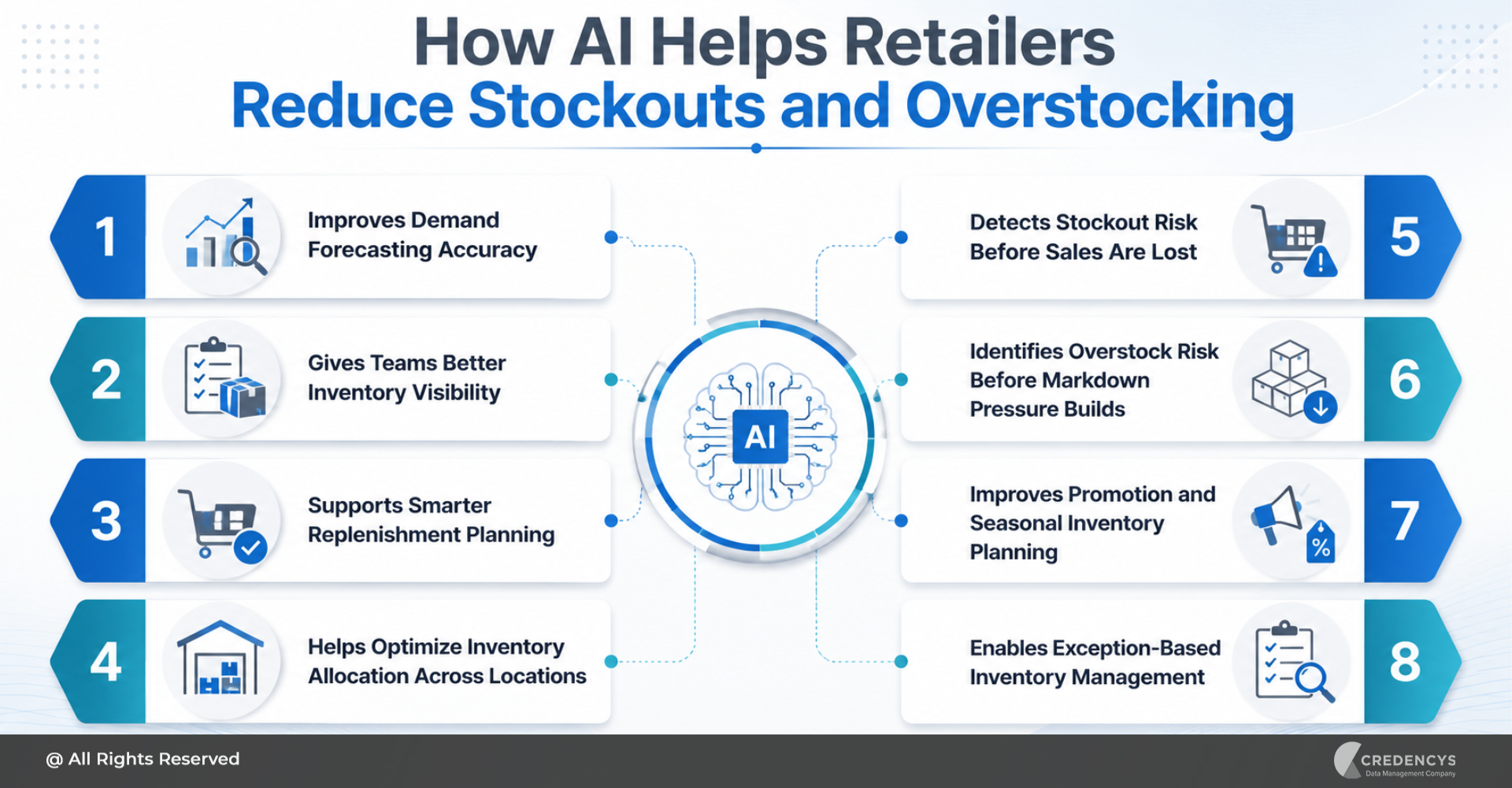
How AI Helps Retailers Reduce Stockouts and Overstocking
1. Improves Demand Forecasting Accuracy
AI can analyze more demand signals than traditional forecasting methods. These signals may include:
- Historical sales
- Recent sales velocity
- Store-level demand
- eCommerce activity
- Promotions and discounts
- Pricing changes
- Product attributes
- Seasonality
- Customer behavior
- Weather and local events
- Supplier lead times
- Returns and cancellations
This helps retailers forecast demand at a more granular level. Instead of planning demand only by category, retailers can forecast by SKU, store, region, channel, or customer segment.
This makes it easier to identify where inventory is needed and where demand may slow down. Better forecasting does not eliminate uncertainty, but predictive analytics in retail helps planners identify demand shifts earlier and act with more confidence.
But it gives planners stronger signals for replenishment, allocation, and purchase planning.
2. Gives Teams Better Inventory Visibility
Retailers cannot reduce stockouts or overstocking if they do not know where inventory actually sits. Inventory may be spread across stores, warehouses, fulfillment centers, dark stores, marketplaces, and third-party logistics partners.
When systems are disconnected, teams may not have a reliable view of what is available, reserved, in transit, misplaced, or stuck in the wrong location. Strong data integration services help connect inventory, order, supplier, and fulfillment systems into a more reliable operating view.
AI can help identify:
- Inventory mismatches
- Misplaced stock
- Slow-moving items
- Products at risk of stockout
- Store-level inventory gaps
- Fulfillment bottlenecks
- Inventory stuck in the wrong location
This is especially important for omnichannel retailers. A product may be available somewhere in the network, but not in the location where demand is rising.
AI helps teams identify these gaps earlier and make better decisions about transfer, fulfillment, or allocation.
3. Supports Smarter Replenishment Planning
Replenishment decisions need to balance demand, supply, lead time, service levels, and working capital. AI can recommend when, where, and how much to replenish based on current inventory, forecasted demand, supplier lead time, minimum order quantities, safety stock, promotion calendars, store velocity, and warehouse capacity.
Reliable real-time data pipelines make these replenishment recommendations more useful by keeping demand, inventory, and supplier signals up to date. This helps retailers avoid two common mistakes:
- Under-ordering products that are likely to sell faster
- Over-ordering products that are likely to slow down
AI-powered replenishment can also support exception-based planning. Instead of asking planners to manually review every SKU, the system can highlight the products, locations, and orders that need attention.
This allows teams to focus on high-impact decisions rather than routine monitoring. The goal is not just to replenish faster. It is to replenish more intelligently.
4. Helps Optimize Inventory Allocation Across Locations
A retailer may have too much inventory in one location and not enough in another. This creates two problems at once: lost sales in one market and excess stock in another.
AI can help identify where inventory should be allocated, transferred, or held. It can evaluate location-level demand, channel performance, local trends, available stock, shipment timelines, and fulfillment options.
Common use cases include:
- Store-to-store transfers
- Warehouse-to-store allocation
- Regional demand-based allocation
- Channel-specific inventory planning
- Omnichannel fulfillment decisions
- Inventory rebalancing before peak demand periods
This helps retailers move inventory closer to where demand is likely to occur. For example, a product may be selling faster in urban stores than suburban stores.
AI can detect the imbalance and recommend a transfer or future allocation adjustment before the stockout risk becomes visible to customers.
5. Detects Stockout Risk Before Sales Are Lost
Stockouts often become visible too late. By the time a team realizes a product is unavailable, the lost sales may already have occurred.
AI can detect early warning signals such as:
- Rising sales velocity
- Low inventory coverage
- Supplier delays
- Promotion uplift
- Regional demand spikes
- Increased online search or cart activity
- High return-to-sale imbalance
- Forecast confidence changes
These signals help teams act before products become unavailable. Possible actions include replenishing faster, transferring inventory, recommending substitutes, escalating supplier issues, adjusting campaign support, or prioritizing fulfillment from another location.
AI does not remove the need for planner judgment. It gives planners earlier visibility into risk.
6. Identifies Overstock Risk Before Markdown Pressure Builds
Overstocking often becomes apparent only after it has become expensive to fix. At that stage, retailers may need markdowns, clearance campaigns, product bundles, or storage changes to reduce excess inventory.
AI can identify overstock risk earlier by detecting:
- Slow-moving SKUs
- Excess inventory by location
- Products with declining demand
- Over-forecasted categories
- Seasonal items nearing lifecycle end
- Products with high holding cost
- Items likely to require markdowns
This gives retailers more options. They may slow replenishment, reallocate inventory, adjust purchase plans, create bundles, change marketing support, or plan markdowns earlier with better margin control.
The earlier overstock risk is detected, the more options the retailer has before margin leakage begins.
7. Improves Promotion and Seasonal Inventory Planning
Promotions and seasonal events create demand spikes that are difficult to manage manually. A discount may increase demand for one product while reducing demand for another.
A holiday campaign may perform differently by region. A fashion drop may sell quickly in one channel but underperform in another.
AI can help estimate:
- Promotion lift
- Product substitution
- Cannibalization risk
- Regional campaign response
- Inventory needed during campaign periods
- Post-promotion demand drop
- Markdown risk after the event
When paired with AI-driven pricing, retailers can make more informed decisions around discounts, markdowns, and margin protection. This supports better inventory planning for holidays, festivals, back-to-school seasons, fashion drops, and limited-time promotions.
Retailers can reserve inventory more confidently, avoid overcommitting stock to low-performing regions, and reduce the risk of leftover inventory after the campaign ends.
8. Enables Exception-Based Inventory Management
Retail planners cannot manually review every SKU, store, and warehouse to produce forecasts. AI can prioritize the exceptions that need attention.
Examples include:
- High stockout risk
- Excess inventory risk
- Forecasts with low confidence
- Unexpected demand spikes
- Supplier delay impact
- Inventory imbalance across locations
- Promotion underperformance
- Products nearing markdown risk
This helps planners focus on decisions that require judgment. For example, a planner may not need to review every replenishment recommendation.
But they should review cases where the model shows low confidence, high financial impact, or unusual demand behavior. Exception-based inventory management helps teams move from manual monitoring to focused decision-making.
Key Retail Use Cases for AI Inventory Optimization
Grocery and CPG Retail
AI can support fast-moving goods, perishables, promotion-driven demand, and store-level replenishment. For perishable products, better forecasting can help retailers improve availability while reducing waste.
Fashion and Apparel
Fashion retailers can use AI for size-level forecasting, seasonal planning, regional allocation, markdown timing, and new product demand prediction. This is useful because demand can change quickly based on style, size, color, season, and local preferences.
Home Improvement and Specialty Retail
AI can help forecast regional demand, manage large assortments, and account for supplier lead times. These retailers often manage complex product categories where demand may vary by geography, weather, projects, or local events.
eCommerce and Omnichannel Retail
AI can improve availability across warehouses, stores, marketplaces, and fulfillment locations. This helps retailers decide where to fulfill orders from, how to balance inventory across channels, and when to adjust replenishment.
Pharmacy and Health Retail
AI can support availability planning for essential products, regulated items, and location-specific demand patterns. In these categories, accurate inventory planning can directly impact customer trust and service quality.
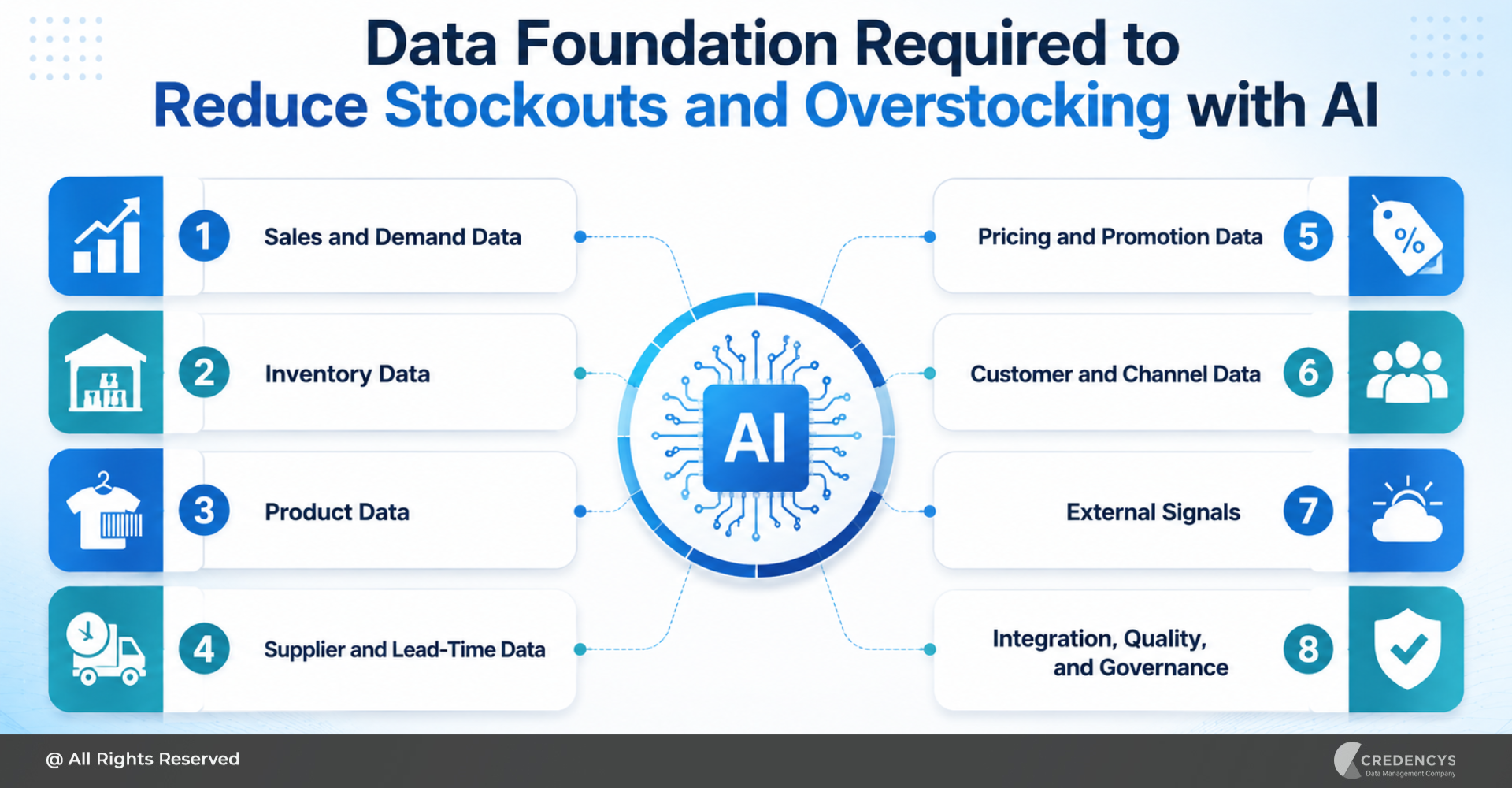
Data Foundation Required to Reduce Stockouts and Overstocking with AI
AI inventory optimization is only as strong as the data feeding it. Retailers need connected and governed data across sales, inventory, product, supplier, pricing, promotion, customer, channel, and external sources.
Sales and Demand Data
This includes POS sales, eCommerce sales, marketplace sales, recent sales velocity, lost sales indicators, returns, and cancellations. This data helps AI understand what customers are buying and how demand is changing.
Inventory Data
Retailers need store inventory, warehouse inventory, in-transit inventory, safety stock, stockout history, inventory adjustments, and shelf availability signals. This helps teams understand what is available, where it is located, and where inventory gaps exist.
Product Data
Product hierarchy, categories, attributes, variants, sizes, colors, lifecycle status, and substitution relationships are critical. Strong Product Information Management enables AI to compare products, understand the assortment context, and improve forecasting for new or similar items.
Supplier and Lead-Time Data
Supplier reliability, purchase order status, lead-time variability, shipment delays, fill rates, and minimum order quantities help AI estimate whether supply can meet forecasted demand. This is important for stockout prevention and replenishment planning.
Pricing and Promotion Data
Discounts, campaign calendars, promotion lift, markdown history, price elasticity, and margin rules help AI understand how pricing and promotions influence demand. This prevents models from confusing temporary promotion-driven spikes with sustained demand growth.
Customer and Channel Data
Customer behavior, channel preferences, loyalty activity, browsing activity, cart signals, and regional preferences help retailers understand where demand may emerge next. A connected Customer 360 solution can make these signals more useful for planning and personalization.
External Signals
Weather, local events, holidays, regional trends, economic signals, and competitor activity can also influence demand. Not every use case needs every external signal. The focus should be on the signals that improve the inventory decision.
Integration, Quality, and Governance
Retail data often sits across POS, ERP, WMS, OMS, PIM, CRM, eCommerce, loyalty, and supplier systems. To make AI useful, retailers need:
- Data engineering services
- Data integration
- Real-time data pipelines
- Master Data Management
- Data quality for AI
- Governance and access control
- Data observability
Without this foundation, AI models may produce recommendations based on incomplete, outdated, or inconsistent data.
AI Techniques Retailers Can Use
Machine Learning Forecasting
Machine learning forecasting predicts future demand using historical, current, and external signals. It can support planning by SKU, store, region, channel, or customer segment.
Demand Sensing
Demand sensing updates short-term demand predictions using recent sales, inventory movement, customer behavior, promotions, and external signals. This helps teams respond faster to current market conditions.
Anomaly Detection
Anomaly detection identifies unusual demand patterns, inventory changes, transaction activity, or fulfillment issues. This helps teams investigate problems before they create larger business impact.
Optimization Models
Optimization models can recommend decisions on replenishment, allocation, transfer, safety stock, and markdown. They help retailers balance service levels, inventory efficiency, and margin protection.
Computer Vision and Shelf Analytics
Computer vision can help detect shelf gaps, misplaced products, and inventory accuracy issues in stores. This can improve on-shelf availability and reduce the gap between system inventory and actual availability.
Generative AI and AI Agents
Generative AI and AI agents can summarize inventory risks, explain forecast changes, support planner workflows, and recommend next-best actions. However, high-impact actions such as large purchase orders, supplier changes, or markdown strategies should include human review and governance.
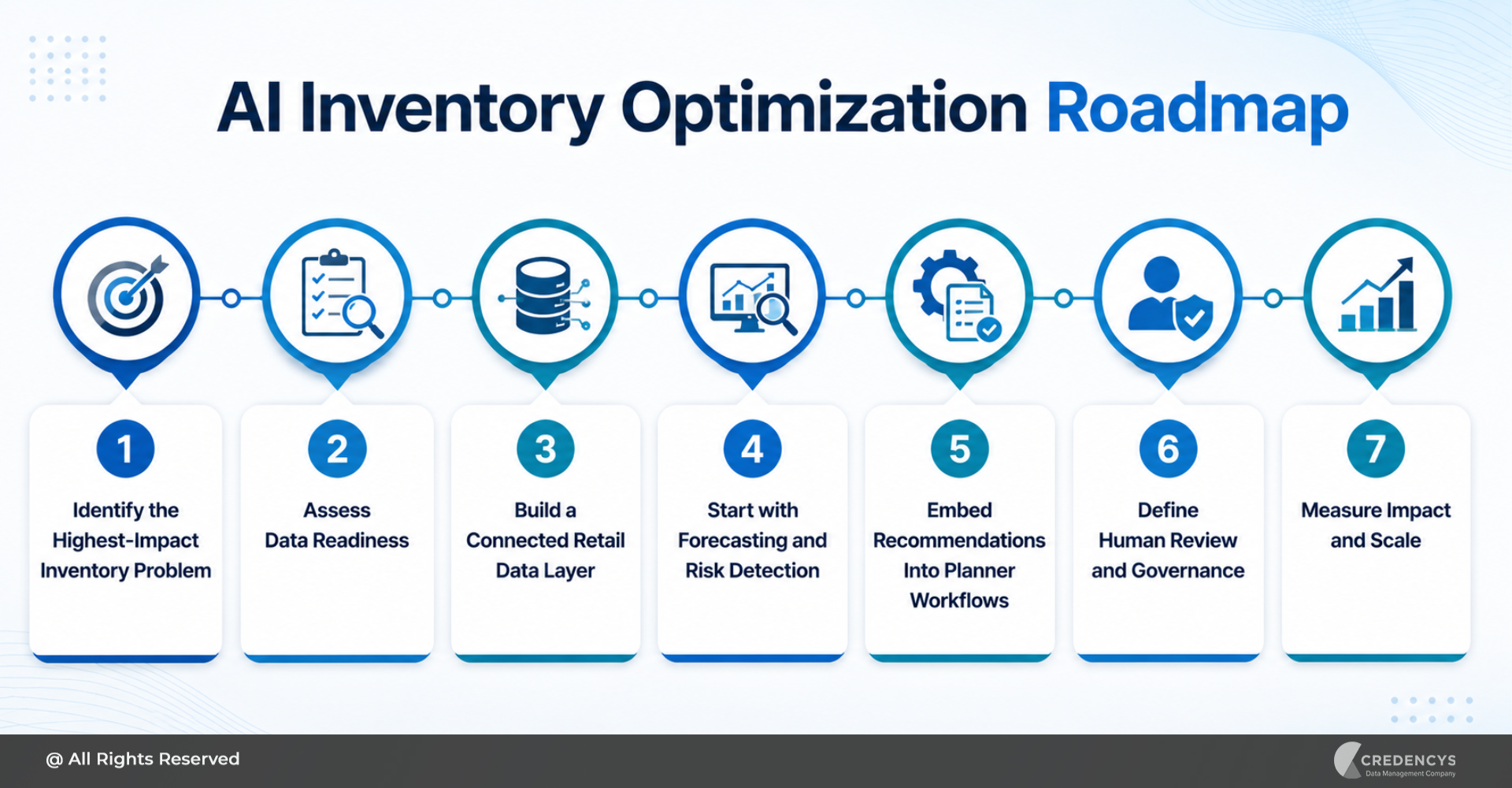
A Practical Roadmap to Reduce Stockouts and Overstocking with AI
1. Identify the Highest-Impact Inventory Problem
Start with a measurable issue. Examples include stockouts in top-selling SKUs, overstock in seasonal categories, poor store allocation, or high markdown rates.
2. Assess Data Readiness
Evaluate the availability, quality, freshness, and granularity of sales, inventory, product, supplier, promotion, and channel data. Identify data gaps before building models.
3. Build a Connected Retail Data Layer
Connect ERP, POS, WMS, OMS, PIM, CRM, supplier, and eCommerce data using APIs, pipelines, and governed data models. This creates a reusable foundation for forecasting, replenishment, allocation, and risk detection.
4. Start with Forecasting and Risk Detection
Begin with models that identify demand shifts, stockout risk, overstock risk, and inventory imbalance. This helps teams prove value before moving into more advanced automation.
5. Embed Recommendations Into Planner Workflows
AI insights should appear where planners make decisions. Push recommendations into replenishment, merchandising, supply chain, and store operations workflows so teams can act quickly.
6. Define Human Review and Governance
Clarify when AI can recommend, when it can automate, and when human approval is required. Strong AI data governance helps retailers define ownership, approval rules, monitoring, and accountability for inventory decisions.
High-impact inventory, supplier, and markdown decisions should be subject to oversight.
7. Measure Impact and Scale
Track improvements in availability, lost sales, inventory turns, markdown rates, working capital, forecast accuracy, and planner productivity. Scale once the initial use case shows measurable value.
Metrics Retailers Should Track
| Metric | What It Measures | Why It Matters |
|---|---|---|
| Stockout Rate | Percentage of items unavailable when needed | Measures product availability |
| On-Shelf Availability | Product availability at shelf level | Shows whether inventory is available to shoppers |
| Forecast Accuracy | Difference between forecasted and actual demand | Measures planning reliability |
| Inventory Turnover | How often inventory is sold and replaced | Tracks inventory efficiency |
| Days of Inventory | How long current inventory is expected to last | Helps detect overstock risk |
| Sell-Through Rate | Percentage of inventory sold in a period | Indicates product movement |
| Markdown Rate | Share of products sold at a discount | Shows excess inventory or pricing pressure |
| Lost Sales Estimate | Revenue missed due to stockouts | Quantifies stockout impact |
| Planner Override Rate | Frequency of manual changes to AI recommendations | Shows trust and usability gaps |
Common Challenges in AI Inventory Optimization
Poor Inventory Accuracy
AI cannot recommend reliable actions if system inventory does not reflect actual inventory. Inventory accuracy must improve before teams can trust AI-driven replenishment and allocation.
Fragmented Retail Systems
Disconnected POS, ERP, WMS, OMS, PIM, CRM, and supplier systems make it difficult to build a complete inventory view. Integration is a core requirement for AI inventory optimization.
Weak Product Data
Incomplete product attributes, variants, lifecycle status, and substitution data can weaken forecasts. AI needs strong product context to understand demand patterns and recommend the right actions.
Promotion and Seasonality Complexity
Demand can spike or drop quickly in response to promotions, weather, events, and seasonal patterns. AI can help, but teams still need business context, campaign visibility, and planner oversight.
Lack of Workflow Adoption
AI insights do not create value if planners do not trust them or cannot act on them inside existing workflows. Adoption depends on explainability, usability, and clear action paths.
Over-Automation Without Governance
AI should not automatically approve high-impact replenishment, markdown, or supplier decisions without governance. Human oversight is essential where decisions affect margin, customer experience, or supply chain risk.
How Credencys Helps Retailers Reduce Stockouts and Overstocking with AI
Credencys helps retailers create the data, analytics, and AI foundation needed to improve inventory visibility, forecasting, replenishment, and allocation decisions. Our capabilities include:
- Retail data strategy
- Data engineering and integration
- Real-time data pipelines
- Product Information Management
- Master Data Management
- Customer 360
- Data quality and governance
- Analytics and BI
- AI/ML solutions
- Demand forecasting
- Inventory optimization
- AI agent development
- Cloud data platform modernization
Credencys also supports retailers with cloud-scale analytics foundations through Databricks consulting and Snowflake consulting services. Credencys helps retailers connect fragmented retail data, improve forecasting accuracy, identify inventory risk earlier, and embed AI-driven recommendations into planning and operational workflows.
Conclusion
Reducing stockouts and overstocking is not only an inventory challenge. It is a data, forecasting, workflow, and decision-intelligence challenge.
AI helps retailers predict demand shifts earlier, improve inventory visibility, identify stockout and excess-risk signals, and guide planners toward smarter actions. The goal is not to replace retail planning expertise.
The goal is to give teams better signals, better recommendations, and faster visibility so they can protect sales, reduce markdown pressure, and improve customer experience.
Frequently Asked Questions
How can AI reduce stockouts in retail?
AI can reduce stockouts by forecasting demand more accurately, detecting inventory risk earlier, improving replenishment planning, and recommending transfers or supplier actions before products become unavailable.
How can AI reduce overstocking?
AI can reduce overstocking by identifying slow-moving products, detecting excess inventory risk, improving demand forecasts, and supporting earlier markdown, transfer, or purchase-plan adjustments.
What data is needed to reduce stockouts and overstocking with AI?
Retailers need sales, inventory, product, supplier, pricing, promotion, customer, channel, and external data such as weather or local events.
Can AI automate replenishment planning?
AI can recommend replenishment actions and automate low-risk workflows, but high-impact purchase, markdown, or supplier decisions should include human review and governance.
What are the benefits of AI inventory optimization?
Benefits include fewer stockouts, lower excess inventory, improved availability, better inventory turns, reduced markdowns, stronger margins, and better customer experience.


Tags: