


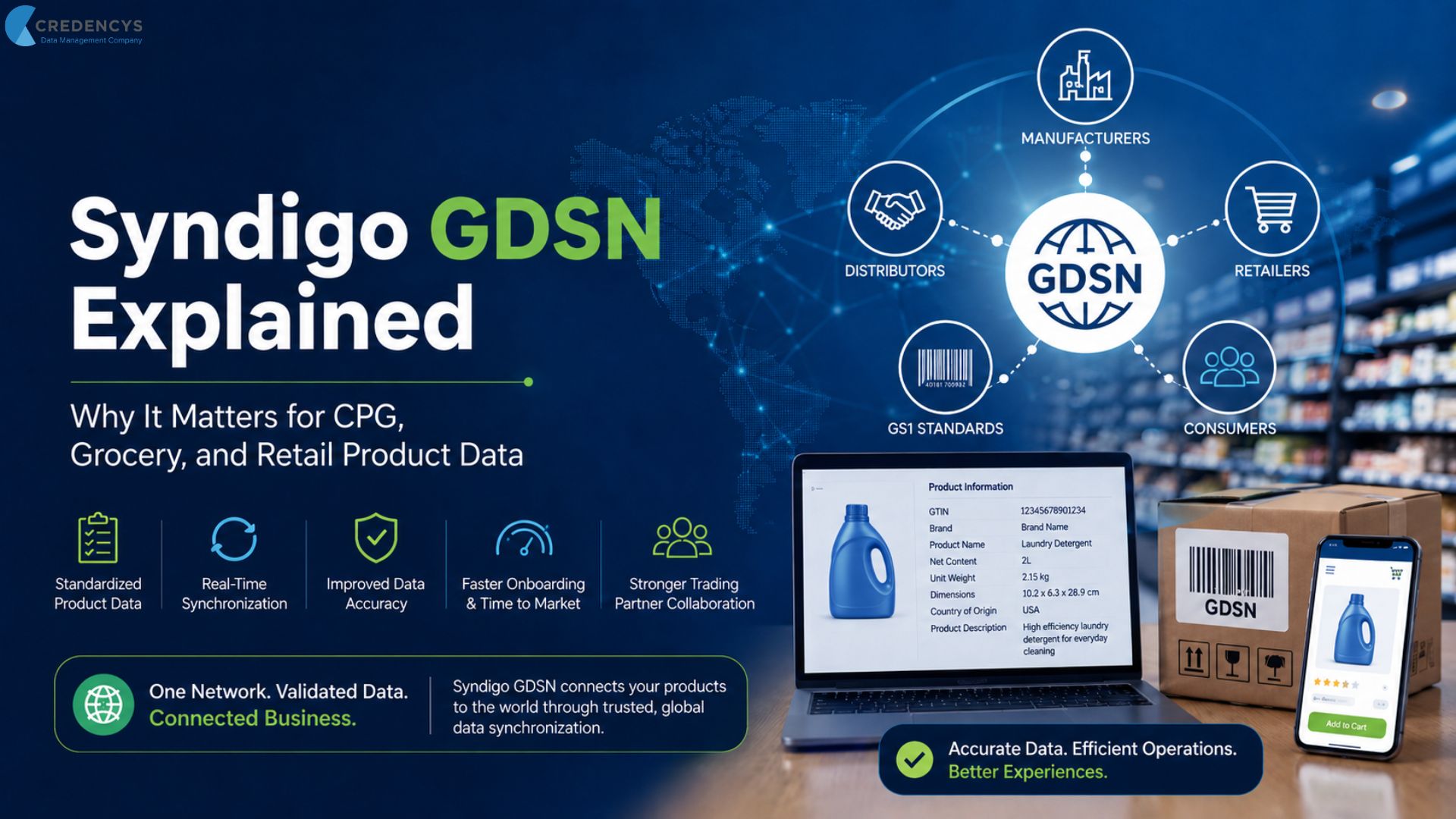
Syndigo GDSN Explained: Why It Matters for CPG, Grocery, and Retail Product Data
How can a CPG brand update product dimensions, nutritional details, or packaging information across multiple retailers without manually sending the same data to every trading partner?
This is the challenge the Global Data Synchronization Network, or GDSN, was designed to address.
GDSN provides a standards-based method for brands, manufacturers, distributors, and retailers to exchange product master data. Instead of relying on spreadsheets, emails, retailer portals, and disconnected product files, trading partners can share standardized product information through certified data pools.
Syndigo GDSN gives brands and retailers access to this network through a GS1-certified data pool. It helps organizations validate, publish, receive, and continuously synchronize product data across their trading partner ecosystem.
For CPG, grocery, and retail businesses managing thousands of products, suppliers, packaging levels, and channel requirements, this synchronization is critical to faster item setup, accurate product listings, reliable supply chain processes, and better consumer experiences.
New to GDSN in general? Read what GDSN is and how it works.
What is Syndigo GDSN?
Syndigo GDSN is a GS1-certified solution that enables businesses to exchange standardized product information through the Global Data Synchronization Network.
GS1 defines GDSN as a network of interoperable data pools that support the synchronization of master data between trading partners. A business connects to the network through a certified data pool, which facilitates the standardized exchange of product information with other connected companies.
Syndigo operates as one of these certified data pools. It provides the technology, validation rules, trading partner connections, workflows, and services needed to send or receive GDSN data.
The distinction can be understood as follows:
| Term | Role |
|---|---|
| GS1 | Develops and maintains the standards used to identify and exchange product data. |
| GDSN | The global network through which standardized product data is synchronized. |
| Certified Data Pool | The service through which a company connects to the GDSN network. |
| Syndigo | A GS1-certified data pool and product data platform. |
| Brand or Manufacturer | Creates, maintains, and publishes product information. |
| Retailer or Distributor | Subscribes to and receives synchronized product information. |
Syndigo explains the relationship using a network analogy: GS1 establishes the standards, GDSN is the network, and certified data pools such as Syndigo provide access to that network.
Why is Product Data Synchronization Necessary?
A single consumer product can contain hundreds of operational, logistical, regulatory, and consumer-facing attributes.
These may include:
- Global Trade Item Number, or GTIN
- Brand and product name
- Package dimensions and weight
- Case and pallet configuration
- Ingredients
- Nutritional information
- Allergens
- Storage instructions
- Country of origin
- Marketing descriptions
- Product claims
- Packaging hierarchy
- Effective and discontinuation dates
GS1 US identifies weights, dimensions, nutritional information, and allergens as examples of standardized product data that companies can share through GDSN.
The difficulty is not simply collecting this information. The same product data must remain accurate across internal systems, distributors, physical stores, retailer websites, marketplaces, warehouses, and consumer applications.
Without synchronization, businesses frequently encounter:
- Different product dimensions in retailer and supplier systems
- Missing allergen or nutrition information
- Products rejected during retailer onboarding
- Incorrect case-pack or pallet configurations
- Outdated packaging information
- Duplicate manual data entry
- Delayed product launches
- Inconsistent online and in-store product information
GDSN helps reduce these problems by giving trading partners a common structure for sharing and updating product master data.
How Does Syndigo GDSN Work?
The GDSN process connects a product information source, such as a CPG manufacturer, with a data recipient, such as a retailer or distributor.
A typical process involves five stages.
1. The Brand Prepares Product Data
The manufacturer gathers product information from systems such as:
- Enterprise resource planning systems
- Product information management platforms
- Master data management platforms
- Packaging databases
- Nutrition and formulation systems
- Digital asset management platforms
- Supplier information systems
The data must be associated with the appropriate GS1 identifiers, including GTINs for products and GLNs for organizations or locations.
A GTIN uniquely identifies a trade item that may be priced, ordered, or invoiced within the supply chain.
2. Syndigo Validates the Information
The product data is submitted to the Syndigo data pool, where it is checked against GS1 standards and recipient-specific requirements.
Syndigo states that its GDSN solution performs real-time validation against more than 10,000 data quality checks. These checks can identify missing attributes, invalid formats, incorrect measurements, inconsistent hierarchies, and other issues before the information reaches a recipient.
This validation is important because technically valid GDSN data may still fail to meet a particular retailer’s requirements.
3. The Product is Registered in GDSN
Once validated, the product information is registered and made discoverable to authorized trading partners through the network.
The product is normally identified by its GTIN and connected to the brand or data source through a GLN.
4. The Brand Publishes to Trading Partners
The manufacturer publishes the product information to selected retailers, distributors, marketplaces, or other recipients.
One publication can support multiple connected trading partners. However, individual recipients may request different attributes, formats, categories, or validation rules.
Syndigo addresses these variations through configurable data views, specification sheets, validation rules, and recipient-specific requirement sets.
5. Recipients Receive and Confirm the Data
The retailer or distributor receives the synchronized product information through its own GDSN-certified data pool or connected system.
The recipient can then accept the information or request corrections. When the brand updates an attribute, the revised information can be synchronized with subscribed recipients instead of being redistributed through separate manual files.
What Product Information can be Shared Through GDSN?
GDSN supports a wide range of product master data. The exact attributes depend on the product category, market, industry, and trading partner.
Product Identification
This information establishes what the product is.
Examples include:
- GTIN
- Brand name
- Functional name
- Product description
- Manufacturer
- Sub-brand
- Model or variant
- GPC classification
Packaging and Logistics Data
This information explains how the product is packed, shipped, stored, and handled.
Examples include:
- Height, width, and depth
- Gross and net weight
- Units per case
- Cases per layer
- Layers per pallet
- Packaging type
- Minimum and maximum storage temperature
- Shipping and ordering units
Accurate packaging levels help connect the correct GTIN with each consumer unit, inner pack, case, and higher-level packaging configuration. This supports ordering, receiving, inventory management, and labeling processes.
Food, Nutrition, and Allergen Data
For grocery and food products, GDSN may carry information such as:
- Ingredients
- Nutrient values
- Serving size
- Allergen declarations
- Preparation instructions
- Storage instructions
- Dietary claims
- Product certifications
- Handling temperatures
This information can support retailer websites, restaurant menus, shelf labels, product catalogs, procurement systems, and consumer applications.
Product Lifecycle Information
GDSN can also help communicate lifecycle changes such as:
- New product introduction
- Product availability
- Packaging changes
- Reformulation
- GTIN changes
- Product discontinuation
- Replacement items
- Effective dates
This continuous synchronization is especially valuable when brands frequently update packaging, ingredients, claims, dimensions, or case configurations.
Why Syndigo GDSN Matters for CPG Brands
CPG companies usually sell products through multiple retailers, distributors, wholesalers, marketplaces, and regional channels.
Every partner may have its own onboarding process and data requirements. Without a scalable synchronization model, product teams may have to repeatedly upload similar information into separate portals and templates.
Faster Retailer Onboarding
Brands can validate and distribute standardized information before sending it to retailers. This reduces the number of errors that could delay item creation or require repeated corrections.
Syndigo combines automated validation, compliance checks, workflows, and integration capabilities to support faster product onboarding.
Fewer Data Rejections
Incomplete or incorrectly formatted information can cause publication failures and lengthy conversations between the brand and retailer.
Syndigo applies both GS1 validation and recipient-specific rules so brands can identify problems before publishing their content.
Easier Multi-Retailer Distribution
A brand can manage product data centrally and publish it to multiple connected trading partners instead of maintaining a separate manual process for each retailer.
Syndigo reports that its network connects businesses across 25 countries and more than 7,500 trading partners.
Better Control Over Product Changes
When packaging dimensions, ingredients, claims, case packs, or nutritional information change, the updated attributes can be synchronized with subscribed trading partners.
This reduces the risk of older product details remaining in retailer or distributor systems.
Support for Global Expansion
Product data requirements can vary by country, market, and recipient. A scalable GDSN process helps brands manage these variations while continuing to use standardized GS1 structures.
Why Syndigo GDSN Matters for Grocery Businesses
Grocery product data is particularly complex because it influences both consumer decisions and operational processes.
An inaccurate product weight can affect warehouse planning. An incorrect allergen statement can create consumer safety concerns. A missing storage temperature can affect handling. An outdated case configuration can disrupt ordering and receiving.
More Reliable Nutrition and Allergen Information
Retailers and foodservice operators can receive standardized nutritional, ingredient, and allergen data directly from product manufacturers.
This information can support:
- Online product pages
- Digital shelf labels
- Menu planning
- Dietary filters
- Consumer health applications
- Customer service teams
GS1 US notes that standardized GDSN data can support accurate menu creation while increasing transparency and adding a measure of safety.
Better Supply Chain Planning
Accurate dimensions, weights, package hierarchies, and storage requirements help grocery organizations improve:
- Warehouse slotting
- Transportation planning
- Receiving
- Inventory management
- Shelf allocation
- Case and pallet handling
Consistency from Supplier to Shelf
Grocery data often moves from manufacturers to distributors, retailers, e-commerce systems, stores, and consumer applications.
GDSN provides a standardized foundation that helps each participant interpret product data consistently.
Syndigo describes this standardization as a common language that reduces confusion and errors across the food supply chain.
Faster Management of Product Changes
Food products frequently change because of reformulations, seasonal packaging, new claims, regulatory updates, or revised nutritional details.
Continuous synchronization gives retailers a more reliable way to receive these changes from suppliers.
Why Syndigo GDSN Matters for Retailers
Retailers receive product information from hundreds or thousands of suppliers. Each supplier may use different systems, data formats, taxonomies, and levels of data maturity.
This creates significant onboarding and governance challenges.
Standardized Supplier Data
Syndigo GDSN helps retailers receive product data in a consistent, standards-based structure.
This can reduce the effort required to interpret spreadsheets, map supplier files, and manually correct formatting differences.
Automated Data Validation
Retailers can validate supplier information against GS1 requirements and their own business rules.
For example, a retailer may require particular attributes for grocery, household care, beauty, or general merchandise products. Validation workflows can identify missing or unacceptable information before an item enters downstream systems.
More Consistent Supplier Onboarding
Preconfigured rules and automated processes help retailers establish a repeatable onboarding model for suppliers rather than creating a different process for every vendor.
Better Omnichannel Product Information
The synchronized data can feed systems such as:
- ERP
- E-commerce platforms
- Merchandising systems
- Warehouse systems
- Digital shelf applications
- Point-of-sale systems
- Online catalogs
- Supplier portals
Syndigo specifically positions GDSN integration with ERP and e-commerce platforms as a way to streamline product data exchange.
Improved Supplier Collaboration
When validation errors, missing attributes, or rejected publications are visible, retailer and supplier teams can resolve issues using a structured process.
This is more efficient than identifying problems after a product has already been delayed, incorrectly listed, or entered into downstream systems.
Syndigo GDSN vs. PIM vs. Product Content Syndication
GDSN, PIM, and syndication are related, but they are not interchangeable.
| Capability | Primary Purpose |
|---|---|
| ERP | Manages transactional, financial, inventory, and operational product information. |
| PIM | Centralizes, enriches, governs, and manages product information. |
| GDSN | Exchanges standardized product master data between connected trading partners. |
| Product Content Syndication | Distributes channel-specific product content to retailer websites, marketplaces, and digital endpoints. |
| DAM | Stores and manages product images, videos, documents, and other digital assets. |
A PIM may serve as the internal source of product information. GDSN provides the standards-based network for exchanging selected master data. Content syndication extends the process by distributing retailer-specific descriptions, images, feature bullets, rich media, and other digital shelf content.
GDSN data is therefore an important foundation, but it does not always represent the full product experience.
For example, a GDSN record may provide standardized dimensions, ingredients, and logistics data. A retailer product page may also require:
- Search-optimized product titles
- Feature bullets
- Lifestyle images
- Videos
- Comparison charts
- Usage instructions
- Enhanced content
- Channel-specific marketing copy
Syndigo supports GDSN publishing alongside broader product content management and syndication capabilities. This allows businesses to manage standardized operational data and richer consumer-facing content through a more connected process.
Key Benefits of Syndigo GDSN
When supported by good data governance, Syndigo GDSN can help brands and retailers achieve several business outcomes.
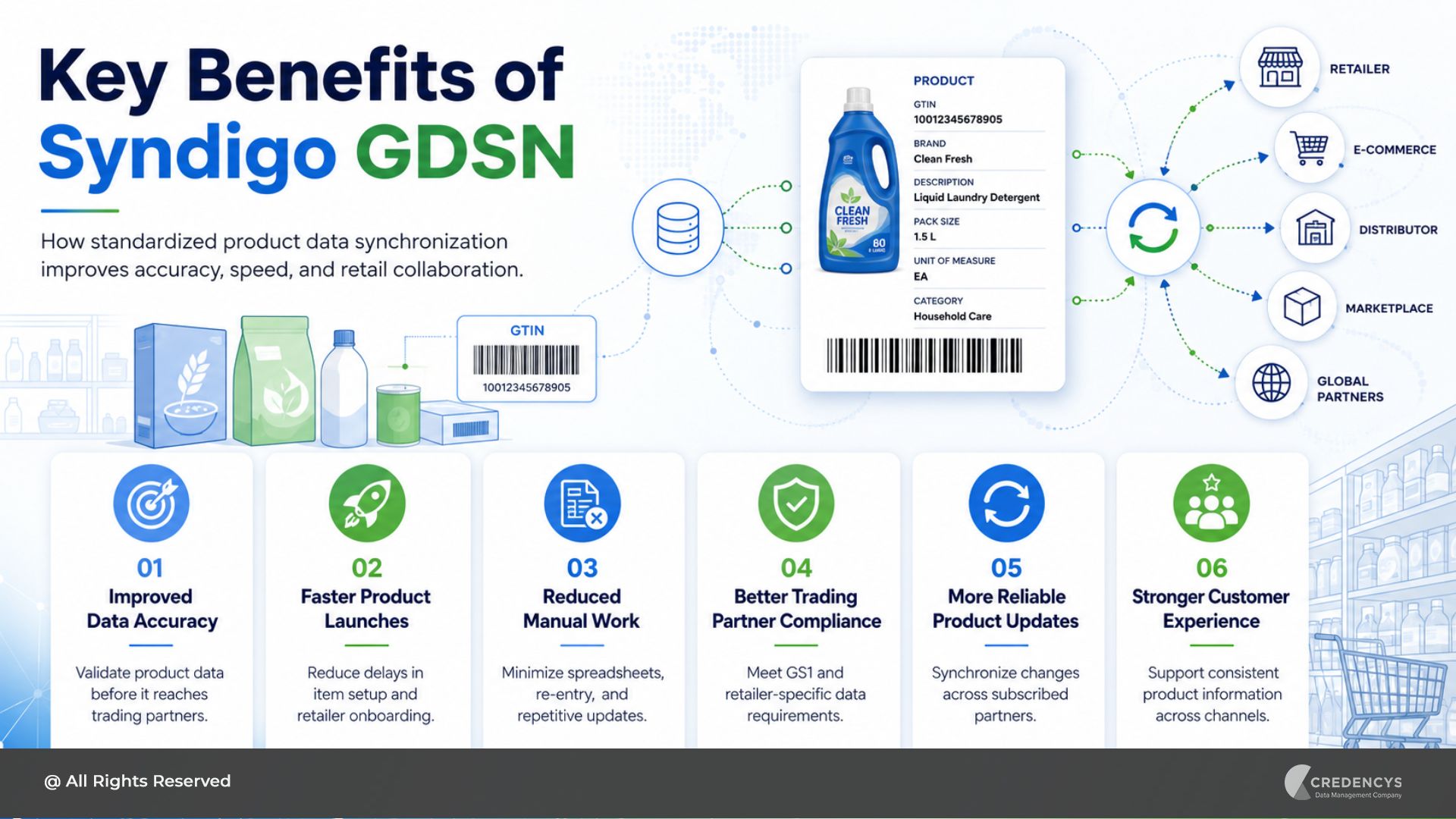
Improved Data Accuracy
Automated validations detect missing, inconsistent, or incorrectly formatted attributes before publication.
Faster Product Launches
Products can move through retailer onboarding with fewer errors, corrections, and manual exchanges.
Reduced Manual Work
Teams spend less time entering the same information into retailer portals, spreadsheets, and disconnected templates.
Better Trading Partner Compliance
Product information can be validated against both GS1 standards and individual recipient requirements.
More Reliable Product Updates
Changes can be distributed to subscribed trading partners through a synchronized process.
Improved Customer Experience
Retailers can provide more consistent product information across stores, websites, apps, catalogs, and digital shelves.
Stronger Data Governance
Validation, reporting, ownership, and structured workflows help organizations maintain product information over time.
GS1 US emphasizes that accurate product data depends on governance, clearly assigned data ownership, training, and recurring physical audits—not technology alone.
Common Syndigo GDSN Implementation Challenges
Connecting to a certified data pool does not automatically solve every product data problem.
Businesses should prepare for several common challenges.
Incomplete Source Data
A GDSN implementation cannot publish information that does not exist or cannot be trusted internally.
Brands may need to correct gaps in dimensions, packaging hierarchies, nutritional attributes, or product identifiers before onboarding.
Unclear Data Ownership
Product data may be maintained by marketing, packaging, logistics, regulatory, sales, and IT teams.
Without clearly assigned ownership, changes may be delayed or published inconsistently.
Incorrect GTIN Hierarchies
Consumer units, inner packs, cases, and pallets may require separate GTINs and clearly defined relationships.
Incorrect hierarchy data can affect ordering, warehousing, receiving, and retailer setup.
Recipient-Specific Requirements
GS1 standards provide the common foundation, but every retailer or distributor may request additional attributes or apply different business rules.
A successful implementation must account for both global standards and recipient-level requirements.
Lack of Integration
Manual uploads may be manageable for a small catalog but become difficult as product volume and update frequency increase.
Integrating PIM, ERP, MDM, packaging, and other source systems with Syndigo can reduce re-entry and support scalable publication.
How to Prepare for a Syndigo GDSN Implementation
Organizations can improve implementation outcomes by following a structured approach.
1. Identify Trading Partners
List the retailers, distributors, marketplaces, and other recipients that require GDSN data.
Document their categories, markets, onboarding processes, and required attributes.
2. Assess Product Data Readiness
Review the completeness and accuracy of:
- GTINs and GLNs
- Product descriptions
- Packaging hierarchies
- Dimensions and weights
- Nutrition and allergen data
- Logistics attributes
- Lifecycle statuses
- Regulatory information
3. Define Data Ownership
Assign accountable owners for each major data domain, including packaging, logistics, nutrition, regulatory data, marketing content, and digital assets.
4. Map Source Systems
Determine which systems own each attribute and how information will move into Syndigo.
Avoid maintaining the same attribute manually in multiple systems whenever possible.
5. Configure Validation Rules
Apply GS1 rules, industry requirements, and recipient-specific validations.
Errors should be identified before publication rather than after rejection.
6. Start with a Controlled Product Set
Pilot the process using a representative group of products and trading partners.
Include different packaging levels, categories, and attribute requirements to expose potential mapping and governance issues.
7. Establish Change Management
Define how new products, reformulations, packaging changes, discontinuations, and GTIN changes will be approved and synchronized.
8. Monitor Publication Results
Track:
- Validation errors
- Publication status
- Recipient confirmations
- Rejected attributes
- Data completeness
- Time required for item setup
- Manual interventions
These measurements help teams identify where source data, workflows, or integrations need improvement.
Is Syndigo GDSN Only for Large Enterprises?
GDSN is widely used by large manufacturers and retailers, but its value is not limited to enterprise businesses.
Growing brands may also benefit when they:
- Sell through several national or regional retailers
- Need to meet retailer GDSN requirements
- Manage complex packaging hierarchies
- Sell regulated food or consumer products
- Frequently introduce new products
- Plan to expand into new markets
- Spend significant time updating retailer portals
- Experience repeated item setup errors
The business case depends less on company size and more on product complexity, trading partner requirements, publication volume, and the cost of maintaining manual processes.
Final Thoughts
Product data is no longer used only to print a label or create a retailer item record. It supports ordering, warehousing, transportation, compliance, e-commerce, digital shelves, menu planning, consumer safety, and customer experience.
For CPG brands, grocery businesses, and retailers, inconsistent information can delay product launches, disrupt supply chain processes, and reduce customer trust.
Syndigo GDSN provides a standards-based way to validate and synchronize product information across trading partners. By combining GS1-certified data exchange with recipient-specific validation, integrations, workflows, and broader product syndication capabilities, Syndigo helps organizations move away from fragmented product data processes.
However, the platform delivers the greatest value when it is supported by accurate source information, clearly assigned data ownership, reliable product identifiers, system integration, and ongoing governance.
For businesses managing complex product portfolios and growing trading partner networks, Syndigo GDSN can become an essential foundation for accurate, scalable, and connected product data exchange.
Frequently Asked Questions About Syndigo GDSN
1. What is Syndigo GDSN?
Syndigo GDSN is a GS1-certified data pool solution that allows brands, manufacturers, distributors, and retailers to exchange standardized product master data through the Global Data Synchronization Network.
2. Is Syndigo a GDSN data pool?
Yes. Syndigo provides a GS1-certified data pool through which companies can publish or receive standardized product information.
3. What type of information is shared through GDSN?
GDSN can support product identifiers, descriptions, packaging hierarchies, dimensions, weights, nutritional details, allergens, storage information, logistics data, lifecycle statuses, and other standardized attributes.
4. Does GDSN replace a PIM system?
No. A PIM manages and enriches product information internally, while GDSN provides a standardized network for exchanging selected product master data with trading partners. The two systems can work together.
5. Who uses Syndigo GDSN?
Syndigo GDSN can be used by CPG manufacturers, food and beverage companies, grocery retailers, distributors, foodservice organizations, general merchandise retailers, healthcare companies, and other businesses that exchange standardized product data.
6. How does Syndigo GDSN help retailers?
It helps retailers receive standardized supplier data, validate attributes, improve supplier onboarding, reduce manual corrections, and distribute accurate information to e-commerce, ERP, merchandising, and other internal systems.
7. How does Syndigo GDSN help CPG brands?
It helps CPG brands validate product data, meet retailer requirements, publish updates to multiple trading partners, reduce item setup errors, and support faster product launches.
8. Can GDSN distribute images and marketing content?
GDSN can support certain product information and content references, but many retailers also require channel-specific descriptions, feature bullets, digital assets, rich media, and enhanced content. These requirements are typically managed through broader product content syndication capabilities.




Tags: