

The Scale and Complexity of Commerce Product Data
Commerce businesses manage product information across suppliers, brands, ERP, commerce platforms, marketplaces, digital assets, regions, and customer channels. As catalogs, variants, markets, and selling destinations grow, fragmented data and manual product processes make it increasingly difficult to keep every product complete, accurate, discoverable, and ready to sell.
Fragmented Product Data Across Systems
Product information may be distributed across ERP, supplier files, spreadsheets, DAM, PLM, commerce platforms, marketplaces, and legacy applications, creating multiple versions of the same product record.
Growing SKU and Variant Complexity
Products may contain hundreds of combinations across size, color, material, configuration, pack size, model, or other options, making product relationships and attribute management increasingly difficult.
Incomplete Product Information
Missing specifications, identifiers, images, descriptions, categories, variant attributes, and other information can delay publication and weaken product discovery across commerce channels.
Different Channel Requirements
Webstores, marketplaces, search engines, B2B portals, retailers, and social-commerce channels may require different product attributes, categories, titles, image standards, identifiers, and content formats.
Slow Product Enrichment and Publishing
Manual data entry, spreadsheet-based enrichment, repeated channel formatting, disconnected approvals, and last-minute corrections increase the time required to make products commerce-ready.

How Much is Your Product Data Costing You?
Get Your Score + 90-day action plan in 3 minutes.
Check Your ScoreThe Strategic Role of PIM in Commerce
PIM gives commerce businesses a governed foundation for collecting, enriching, validating, and distributing product information before it reaches customer-facing channels. It helps reduce product-data bottlenecks, improve product discovery, accelerate launches, simplify channel expansion, and ensure every commerce experience is powered by accurate and complete product information.
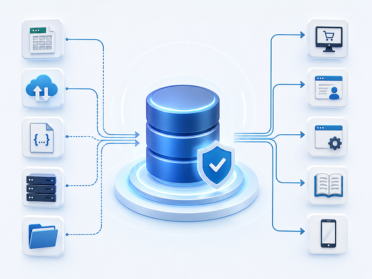
The Single Source of Truth
PIM creates one governed foundation for product titles, descriptions, specifications, identifiers, variants, categories, relationships, digital assets, and channel-specific content. It enables product, merchandising, marketing, eCommerce, marketplace, and data teams to work with consistent information.
- Consolidate product information from ERP, suppliers, spreadsheets, DAM, PLM, and legacy systems
- Reduce duplicate and conflicting product records
- Maintain governed product information across brands, markets, and commerce channels

Commerce-Ready Product Enrichment
Products need more than basic SKU information before they can perform effectively in digital commerce. PIM structures the enrichment process so required descriptions, specifications, attributes, identifiers, images, and merchandising content are complete before products reach the storefront.
- Define category-specific product-data requirements
- Enrich descriptions, specifications, attributes, and digital content
- Track completeness and commerce readiness before publication

Product Taxonomy and Variant Management
Search, navigation, filters, product comparisons, and recommendations depend on well-structured categories and attributes. PIM creates consistent product models and relationships across complex catalogs.
- Build scalable categories, taxonomies, and attribute structures
- Manage parent-child products and variant relationships
- Standardize attribute values, terminology, and units
- Connect accessories, bundles, replacements, and related products

Marketplace and Channel Syndication
Every commerce destination may expect product information in a different structure. PIM allows approved core product data to be transformed and distributed according to channel-specific requirements without maintaining separate master records for every destination.
- Publish product information to eCommerce platforms and B2B portals
- Prepare marketplace- and retailer-specific product feeds
- Map attributes to channel-specific schemas and taxonomies
- Validate required information before syndication

Intelligent Commerce and AI Readiness
Modern search, recommendations, personalization, conversational commerce, and AI shopping experiences depend on structured, machine-readable product information. PIM provides the trusted product context these applications need.
- Improve search, filtering, comparison, and product recommendations
- Support semantic and natural-language product discovery
- Enable structured data for AI-driven merchandising
- Prepare product information for shopping assistants and commerce agents
Our Approach to PIM Implementation Services
Our PIM implementation services establish the product models, enrichment workflows, taxonomy, integrations, and channel structures needed to support scalable digital commerce.
01
Assessment and Planning
Analyze your product portfolio, data sources, commerce platforms, marketplaces, taxonomies, enrichment processes, workflows, integrations, and business goals to define a clear PIM implementation roadmap.
02
Customization and Configuration
Design product models, categories, attributes, variants, relationships, channel requirements, validation rules, workflows, user roles, and integrations around your commerce ecosystem.
03
Enrichment and Governance
Cleanse and migrate product information, standardize attributes and classifications, establish ownership, connect digital assets, and configure enrichment, completeness, review, and approval workflows.
04
Deployment and Training
Connect PIM with commerce platforms and downstream channels, launch priority catalogs and markets, train internal teams, monitor adoption, and provide ongoing post-deployment support.
Business Impact of PIM for Commerce
PIM transforms fragmented product information into a governed commerce asset. It reduces manual product-data work, accelerates launches, improves product discovery, strengthens marketplace readiness, and enables businesses to scale catalogs and channels without increasing product-data complexity.



Real Business Impact: PIM Success Stories in Commerce
Leading Automotive Aftermarket Retailer
50%
Improvement in Data Compliance
Credencys implemented a centralized PIM solution to unify fragmented product information, automate ACES and PIES validation, standardize taxonomy, and streamline product-data syndication to distributors and trading partners.
Read MoreLuxury Watches & Jewelry Retailer
45%
Increase in Data Accuracy
Credencys implemented an integrated PIM, DAM, MDM, and CMS solution to centralize complex luxury product information, manage digital assets, strengthen eCommerce operations, and enable real-time product-data syndication across channels.
Read MoreReady to Build a Stronger Commerce Data Foundation?
Build commerce experiences on trusted product data that improves product discovery, accelerates launches, simplifies marketplace syndication, and prepares your business for scalable digital and AI growth.
Book a Free ConsultationWhy Leading Enterprises Choose Credencys?
Credencys helps enterprises turn complex data into trusted insights, intelligent operations, and measurable business growth. Here’s what makes us a preferred data and AI partner:

End-to-End Data Expertise
From data strategy to AI deployment, we cover the entire spectrum—Data Management, Engineering, Insights, and Intelligence—to ensure your data drives measurable business outcomes.

Domain-Focused Solutions
Whether you're in retail, automotive, or manufacturing, our purpose-built platforms solve industry-specific challenges with precision and speed.

Enterprise-Grade Partnerships
We collaborate with the best in the business to deliver future-ready, scalable, and secure solutions.

AI-First
We help you move beyond dashboards—accelerating AI readiness, deploying GenAI and enterprise AI agents, and enabling intelligent automation across your data ecosystem.
50+
Enterprise Clients
100%
Certified Consultants
15+
Years Experience
4.9/5
Client Satisfaction
We Build PIM Solutions for


Frequently Asked Questions
PIM for Commerce is a centralized approach to collecting, structuring, enriching, governing, and distributing the product information required across eCommerce, marketplaces, B2B portals, retailer channels, and other digital selling experiences. It helps businesses manage product descriptions, attributes, specifications, identifiers, variants, categories, images, product relationships, localization, and channel-specific content from one governed product-data foundation.
As commerce operations grow, product information often becomes distributed across ERP, supplier files, spreadsheets, DAM, commerce platforms, marketplaces, and other systems. Teams then spend increasing amounts of time copying, correcting, enriching, validating, and reformatting the same product information.
Commerce platforms can manage the product records required by the storefront and may be sufficient for businesses with relatively simple data requirements. A dedicated PIM becomes more useful when product information comes from multiple upstream systems, catalogs contain large attribute models, multiple teams participate in enrichment and approval, or products need to be distributed to many external channels with different requirements.
PIM manages and governs enriched commercial product information. An eCommerce platform manages the digital shopping and transaction experience, including storefronts, carts, checkout, promotions, accounts, and other commerce capabilities.
PIM can consume and distribute pricing or availability information when required by a commerce experience, but it should not necessarily become the authoritative source for those rapidly changing operational values. Pricing may be mastered in ERP, pricing, or commerce systems, while inventory and availability may come from ERP, OMS, WMS, or inventory services.
Trusted by Best
Choosing Credencys means partnering with a team that’s deeply committed to unlocking the true value of your data. Here’s why industry leaders trust us:
Our Valued Clientele


Send us a Message
