Product Data And its Benefits – Briefly Explained!

The most important factor of the product life-cycle is product data. Have you ever faced a situation when you are pressurized to launch a new product but can’t do so because of a lack of proper product data? If yes, then no one would understand the benefit of product data more than you.

You need product data at every stage, for the growth of your business and to sustain in cut-throat competition; you should have consistent data on which you can rely. For incremental sales and to add lifetime value to customers, you need product data.

What is Product Data?

Definition of product data is like trying to explain the taste of water; everyone has a different one. There is no precise way in which you can describe the product data. In simpler terms, we can say that Product data is the information of a product that is put forward in a structured way and a usable format.

The information can be of anything; the date of creation of a product, its feedback/reviews, the similar products, the manufacturer of the product, the supplier of the product, and every small detail of the product that may attract customers to buy the product from you.

What is Product Data Management (PDM)?

Product Data Management is also popular as Product Information Management (PIM). It is the technique that is used to store product data and all product process-related information in one central system. The information of the product may include product parts information, manufacturing instructions of the product, product requirements, and any additional notes related to the product.

To meet the business-specific need, PDM is such a single central platform that is accessible to all the departments of business organizations. PDM can integrate with other applications within an organization. It is a central platform so it reduces the risk of data loss and is a strong tool for secure data management.

For your multiple business data, you might be constantly kept on worrying about secure data management, configuration management, and product process enablement. The PDM is an all-in-one solution for your all worries. The central platform secures product data in a structured way so that it could be easily accessible to users.

What’s included in the product data?

As earlier stated, product data is so vast and PDM covers the ocean of product in itself. The common attributes of product data are;

1. Title and Image

Without an accurate title, how would you distinguish your products? The accurate title for the product and image is included in product data. The image of the product is the first impression of the product on customers, so the clear visible image of the product is also stored in the product data. A product with a unique image needs a unique title to catch the attention of customers, so a title according to the image is counted in product data.

2. Category of Product

Product data includes product categories so that PDM can create a product catalog based on similar products. When you have divided products into a particular category then the formation of catalogs becomes much easier. You must need product categories when you need to deal with multiple suppliers or manufacturers.

3. Type of Product

Product data includes the type of product so that the consumers can filter out the products based on their preferences. You need accurate product types to divide the products into groups. When groups are made; consumers can simply go into the specific group of products to find their relevant products. The comfort of the customer is your duty and it will eventually help you.

4. Product Description

The type of product, the category of product, the title, and the image of products all are useless unless you have a specific product description. Product information includes product specifications. The specification includes every small detail related to the product that customers may require at the time of their purchase decision. To get ultimate profit, provide the ultimate product description.

Why Product Data is Important?

The importance of the effective management of product data is often underestimated by business owners and retailers. As a result, many businesses underperform due to incorrect or improper product data.

Here are the two important ones that tell you why product data is important.

Better Customer Experience

The ultimate goal of any business is to earn more and more profit. Now, let’s face it the milestone of maximum profit is only possible with a ladder of customers. You must give a better experience to your customers otherwise they are going to jump over other business platforms. The customer’s liberty will lead you to loss.

For a better customer experience, you must need product data. The accurate product data will attract customers to make a purchase decision from your business. There will be minimal or no product returns. You can save much time and effort with product data. The loyal customers will be loyal and product data will convert potential customers into loyal customers.

Data Optimization

You need multiple resources to gather your data and to store it on various platforms. What if you are not able to access the product data when needed? That would create a challenge, you never want to face. With accurate product data stored in one single platform, you can optimize your product data.

The Benefits of Managing Your Product Data Effectively

In the present era, particularly, it’s the data that seems to be the most important resource for any organization. It refers to the collection, storage, protection, and proper organizing of data. It’d be a hassle to lose any important data or if it takes longer than usual to collect and manage them in a proper way. Above all, with the significant proliferation in their amount, there shall be no reduction in the growth rate as well.

1. Improves Customer Experience

It’s all about the reputation of the brand. And this can only be improved with the betterment of customer experience which, in turn, requires a closer look at the customers’ preferences. It’d be bad if a customer gets to know that their size is unavailable. The demands for several products vary from one store to the other. The proper information regarding the same would help to meet everyone’s needs.

2. Cost-Efficient Business

Data Management can help you avoid the time spent on the previously done works. This can be made possible by the proper data storage and ensuring that none of the members have to conduct research and analyze the same work again. This, in turn, makes any business more cost-efficient. Plus, it also ensures accuracy in the product data and keeping them, all updated with time.

3. Reduces Security Risks

There’s a vast history where several companies have fallen prey to major attacks just because of the lack of strong data management. So, it’s important to manage the data properly so that there’s no leakage of necessary information of any of the users.

4. Reduces Data Loss

Data loss is one of the major concerns for any organization. The need for a proper data management plan that is easy to assimilate by each employee is the need of the hour. Moreover, certain measures can be taken to back up the credentials at a place and retrieve them for future use, even if the main source is facing any issue.

5. Improved Collaboration

The absence of data management would be more of a blunder in the work environment. Especially, it becomes a misery to connect with the internal departments as well as external sources. When the authority for managing data is in the hands of various administrators, it’s eventually going to hamper the development of any organization. The worst of all happens when each employee sees the other as a hindrance. However, with product data management, it’s easy to work towards one objective at a time.

To inculcate maximum productivity, data management is a necessity as it makes it easy to perceive the information and avoid additional costs as well. There’s no specific time to examine the data management in your company. It is something that needs immediate consideration or else, it can either lead to data loss or leakage of information. Plus, the related repercussions are going to be more expensive. So, it’s better to take quick action to prevent destruction in the foreseeable future.

Top 8 PDM Software 2021 – Review

1. PDXpert PLM Software

The software is simple to use, flexible and it improves the accessibility of product data. It has multi-user access and will keep you free from searching texts. The software also increases the workflow of the organization. The features of the software assist you in product identification till the product designs.

The charges of the software start from 17 USD per user per month. It has a free trial version. The software is the best suit for simple product lifecycle management companies.

2. Sales Layer

For coping up with the market trends, this software is the best solution. It has agile solutions for the implementation of market trends. It resolves the complexity of mixed product data and provides simpler product data that is easy to interpret.

With this software, you can easily provide product information to your manufacturers, retailers, and distributors. This software is a must need, for those businesses that have large product data.

3. SolidWorks Enterprise PDM

This is cloud-based software built for businesses to manage product data, product design, and product progress. With this software, the sharing of product information is easier than ever before. The software monitors progress and makes automated workflows.

This software offers a free trial version and is the best fit for all sizes of businesses that seek automated workflow. This software can also track the tasks and manage the timeline.

4. Plytix

You can have your product data to a whole another level with this software. The software has unlimited users, who can collaborate to manage images and visuals of products. Your product data and media are in safer hands with this software. You can set and define your roles with access to permission.

For providing a high-quality experience to your customers, you must need this software. Per feature, the pricing of this software starts from 300 USD.

5. Salsify

This powerful software will give you accessibility to manage product data while integrating with existing systems. You can consolidate, and manage product data easily with this software. Publishing accurate product data is easier with this software. For driving more sales, you need this software.

This software is best for wholesalers, manufacturers, and leading brands who have to manage multiple product information across multi-channels.

6. Productsup

It is an award-winning software for data integration, data distribution, and data optimization. This software helps brands and retailers to enrich product information. Those enterprises who seek to improve their product content and product feed should not wait for long and must implement this software.

This cloud-based software has impacted many brands and businesses. The software is cloud-based so that you can have product information across the globe.

7. aPriori

You can have higher product information and higher value of the product with this software. The software automatically generates designs for manufacturers so that they can easily carry out their further task of product creation. This software collaborates with other software in the product development process.

You can make the faster decision of products with this software’s product data. With this software, you can have better designs of products and can source the product information easily.

8. Channable

It is product feed management software for online agencies. It has an all-in-one feature of product optimization, product listing, and can generate dynamic text ads. Product listing and order connection are also possible with this software. With this software, you can take international expertise from anywhere.

The pricing starts at 39 USD per feature per month. This software is the best fit for online agencies. The software provides knowledge support to its users.

Concluding with

To optimize data, to give better customer experience, to sustain in cut-throat competition, and to generate the ultimate goal of- maximum profit; you need high-quality product data. Every software for managing product data is as unique as the product data itself. No matter which software you choose, you will never run out of high-quality structured data.

Digital Experience Platform – An Ultimate Guide

It’s not easy to impress, engage and retain modern customers by beating the cut-throat competition. Every business is trying extremely hard to win customers’ trust by adopting new approaches and the latest technologies. The Digital Experience Platform guide helps organizations gain a competitive edge and increase customer engagement by enabling them with highly contextualized digital experiences.

Today, tech-savvy customers do not make buying decisions just like that. They conduct thorough research and then buy the product that meets their specific expectations.

Implementation of a Digital Experience Platform (DXP) helps you drive customer engagement in many ways.

DXP allows brands to stay relevant to customers’ needs by creating, optimizing, and delivering personalized experiences. It also facilitates organizations to deliver consistent and consolidated digital experiences across multiple touchpoints.

In this post, I have covered almost all the aspects related to Digital Experience Platform Development. I assure you this blog enables you with exclusive insights into Digital Experience Platform Development that help you understand the essence of DXP for your business.

Table of Content

  • What is Digital Experience?
  • What is a Digital Experience Platform (DXP)?
  • Evolution of Digital Experience Platforms: Shift from CMS to WEM to DXP
  • Artificial Intelligence (AI) and Machine Learning (ML) capabilities
  • Types of Digital Experience Platform (DXP)
  • Most Important Features of Digital Experience Platform
  • Core Components of A Modern DXP
  • What are the Key Characteristics of a Digital Experience Platform
  • Benefits of Digital Experience Platform
  • How to boost customer acquisition and retention through the Digital Experience Platform?
  • How does a Digital Experience Platform work with AI?
  • How Digital Experience Platform helps you meet the expectations of today’s customers?
  • Do I need a Digital Experience Platform?
  • When do I need to implement a Digital Experience Platform?
  • How Much Does a Digital Experience Platform Cost?
  • Popular Digital Experience Platform Trends to watch out for 2021
  • How to Choose a Digital Experience Platform
  • Questions to prepare before choosing a DXP
  • Top 5 Digital Experience Platforms that you should consider for your business
  • How to get started with Digital Experience Platform Strategy?
  • How is Pimcore’s Digital Experience Platform the right choice for you?

So, shall we get started?

Let’s begin with the Digital Experience Platform definition.

What is Digital Experience?

Let’s understand a digital experience from the very basic level through the Digital Experience Platform guide.

A digital experience refers to integrations that your target audience has with your bra through different online platforms. They receive the online experiences by browsing your website, posting on social media, sighing up for a newsletter, reading blog posts, checking out your online catalogs, brochures, flyers, and more.

By designing exclusive online experiences, companies can keep the customer engaged with the brand. It enables the customers with an amicable buyer journey that involves an easy-to-use platform with intuitive navigation and a clear call to action that encourages customers to make instant purchase decisions.

To deliver enriched digital experiences to shoppers, companies need to go the extra mile. It’s not enough to have an online presence just through a website. It is highly required to manage and optimize digital presence to stay ahead of the competition. This is where organizations need a robust Digital Experience Platform (DXP).

Below are a few examples that facilitate you with the different ways of creating superb digital experiences.

  • Host a virtual event or webinar
  • Plan an email marketing campaign
  • Develop a mobile app to support varied phases of the customer journey
  • Design an interactive infographic
  • Integrating a chatbot in your website and mobile app
  • Offering discounts for signing up for your newsletters
  • Increasing in retargeting ads
  • Creating a poll or quiz on your website or mobile app
  • Creating microsite for product launch
  • Creating eBook and whitepaper

Digital experiences are also known as digital customer experiences that encompass all the online interactions a customer has with your brand through varied devices and digital channels.

Devices involve:

  • Computer
  • Mobile
  • Tablet
  • Laptop, and more

Channels consist of:

  • Email
  • Website
  • In-store kiosk
  • Online adverting
  • Social media
  • Your branded website and any affiliated websites
  • Online reviews

The digital experience empowers the customer journey starting from discovery to evaluation through purchase and on to post-purchase advocacy and support. Every output channel at every phase of the customer journey is a part of the digital experience.

I guess we have enough understanding of digital experience.

Now, it’s time to go ahead with the main topic of the Digital Experience Platform guide.

Yes, you get it right. Let’s start exploring the Digital Experience Platform and its robust capabilities and hidden potential that drive immense success and growth for an organization.

What is a Digital Experience Platform (DXP)?

The simple definition of a Digital Experience Platform is it’s a highly advanced Content Management System (CMS) that allows organizations to track customers’ activities, locations, and interactions throughout the entire buying journey.

With the help of DXP, companies deliver targeted content to the intended buyers along with extremely personalized and compelling customer experiences based on the customer profile, across a broad range of digital touchpoints.

Here is a definition from Gartner that consists of a technical point of view for DXP.

Gartner defines, “A digital experience platform (DXP) is an integrated set of technologies, based on a common platform, that provides a broad range of audiences with consistent, secure and personalized access to information and applications across many digital touchpoints.”

DXP allows brands to develop and deploy websites, mobile apps, portals, and other digital platforms and continually improve them to create better experiences.

Moreover, the Digital Experience Platform manages the presentation layers based on preferences, security privileges, and the role of each individual. It enables you with the facilities of content management, personalization, workflow, collaboration, multichannel support, aggregation, integration, mobile support, search and navigation, and more features.

To learn about DXP in detail, you can visit What is Digital Experience Platform – A Brief on How can PIMCORE’s CaaS deliver Outstanding DXP?

Evolution of Digital Experience Platforms: Shift from CMS to WEM to DXP

Before two decades, companies struggled to inform customers about their products and services. Later on, Content Management Systems (CMS) are invented to help brands in selling and promoting their wide variety of products or services. The CMS has allowed companies to create and publish content related to their offerings on their websites.

After that, Web Experience Management (WEM) came into existence. It allows organizations to deliver content to eCommerce and marketing channels. It also involves analytic capabilities to understand customer behavior and serve their needs in a better way.

In today’s competitive world, delivering content across your different customer touchpoints such as websites, mobile apps, emails, social media, Augmented Reality and Virtual Reality devices, customer portals, digital signage, POS systems, etc. is not enough. To improve customer engagement, you need to connect your content with the experience.

Customers use multiple devices during their buying process. Therefore, along with content, make sure you deliver a connected, consistent, and continuous experience to buyers that helps them to make the right buying decisions.

To enable the customers with a compelling experience across all the channels, companies have started adopting the Digital Experience Platform.

Let’s have a profound understanding of each CMS, WEM, and DXP one by one.

Content Management System (CMS)

CMS

The term itself indicates Content Management System allows companies to manage content on desktop computers and mobile apps. It allows companies to create, manage, and track content, images, videos, data, and other collaterals required for online presence. Thus, it helps companies to maintain consistency of content and voice across their different online domains.

CMS also facilitates you with version control and management as well as authoring workflow to maintain consistency in your large-scale global sites. CMS is also known as Web Content Management (WCM).

If you want to learn about the difference between CMS and DXP, you can visit CMS vs. DXP – How Both are Different From Each Other?

Web Experience Management (WEM)

WEM

With the emergence of new customer touchpoints, Web Experience Management was introduced to manage cross-channel functionality for data and content. It allows the different business units of the company to share information digitally.

WEM introduced role-based personalization. It enables you with greater insights into customer behavior by collecting the data. It defines the consumer persona and allows for creating and delivering the content more consistently across all online and offline channels to the target audience.

Through the Web Experience Management system, you can share content, logic, data, and other components across varied channels consistently.

These systems allow companies to automatically create personalized, tailored, and cross-channel communication for each customer.

Digital Experience Platform (DXP)
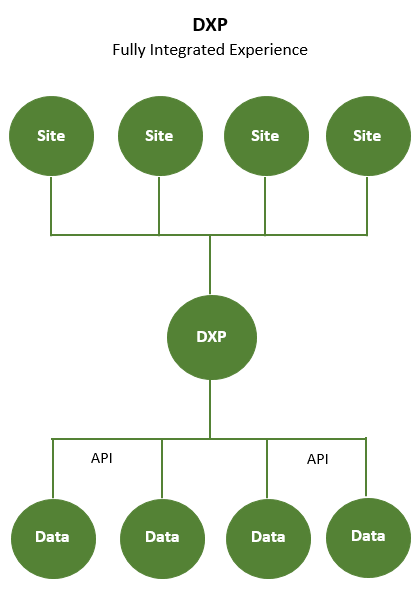
DXP

Nowadays, it is quite impossible to gain customer attention through Content Management Systems and Web Experience Management due to the highly dynamic requirements of the buyers.

Digital Experience Platform allows you to create fully integrated multi-channel marketing experiences. Businesses can deliver the content to different touchpoints including in-store, online, eCommerce systems, kiosks, customer portals, billboards, and more.

Compelling digital experiences are no longer just a way to drive customer engagement. However, it is quite essential to earn customer loyalty and satisfaction in the post-acquisition phase.

With the increasing usage of backend applications, the digital journey has expanded. These backend applications are necessary for your different teams to manage their operations seamlessly and effectively. Companies need to integrate these backend systems to enable customers with a consistent experience from acquisition to consultation.

Gone are the days when digital platforms are required and used by the marketing team. Now, different teams of the company need to use digital solutions to improve their productivity, streamline business operations, and generate better revenue.

Implementation of the Digital Experience Platform allows you to create and deliver a connected and consistent digital experience to your consumer-facing and internal digital solution.

Artificial Intelligence (AI) and Machine Learning (ML) capabilities

All the modem DXP come with integrated AI and ML capabilities. It processes and analyzes customers’ browsing, search, and buying histories along with their demographics, interactions, and locations. It becomes easier for companies to predict which product the customer is interested in.

DXP also helps them to design the personalization strategy accordingly. You can deliver relevant content and opportunities to the target audience while they are about to make a buying decision.

Therefore, DXP is a level-up solution than a CMS or WEM. It helps the brands to deliver digital experiences across all the intended customer touchpoints and on any device.

5 Types of Digital Experience Platform (DXP)

There are different types of Digital Experience Platforms available in the market. And, all the DXPs are not alike. The modern DXP evolved from different types of systems based on a business’s specific use cases over a period of time.

In this Digital Experience Platform Guide, we are going to discuss five basic types of Digital Experience Platforms

Types of Digital Experience Platform (DXP)

1. Open DXPs

Open DXP is a platform that works as a connecting bridge of digital experiences by integrating different products from multiple vendors or partners together. It helps the vendors to access all the essential data from a single platform and perform the required actions from Open DXP.

If you are an organization that already has a strong online presence and own varied digital experience products, you can get maximum benefits from Open DXP.

2. Closed DXPs

A Closed DXP is a one-stop solution that contains all the important components of DXP. The major differences that define Closed DXP are, that all the components are maintained by a single vendor as well as it offers limited integrations with other applications and solutions.
Every business has some specific objectives that they want to attain through DXP implementation. Based on the organizational goals, entrepreneurs need to choose from Open DXP and Closed DXP.

For example, a company can go with Closed DXP if they do not want to invest in multiple vendors. They can buy the DXP from a single vendor that contains all the essential components. As it allows for limited integrations, you might face difficulties in managing customer experiences effectively.

While selecting the Open DXP, companies can integrate any number of systems with the platform. However, they need to connect with multiple vendors to get access to all the essential components of Open DXP. It ensures delivering excellent experiences but that is after connecting all the experience toolsets seamlessly. Open DXP drives more flexibility to a company’s future.

Make a wise choice after analyzing all different aspects of Open DXP and Closed DXP and evaluate their potential in the context of your business needs.

Based on the company’s precise use cases, DXP has divided itself into three further categories.

3. CMS DXPs

Marketing advertising agencies and creative firms are involved in B2C initiatives. To perform these activities, they need a solution that has more advanced capabilities than basic CMS.

These systems allow you to collect the customer data that is used for customer segmentation later on. CMS DXPs help companies to solve the issues related to customer acquisition.

Challenges addressed by CMS DXPs

  • Targeting offers
  • Generating interest and awareness
  • Improving purchases

CSM DXPs are highly used in B2C businesses such as retail, fashion, etc. where the sales cycle tends to be transactional and short and target audiences are larger in volume.

The popular CMS DXPs facilitate business with a wide range of features.

Important features of CMS DXPs

  • Web-based analytics
  • User segmentation
  • Email campaigns
  • Advertising campaigns

With the help of features like analytics and persona-based segmentation, you can meet your pre-purchase consumer-facing endeavors such as demand generation, delivering personalized promotions, customer acquisition, and accelerating sales funnels easily.

Some of the CMS DXPs contain commerce capabilities, while others offer portal-like features such as logged-in experiences. All these features and capabilities eventually empower your partnership and customer acquisition strategy.

4. Portal DXPs

Portal DXPs are primarily designed for B2C and B2B firms in the manufacturing and fintech domains to manage post-sales CRM and customer support activities. The main objective of these companies was to earn customer retention, loyalty, and renewal.

This type of Digital Experience Platform also supports digital workplace scenarios where you can consider traditional intranets. Well, digital workplace solutions are more dynamic and engaging than the intranet. Portal DXP can work in sync with any of your workplace solutions effortlessly.

You have the flexibility to integrate these portals with any of your existing enterprise systems and any third-party applications or software. Moreover, it allows you to integrate your corporate intranet portals to provide support to suppliers and partners.

Portal DXP enables you with a full digital transformation strategy that allows you to leverage the maximum potential of your internal and external resources. Through all these, Portal Digital Experience Platform Development helps you create and deliver strong customer experiences.

Important features of Portal DXP

  • Workflow automation
  • Mobile support
  • Content Management System

According to Forrester, the right Portal DXP contains integration capabilities that are important for the digital transformation of your business. The Portal DXP allows for the management of reusable modules and services when you need to evolve your strategy quickly.

5. Commercial DXPs

Commercial DXPs are highly used by retail businesses to push their promotional content to their eCommerce websites. It is also suitable for online shopping.

Important features of Commerce DXPs

  • Inventory management
  • Shopping cart
  • Fulfillment
  • Check-out
  • Payment integration

While looking for a Digital Experience Platform, it is not compulsory that you will have these features built-in. But, you should pick the one that allows you to integrate these features into your Digital Experience Platform Development.

Generally, DXP is related to the content but they contribute significantly to your online commerce endeavor.

For example; when you launch a product on an eCommerce website, marketplaces, website, and other online platforms, you need to use content management to support the promotion of products in the catalog.

6 Most Important Features of Digital Experience Platform

Implement a Digital Experience Platform that allows you to create a unified and seamless digital experience that helps you manage, deliver and optimize the contextualized and personalized digital experiences to every customer across each touchpoint.

Ensure the platform delivers the GrapcQL-API-based headless content delivery approach. With the headless approach, brands can have a decoupled web content management strategy or go hybrid to avail benefits from the best of both worlds with a modular DXP.

Many Digital Experience Platforms are available out there in the market. They all offer a wide range of features. You need to pick the one with the features you need the most. The platform should allow you to integrate any enterprise systems and third-party applications and develop custom features to meet your specific business needs.

In this Digital Experience Platform guide, you can have a lit of the most essential features that every business that wants to deliver stunning digital experiences should consider.
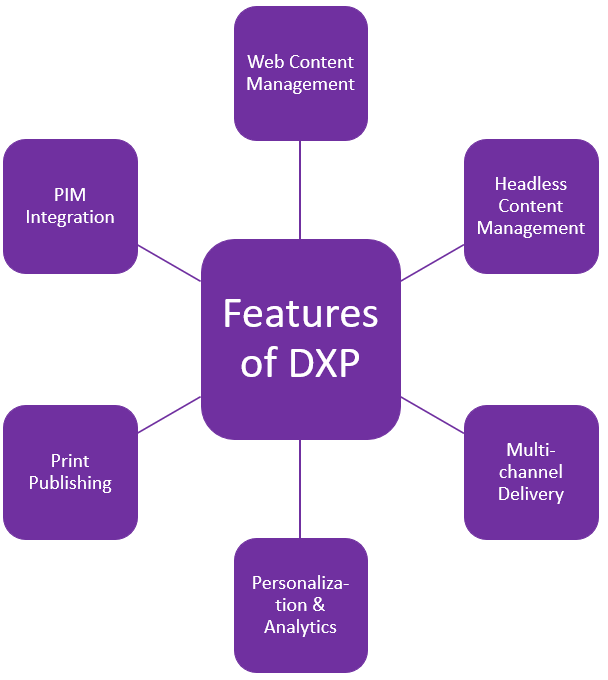
Feautres of Digital Experience Platform

1. Web Content Management

Advanced DXP is capable of managing multiple sites with multi-lingual and mobile-friendly content y providing a web content management system. Unleash the power of content by managing all your content from a single platform using a robust web content management platform. A scalable CMS empowers experience-driven sites and content-rich portals.

DXP with flexible content architecture allows for independent content management, authoring, and API-led delivery of data that enables you to connect content to other apps/sites quickly. To create outstanding digital experiences, it offers powerful omnichannel orchestration.

Track your content everywhere through delivery, standardized authoring, and analytics to fasten the content optimization cycle.
Below are the advanced capabilities of Web Content Management features

  • WYSIWYG & Usability
  • Multi-Lingual
  • Multi-Site Management
  • Personalization
  • Content-Commerce
  • SEO & Marketing Toolbox
  • Mobile Friendly

2. Headless Content Management

An advanced DXP offers headless content management that enables brands to do easier, faster, and more effective content management. Distribute your content across different channels using API-driven headless content management.

The platform works as the content-centric heart of a modern marketing technology stack. It unified data in a single repository that makes content easily accessible to the users and integrates it with your existing IT ecosystem seamlessly. Headless content management offers the smartest way to manage your content. Thus, pick a DXP that comes with built-in headless content management.

Below are the advanced capabilities of Headless Content Management features

  • Content platform
  • Agile workflows
  • Flexible content data models
  • API-based content delivery
  • Unlimited content types, users, workflows & API calls

3. Multi-channel Delivery

Digital Experience Platform offers a multi-channel delivery feature to automate publishing processes across channels and devices for accuracy and consistency. It allows brands to communicate with customers seamlessly.

Below are the advanced capabilities of multichannel delivery features

  • Multichannel publishing
  • Mobile Marketing
  • Print Publishing
  • Marketing Automation
  • Content-as-a-Service
  • Commerce Integration

4. Personalization & Analytics

A Digital Experience Platform builds personalized and compelling digital experiences using analytics to build customer loyalty by delivering a positive brand experience. Drive tremendous customer engagement based on KPIs delivered from business intelligence infrastructure and web analytics.

Below are the advanced capabilities of the personalization feature

  • Behavioral Targeting
  • User Profiling
  • Data Collecting
  • Analytics Integration

5. Print Publishing

Revolutionized your traditional printing processes for creating price sheets, personalized sales and marketing collaterals, and product catalogs. Connect content with the data of Master Data Management (MDM), Product Information Management (PIM), and Digital Asset Management (DAM) frameworks seamlessly using the Digital Experience Platform.

It facilitates organizations with varied business benefits such as brand consistency, time-saving, cost-saving, error reduction, up-to-date publications, and boosted internal productivity.

Below are the advanced capabilities of the print publishing feature

  • Compatible workflow
  • Adobe InDesign Integration

6. PIM Integration

Integrate a hyper-flexible and agile product information management platform that contains functionality with 40+ high-performance data styles. It allows for managing all the product data related centrally. By integrating with DXP, companies can have smart management of product-related information and consumer-centric data that helps improve buyers’ journeys, increase conversion, and boost sales and revenue.

Below are the advanced capabilities of the Product Information Management feature

5 Core Components of A Modern DXP

A Digital Experience Platform contains a plethora of components that make the solution compatible to work with any IT environment and deliver the expected output. Many DXPs are available in the market that is developed by different vendors. Each platform has a certain set of components at its core. So choosing the best fit becomes challenging for you.

Am I right?

Through the Digital Experience Platform guide, you can learn about the most crucial components that one should look for in a DXP. Ensure enormous business success by picking the platform that has the below-listed capabilities at its core.

Core Components of Digital Experience Platform (DXP)

1. Openness

An excellent DXP comes with the ability to connect to 3rd party systems or applications so communication can flow seamlessly between DXP and the systems. The openness of DXP comes in the form of data being able to flow out and in easily.

2. API-first Architecture

An advanced DXP provides a powerful collection of APIs that DXP programmers can connect to their front-end applications. By developing the API-based architecture of DXP, brands can leverage business flexibility and consume modularity, and experience an ability to iterate as consumer behavior and market demand as the user expectations evolve.

3. AI-powered Algorithms

Artificial Intelligence transforms the way business operates. DXP assists the company to share stunning experiences across different touchpoints from doing grunt work that facilitates personalization to exploring hidden insights within data.

4. Strong Data Foundation

To create and deliver scaling personalized digital experiences, DXP is needed. It’s a platform that comes with a profound understanding of products and customers. At the core of the Digital Experience Platform, there must have a strong foundation of data.

5. Advanced Tools and Capabilities

With the help of an advanced Digital Experience Platform, businesses can create personalized and optimized experiences effortlessly. The DXP should contain features like content management, channel management, search management, digital merchandising, testing and targeting, recommendations, insights, and more.

What are the Key Characteristics of a Digital Experience Platform

By considering the specific requirements of the stakeholders, brands should have well-defined priorities and agreements. Based on these requirements, companies should select the right DXP. No matter what DXP you select for your company, flexibility will be the highest priority. Discover other extremely important characteristics of an advanced DXP.

Key Characteristics of a Digital Experience Platform

Content Management System

A Content Management System (CMS) is the base of every Digital Experience platform. Using the powerful CMS capabilities of DXP, companies run websites and perform varied editorial operations effectively.

You might be thinking about why to go for DXP and not for CMS if the foundation of DXP is CMS. Read CMS vs. DXP – How Both are Different From Each Other? to get exclusive insights into the differentiation between both platforms.

Commerce

To create compelling end-to-end shopping experiences for your target audience, you need a robust eCommerce engine that can be integrated with the content. DXP provides you with award-winning solutions that contain both commerce and content capabilities.

With the Digital Experience Platform, companies can manage inventory, orders, pricing, promotions, and so on from a centralized portal.

Analytics

To deliver superb digital experiences, it is essential for the organizer to collect the data from every iteration that happens across every online and offline channel of the brands. It helps them get a clear picture of the expectations, requirements, and challenges of your customers as well as constantly changing market trends.

If you cannot transform this data into actions, then the data is useless for your business. There is no meaning in drowning the data without gaining real insights out of it and taking the right actions at the right time that drives results.

Pick the Digital Experience Platform that comes with analytics capabilities to facilitate you with actionable insights.

Future-proof

As your business grows you need to extend the capabilities of DXP. Thus, it is essential to choose DXP that can be easily extensible. If the platform is not scalable and extensible from the original scopes, it will be difficult for the organizations to support marketing automation, digital asset management, product information management, or other platforms.

Before making a selection ensure the DXP supports different platforms and applications as well as can easily be a part of your existing IT ecosystem.

Cost

There are different ways of evaluating the cost of ownership for the Digital Experience Platform. You can consider multiple options such as licensing, subscription, professional services, and other fees. You can go with the most suitable option that helps you attain organizational benefits. Select a DXP that helps you attain exceptional ROI.

Security & Compliance

This is a default expectation when selecting a Digital Experience Platform. The platform must provide high-level security during every operation. International organizations need to maintain compliance with privacy regulations across the globe to increase the reliability of the company.

Interoperability

Interoperability is a vital part of any digital solution. The Digital Experience Platform should easily be integrated with 3rd party solutions and applications.

7 Benefits of Digital Experience Platform
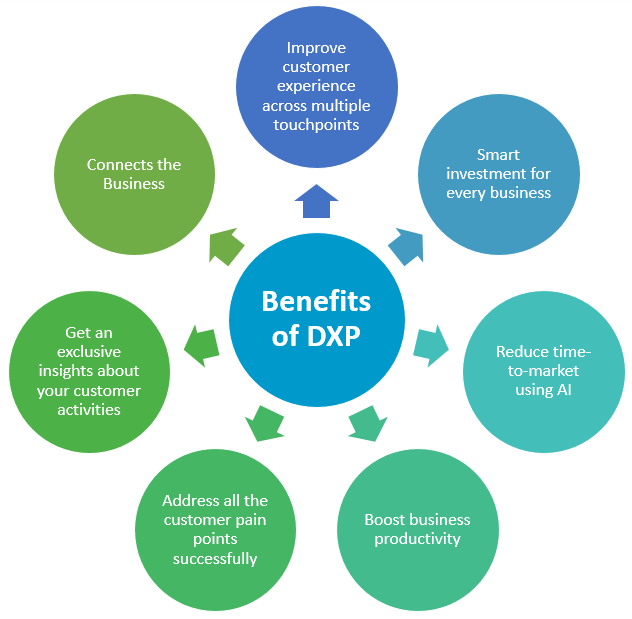
Benefits of DXP

Implementation of the Digital Experience Platform enables you with several lucrative benefits. Let’s talk about them one by one in this Digital Experience Platform guide.

1. Improve customer experience across multiple touchpoints

With the emergence of multiple digital platforms, it becomes convenient and easier for brands to reach their target audience. They are utilizing the maximum potential of websites, mobile apps, emails, social media, chatbots, and in-person interactions too.

Digital Experience Platform helps companies to maintain their brand consistency across all the output channels. DXP allows you to utilize the personalization capabilities to drive tremendous customer engagement.

The advanced platforms come with built-in capabilities of data analytics and trend analysis to help you with customer behavior tracking across every critical touchpoint. Later on, it helps you to understand customer expectations and meet them effortlessly.

2. DXP is a smart investment for every business

To manage different business operations, companies need to develop and deploy different software.

For example; organizations use Content Management Systems (CMS) to create and manage digital content, portals for content aggregation, campaign management to run various digital campaigns effectively, analytics for tracking customer behavior, and more.

Earlier, to address all these needs, companies needed to deploy separate software which required considerable investment.

Digital Experience Platform is the one-stop solution for all such needs. It allows you to integrate different software and applications under a single platform. It allows you to access the updated data all the time across all your systems. Offering an integrated approach, DXP allows you to develop a responsive application as well.

Undoubtedly, instead of investing in 5 to 8 different software, it’s a smart move to invest in an advanced DXP that enables you with all the robust capabilities.

3. Reduce time-to-market using AI

Today’s customers are getting smarter with each passing day. To meet their changing expectations, companies need to understand their mindset. To get insights into your customer’s needs, you need to analyze relevant data.

You can learn about your customers by tracking their contact information, social media interactions, preferences, purchase history, demographics, communication information, browsing data, and more. The study of your customers enables you with actionable insights that add incredible value to your business.

By integrating Artificial Intelligence into your DXP, you can perform this analysis seamlessly. The technology helps you identify important customer information from a large chunk of customer-related data.

The amalgamation of AI and DXP allows the companies to work on updated, accurate, and consistent information about the customers on the fly.

4. Boost business productivity

Generating better revenue is the ultimate goal of all organizations. This can be achieved only through an increasing number of customers and their retention. Digital Experience Platform plays a critical role when it comes to delivering compelling customer experiences.

The advanced DXPs allow you to utilize content and commerce elements to deliver a desirable customer experience and attract targeted users.

Additionally, DXP is a flexible system that permits companies to integrate their existing enterprise systems and third-party applications through APIs. So, when you need to introduce a new service in the future, it becomes easier for you to integrate it into the platform. This simplifies business operations like never before.

Leveraging the content, commerce, and integration capabilities of the Digital Experience Platform, brands improve conversion rate, increase sales, and reduce operational costs respectively. In the end, all this contributes to improving your overall business productivity.

5. Address all the customer pain points successfully

When customers interact with any of your digital platform/s, they become your prospects. Their conversion from prospects to loyal customers is a journey. To create a successful marketing strategy you need to track their interactions across your sales and marketing channels at every stage. This is not a one-time job, make it your standard practice to pave the path of success.

DXP enables companies to have complete control over analyzing all the channels through which their target audience interacts with the brand. It helps you to understand your customers’ needs and challenges.

DXP provides you the measurable data that you can utilize in making a stronger marketing strategy.

The customer data helps you figure out the customer pain points through their interactions across different channels and design a customer journey mapping strategy. Based on your customer’s pain points, you can propose the relevant products and services to them.

6. Get exclusive insights about your customer activities

DXP enables organizations with a single interface where you can have a consolidated view of all the customer interactions and activities across all the customer touchpoints.

This information enables the management team with actionable insights and makes effective strategic decisions. The right business decisions ensure the success of your brand.

This clearly depicts how the Digital Experience Platform is essential to stay ahead in today’s competitive business space.

By analyzing the customers’ interactions and activities, you can easily predict future trends and offer them more relevant and accurate recommendations. Thus, by offering a thorough analysis of customer behavior, DXP helps companies attain improved customer loyalty, better customer engagement, and ensure higher retention.

7. Connect the business

Well, DXP is a very advanced system but it is not sufficient to address all your business requirements. You need to deploy some other software as well.

For example; you need to use an eCommerce solution to manage transactions and inventory, marketing software to bring customers to the door, customer support solutions to provide quick support to the existing customers, and more.

You can connect DXP with any of your business solutions. It uses APIs to organize and aggregate the data to define and deliver the right experience to the customers every time they interact with your brand.

Technical benefits of Digital Experience Platform to customers and organizations

DXP CapabilitiesBenefits to CustomersBenefits to Organizations
PersonalizationEach touchpoint creates the right value for customers.
For instance; you have filled out an online inquiry form to avail of certain products or services. When an executive of the service provider contacts you, they already have the data about you through that online form.
The flexibility of integration in any enterprise system or 3rd party apps such as CRM, marketing, social media, etc. enables brands with a complete view of each customer.
With help of Machine Learning and an intuitive dashboard provided deep insight into customer behavior.
Flexible architectureImproved experience on all the preferred channels.Provides microservices architecture and hybrid headless to deliver the same content across multiple channels.
Reduces the burden on your marketing team for creating more content to deliver a better customer experience.
AdaptabilityConnect when they want and how they want.DXP allows you to integrate and adopt the new technologies and connect with your target audience as new technologies are introduced or digital maturity increases.
Integrated control centerExperience a connected and consistent journey across all the touchpoints.Leverage the right mixture of customer data, analytics, and omnichannel content to create compelling experiences that improve customer retention.


How to boost customer acquisition and retention through the Digital Experience Platform?

Personalization

Personalization is about improving customer engagement. It can be achieved through the right mixture of a great design and consistent customer experience. You can drive customer engagement by sharing this amalgamation across different customer touchpoints starting from one-to-all to one-to-one approaches. It is the best way to move from a generalized to a personalized approach.

Digital Experience Platforms enable you with exclusive customer insights and behavioral data that help the brands to create relevant and individualized interactions.

Implementation of DXP solution helps you recognize optimal experiences for each customer and modify the digital presence of your organization accordingly.

Make sure your internal teams are aligned with the implementation of the personalization strategy. To enable customers with a higher value, you need to ensure the buyers are getting the same experiences across all the sales and marketing channels.

In most organizations, it is believed that personalization is the responsibility of the marketing department solely. Well, that’s not the case. It is true that personalization is driven by the marketing team but it won’t be effective without alignment with their teams of the organization.

All the teams are equally responsible for designing the personalization strategy as it is strongly connected with the approach, implementation, aim, and overall optimization strategy of your company.

Through the Digital Experience Platform, you can collect a wide range of data such as purchase patterns, sessions, customer profiles, website visits, transaction history, and more data. You can analyze this data, understand the customer behavior and accordingly enrich the personalization strategy.

How Digital Experience Platform supports personalization?

  • Connects siloed engagements
  • Allows for real-time decisions making
  • Drives agility in marketing personalization
  • Leverages machine learning and predictive analytics
  • Uses location-sensing such as beacon-based technologies

Personalization

Image credit: pimcore.com

Interoperability

To leverage optimum digital engagement, companies need to establish interoperability between the systems. This is not a choice for an organization but it’s mandatory to attain the expected success. Management and technical teams cannot collaborate on organizational, technological, and strategic levels without establishing interoperability between the digital commerce platform and Web Content Management (WCM) technologies.

The proliferation of data repositories and Web Content Management can result in inefficiencies and inconsistencies in the product of content management. It allows the brands to deliver fragmented customer experiences.

Interoperability enables the IT leaders to bring different departments that are performing varied customer-facing functions separately such as email marketing, customer engagement centers, website management, retail stores, digital commerce, and more. It becomes easy for the team to attain a shared vision around digital commerce and WCM.

Basically, interoperability is all about bringing all these different systems together.

How to create an interoperability strategy?

While defining interoperability strategy, you need to

Start with your ultimate goal

Define an ideal scenario from your viewpoint where the maximum collaboration of systems, processes, and teams takes place in order to attain expected business results and overcome all the hurdles. Do all these with a customer-centered mind.

Develop a data repository

Create a centralized repository for all your existing data silos and manage the data of different functions such as websites, digital marketing, digital commerce, and more consumer-facing platforms where you need to deploy the content. Compare the cost required by WCM to align the systems with the cost of maintaining numerous silos.

Take action on the data

Design a rough strategy for achieving a compelling customer experience and improved ROI. Check out whether your existing data silos effectively support that new data repository or not. Usually, sticking to the silos will not be compatible with your long-term growth strategy.

Advantages of a good interoperability

  • Enhanced contextualization
  • Improved relevance of delivered customer experience
  • Cross channel continuity and a non-disrupted customer journey
  • Improved user experience or storefront
  • Address the complex cross-channel and marketing requirements
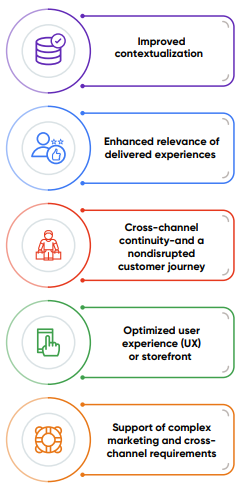
Advantages of better interoperability

Image credit: pimcore.com

Advanced CMS

To enable the customer with the best experiences, organizations have been constantly investing in advanced marketing technologies, innovation, and personalization. With the help of Content Management Systems, you can create and deliver consistent, seamless, and unified customer experiences through rich media and content throughout their buying journey.

Digital Experience Platform also helps them in transforming their eCommerce operations too. The platform helps companies to create requisite transformative influences over their target audience in two ways.

Contextualization

Contextualization in content is the key to personalization. Understand the perspective of your customers and deliver consistent and highly relevant experiences to them across different customer touchpoints.

Creating contextual content is critical. You can’t make the content for commerce so impactful if the context of the target audience is unknown to you.

Over a period of time companies have realized, in the convention processes, that customers do not see any difference in their buying journey starting from discovery to purchase to order fulfillment. Contextualization offers bespoke experiences and real-time personalization.

By enabling customers with contextual content for commerce, you can scale their experiences all the time.

Contexual Engagement through Digital Experience Platform

Image Credit: pimcore.com

Analytics

Customers prefer to buy from companies that identify, remember, and provide them the recommendations and offers. To achieve this, marketers need to get insights about the most valuable aspects for the customers using visitor features, create limitless segmentation to understand the actual reason for interactions, and analyze cross-visit data and visit trends.
Analytics in Digital Experience Platform

Image Credit: pimcore.com

To understand your customer, you need to be clear about

  • How do customers interact with your brand?
  • Are these conversations related to research, inquiries, and abandonment?
  • What are the outcomes and learning?
  • What are the other better ways to optimize customer engagement?
  • Is it possible for you to measure all the experiences?
  • Have you considered the multi-channel attribution model in order to impact every engagement across different channels?

By integrating advanced analytics into your Content Management System and portal, you can address all your queries by improving customers’ lifetime value and boosting customer-centric innovations at the same time.

AI-based content management

Because of the increasing need for personalization, B2B and B2C organizations have started adopting Artificial Intelligence (AI) capabilities. The popularity of AI is increasing due to its outstanding capabilities that contribute significantly to improving customer experience. AI also helps brands in addressing the changing needs of content management and digital interactions.

Consideration of AI allows companies to automate the process of creating customer personalization. The technology analyzes the different content journeys taken by your target audience and provides you insights into their preferences and interests.

With the data, it becomes easier for you to design an effective personalization strategy and deliver an amazing customer experience.

For example; a customer is not responding to one type of personalization approach. Integrate AI in your Web Content Management that automatically tracks what your targeted audience is viewing. Thus, you can test, analyze, and enrich the experiences on a continuous basis.

These days, most Web Content Management systems work as a data hub where all the data is gathered from different sources, transformed and merged with other relevant data, pushed to different channels, and more. It also offers functionality such as image tagging when an image is uploaded.

With AI, WCM allows you to create and publish related content. This content should be based on the analysis of customers’ sentiments.

Content-as-a-Service

Since the essence of multichannel increases for the customer journey, content becomes the top priority to ensure the digital success of your business. Thus, CaaS comes into the picture.

CaaS stands for Content-as-a-Service. These days, to drive customer engagement from different sources, brands need to distribute relevant content across different applications such as websites, mobiles, connected devices, smart TVs, and more customer touchpoints that your target audience is still exploring.

CaaS is a platform where content is delivered via APIs and made accessible through web services. It also involves all the content-based eCommerce and transactional processes.

Here’re the three main approaches for content delivery. Let’s have a brief introduction to all of them.

Traditional CMS

The traditional CMS is also known as coupled CMS. It has a strong connection between the CMS and the delivery layer. A presentation layer is also incorporated into this type of CMS that is required for assembling and delivering web pages.

It results in a solo development platform and a standard presentation that restricts building more user interactions.

Headless CMS

Headless CMS focuses on the back-end part. It provides a set of tools for the content creators to get their workflows readily consumed in a CaaS environment. It does not have a presentation layer.

Headless CMS sends the content to the different systems with the help of APIs as and when your frontend system sends requests for the content.

Hybrid CMS

Hybrid CMS is also popular as decoupled CMS. In this type of CMS, the content is accessed and managed separately through the CMS API, just like headless CMS. It does not have frontend delivery capabilities if you need it.

Decoupled CMS and Headless CMS ensure that content repositories can be accessed directly from APIs. It also makes sure the content is delivered to the target audience through any technology and application.

Content-as-a-Service uses Headless CMS. It addresses the requirements of business users and allows for collaboration throughout the content life cycle starting from strategy to planning to analytics to authoring to optimization. It eliminates the content silos automatically and assures a smooth flow of content to deliver consistent customer experiences across multiple touchpoints.

Flexible architecture

Web Content Management architecture-related decisions are critical. It can have massive implications for WCM stability and performance. Every architecture has a solid vision, strategy, and implementation plans based on the specific business needs of an organization. The architecture of WCM depends on

  • How a business is modeled?
  • How the digital ecosystem of a business is structured?
  • How does the business utilize the potential of WCM?

Most advanced WCM addresses the needs of rich digital interactions on the web, mobile, social and other platforms. To meet the specific requirements of the different channels, developers adopt an API-driven approach to empower content management technology. In simple words, developers have started adopting headless and decoupled content management systems instead of traditional architecture.

Traditional WCM architecture

In the traditional WCM architecture, codebase and frontend display functionality are coupled with the admin portal and backend.

Decoupled WCM architecture

Decoupled WCM architecture conceals the admin or backend layer from the presentation or display layer. It publishes the flat files to third-party destinations with the help of APIs. When it comes to multi-channel dissemination, it helps a lot.

Headless WCM architecture

The specialty of headless architecture is it is specifically designed to manage API-driven experiences. For example; APIs do all the heavy lifting activities. Thus, headless is the best-suited architecture for multi-domain environments. Offering API connectivity, headless WCM provides businesses with multiple options to pull content from different systems.

The Web Content Management platform is architected squarely depending on the kind of projects you consider under WCM.

How does a Digital Experience Platform work with AI?

These days, it is highly essential to deliver compelling custom experiences across different customer touchpoints. Businesses have to collect data from multiple sources. Also, you need to deal with the growing customer base along with the increasing number of products and services.

How do you maintain all these criteria and improve all of them?

Artificial Intelligent helps you to create and deliver innovative experiences along with personalization and generating hidden insights within your data.

The amalgamation of AI and DXP allows you access to data from every customer touchpoint and tool. AI helps you a lot understand and improve customer experiences starting from acquisition to loyalty.

Contextual personalization

Companies can consider personalization through both role-based and experience-based. AI-enabled experiences offer a wide range of elements to the companies such as store location maps, regional contact numbers, product grids, and more. To apply personalization to these elements, you can design the rules manually.

For example; a visitor that visits a marketplace website from his home through his desktop has completely different requirements when he visits the mobile apps of the same marketplace while he is abroad.

When you try to manage all these micro journeys for each and every visitor manually, there are chances you probably miss some of them. Eventually, this converts into a business loss.

Considering Artificial Intelligence you can take contextual personalization to the next level where you can consider customer behavior, device use, every piece of content, and the right conversion path to explore, learn, deliver and learn again. This pattern allows the brands to enable the prospective buyer with better experiences and ultimately generate better outcomes.

All the latest Digital Experience Platform contains AI capabilities that help you to learn about your visitors on an ongoing basis and improve their experience automatically and continuously.

Semantic search

The search query of each buyer is not the same. Their context might be the same but the keywords they use are different. Thus, the concept of semantic search is evolved. It is quite difficult to manage these different keyword combinations manually.

Considering AI for the semantic search, you can deliver highly relevant results, for any query, at any scale. Let your users view the information they are looking for and engage them on your site or app for a long time.

Machine and man

The use of AI is not just limited to utilizing the connected data to enable the customers with the information they are looking for. It also helps you to get clarity on what your target audiences are looking for.

You might have questions about how to measure the impact of the experience delivered. For this, you can take the help of some metrics.

With Artificial Intelligence, you can open the door to new business opportunities by getting insights through data and analyzing the latest trends and buying patterns. A thorough analysis of the data helps your team to refine its strategies to boost customer engagement, conversions, and retention by generating better revenue at the same time.

Well, the way AI collects, analyzes, and delivers better customer experiences automatically, it seems like in the future human intervention is not needed for these jobs. But, in the current phase, human efforts are quite necessary.

Artificial Intelligence fine-tunes your search, empowers personalization, and provides you insights into your customers and market trends. It gives space to your people to focus more on more innovative ideas and creativity to create a compelling digital experience that enables you with a competitive edge.

How Digital Experience Platform helps you meet the expectations of today’s customers?
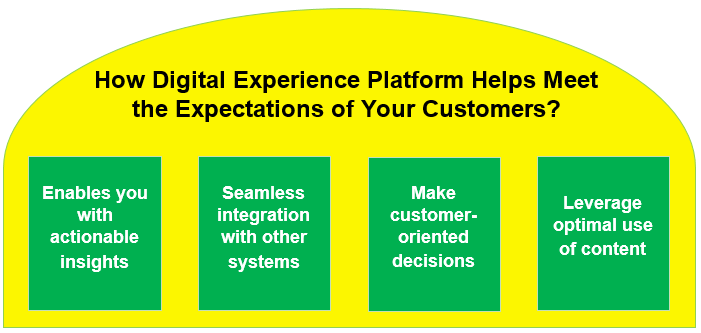
How Digital Experience Platform helps you meet the expectations of today’s customers.

Today’s customer demands are quite dynamic. Also, before making a purchase, they have multiple preferences and criteria in their mind. They perform enough research before buying their products to ensure they get the best products at the best price.

To meet the highly dynamic and frequently changing demands of your customers, you can take the help of the Digital Experience Platform. Let’s see how a DXP helps you in engaging and retain customers through this Digital Experience Platform guide.

Enables you with actionable insights

Digital Experience Platform connects your different internal systems with varied digital channels. Along with collecting, managing, analyzing, and distributing the data from mobile, web, and social media, DXP also takes care of your in-store, e-commerce portal, customer portals, and billboard data.

Using the DXP, you can perform various customer data-related tasks such as data capturing, profiling, and processing. If performed collectively, all these activities provide a 360-degree view of your customers. This improves your customer service significantly.

For example; if a customer shares a bad experience with your product or service, DXP enables you with customer history so that you can understand their buying journey and service gap and improve the service quality. It also helps your sales team understand the interest and preferences of potential customers before calling.

Seamless integration with other systems

By connecting DXP with your existing enterprise systems, third-party applications, or other tools and software, you can track buyers’ history, map their journey, and identify the critical bottleneck.

With better insights into your customer behavior, you can redesign your business practices. This helps you create and deliver an excellent customer experience.

Make customer-oriented decisions

Businesses need to use the tools and technologies that are best for the business and are required by the different teams to perform their respective tasks effectively. Digital Experience Platform is an open-source entity so it will be quite easy for you to connect it with any of your systems and solutions.

In the future, if you are required to switch to another tool and update the existing software, you can easily do it without being worried about DXP.

When you apply this to your marketing tools and software, it allows you to leverage agile marketing and improve personalization in manageable steps.

Leverage optimal use of content

Quality content is a critical part of any organization. Especially, when it comes to personalization. DXP allows you to coordinate your content and reuse the content across different channels and environments by decoupling the presentation layer from the content and its metadata. Reuse of the content saves your investment and enables you with better results.

Digital Experience Platform can be used by both B2C and B2B customers. Both B2B and B2C companies can create seamless experiences that bring loyalty, connection, and meaning.

Do I need a Digital Experience Platform?

Every business that wants to get the benefits of a fully connected experience should consider the Digital Experience Platform.

Most companies want to continue with CMS and are not ready to move ahead with DXP. But, the adoption of DXP depends on your organizational needs.

The Content Management System enables you with the features of content management, workflow management, version management, authorization, and other features.

All these capabilities are already there in the Digital Experience Platform. But, the essence of DXP lies in it allowing brands to connect with diverse audiences through multiple touchpoints.

Digital Experience Platform allows companies to integrate any number of backend systems. It allows marketers to design and deliver highly differentiated and personalized customer experiences.

While deciding whether you need a DXP or not, I would suggest not just thinking about the current condition of your brand. Think of the next 5 years. Analyze what benefits you can gain by developing and implementing a customer DXP and how it supports and empowers your business.

When do I need to implement a Digital Experience Platform?

Well, you can implement the right DXP now only. But again, it depends on where your company is right now. However, you can consider the platform now. In today’s competitive edge, if businesses do not keep pace with the changing digital world, there are chances they are left behind.

Based on the digital maturity of your organization, you can go with a CMS for now. But, select a CMS that enables you with a pathway to grow into a DXP.

When your goal is to attain better customer engagement through digital transformation, you need to consider a CMS that can scale easily, has a wide variety of APIs for fluid integrations and can be deployed on the cloud.

As and when your organization, teams, and digital capabilities get mature, you can add more advanced features and functionality that end up implementing a DXP.

But, if you are one of the companies that are looking forward to achieving tremendous growth, then the Digital Experience Platform is the must-have digital platform for you.

A Digital Experience Platform streamlines and consolidates marketing and content-related processes and data. It also eliminates redundancy and ensures the ability to integrate fluidly.

DXP implementation processes can also be a catalyst for breaking down silos, streamlining processes, and organizing teams.

Signs that you need a Digital Experience Platform

  • Need to deal with a diverse audience and multiple touchpoints
  • Multiple front-end tools and back-end systems are in silos along with experience
  • Invested a significant stake in digital space
  • Developers and marketers in your organization are desperate to innovate with highly differentiated customer experiences
  • Investing a considerable amount of time, money, and resources in integrating digital solutions that don’t work effectively together

As we have already discussed earlier in this post, the integration of AI has completely changed and simplified the way DXP works. It has simplified various jobs whether it’s about automatically identifying the visitors’ trends, using natural language processing to tag content, modifying pages, and creating customer segments. Artificial Intelligence and Machine Learning (ML) improve customer insights, the organization’s ROI, and overall productivity.

Organizations do not only need to focus on downstream needs such as data collection and experience delivery. They also need to consider upstream needs that involve collaborative content creation and digital asset management. To enable brands with an end-to-end content management system, DXP allows for fluid integration with other systems.

Implementation of the Digital Experience Platform has transformed the way you operate the business. It enables you with opportunities like customer-oriented engagement and risk of disruption for organizations of any size and domain. Thus, DXP is essential to meet the changing needs of today’s digital space.

How Much Does a Digital Experience Platform Cost?

When choosing a Digital Experience Platform for your business, you can either go for a ready-to-use platform or create a tailored DXP platform that is specifically designed for your business and contains all the features that your business needs.

If you select any ready-to-use DXP, there will be a pre-defined cost for platform subscriptions, licensing, and other fees.

In case you are interested in considering the development of a custom DXP, the cost of a DXP depends on the features and functionality you want to cover in the solution. Compared to other digital platforms, DXP is more expensive due to the constantly increasing functionality that they offer.

Small companies need access to limited features so the cost of DXP that they need is between $7000 to $17000.

On the other hand, large-scale organizations need the Digital Experience Platform that comes with plenty of features and functionality that streamline multiple operations related to the content, marketing, and sales. For big brands, the cost of DXP is from $20000 to $50000.

These are the approx. Pricing of the DXP. The more features, integration, and configuration you need, the price will be higher. To get the exact pricing of your custom DXP, connect with our DXP experts. Discuss your requirements with our team and we will provide the exact costing of your DXP based on your pre-defined needs.

Top 5 Digital Experience Platform Trends to watch out for 2022

Brands that are seeking to reach out to a larger target audience have started considering advanced technologies like AI and ML. It helps companies to create and deliver contextual experiences and personalized content for the target audience to meet the changing demands of the customers.

The importance of the Digital Experience Platform is going to increase only. Thus, in the Digital Experience Platform guide, I have covered a few most essential DXP trends that assure your decision for DXP implementation will enable you with amazing benefits.

Digital Experience Trends

1. Digitally integrated business

Connected data is the key to the success of any business. Through a modular approach, you can streamline operational processes and workflows across all the tools and teams.

Implementation of DXP provides you with better insights into how the jobs performed by each team impact the other departments and the company as a whole. It also ensures providing cohesive customer experiences across multiple touchpoints.

When you pair your Digital Experience Platform with marketing automation tools, it becomes way easier for you to promote your products and services to customers without the need for constant moderation.

2. Customer Privacy

Since the GDPR (General Data Protection Regulation) is established there is a drastic change in the way companies ensure customer privacy. It’s no longer an issue related to the marketing department. All the departments of the organization including customer support, sales, lead generation, and human resources need to change the data policy.

These days, it is very important for brands to protect and respect customer data privacy to win the customers’ trust. By ensuring customer data privacy, you can gain a huge competitive advantage.

3. Artificial Intelligence

Undoubtedly, AI contains so many amazing capabilities within it including highly effective data analytics. It enables companies with detailed insights into customer behavior and provides accurate predictions about the buyers.

AI helps brands in a smarter way by processing and analyzing the data and identifying the required actions. Algorithm dominating search engine optimization is one of the most common examples.

4. Voice assistance

Consumers are looking for voice-based assistance these days to simplify their searches. However, make sure, it provides the best values.

Integrate a voice assistance solution that allows you to create content that serves the human speech pattern. This type of interactivity will impact the UI design specifically for web-based systems and mobile apps.

5. Be open to new tech trend adoption

To keep the business up and running smoothly, companies need to adopt the changes that occurred in the business world to be future-proof and run the business constantly.

The largest and latest change that has impacted the business world significantly is the adoption of microservices and cloud platforms. Both tech inventions enable the brands and tech world with scalability and agility for processes and systems.

By adopting the latest technologies, you can address many business necessities such as voice technologies, data analytics, AI, ML, and more.

How to choose a Digital Experience Platform (DXP)?

Many Digital Experience Platforms are available in the market. So, selecting the right one is a challenging job for any business. Especially, when you do not have basic knowledge of DXP such as what are the essential features, benefits, components, etc. a DXP provides.

Check out the below list that provides you with essential aspects of DXP.

  • Ensure the DXP has advanced security features
  • Select a platform that provides extreme customization and flexibility
  • Make sure the platform offers good and quick customer support
  • The platform should be extremely scalable
  • DXP allows the integration of any of your existing enterprise systems and 3rd party applications or software

Apart from the above-listed aspects, there are many things companies need to consider while adopting a DXP solution.

The most common scenario is companies get attracted to the features offered by the platform and the company’s mission takes the back seat. Well, this should not be the case. Brands should stay focused on their unique business needs and explore the features that meet the precise needs of the brands.

Make sure you are integrating features and functionality not because they are currently trending but because they help you develop a better digital experience.

Firstly, define milestones and goals for your organization and then look for a suitable digital experience platform that helps you attain all your business objectives.

Through the Digital Experience Platform guide, I am going to unveil a few strategies and tips for selecting the right Digital Experience Platform for your company.

User Journey

Every DXP is not right for you. Before making a choice of a DXP and executing a digital experience strategy, it is advisable to understand your customers’ buying journey. Get insights into how your customers interact with your brand through different online and offline channels.

Analyze what products or services they are looking for, what devices they are using, and how they interact through channels and devices. It helps get a better idea that which technologies should be a priority to drive more customer engagement and ensure consistent business growth.

Create a user journey map based on the current capabilities that will help you identify the gaps. You need to select a DXP that fills these gaps and is the best digital Experience Platform for your organization.

Agility

The most critical part of DXP that businesses should consider is how quickly the platform allows you to get to market and its ability to adapt to your specific business needs.

As market demand keeps changing swiftly, facilitate your target audience with the most advanced and innovative digital experience that they haven’t thought of. Offering outdated experiences, there are chances you lose your customers. So, implement a DXP that is quickly adaptable by your company.

Integrations

As the tech world is blooming with the emergence of a lot of advanced tools and technologies, it is highly required that the DXP allows to integration with the technologies that empower content management, eCommerce, and personalization strategies to deliver consistent and excellent omnichannel experiences.

If you are using a legacy system, then you might be facing challenges to create great digital experiences through a monolithic piece of the platform. With such solutions, you keep struggling to meet the changing demands and expectations of today’s tech-savvy customers. It also costs your organization to keep the solution running flawlessly. Eventually, it affects negatively to your ability to compete and innovate.

Considering a feature-packed Digital Experience Platform, companies can integrate the technologies and leverage the MACH methodology.

Are you aware of the MACH approach? If not, then let’s understand it.

MACH is an acronym for the technologies that are developed based on four modern principles.

Microservices

Microservices are applications that can be easily scaled, maintained, and deployed independently to facilitate customers with infinite services.

API

API is an abbreviation for Application Programming (API) Interface. The technology connects different services to design a composable ecosystem that can be rearranged as and when required.

Cloud

Cloud-native platforms are delivered as a service by a vendor. It allows limitless scalability that‘s still affordable.

Headless infrastructure

Headless technology is popular as it decouples the presentation layer and logic. The headless architecture allows for channel-independent service delivery and endless integrations.

When all the above-listed components come together in a digital experience platform, it becomes easier for the marketing team to create personalized omnichannel digital experiences.

6 Questions to prepare before choosing a DXP

If you have just started exploring the different digital experience platforms for your business, do some analysis first. You must get the answer to these six questions to get clarity on your business objectives and project requirements.

1. What business objectives do you want to achieve through the Digital Experience Platform?

Digital experience platform implementation should not be part of your business agenda. It should be considered to empower your digital strategy. Thus, brands need to set the business objectives at the very first stage, define the roadmap, strategies, and role for DXP, then look for the right DXP that helps you attain all the business objectives seamlessly.

2. What capabilities do you need to meet your business objectives?

You might aspire to achieve excellence in omnichannel, analytics, and eCommerce delivery. This list might be longer. Create the list of your requirements, and identify and group the requirements for which you already own all the required capabilities and the needs for which you need to acquire the capabilities.

3. What are the key stakeholders?

Determine a small group of individuals to discuss and guide the decisions.

4. What is unique about the digital experience that you curate for your customers?

Understand the needs of your publishing environment and marketing campaigns. Based on the evaluation select a DXP. Make sure it addresses your business requirements and aligns with the organization’s current workflows.

5. What does the existing marketing technology stack look like?

Before selecting a digital experience platform, conduct a thorough review of your current marketing technology stack. List down who the company uses which part of the technology task, which stages of the purchase cycle every component supports, and any existing connections within the stack.

Along with marketing technologies, think about other technologies too such as ERP, CRM, Business Intelligence, and so on that you need to integrate with DXP. This is very essential information that helps you plan, deploy, and adoption of a reliable Digital Experience Platform.

6. What type of analytical insight do you need from DXP to make strategic business decisions?

Understand the real picture of the data that you want to collect and use the insights that the data reveals. It helps you choose the best Digital Experience Platform.

Top 5 Digital Experience Platforms that you should consider for your business

There are many Digital Experience Platforms available in the market. More options, more confusion. The Digital Experience Platform guide contains the list of some so the most popular and reliable Digital Experience platforms that you can consider for your business.

Pimcore

Pimcore allows you to create and deliver a seamless and unified digital experience. It manages, optimizes, and delivers contextualized and personalized experiences to each target audience across every customer touchpoint.

It enables you with a decoupled web content management strategy and headless content delivery approach. Pimcore allows you to build hybrid DXP systems to gain the benefits of both worlds.

With Pimcore DXP, you can ensure cross-channel continuity throughout the whole digital experience and customer journey. It contains customer journey analytics and customer data management as complementary systems.

It also allows you to integrate and scale any of your existing enterprise systems and third-party applications and software or marketing software stake.

Key features of Pimcore’s Digital Experience Platform

  • Web content management
  • Headless content management
  • Multi-channel delivery
  • Personalization and analytics
  • Web2Print
  • Integrated PIM module, and more…

Benefits offered by Pimcore’s Digital Experience Platform

  • Leverage the perfect amalgamation of content, commerce, and contextualization
  • Create extremely customized, relevant, and personalized experiences to improve your behavioral targeting
  • Advanced marketing technologies streamline data, processes, and operations to address the needs of your target audience
  • DXP can be connected with eCommerce systems seamlessly to improve the ROI of B2C or B2B businesses
  • Leverage single source and multi-channel publishing

Adobe Experience Management

Leverage the Adobe Experience Platform to bring your data into action. It’s an open-source system that transforms all your Abode and non-Adobe data and creates robust customer profiles. You can update these profiles in real-time and also utilize AI-driven insights to deliver the right experience across multiple channels.

Key features of Adobe Experience Platform

  • Behavior-driven insights
  • Intelligent optimization
  • Real-time personalization
  • Customer journeys at scale
  • Real-time customer profile
  • Data science workshop
  • Query service, and more…

Benefits offered by Adobe Experience Management

  • Maintain and update the customer data in real-time
  • Deliver a unified cross-device and cross-channel experience
  • Create and deliver improved tailored experiences to boost customer satisfaction
  • Deliver personalized experiences through mobile apps
  • Seamless integration with other customer experience management capabilities and technologies
  • Store information in a centralized repository and eliminate data silos

Acquia

Acquia enables brands with a robust Digital Experience Platform that helps companies to engage customers, improve conversions, and stand out your business from competitors. They offer products like Marketing Cloud and Drupal Cloud that allow companies to create and deliver cutting-edge digital experiences across multiple channels, at any scale quickly.

Key features of Acquia Digital Experience Platform

  • Autoscaling
  • CMS integration
  • Multi-site management
  • Custom access management
  • Workflow automation
  • Multilingual content management
  • Performance monitoring and reporting
  • Integration of a variety of tools and systems, and more…

Benefits of Acquia Digital Experience Platform

  • Drive tremendous traffic on your website
  • Improve customer engagement and conversation
  • Empower your marketing efforts by harnessing the potential of Machine Learning
  • Grow your business by automating and organizing the customer journey

Sitecore

It provides a powerful Content Management System for small-scale businesses to start with. Sitecore enables you with advanced features like marketing automation, customer data, AI, analytics, and many other capabilities to define customer journeys along with personalized content across any channel, in real-time.

Key features of Sitecore Experience Platform

  • Conquer omnichannel delivery
  • Cross channels campaigns
  • Experience editor
  • Marketing automation
  • Personalization with AI
  • Seamless integration
  • Omnichannel distribution, and more…

Benefits of Sitecore Experience Platform

  • Best in class content personalization
  • Powerful cloud
  • AI-powered marketing automation
  • Holistic end-to-end ecosystem
  • Unparalleled content management
  • Insight-driven online storefront
  • Omnichannel content delivery
  • Single platform management

Liferay

Liferay allows you to build a solution that delivers fast, secure and connected digital experiences to your target audience. It allows companies to enable customers with personalized experiences throughout their buying journey.

It is designed in such a way that it works seamlessly within your existing business processes and technologies. Using the Liferay platform, you can develop intranets, websites, partner portals, integration platforms, and customer portals.

Key features of Liferay Digital Experience Platform

  • Identity management
  • Personal data management
  • User management
  • Content modeling
  • Enterprise DAM
  • Online document editing
  • Automatic versioning
  • Auto-tagging, and more…

Benefits of Liferay Digital Experience Platform

  • Create unified customer experiences
  • Streamline varied business processes
  • Empower your digital strategy

How to get started with Digital Experience Platform Strategy?

If you think your organization is ready to leverage digital transformation by adopting a robust Digital Experience Platform, then you need to develop a content-driven website or an eCommerce platform.

A website and commerce solution is the customer touchpoint where your target audience interacts frequently. Thus, it will work as the strongest foundation of the Digital Experience Platform.

The next thing that you need to take care of while choosing a DXP is who your target audience is. You need to define whether you need a commercial, portal, or CMS DXP (as listed in this post only).

Selecting the right DXP is a critical job as you need to consider more criteria such as your business size, specific business needs, and customer touchpoints.

How is Pimcore’s Digital Experience Platform the right choice for you?

Pimcore is an open-source Digital Experience Platform that is built using a modular set of technologies. It ensures delivering personalized and targeted experiences to an edge variety of target audiences. It contains advanced functionality such as multichannel publishing and a user-friendly single source.

It offers Web Content Management that allows you to manage and compose the content as well as deliver multifaceted and complex digital experiences across different digital channels such as web, mobile apps, social media, IoT, AI-powered conversational interfaces, digital marketplaces, in-store experience, and more.

Pimcore’s Digital Experience Platform allows you to integrate different systems and equipped you with a consolidated platform for Product Information Management (PIM), eCommerce, Web Content Management (WCM), and Digital Asset Management (DAM).

The Digital Experience Platform of Pimcore comes with some amazing inherent capabilities like creating a tailored design for each of your websites while ensuring their control through a single interface in order to deliver compelling content and commerce experiences.

Leveraging the analytical capabilities of Pimcore’s DXP, you can create a unified customer profile based on third-party or first-party data streams such as CRM data, on-site user behavior, conversions, and more.

A Brief on Enterprise Resource Planning (ERP) and How It Can Be Enhanced by PIM System

Managing resources for any organization is an encumbrance. Be it people’s resources or time as a resource, the proper planning of resources leads to a systematic process. The systematic process then later onwards will make you use your resources at an optimal level. As a manager you already have a lot on your plate of keeping track of tasks and time; you can’t have more burdens on yourself.

You need a proper system that identifies your resources, evolves your resources, and develops resources to their optimal for you to have maximum benefits. You need a simple solution for your complex problem of resource planning.

What is Enterprise Resource Planning (ERP)?

Enterprise Resource Planning-ERP is an automated system that manages software and system of organization. ERP software simplifies the complex process of organization and manages all manufacturing, services, financial, supply chain, and other important processes of the organization. A complete suite of ERP applications offers compliance, supply chain management, risk management, and customer management.

ERP provides many solutions for your business, such as; risk management, financial management and helps you in communicating effectively. All your business processes can work smoothly as the data will flow from one end to another easily with the help of ERP. ERP is a common database for both cloud service and On-premise service.

When was the last time you have an unbalanced budget because you have trouble planning the statistics? Not very much longer, right? With ERP you can forecast your budget more effectively and accurately as the planning of the budget becomes much easier. You can have an efficient budget, as it will be nearly as similar to your predicted budget.

How Does an ERP System Work?

The main role of ERP is to make organizations enable on their feet to make maximum utilization of their resources. Better utilization of resources will increase the efficiency of your business. For any business’s growth or profit, the enhancement of resources without hindering the quality is most important. ERP works in a simpler way to solve your complex problem.

ERP collects and compares metrics of different departments and provides different reports. That way, it gives insights into your business’s performance. It also gives detail of how your resources are being used or unused. ERP generates reports after collecting data so that you can streamline the work process and can make real-time decisions for your business.

When Does Your Business Need ERP?

Achieving either your short-term goal or long-term goals is very difficult as there are many potential business challenges for your business that thwarts the growth. First thing is to analyze the challenge because when you analyze the challenges you also analyze the opportunities. For analysis of your business, nothing is as better as ERP.

The quite challenging task is to understand the need for ERP for your business. You need ERP when you are;

  • Facing inefficiency of Resources
  • The company’s growth has become stagnant
  • Lacking Security Requirements

As stated above the challenges can be turned into opportunities only if you know how to react. You can have inefficiency of resources due to lack of knowledge or technology. It is quite natural to have stagnant company growth when you are not able to use your resources at an optimal level. Other activities that show the need for ERP are:

Your customers might be screaming at you because of incomplete data. Your day-to-day process is being delayed due to prolonged delayed activities. When you need to rely on manual tasks for your data management, all these are the indicators showing you need ERP for your business.

4 Key features of ERP systems

To be able to operate on maximum functions you need ERP and the key features of ERP are as stated below:

1. Integration

ERP integrates your business process across all departments. When one data is generated for one department it automatically reaches the other departments. The integration between departments will dismiss all possible conflicts. i.e. When one order is released- all departments will work in their individual area of expertise to make sure the product is shipped and the invoice is sent.

2. Real-time Operations

As all departments have integrated to work together for achieving the business goals, no department will need to rely on other departments for pending or missing product status or anything. All can work independently yet together and that will make the operation a real fast.

3. Common Database

Multiple departments have multiple manpower and all manpower might be having different definitions of workflow or product improvement. When you have ERP, you set one standard process of definition that everyone has to follow in every manner. ERP will generate a common database, which everyone must follow.

4. Consistency

A consistent system reduces training costs. ERP vendors keep consistency at their top-most priority and they also like to cope up with the changing trend of the market. Consistency from vendors will make your business more professional and trustworthy.

Benefits and Business Value of ERP

From small enterprises to massive enterprises, ERP can overcome many business challenges for you. For your business, ERP has many benefits as discussed below.

1. Cost-saving option

As stated earlier, ERP integrates with departments so that their productivity and efficiency to carry out business goals will be increased. ERP provides integration and automation to businesses so that ultimately you need to imply lesser costs than you used to do.

2. Business Insight

If you know where your business stands then you know why it is where it is. With ERP you can have better insights into your business’s status. You can have ample opportunities with business insight. With aggregated information from one single source, you can have real-time data and can make an informed decision.

3. Fewer Efforts and Risk

There is no shame in accepting the fact that, when you perform manual tasks; the chances of risks are higher. You have to put so much effort into carrying out a manual task but with ERP you can be more relaxed as the ERP takes care of everything. You need not do any manual or risky tasks for your business.

4. Collaboration

In recent technology, no one likes to have a barrier and everyone wants to work in a neutral environment with zero communication barriers. ERP makes your technology collaborate with manpower and you can have improved job efficiency for your business.

Thus, the benefits of ERP are many-folded, but the important benefit of ERP is to make business/ organization meet their short-term and long-term goals.

Tips for Selecting an ERP System

Implementation of ERP system is an unnerving task but you need not worry as I have done the research and below are the simple tips for selection of ERP system.

Before straightaway picking a system you need to ask yourself that if the selected system aligns with your company goals? If the system matches your requirements or not? Will it easily integrate with your existing systems? Will network support be available? Would you be able to get recommendations from your customers?

Most importantly will the system help you in achieving your business goals? Once you narrow down the ERP system that follows all the above answers, the next step should be to check the features and reviews of the narrowed system.

Once everything falls in your favor you can adopt a system for your organization.

Here are the steps to be followed for selecting the right ERP system

  • Know the system
  • Check the compatibility
  • Narrow Down System
  • Check the review
  • Implement System

What is the PIM System and How PIM and ERP Work Together?

A Product Information Management system is basically the source data of product information. In PIM the product information is stored securely till the product’s eternity. The source provider of information to PIM is ERP. PIM gathers the data from ERP for marketing and sales purposes. The PIM data can easily merge with your descriptive information and seamless workflow will be achieved.

PIM and ERP

For delivering accurate product information to your customer, these two systems work together and ensure that there is consistency and transparency maintained. The purpose of both systems is somewhat similar so they are complementary to each other and they serve the same purpose-growth of your business/ organization.

Product Catalog

Retailers need product information in large catalogs. For that PIM creates product catalogs after taking information from the ERP system. The catalogs will work accurately and will provide a detailed description of the products. For delivering accurate detailed product information to customers, you need collaboration with PIM-ERP.

Streamline Process

The collaboration of PIM-ERP will leave your organization to work in a streamlined process. There will not be communication barriers, there will not be inter-departmental conflicts, and there will not be procrastinated tasks. Your business will work on an optimal level with minimal efforts and minimal costs.

Fewer Efforts and Less Time

You must have experienced once in your lifetime, the struggle of managing a bundle of product information and might have faced catastrophic results for mismanagement of product information. The PIM-ERP makes your business put as much minimal effort as you can so that you have proper management of data in less time.

Reasons to add a PIM System and Enhance Your ERP

We have seen the benefits of ERP and have seen the role of PIM. Now, we are going to discuss the reasons to add a PIM system for enhancing the ERP system.

1. Faster Data Onboarding

ERP system when performing as a single system; it has some barrier. The unwanted data may pile up and take up space of wanted data. You cannot keep track of inactive products with just ERP. You need PIM so that the concerned person can add the specific product information quickly.

You can standardize your data received from multiple suppliers with PIM. With PIM-ERP you can easily interpret product attributes. PIM makes sure that the product reached the market in the real-time and relevant product information is stored in a single place.

2. Data Integration

PIM can integrate the data of ERP as well as other systems, databases, spreadsheets, and programs. The process of e-commerce is incomplete without the visual representation of the product, so PIM also understands the concept and makes the objects visually available after tracing the data from the ERP system.

With PIM you will never juggle and can have a smooth, automated, and reliable work system. You can easily share the information, take reports, and make an analysis of the products. Say goodbye to your manual head-scratching tasks of data entry after the implementation of PIM for ERP.

3. Data Optimization

High-quality data that is consistent and reliable is most important for any e-commerce business. Likewise, the same you must need optimal data at every stage of your business. PIM and ERP ensure that you have high-quality data to impress your customer throughout all the stages of the product life cycle.

With these two systems, you can find unstructured data, you can find missing data, and can delete misused data. You can fill in the data gaps and remove errors of data with ERP-PIM.

4. Rich-product Experience

The pool of data from these two systems without any doubt will give a rich product experience to your customers. PIM provides rich product information so that the description features and benefits of the products are properly accessible to customers.

Using analytics PIM performs data for external markets and makes sure that your business is in lead than your competitors. Thus, the systems work together but without the PIM system, the ERP system is void.

Wrapping Up

To enhance your existing resources, you need an ERP system. To enhance the ERP system, you need a PIM system. The collaboration of both the systems will end up in having growth for your business, better productivity, better customer experience, better efficiency, lower costs, more profits, and fewer efforts.

How to Create Global Product Experience Using PIM’s Product Data Syndication (PDS)?

Product experience is the interaction of a product and its users. The attachment of the product, the feeling towards the product, and senses related to the product create a good product experience for a customer. Achieving global product experience means delivering the great experience of the product to the global audience.

To be able to reach a global audience, you need a strong product data supplier platform that provides relevant information in real-time. Reaching a global audience and delivering relevant product information for a better product experience is not at all easy as it may seem. You need PDS for the same.

What is Product Data Syndication?

Product Data Syndication-PDS is part of Product Information management-PIM.PIM focuses on storing and submitting information to an organization, while PDS is one step further to PIM and it focuses on sharing product information to manufacturers, merchants, and the market.

PDS takes care of sharing and publishing product information across different customers and merchants. For encouraging customer experience and with the increase in the customer interface; syndication channels like B2B, B2C, and B2B2C are required.

Your business might have billions of products and your merchant needs precise, unique product information of every product in detail so that the merchant can carry out his task. The merchant needs information to stay ahead in the competitions from other merchants and PDS is just one tool to provide information to your merchant.

You need PDS to share information with merchants and manufacturers because they might not have consistent product information throughout the product cycle. Merchants and manufacturers need to be updated with the product so that they can stand out from their competitors.

How to Drive Revenues through PDS?

Driving revenue with PDS is possible because of its ability to show product information in the same way; as a physical store would do. Customers can have access to product information in detail even though touching or checking the quality of the product physically. When a customer gets the right information about the product, then become more confident towards your brand.

Your potential customer will be your loyal customer as long as you keep delivering reliable data of products to them. The consistent product information will attract your loyal customers to buy products from you so that your revenue will always rise. Thus, with accurate product information, you can gain the trust of customers and they will help you in driving your revenue.

PDS delivers relevant information to relevant customers so that they can make informed decisions about product purchases.

Benefits of product data syndication

1. Get Products faster to market

The trended times have worked in the favor of customers as they have the liberty of choosing products from multiple e-commerce platforms. The medium of their purchase process has changed but their tendency of making a purchase decision is still the same- Customers want precise and detailed information about the product before purchasing the product.

To be ahead of the others you need to have a faster time to reach to market than your competitor does. In doing so you need to make your merchants and manufacturers updated with product information so that they can continue their working pattern and for that you need PDS.

2. Data Management

PDS is part of PIM PIM is a key source of relevant and consistent data. No business works on a single product now a day and likewise, your business must be having multiple products too. Multiple products’ distribution is more difficult as it involves numerous manufacturers and merchants. Each and every manufacturer will require product information at every stage.

You single-handedly can’t take follow up from different merchants for different product statuses. You need a proper system to deliver the right information to retailers about the trend of customer’s preferences. PDS is important for your business as it tracks product information and easily communicates product information to manufacturers.

3. Single Source of Data

Your pool of data has to be in the standard method and integration with each other. Would it not be easier; if you have a single source of data where your data is in the standard method and integration with each other? PDS is a tool for your single source of data problem. A variety of system data has to be targeted to the distribution channel.

The collection of specific, accurate, and reliable data from the different systems is equally a tedious task as collecting data from old files manually. But, when you have a single source of PDS you can collect the data in its system and you can deliver across channels.

4. Data Consistency

Data consistency and supply of data are two crucial things for any business. Luckily with PDS, you are away from the trouble because PDS generates consistent data throughout the product cycle. PDS not only generates consistent data but quickly supplies the data to manufacturers and merchants.

Manufacturers never need to wait for consistent product data to carry out their branding or other activities as PDS shares the data right on time. With lower efforts and lower cost; you can increase efficiency and productivity.

Biggest Pain Points That Product Data Syndication Solve

Your business has already many barriers while growing; so why need to have pain points when PDS can take care of it? Following are the biggest pain points that PDS solves.

1. Dismisses Manual Work

Whether your business is global or local; when you do manual work, you are bound to make mistakes. In a survey, it was found that lack of automation of data is one of the toughest pain points for any business. PDS takes care of automation data so that whenever any data has been updated you can get to know about the same. Dismiss your manual data, which may lead you to a complicated workflow.

2. Global Competition

Many companies are facing more competition than they ever did, because of the customer’s preference for globalized product purchase. The competition due to globalization will increase even more in upcoming years. For better growth of your business, you need PDS, which takes precise care of the global customer and their preference. PDS can easily supply information to merchants so that they can compete in the global market.

3. Faster Time-to-Market

Faster time to market is a process of coping up with market demand and the ability to deliver products to customers on trended demands. In increasing global competition it is one of the other pains to have faster time-to-market for any business. PDS solves the pain as through PDS medium you can supply data of the product to the merchant and they can brand the product accordingly so you can ultimately launch the product faster in the market.

4. Context

Every customer is unique and so is their requirement. You need to maintain the standard context for each channel so that customers can have the best buying experience. You need to keep content engaging, use various attractive images, and just need to answer all the questions your customers ask. Don’t stop for generic content and always deliver more.

5. Consistency

Consistent data is a magnet that attracts both customers and merchants. Your merchant and customer will be bound to trust you and show you confidence when you provide relevant consistent data to them. Many businesses fail to have consistent data when they follow old-fashioned product data tools, but with PDS you can never fail.

Product Information Management (PIM) & Product Data Syndication (PDS)

The Product Data Syndication capability of PIM has significant benefits for any business. By adopting PDS in the PIM platform your business can have high-quality data, real-time pricing, which will enable you for better customer support and deliver data on time to suppliers.

The collaboration of PIM with PDS lets you understand the unique requirements of trading partners and their tailored product data format. You also can have shared transformed and mapped consistency for your business.

Implementing Syndicated data will create new opportunities for enterprises to increase the customer experience and boost their sales ratio. Besides, sticking with the PDS along with the product data management (PDM) will allow enterprises to transfer quality data to different channels from the centralized location much faster.

Ways to use PIM’s Product Data Syndication to Create Global Product Experience

1. Data Integration and Standardization

For having a global product experience you need to have standard data on which you can rely completely. With PIM’s Product data Syndication, you can collect data or information from any source without worrying about the format of data. You can fetch data from anywhere and can integrate that data easily with PDS.

You can choose a definite place to put all the gathered data and put it in any desired format you want. Once data is formed in the desired format you can even merge it with new content that you may have found later onwards. Now you may wonder, how will you consolidate the data into a structured format? PDS has got you; as it filters out unstructured data, silo data, and gives you ultimately standard data.

2. Content tailoring

Now to fit the unique requirement of the output channel, you need structured product catalogs as you can’t rely on raw product information. You can use updated Chanel templates for mapping product data as per individual demands. You can have missing product information, overall channel health, and a visual summary of data with PDS.

In addition, you can also have tailored-made price formats, editing options, and character counts. With PIM and PDS you can match unique requirements instantly with structured product information. You can have a detailed summary of the product and according to the same, you can make other important decisions for your business.

3. Customization & optimization

With PIM and PDS you can achieve maximum performance by optimizing product catalogs on any channel and any market. Analysis of individual performance and visualization of critical data are only feasible because of PIM-PDS. Based on the analysis you can identify the lower performing items, which may be hindering your business.

With simple clicks, you can easily auto-generate product catalogs and infuse information. You can do a trial-error basis to compare the descriptive variants of products to see which generates the best results. You get an overview of missed opportunities, best practices, and optional attributes for your business.

4. Distribution

Be it manufacturers or merchants or any other market, you can easily distribute product catalogs in any format you like. You can deliver product catalogs and product information in any marketplace. With PIM and PDS you can distribute the product information at the right time.

You can distribute the product data to concerned parties so that you can hit your target market easily. The best thing about distribution through PIM-PDS is that when you modify certain data, the distributed data automatically modifies if you update product information. You do not need to re-deliver the updated product information to merchants again and again.

Thus, PIM and PDS combine perfectly to deliver the right product information, increase customer touchpoints, and allow your business to be prepared for future challenges. To meet the customer’s evolving needs, implementing PIMCORE’s Product Data Syndication would be the perfect choice especially at the customer touchpoints for the enterprises.

Wrapping Up

The need for Product Data Syndication is a must for consistent data to be supplied to merchants at the right time to have a faster time to market and to have a competitive advantage over competitors. The management of complex data can be solved with the simple process of PDS. You can remove inconsistent and unimported data with PIM.

With PDS you can dismiss your manual work, where there are high chances of mistakes and you can increase the productivity and efficiency of your business. After the implementation of PDS, your merchants will never have to wait for proper relevant product information.

Master Data Management for Beginners – Explain with Example!!

Have you ever come across a situation where your work was hindered because you were not capable of finding accurate data related to the project? Did you ever store data in one place and forgot where you stored it? If yes, then no one can understand the importance of MDM- Master Data Management as much as you can. Here, we are going to discuss Master Data Management for Beginners from heel to head.

What is Master Data Management (MDM)?

Master Data Management is a discipline that brings business and information technology together. MDM is a technology that every business needs for the management of data assets. MDM is a “Single version of the truth”- that keeps data values in alignment.

The collaboration of business and technology for MDM brings uniform, accurate data, semantic consistency, stewardship, and accountability of the master data assets of the enterprise. MDM manages customer data, product data, asset data, and location data precisely.

There are some types of data, whose management is a tedious task and requires a lot of attention. Some data like; unstructured data, metadata, hierarchical data, master data, references data, and transactional data. MDM is a tree and other data are its branches, MDM takes care of all the data.

To learn more about MDM, read What is Master Data Management & How Can It Benefit Your Business?.

Learn Master Data Management System for Beginners

A business is incomplete without the data of its customer, products, and employee engagement. Even minor mismanagement of data can cost you a substantial loss. MDM has become so popular because of the purpose it serves to the business or enterprise.

1. Increasing Complexity

Businesses now a day never get satisfied with one product and businesses have to deal with multiple products and multiple customers. The complexity has swirled like never. An increase in complexity will make businessmen lose their nerve.

Master Data Management (MDM) has become popular so that the alignment of business and technology can reduce complexity. The MDM ensures that the data asset flows smoothly to internal and external enterprises of business. The problem of management of data has a solution of MDM.

2. Globalization

For every business, the ultimate goal is to be able to deal with a global audience. The management of a global audience is nearly 10 times more difficult than the management of a local audience. In the transformation of globalization, your business is going to require multilingual tools and many other advanced tools.

The management of multilingual data and globalized transactions are nearly impossible if it wasn’t for MDM. MDM not only manages data but also gives you a lead in the race of being the best businessman amongst your competitors. With the evolving requirement of globalization and the increase in the complexity of data, MDM has become the most popular. You will get all the details for Master Data Management for Beginners.

What are the challenges presented by Master Data Management (MDM)?

The study has shown that 45% of businesses can’t enhance their master data effectively because of the lack of MDM. The ignorance of MDM has immensely impacted businesses. Without MDM, your organization must be facing the below challenges.

Multiple Data

If you have put your best foot forward in your business, then your business will have multiple data. You need to manage multiple data for your internal and external members. There are fair chances that you will have duplicate data or the same data in different versions.

Inconsistent Data

The mismanagement will generate inconsistent data. You can’t rely on inconsistent data when you have to make an important decision. Low-quality, unstructured data is a barrier to growing your business. You will not be able to control your inconsistent, unstructured, and low-quality data.

Customer Experience

When you are not able to produce consistent data for your customer, they are going to be highly dissatisfied with your service. Not only your customer will have a lack of trust in your brand but also you will not trust your outdated-incorrect data.

How Master Data Management (MDM) overcomes challenges?

The inconsistent, low-quality, outdated, and unstructured data creates a negative impression on your business. You will lose your loyal customers. The above challenges are a big barrier in your journey of having a successful business. Thanks to MDM, as it has the potential of digging out the barriers.

Creates Single Source of Truth

MDM eliminates duplicate data of products, customers, suppliers, and asset-related data. MDM increases high-quality data, reduces errors in data, easily maintains data so that you will never have to worry about the management of data.

Higher Efficiency

With MDM, you have consistent data; you can rely on the data, and your efficiency in performing will be higher. Your internal and external members can easily collaborate. Overall business performance and streamline workflow with high-quality data; is only possible with MDM.

If you want to learn about the challenges that can impact the MDM challenges, visit Top 10 Challenges that Can Fail Master Data Management Implementation.

Benefits of Master Data Management (MDM)

MDM not only helps in managing data, and converting unstructured data into structured data, but it has many significant benefits.

1. Effective Data Analysis

You go through a lot of trouble in saving the right data at the right place so you can utilize it when needed. What is the purpose of saving data, if you can’t analyze it properly? You already have structured data in your system with MDM. The interpretation and analysis of the data are equally easy as managing the data; with only MDM.

You will be able to precisely and accurately interpret data. The quicker analysis will push you in making an informed decision. Business decisions are made after properly analyzing data, and Master Data Managment Guide helps in the same. You can always rely on consistent data and interpret them easily.

2. Enables Synergy

Your business comprises many departments. It is hard to keep 100 heads in one room and let them work in Synergy. You may disagree with other departments now and then; there is no solution for that. Although, you can make them work in Synergy with MDM.

With Master Data Management, your inter-department will not fight over whose data is more accurate and correct. MDM is master data, which everyone has to follow. The one simple standard process of work will create a synergetic environment of a workflow.

Achieving a positive environment is very crucial but with MDM it is an artless process.

3. Flexibility

How convenient and comfortable is it to have master data, where you can access all types of data easily. Your workflow and working process will be much more flexible with MDM. You don’t need to jumble on different types of data, and you can find one source of data. Your flexibility will make you more productive and efficient.

The flexible working pattern will increase the engagement activity of your employees. The more the employees are engaged, the more productivity. Your internal and external employees can flexibly gather data as and when needed through MDM.

4. Transparency

Through MDM, all employees of different departments will have more transparency of data. In some organizations, it happens that some departments develop data in complete isolation without other departments having any clue about it.

With MDM; transparency is always going to be maintained. There never will rise a day; where someone unethically modifies data without catching the attention of anyone. Your employees will feel more empowered with the transparency of data.

5. Globalization

Businesses are running towards globalization with the speed of light. Towards globalization, you are going to require multiple platforms and many pools to make you compatible with globalization. MDM helps in the complex process of globalization.

You have MDM, and you have everything. The MDM ensures that global audience data is securely managed. No matter what, managing multiple-products data with multiple audiences is the basic purpose of MDM and it serves its purpose very well.

6. Cost-cutting and Time-saving

How head-scratching task it is to find the right content on the right platform at a precise time? We all know that we need to put a lot of time into finding consistent data. You save a lot of your time and efforts in finding relevant data with help of MDM.

You not only save time but also save the cost of searching for data. You need not hire experts from outsiders for finding your back-up data, and you can do it yourself with MDM. Ditch your complex problems and find creative solutions with MDM.

Well, the need for Master Data Management has increased because of globalization and the enterprise’s decision of expanding. There are plenty of benefits of MDM and the most important is high-quality data. Consistent data which is reliable and accurate is the most important thing for any organization.

However, many hesitate to implement MDM with the negative thoughts of getting to succeed with MDM is difficult. But it isn’t like that, MDM success is easier, here are a few ways to achieve it.

How to Succeed with Master Data Management (MDM)?

Master data management (MDM) is emerging as one of the most desired aspects of a business. It’s one of the most popular topics today. It is one process to manage, organize a cluster of data elements based on different strategies of an organization. The main objective is to always maintain data quality.

However, it’s also easy to get perplexed on how you should plan your way to succeed with MDM. But we’ve got you covered with our six major steps to get started.

1. Elucidate your goals

Be specific with your goals. Initially, you need to establish what you consider as success to the pertaining MDM project. It helps you to follow a path in a more focused way. There are several factors instrumental for it such as profitability, stocks, commodities, cash, etc.

2. Devise your digital transformation plan

Building your MDM base on a digital transformation plan is essential as data management comprises numerous data elements and product(s) on which an organization focuses. The parameters of your progress may vary from others. It could be more about innovation, customer engagement, etc. It must be reflected in your strategy.

3. Prepare a controlling process

You would require to handle several conflicts when data is utilized for different reasons. There needs to be a concrete controlling process that doesn’t solely depend on an individual but a group of people. The solutions will come up on their own once you set up your MDM project. A controlling process is what you need to keep up with the quality.

4. Plan your course of action

Be clear as to what you need to target first. It’s always better to concentrate on the subject areas that yield a high value, low complexity because these are ones with less probable consequences. On the contrary, managing your master data is never a good way to go and may seem to be an arduous task.

5. Focus more on simpler things

Succeed more on small goals to achieve great success in MDM. So, you can always have the advantage instead of the caveats involved in large projects. Also, there shall be an implementation of iterative methodology that includes specification, design, development, testing, and deployment. While some of the steps are relevant for a business team, other methods like design, development, deployment are to be managed by a technical team.

6. Perspective and techniques

It’s also important to look into the direction followed by other companies and to implement that same in yours. Following more conferences, webinars, forums, etc will help you in forming a better technique. Although the challenges and your situation would differ from others, it’d be great to seek inspiration from these resources.

Conclusion

MDM helps in taking faster-informed decisions, is a cost-cutting option, makes you stand out from other businesses, gives your employees transparency, gives your employees empowerment, and makes your business globally available with minimal effort.

MDM has continued to gather attention in the present scenario. Everything here is defined by the growth of your MDM project. All you need to do is work well on your steps to get started and the list for Master Data Management for Beginners that we’ve created is going to help you in this process.

How PIM Solution Improves Customer Experiences (CX) Of Your Business?

A happy customer can be your loyal customer, only if you provide services to them that are accurate and consistent. You have customer loyalty when you provide consistent guaranteed services, which they expect from you. Customer-focused companies have 1.5 times more engaged employees.

Customer-focused companies can drive revenue higher up to 4-8% than their rivals. 84% of companies, which put their customers above all, have reported increased revenue. In choosing brand loyalty, 96% of customers think that customer experience is a key factor in brand loyalty.

What is Customer Experience (CX)?

Customer experience is the customer’s cognitive mindset, the customer’s affection towards your brand, they are sensory towards your business, and their purchase behavior from your brand. When a customer is loyal to you through pre-purchase, consumption of product till post-purchase, then you have a loyal customer.

Customer experience, in simpler terms, is your professional relationship with customers. Good relations can be built by understanding customer’s needs, considering customer feedback, and measuring customer satisfaction from your business.

Importance of Customer Experience (CX)

The great Customer Experience is equally important for a growing company, as it is important for giant companies. The significance of Customer Experience is;

Increases Revenues

A satisfied customer (either from product or service) will keep running to your business every time. A study has found that loyal customers can lead you to 300% more revenues. On the opposite hand, dissatisfied customers can bring down your revenue to 14%. A dissatisfied customer will badmouth your business, and you will need to pay higher prices for it.

Great CX leads to Great employee engagement

As earlier stated, a higher CX value of your business will attract employees 1.5 times more than it normally does. A high employee engagement will lead you to higher performance. When employees are naturally satisfied with the work culture, they are going to be more productive and that eventually will help your business is growing.

Other than higher revenues and great employee engagement; one additional benefit of customer experience is brand promotion. A loyal customer will promote your brand more than you need to do. A loyal customer will attract thousands of more customers.

Top 5 Customer Experience (CX) Trends of 2021

1. AI-powered interactions

On the contrary, certain advancements in the field of Artificial Intelligence (AI) helped business owners to find an efficient strategy.

Implementing chatbots and knowledge management systems proved to be effective for tier-1 requests, while the officials could focus more on unusual complaints. And as a result, self-service tools have become more of a necessity in the present situation.

2. Remote customer service

The pandemic made our stay at home a compulsion and the same goes for the employees in any organization. Be it customer service departments as well, they had to embrace this new way of providing the same customer service right from their homes. This is yet another challenge. Factors like remote cooperation and sharing of data are instrumental.

3. Hyper-personalization

It’s not the quality or price that brings ecstasy to the customers but the response they get from a company. It’s one of the expectations that if fulfilled, would tend to seek the attention of the masses. And with the help of the right technology, it’d be easy to bring this upshot.

4. Communication through multiple channels

As per the recent studies, it’s evident that customers now expect a business to be available on several platforms. Also, 51% of businesses are now switching as per this requirement to multiple channels and it’s indeed a need for great CX.

5. Improved data security and privacy

Lastly, there’s nothing more important than the concern for customer’s data and privacy. But it’s not for an individual to protect the same. It’s the company’s responsibility to do so. Customer service teams need to enhance and keep themselves updated to keep the security at the highest consideration.

Benefits of Having Good Customer Experience (CX)

1. Brand equity

Brand equity has a broader meaning and it includes several aspects as well. A better customer service team, delivery before the mentioned timeline, and maintaining the quality of products and services are some of the necessary factors. On the contrary, if it’s all the opposite of what we initially mentioned, it’d eventually lead to negative brand equity.

2. Engaging the existing customers

It’s easier to engage the existing customers and keep them elated, but more expensive to acquire new ones. If a company keeps its customers updated via email, messages, and phone calls, it’s certain to make an impact. So, if they contemplate buying another product, they’d look no further than the ones they already have a bond with.

3. Reduced service and marketing cost

CX management enables the team to inspect clearly what the customers are buying and what they’d need in the foreseeable future. The sales process makes them aware of the ongoing trend. With the help of this data, a company can look up to the consumer’s requirement, thereby, becoming a trustworthy brand in the market.

4. Better crisis management

Dissatisfaction with a product and improper customer service is going to make it worse. If a company sticks with the customers through more interaction, it’ll also avoid the setbacks and fill the voids.

5. Improved customer conversions

Though it may seem reasonable to focus on increased revenue, it’ll be of better worth if relationships are more prioritized. Better customer experience reflects when their feedback is also positive. Genuine interactions will add more value, thereby, increasing conversion rates for any company.

How PIM Improves Customer Experience (CX)?

Product Information Management-PIM is a tool that is enriched with product data. PIM is a central platform of product data and it organizes, synchronizes, manages, distributes, and filters product data. PIM can significantly affect Customer Experience. Adaptation of the PIM tool will make your customer happy, in the following ways.

1. Rich Products Information

Through PIM, your business can have rich product information. When a customer is making a purchase decision, rich product information is the backbone. On E-commerce platforms, customers completely rely on product information while buying a product, so they need accurate and precise data of the product.

If you are not a B2C market and are a B2B market, then also rich product information is needed for your successful business. You need to provide accurate product information to your retailer and resellers so that they can trust you with the product.

2. Hit Bull’s eye in the first attempt

With perfect and genuine product information, your customers can hit the bull’s eye on their first attempt. Through PIM, every single detail of the product is shown to your customer, the way it is without any fallacy. When customers buy exactly what they want with the right information, then they are not going to return the product.

When you have minimal product return, you have maximum benefit/profit. You don’t need to worry about product denial or product return at all. It is found that 22% of products return happens because the customer receives a whole different product than they had seen online. With PIM, you can save the cost of product returns.

3. Consistent Product Data

If you were a customer, how would you feel if you can’t find product information about one product which you had just seen yesterday? Pretty awful, right? Consistent product information is very crucial. It is so easy to post product information on an e-commerce platform without validating the information.

When you post product information without validation, chances are there that you end up posting irrelevant data. With PIM, you will never be in a panic situation because PIM already has relevant product information securely stored in its central platform.

4. Faster Time-to-Market

With enriched product information, you can launch new products more quickly than your competitors. You have accurate product information in your hand that you can use easily. You don’t need to jumble on different platforms for product information before launching a new product.

When you have faster time-to-market, your loyal customers would be pleased to see new products on their reliable platform. Customers will feel more important as their favorite brand has launched a new product before any other platform has launched. This will end up having a decent customer experience.

5. Multilingual PIM

PIM has the tool of Multilingual. This tool of PIM can make a website’s content available in different languages. This feature will make customers feel more special and a better customer experience will be achieved for your business.

When customers see a website in their native language, they can connect more to the product and your business website. This multilingual feature of PIM will attract customers to buy products from your e-commerce platform only.

6. Data Security

PIM is a central platform for the storage of product information. Security and safety are the top-most priority of PIM. With PIM, you will never lose a single data of either of your product or customer’s feedback. The secured data is stored in a central platform so you never lose data.

If the customer has shown their interest in buying a product, and when you remind them to buy the product with help of PIM data, then they are going to get a whole different level of customer experience.

How to Measure and Analyze Customer Experience (CX)?

Before starting the measurement and doing analysis for CX, you need to be ready with data of ideal customers- whose results you want to measure, their journey’s key points, and insights of customer feedback.

The indicators of Measurement of Customer Experience are

1. Customer Effort Score

This indicator measures the level of difficulty customers faced throughout the action of purchase. This CES indicator is helpful after customer service. This is the kind of customer survey, where customers mark you based on the service you provided them.

You can ask customers questions regarding, “How difficult it was for you to purchase a product?”, “How long you had to wait till you find a proper solution for your query?”, and many more. Once an ideal customer becomes a loyal customer, you can ask them to fill the survey for customer satisfaction and your reputation.

2. Net Promoter Score

This indicator is simple; it has simple questions for customers. In this survey, you need to ask customers questions regarding if they would promote your brand to others or not. With some simple closed-ended questions, you can get your answers.

If you have a higher number of positive responses, i.e. Customers are more likely to promote your brand- recommend your brand to others, which means you have successfully created a positive impact of your business on your customers.

3. Customer Satisfaction Score

This indicator is measured after taking a survey on customer’s satisfaction with products and services. This survey is different from others because it specifically lets customers elaborate or rates the areas from where they are satisfied or dissatisfied.

This survey’s results will create a huge impact on your business. You can get insights into where you can improve and where you are doing best. This Survey will take you one step ahead to your success.

4. Time to Resolution

TTR is the average duration of time it takes to close the issue ticket raised by a customer. It can be measured in days or by adding up all the times you took to solve the customer issue. The quicker the timer, the more advanced you are.

If you need more time in closing the issue tickets of customers, then you are lacking in doing your core activity. Customers should always be your priority. You have to focus on their issues for having a better customer experience.

Analyzing a customer’s journey has become a fundamental need for the growth of your business. Customer Experience is key to a successful business. Once you have in-depth knowledge and data available with you, then you can perform the above tests to check the level of customer experience from your business.

Concluding with

For boosting sales/revenues, having a competitive edge, reducing customer churns, better customer satisfaction, and customer retention, customer experiences are very important. You can improve your customer experience by enhancing your resources, Omni-channel supports, and social media support.

How PIM Optimizes Multilingual Ecommerce Content Management?

If you keep your e-commerce business in one bubble, which has the accessibility of just one language, then your bubble of eCommerce will never grow. The internet has made the world smaller, where everyone prefers e-commerce shopping over shopping from a physical store.

When customers do shopping from a physical store, their seller will describe the product in their native language. The same is not the case with shopping from e-commerce. If you have your e-commerce business that does not have a multilingual function, then you are going to lose customers.

Well, a recent report collected during the timeline from the year 2019 to 2021, the eCommerce business will have strong growth. Besides, the current pandemic due to the COVID-19 has also pushed every business towards online much faster than expected. Experts have predicted as in the next 20 years, everything will be completely switch-over to the online store.

Interesting Facts About Ecommerce

  • According to the Statista report, the current growth of the eCommerce business from 14.1% will reach more than 22% by the year 2023.
  • Experts predicted as, by the year 2040, more than 95% of the purchases will be done through eCommerce.
  • Mobile commerce is likely to grab a market share of around 73% by the end of 2021.
  • Statista reports show as there are currently more than 2billion online shoppers around the world.

This article deals with how you can optimize your multilingual eCommerce store effectively to increase your customer base and also your online store sales. Before stepping into the core topic, let us brush up with some basics.

What is a multilingual eCommerce website?

A multilingual eCommerce website is nothing but an ordinary eCommerce site having different versions in terms of the site language. Yes! It is an eCommerce site with multiple languages which offers customers the option to choose their native language in which site needs to be displayed.

Here the main thing to be noted is it is not necessary to mean that every multilingual eCommerce website is an international site. Rather it can be specifically developed to cover few audience groups from different native places.

Why multilingual eCommerce websites?

You need a multilingual eCommerce website so that your business will go, and for several other reasons. There are plenty of benefits to website translation. Automatic translation, in a couple of minutes, will rule out your tension.

The other hidden benefits are as described below.

1. Online Visibility

Your e-commerce business’s online visibility or SEO ranking will go higher. When your e-commerce website can translate many languages, it is naturally going to pick up the keywords- that customers are typing in search engines.

If you allow the multilingual function to work on your eCommerce, then you are likely to get higher SEO traffic, which can increase up to 50%. The multilingual function is very important in countries where a second unofficial language is extensively spoken. The Multilingual function will make your e-commerce internationally visible.

2. Promoting website without investment

A multilingual website will have an international audience who can communicate easily and that will generate more revenues. The cost of creating a multilingual site is minimal than having various sites for various languages.

So ultimately, one good performing website with multilingual is far better than having numerous sites. You are promoting your e-commerce business to international customers without spending any additional costs or without making any investment.

3. More Revenue Generation

Since your e-commerce website has online visibility and international promotion, it will by default generate more revenues for you. Customers can easily reach out to your e-commerce (higher SEO), and promotion (availability of different languages) will lead to more sales.

Well, every businessman surely is aware of this fact, Higher the sales; Higher the profit. Customers can easily search for the product they want, and they will find the product description in their native language. The presence of their native language will attract them to buy more products.

4. Nurtures Trust

As per the recent survey report, the number of people who complete the online transaction after purchasing a product from an online store is increased by 3 times when the online store has a native language service. This simply highlights the trust factor. By having multiple languages, you can surely earn the buyer’s trust and it will lead to an increase in sales.

When a customer is happy with the e-commerce business, then he/she will naturally tell other customers about it, and snowballing will help you and your e-commerce to grow.

5. Competitive Edge

As earlier stated, the world is getting smaller and smaller. Everyone prefers to purchase from an e-commerce platform. The bubbles of e-commerce are growing day by day- Competitors of your bubble of e-commerce business are growing day by day.

When competition is fierce, so should be the preparation to fight the competition. In cut-throat competition, it is wise to have a competitive edge over your competitors. Having a multilingual website is a competitive edge as it generates more revenues and nurtures the trust of customers.

6. Better Customer Experience

In today’s competitive world, it is not sufficient to just fit in a box of competition. You have to make your e-commerce stand out from your competitors. When everything from product description to checkout is translated into the native language of customers, they will feel more personalized and precious.

For a potential customer, the automatic translator will meet their demand easily. Customers will have a better idea about the product, if the product description is available in a foreign language then customers are less likely to buy the product because of a lack of understanding of the product.

7. Reach wider customers

Any business has two goals; Earn more revenues and reach wider customers. Multilingual settings of the website not only help in generating more revenues but also help in reaching wider customers. When your e-commerce has a higher SEO ranking it will naturally be reachable to more audience globally,

Global audiences can easily interpret products in their desired language, and customers will make easy-informed purchase product decisions. More international customers will generate more revenues and you will keep leading in the competition.

8. Assist Distributors and Franchisee

When you are open to offering multiple languages to your e-commerce website shows, you support your distributors and are open to franchise options as well. The multiple languages will not attract new customers, but they will also attract business prospects in distributors’ native language.

Thus, for availing above mentioned benefits, the need for a multilingual e-commerce website is a must.

How PIM optimizes multilingual eCommerce content management?

Quality translations are a must need for a better customer experience and for attracting new foreign customers. When your business has a pool of product data and data in a different language, then the translation will become more complex.

PIM-Product Information Management will ease out your pain. PIM will centralize and manage your translation with the help of a unique interface. PIM’s multilingual content management allows editors to create new content in any language. The created new content will work in the customer’s native language.

PIM not only generates new multilingual data or native data for the customer but also keeps consistent data throughout the country and language-specific outputs.

The difficulties without PIM

As we have already seen the benefits of multilingual websites and PIM, let us have a look at the difficulties which you will face, if you adapt the multilingual option without adapting PIM.

Multiple Translators: When a central platform is not available for translations, then you will be requiring multiple translators to translate different languages for different countries. The management of different translators is time-consuming, requires a lot of attention, and is a tedious task than having a single platform.

Cost-Consumption: When multiple translators are installed instead of a single platform, costs will be higher. The costly and time-consuming tasks will bring down your performance. Being under intense competition, you can’t afford to have a lower performance.

Revision and Correction: PIM takes care of all punctuations, syntaxes, idioms, and currencies very carefully. No other translators of the system will take care of all the way PIM does. So your content may require revision and correction over and over again- which is a tedious and head-scratching task.

Thus, to avoid having multiple translators that may differ the working procedures of your e-commerce website, to avoid revision, and to save the cost PIM is a must needed for a multilingual e-commerce website.

How is PIM effective?

PIM effectively works as below, so that you can have a higher SEO ranking for your e-commerce website.

Centralize translation project: PIM is system management of content translation. Through this central source, you can manage the content of your translations in as many languages as you want. The organization of content is checked thoroughly before it goes on the digital platform.

Control quality of translation: PIM is the central platform for management, centralization, optimization, and the translation process. Through its user rights, users can manage the function and contribute or revise translations, approve translations and delete translations.

Optimize translation quality: You can translate product catalogs through a user-friendly interface. PIM’s central product reference source has data in different languages, and PIM makes a complete product datasheet in the interface.

How does PIM work?

PIM stores the supported languages in parallel layers. PIM takes the base language as English, and with the help of an outside translator, it will convert the desired language of an e-commerce website for a particular country. The new content has been produced by technology, but it needs a human touch.

Human review is required to check if the produced data is readable and holds correct information or not. PIM allows users to compare the data- one existed and one newly produced. Those users who have access can modify the data if any corrections are found.

The new data product for different languages is a lengthy process that eats a lot of time. But the results are fruitful of a lengthy process- results are new international customers and existing loyal customers.

PIM supports the localization of content and allows marketers to put content on different channels. PIM interface seamlessly translates the content. Before publishing, the concerned in-house persons can preview, edit, modify, delete, and check the translation before it goes publicly published.

Globalization through localization

If you want to have your globally scalable eCommerce platform, then you must start with localization. PIM does localization of units. PIM and multilingual features of the website will uniform the localization of units. You only need to edit one unit and then distribute it across the desired products.

When a website is showing the product’s description in the customer’s native language, another great benefit of the multilingual website is that the price will be also in the customer’s desired currency-their local currency. Customers are more likely to buy a product when the pop-up prices are of their native currency.

Connection of Globalization: When you give customers access to doing shopping in their local language. They will feel free and this localization will end up getting into a global place. Your e-commerce brand will connect with international customers, which was not a feasible option without multilingual and PIM.

Let your customers choose their region and language. You need to provide them with a pool of choices of where they can choose their preferred language.

Final Thoughts

The E-commerce platform is a future platform for shopping. You can’t be in the dark and let your competitors win easily. A multilingual e-commerce website is useful for having a higher SEO ranking of your e-commerce website, for doing free promotion, for getting new international customers, for better customer experience, for gaining trust, and for having a competitive edge over competitors.

PIM is the best solution as it removes the panic situation where you have to worry about multiple translators, investing a lot of bucks in translators, and wasting time in the revision of translated data. PIM works effectively so that users can modify the data before it goes digitally published.

Digital Asset Management Strategy: All You Need to Know

We have learned a lot about Digital Asset Management in our previous posts such as definition, features, practices, benefits, signs that indicate DAM requirements, who (users) need the DAM, which industry should consider it, types of DAM, best practices, and much more.

These all apply after the DAM selection and implementation process.

Through this post, you will get insights into the Digital Asset Management strategy. Based on your specific DAM strategy, you can select the suitable Digital Asset Management solution for your organization and gain maximum benefits from it.

You can definitely select a DAM solution randomly by considering its capabilities. But, it won’t be as effective as DAM implementation through a strategy.

Let’s begin with defining and implementing the right Digital Asset Management strategy for your business.

11 steps to define and implement the Digital Asset Management (DAM) strategy

To leverage the successful implementation of a Digital Asset Management solution, you need to understand your digital assets and what values they are creating for your business.

For the effective planning and implementation of the DAM strategy, you need to strengthen your communication, reviewing, and consultation approach as well as embrace the cultural change.

Once you have complete control over your digital assets, you can take maximum values out of them. Eventually, it helps you to attain organizational goals and manage your digital asset collection sustainably.

Here are the steps that you can consider to define a Digital Asset Management strategy for DAM solution auditing, planning, and implementation. Also, it helps you meet the expectations of different stakeholders.

1. Discuss the DAM requirements with your internal team

Usually, organizations select a Digital Asset Management system, implement it, and then the solution is introduced to internal and external users.

The reverse cycle will be more effective.

Firstly, you need to have a brief discussion with your internal teams to understand the challenges they face and the requirements they have in the absence of a Digital Asset Management solution.

Identify how they will use the DAM solution and what capabilities they need to drive improvement in their daily work.
When you involve the people who are going to use the solution in the decision-making process. It helps you to build a team full of trust and support.

Now when you have the list of problems and needs of your different departments, your search for the right DAM platform becomes easier. While contacting a DAM solution vendor, you can ask how the DAM solution they offer helps your internal teams to address their issues and satisfy their needs.

Not only that, during the demo, you can check out whether the system is capable of meeting your expectations or not. Thus, you will end up implementing the DAM solution that fits your business requirements.

It fastens your decision-making process and also ensures your all investment is worth it.

Don’t you think this is a more realistic approach than picking just another DAM solution?

2. Create some use cases

Identify the use cases in which digital assets are required in your organization.

To pick the right Digital Asset Management system, the ideal practice is to have sessions with your different teams and list down all the possible use cases.

When you have all the use cases, it becomes easy for you to judge whether the DAM solution offered by the vendors is worthy for you or not.

3. Audit your assets and systems

In the absence of a Digital Asset Management solution, your teams are definitely managing the media assets somewhere in a local computer or intranet or in a tool or software.

Spend some time to find out the digital assets that are already there in your organization and collect the below-listed data.

  • How many digital assets do you have?
  • Where the digital assets are being stored?
  • What is the existing software your teams use to manage the digital assets?

It helps you to understand the volume of digital assets you have. Also, if they are stored and managed in different systems which are disconnected from each other, you get clarity on the challenges that your teams are dealing with.

Of course, based on this analysis, when you connect with a DAM solution provider, you can check the capabilities of the system. You can make sure the DAM system allows you to manage all your assets in a single location. You can also inquire about the integration capabilities of the platform. Once you get satisfactory answers to all your queries you can move ahead with implementation.

4. Identify your stakeholders

After getting all details about your digital assets, the next step is to identify stakeholders of the DAM solution.

Here all I mean is you need to define the users who are going to create, use and manage the digital assets.

Your people play a vital role in either making or breaking your Digital Asset Management strategy.

If your people are used to manage digital assets in a certain way, then it will be difficult for you to convince them to adopt the new technology platform. They either help you by adopting the DAM solution or hinder you by protesting against this change.

You need to take all the required efforts to get them by your side and involve them in the new DAM strategy planning and implementation.

5. Collect the DAM requirements from your external resources

Your external resources such as suppliers, retailers, distributors, vendors, etc. are also sharing the digital assets with you and vice versa.

For example; you might be creating a customized quotation for each of your suppliers and every supplier sends you specific invoices. All these usually happen through email. Imagine the number of emails you are sending and receiving daily. It’s a time-consuming and confusing process.

Implementation of Digital Asset Management allows the external users to store and manage digital assets in the system.

For example; you can store, manage and share the custom quotation with the respective supplier. The supplier can store, manage and share your invoices from the DAM solution only.

Moreover, you and your external users are using some set of software and tools such as Collection Management System. If you want to integrate the DAM system into your existing workflow, advanced DAM allows seamless integration with any of your existing enterprise systems and third-party applications.

6. Define a business case

The business case is quite related to how the management of digital assets contributes to attaining your business objectives. You can consider the return on investment, training, time, budget, etc.

Considering a robust Digital Asset Management solution you can achieve your business goals either by reducing overhead cost or by generating better ROI.

DAM streamlines and automates many of your digital asset-related activities and reduces the number of mundane tasks for your teams. It directly impacts employee productivity.

7. Determine the DAM strategies

Once you have all the requirements, challenges, and use cases in place, it becomes easier for you to design a plan for action for your Digital Asset Management system. While creating DAM strategies, make sure it helps you accomplish milestones and generate opportunities for the company and people of your organization.

Keep your DAM strategies achievable and measurable. Setting unrealistic targets and expecting too much from your DAM strategies in the initial phase, won’t help you. Make sure your targets for DAM implementation success are realistic and measurable.

Once you have a Digital Asset Management strategy in place, share it with everyone including internal and external users, and involve them in the process of DAM strategy implementation to improve the effectiveness of your strategy.

8. Roll out the DAM implementation strategies in phases

Usually, organizations prefer to implement the entire DAM strategy in one go. But, to be honest, it’s not the right way. Many Digital Asset Management strategies fail because companies want to go too far, too fast.

Implementation of the DAM strategy requires considerable time, effort, and investment. In case, it won’t work the way you expected, you might bear a big loss.

Roll out the strategy in incremental phases. It becomes easy for you to judge the impact and measure the results. In case something goes wrong, you can make the required changes in strategy.

Moving ahead, you will take these lessons into consideration along the way of DAM strategy implementation. This helps to avoid a failure of the entire strategy accordingly and move further.

At each phase of DAM strategy, make sure your staff and external stakeholders are involved.

9. Mapping out your Digital Asset Management strategy

Defining the Digital Asset Management strategy is not enough. You need to take care of mapping out DAM strategy. While you start mapping your DAM strategy with your existing business processes, you need to take care of different aspects start from

  • Configuring the strategy in the existing workflows
  • Defining a taxonomy for easy search of digital assets
  • Managing and assigning asset access and ownership
  • Fostering user adoption rate
  • Measuring the digital asset performance and results, and more…

10. Integrate DAM strategies into your day to day DAM practices

As you implement the DAM strategy, start incorporating it into your organizational workflow. The success of DAM implementation cannot be assured until all your users do not feel comfortable working with it on a daily basis.

But, of course, you cannot ask your people to start working with the DAM solution on the next day of its implantation. You need to define policies, role descriptions, and plans.

For the seamless adoption of the DAM solution, it is important to provide thorough training to your staff.

11. Build a community

Implementation of DAM drives a cultural change in your organization. Create an active community of your stakeholders who are ready to embrace this change and provide support for its success.

Latest DAM Strategies to consider for your modern workforce as a part of your Digital Asset Management strategy

Media assets are highly essential to engage and connect with the target audience. It also helps organizations to gain a competitive edge.

However, when it comes to creating, managing, distributing, and publishing a large volume of visual content, it becomes a challenge. Every visual content required to be resized and reformatted as per the needs of different channels and screen sizes on which they might be displayed. Imagine the number of variations for each asset.

To manage the media assets with its all variation in a structured and organized way, implementation of the advanced Digital Asset Management Strategies are highly required.

Cloud-based Digital Asset Management solution allows for remote work

It is very important that your teams can access the media assets whenever they need them. Also, they can optimize the media files as per the requirements of specific channels and use them.

Especially, during the COVID-19 situation, when almost all the teams operating from remote locations need quick access to the needed media files. DAM implementation allows your distributed teams to work remotely in their fluid work schedules.

Cloud-based DAM allows the companies to enable their teams to access all digital assets on the fly. Not only that, they can create, manage, resize, reformat, distribute and publish the asset quickly and accurately. Eventually, DAM helps companies to establish and maintain a productive and efficient workflow.

AI-driven asset organization and analytics

When you select a dynamic Digital Asset Management platform like Pimcore, you will have access to its three core capabilities.

  • Automated asset transformation and optimization
  • Manage all the asset variations in a structured way
  • Publish the media files in an optional format

Before utilizing these capabilities, organizations need to identify the assets which are available in bulk.

If you are an organization that owns a large library of images, videos, and documents, you require informed planning by Artificial Intelligence.

AI automates the content identification process for your team to facilitate them with

  • Rapid deployment of metadata
  • Adding the appropriate tags and relevant search terms to make the assets easily searchable

DAM is a must-have solution for product-driven organizations and industries.

For example, you are a retailer who needs to sell apparel. To promote the products on a website or eCommerce store, you need to click pictures of the apparel. Also, you need to resize and reformat the images as per the specific requirements of multiple output channels.

It is always preferable, not to reinvent the content if you have a similar type of content. In most scenarios, teams raise the request for creating new digital assets when they can use existing digital assets to deliver the experience they want. In many cases, they don’t do this intentionally, they just don’t know required assets are available.

The latest Digital Asset Management platform offers AI-powered tagging and analytics so that your content creation teams can have clarity on what assets they already have.

With the help of analytics, you can get insights into asset usage. For example; certain assets are rarely used, the analytics shows why it is so. It allows your teams to enhance the assets or create different versions of such assets. Content creators can use user engagement metrics to gain better insights in order to optimize and repurpose the existing content.

Image and video transformation

Digital Assets are used by your different teams across the company. They all need to use the media files with the required editing and optimization.

Advanced Digital Asset Management solution automates resizing, reformatting, and cropping processes for your respective digital assets.

For example; DAM automates manipulation of the background that distracts the users from the content and foreground subjects in a photo.

DAM deployment [considering distributed workforce and emerging technologies]

For extreme flexibility, it is recommended to implement the cloud-based DAM solution as a part of your Digital Asset Management strategy. It becomes quite simple and effective for your distributed teams to collaborate effectively from remote locations.

Thus, the SaaS-based DAM solution works as a Productivity Bridge that breaks down logistic barriers and removes the functional gaps between content delivery and asset management teams. It allows you, different teams, to continue their work without interruption.

Most of the advanced DAM solutions enable you with the flexibility to create modern asset workflows. Collecting digital assets, storing them in a well-structured fashion, and permitting them with searchability and access are the core capabilities of any DAM platform.

The cutting edge Digital Asset Management solutions are:

Mobile-first

The latest DAM adapts assets to display effectively on any screen size and device including mobile. It needs intelligent resizing, cropping, and adjustments made on the fly.

Rich media support

Digital Asset Management transforms image format, animated GIFs, 3D models, 360-degree images, and animated GIFs. The advanced tools automatically crop, resize, and transcode all the rich media to create multiple versions and make them compatible for different use cases.

Last-mile asset delivery

Leverage last-mile asset delivery to design and deliver highly creative assets to the end-users at greater quality and faster loading time. In Digital Asset Management, every asset has a URL. You can directly use these URLs in the website and mobile apps to deliver content through a faster Content Delivery Network (CDN).

Seamless integration with different systems

The modern Digital Asset Management platform is extensible. Thus, its capabilities are not just limited to the features and functionality offered by the platform. By allowing to integrate any number of existing enterprise systems and third-party applications, you can access all the required features that you are using every day.

While selecting a DAM platform, make sure it has built-in connectors for all systems with which the digital assets work such as Customer Relationship Management (CRM) system, Content Management System (CMS), Product Information Management (PIM) systems, Enterprise Resource Planning (ERP) and Business Process Management (BPM) tools, marketing tools, and social media.

By integrating a wide variety of software and systems, you can streamline various business operations, boost the efficiency of the team and deliver a better customer experience.

To make these integrations possible, DAM should consist of a host of SDKs, Widgets, and APIs. In case, you are facing any barrier in asset delivery, you need to find it and solve them for smoother media delivery on the different platforms.

Integration with the other systems ensures you have a single source of truth for every asset across every asset delivery and team. This centralized data helps you a lot when it comes to managing the brand standards, tracking version history, and enforcing copyright and usage compliance.

Prioritize company culture and buy-in as you implement the DAM

Implementation of a DAM solution with the right Digital Asset Management strategy helps organizations to bring their efficiency to the next level and address the critical issues of the teams effectively. If you are not involving people in the DAM strategy and solution selection and implementation, you cannot attain the expected output. So, let the DAM play a supporting role to improve your organization’s work culture.

Why Do You Need a Digital Asset Management Strategy?

Maintain brand consistency across multiple channels

Digital Asset Management contributes significantly to improve brand consistency across multiple sales and marketing channels for each campaign. DAM offers

  • Next-level automation in managing local or global versions of assets
  • Integration with the enterprise systems and third-party software of engagement
  • Different renditions of digital assets across multiple channels

It’s challenging to know and find the digital assets

In the absence of the right Digital Asset Management strategy, many businesses today have been acquired and created digital assets without any coordinated approach. Eventually, they end up with the inability to identify what the assets are, where they are located, and how to use them potentially.

In most cases, organizations have no comprehension of what digital assets and what role they play in a company.

This is the most inefficient and costly exercise that impacts the competitiveness of your business. When your assets are scattered, it eats a lot of time and effort of your teams to find them. If they are not able to find them, they need to recreate the asset again though the assets are already there.

Without a DAM, you cannot have a reliable digital asset standardization. Due to a lack of standardization, you might face the issue of third-party licensing and version control. There are chances you incur the cost of storing duplicated assets.

Create delightful digital experiences for your customers

The well-managed digital assets empower the content value by creating and delivering a compelling digital experience. It involves many steps to create such experiences.

At the time of designing a Digital Asset Management strategy, you need to consider

  • Management, production, innumerable editorial activities
  • Editing and enriching the digital assets
  • Storing and indexing the multiple renditions
  • Reviewing and approving the final versions
  • Identifying derivative works
  • Channeling the distribution to marketers across the organization, and more…

Implementation of DAM simplifies commercial rights and payments-related matters such as analyzing how digital assets are used, making sure that usage terms are met, generating data for royalty payments, and identifying the issues before they become a costly mistake.

If you are planning to define business models for commercial content, I would like to share that they are going to be complex and not easily reduced to predefined rules and algorithms.

Brand-conscious companies are facing brand consistency issues. With the emergence of DAM platforms, they can successfully manage the wide range of digital assets by storing, organizing, protecting, and distributing the digital assets effectively and securely.

Allows your teams to focus more on creative and revenue-generating activities

If you have implemented the SaaS-based Digital Asset Management solution, your sales, marketing, and other teams can easily and quickly convert the media files with less time spent and less bandwidth. They can enrich the content on the fly and move ahead to address the rest of the challenges without following a chunky workflow and manual requests.

Gain a competitive edge with a Digital Asset Management strategy

Using the analytics of Digital Asset Management technologies platforms, digital architecture, and frameworks, organizations are making a massive volume and diversity of actions and decisions every day.

In every domain, organizations are constantly trying to develop data exploitation and accumulate unique data assets, before the competitors outmaneuver, outperform, and outpace them. Organizations that do not consider digital assets as their core business necessity are unable to develop an effective Digital Asset Management strategy. While declining the essence of digital assets, companies risk business failure.

DAM transforms the way your creative team operates

As the Digital Asset Management platform automates the asset management processes, it drastically changes the way creative teams accomplish their work and achieves the targets. Implementation of an advanced DAM system

Offers efficient workflow

DAM enables brands with automated workflows to keep the projects moving and sending necessary alerts to the stakeholders so they can perform the reviews and approval processes on time and meet their deadlines seamlessly.

Reduces file search time

Meta Tagging is one of the most essential Digital Asset Management strategies that allows users to search the digital assets faster as well as reduce the possibilities of recreating the unfound digital assets.

Streamlines file repurposing and creation

DAM platform allows companies to create the assets as well as edit and enrich them as and when needed. It also allows you to distribute it quickly through multiple channels.

Ensures brand consistency

Implementation of Digital Asset Management solution, companies can improve the quality of their digital assets. Also, it prevents the usage of outdated digital assets as it impacts negatively on the brand reputation.

Define user rights and permission for content accessibility

With the help of the Digital Asset Management system, you can control the user access to the digital assets using the user rights and permission feature.

As we know, DAM is the centralized repository of all your digital assets that are ready for distribution across multiple output channels. These assets can be shared with others as well.

But there are digital assets that are still in progress. Such assets need to be accessed by an internal team until they are not ready for distribution and publishing.

In absence of the right DAM platform, your employees usually manage the digital assets in their local computers. This will create an issue when your old employees leave the organization. There are chances the data leave with them. When new employees join the company, they might end up recreating the same type of assets. This is obvious as they are not aware of already available assets.

By managing all the digital assets in a single location, you do not need to worry about employees’ exit and entry into the organization.

How to be prepared for Digital Asset Management (DAM) strategy implementation?

Perform digital asset audit quickly

It is always the first step to identify what you have and how you can utilize it regardless of any business and strategy. The reason is it is a cost-effective approach. Thus, it applies to digital assets too.

You need to start with identifying the most common use cases for Digital Asset Management in your organization. Coordinate with your internal teams to get clarity on how digital assets are used to address your organizational needs now and in the future.

Once you understand how the Digital Asset Management systems are being used in your company and across your different teams, it’s time to identify where your assets are stored, what is needed to manage them, and how these digital assets are accessed by the users.

When you have all this information in place, it becomes easy for your Information Technology and digital asset management teams to compile all the required information and address them on an early basis.

I guess now you are clear which teams are required to work with digital assets.

Involve all your team members in creating, implementing, and managing the Digital Asset Management system. Their inputs are crucial as they are performing day-to-day DAM activities. Discuss their everyday frustration and their requirements to build a suitable DAM solution instead of selecting any ready-to-use one.

Develop a Business Plan

Here, consider the business plan in the context of DAM. While making a decision of implementing a DAM solution, outline the values it delivers to your company and how the system will help you to accomplish your organizational objectives and challenges. You also need to quantify the investment for the DAM and then justify that investment.

To design a perfect business plan, you need to create detailed documentation that covers

  • The way processes are managed now
  • What is the cost of the existing process in terms of efforts, time, and resources

Consider this as a baseline while deploying a DAM. Make sure it will be a cost-efficient project in all the ways regardless of resources, time, and efforts.

Define your business plan in a way that maps out where you are currently, where you are going and the complete plan to accomplish your objectives. Basically, you need to create a business plan that works as a blueprint for your entire project.

Discuss DAM requirements & challenges with your teams

As we have already discussed in our Digital Asset Management strategy section, you have to involve the DAM users in the decision-making process. You need to understand how your team members are going to use the DAM as a part of their daily work. It simplifies the digital asset management processes as well as builds a culture of trust and support across the organization.

Identify the DAM implementation objectives

Determining the objective is essential for everything that you do. The most common way of doing that is through face-to-face meetings. Have a detailed discussion about the digital asset-related requirements and challenges with your stakeholders and users and learn what is important for your team.

Based on the users’ and stakeholders’ needs and issues, you can define the objectives and find out the way to achieve these goals.
For example; if your objective for the DAM implementation is to fasten catalog production, then you should define and document this at the pre-planning stages.

Determine your basic requirements for the DAM

Before moving ahead with DAM platform selection and implementation, you need to define your basic needs. Based on your requirements, you need to invest in the Digital Asset Management solution.

It’s very tough to get a “one size fits all” solution when it comes to DAM. So, analyze your business requirements, wants, and desires thoroughly. The requirements of the digital asset managers consist of:

  • A centralized repository of media assets preservation
  • Managing the media assets for marketing, sales, and production purposes
  • Market and sell products online through digital assets
  • Built-in media asset distribution facility

There might be multiple objectives that as an organization you want to achieve. But out of all of them, there is a specific objective that holds the top priority and it is quite impossible to deliver by avoiding the Digital Asset Management solution.

So, DAM addresses your top-rated objectives. Other objectives will be accomplished phase by phase later on.

During your market research, you might become across a wide variety of DAM solutions. Make a list of them, analyze which platforms meet your primary objectives and which can more easily be extended to deal with your secondary objectives.

Points to be considered while defining a Digital Asset Management strategy

Leverage metadata to simplify asset search and amplify SEO result

Metadata makes the asset search simplified. It allows you to describe and define the digital assets in the DAM system. Usually, metadata contains the specific attributes of the digital assets and keyword phrases for creating effective asset structure and organizing the data logically.

While defining metadata for our digital assets, ensure that it doesn’t make the asset search process complex. Metadata supposed to make the assets search more efficient and easier.

By adding the keywords to your asset name, you can empower your Search Engine Optimization (SEO) activities. It allows leading search engines including Google to understand the content of your image and increase the SEO value of your blog, web page, social media, or other online platforms where your assets are live.

When the SEO value of your page is increased, it amplifies your page authority. The chances of being found are improved due to prime visibility on the search engines.

Most of the Digital Asset Management search works just like Google search so optimizing the digital asset names is worth investing time and effort. Always choose the relevant attributes and keywords as metadata for your digital assets.

To create the right metadata, it is important that everyone that uses the DAM system is clear about metadata structure. Thus, connect with your potential users and actual users to create the right set of metadata fields.

There are chances the needs of actual users are different from the admin’s expectations. Hence, to set up a solid metadata structure, having face-to-face communication with your users is the more effective approach.

Insufficient metadata makes the asset search complicated

The main job of metadata is to make the digital asset easily searchable. This can be only possible if you have cataloged the assets using meaningful and descriptive metadata. When the assets are created and uploaded into the DAM system, the admin practices to add only perfunctory cataloging metadata. This is quite riskier.

In such cases, the users won’t be able to find what they are looking for. There are chances that they might start hoarding the assets in their personal collections.

While defining the Digital Asset findability strategy, consideration of training and cataloging processes parallel is necessary. It helps you to create sufficient metadata for all your digital assets.

Consider DAM as a part of your content roadmap

If you consider Digital Asset Management strategy as an integral part of your content roadmap then you can implement it quickly.
In fact, tracking digital assets becomes easier for you where you can analyze how each of your digital assets is being used including videos, images, logos, documents, graphics, PDFs, and more.

To gain the optimum output from your digital assets, you need to align DAM with your organizational objectives. Define monthly, quarterly, and yearly goals. Perform an audit for your DAM on a regular basis to check if you have all the necessary assets that support your video campaigns or new product launch.

With the help of DAM, digital asset audit becomes easier which is quite a time and effort coming in an internal server where the hundreds and thousands of assets are available in an unorganized way.

In the DAM, to find assets, you need to search assets by asset type, tagged with the keyword of the new product. It instantly lets you know if you have any content gaps in your digital asset library.

Strategic advantages of Digital Asset Management (DAM)

Improved Productivity

Digital Asset Management enables organizations with powerful search capabilities, flexible access rights, automated workflows, third-party integrations/plugins, content repurposing, and many advanced features.

It also provides a version control feature that has the ability to track changes, save time for your team, drive efficiency in your DAM processes, and boost the organization’s productivity.

Measure Performance of Digital Assets

All the modern Digital Asset Management solutions come with a built-in insights feature that helps the brands to get a detailed understanding of where and how your digital assists are being used. The system allows you to embed code and provides you custom links to help you to measure the performance of each asset on specific sales and marketing channels.

Integrate Google Analytics with DAM to improve your performance tacking process significantly.

Break Down Data silos

Leveraging automated workflows, companies can manage digital assets with minimal human intervention. The user control feature allows the users to control access to the critical business assets and discuss the changes and feedback within the system. This breaks down silos and improves interdepartmental collaboration.

Digital Asset Backup

Implementation of DAM allows you to keep the back of the old version. So. At any point in time, if you want to return to your earlier version of digital assets, you can quickly search for the old version and use it.

Similarly, all the files can be archived and preserved in the DAM solution. Thus, if you need them in the future, you can easily retrieve them from the system.

Closing thoughts

Before implementing a DAM solution, it is essential to define the right strategy as per your business needs. It helps you in either selecting or developing the right DAM solution for your business that delivers outstanding values to your organization. So, make sure you are determining the right strategy to address and satisfy your digital assets-related challenges and requirements.

How Digital Experience Platform (DXP) Helpful For Successful Marketing?

The digital experience platform is very important as it provides customer data and throughout the customer journey. Through digital transformation DXP helps businesses in profit generation; it saves their time, customer insights, and removes customer complaints. So ultimately with the growing market, growth of business arises with Digital experience Platform. The main object of business growth and serving customer’s needs are fulfilled by DXP.

To engage worldwide with digital transformation, the usage of DXP in businesses cannot be neglected. Knowing the right needs of customers is the heart of any business and it is only possible with DXP. For lifetime loyalty of customers, and revenue generation- DXP is absolutely necessary. It is a win-win platform as it helps businesses and customers both (For customers – better decision-making process and for businesses – overall growth).

What is a Digital Experience Platform?

Digital Experience Platform (DXP) is software that builds the bridge between a company’s digital transformations with a better customer experience. DXP works as architecture for business goals, operation and helps in getting customer insights. It provides a platform for personalized user experience across all channels and devices. Digital Experience Platform can manage, handle, and create content easily on the centralized platform with security and safety.

In simpler terms, DXP is in the interaction between a user and organization, through digital technologies. To build websites, portals, and applications with content, and media- DXP is important. DXP takes care of both customer satisfaction and helps businesses in higher performance. Personalized customer experience is an added advantage of DXP. DXP is easy to use the software as it collaborates with existing tools/software easily.

Types of Digital Experience Platform

There are mainly three types of DXP, which are bifurcated on the basis of organizational cases and uses. The three types are:

  • Commercial DXP
  • Portal DXP
  • Content Management System DXP

Commercial Digital Experience platform

The organizations, which are in need of promotion of their content on websites for commercial purposes should follow CMS DXP. Facilities provided by the Commercial Digital Experience platform are Shopping carts, various payment methods, stock management, product return, pre-purchase, and fulfillment. To push the promotional data to the company’s website, CMS DXP is important.

Portal DXP

In working with B2B- Business to Business, and B2C- Business to Customer, Portal DXP is important as it is specially designed to serve customer support initiative- for better customer relations with the organization. For manufacturing sectors- its primary goal is to fulfill the needs of suppliers and partners. Its key features are Workflow automation, mobile support, CMS, and front-end presentation.

Content Management System

CMS has all kinds of information related to the company in it. Information: workflow, security, administrations, and all content delivery purposes. Thus CMS is the heart of any business. All organizations use CMS, according to the need and the key feature of CMS are personalized content delivery, customer acquisition, and demand generation.

Marketing Benefits of Digital Experience Platform

By bringing data together, DXP helps businesses in fulfilling their customer’s needs. The key marketing benefits of the Digital experience platform are as below.

1. Promotes Digital Transformation

To sustain in a competitive environment, having a competitive edge is necessary, and DXP helps in having that competitive edge. For any company digital transformation is the digitalization of information, content, tools, and growth on the digital platform. DXP plays the role of agent and brings digital transformation by collecting customer information and gives insights for improving customer reviews.

The flexible system of transformation with longer customer loyalty, through DXP, will boost up the organization’s brand name and it will help in marketing. DXP is a single unified platform, and when it helps in digital transformation, the results will be extraordinary for marketing purposes.

2. Profit Generating Revenue

The company would accept less profit, but no company would accept loss or bigger expenses. DXP is a single platform and acts as a unified platform, which can perform tasks of many others, software. If DXP is not implemented, the cost of different software, for different needs has to be incurred. To save the expense of different software, and to generate more revenue, using one single platform, DXP is important.

One useful creation of software is sufficient if it brings the desired revenue. Thus DXP helps in profit generation, directly and indirectly. It also helps in increasing employee productivity. With employee productivity and playing the role of many software combined, DXP is important for the organization.

3. Effective Time management

It is tough to keep an eye on all the customer’s needs and their interest. If one decides to do so, it will be time-consuming tasks to look at what customers are browsing (for purchase decision making) and their successful transaction. The tedious task of customer insights can be done easily with DXP. DXP gives real information in no time, about customer’s insights and interests.

The rich data of DXP is accessible and without putting much effort and time, the data could be readily available. Time management through DXP can help you in focusing on your other business core activity. The saved time could be utilized to generate more leads and revenues. Thus DXP helps in managing updated data constantly with accuracy.

4. Optimal Content Usage

For any department the access and usage of content are important. But specifically for the marketing department, the optimal content usage could lead to profit generation. Digital experience Platform helps in storing rich content, which is available easily when in need. The accessibility of content, at the right time to the right people, can help in generating more revenue for the business.

5. Centre of Rich Client/User Experience

Customer loyalty is important but so is getting new customers. DXP has a rich content of customer information. When the customer needs a product and searches through the company’s website- their information about contacts is saved. To get a new customer’s basic requirement is to know the customer’s preference. Through DXP new customers can be gained by knowing their preferences.

DXP has a strategic tool that shows the records of customer’s preferences and each touchpoint could tell us the customer’s decision-making process. Through DXP, customer’s preferences and decisions could be improved by giving reliable, right, and consistent content.

6. Customer’s activity provides feedback to business

As already stated, DXP is rich in customer data. DXP not only collects information about customer’s choices and preferences but also shows their activities on the digital platform. When the activity of customers is accessible to business/ organization/ or firms- it is quite helpful to them in growing up. If the customer is leaving his/her activity in between their buying decision, the point where they left becomes important.

For i.e., if the customer leaves the product in the cart when he/she has to make a payment, it means they are facing issues while paying out for the particular product. Thus the point where improvement is needed could be easily detected with DXP. And in the end, the information of customer’s activity helps in improving areas of business which were lacking in the first place.

7. Dismiss negative customer review

A happy customer is the strength of many organizations, but on the other hand, a negative customer is the weakness of any organization. DXP helps in improving the customer’s buying decision-making process and also dismisses negative customer reviews. It does not automatically work and dismisses the review but it solves the query of customers within no time so they do not have anything to complain about.

In simpler terms, their queries are being solved before they have been raised by them. So the chances of negative customer reviews are nearly not possible, which in turn will help in getting new customers. The existing customer’s loyalty will be sustained for a longer period of time.

8. Overall Business Growth

With touchpoint optimization, profitable investment, ability in building customer-centric approach, by using content, by optimizing employee productivity, by getting positive and negative feedback from the customer, by effective time management, and by generating profit- DXP helps is achieving growth of business with digital transformation.

No business wants to get a stagnant position and their ultimate goal is to grow and also provide better customer satisfaction. With DXP, both are feasible. Managing time and better employees could use productivity- the saved time for other business activities.

Tips for Choosing the Best Digital Experience Platform:

The Digital Experience Platform (DXP) is the set of software technologies that ensure the development, delivery, and optimization of personalized, content-rich digital experiences at any time and anywhere.

The DXP is developed to manage content and assets on a wide scale. A robust DXP can help brands promote eCommerce projects, establish intranets, and manage multiple microsites with simplicity.

At first, it seems overwhelming to choose a digital experience platform, but many resources can enable you along your journey. No business is the same, so your requirements are undoubtedly different.

1. Map the Requirements to Your Goals

It is necessary to put together a roadmap when selecting a DXP. You can then set priorities, key goals, and tasks realistically and practically for your business in every project phase.

It is simple to get involved with all the latest advanced features. But the requirements of your organization are unique. You should ensure the new features and functions on your list are omitted because they are the latest trend or buzzword. Instead, set specific goals and consider how the technical requirements can help you achieve them. It is also useful to separate the needs into phases.

2. Properly Assess Ecosystems

Partner ecosystems and easy integration of vendors must be kept in mind when considering options. The software must interact with other software, not operate in silos. Be sure to consider the community, resources, and integration partners that exist for a specific system as you approach your technology decision.

3. Don’t Make a Compromise.

It would be best if you never compromised in personal relationships. The same applies to the option of a technology provider. If you start feeling like that, consider moving in different directions in areas of speed, efficiency, cost, or support.

Choose a vendor that offers you the best of both worlds, instead of selecting between speed and quality. It would be best if you did not have to choose a vendor with a specific authoring framework for both vendors and developers. Never compromise the performance. To make this decision, give yourself enough time.

4. Get To Understand the Technology

Before moving into a new technological world, it is essential to understand who and what the current technology can do. A user travel map is helpful here, as it helps you recognize technological gaps that prevent great user experiences. When you understand your technology, you can consider whether it is compatible with DXP technology.

5. Enhance User Interface

It is vital to consider how users interact with the different touchpoints in your organization so that you can improve the overall user interface. You will select the best technology by analyzing what users are searching for with the different touchpoints.

A DXP streamlines the experience of its customers. DXPs allow organizations to centralize all their digital assets, collect research findings of customer preferences, and deliver unique digital experiences. You will need to integrate the digital platforms into your business and learn how to use business logic to communicate with your customers. It is vital to deal with any legacy application and link to any user data source.

Bottom Line

The digital experience platform is easy to use and has many benefits for businesses. DXP is easy to use, which brings customer data and business, hand in hand. Both customers and businesses get benefits from it. DXP is evidently important for any business to grow. DXP has a variety of functions and saves the cost of many software by performing all the activities.

Implementations of DXP will lead to digital transformation, rich content of customers, time management, revenue generation, and overall growth of the business. Either a temporary requirement or permanent, the need for DXP is inevitable. Many platforms are available for different requirements and one could easily choose from the options.

A Brief About Digital Asset Management Practices For Availing Better Efficiency

DAM (Digital asset management) is the operation of the collection of digital assets. This system provides the facility for creating data, in management, in organizing data, in production, in distribution. Also, finding the stored data can be done with minimal effort and less time by using a DAM system.

Through this DAM system, any digital assets like images, documents, files, audio-video clips, and digital files are stored with security and transparency. All those above-mentioned business data stored in a centralized location for better and easy access.

To access the digital assets easily, DAM is most important.

Here in this article, we are going to discuss availing better efficiency and productivity from the DAM. On average, employees spend 2.5 hours a day looking for up-to-date files. This inefficiency can lead to a major loss in your team’s productivity.

Without a centralized location for the storage and management of valuable business assets and the details become outdated. An intelligent and powerful central storage allows any digital asset to be saved, edited, and recovered.

Digital asset management (DAM) helps you to approve and update all your business assets from a centralized location. DAM reduces waste of time and helps the design team concentrate on what matters.

What is Digital Asset Management (DAM)?

Digital Asset Management (DAM) is a software platform for organizing multimedia assets such as images, videos, and audio. Organizing and using thousands or even millions of these assets can represent a major challenge for organizations in industries such as entertainment or advertising.

When an organization accumulates multimedia files in several projects, it is extremely important that they can easily locate a given asset. The process of arranging, storing, and distributing digital assets within an entity is Digital Asset Management.

Any virtual file offering value to the company is a digital asset. Images and videos are the most common formats, but they can include audio files, documents, spreadsheets, presentations, and more as well.

Usually, a Digital Asset Management system functions as a central repository for your properties. DAM software allows you to store, organize, and digital exchange properties from one centralized location.

Benefits of Digital Asset Management (DAM)

1. Performance Enhancements

Graphic designs and imagery are continuously used in the marketing industry to elevate quality by adding visual impact.

DAM helps improve productivity and performance by eliminating the need to request assets when used. The design team can spend the time to develop assets by housing all illustrations and images in a specific location. This decreases design requests and avoids reworking of assets already completed.

The constant need for marketing content implies that new assets are still being created. But getting more files will make misplacing them easier. DAM solutions eliminate the expenses associated with reconstructing lost materials. It is safe and easy to recover once stored in the system.

2. Maintain Integrity And Consistency Of The Brand

Business logos, color palettes, photographs, and videos are shared widely through promotional materials. DAM solutions ensure that all team members use the same on-brand files. Using simple search tools to guide everyone to one content repository, marketers can curb the use of outdated file versions.

Old logos and outdated images are too frequently used because people couldn’t find the redesigned versions or were unaware of them. Centralized storage for all assets ensures that the most approved versions of files still have access to teams, associates, affiliates, agencies, and clients.

This systematic use of the right content ensures that the brand images are consistent at every customer touchpoint.

3. Ensures Secure Allocation of Assets

It is not easy to know who has access to images and data floating around in emails and documents.

DAM helps centralize and maintain digital asset control by setting permissions and various file levels. This security enables the design team to verify who has access to files and give you guidance on when and how to use them.

DAM systems offer information to stakeholders faster. In a self-serve environment, internal content associates, sales teams, and external stakeholders will instantly access materials. Integration with other marketing platforms will simplify and enhance distribution processes across networks and other systems.

4. Accelerate Innovation and Production Cycles

Various DAM tools contribute to content creation with reliability and flexibility. To speed up and boost creative production, version control, on-the-fly transformations, and workflow approval features minimize time spent on manual tasks.

You can search for data by name, date in a simple storage system. A DAM works in the search process and saves your time with the specific keywords, groups and subcategories, the collections.

5. Reduce Redundancies in Workflows

DAM systems can expand the value of assets by reuse and repurpose by presenting a complete picture of available content. Also, DAM supports cross-team collaboration and lowers the risk of costly miscommunications.

A DAM system helps ensure that the files are secured in your storage center and sent through all channels. You can add business-level data encryption and other functionality, including a watermark in visual assets.

6. Authorized Access

DAM administrators can regulate how various user groups can associate with assets. This enables businesses to limit access to confidential data or restrict privileges for downloading certain files. If anything changes, you’ll know who did it. A DAM registers all read-only or editable administrators.

These features will enhance all DAM users’ user experience while protecting the confidentiality of the data and restricting the disclosure of sensitive information. This is why a DAM security system will limit access to information based on its importance to a specific user. In the same manner, the software can also control access to features.

7. Rich and Powerful Metadata

Another powerful feature of a DAM is the capability to edit asset metadata. These metadata can contain crucial details, such as legal access controls. The metadata is also critical to search: if you don’t know where a particular asset is stored in your hierarchy, you can search for all the pictures or all the specific individual’s related products.

A digital asset management framework is a vital digital foundation for many media industries, advertisers, and others. By using the DAM’s powerful organization, security, and workflow features, the operations can be streamlined, and new performance levels can be achieved.

How to choose a Digital Asset Management (DAM) solution?

A DAM system is rich in storing digital assets, so implementing it is going to give you enormous benefits. There are several digital asset management systems available in the market and which to choose is a critical dilemma. But with the right information, choosing a DAM system becomes easy. Check for the below points to know what is best for your organization.

1. Review the Existing Model

It is important to understand your workflow and structure. Make sure you are aware of; who are your end-users, in what format your assets are stored, and what difficulties are faced by the existing model. Only if you know what the problem is then only you can find the solution.

2. Integration with the existing model

A DAM system is going to be a key holder and central platform for all of your digital assets. As it is going to be a central platform, it has to be integrating with your existing model. So consider only those DAM systems, which collaborate with the existing system.

3. Pricing and Security

As there are several options available for DAM practices, make sure to choose, which has benefits with affordable prices to your organizational needs. Strong authentication with multi-factor security should not be neglected when you choose a practice at affordable prices. Prices and security should be hand in hand.

After choosing a DAM system, the next important part would be digital asset management practices. Here in the article, we have enlisted important steps to practice the DAM system in your organization and let the system benefit you, the way it should. Practicing the DAM is a simple process. After implementing a DAM to get the maximum benefit from it, you want to consider the below digital asset management practices.

Top 7 Best Digital Asset Management Practices

Follow some of the digital asset management practices recommended by the experts in your organization.

1. Create a business workflow around the DAM platform

Understand the critical workflow that relates to the content. To understand workflow, a simple method is to contact employees who are dealing with them. Ask them what kind of problems they are facing with the existing model and what could be possible solutions for those problems. Create opportunities with existing problems. Leverage DAM with those problems and create an automated workflow, improve productivity, and get maximum asset usage.

2. Integrate DAM into Workflow

A DAM system is going to be the central platform for storing all the digital assets. Integration of DAM with existing workflow can be done by training users for the use of the system. To get maximum productivity, access procedures (saving, tracking, modification access) should be redefined. DAM’s inbuilt collaboration tools communicate the usage and development of assets in minimal time.

3. Use DAM analytics when creating new content

Digital asset production- new content creation is not a head-scratching task with the help of DAM. The content creator team should have access to DAM analytics to overview the most-used content, to find out gaps, to find out why the asset is least used, and in improvement or creation of different updated versions of that least used asset. By finding gaps, the new content with the DAM can be easily created.

4. Take advantage of permission and security

A DAM system has the function of authentication and double-layer security with permission. Different departments have different roles and not everyone is going to require all the data of digital assets. With DAM, access to particular data to a particular department should be given so that with security, users can access content which only they require as part of their roles and responsibility.

5. Don’t use a DAM for everything

Using DAM is important for organizations when they want to grow. But do not use a DAM for storing everything. If you end up storing everything on DAM, you possibly could upload the same asset with multiple variations. The same asset when uploaded with variation is the time retention process and is not going to give you multiple benefits.

6. Avoid copyright issue with Access control

A DAM system does everything it can to void copyright infringement. When content is being purchased by you on a license then configure the same thing on the DAM. Let the DAM administrator alert the concerned team about the expiry of the license so that the concerned teams could switch to the new digital asset or renew the license. If the configuration of the license is not done with the DAM, it would create a problem.

7. Standard naming convention

While practicing DAM, another important step is naming conventions. Naming is very important for organizing and searching assets. Create clear, specific, simple, standard, and structure for metadata. Train your creative teams for naming content with DAM analytics with standard procedure. Make sure all the creative members are following the same standard method. When a standard naming procedure is followed for storing digital assets, it becomes easy to find those assets with a particular name.

Summary

Thus after investing in the DAM, it becomes absolutely necessary for your organization to get the maximum output from it. The above mentioned are some of the best digital asset management practices to get the most benefit from DAM investment. You spend a lot of money, time, and energy before choosing the right DAM system for your organization. With the best practices, you can compensate those spent money, time, and energy with better output from DAM.

To have better control of your digital assets, these digital asset management practices are very important. By creating workflow around the DAM platform with integration with the existing model, by using DAM analytics for new content creation, to avoid copyright infringement, and by standard naming procedure, one can get the most out of the DAM system.