How A Digital Platform for Industrial Equipment Companies Improves the Operational Efficiency?

The digital space is constantly changing. And, to keep pace with the immensely expanding digital world, every business needs to adopt a set of digital technologies and digital platforms.

Advanced digital platforms are changing the way businesses operate nearly almost all industries. However, a few of the industries such as industrial equipment are thoroughly transformed through the digital platform implementation.

Digital platforms for Industrial Equipment companies are not merely transforming the way industrial equipment products are sold but also how the companies operate. It contributes significantly in generating greater profit either by reducing the cost or by earning tremendous revenue.

Additionally, the growth of the Industrial Equipment domain is essential as other industries rely on it to meet their equipment demands regularly.

Challenges Faced by the Industrial Equipment Companies

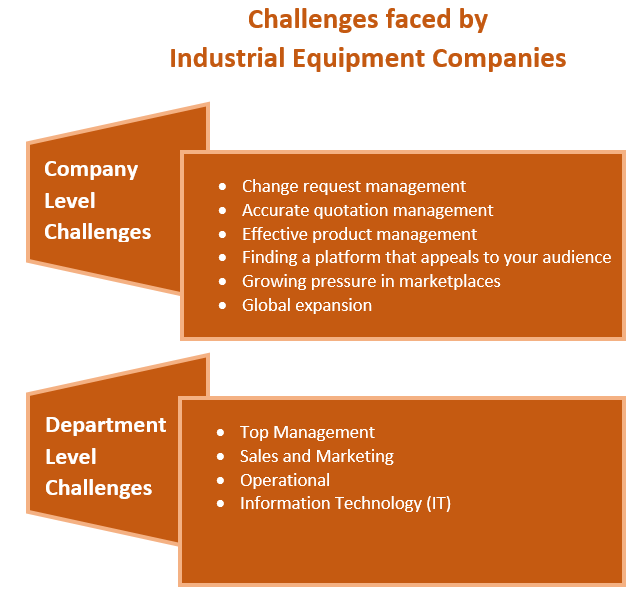
While helping varied brands of different sectors to grow and sustain, the Industrial Equipment companies are dealing with several challenges such as

  • Complex business process
  • Least effective management of organizational data
  • Lack of business insights
  • Incapability of understanding the customer behavior
  • Lack of proficiency in delivering the personalized experience
  • Complicated process for online product selling
  • Lack of provisioning for updating the content on the website or B2B or B2C or B2B2C stores as and when required

With the help of a digital platform, it becomes easier for Industrial Equipment companies to deal with such issues efficiently.

Apart from that, the Industrial Equipment companies also deal with several departmental challenges. In an Industrial Equipment company, different teams are facing various technical and functional issues.

Let’s have an overview of different level challenges in an Industrial Equipment company.

Top Management

The top management of the company involves a team of C-level executives, Managing Directors, Directors, and other leadership positions. They do not deal with every single problem of the organizations.

The top management of the Industrial Equipment company is more concerned about having a single source of truth for all the organizational data, faster time-to-market of industrial equipment products, faster turnaround time, delivering personalized customer experiences, centralized management of essential brand assets, and more.

Sales and Marketing Teams

Most of the challenges faced by the sales and marketing team of Industrial Equipment companies are related to cataloging, personalization, and pricing.

If we elaborate on this in detail, the Sales and Marketing teams need quick access to the updated information related to products or services.

Apart from this, these teams need to deal with the problems of managing and sharing in-stock product quantity, creating custom questions for each customer, managing promotions, sharing updated technical details of products, determining the price, updating the product quantity, and more.

Operational Team

In an Industrial Equipment organization, the operational team deals with the challenges related to data collection, data aggregation, data syndication, data consolidation, generating quotations on time for dealers and suppliers, managing thousands of product data with hundreds of attributes of each effectively, sharing pricing updates, and more.

Information Technology (IT) Team

The key job of the IT team is to manage the organizational data by ensuring security and efficiency. As the data is scattered across the different enterprise systems and third-party applications, the IT team is responsible to synchronize all the data and manage it in a centralized location.

Along with these, they also need to deal with the challenges of data enrichment, data duplication, data merging, data cleaning, data aggregation, data update, and more.

When your data is available across different systems, it becomes challenging for them to generate MIS reports on time.

All the organizations who are facing any or many or all these challenges need to analyze these issues. While analyzing the challenges, you will get clarity on the essence of effective data management and can address all the problems.

With the right digital platforms, you can manage all the data in a single location. Beyond that, you can get meaningful business insights that help to make the right business decisions at the right time. Also, it boosts team productivity by streamlining and automating various business processes. Eventually, it ensures the success of your venture.

“What is a digital platform?” If you are not aware of the term “Digital Platform” this is the obvious question.

Let’s have a brief introduction to Digital Platform.

What is a Digital Platform?

The digital platform is a technology model that allows companies to manage their data in a centralized location, understand their business, customer, and market needs, and optimize their business process with the changing market trends.

It works as a centralized repository of your critical business data including product, product attributes, customers, media assets, eCommerce, marketing, content, and more. Along with internal data, robust digital platforms allow companies to manage the data related to other business entities such as distributors, vendors, employees, accounting, etc.

If you are interested in exploring more about the Digital Platform, don’t miss to read What is a Digital Platform? Everything You Need to Know about Digital Platforms.

How a Digital Platform addresses the challenges of Industrial Equipment companies?

There is a wide variety of digital platforms available in the market. They all offer different types of solutions to the brands to streamline the various business processes and make the right and data-driven business decisions.

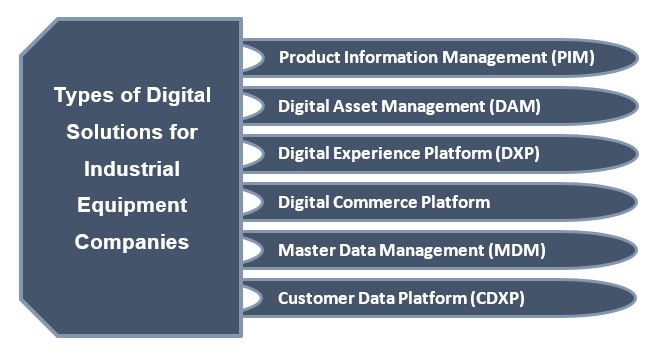
Product Information Management (PIM)

Industrial Equipment companies usually deal with 5 to 5000 small to large scale equipment products. All these products have 10 to 10000 different attributes. So, the Industrial Equipment organization has to manage such a massive volume of product data.

How do you manage all your product data?

Probably, you are managing product-related information in ERP, excel sheets, PDFs, and other systems manually.

If you are managing the product information through this approach, then I am pretty sure product data management and analysis become challenging for you. Even, when your product data is scattered across different systems, data aggregation and consolidation becomes a headache.

How A Product Information Management (PIM) Solution Helps Industrial Equipment Companies?

Product Information Management solution is inevitable for any product-driven company and so for Industrial Equipment brands. It collects, stores, manages, aggregates, syndicates, consolidates, enriches, and distributes the product information across different output channels from a single platform.

Being a centralized repository of all your product data, it becomes easy for your different departments to access the product data quickly, update the data as and when needed, and share the updated data with internal and external users of the organization.

To learn about Product Information Management in detail, read What is PIM? – An Ultimate Guide for Product Information Management.

Core qualities of a Product Information Management solution

Industrial Equipment companies should implement the Product Information Management (PIM) solution to optimize their product data management processes and practices. PIM allows Industrial Equipment organizations to

  • Manage a large number of product data effectively in a single platform
  • Determine the data models to manage your product information in a logical and structured way
  • Integrate any number of your existing enterprise systems, third party application or software, and database effortlessly
  • Provide a consolidated and aggregated view of all your equipment product data
  • Update the product quantity on the fly
  • Manage and share the available equipment product quantity with all the users
  • Zero chances of data duplication
  • Perform the processes of data cleaning, data enrichment, and data merging seamlessly
  • Allow your varied teams to access and update the product data on the fly

If you have made up your mind to implement a Product Information Management solution for your Industrial Equipment organization, you must read Product Information Management: The Ultimate Buyer’s Guide.

Essential features of a Product Information Management (PIM) solution

All the above-listed capabilities of a PIM solution are thanks to the robust feature set it. Enabling the Industrial Equipment organizations with advanced features, PIM not only manages the product data but also provides better insights about the different products.

Let’s have a quick overview of the core features of the Product Information Management solution.

Basic Features of Product Information Management (PIM)Enterprise-class Features of Product Data Management (PIM)
  • Data Modeling
  •  Product Experience Portal
  • Data Management
  • Product Data Syndication
  • Data Quality Management
  • Marketplace Integration
  • Workflow Management
  • Product Feed Management
  • Digital Asset Management
  • Enterprise Translation Management
  • Omnichannel Publishing
  • Microsoft/Adobe Integration
  • Apps and Data Integration
  • Enterprise Print Publishing

There are many other essential features of the Product Information Management solution that you should consider. Get better insights through Must Have Features of the Product Information Management System.

Digital Asset Management (DAM)

Almost all the small and mid-sized Industrial Equipment companies manage their media assets in the local computer, intranet, and other specific media management tools or software.

Let me first clear, by the word media assets, here all I mean is the images, videos, documents (PDFs, manuals, user guide, etc.), graphics, marketing, and sales collaterals, and many other types of digital files.

When all these digital assets are available in different systems in a scattered way, you cannot aggregate and consolidate the media assets with other relevant data. In the absence of aggregation capabilities, sharing the digital assets with your internal or external users will become a tedious and time-consuming job.

How a Digital Asset Management (DAM) solution helps Industrial Equipment companies?

Considering Digital Asset Management with outstanding features, you can manage all your critical media assets in a centralized location. It contains many advanced abilities that simplify several image-related tasks.

One of the most tedious tasks related to media assets is to resize the files as per the specific requirements of your intended platforms.

For example; you have used an image in a blog. Now, the same image you want to use for your social media platforms while promoting that particular blog post. Of course, you need to resize the image as per the specific instructions of each platform. DAM allows you to pre-set the size as per your needs and leverage the automated resize of any image.

Moreover, the DAM solution ensures management, consolidation, and aggregation of any amount of digital assets, regardless of any type.

To enrich your understanding of the Digital Asset Management platform, visit An Ultimate Guide to Digital Asset Management (DAM).

There are a lot more abilities you can access by implementing the right Digital Asset Management solution.

Let’s get clarity on the capabilities of Digital Asset Management that are simply amazing.

Core qualities of a Digital Asset Management solution

Implementation of a Digital Asset Management solution ensures the storage and management of all your media assets in a single location in a logical and structured way.

Other essential capabilities of DAM involves:

  • Allows to manage 360-degree images, scheduling, versioning, face recognition, image editing, and more
  • Supports 220+ file format including PNG, JPEG, SVG, office documents, PDF, bitmap, vector, and many other video codecs
  • Consistent and easy metadata management of digital assets
  • Effective management of different types of metadata that involves
    • Technical Metadata (grocery, database, etc.)
    • Descriptive Metadata (title, keywords, file type, and more)
    • Administrative Metadata (licensing details, geographical parameters, date created, expiration dates, and more)
    • Process Metadata (project, approver, status, and more)
  • Provides multilingual support to create and manage metadata
  • Manage metadata in an organized way

Now when you have clarity on DAM and its capabilities, you might be convinced to dig deep into Digital Asset Management from select the right DAM solution for your company.

Read Digital Asset Management (DAM): An Ultimate Buyer’s Guide to ensure you are making the right buying decision.

Essential features of a Digital Asset Management (DAM) solution

To enable the Industrial Equipment companies with the effective management of media assets, Digital Asset Management provides a wide variety of features. Here’re some of the highly essential features that you consider while choosing a DAM solution.

Digital Asset Management Solution Features

Basic Features of Digital Asset Management (DAM)Enterprise-class Features of Digital Asset Management (DAM)
  • File Management
  •  Asset Experience Portal
  • Metadata Management
  • Brand Hub and Asset Sharing
  • Image and Video Conversion
  • Microsoft and Adobe Integration
  • Works with Any File Type
  • Direct Editing
  • Workflow Management
  • Enterprise Print Publishing
  • Omnichannel Publishing
  • Enterprise Metadata

After getting a brief overview of the DAM solution, you might be thinking about how to recognize that your Industrial Equipment business needs a DAM solution. Go through 36 Signs That Proves Your Business Needs a Digital Asset Management (DAM) Solution.

If you are witnessing any signs mentioned in the post, it’s high time that you need to implement a DAM to save a lot of time and effort for your team and gain monetary benefits.

Digital Experience Platform (DXP)/ Content Management System (CMS)

Personalization is the key to success these days.

Customer engagement is always a challenge for any business. By proposing a product to your all customers with the same content, you cannot drag their attention. You need to provide them the personalized content that directly triggers their pain points and requirements.

Content personalization is not enough.

You cannot target customers from different regions through one single language. You need to share the content in the native language preferred by your consumers. Then only they can understand your offerings and connect with your brand.

Also, to attain tremendous customer engagement, you need to cover all the customer touchpoints where your target audience is available and active.

How a Digital Experience Platform (DXP) solution helps Industrial Equipment companies?

Digital Experience Platform helps Industrial Equipment companies to deal with their personalization-related requirements seamlessly.

The platform contains the capabilities of customer data management and analytics that allow you to manage, deliver and optimize the contextual experience of your target audience.

By creating personalized customer experiences, you can drive immense customer engagement and conversion.

Additionally, the Digital Experience Platform provides multi-lingual support to help you with regional targeting. Create a customer-facing interface in the native language of your target audience so they can connect with your brands and make timely buying decisions.

Core qualities of a Digital Experience Platform

To create the contextualized content, the Digital Experience Platform contains various capabilities that include

  • Manage community, commerce, and content in a single solution
  • Integrate your existing enterprise systems and third-party applications with DXP
  • Create and deliver personalized and relevant content to the customers
  • Distribute and publish high-quality data on varied sales and marketing channels
  • Manage any number of pages, media assets, products, etc. from a single platform that is edited by hundreds of editors in a month and visited by tons of visitors
  • Allows for multi-channel publishing regardless of digital, print, and social
  • Delivering personalized customer experiences in real-time
  • Integrated customer data module for marketing automation
  • A seamless amalgamation of content and commerce to deliver robust customer experiences

Essential features of a Digital Experience Platform (DXP)

To enable the Industrial Equipment companies with personalization facilities, the Digital Experience Platform offers so many advanced features.

Digital Experience Platform feature set involves

  • Web Content Management
  • Multi-channel Delivery
  • Personalization and Analytics
  • Print-Publishing (web2Print)
  • Integrated Product Information Management

Harness the full potential of DXP by creating and distributing the content that interests your target audience. It directly impacts our number of customers and conversion ratio.

Master Data Management (MDM)

There are digital platforms that enable you to manage the information related to products, customers, eCommerce, and digital assets. You can organize all these data in a well-defined structure.

What about other types of organizational data?

I mean, you also need to manage additional information such as data related to suppliers, distributors, accounts, employees, and more.

Probably you are managing all this information in other software. So, you need to bear the cost of software implementation and integration.

And, still, your data can be synchronized but it cannot enable you with an easy aggregation, consolidation, and syndication of all business information. To get better business insights, you need to look into all these different business information separately.

How a Master Data Management (MDM) solution helps Industrial Equipment companies?

Opting for the right Master Data Management solution for your Industrial Equipment organization, you can manage all your business data in a single platform, in a structured way. Not only that. You can define different categories and attributes for your business data.

In other words, MDM is the ultimate platform to access and manage your different data including products, content, eCommerce, media assets, customers, suppliers, distributors, vendors, accounting, employees, and more.

It allows you to add any number of information in your way. Yes, you can define your own/custom models to manage the data in MDM.

For example; with a Product Information Management solution, you can manage the product details. But every product has many attributes. MDM allows you to manage hundreds of product attributes by defining a flexible data model. The same could apply to other data as well.

Well, don’t confuse Master Data Management with Product Information Management. They are different from each other. Want to know how? Read PIM vs. MDM: A Detailed Comparison that Leaves You with No Confusion.

Basically, Master Data Management is the single source of truth for all your business data.

As MDM allows you to manage all the data centrally, you can have freedom from storing and managing the data in different systems. And, you need to access one solution to get all critical business insights on the fly.

If you want to learn about the MDM and its benefits in detail, check out What is Master Data Management & How Can It Benefit Your Business?

Core qualities of a Master Data Management solution

Master Data Management is the master record of all your business information. It manages the massive data with assured security and effectiveness.

  • Advanced capabilities of Master Data Management includes
  • Collect and aggregate a wide variety of data from different business systems
  • Update and aggregate all the organizational data in a single solution
  • Integrate all your existing enterprise systems and third-party applications with MDM
  • Create custom quotations for dealers, suppliers and distributors accurately and quickly
  • Attain faster time-to-market of data
  • Generate MIS reports on time

MDM enables you with the data hierarchy, data structure, data enrichment, data versioning, and data validation facilities. You can leverage these facilities for documentation, translation, descriptions, attributes, and other data.

All the Industrial Equipment companies do not only deal with product or eCommerce or content or digital assets. They have to manage other business information too.

Master Data Management allows the Industrial Equipment companies to manage the data related to various external and internal resources such as suppliers, vendors, distributors, etc., and human resources, employees, accounting, administration, etc. respectively.

So why invest in different systems or software when you can manage all the data in a single one. Go for MDM and make a smart choice.

Are you excited to know more about MDM and its different aspects? Visit our thought leadership on Master Data Management.

Essential features of a Master Data Management (MDM) solution

To enables the Industrial Equipment companies with the effective management of business data, MDM is backed by amazing features that include

Master Data Management Solution Features

Basic Features of Master Data Management (MDM)Enterprise-class Features of Master Data Management (MDM)
  • Data Modeling
  •  Product Experience Portal
  • Data Management
  • Data Syndication
  • Data Quality Management
  • Marketplace Integration
  • Workflow Management
  • Feed Management
  • Digital Asset Management
  • Enterprise Translation Management
  • Omnichannel Publishing
  • Microsoft/Adobe Integration
  • Apps and Data Integration
  • Enterprise Print Publishing

To learn about more features with comprehensive details, read Essential Features of a Robust Master Data Management (MDM) Solution.

If you are impressed with MDM abilities, realize that your Industrial Equipment business needs one, and want to implement the right one, but don’t know which one to pick. Read 11 Best Master Data Management Tools You Should Consider.

Digital Commerce Platform

Online business is not only an option in this highly competitive time. It’s a necessity. An online store drives more opportunities in terms of generating business in comparison to a physical store. Investment required in establishing a physical store is quite higher than creating and running an online store.

In the absence of an eCommerce platform, it becomes difficult for you to reach out to a large customer base and market and sell your wide variety of products and services.

Well, online commerce is a popular and widely adopted approach in this competitive era. Every business is promoting and selling its products through either its own eCommerce store or leading marketplaces.

Thus, it won’t be easy for an Industrial Equipment company to pave the path of success just by establishing an eCommerce portal. They need to go the extra mile too to stand out of the industry crowd.

How a Digital Commerce Platform helps Industrial Equipment companies?

With the help of the Digital Commerce Platform, Industrial Equipment brands can do much more beyond just promoting and selling the products.

It allows you to create and deliver personalized shopping experiences for the target audience and helps you drive immense customer engagement and conversion. Additionally, consider a feature-rich Digital Commerce Platform for your Industrial Equipment business, you can attain all your sales and revenue-related targets.

Embracing the potential of the Digital Commerce Platform, Industrial Equipment companies can develop different eCommerce portals as per their business nature and needs.

Business to Customer (B2C)

In the B2C business model, the Industrial Equipment companies are directly selling to the consumers through an eCommerce store or marketplace. Usually, the required quantity of the products is limited per customer. Also, it has less complex pricing and product structure.

Business to Business (B2B)

In this model, the Industrial Equipment companies are selling the products to wholesalers or retailers, or other companies. Mostly, they receive orders in bulk. Industrial Equipment organizations with B2B models need to deal with complex product and pricing structures.

Business to Business to Customer (B2B2C)

As this model involves multiple stakeholders, it is quite complicated. It allows the Industrial Equipment companies to sell the products to the wholesaler, retailers, and other companies as well as the consumers too.

A B2B2C digital commerce solution has highly complicated pricing and product structure as Industrial Equipment needs to address the varied requirements of two different target audiences.

Developing a Digital Commerce Platform, you can have a cost-effective platform to connect with your multiple stockholders. Apart from that, Industrial Equipment companies can leverage reduced product time-to-market, increased sales, and improved revenue.

Core qualities of a Digital Commerce Platform

While developing a Digital Commerce Platform for your B2C, B2B, and B2B2C business, every business has different requirements as well as some common set of needs. To address different requirements of the different businesses, the Digital Commerce Platform contains a wide range of capabilities.

Capabilities of B2C solutions

  • Create and deliver extremely personalized customer experiences across the different customer touchpoints in a real-time omnichannel environment.

Capabilities of B2B solutions

  • Create and manage multiple catalogs
  • Allows to manage complex product and pricing structure
  • Manage multiple currencies
  • Provides multi-lingual support
  • Manage price lists and reviews of all products
  • Highly secured checkout process
  • Manage promotions with extreme flexibility
  • Manage multiple front-end apps, and more…

Capabilities of B2B2C solutions

  • A mixture of B2B and B2C capabilities

Common capabilities of B2C, B2B, and B2B2C solutions

  • Digital Commerce Platform allows Industrial Equipment companies to run promotions and sell products
  • Allows to update product catalogs as and when needed to reduce product churn rate
  • Enable buyers with the customer-specific checkout process
  • Offer discounts to specific customers
  • The component-driven structure allows the development of highly flexible and scalable B2C, B2B, and B2B2C eCommerce solutions
  • Define specific pricing for different customer segments
  • Leverage content and commerce to create and deliver personalized experiences for the customers by sending them relevant and contextual messages
  • Create customized quotation for each customer with the least human intervention
  • Access to the advanced features and functionality such as price calculation, checkout processes, shopping cart management, product filtering, and more.
  • Manage end-to-end order processing through the order management module
  • Update the product pricing and share the updated pricing data across the company, and more…

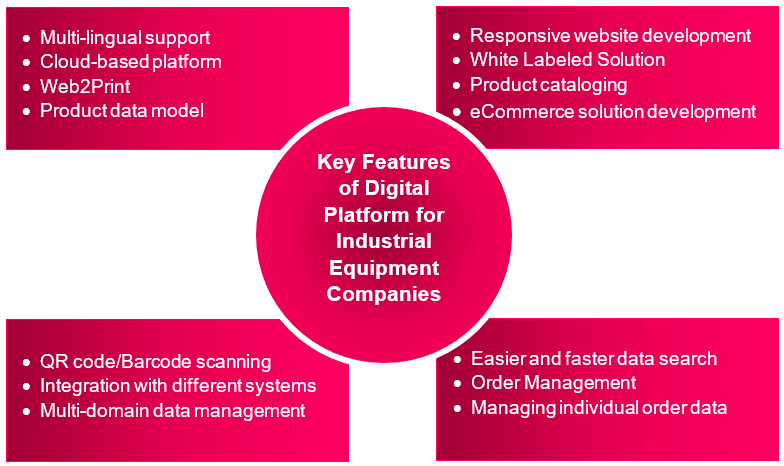
Essential features of a Digital Commerce Platform

All the above-listed capabilities are due to the advanced features offered by the Digital Platform solution.

To address varied requirements of the Industry Equipment companies and their different types of customer base, the Digital Commerce platform offers the right mixture of commerce, content, and Product Information Management.

So, the feature set of Digital Commerce Platform is divided into three categories as listed below.

Digital Commerce Platform Features

Digital Commerce PlatformEssential Features
B2B & B2B eCommerce Framework
  • Framework Driven Approach
  • Digital Storefront
  • Product Search and Filtering
  • Shopping Cart
  • Price Calculation and Abilities
  • Promotions
  • Order Management
  • Checkout
Customer Experience Platform
  • Content Commerce
  • Personalization
  • Multichannel Commerce
PIM for eCommerce
  • Data Management
  • Configure/Price/Quote (CPQ) Tools

Customer Data Platform (CDP)

Personalization is an essential aspect of success. But, do you think without knowing your customers you can achieve real personalization?

Certainly, that’s impossible.

You need to track your customer behavior across the different sales and marketing channels and analyze the data to identify their preferences. After that, you will be able to sell what they are looking for or interested in.

Now you might have a question: how to design your personalization strategy?

Well, you can harness the potential of Customer Data Platform to define the right personalization strategy for each of your customers.

How a Customer Data Platform (CDP) helps Industrial Equipment companies?

Customer Data Platform is the solution that allows you to manage all information about your customer in a centralized location.

Industrial Equipment companies can collect, manage, and aggregate customer activities across the varied touchpoints using the Customer Data Platform. It also enables you with a unified view of all customer-related data. In other words, CDP provides a 360-degree view of each customer.

When you have all the data about your customer including their region, preferences, demographics, customer targeting becomes easier for you. Providing the customer preferences, CDP not only drives immense customer engagement but also increases the conversion rate.

Enabling you with exclusive insights about your customer, CDP allows you to define customer segments and design the personalization strategy for promotions, discounts, offers, and more.

By implementing the right Customer Data Platform solution, Industrial Equipment companies can efficiently deal with customer-related problems and marketing-associated challenges efficiency.

Core qualities of a Customer Data Platform

Customer Data Platform allows the Industrial Equipment companies to learn each detail about their customers. The core capabilities of the CDP consists of

  • Manage the customer data in a well-organized and structured way
  • Leverage customer data classification and attribute management using the Customer Data Modeling of CDP
  • Connect multiple devices using the Customer Data Platform to identify the unique customers and remove the possibilities of customer data duplication
  • Collect, store, manage and aggregate each customer information from an online solution or offline platforms (first-party apps or third party systems) in real-time
  • CDP provides customer segmentation and on-site behavioral targeting to create and deliver contextualized customer experiences by providing real-time implicate and explicate
  • Customer Management Framework automates all actions associated with the customers, based on the predefined rules

Essential features of a Customer Data Platform (CDP) solution

To enable the Industrial Equipment companies with effective segmentation, targeting, and personalization, Customer Data Platform provides a wide variety of features including

  • Customer Data Integration
  • Profile Unification
  • Customer Data Modeling
  • Real-time Personalization
  • Automation

I guess now you have information about all the possible digital solutions that you can build using the leading Digital Platforms.

You might be in a dilemma about what if I need one or two solutions and not all.

Let’s talk about that.

What if I do not need all the digital solutions and just some of them?

It is not mandatory for any Industrial Equipment company to implement all the solutions together.

Every business has different needs and challenges. To deal with these issues and requirements, they need a specific solution(s). From the above list, you have the freedom to select any or many or all the digital solutions as per your specific business needs.

For example; you need to develop an online store to promote and sell your products. In such a case, you need to consider Product Information Management, Digital Experience Platform, and Digital Commerce platform.

The rest of the solutions you can consider are based on your needs.

For instance; you can manage the product-related media assets in PIM too. But, the implementation of Digital Asset Management allows you to manage the media assets in a far better way than PIM.

These solutions support each other to perform your various processes seamlessly. However, you can choose the number of solutions you want.

At Credencys, we have a team of certified developers who build and implement an advanced Digital Platform that contains all these solutions. We also hold expertise in developing and implementing the custom solution considering your selected solutions.

Thus, you don’t need to build a digital platform using all the six types of solutions listed here. You have the flexibility to choose as per your business requirements.

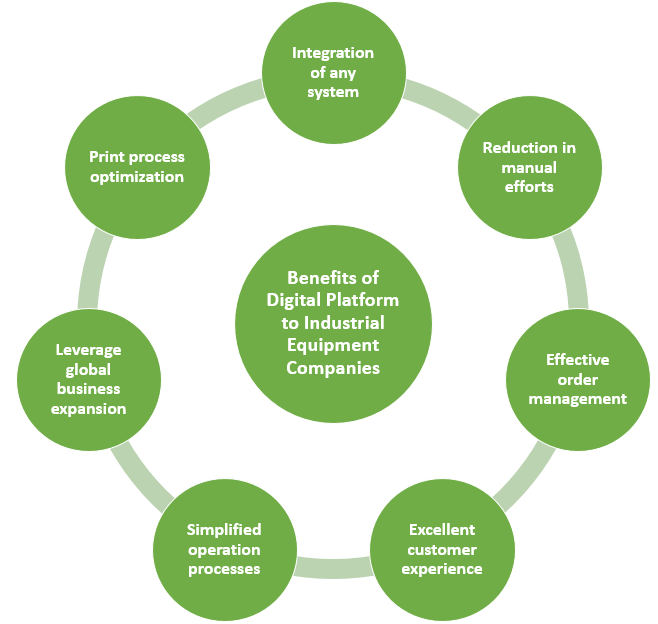
Benefits that Industrial Equipment Companies can expect from Digital Platform

Faster product time-to-market

Industrial Equipment companies can attain this benefit through the Product Information Management solution.

PIM allows brands to collect, store, manage, enrich, aggregate, syndicate, consolidate and distribute the product information across different sales and marketing channels from a single location.

Through an automated and streamlined process of product data management, PIM helps companies improve product time-to-market.

When the Industrial Equipment companies manage the unique information about their equipment, they can use the Master Data Management components along with PIM.

PIM ensures to deliver consistent customer experience across the multiple output channels. It also extends or improves the product assortment.

Leveraging PIM and MDM capabilities, Industrial Equipment brands can make new product onboarding easier, automated, and quicker.

Single source of truth for all your data

Whether you use any of the above-listed solutions separately or use them with other solutions, they all enable you with this benefit. They all provide you a single source of truth for all your data related to their specific categories.

Let’s see how.

Product Information Management (PIM) – you can access every data related to your wide variety of products. It provides an aggregated view of all product information. You can easily consolidate one product with others.

Digital Asset Management (DAM) – It’s a single source of truth for all your media assets such as images, videos, documents, animations, graphics, illustrators, and more. You can store, and manage any number of media assets in the DAM. You can seamlessly consolidate the media assets with the relevant products and departments.

Master Data Management (MDM) – You can add any number of data related to any functional process in the MDM. It enables you with a centralized repository of all your critical business data. You can consolidate any data with the other relevant data as per your requirement.

Digital Experience Platform (DXP) – Manage all your content through Digital Experience Platform regardless of your website, eStore, marketplace, etc. You can manage the content of your multiple websites as well.

For example; you have a website. And you want to target multiple regions. Digital Experience Platform allows you to develop and implement different websites for different regions with their regional languages and manage all these websites through a single platform.

Moreover, you can manage personalization activities for all the online platforms using DXP.

Allowing you to create and manage content in a centralized repository, DXP saves a lot of time and effort of your team for managing the different presence.

Digital Commerce Platform – It is a centralized location to store, manage and track all your eCommerce-related data. It aggregates and consolidates your B2B, B2C, and B2B2C business data. You can check the details on the fly.

Customer Data Platform (CDP) – For effective personalization, you must know your customers. Customer Data Platform helps Industrial Equipment companies in collecting and analyzing all the customer information. You can define the client segmentation.

Later on, for different customers, you can define suitable pricing, offers, discounts, and more.

Also, by tracking the customer behavior across all your digital platforms, you can get insights into their preferences. Based on their preferences, you can define a personalization strategy for each of your customers.

Enriched customer experience

To deliver a compelling customer experience, Industrial Equipment companies can utilize the Digital Experience Platform. It enables you with the flexibility to update and change the content as per the changing market needs.

Leverage web analytics and intelligence of DXP for data collection, user profiling, behavioral targeting, and more. Using web analytics, you can track and analyze your customer journey and understand their requirements.

Once you know about your customers, it becomes easier to create and deliver personalized shopping experiences by suggesting them to the products or services they are interested in. When the customer comes across something that they are looking for, they make the buying decisions instantly.

Design and deliver engaging customer journeys and personalized shopping experience by leveraging the right mixture for context, content, and commerce by implementing the right Digital Experience Platform.

Faster turnaround time

Consideration of Digital Platform automates many of the data-driven activities of your organization. It saves a lot of time and effort for your different teams such as production, sales, marketing, etc.

For example; a digital platform allows you to automate and streamlines the entire eCommerce process that starts with generating quotations and ends with the secured checkout process.

Select a digital platform smartly so you can access all the advanced capabilities of it.

Better team collaboration

Implementing a reliable digital platform, you manage all your organization data in a centralized repository and share the data across the organization. Your different teams can access the updated business data.

As all the teams can access the same information, there are fewer chances of communication gaps amongst the teams and eventually, you can improve the cross-team collaboration. When your sales, marketing, production, accounting, and other departments have correct collaboration, they together deliver the best customer experience.

Make the data-driven strategic decisions

All the data is available to your respective teams. With the proper and detailed analysis of each data, you can get insights into the varied business aspects.

Moreover, by implementing advanced digital platforms you cannot have access to the raw data. The solution enables you with consolidated, aggregated, and meaningful data that enables you with a complete overview of the overall business.

When you have clarity on varied business aspects, you can make the right business decision faster.

Integration with third-party systems

The modern age digital platforms not only enable you with the structured management of data but also allows you to integrate any of your existing enterprise systems and third-party software or application with the digital platform.

Every organization has established a set of systems such as Enterprise Resource Planning (ERP), Project Management, Customer Relation Management (CRM), sales tools, marketing-related solution, Human Resource Management solutions, Accounting software, graphic design software, and more.

You can integrate all your software with the digital platforms and set the bidirectional data flow amongst all the systems. It allows you to access the updated data across all the systems at any point in time.

Cost-effectiveness

Different types of digital platforms are available in the market. You need to choose from the options like on-premise, open-source, and hybrid digital platforms. But, the highly cost-effective one is open-source digital platforms. Such platforms are available for implementation at zero licensing cost.

In open source solutions, all you need to pay is for customization and implementation of a digital platform as per your specific business requirements.

As we have already discussed, you need to consider all the solutions and all the features listed here. You need to build and implement the solutions that you need.

Improved conversion ratio

To boost the customer conversion ratio, you need not use only one digital solution listed here. It’s the overall impact of the right set of digital solutions. Every digital solution contributes to increasing customer conversion from one or another way by increasing customer engagement with your different online portals.

For example; you have developed a digital platform using product information management. It allows you to not only collect and manage the product information but also enrich, aggregate, consolidate, syndicate, and distribute data across the different channels by making them compatible with different digital platforms.

It allows Industrial Equipment companies to sell and promote their products across different platforms such as marketplace, web, social media, eCommerce store, mobile, in-store, and more to create and deliver a consistent and seamless omnichannel experience.

Offering a consistent customer experience, Industrial Equipment organizations can earn the customer trust. When you add the flavor of personalization, it’s like icing on the cake. It reduces the decision-making time of the customers and increases the number of conversions.

Why is Pimcore the best choice to build digital solutions for Industrial Equipment companies?

Considering a Digital Platform like Pimcore, you can build a comprehensive solution that allows you to build all the above types of solutions under a single platform.

Yes, you heard it right.

Pimcore is the most trusted Digital Platform among others. It offers Product Information Management, Digital Asset Management, Master Data Management, Customer Data Platform, Digital Commerce Platform, and Digital Experience Platform under a single solution.

It enables Industrial Equipment companies to build advanced digital solutions that meet all the organizational goals and changing marketing needs.

We have a team of certified Pimcore developers who have developed and implemented digital solutions successfully for different industry domains. To learn about our competencies, you can read case studies of Kenmare and IronList.

Conclusion

So, are you ready to skyrocket your Industrial Equipment business by implementing the right digital platform?

I guess after knowing how the different types of digital solutions contribute to your business growth and success, you have got clarity on what benefits you can avail out of these solutions. Thus, your answer will be positive.

If you are aware of your business requirements and challenges that you can address using varied digital solutions, you can connect with our certified developer who offers end-to-end Pimcore development services to build and implement the custom solution that addresses your business needs.

Book a 30 minutes free consultation with Credencys experts to discuss

  • Your Industrial Equipment business challenges or requirements
  • How does the implementation of digital platforms make a difference to your existing business?
  • Which solution(s) you should consider addressing your precise requirements or challenges?

Leverage our proven experience in developing cutting-edge digital solutions for varied industry domains. We have worked with all sizes of organizations from startups to multinational companies and delivered them the robust digital solution that helps them to attain their ultimate business goals.

We suggest you the right set of solutions and features to build a perfect digital platform for your organization. It helps you reduce overhead costs by streamlining and automating your various business resources as well as increase the revenue by delivering wonderful customer experiences.

11 Best Digital Experience Platforms to check out in 2023 for Digital Transformation

Digital experience platforms have recently emerged so it is important to know what it actually does. Many companies feel like they are not capable of performing and keeping the standard of the company which it should be or as expected. To make a smooth process for the company, the Best Digital Experience Platform comes into the picture.

Why Do You Need a Digital Experience Platform (DXP)?

Running a business is never going to be easy in today’s heavy competition. Most of the modern age business owners get the natural fear of falling behind their competitors. Being abreast with all the latest and advanced technology is one of the ultimate things that every businessman does.

The Best Digital Experience Platform (DXP) will reap your business to the new high with its excellence. DXP plays a significant role in alerting your business to downward trends and improving your business culture by boosting employee experience along with boosting customer satisfaction.

If you are not willing to leave your business behind, then you should desperately need to invest it. Investing in DXP would be the smart move as it allows you to look forward to your business growth rather than keep concentrating on your business operation.

This software is used to meet the company’s ultimate goal of customer satisfaction. If a company is going through digital transformation, DXP helps them in meeting their goals. Here are the key features of Digital Experience Platform (DXP) that helps enterprise a lot for its growth.

Key Features of Digital Experience Platform (DXP)

  • DXP has the tendency of improving business culture and progress towards positive. And this is done by DXP by easing the communication, strong integration, and also through personalization.
  • Though, you can find several tools for improving business operation. But none of them was specifically designed to tandem the business operation as DXP. The platform simply improves the efficiency of your business operation that plays a key role in gaining an edge over the competitors.
  • The DXP platform with the aid of evolving technology smoothens the business integration process. This plays a vital role in improving the employee experience and customer satisfaction rate tremendously.
  • DXP platform acts as a cost-effective solution for businesses that look to streamline their internal communication.
  • The embracing technology possessed by the DXP platform allows business owners to focus on their business goals by leaving the business operation to the platform.
  • This Digital Experience Platform is specially designed to evolve on its own and help the business to grow its full potential.
  • The DXP has high flexibility that avoids business owners or developers from costly redesigning operations as per their requirements.
  • The efficient digital infrastructure provided by DXP allows developers to find innovative solutions for boosting business operation at a faster pace.
  • DXP manages, creates, and handles content and asset management on a larger scale. DXP provides services for the company, services of digitizes business operations, gives actionable customer insights, and delivers a better customer experience. It continuously makes websites, portals, and applications better. DXP can integrate with existing tools easily to perform efficiently.

Top 11 Best Digital Experience Platforms

In today’s market, you can find numerous brands releasing DXP software. Each one of them has its own features and tendencies. It is essential for the business owners to pick the right DXP platform for their business that suits well for their requirements for experiencing high benefits.

1. Pimcore

It is also one of the best and must look at the platform while talking about DXP. It combines two platforms into a single digital platform for better deliveries- it combines data management and experience management. It can collaborate easily with the existing IT system and makes data transfer flawless, with a flexible and API-driven approach.

It is an open-source DXP and has global existence and connection in many countries. This DXP is available for enterprises, agencies, and for developers at zero license cost. It is the best DXP for developers and marketers. It gives customer-oriented, personalized, and optimized solutions and even offers free trials.

2. Nuxeo Platform

Nuxeo Platform is an open-source platform, data can be stored in an SQL database. It provides a low-code approach in the development of centric applications. It helps in accelerating products into the market, in the decision-making process, and in enhancing the customer experience with its smart built content-centric application. Nuxeo platform is built with an open development model.

Some basic uses of this platform are Document management, content management, knowledge management, and digital asset management. It does not matter how big in size the data or content is, this platform helps organizations in finding that stored data, gives easy and secured access, and helps them in using that information across multi-channels, applications, and business units.

3. Adobe Experience Manager

This platform simply connects digital asset management with the content management system. Through its content management system, it makes sure that your content is consistent and personalized for a particular customer. With its automated tools, it manages and creates your digital experience flawlessly on all channels.

Through its digital asset management system, it helps you in finding, adapting, and delivering assets throughout all channels with its automated smart tools more quickly and with better accuracy. This platform helps in making the communication process faster by connecting forms to communication processes. It also has a feature of cloud service and helps in giving optimal cloud performance.

4. Acquia

Its open DXP offers rapid digital transformation. To grow easily with freedom and without having constraints this platform helps IT and marketing teams in easy-to-use tools, with customer data and contents. For developers, IT, and marketing it is flexible, comprising business capabilities.

Its traditional marketing cloud solution takes care of the execution and activation process. It is the only platform to provide breakdown technology; it collects data from different channels and filters them out, combines them, and provides useful unified data for 360 customer view.

5. Usersnap

This platform is very important in getting feedback; your company could only grow if it knows where it stands. It helps in getting feedback so a business can understand, analyze, process, and can improve their companies by monitoring the feedback, and can know their growth and downs. More than 20,000 companies, including Microsoft and Facebook, have used Usersnap in getting customer feedback.

It has key features of bug tracking, feature requests, and visual design feedback. Despite having key features and maximum benefits a company could incur, it has a minimum starting price which any company can afford easily.

6. Contentstack

With modern CMS, this platform accelerates the delivery of digital assets. It brings business and technology together and delivers a personalized digital experience. It can create unlimited content management for business processes and allows developers to build and edit content. It can integrate with existing tools powerfully to accelerate market growth.

This platform helps in better collaboration between business and technology, gives better control to both parties, and helps in getting a higher return on investment. It is easy to use-maintain and empowers business and with rich visual editing, it helps a business is growing.

7. Centralpoint

Many clients around the globe use this platform and the main reason for that is its self-service interaction with secure and authenticated methods. A rich filtered data can be used by you from anywhere by using Centralpoint as it collects data from multiple sources, filters them, and gives rich data. This data can be searched and used from anywhere whenever needed. It is one of the best DXP available.

Its unique solution of automatic metadata, automatic retention policy, and method of simplification of data that is collected from multiple sources makes it unique and must install the platform. It can be implemented in the premise or in the cloud and can be used for any secure portal solutions.

8. Mura

For better customer feedback and retention, this cloud-based software is very useful for businesses as it gives content to digital brands with its cloud service without any technical turbulence. This platform combines with AWS to give a better digital experience to businesses. It is a flexible yet secure platform for digital experience.

With its technical resources and highly trained employees with extensive training, this platform provides 24/7 support. It does not just collaborate with AWS, but it can collaborate with any private cloud to deliver the best result. It is a simple, understandable platform that can be used by any enterprise.

9. dotCMS

It is one of the best digital experience platforms used by many great companies for a better customer experience. This platform runs on the premise and on cloud service too. It creates, manages, stores, and reuses the content with its advanced features. It has key features of workflows, analytics, multi-channel deployment, content authoring, and many.

The main added advantage of this platform is that it can integrate with third-party applications that you might already be using. With its advanced search engines, you can find your assets and data quickly, more efficiently, and retrieve documents too. This platform understands the importance of the content with the highest level of NoCode.

10. Censhare

This platform collects and makes data/content centralized in one platform so that it can be used for marketing on any channel, in any language. Give customers a unique experience helps businesses to focus on their core activities and not spend precious time managing and searching content. The complexity of sharing data is demolished with its global sharing data through central management where content is stored.

With powerful data management and search filters, you can find your content easily and can manage or create your content with fewer efforts and more efficiently. With its personalized content, product information, and digital assets available across multi-channels in different regions and different languages, it is trusted by many renowned brands.

11. Rigor

To get valuable insights into user experience, this platform is very useful. It prevents the problems that your users may experience while using your web. It detects issues affecting your web performance and cloud services. Through visualization and root-cause analysis, it takes immediate action in fixing that particular problem. It collects data from various portals to give better business transactions, third-party tags, and performance budgets.

It turns data into action and helps businesses in using it to get web optimization. It can easily integrate with your sites. With root-cause analysis, it can detect issues faster and quickly resolve them before it could create a problem for you or for your customers. With its ability to detect a problem in web performance, this platform gives you an edge over your competitors. When detection of the issue is done quickly you can lead in the market.

Tips to Choose Right DXP For Your Business

  • Firstly, run a proper analysis of your business and make sure what kind of technology stack you may need for its growth.
  • Now, check with points for what purpose you are in need of a digital experience platform. And sort down the DXP that suits your requirements.
  • Before finalizing, measure the vendor’s integrity and your business goals.
  • Finally, always think in terms of user journey especially on how they interact with your business.

Bottom Line

Thus, these are the top 11 Digital experience platforms to help you in better customer experience, and in keeping customer loyalties. For faster digital experience and for digital transformation using one of the above platforms is necessary. For faster working of the cloud without any restrictions to the usage of any of the above platforms is necessary. For the collection of data, management, and flexibility DXP is important to get the right content with a better customer experience.

All the platforms mentioned above are useful and are mostly used by branded companies globally. The selection of a particular platform completely depends on the nature and need of your business type. To stay ahead in the competition of this digital world, it is absolutely necessary to use any of the platforms, as all are the best digital experience platform.

11 Best Digital Asset Management that You Shouldn’t Miss to Use

To have assets that you cannot utilize at the time of need is as good as nothing to have. When was the last time you had your data (asset) lost and could not utilize it at the right time? To stop it from happening over and over, the best digital asset management is the best option. It is storage for your digital asset to boost up your productivity and profitability.

There are many Digital Asset Management tools that you can choose from, but some of the best are mentioned so that you can make an informed decision before implementing them.

When you already know the type of business and your requirements, and expected results from the solutions of Digital Asset Management, it becomes easier to choose the product. The benefits of all are the same, but functionality and efficiency can differ from product to product.

Based on the needs of your business or the nature of your work, you can make a decision of choosing the product which fits best.

Below are the top 11 best digital asset management lists that you should not miss in 2022 if you want to keep your firm/ business ahead of every competition. This list will help you in comparing all the products and evaluating between them.

11 Best Digital Asset Management Platforms to check out in 2022

1) Pimcore

Pimcore’s Digital Asset Management centralizes all media assets- like images, graphics, documents, any other media content, and videos. It can aggregate, consolidate, and manage any type of media assets.

It not only stores and reshapes the data but also offers high performance to help your e-commerce in operating more efficiently. Workflow becomes smooth after Pimcore; from production to distribution everything becomes flawless.

Pimcore disseminates product data and makes content search quicker to make your digital asset more solid. It also boosts your multi-channel marketing strategy. Its basic feature is to let organizations use Pimcore’s platform to achieve and meet their DAM requirements.

There will not be any inconsistency or inaccurate results after implementing Pimcore. Pimcore also gives you free products before implementation so that you can make know your product exactly before buying it.

Pimcore consolidates the data of digital assets in one single platform, the data which was isolated from one another previously.

2) Widen Collective

This is really useful in sharing data across the web. Its powerful function for search and flexible models of metadata are its unique features. Search and flexibility is at the best in Widen Collective.

With metadata- digital assets can be classified and different users can be assigned to that specific classified data. It helps in delivering content to market persons, to salespeople, and to partners who are going to need that data.

Its analytic feature stands out from others as it lets you know who is using your digital assets—your data. This will give more effective results. A larger management system can be built from a widening collective. It can create, manage, and distribute content to create a powerful platform for asset catalogs and categories.

Widen collective also provides a free demo session before implementation, in this demo they give 30 minutes of their time to make you understand its service and also understand your challenges, a personalized demo with the next procedure.

3) Monday.com

It is a simpler tool for your DAM. It manages the sequence of work in a simple and visually intuitive way. It allocates and prioritizes your work, it can even use different tools to find insights and inform you where everything is placed, and track multiple projects. It has a client management feature that works automatically and sets up a reminder so that you do not miss anything important.

Planning, tracking, and delivering is its basic feature. When automation is done, there are fewer chances of errors so you can save up the cost of human error. With different tools, it lets you visualize your data, can integrate it with your current tools, and can manage everything in one place. With Monday.com you can analyze your projects and tasks easily.

4) Swivle DAM

The swivle makes sure that you have a visual view of your business’s core activities, and you can find your asses-data within seconds with its optimal search engines.

With Swivle one can store unlimited data and can replace cloud storage and servers if ever needed, with ease. It’s an extra feature- on the fly, you can use any variation you want, and it eliminates more time consumption over small things.

With Swivle, you can share content with targeted audiences, clients with portals. Each portal has its own content that is different from others, has unique branding methods, and has unique subdomains.

It can integrate with your existing apps, open any file of Swivel with your existing app; upload your new file with just one touch. Recommendations and approvals come from the one shared file- so it makes its users work collaboratively.

5) MediaBeacon

MediaBeacon is used for the creation of assets, finding those assets, and distributing those assets. It can create an asset with managing workflow-it drags and drops workflow, through project management, and in review and approval, it creates an asset.

It lets you find your assets which are stored easily with its search engines, and saves time and cost both, and eliminates the reproduction cost of an asset.

It empowers your assets, and lets you use them more efficiently. With social posting on branded portals, it helps in distributing asset data to individuals and to teams.

With external links and internal saved searches, MediaBeacon helps in asset dissemination. To design a lifecycle and to save time, MediaBeacon is the best solution.

6) Libris

With Libris, you can centralize digital media in a shared library. It eliminates the specific place for every single product and saves storage. With its smart engine tools of search, it helps in finding files easily and smartly.

Converting and resizing complex desktop software is so easy with Libris. When you are in search of finding assets in urgency, Libris helps you in that because through it every data is safely secured in one place.

It gives access to its users via shared drive, it can send brand materials to concerned parties, can eliminate oversized attached files, and everything is stored in one place so tracking and monitoring become so easy with it. One of the best features of Libris is its capability to convert between graphics formats.

7) Amplifi.io

When data is stored at different places without security there is a chance of data loss, to avoid data loss this DAS software is a must. It stores all the data in one single system so that it creates an automated asset organization for your data.

It is easy to use and data can never be lost with it. It has a system that helps you keep track of your data from anywhere, so whenever or wherever you need it, data is available at the door.

It not only manages digital assets but also helps in distributing them with partners – with customized presentations, with guides it helps you in distributing it.

With the latest technology, this software has made people burden-free, as data is stored automatically and the burden of humans. This software has the highest adoption rate in any organization.

8) Mediavalet

It makes your marketing data-asset, content, and media, centralized so that all the team members can have access to it. All team members should have your business data so that they can have immediate access to data, which they are going to need.

With Mediavalet and its AI-driven objects, discovering assets is easy. Implementation of AI makes business customized.

Mediavalet’s primary function is to boost sales and channel teams with accurate and up-to-date data, which can be accessed from anywhere. Files are being categorized so that they can be easily used when in need. It can create a problem sometimes when two users are using or are working on the same file, but the benefits of Mediavalet are more than the cone.

9) Wedia

Wedia works as a central tool for all digital assets. To have full control over management’s digital assets, and its distribution- Wedia was formed to serve the purpose. It does not affect how small or big a firm you have, or how bigger data of digital assets is. Wedia can manage millions of digital assets. Wedia is trusted by global brands for its benefits and outputs.

All marketing, sales teams around the globe are inclined towards Wedia because of its output more than expected. Wedia also helps with consistency and data quality for larger organizations as well.

The flexibility of internal and local teams can also be enhanced with Wedia. It also gives you access to compliance issues so that you can know what is stopping your marketing activities from getting boosted up.

10) Brandfolder

It is widely believed as the best digital asset management platform for enterprise usability. It helps marketers and managers in distributing their digital assets and also keeps them on track that how they are performing, time to time.

From single-source, Brandfolder helps you in finding assets within seconds which you might be spending hours in finding without Brandfolder. A brand asset is shared easily with Brandfolder.

It has a key feature, named Brand Intelligence that informs you how your assets are performing. It can integrate with tools that you are currently using so without many modifications it can be used easily.

It has multiple files supported, every digital asset is securely saved, easy bulk can be uploaded with drag and drop.

11) Bynder

It has a one-stop for managing your digital assets. It also has a filter structure for your different marketing needs. It shares data with relevant parties securely. It has a system that lets its users use the data only which is relevant to them.

So unapproved data can never go into the user, who has nothing to do with it. With Bynder, file sharing is easy and secure; it can share within internal and external.

You can download media from it in your desired format, so you can save your time editing those Media. Bynder can do automated dissemination of content so you do not have to do it manually. It makes your asset of high value because the asset is stored in one single platform where it is secure and safe. Tracking assets and searching assets are key features of Bynder.

In today’s market, you can find a lot of software for digital asset management all with unique capabilities, it is necessary to pick the best digital asset management that suits well for your requirement.

There should not be any comparison between these tools. All are best in the way they are. For different requirements and needs of the business, they perform accordingly. To make an informed decision it is wise to know the products before implementation.

Bottom Line

These are the top 11 best digital asset management that should not be missed by any e-commerce business persons. In the year 2022, it is so important to store all the assets in a secured place.

To save time and cost, it is so important to store and manage the data; otherwise, there is no meaning in having it. The creative files are securely stored in one single system which can be accessed by all, from anywhere when needed.

So to stay ahead in a competitive world, and to have a competitive advantage it is a wise option to implement one of the above-mentioned tools so that marketers, salespersons, and every concerned party can use the data.

To save time and cost, to reduce human error, to save timing of editing and cropping those digital assets, it is a practical option to implement one.

Almost all the solutions listed above give a free demo service of the product. So before using your product you know exactly how it works, your queries would be solved well in advance, your customer and partners will be satisfied with your service.

Any questions related to products are supported with a 24*7 support system, so your queries would be solved quickly. So grab the opportunity now.

How Pimcore Boosts Business Growth by Beating Competitors?

Today, many businesses and international brands face the challenge of “digital disappointment.” Digital Disappointment is simply a more compatible, sophisticated, and user-friendly concept with your business systems and tools.

Today, Pimcore is the best open-source digital transformation technology on the market to integrate digital technologies. A PIM for an eCommerce business acts as a centralized data storage and management system. It focuses completely on product data and other fields of eCommerce.

What is Pimocre?

Pimcore is a digital open-source platform for businesses that helps to integrate the data into a user-friendly system.

Pimcore is basically a multi-tool that enables a business with data management modules to achieve digital transformation.

This usage of data management modules makes companies more productive, improves their business performance, and allows unlimited connectivity with external software.

The PIM supports the eCommerce database and other third-party systems as the definitive source of product data. Pimcore is now the only DXP interface to customize completely according to your business’s specific processes, features, and relationships.

Multi-store set-ups all have extremely complex data processing requirements, and PIM ensures data confidentiality in all processes and environments.

Pimcore Components

A Pimcore System can be utilized in many ways as an effective solution for your eCommerce business. Here we have provided how the components of Pimcore play a key role in offering wholesome eCommerce solutions.

MDM – MDM stands for Master Data Management. It allows business owners to manage all sets of data in a centralized location.

DXP – DXP stands for Digital Experience Platform. Pimcore uses CaaS (Content-as-a-Service) feature for delivering content to different channels via API-driven solutions. Owing to that, the customer will avail tailored buying experience.

DAM – DAM stands for Digital Asset Management, this allows business owners to manage and handle digital media assets including social media. With such easy handling, digital media assets managing e-commerce business becomes so easy. Especially on managing digital data on a daily basis.

Digital Commerce Platform – Well, Pimcore’s Digital Commerce Platform enables the business owner to build and manage a unique platform that integrates all reaming modules of the PIM system. Moreover, it empowers admin to utilize part of the Pimcore according to eCommerce business needs.

How Pimcore Boosts Business Growth by Beating Competitors?

1. Innovation

In a hyper-competitive market where the next generation of leaders can emerge at any moment, it is essential consistently to innovate. With new business entries, the expansion of competitive landscapes, and new consumer demands, Pimcore is continually challenged. A PIM for the eCommerce business aims to retain the increasing market demand and improve the services by offering great digital experiences.

2. Speed

A solution helps build new and exciting opportunities. The parameters of traditional software solutions are not limited to Pimcore. The system is 100% Open Source, introducing the door to a new digital world. Companies can speed up, develop, modify, and build what they want very quickly.

3. Open Source

Due to the 100% open source, the customers can opt for any digital experience. It enables a global community to put together new ideas and create a digital experience that further outperforms proprietary models.

4. Productivity

In terms of profitability, a PIM provides several associated benefits. Optimized product quality and specific categorization allow clients to find what they want quickly and reduce the chances of an inefficient category hierarchy. If products are presented properly with clear and accurate information, consumer return rates decrease, and thus profitability is further improved.

5. Improves Customer Experience

If products are properly organized and stored, customers can find more easily what they want, value their decision to purchase the products. PIM for an eCommerce business offers more effectively, creates dynamic templates, and does customer personalization.

6. Brand Consistency

Pimcore helps businesses to establish brand consistency in comparison to other DXP platforms. Pimcore enables integrating all information, data, and media assets in a website, e-mail, print catalog, and any other output channel extremely easily.

You can use the PIM for an eCommerce business for the promotion of your wide range of business products. You can manage the entire product details, including images, product descriptions, and product attributes, and more.

Why You Should Choose Pimcore As Digital Partner for Your Business?

Pimcore for an eCommerce business gives full control to the business owner/admin on handling the enterprise’s technology architecture. Pimcore eCommerce gives an excellent digital experience for the customers.

Besides, business owners can find it so easy to manage business products, publishing content in different channels, and so on.

Every eCommerce business has its own way of handling data, unique business processes, and a specific set of business requirements. So picking the right digital platform for your eCommerce business is mandatory to achieve your goal. PIM for an eCommerce business could be the best and wise option to consider as it definitely fits all types of business requirements.

How Pimcore aids your e-commerce business?

PIM for an eCommerce business is a feasible option in today’s cutthroat competition. To stay ahead of competitors, Pimcore is preferable as it has many benefits for your e-commerce business, listed below. Some are hidden benefits and some are obvious benefits.

1. The pool of Data

Pimcore can hold a pool of data. Data is stored in the central platform of all the products, products description, and specifications. So basically you can get all the product information easily which you are going to need for marketing your eCommerce business. When effective marketing is done with reliable data of a product, it helps in getting maximum profit.

Pimcore has a pool of data of every single product, classified product data that is completely transparent and trustworthy. Moreover, with PIM it is easy to share data among various channels from the central platform. It classifies and aggregates data automatically, which makes it more suitable for e-commerce.

2. Digital Revolution

It does not matter how much-advanced technology you might be using for your e-commerce, to some extent it is going to be restrained and will create troubles for your business which you do not want to happen.

With Pimcore, consistent data with flexibility is stored in a platform for strong product data. This product data will not be restrained if multiple products or channels will demand it to work. This product data is your digital asset for the future and will bring a digital revolution to your e-commerce. The digital revolution of data and systems is important.

3. Content management system

One of the basic roles of Pimcore is to manage content on a central platform. It contains all the product specifications, product descriptions, product availability, and product reviews. When accurate product data is available at ease, it helps a lot in building perfect marketing strategies. Also, it helps in product development, and it helps in the product life cycle.

Multiple location data is stored in a single platform, which is transparent for its users. When data is stored transparently managing and updating becomes much easier. For many endpoints, one solution of Pimcore is enough.

4. Dominance of PIM on e-commerce

In today’s technological world one has to rely on PIM without having any second thoughts about not using it. With digital transformation and with a pool of data, PIM has dominated the e-commerce business. No one likes to save their data in the traditional way by spending more time, and every e-commerce business wants their product data to be stored in a modern way, which is less time-consuming.

When every one of your competitors has gotten the benefits of PIM, then you should not wait because PIM is a must, if you want to cope up with your competitors.

5. Time management

Time is everything. When PIM takes care of your primary activities of product management, at the same time it allows you to have spare time, which can be utilized in your core business activities. If you are wise enough to utilize your timing, it can be an added advantage for you.

Plus whenever particular data, for a particular product is required, you do not have to shuffle websites for the details, the data is ready and secured in the central platform- this too saves time for you. Competitive advantage will be on your side when you focus on core business activity with saved time.

6. Cost-saving decision

When you implement Pimcore, it is a cost-saving decision for your e-commerce. PIM takes care of content management and that makes no other operational costs. Implementing Pimcore saves operational and supply chain costs. Through content management, information is secured with accuracy, that accuracy will reduce the cost of missing product data.

The chances of product returns are nearly minimal because every detail of the product is available at ease. At the time of implementation, you just have to invest in Pimcore, but in the future, it will give you so many profits, and money will be worth spending.

7. Customer Satisfaction

A happy customer is the measure of your e-commerce business growth. When product data is accurate, customers can make an informed decision about whether to buy the product or not. If data is misleading or inaccurate it will lose customer’s interest in the product.

With Pimcore, product data will never give a customer a chance to complain. So customer queries will be minimal in regards to the product. A satisfied customer is assessed and it will benefit your business again and again. A word of mouth from a happy customer is helpful in getting new customers.

8. Boosts up productivity

With Pimcore, master data is generated, so there is no requirement to save data on multiple sources. Also, users or retailers can get the product data easily from master data whenever they need it. This automatic process of data feeding to those who require it makes it generate more profit for your business.

Productivity is directly related to efficiency, when time is saved, great technology is rolling, the cost is cutting, efficiency is more it all will eventually boost up the productivity of your business. When productivity is boosted, the profit of your e-commerce business will also increase simultaneously.

9. Data Migration

When data is stored in one single central platform it is so easy to migrate it. If you ever have to re-platform your business then you should not worry about data migration.

When data is stored in multiple locations, with different product details, without systematically it creates a problem when the migration of data has to be done. But with the PIM system, data migration is so easy and a practical option.

10. Technology

Pimcore for an eCommerce business specifically designed to meet the expectation of the programmers. Pimcore system totally relies on modern technologies (MySQL, Mongo DB, PHP, Elastic Search, Varnish, and so) which are in high demand among the programmers.

Apart from that, users can operate the Pimcore directly from leading web browsers like MS Internet Explorer, Chrome, Safari, Firefox, and so. The user-friendly interface along with the multiple OS compatibility of Pimcore gives a real advantage.

The above-mentioned points, you need PIM for an eCommerce business so that you can have a pool of data stored in a digital platform, that will save your time, will cut your cost, will give you more productivity and profitability, will give your customer satisfaction on products, and at the end, data migration will be so easy with PIM.

Stats on Pimcore eCommerce

According to the survey report from the trusted source, around 85K top companies from 56 leading countries are using Pimcore for their eCommerce business. This includes Pepsi, IKEA, Audi, Energa – leading energy supplier in Europe, and so.

Bottom Line

PIM for an eCommerce business must be an integral part of this fast-paced environment of competition, as it saves more cost than it brings. For the past few years, Pimcore has entirely turned the tables in business operations. It enables top businesses to handle their multi-business operation right from the centralized location. Thus it saves a huge amount and also boosts productivity.

If you haven’t implemented your business do it as soon as possible.

What is Digital Experience Platform – A Brief on How can PIMCORE’s CaaS deliver Outstanding DXP?

Digital pioneers have always changed the perceptions of clients with new digital interactions. Connected consumers now need proactive support, tailored interactions, and seamlessly connected experiences across all platforms. You will lose chances to a competitor if you cannot deliver outstanding digital content.

Access the integrated Digital Experience Platform (DXP) to help marketers quickly develop and deploy this engaging experience. A well-developed DXP delivers outstanding digital experiences that the companies need.

Modern-day customers are using various digital touch-points and various smart devices to engage with the enterprises/organization. To satisfy the needs of those customers accessing via various conversational interfaces, enterprises need to seek different digital experiences –strategy.

Traditional content management limits enterprises/businesses from offering a wide range of services in their digital commerce platform. Here in this blog, we are going to see how PIMCORE’s CaaS delivers an exceptional Digital Experience Platform (DXP) and delivers exceptional business values to the customers.

Before getting into the core, let us brush up with some basics.

What is a Digital Experience Platform (DXP)?

As an integrated software application, the Digital Experience Platform (DXP) includes a wide variety of audiences across a broad range of digital touchpoints.

DXPs enable the company to process digitalization, connected customer interactions, and a workable customer perspective for businesses with architecture.

It’s become a financial necessity to have maximum digital experience. Today’s consumers demand clear and united experiences at all points of communication.

Organizations are using DXPs to create and deploy websites, portals, mobile applications, and other digital experiences continuously and improving them.

DXPs have two core principles

A broad range of touchpoints includes multiple integrated technologies
The need to be the control center of this enhanced experience with a central forum.

Benefits of Digital Experience Platform (DXP)

The primary reason for brands using Digital Experience tools is for their consumer engagement program to provide richer, more personalized experiences with a uniform nature.

1. Better controls at Touchpoint

DXPs allow brands to provide touch points of content through online and on-the-ground platforms.

You will continue to increase the number of interaction points that you need to manage. This is the first-ever design of the API. APIs distribute the raw information in a pre-defined manner, and each touchpoint will present the raw information in its structured way.

This is crucial because brands have to provide consistent knowledge everywhere their customers go. This will support websites, mobile devices, customer portals, kiosks, chatbots, voice assistants, and other digital points that you choose. Check your FAQ once and anywhere it is updated.

2. Connects with the Business

DXPs have been developed to interact in real-time with the marketing, trade, and customer service channels of a brand.

By using APIs’ versatility, DXP will gather and orchestrate all related input and stored data to provide every customer with the right content and experience. The result: brands are more able to monitor their customer engagement.

An open DXP will provide any best-of-breed system with minimal interruption and impacts on delivering an outstanding digital experience.

3. A Flexible Infrastructure

The microservice architecture allows the quality assurance and distribution of massive, complex applications. That allows a company to build its technology stack.

This means that developers are in the back end and marketing in the front end. It can adjust and enhance various parts of the platform independently without impacting any other shop. Developers and marketers may modify each other quickly and independently.

Platform updates can be made modularly and deployed without interrupting the rest in one place. To build and deploy custom components or integration with other best-of-breed systems, this is especially necessary. This flexibility helps businesses to make use of the DXP.

4. AI power

Artificial intelligence is incorporated into DXPs. It gives brands an operating perspective into any point of interaction in the digital consumer experience.

AI can uncover knowledge deeply concealed in vast quantities of information. That allows tourists to find the information they want.

5. Customer flexibility

AI also offers customer loyalty to the sort of accessibility that provides every user with a personalized experience.

Contextual personalization considers all customer steps to learn their designs so that brands can enhance customer experience on any interaction point reliably and automatically.

The effective use of consumer data lets companies target the best shoppers in the customer life cycle at the right time.

Exceptional Digital Experience with Content-as-a-Service (CaaS)

The CaaS model allows businesses to guarantee the provision of relevant content across all platforms (web, mobile and social), devices (wearables, smart kiosks, and other IoT devices), as well as physical stores. The CaaS model is in place to ensure that relevant content is distributed.

The service-oriented approach at CaaS makes reliable content and a smooth experience possible. The unrelenting diversification of digital touchpoints to consumers pushes businesses to reconsider their strategy for their digital interactions.

Their various platforms produce content in silos as companies tap into more networks. As a result, providing full company principles to consumers makes matters complicated.

It’s now an entirely new ball game, as the consumer wants a consistent brand experience — anytime and wherever. Given the steep market rivalry, audience fragmentation, recent demographic changes, and complexities, it becomes a time to demonstrate personalized content. That will encourage to delivery of outstanding digital experiences.

What is Content-as-a-Service (CaaS)?

Content-as-a-Service (CaaS) is a structured method by which an organization can store their business content or data in an organized manner in the Content Management System (CMS). Also, CaaS can deliver the stored content from CMS to various channels in a common format with the aid of APIs. In simple words, CaaS can be termed as the next-gen way of managing and delivering business content or data.

Characteristics of Content-as-a-Service (CaaS)

Here we have elaborated the ways by which Content-as-a-Service (CaaS) differs from the traditional content management process.

Content Fragmentation

CaaS stores content in a fragmented form, by doing so it eliminates the complex layout structure for storing bulk content. With an easy layout structure, it becomes easier to extract content from the storage and deliver it to a specific channel.

Decoupled Infrastructure

CaaS decouples the backend content storage and management layers from the frontend presentation layer. By doing it completely mirrors the entire operations of CMS and it eases marketers & developers to handle content much easier.

Cloud Host

CaaS uses a cloud host for storing and sharing data resources to the vendors despite storing those business content or data on their own personal server.

Custom & Unique Presentation Layers

CaaS uses separate layers for presentation, by doing so customization of content can be done easily, and also the customized data fits perfectly to various channels.

Why Should You Go For CaaS?

CaaS gives the content and the UI team greater independence and versatility. It can design a personalized experience without limiting the specification of the show. This added freedom makes content more scalable and versatile.

  • It removes the need for expensive integrations, providing mobility. It allows new channels to be added easily and quickly.
  • It encourages you to draw on multiple immersive and engaging interactions that contribute to further conversions.
  • A single source of reality can be used as a content resource and can be used in all channels in each format given by CaaS. This property is fundamental in the digital sector because businesses need material that is properly organized.
  • Adopting CaaS transfers websites from a page-centered interaction model to a content-centered model, removing the need for content adapted from one channel to another.
  • A CaaS allows for abstract cluster use of the underlying infrastructure. They take even fewer resources and “rent” space using smaller, lighter clusters.

How CaaS can facilitate Your Digital Commerce Operation

a) Optimize your channel content

As CaaS does not have a hard-coded content structure, it can be simultaneously crafted and employed with minimal effort for various networks.

CaaS often enables brands to deploy content rapidly and reliably on a variety of platforms. Optimized content can be launched for any platform with a single content hub.

CaaS is instrumental in addressing the digital age’s main needs – customizing content delivered to various target groups. So even the existing digital trade platforms can be strengthened and expanded without a restoration.

b) Remove fragmentation of experience

Content that delivers outstanding digital platforms is usually put in silos in a conventional digital trade process.

This not only makes system management more complicated but also raises the possibility of a fractured, uncoordinated brand experience. CaaS may integrate many content silos in a single cross-channel service for a brand.

c) Facilitate delivery

Content can be delivered seamlessly to the current app stack since it delivers content to every platform without any layout. New data points, channel changes, product information security (PIM), and CaaS enable the system-wide holistic tracking of the contents.

The solution offers quick response times and easy content expansion on new platforms without disrupting continuity or quality.

d) Creating Complete Unlock

When contents need to be circulated between various devices, the creativity of design and layout is restricted by conventional WCM platforms. However, CaaS allows you to use lightweight WCM features for existing platforms like a digital, experiential framework.

You can improve your consumer interactions with the appropriate messaging and design through such independence. This will, in turn, result in high conversion rates, consumer loyalty, and greater brand appeal.

e) Improving the capacity to test and publish

The incredible autonomy to play with content and evaluate iterations is also a distinct advantage of heading towards CaaS.

This helps you to calculate content performance in advance and to ensure the highest audience effect. It also helps you to rapidly create the best variations of content across platforms and geographies for fast user experiences.

f) Speed up campaign roll-outs

CaaS empowers user interface developers uncannily. The lack of headlines in content development from the presentation level does not even limit developers’ off-stage features and complex forefront experiences.

Since it locks with WCM, it is only important to construct the content architecture and configuration. This dramatically decreases the periods of time-to-market production and research. As a result, CaaS helps to scale and introduce new policies on digital trade more rapidly.

CaaS – The Content Management Of The Future

If you are running an organization, you will be well aware of the importance of delivering content consistently to your sales support team, marketing teams, developing team and so.

Delivering content consistently will improve your digital experience, especially when handling a B2B2C type of business. Apart from that, content can play a vital role in social media platforms, native app development, developing interactive user interfaces with AR/VR, and so.

All those can be easily done with the aid of Content-as-a-Services (CaaS); it simply delivers data consistently along with boosting customer experience. Besides, CaaS helps developers to build comprehensive eCommerce solutions along with integrating Product Information Management (PIM) and Web Content Management (WCM).

The integration of PIM & WCM makes wonders for businesses running in B2B, B2C, and B2B2C environments.

Bottom Line

Various names can be attributed to digital experience platforms and various features. At its core, a digital network helps a business to deliver outstanding digital services and connects to its distribution functions.

Digital platforms provide a layer within a corporate ecosystem with different features and capabilities such as databases, APIs, payment processing technology, digital asset management, diverse user portals, tools for content management (CMS), and more.

The easy import and export of data between Pimcore and external systems enable the integration of product data. Pimcore integrates data from different internal data sources effectively. Pimcore is incredibly flexible but also requires a lot of work to satisfy unique needs out-of-the-box.

It helps businesses to plan, produce, and optimize digital experiences in context. With Web analytics and market intelligence, Pimcore DXP equips businesses with inspiring and customized digital experiences. Pimcore DXP can create consumer-focused content accounts in real-time with personalization quickly.

Why You Should Consider Pimcore’s Digital Asset Management for Your Business?

Digital Asset Management is a strategy to maintain understructure digital assets in central, systematic, and searchable storage. It helps remove data silos and increase productivity by empowering you to make your customer experience personalized and content-driven.

Pimcore is a single open-source platform that connects all touchpoints in your business. The best choice for Pimcore’s Digital Asset Management (DAM) solution can be a comprehensive method. You can easily select vendors that fulfill your needs after recognizing your core needs and pain points.

Features of Pimcore’s Digital Asset Management

  • Facilitates all media assets such as images, videos, documents, graphics, and other content
  • Optimizes data distribution, digital asset reuse, and search for content
  • Offers high efficiency and scalability
  • Performance of operating aid, automated workflows, multi-channel marketing
  • You can handle metadata effectively
  • Easily integrated with PIM, CMS, and software for desktop publication
  • Provides content and media assets available 24/7
  • Ease workflows of Google TensorFlow’s AI/ML image tagging

Reason for choosing Pimcore’s Digital Asset Management

Many businesses have thousands of digital assets today. All these properties are in several cases distributed in many locations. This makes it much more challenging to handle these properties.

Pimcore’s DAM system resolves organizations’ over-abundance issues. All assets are held in one location so that all departments and customers can reach quickly if necessary. It enables employees to avoid lengthy searches for requests.

Pimcore’s Digital Asset Management is the only solution that integrates all your product information with your DAM, CMS, and multi-channel user experience. Also, it is the first platform to incorporate all your data.

In essence, this means that you can also provide your customers with all the data through any channel. The data collected from DAM is mostly used in the commercial viability, IT, product managers, developers, and excellent feedback.

As you can see, it is not necessary to use Pimcore with advanced technical expertise. An open-source Pimcore’s DAM system includes APIs which provide excellent compatibility with any software from a third party. It also offers a single repository for pictures, animations, images, logos, audiovisual material, and hordes of other digital media present in different formats and metadata.

Automation Asset Management Processes

Approximately 90% of organizations depend on their working on open source components. Whether it makes scalability, versatility, transformation easier, costs less, and creativity easier, open-source DAM is essential. This is because of only other proprietary Applications from the same provider and not other software solutions.

Pimcore’s DAM removes the media asset management manual process. It is automatically recognized for face, features VR images, edit images, versioning, tag, etc.

It allows you more time to concentrate on managing these workflows and developing your overall plan.

What do you get from Pimcore’s Digital Asset Management Solution?

1. Ingesting Media Assets

By using Pimcore’s Digital Asset Management you can easily add complex folders into your hierarchies with a simple drag & drop operation right from your desktop. Besides, you can make use of the relevant tag module including Google Tensor flow & Amazon Recognition for finding appropriate data assets.

2. Security of Media Assets

PIM’s DAM gives you an intuitive dashboard by which you can easily track and access all those digital assets. With this feature, admin or enterprises can empower members with access rights, defining user roles, and all other vital business metrics.

3. Storing Media Assets

All sorts of business data are collected by the enterprise-ready platform PIM’s DAM. And the collected information is stored in a centralized repository. Also, accessing and retrieving those stored data from the repository is so easy.

4. Transformation of Media Assets

The DAM solution offered by PIM comes with advanced transformation pipelines by using which enterprises can transform media assets suitable to several output channels.

5. Enriching Media Assets

PIM’s DAM solution comes with a multi-tab interface and conceptual navigation which makes it an extremely user-friendly interface. By using this, users can easily navigate and quickly access the enriched business information. Since DAM from Pimcore, powered by leading web analytics software company Matomo, users can gain 100% data ownership along with data privacy protection for their business data.

6. Related Media Assets

Unlike other DAM solutions, PIM offers a unique DAM solution by using which users can create as much metadata for their media assets.

7. Process Media Assets

With the aid of a structured process, Pimcore’s DAM solution offers pre-defined transformation templates. Enterprises can make use of those templates for working on their media assets. Besides, it delivers assets in multiple formats. This can be useful for getting the same file in different formats, and to send through various content delivery networks.

8. Find Media Assets

With the presence of a flexible and highly configured meta-data management module, the content searching process in Pimcore’s DAM solution is extremely easy. Moreover, the searching process is highly streamlined with the enhanced tagging modules.

9. Preview Media Assets

Previewing media assets is considered the most substantial aspect because it gives the real convenience for the users to engage. Pimcore’s Digital Asset Management offers more than 220 file formats by using those enterprises can create a rich preview of their assets attractively.

10. Publish Media Assets

The automated digital asset pipelines offered by Pimcore’s DAM solution make the publishing process of media assets extremely easy. Moreover, the centrally managed digital assets of Pimcore’s DAM solution use a single-source publishing feature that makes the process highly efficient and scalable.

Improve business consistency with Pimcore’s Digital Asset Management

Implementing your digital content with a software framework ensures the identity of your brand.

You can share all of your content from one location with Pimcore’s Digital Asset Management software. As a result, branding has full control. Brand recognition is the most critical and simplest advantage of brand consistency.

Companies should generally strive to get their target audience instantly recognizable. It is a precious advantage in today’s dynamic and saturated markets. It builds a significant connection between core messages, values, and visual elements of the companies and distinguishes the companies from their competitors.

Pimcore’s Digital Asset Management contains all the things you have to sell, such as logos, pictures, and brochures. The PIM module allows integration of asset data into product data simple, thus ensuring brand consistency.

Factors that make Pimcore’s Digital Asset Management solution the best

1. Alignment of the Organization

The performance of DAM implementation depends heavily on those who use it, much like any other technology investment. DAM implementation requires a wide variety of teams and workflows to be organized

2. Usage Is Simple

After the performance, users would need to spend a lot of time exploring how to use and benefit from the new solution. Pimcore’s DAM solution allows users to control the processes they need to build without IT.

3. Integration of Typical Applications

Pimcore’s Digital Asset Management plays a critical role in the cost-effective integration of various business processes that adds value to the brand. You must have advanced pre-constructed integration and extensibility capabilities for the DAM solution. This facilitates interoperation and results in a smooth asset management experience with existing systems.

4. System Management

DAM solution offers the upper hand on managing business workflow along with providing full visibility to the on-going business processes, owing to that reason most modern-day business owners prefer DAM.

Besides, it helps them to achieve the control they need for a competitive advantage in their business operations.

Go for Pimcore’s DAM solution that combines low-code workflows and integrated asset-tracking from ideation to distribution.

5. Cloud-Based Environment

A cloud-based environment allows you to take advantage of the flexibility and scalability of standard cloud computing. It helps to increase efficiency and reduce costs.

It offers an innovative plug-in that carries the collaboration operation with external partners. This collaboration allows you to access a cloud-based digital asset management solution.

6. Database Management

Pimcore’s DAM solution is different from a general file storage feature because it provides a complete view of an organization’s digital assets. Investing in a DAM solution supporting any media format is incredibly scalable and can handle a growing number of assets and users seamlessly.

The digital solution must ensure that your business demands are fulfilled, preserved, retrieved, connected, and shared. Wherever your assets are kept, your DAM solution requires advanced search and indexing to help you locate them quickly.

7. Security Checking

Pimcore’s Cloud-based DAM systems increase significant security concerns regarding access and exchange of digital assets. Investing in new asset management provides strict security features such as multiple-factor authentication, variable user permissions, periodic script authentication auditing, user access control, and logging. These functions help protect the assets and substantially mitigate security risks.

The uniqueness of Pimcore’s Digital Asset Management solution

When it comes to organizational workflow, Pimcore shows outstanding results. It is user-friendly, and its intuitive interface enables platform management.

  • All your digital data are easily accessible
  • Builds the Brand Consistency
  • Easy data export process
  • Intuitional interface

Why is Pimcore’s Digital Asset Management your best choice?

Though Pimcore’s Digital Data Asset Management is truly an open-source platform, yet, it comes with advanced technology. When compared with all other existing Data Asset Management, PIM’s DAM provides a convenient way of integrating with other systems.

Besides, unlike other DAM solutions, Pimcore’s Data Asset Management comes as a pre-bundled package of PIM, CMS, and eCommerce Platform. Owing to that, the DAM solution provided by Pimcore is considered the most suitable and superior content hub for enterprises.

With the proper implementation and handling of PIM’s DAM solution, enterprises can witness fast-track growth and it gives great opportunity to make business as robust and future-ready.

Bottom line

In addition to being open-source, Pimcore’s Digital Asset Management is just one of that industry software that is fully open to real business transformation. Pimcore does this by integrating and managing all digital media assets for every sector and any data.

How to Integrate PIM to Build Next-Generation Customer Relationships in Digital Commerce? [Challenges and Solutions]

The word customer experience in digital commerce applies to all the customer’s online experiences. It can also include mobile applications, chatbots, social media, and all other platforms that have virtual touchpoints on their website.

Regardless of the area and platform, customer experience in digital commerce depends on how a customer perceives a brand during its customer lifecycle, based on their interaction with it. It contains impressions before and after-sales and includes online and offline interactions.

Using a central PIM network allows brands to develop and access the truth of the single source, offering excellent multi-channel consistency, data accuracy, and continuous upgrade and selection of data.

In various forms of digital commerce, several innovations are being developed and delivered, but consumer experience remains at the centers. The importance and usefulness of a PIM solution cannot be undermined in replacing this technology.

What is PIM (Product Information Management)?

PIM is a process of handling all information, contents, and other materials needed for the marketing and selling of the product. PIM also ensures the output for internal usage and multi-channel delivery of quality data.

PIM tools that allow businesses to integrate and manage their entire product range at one location. This can be hosted in the cloud, customized, or even deployed on-site. These are resources that help to optimize information for the wider use of industries as a centralized product database or library.

The use of product information management software can benefit businesses of all sizes. The method of creating, managing, and using product details and specifications for product catalogs online and offline is therefore radically simplified.

In the field of marketing and management, a PIM can monitor all the company’s catalog and inventory data in real-time, transmit it in a correct format to distribution channels, and provide for automatic sync to channel from the PIM.

To learn more about PIM, read What is PIM? – An Ultimate Guide for Product Information Management.

Why Do You Need Product Information Management?

One of the essentials imperatives for enterprises is to provide secure, relevant, and informative product data. For buying products, the consumers depend on rich product content and detailed product details. Business managers rely on PIM to provide comprehensive, reliable information to make important data-driven decisions on how to procure, distribute, and market products.

A solid PIM platform improves overall data quality significantly and controls access to, and use of data. With the growth of your business, it allows portfolio expansion for a better customer experience in digital commerce. Effective handling of product knowledge offers flexibility to adapt to changing market conditions.

1. Improve the quality of data

For e-Commerce, data quality is important. Consistent attribute values drive search and complexity while rich, robust content drives SEO.

PIM allows you to solve issues and delete unfinished tasks, inconsistent attribute values, and uncontrolled choices. With a reliable

PIM, you can comply with the regulations and legal requirements to ensure the completeness of the data. Consistency with the list of preferences and the inherited values can be controlled.

2. Align Multi-Channel

You can align your content to different channels using a PIM. Since potential customers will size you from different angles and touchpoints, your message, branding, and product data need to be consistent perfectly.

A good PIM enables you to balance consistency with relevance by finding product content elements to satisfy the needs of various customers and downstream channels.

3. Enhance efficiency

PIM maximizes the team’s productivity and increases customer experience in digital commerce.

A strong PIM allows you to reduce redundancy, and avoid focusing on error-prone, complex spreadsheets. The PIM system helps simplify the business starting activities and keeps things going with various tasks and notifications from one step to the next.

Without considerably improving your work efforts and the overall success of your team, you can provide more channels with the content, increasing your marketing strategy.

Basic Features of Product Information Management System

1) Simple import of data

Data import has become one of the major aspects of PIMs, specifically with multiple devices, operating systems, and data storage tools.

If you need to provide consumers with information from the spreadsheet, it will considerably reduce waiting times. You will keep customers who won’t wait to find precise data from records that they need.

2) Viewing Capability Data with Channel

You need a database on your mobile device to see how well your data looks on these networks.

The ability to view the requirements on each channel is even more critical so that content can be modified accordingly. It can also become difficult to maximize user interactions without seeing everything together.

Basically, via a working search engine, you will have an omniscient digital view of the data.

3) Getting Prepared the Channel

Either when data is stored in many databases, planning your data for all your proposed channels is not easy. You take care of this with digital asset management in your PIM.

Digital files, videos, user manuals, or guides are some of the data that you can need to alter. You can access all of these on the platform using the appropriate PIM software so that you can prepare them for their intended purposes.

4) Analytics of Content

Quality PIM system enables you to read and compile analysis quickly using machine learning.

This brings great advantages to monitoring the efficiency of your products online. You can now see how well those products are represented and are required now. Easy-to-read analyses demonstrate just what you must do.

5) Management of Global Governance

To be able to configure your data in one place, your PIM is a useful tool.

A feature that allows you to locally handle global governance is the best way to do this. It offers the marketing team a quicker way to handle content for marketing, giving local control over how to maximize content.

If you want to learn about more advanced PIM features, don’t miss to read Must Have Features of Product Information Management System.

Advantages of Product Information Management

1. Better Handling of product data

As the company expands, monitoring all product information can be challenging. This leads to instability, which affects the experience of customers.

You can work this out through a reliable PIM process. All product information is organized and maintained. It also enables the sharing of these data through various channels.

2. Customer experience enhancements

PIM solutions provide a customer experience in digital commerce with clear access to comprehensive information about the specific product. In this way, product refunds or complaints are minimized. It also eliminates the abandonment of shopping carts.

It provides consumers with new products much easier than average. If customers buy something, they can see how much stock is available.

Customers will browse for what they want and go to the check-out to order it. Instead of making an agent force them to buy they get more control.

3. Boosts time Performance

You save time on tasks with PIM tools and focus on essential work. Continuous and manual input processes are minimized. It enables product searching and inventory updating.

Cleaning data and simplifying information is simpler. It also eliminates frustration in data processing that could impact the working environment.

4. Cost savings

Deploying a successful PIM system lowers costs for service and supply chain. Accuracy of information decreases the risk of management and avoids the expense of bad product information. Before consumers begin to complain, businesses should replace out-of-stock products.

This improves the customer experience in digital commerce and encourages suppliers to perform more efficiently.

5. Easy Integration

In comparison to business processes, PIM solutions are easier to integrate. To control all your data operations, you can configure PIM. This will reduce costs for new technologies managed and marketed.

To get better insights about the PIM benefits, go through What Are the Benefits of PIM (Product Information Management) Systems?

Why Do You Need A Product Information Management System for E-commerce?

1. Faster lead times for products

In enabling you and your team to handle and edit all product information simultaneously, a good PIM will increase the speed and simplicity process. Reducing the lead times of the product would save you money and optimize your company resources.

2. Consistent cross-channel Product Specifications

You can create, edit, and maintain your product details simultaneously with the help of a PIM solution. In reality, a PIM system can reduce mistakes when upgrading item numbers, references, catalogs, SKU data, and several other item numbers, even though you manage products on different platforms.

3. Better customer experience

When product structure and descriptions improve, customer experience in digital commerce also improves.

The better your products are, the better they are classified effectively. The more detailed their explanations are, the more easily searches and product results are conducted with your readers.

4. Data enrichment gives you a competitive advantage

In the e-commerce world, it also simply means offering more information and data that increases competitiveness over other companies.

You can give your users more value and resolve your competition by the use of a PIM process to promote and improve your data. Also, this allows the company to expand and improves mobility.

5. Better cross-sales and Up sales

A PIM solution will support you if you are looking for a way to improve cross-sales and promote up sales. PIM systems reduce the time that you have to deal with your data, making it easier to use your sales strategy and more resources.

PIM solutions can help to link products and build up your company’s revenue.

6. Fewer Product Returns

If consumers know what they are purchasing, they will return products much less after they receive them. This reduces the time you spend replacing materials and helps to validate and motivate your company.

Low product returns help to promote customer satisfaction and ensure that the customers have an easy experience.

If you are an eCommerce marketer and want to get insights into PIM, read Why eCommerce Marketers Should Consider Product Information Management?

Next-Gen Ecommerce Platforms

In enterprises, the products with the best customer experience in digital commerce typically win. These products have become so intuitive that you don’t have to open a manual to explore how to do it.

Businesses need to remain agile and adapt to change to create better user experiences. You must also take a step ahead of the competition.

In the world of eCommerce, customer experience plays an important part, including a variety of goods, pricing, delivery, and service. The platform will continue to grow to offer better pricing and faster delivery for the customers.

Some elements play a critical part in enjoying users. They will remain relevant in the future, and businesses definitely won’t be left behind.

How Next Generation of Ecommerce Driving Customers?

This modern e-commerce generation and its ever-changing capabilities influence the customer experience in digital commerce.

If brands continue to refine and improve their digital policies, the defining factor in customer loyalty is personalization. There are a variety of solutions that can particularly revolutionize e-commerce, due to this rapid expansion of customer experience in AI.

Commercial digitization transforms consumer expectations and stimulates new buying habits and interactions that are unprecedented. To update their customer involvement strategies or face the risk of extinction, Brands have to focus on voice-powered and digital supports emerging markets.

Building a customized “genome” for customers through automation will increase the reputation of a brand within a fickle user base. The use of wearable technology is one-way brands solve this issue.

How to Solve Next-Generation Customer Experience with A Product Information Management Platform?

Maintaining and synchronizing product data has become difficult for modern-day businesses. Especially, when publishing in multiple channels in different formats.

Using a central PIM network allows brands to develop and access the truth of the single source, offering excellent multi-channel consistency, data accuracy, and continuous upgrade and selection of data.

Here are the 3 vital instrumental tools of the PIM system that solves the modern-day customer experience problem.

1. Visual Commerce

Modern-day buyers are always keen on finding their products quickly. And also they seek only quality products. Implementing 2D or 3D technologies in the design ensures customers getting a better visual experience. PIM System comes with rich interactive product configuration, product display, and managing product data in a simplified manner.

PIM also filters visual attribute-based products and enhances the search experience. Data assets may be textual, visual, and audio or documented in the PIM database.

2. Unified Commerce

A PIM framework can build a new product data model in minutes with flexible database design capabilities. It also simplifies content and attributes related to products such as product availability, prices, and promotion across platforms. This helps brands achieve a cohesive market, offering superior customer experience in digital commerce.

3. Personalization

The trend of having personalized data in the business initially started by the B2C retail eCommerce, later businesses from several sectors followed the same path. PIM system enables you to store a multitude of consumer data – separated by various categories – and then use it to deliver impressive interactions with human emotions and feelings.

4. Things Commerce

Apart from maintaining quality and accuracy, the PIM system also does the structural feeding of data into the digital commerce platform. This ensures smart data management in a unified and dynamic environment. The data optimization and management process carried by PIM systems improve business intelligence (BI). Besides, data analysis, eliminates human error and makes sure the entire data analysis goes to perfection.

Concluding with

In many digital commerce areas, several innovations can emerge and deliver but the core is the customer experience. Customer experience is not a kind of a phasing trend, which enterprises can adhere to for a while; it is a prominent thing in the digital commerce space. PIM system mainly provides value in this aspect and never dissatisfied customers based on results.

Why Do You Need a Digital Asset Management Platform? [Significance, Advantages, Common Issues & Criteria ]

Digital asset management (DAM) is an online platform for protecting, sharing, and organizing available and usable digital assets in a central location. It helps in intensifying the benefits of creative files like images, videos, and other media. DAM is an ideal solution for a company’s content sharing and storage and acts as a one-stop solution for all digital requirements. Let us get deep into digital asset management now.

What is considered Digital Assets?

Anything that can be digitally used is called a digital asset. For example, files like photos, videos, music, documents, and other media are considered digital assets. With the increase in digital content creation and sharing, the value of digital assets grows exponentially.

Significance of Digital Asset Management (DAM)

Digital asset management makes it easy for teams to access centrally stored relevant branded materials. It enhances the searchability of digital assets, along with the aspect of security and organization. Digital Asset Management plays a crucial role in expanding digital content storage and maintaining brand consistency. It empowers productivity among your employees by making them understand what is needed.

Advantages of Digital Asset Management (DAM)

DAM organizes digital assets in a centralized repository.

  • It automates workflows and improves your team’s creativity.
  • It quickly finds media files using enriched search capabilities.
  • It flexibly managed press kits and picture collections.
  • It provides automated watermarks for images.
  • It contains extensive copyright functionality through which you can easily manage permissions.
  • It tags images automatically and uses facial recognition.

Now as we know in what ways digital asset management can be useful to an organization, let’s look at the factors that may influence your decision while selecting a digital asset management solution.

Common issues that show it is time to consider a DAM solution

1. Versions and duplicates in digital assets

You want to print a brochure for an upcoming meeting and your quick search displays three different versions in the result. Finding the latest one would be the most difficult thing to do. You may feel twisted to choose the right one and end up printing the wrong one, which can be unfavorable to your company.

2. Multiple asset requests lead to confusion

If you have many departments that keep sending constant requests to creative teams for developing digital assets, it confuses which file to choose, and most of the files look alike and by mistake, you may intend to choose the wrong one. Sometimes, the format may go wrong even the required asset is available.

Because every day your creative team might be handling plenty of digital asset creation requests such as photos, videos, logos, and other brand assets, and confusions are common to happen. Therefore, DAM can be a great tool and solution for them that can lighten the request load from others, while still able to send the content to those who need it.

3. Lack of brand and content control

You might have added new products to your catalog/brochure but by mistake, you end up sending an older version of your marketing collateral to your customer or any of your stakeholders. The price hike or the change in product quantity may seriously affect your business. Because these factors will lead you either to lose customer retention or to end up in loss. Therefore, to take control of your brand and content a digital asset management solution is essential.

4. Sharing large files

Many platforms allow storing data files without any space limitation, but with digital files getting larger, it can cause many issues while collaborating. You try to send your photos to an agency and instantly you could see a bounce back due to file size. If the same thing happens repeatedly, at one point, you may get irritated.

Anyhow, companies are slowly realizing that this way of working can no longer be effective and require a system that makes asset sharing and collaboration way easier with their teams and get the work done. This emphasizes the need for a digital asset management system in the organization.

We have learned about the most common signs that indicate you need to implement a digital asset management system, we will now look into the factors you should see while opting for the DAM solution.

Top Criteria That Attracts Towards Selecting Digital Asset Management

#1: Organizational Alignment

Before you go for a digital asset management solution, it is a great idea to discuss with your stakeholders across the organization and know their comfort and adaptive tendency towards using the technology. Like using other technology, the success of DAM also depends on people’s usability, thereby justifying the amount you invest in implementing the solution.

Unless you have the organizational alignment in place, your extensive teams and workflows might have an impact on the DAM’s implementation.

#2: Ease of use

Once the DAM is implemented, it takes a considerable amount of time for your team to understand. Especially, your team may face trouble on how to use the new solution. And also, on confirming whether it works to their advantage.

With DAM solution, you should give your users the control they need to develop their business processes without showing more dependence on the IT department.

Digital asset management with intuitive user experience, collaborative workflow templates, and seamless navigation makes it certain and ease-of-use for every user, irrespective of any high-end technical expertise.

#3: Integration with legacy applications

DAM is a cost-effective solution in synchronizing hundreds of applications in a typical organization and integrates several business processes, which brings a greater value to the brand.

The DAM solution you choose for your organization should have intrinsic and pre-developed integration as well as extensibility potentialities. Therefore, it allows interoperations with an existing system and offers you a seamless asset management experience.

#4: Workflow management

Most business owners in the present day expect visibility into their business processes. Owing to that they prefer a DAM solution that efficiently manages workflow.

To overcome the existing competition and sustain in the cut-throat competition, DAM solution lets the business owners enjoy control over their business processes that are constantly evolving.

Therefore, prefer a DAM solution that has low-code integration and adapts existing workflows along with automated asset tracking, right from the beginning to review distribution and archiving.

#5: Cloud-based environment

If you want to implement a DAM solution to meet your business goals, consider a cloud-based environment. You can anytime leverage your standard cloud computing benefits. The benefits like flexibility and scalability for improving productivity, speeding up, and boosting time-to-market save huge costs.

A cloud-based DAM solution also endows you with highly creative plug-ins for collaborating with external partners supported by a robust global infrastructure for distribution and backup support.

#6: Metadata management

A digital asset management solution completely varies from general file storing options. The DAM provides a comprehensive view of the digital assets of an organization. The view is obtained by using robust metadata management. While you are investing in a DAM solution, make sure it supports all media formats, and is highly scalable, and can provide seamless features to any number of increasing users and assets.

The DAM solution you choose should ensure that the information you store in the central location can be assimilated, connected, properly maintained, reviewed, and shared across your organization. Moreover, despite the location you store your assets, your DAM solution should be able to provide you with advanced searching and indexing capabilities to find the needed digital assets quickly and easily.

#7: Security checks

Although the cloud-based DAM solution is highly supportive and cost-effective, it raises a concern of security apprehensions, thereby making it questionable to access and share digital assets.

The digital asset management solution you invest in should offer a wide range of security features. Features like multi-factor authentication, whitelisting file sharing destinations, auditing periodic automation script, variable user permissions, logging, user access controls, and monitoring are highly useful. With these features, you can safeguard your assets and cautiously prevent security risks.

Bottom Line

Your organization may involve many business processes that require quick and frequent visibility, accessibility, and sharing of digital assets across all the channels. Besides, it is essential to make use of the data effectively.

Therefore, to make digital data delivery amazing, you need to create relevant, personalized, and engaging digital experiences. You can deliver compelling digital experiences only by implementing a digital asset management solution for your organization.

Offering a seamless and convincing customer experience is highly difficult these days since the proliferation of devices, channels, and tools are often connected to it. This makes a huge demand for a solution like DAM in today’s business scenario. Keeping a DAM solution in place is highly beneficial in many ways. All you need is to provide proper training to your team on using the platform effectively and obtaining efficient results.

Moreover, due to gaps in content management and data points, the interaction of customers reduced significantly. Therefore, investment in an efficient digital asset management solution can help mitigate all these challenges, and fill those gaps to engage customers, increase conversions, and influence brand loyalty and advocacy.

Complete Digital Experience with Pimcore to Develop a Strong eCommerce Platform

PIM is considered a significant ingredient that contributes immensely to the workflow of eCommerce. By enriching, preparing, arranging, and publishing meaningful product data, Pimcore’s PIM framework stacks up with other digital resources; it boosts the entire business efficiency.

Product Information Management (PIM): The Primary Source

An integrated PIM, CaaS, and a digital experience framework are included in Pimcore’s open-source eCommerce application.

PIM centralizes all product information in a single location to give a complete, accurate, holistic image of the product. It facilitates the supply of rich product content to customers in any language or any device.

PIM maintains the accuracy and efficiency of product data obtained from different sources and integrates them into a single master data source. PIM can also find and prevent data problems and incorporate legacy applications.

Do you want to know more about the PIM? Don’t miss to read What is PIM? – An Ultimate Guide for Product Information Management.

Reasons to Choose Pimcore Product Information Management For Digital Commerce Journey

1. Improve Data Quality

For eCommerce, data quality is important. It is difficult to ensure compliance with industry mandates and global laws in the face of rapidly evolving regulations and legal requirements.

PIM allows you to solve problems related to incomplete and inconsistent attributes and uncontrolled choices. You can achieve data adequacy and consistency with rules and regulations using good Product Information Management. The continuity with the list of choices and inherited values can be managed.

In-field validation methods prevent the introduction of non-compliant data into the system. You can also focus on establishing data integration capabilities for unauthorized content detection, correction.

You can quickly find and address gaps in data completion with embedded reporting and analytics.

2. Align Multichannels

A PIM allows you to coordinate the product content on various platforms. By allowing to manage of the product data in a centralized repository to distribute the consistent product data across multiple channels, PIM enables the customers with impeccable consistency in terms of product information across different customer touchpoints.

Although a PIM offers your team a single entry point for data processing. PIM allows you to generate product data in many ways such as by creating data specifications, defining management rules, and determining hierarchies for different sales and marketing channels.

A successful PIM also enables you to align relevance with the localization of product content elements to meet the needs of various markets and downstream networks.

3. Improve Customer Experience

Due to increasing multichannel competition, it becomes harder to attain customer satisfaction and loyalty.

You can create customized digital experiences with more granular content and use the personalization capabilities of your eCommerce platform. A PIM can also enhance the relevance of each product by keeping a golden record and addressing the differences between marketing channels and touchpoints efficiently. A PIM helps you boost future customer interactions.

4. Development & Growth

To expand and grow, when business opportunities emerge, you need to respond quickly.

A good PIM eliminates time and effort with efficient data integration tools.

You can syndicate content easily to new marketplaces using PIM. A PIM will assist you in handling content in multiple languages, distributing content to trainers.

5. Boost Efficiency

PIM maximizes the team’s productivity and increases their work satisfaction. A strong PIM helps you reduce complexity, rework, and avoid using complicated spreadsheets that are prone to errors. You will build value-added activities in your team by removing manual tasks and automating core processes.

You will simplify your product launch activities in different markets with a PIM.

You spend less time waiting for the new update by keeping your product content in a single, consistent source. Without raising the work and the overall performance of your team, you would be able to extend your business scope.

To know more about the benefits of Product Information Management, check out What Are the Benefits of PIM (Product Information Management) Systems?

Implementation of Digital Commerce Data Enhancement

The value of PIM integration cannot be overestimated for businesses. However, a planned strategy and roadmap are essential to adopt a modern structure that spreads throughout the organization. Although several options are available in the market – only a few take commerce operations and product information into account in a comprehensive manner.

Pimcore’s Digital Commerce Platform acknowledges this gap and aims to solve the complexities of eCommerce through strategically built solutions. While Pimcore’s PIM manages the product data collection, management, aggregation, syndication, and distribution processes from a single platform.

Global Development of E-Commerce with Pimcore Digital Commerce Platform

All product data is the core element of any digital commerce strategy. For both IT and corporate executives, Pimcore digital has become a crucial technology investment.

A powerful Pimcore PIM solution lets you enhance your data quality significantly and controls data access and usage. It helps you to expand the business’s portfolio. Efficient management of product information offers flexibility in adapting to changing market conditions.

PIM & Digital Commerce Platform of Pimcore: What Benefits to Expect?

A PIM-eCommerce tandem will provide the online business with the most significant benefits.

1. Coherent Product Data On All Platforms Is Assured

At all times and through any channel PIM-eCommerce will supply your customers with simple and well-structured product information. Right delivery of timely product data enhances customer service and drives your digital growth.

2. Improved Search Results

Organic quest is a great way to advertise goods and services when it comes to extending your brand presence on the eCommerce market. It is easy to rank at the top of the page rankings due to the importance of your product content provided by PIM-eCommerce. Google will manage the rest of the search engine’s operation.

3. Effective Up-selling and Cross-Selling In-Store

Since PIM-eCommerce categorizes and stores all product data in a single repository, AI optimizes interconnections between product items along with conceptual analysis methods. It helps you to offer and simultaneously sell many more related SKUs to maximize profit. The latest research shows that 44 percentage of PIM-employed online businesses profit from increased future cross-sales and upselling.

4. Better Services for Shipping and Delivery

Use Pimcore PIM-eCommerce resources to boost online shopping, fine-tune the processes of fulfillment, and keep your delivery fast and secure. Well, having a prolific shipping policy will definitely lead to success.

5. Improved Processing Of Inventories To Eliminate Out-Of-Stock Situations

It has never been so easy to anticipate the demands of goods based on customer preferences and to bargain with your suppliers. Due to specific inventory tracking details, PIM-eCommerce helps you with all stakeholders.

The E-Commerce platform of Pimcore digital helps to create a smooth procurement process on the one hand; on the contrary, it provides the consumers with a better shopping experience.

6. Customizing the Product to Cut Down Return Rates

Based on intelligent data-based algorithms, the eCommerce of PIM enables you to exceed your consumer requirements and provide e-shoppers with the exact product details so that their requirements are fully satisfied. This gives you positive reviews with low product returns (up to 23%), which contributes ultimately to consumer loyalty and commitment.

How to Deliver Consistent Customer Experience with PIM & Digital Commerce Platform of Pimcore?

To have a robust eCommerce platform, you need to have better and consistent customer service. Having a consistent customer experience will enhance the shopping customer experience.

Here we have listed a few of the vital actions that can really happen in the digital commerce of PIM.

Customized digital interactions in real-time through all points of communication

Provide customized content to all consumer channels. The same product details for a website and a mobile application have different criteria for displaying and assortment. Content that affects all distribution channels connects the customers better.

Digital, social, and print multimedia publishing

With a “unique source,” coordinated content publication across media, such as web channels, social media, and print, can be managed. To promote customers’ purchasing decisions and sales conversion, provide digital product information to stores, sales personnel, blogs, consumer portals, and social networks.

Automated publishing multi-channel distribution

Eliminate gaps and add coherence by enabling all stakeholders to collect, edit, or modify data at a central location. The adjustments introduced globally represent the entire supply chain so that incomplete, obsolete, or distorted data are not likely to occur.

Seamless content for customer experience

Improve the consumer experience and commitment through rich content such as photos, videos, features, accessories, brochures, and other knowledgeable content types. For other channel and retail partners and catalogs, product data can be exported in various formats, and approved teams can edit and manage them online. In the process, it improves both customer’s and content delivery to ensure the consistency of all product details.

Single Source Service Distribution

Boost efficiency by enabling synchronization, management, and sharing of product information on all retail platforms and partners. Content-as-a-service (CaaS) capabilities with headless content can deliver through the enterprise-driven architectural API solution. It can work for online markets, smartphone/web applications, social media, IoT computers, indigenous apps, newsagents, and so on. This enables personalized shopping experiences for every customer without any extra infrastructure costs.

Effective interactive experiences

Enhance customer interaction by building convincing and customized digital interactions based on KPIs from web analytics and corporate intelligence solutions. Solve the complexities of dynamic digital transformation by building an extremely flexible and personalized customer experience. Also provide a positive brand experience while monitoring typical websites — visits, traveling patterns and download conversions, and keywords— while building customer loyalty.

Why Should You Rely on the Digital Commerce Platform of Pimcore?

Pimcore Digital Commerce Platform is an effective, all-inclusive collection of middleware processes and resources that complement your digital solutions.

To create a single holistic product data ecosystem, the commerce platform integrates and administers the majority of the siloed product information. The siloed product information is distributed among different producers, service providers, and corporate departments.

Here are the few attractive things you can get from the Pimcore Digital Commerce Platform

  • It offers a seamless API-driven framework for achieving better CAAS (Commerce-as-a-service)
  • Pimcore digital Commerce Platform powered by nextgen Open Source Omni-channel technology.
  • It has a strong foundation for configuring products in B2B/B2C platforms and also in CPQ platforms.
  • Pimcore digital commerce platform collaborates well with several content commerce platforms like CDP, PIM, MDM, DXP, DAM, and so.
  • Delivers personalized real-time experience for customers on any eCommerce touchpoint.

Bottom Line

Digital eCommerce platforms always keep evolving. To have a competitive edge, you must be keen on providing better information to your potential audiences/customers. By offering enriched digital experiences to audiences/customers, you can surely improve your customer experience. Moreover, you also increase your conversion rate significantly through it.

Consideration of the Pimcore platform will enhance your digital eCommerce customer experience. Also, it offers you the desired competitive edge to your business which is essential in the online market.

What Makes A Digital Platform So Essential for Industrial Equipment Companies?

Industrial Equipment (IE) empowers the different sectors such as engineering, manufacturing, gas, automobile, power, and more by offering highly specialized products (equipment/machinery) and services.

IE is responsible for lifting the other industry vertices across the globe. With the augmentation of other industries, the Industrial Equipment sector grows too as a lot of opportunities open up for the Industrial Equipment companies.

But, to grab the opportunities and respond to the market needs effectively, IE companies need to excel in

  • Creating an excellent customer experience
  • Adopting globalization
  • Streamlining and automating data management processes
  • Making data-driven business decisions
  • Strategizing sales and marketing efforts
  • Expanding the product and service range constantly

In the process of achieving the aforementioned objectives, Industrial Equipment companies can’t stick with their conventional practices. To stay competitive, you need to take the help of the advanced digital platform that contributes to your business growth and addresses your various pain points.

If you are an Industrial Equipment company, then this post is a must-read piece for you. You can get a profound understanding of why a digital platform is so important for your Industrial Equipment business.

Let’s have a look at the points covered in this write-up.

Table of content

  • Business nature of Industry Equipment companies
  • Challenges faced by Industrial Equipment companies
  • What is a Digital Platform?
  • 6 types of solutions Industrial Equipment companies can build using Digital Platform
  • Widely used features of Digital Platform that Industrial Equipment companies should consider
  • Benefits of Digital Platform to Industrial Equipment companies
  • 3 Exciting Use Cases of Industrial Equipment Manufacturing Businesses

Business nature of Industry Equipment companies

Industrial Equipment companies manufacture and sell small and heavy machinery equipment to resellers or other companies.

Products

IE manufacturing companies deal with various types of equipment including breakers, dump trucks, off-highway dumpers, vibratory compactors, cranes, wheel loaders, graders, scrapers, backhoe loaders, motor graders, asphalt wet/drum plants, forklifts, rope shovels, pavers, bulldozers, tippers, and the list goes on.

Services

The services mainly involve equipment consultation, designing, and engineering of tailored equipment. They offer repair and maintenance services both for equipment.

Challenges faced by Industrial Equipment companies

Undoubtedly, many scopes are out there in the IE sector. But, there are plenty of challenges too that IE companies are facing in their day-to-day operations.

Let’s see what types of challenges the Industrial equipment companies are dealing with at different levels.

Challenges faced by Industrial Equipment Companies

Company level challenges of Industrial Equipment companies

Change request management

You must be receiving a lot of change request management from the customers. Especially, when you have designed and manufactured certain equipment for particular companies.

The most common process for change request management involves generating the receipt, recording the change, and implementing the changes.

Most of the Industrial Equipment companies are dealing with the engineering change requests manually. It becomes confusing and complex as the number of change requests increases. You cannot bifurcate which requests are addressed and which are under process.

For the effective management of change requests, you need to establish a structured flow. It helps you streamline the change request management process and attend to each request more accurately and efficiently. Also, you need to take care that all the requests are tackled quickly.

Accurate quotation management

Better revenue and profit are the bottom line for the survival of any business. And, it starts with a quotation.

With an incorrect quotation and pricing, you either don’t make a profit as you haven’t considered all the required elements or you will lose the customers for charging the wrong price.

Make sure your sales team has access to all details related to the pricing so they can provide the correct estimation or quotation to the customers.

Effective product management

There are different types of Industrial Equipment companies available in the market. Some are producing and selling 10-15 products while others are dealing with thousands of equipment. Almost all of them are using the ERP system or spreadsheet for managing the product data.

This could work if you have a limited number of products to deal with. But, when you manage thousands of products with their hundreds of attributes, it becomes extremely difficult to store, manage, syndicate, aggregate, and find certain product information when needed.

Finding a platform that appeals to your audience

Analyze your digital presence thoroughly.

Most of the resellers or organizations browse the internet for selecting partners for equipment trading. If you are not having a powerful online presence and poor visibility on the search engines, then you are losing a great deal of business.

Without an online platform, you might be earning money from local clientele but it won’t help you to penetrate the global business landscape.

Thus, if you don’t have a digital platform, focus on building one.

If you already have an online platform, then you need to check its effectiveness amongst your target audience by analyzing

  • What impact will the potential customers get while they visit your website?
  • Is it updated?
  • Is it mobile-friendly?
  • Is it difficult to navigate through your solution?
  • Do you have the right social media strategy to promote your brand and engage the target audience?
  • Are you considering Google Ads and other digital media options?

Make sure you have a robust online platform to communicate and sell your offerings to the customers.

Growing pressure in marketplaces

To enable customers with more value, you need to identify their pain points and address them by producing and offering them the right set of equipment.

The marketplaces that are specifically selling industrial equipment are highly competitive. So, you need to make sure you are selling the most trending and relevant equipment with the correct product information display. You can also utilize the media asset capability of the marketplace to display the product pictures, videos, usage documentation, etc.

All these media assets trigger the challenges of your customers and connect them with your brand.

Additionally, whether it’s about responding to the changing government administration or complying with the new safety standards, there are always some external factors that affect the Industrial Equipment domain.

Global expansion

Every business intends to expand from a street to an area to a city to a state to a country to the globe.

As your business expands in different countries, you need to consider a multilingual platform. It allows you to present your website in the native language of the country and customers you are planning to target.

If you do not present the information in the native language of the target audience, the chances are higher they won’t engage with your brand, and your conversion rate decreases.

Department level challenges of Industrial Equipment companies

Different departments of the Industrial Equipment companies are facing challenges related to varied processes and activities. Let’s have a look into it.

Top Management

Top management does not need each detail of each department and process. What they require is efforts, time, and money invested in certain activities and the results gained out of them.

Basically, they need a strategic overview of business data that helps them to understand the efficiency and inefficiency in the business and make the right strategic decisions.

Challenges that top management of the Industrial equipment companies faces involves

  • Centralized management of different organizational data (suppliers, retailers, customers, employees, accounts, etc.)
  • Attain faster time-to-market of the equipment
  • Achieve faster turn-around time of the order processing
  • Creating and delivering extraordinary customer experience
  • Creating a single source of truth for all equipment with a consolidated and aggregated view

Sales & Marketing Department

The marketing department of an Industrial Equipment organization has to take various actions to increase brand awareness, engage the prospects and convert them into customers.

The sales team needs to sell the products/services to them by providing correct pricing.

The challenges of the sales and marketing team of your organization consist of

  • Offering discounts to certain customers
  • Slower time-to-market of equipment catalog as the data is scattered across the disconnected systems
  • Keep updating equipment quantity
  • Needed to perform repetitive tasks manually while creating a custom quotation for each customer
  • Sharing updated technical specification of equipment
  • Determining pricing based on the customer segment
  • Enabling customers with all product variants or options in an interactive way
  • Managing promotions for the specific customer segment
  • Sharing and managing in-stock quantities of each equipment

Operational Department

The operational team of an Industrial Equipment Company deals with the challenges like

  • Gathering and aggregating different data from suppliers
  • In the absence of a centralized system, it becomes challenging to create quotation of distributors and dealers on-time
  • Effective management of thousands of equipment along with its hundreds of attributes
  • Continuous updating of product catalogs due to higher product churn rate
  • Sharing updated product pricing information across the company

Information Technology (IT) Department

The job of the IT department is the most crucial one as they are responsible for the effective and secure management of data. They face challenges like

  • Data cleaning a data merging
  • Integrating existing enterprise systems and different third party application
  • Enable different departments of the organization with the relevant and required data
  • Management of database and disparate systems
  • Product data enrichment due to lack of system interface
  • Inability to generate MIS reports on a regular basis
  • Data duplication across different data silos
  • Update/aggregate the dealer/supplier data in a single system

What is a Digital Platform?

The digital platform is a technology-enabled business model that helps Industrial Equipment companies to drive value for the organization by allowing the exchange of information between different independent user groups.

Industrial Equipment companies streamline their various business processes through a digital platform. There are different types of digital platforms available in the market. Some of them are ready to use and some allow for custom development as per your specific business needs.

Industrial Equipment organizations can leverage the digital platform for product data management, media asset management, customer data management, content management, eCommerce activity management, managing the data of different business entities (such as suppliers, vendors, employees, accounting, etc.), and more.

Do you want to dig deep into the Digital Platform? Read What is a Digital Platform? Everything You Need to Know about Digital Platforms.

6 types of solutions Industrial Equipment companies can build using Digital Platform

Types of Digital Solutions for Industrial Equipment Companies

There are numerous digital platforms available in the markets. Choose the right one that meets your specific business requirements and allows you to build award-winning digital solutions.

Let’s understand the highly popular and widely used digital solutions.

Product Information Management (PIM)

Product Information Management allows Industrial Equipment organizations to manage all their products in a single location. It allows you to collect, store, manage, aggregate, enrich, consolidate, syndicate, and distribute the product information across different sales and marketing channels.

With Product Information Management, you can seamlessly harmonize your sales, marketing, and technical product information for varied departments. Integrating PIM with your existing enterprise systems or third-party applications, you can manage data effectively across all your systems.

Core features of Product Information Management (PIM)

Basic features

  • Product Data Modeling
  • Product Data Management
  • Data Quality Management
  • Workflow Management
  • Digital Asset Management
  • Omnichannel Publishing
  • Apps and Data Integration

Enterprise-class features

  • Product Experience Portal
  • Product Data Syndication
  • Marketplace Integration
  • Product Feed Management
  • Enterprise Translation Management
  • Microsoft/Adobe Integration
  • Enterprise Print Publishing

Extended feature set of Product Information Management (PIM)

Basic Features of Product Information Management (PIM)Enterprise-class Features of Product Information Management (PIM)
Product Data Modeling

  • Visual Data Modeling
  • Multi-domain Support
  • Powerful Data Support
  • Multi-lingual Data Management
  • Intelligent Data Relations
  • Classification Standards
  • Hierarchy Management
  • Product Variant Support
  • Built-in Digital Asset Management (DAM), and more…
 Product Experience Portal

  • Marketing and Sales Content Hub
  • Product Data Search and Filtering
  • Product Data Views
  • Product Data Downloading
  • Product Data Sharing
  • Product Data Collection
  • Reports and Analytics
  • Unlimited Data pools
  • Security and Permissions
  • Configuration Magic, and more…
Data Management

  • Data Editing
  • Batch Editing
  • Users and Rights Management
  • Data Validation
  • Publishing and Versioning
  • Customized View, and more…
Product Data Syndication

  • Connect with Multiple Channels
  • Data Integration and Standardization
  • Content tailoring
  • Customization and Optimization
  • Product Catalog Distribution, and more…
Data Quality Management

  • Data Quality and Completeness
  • Auditing and Versioning
  • Custom Reports, and more…
Marketplace

  • Complete Cross-channel Connectivity
  • Multi-channel Order Synchronization
  • Robust Data Syndication, and more…
Workflow Management

  • Flexible Workflow
  • Customized View
  • Workflow Messaging and Notifications
  • End-user Workflow, and more…
Product Feed Management

  • Complete Product Feed Control
  • Product Data Syndication, and more…


Digital Asset Management

  • File Management
  • Metadata Management
  • Image and Video Conversion
  • Work with any file type
  • Workflow Management
  • Digital Asset Delivery, and more…
Enterprise Translation Management

  • Real-time Translation Memory System (TMS) Integration
  • Complete elimination of manual translation, and more…


Omnichannel Publishing

  • Built-in Digital Commerce
  • Product Configurators
  • Built-in DXP and CMS
  • Print Publishing
  • Headless PIM
  • Product Experience Portal, and more…
Microsoft/Adobe Integration

  • Adobe Creative Cloud Integration
  • Microsoft Office Integration


Apps and Data Integration

  • APIs to Connect Anything
  • Microsoft Excel Integration
  • Product Data Syndication
  • Marketplace Integration
  • Product Feed Management, and more…
Enterprise Print Publishing

  • Automated Database Publishing
  • InDesign Integration, and more…


Challenges that Industrial Equipment companies Can Address through Product Information Management (PIM)

  • Slower time-to-market of products and product catalogs due to disconnected systems and scattered data of products
  • Access to the single source of truth for all product information
  • Creating extraordinary product experiences
  • Management of product data across disparate systems and database
  • Product data cleaning and data merging
  • Product data duplication across the different data silos
  • Integration with your existing enterprise systems and third-party application
  • Product data enrichment due to lack of system interface
  • Collecting and aggregating product data from suppliers
  • Consistent product catalog updating due to higher churn rate
  • Effective management of thousands of products along with hundreds of attributes
  • The growing pressure of marketplaces
  • Providing relevant & required product data to the other departments of the organization (Sales, Marketing, Operations, and more)
  • Enabling customers with all the product options or variants in an interactive way
  • Sharing the updated technical specifications of products

Capabilities of Product Information Management (PIM) that are leveraged by Industrial Equipment companies

  • Product information enrichment
  • Eliminate data duplication in the different silos
  • Sharing and managing in-stock quantities of products
  • Integrate third-party systems
  • Update the product quantity constantly
  • Manage all the product information with digital assets in a logical structure and a centralized repository
  • Manage thousands of products along with their hundreds of attributes
  • Perform data merging and data cleaning
  • Effective product information management in the database and disparate systems
  • Enable the different departments with the relevant and requirements product information

Digital Asset Management (DAM)

Management of the media assets is one of the biggest issues for Industrial Equipment companies. These organizations have to manage the media files such as images, videos, audios, 3D files, animations, graphics, documentation, presentations, excel sheets, and more.

Digital Asset Management allows you to store, manage, and aggregate your digital assets in a centralized location. You can also distribute your assets across multiple customer touchpoints.

With feature-rich Digital Asset Management, you can improve customer experience by distributing relevant, resized, and reformatted media files that look perfect on all your preferred output channels.

Industrial Equipment companies can store, manage, and consolidate any number of digital assets within the DAM.

Core features of Digital Asset Management (DAM)

Basic features

  • File Management
  • Metadata Management
  • Image & Video Conversation
  • Works with any file type
  • Workflow Management
  • Digital Asset Delivery

Enterprise-class features

  • Asset Experience Portal
  • Microsoft and Adobe Integration
  • Direct Edit
  • Enterprise Print Publishing
  • Enterprise Metadata

Extended feature set of Digital Asset Management (DAM)

Basic Features of Digital Asset Management (DAM)Enterprise-class Features of Digital Asset Management (DAM)
File Management

  • Asset Organization and Management
  • Asset Collection
  • Asset Search and Filtering
  • Advanced Right Management
  • Publishing and Versioning
  • Adding PIM/MDM Intelligence, and more…


 Asset Experience Portal

  • Marketing and Sales Content Hub
  • Asset Search and Filtering
  • Asset Data Views
  • Asset Metadata Management
  • Asset Upload
  • Asset Sharing
  • Asset Collection
  • Reports and Analytics
  • Security and permission
  • Configuration Magic
  • Easy to Customize and Extend
  • Ready to White Label DAM, and more…
Metadata Management

  • Central Metadata
  • Custom Metadata
  • Enterprise Metadata
  • Adding PIM/MDM Intelligence, and more…
Microsoft and Adobe Integration

  • Adobe Creative Cloud Integration
  • Microsoft Office Integration


Image and Video Conversion

  • Multi-channel Publishing
  • Image and Video Conversation
  • Digital and Responsive
  • Print and CMYK, and more…
Direct Edit

  • Better and Faster Workflows, and more…


Works with any file type

  • Bitmap and Vector Images
  • Office Documents and PDFs
  • Video Conversation, and more…
Enterprise Print Publishing

  • Automated Database Publishing
  • InDesign Integration, and more…


Workflow Management

  • Flexible Workflows
  • Workflows States and Actions
  • Workflow Messaging and Notifications
  • End-user Workflows, and more…
Enterprise Metadata

  • Advanced UI
  • Metadata Components, and more…


Digital Asset Delivery

  • Content Delivery Networks (CDN)
  • Integrated Publishing Channels
  • Headless DAM Publishing
  • Asset Experience Portal, and more…
Microsoft/Adobe Integration

  • Adobe Creative Cloud Integration
  • Microsoft Office Integration


Challenges that Industrial Equipment Companies Can Address through Digital Asset Management (DAM)

  • Creating an aggregated single source of truth for all digital assets
  • Managing all the digital assets in a centralized repository
  • Management of digital assets in disparate systems and database
  • Digital asset data duplication
  • Digital asset data cleansing and merging
  • Integration of different systems where digital assets are stored and managed
  • Providing relevant & required digital asset data to the internal departments of the organization (Sales, Marketing, Operations, and more) and external users (suppliers, customers, etc.)
  • Digital Asset enrichment due to lack of system interfaces
  • Effective management of millions of your digital data in a single location

Capabilities of Digital Asset Management (DAM) that are leveraged by Industrial Equipment companies

  • Easy and consistent correction as well as metadata management of digital assets
  • As all your media assets are stored in a single platform you do not need to deal with the scattered data available across all your disconnected systems
  • DAM manages all types of metadata including
    • Process metadata (project, status, approver, etc.)
    • Technical metadata (glossary, database, etc.)
    • Administrative metadata (geographic parameters, licensing details, date created, expiration date, etc.)
    • Descriptive metadata (file type, keywords, title, etc.)
  • Resize the image in an appropriate format for the different output channels
  • Leverage automatic product image editing, tagging, versioning, scheduling, face recognition, VR/360 images
  • Centralized management of metadata that consists of asset-specific clarification
  • Structured management of digital assets with a grid interface for easy and fast access to the data
  • Supports 220+ different media file formats such as PNG, JPEG, GIF, vector, PDFs, bitmap, Office documents, many different video codecs, and more.
  • To create metadata in your preferred language, DAM provides multilingual support
  • Store and manage the digital asset metadata in a structured way
  • Automated image and videos resizing and formatting
  • Change request management

Digital Experience Platform (DXP) /Content Management System (CMS)

Personalization is the key ingredient to leverage success in this competitive world. But, it’s harder to achieve.

Implementation of Digital Experience Platform (DXP) allows Industrial Equipment companies to create and deliver customized experiences to each buyer across multiple customer touchpoints. You can create, manage, deliver, and optimize the contextual digital experiences continuously with the help of robust customer data management and analytics.

Through the DXP, you can enable your customers to access all product options and varieties in an interactive way.

Core features of Digital Experience Platform (DXP)

  • Web Content Management
  • Multi-channel Delivery
  • Personalization and Analytics
  • Print Publishing
  • Integrated PIM Module

Extended feature set of Digital Experience Platform (DXP)

  • Web Content Management
    • WYSIWYG and Usability
    • Multi-lingual
    • Multi-site Management
    • Personalization
    • Content Commerce
    • SEO and Marketing Toolbox
    • Mobile-Friendly, and more…
  • Multi-channel Delivery
    • Multi-channel Publishing
    • Mobile Marketing
    • Print Publishing
    • Marketing Automation
    • Content-as-a-Service
    • Commerce Integration, and more…
  • Personalization and Analytics
    • Behavioral Targeting
    • User Profiling & Data Collecting
    • Analytics Integration
    • Big Data Analytics, and more…
  • Print-Publishing (Web2Print)
    • Compatible with your Workflow
    • Adobe InDesign Integration, and more…
  • Integrated PIM modules
    • Data Modeling
    • Data Management
    • Data Quality Management
    • Workflow Management
    • Digital Asset Management
    • Omni-channel Publishing
    • Apps and Data Integration, and more…

Challenges that Industrial Equipment companies can address through Digital Experience Platform (DXP)

  • Create and deliver extraordinary and personalized customer experiences
  • Centralized management of all your content
  • Global expansion
  • Managing promotions for specific customer segments
  • Providing discounts to specific customers
  • Enrichment of website content
  • Keep updating promotions and discounts as per the changing business requirements

Capabilities of Digital Experience Platform (DXP) that are leveraged by Industrial Equipment companies

  • Distribute high-quality data across the different output channels
  • Manage commerce, communication, and content under a single roof
  • Manage millions of digital assets, pages, and products that are edited by hundreds of editors and visited by millions of users in a month
  • Connect the Digital Experience Platform with any of your existing enterprise systems and third-party application
  • Create and deliver personalized content to the customers

Digital Commerce Platform

These days, selling the products offline won’t help you taste the immense success when your rivals are embracing the potential of the digital world. You have to consider the online platform as well. You can either develop your own eCommerce platform or sell the products through popular marketplaces.

The digital platform enables Industrial Equipment companies with a Digital Commerce Platform that allows you to build feature-rich B2B, B2C, and B2B2C portals and connect with intended target groups. The more customers you gain the more revenue you generate.

Along with eCommerce, the Digital Commerce solution also allows you to create and deliver highly personalized shopping experiences to the buyers. By choosing a component-based digital framework like Pimcore, you can reduce product time-to-market and increase your sales.

B2B Portals

Business to Business has complex business models. It enables Industrial Equipment companies with

  • Secured checkout process
  • Management of complex product and pricing structures
  • Product reviews
  • Currencies
  • Multiple catalogs
  • Price lists

Moreover, the Digital Commerce solution allows the IE organizations to leverage flexible promotion, multiple frontend apps, and more as per your specific business needs.

B2C Portals

Leveraging the Digital Platform, you can also develop a powerful and customer-centric eCommerce solution. The B2C solution allows you to interact with your target audience and engage them by delivering highly personalized experiences in a real-time omnichannel environment.

Core features of Digital Commerce Platform

  • B2B & B2C eCommerce Framework
  • Customer Experience Management
  • PIM for eCommerce

Extended feature set of Digital Commerce Platform

  • B2B & B2C eCommerce Framework
    • Framework Driven Approach
    • Digital Storefront
    • Product Search and Filtering
    • Price Calculation and Availability
    • Shopping Cart
    • Product Promotions
    • Checkout process
    • Order Management, and more…
  • Customer Experience Management
    • CMS Integration
    • Content Commerce
    • Personalization
    • Multichannel Support, and more…
  • PIM for eCommerce
    • Data Management
    • Configure/Price/Quote tools (CPQ), and more…

Challenges that Industrial Equipment companies can address through Digital Commerce Platform

  • Enabling customers with all the product options or variants in an interactive way
  • Required to perform a lot of manual work to create custom quotations
  • Defining pricing based on customer segments
  • Delay in creating quotations for dealers and distributors in the absence of a centralized system
  • Sharing updated pricing information across the organization
  • Attaining faster turnaround time of the order processing

Capabilities of Digital Commerce Platform that are leveraged by Industrial Equipment companies

  • Determine product pricing based on the customer segment
  • Share the updated pricing information across the company
  • Manage promotions for the particular customer segment
  • Update the product catalog regularly to reduce the product churn rate
  • Offer discounts to specific customers
  • Improve time to market of product catalog as the digital platform manages product and customer data in a centralized repository. Due to seamless integration, all the different systems are connected to the Digital Platforms
  • Generate custom quotation quickly with minimal manual efforts

Master Data Management (MDM)

Master Data Management is the solution that allows Industrial Equipment organizations to manage all types of data such as products, customers, employees, human resources, sales, marketing, dealers, vendors, accounts, etc. in a single repository.

It allows you to create and add custom fields in your different data. Thus, if you are not able to find certain fields and modules in your PIM, DAM, DXP, Digital Commerce, and CDP, then you can harness the potential of Master Data Management to determine your set of fields and modules.

Along with managing the different data, the MDM allows you to manage all the different elements of master data that consist of data validation, hierarchy, structure, and versioning along with attributes, translation, documentation, descriptions, and other related data.

Core features of Master Data Management (MDM)

Basic features

  • Data Modeling
  • Product Data Management
  • Data Quality Management
  • Workflow Management
  • Digital Asset Management
  • Omnichannel Publishing
  • Apps and Data Integration

Enterprise-class features

  • Product Experience Portal
  • Product Data Syndication
  • Marketplace Integration
  • Product Feed Management
  • Enterprise Translation Management
  • Microsoft/Adobe Integration
  • Enterprise print Publishing

Extended set of features of Master Data Management (MDM)

Basic Features of Master Data Management (MDM)Enterprise-class Features of Master Data Management (MDM)
Data Modeling

  • Visual Data Modeling
  • Multi-domain Support
  • Powerful Data Modeling
  • Multi-lingual Data Management
  • Intelligent Data Relations
  • Classification Standards
  • Hierarchy Management
  • Product Variant Support
  • Built-in Digital Asset Management (DAM), and more…
 Product Experience Portal

  • Marketing and Sales Content Hub
  • Product Data Search and Filtering
  • Product Data Views
  • Downloading
  • Sharing
  • Collection
  • Reports and Analytics
  • Unlimited Data Pools
  • Security and Permissions
  • Configuration Magic, and more…
Data Management

  • Data Editing
  • Batch Editing
  • Users and Rights Management
  • Data Validation
  • Publishing and Versioning,
  • Customized View, and more…
Data Syndication

  • Connect with Multiple Channels
  • Data Integration and Standardization
  • Content tailoring
  • Customization and Optimization
  • Distribution, and more…


Data Quality Management

  • Data Quality and Completeness
  • Auditing and Versioning
  • Custom Reports, and more…
Marketplace

  • Complete Cross-channel Connectivity
  • Multi-channel Order Synchronization
  • Robust Data Syndication, and more…
Workflow Management

  • Flexible Workflow
  • Customized View
  • Workflow Messaging and Notifications
  • End-user Workflow, and more…
Product Feed Management

  • Complete Product Feed Control
  • Product Data Syndication, and more…


Digital Asset Management

  • File Management
  • Metadata Management
  • Image and Video Conversion
  • Work with any file type
  • Workflow Management
  • Digital Asset Delivery, and more…
Enterprise Translation Management

  • Real-time Translation Memory System (TMS) Integration
  • Complete elimination of manual translation, and more…


Omnichannel Publishing

  • Built-in Digital Commerce
  • Product Configurators
  • Built-in DXP and CMS
  • Print Publishing
  • Headless MDM
  • Product Experience Portal, and more…
Microsoft/Adobe Integration

  • Adobe Creative Cloud Integration
  • Microsoft Office Integration


Apps and Data Integration

  • APIs to Connect Anything
  • Microsoft Excel Integration
  • Product Data Syndication
  • Marketplace Integration
  • Product Feed Management, and more…
Enterprise Print Publishing

  • Automated Database Publishing
  • InDesign Integration, and more…


Challenges that Industrial Equipment companies can address through Master Data Management (MDM)

  • Collect and aggregate different data from suppliers
  • Generate MIS reports on time
  • Update/aggregate dealer/supplier data in a single platform
  • Integrate different third party systems
  • Effective management of millions of data securely
  • Scattered data across various systems
  • Data cleansing and data merging
  • Data duplication across different data silos
  • Providing relevant & required data to the other departments of the organization (Sales, Marketing, Operations, and more) and external users (customers, suppliers, etc.)

Capabilities of Master Data Management (MDM) that are leveraged by Industrial Equipment companies

  • Enrich the master data record across any of the data domain
  • Extremely flexible data models effectively handle the most complex data
  • Easily manage your millions of records with thousands of attributes
  • Determine the custom fields and models to add extra information about the different business data of your business
  • Manage all the additional information with greater efficiency and security
  • Single source of truth of all organization information

Customer Data Platform (CDP)

Customer Data Platform manages all your customer information in a centralized platform. It collects, stores, manages, and aggregates customer information and provides you a 360-degree view of each customer.

By collecting customer information from the different customer touchpoints, the Customer Data Platform enables the Industrial Equipment companies with a consistent and unified view of all the related data.

Core features of Customer Data Platform (CDP)

  • Customer Data Integration
  • Profile Unification
  • Customer Data Modeling
  • Real-time Personalization
  • Automation

Extended feature set Customer Data Platform (CDP)

  • Customer Data Integration
    • Connect with any Customer Data
    • CSV Import/Export
    • Marketing Automation, and more…
  • Profile Unification
    • Search for Customers
    • Duplicates Index
    • Duplicated View, and more…
  • Customer Data Modeling
    • Class Definition
    • Data Management
    • Geographical Fields, and more…
  • Real-time Personalization
    • Personalization Engine
    • Personalization Emails/Newsletters
    • Personalized Mobile Push Notifications, and more…
  • Automation
    • Trigger
    • Condition
    • Action, and more…

Challenges that Industrial Equipment companies can address through Customer Data Platform (CDP)

  • Creating an outstanding customer experience
  • Define customer segments to define pricing, discounts, and promotions
  • Customer data duplication across the different silos
  • Customer data merging and data cleaning
  • Scattered customer data across the systems
  • Integrating existing enterprise systems and third-party applications
  • Aggregate/update customer data in the single system
  • Customer data enrichment

Capabilities of Customer Data Platform (CDP) that are leveraged by Industrial Equipment companies

  • Store, manage and aggregate each and every customer data from multiple offline or online sources in real-time
  • Customer data modeling allows Industrial Equipment companies to manage the customer data in a classified and structured way along with all the needed attributes
  • Connect the CDP with multiple devices to determine unique customers and avoid data duplication
  • With the help of customer data management tools, IE companies can predefine the rules and automate any actions linked to the customer data
  • Enabling you with customer segmentation and on-site behavioral targeting, CDP allows you to create personalized customer experiences through real-time explicit and implicit

Widely used features of Digital Platform for Industrial Equipment companies

Key Features of Digital Platform for Industrial Equipment Companies

Multi-lingual support

When Industrial Equipment companies want to expand their business out of their geographical boundaries, it becomes difficult for them to get customers’ attention in the new region.

One way to grab customer attention is by providing them the product or service information in their native language through different online and offline mediums. This makes it easy for the brands to penetrate the new market and engage with the target audience as well.

With DXP, it becomes a piece of cake for the companies to present the content in the preferred language. A platform like Pimcore supports multiple languages so the IE companies can expand their business across every corner of the world. It allows you to translate any of your websites into different languages.

Cloud-based platform

Most Industrial Equipment companies look for cloud-based digital platforms that enable them with extreme flexibility and scalability.

The biggest plus point for considering a cloud-based digital platform is your team can access the data at any point in time from anywhere across the globe. All they need is internet connectivity.

Many of the cloud-based digital platforms are available in the market that enables a future-proof environment for your solution.

Web2Print

Industrial Equipment companies need to create marketing material and product catalogs on an ongoing basis. Not only that, they need to take a printout of marketing collaterals and product catalogs to share with the customers whenever needed.

There are some advanced digital platforms like Pimcore that allow you to store and manage the digital copy of different marketing material and product catalog as well as take the print out of it from the same solution by embracing Web2Print capabilities.

Product data model

Product data modeling is the most essential feature for Industrial Equipment companies that have a large range of products to offer. The more products you have, the more product information you need to manage for websites, catalogs, marketplaces, etc.

Product data modeling allows you to manage the product data in a structured and organized way. It also manages hundreds of product attributes in a centralized repository seamlessly.

Responsive website development

With the help of Digital Experience Platform (DXP), Industrial Equipment Organizations can design and develop responsive, stable, and high-performing websites and online catalogs according to the requirement and usage habits of your target audience.

By creating responsive websites, you can reach out to a wider customer base as it offers device compatibility. It means your website looks perfect in different screen sizes regardless of desktop, laptop, tablet, or smartphone. So you can grab the attention of all the device users.

The website or online catalog contains all the required information about the products that help customers to make instant buying decisions.

White Labeled Solution

Almost every Industrial Equipment organization has a bunch of resellers and partners. If you want to develop a white-label solution for your dealers or other partners, then the feature-rich digital platform allows you to design and develop such solutions.

By implementing the preferred company logo, standard language, and contact information, your resellers or partners can use the functionality of your online catalog to sell your products under their branding.

Product cataloging

This is the must-have feature of any product-driven organization so that it is essential for Industrial Equipment companies too. Using digital platforms like Pimcore, you can create the online product catalog effectively and quickly with minimal effort and human intervention.

Levering the PIM solution, companies can add new product groups into the online catalogs within a very short time.

eCommerce solution development

Industrial Equipment companies can build end-to-end eCommerce web and mobile solutions using a digital platform like Pimcore.

Customers can select the products, add them to the cart, and make a purchase using the eCommerce web or mobile solution.

The eCommerce solutions contain capabilities of simplified order processing, add multiple shopping carts, create different product groups, define customer-specific pricing, online order placement, and more.

QR code/Barcode scanning

This is a mobile-specific feature. Almost every Industrial Equipment company has its warehouse to manage stock of their different products. Most of the companies manually enter all the article numbers in the solution. But with a mobile app, it becomes quite easier.

As we have discussed every product has a unique article number. You need to display that number through a barcode or QR code. Your warehouse team can scan the barcode or QR code with the help of a mobile app. Later on, they can send the product numbers to the eCommerce team or they can directly upload the products in the shopping app.

Thus, the life of the warehouse team becomes way easier and the data entry of article numbers becomes error-free.

Integration with different systems

Almost all the digital platforms available in the market allow you to integrate different systems with your digital solution. Some of them support the limited number of software while others support almost all your existing enterprise systems and any of the third-party applications or software you are using for different purposes.

For example; you are managing pricing structure for each customer, complete customer information, sales data, marketing data, procurement information, and more in your ERP system. ERP can send all this data to the digital solution developed using the leading digital platform. The solution sends orders and offers data to ERP. Not only that, you can send the data to other systems such as customer systems, payment providers, mail providers, and more.

If you consider a digital platform like Pimcore, you can set up unidirectional or bi-directional data flow to keep all the enterprise systems, third-party applications, and digital solutions up-to-date with updated data.

Multi-domain data management

While selecting a digital platform, you need to make sure that it allows you to manage different types of data related to products, customers, digital assets, eCommerce, sales, marketing, employees, procurement, and more.

Multi-domain data management helps you to store, manage, aggregate, syndicate, and consolidate all your business data. It makes sure all your team members have access to the updated data.

Easier and faster data search

Almost all the digital platforms offer advanced search and filter options to find the required data quickly. But, to make the data searchable, it is very essential to store the data with proper metadata.

Order management

The order management enables the Industrial Equipment companies with an overview of previous and present orders. It contains all the orders placed by your customers regardless of any platform such as telephone, webshop, mobile app, EDI, or fax. You can see all your orders under Order Management.

You can also check the status of all your orders and take the required actions as needed. If the customers need to place the order of the spare parts again then it can be done with just a few clicks.

Managing individual order data

With the help of digital platforms, Industrial Equipment companies can store and manage the orders and article numbers in the shopping cart along with useful notes. All the orders have individual numbers and the customers can get an overview of their orders in the online store. This helps a lot in generating the receipt and verifying the invoices.

Benefits of Digital Platform for Industrial Equipment Companies

Benefits of Digital Platform to Industrial Equipment Companies

Quicker integration of any system/application

Advanced digital platforms allow Industrial Equipment companies to integrate the data of webshop or online catalog or eCommerce stores with their customers’ (resellers, suppliers, etc.) systems.

The companies can leverage seamless data flows across the webshop and customer systems in an automated way that allows them to avoid the tedious tasks of manual data entry in different systems.

While your competitors spend weeks integrating customers’ systems with their webshop, digital platform implementation allows your team to perform the same task within minutes. They just do a few clicks and copy and paste efforts.

Reduction in manual efforts

Due to the seamless integration facility, IE organizations can easily distribute the data in different enterprise systems, digital solutions, or third-party applications as per their specific requirements. This eliminates all the efforts of manual data entry across the different systems.

Moreover, manual entry of product identification numbers and other details can be eliminated by developing a mobile app. You can simply cover all the information in a barcode and QR code, take a print of the code, and emboss them on each product. This one-time effort makes the lives of your employees way easier when they are counting, searching, or distributing the products.

Effective order management

There are digital platforms available in the market that support multiple shopping cart systems. It allows Industrial Equipment companies to create multiple shopping carts at the same time for varied product groups. When the customers place an order, your team receives a notification about the placed order through an e-mail.

Excellent customer experience

With the help of digital platforms, Industrial Equipment companies can design, develop, and implement varied digital solutions such as websites, eCommerce stores, mobile apps, enterprise applications, and more.

You can be sure of having a stable, responsive, scalable, and high-performing digital solution with an engaging user interface and the right set of features and functionality.

Moreover, beyond providing a robust digital presence, it makes sure the digital solution appeals to your target audience and meets their expectations.

Simplified operation processes

Most of the operations of the Industrial Equipment companies are related to products. The more products you have, the more complex the data structure you need to manage. Implementation of a cutting-edge Product Information Management solution not only simplifies your operational processes but also enables you with a single point of access to all your product data.

A PIM platform with an intuitive user interface is easier to adopt by your users. Moreover, it becomes easy for you to add a new product group to your online catalog quickly.

Leverage global business expansion

The Digital Experience Platform supports multiple languages and currencies. So, you can expand your business in other countries and regions. You can represent your website, mobile app, eCommerce store, marketing collaterals, documentation, etc. in the different regional languages.

This helps you not only to expand your customer base but also increase the number of resellers in each region.

Print process optimization

To increase brand awareness, offline marketing and promotions are equally important as online.

Considering a digital platform that allows you to manage and use the data only in online mode increases a lot of tasks for your team when they need to use some digital assets or product catalog offline.

Go with the digital platform that supports the Web2Print feature. It allows you to take print of any of your digital catalog or any other document. To get a print of your intended file, all you need is to connect your printer with the system and press a few clicks to transform your digital copy into a physical one.

3 Exciting Use Cases of Digital Platform for Industrial Equipment Companies

Credencys works with Pimcore, a leading and widely popular digital platform. We excel in developing next-generation digital solutions by using the different frameworks offered by Pimcore. Here, we are going to share the 3 use cases from Pimcore.

It helps you to understand the exceptional capabilities of Pimcore in the context of your Industrial Equipment business.

Ludwig MeisterImage

Ludwig Meister - Use Cases of Industrial Equipment Company

Image Credit: Pimcore

Platform: Web

Solution Type: eCommerce Solution

Client: Ludwig Meister is a Germany based company. It is a renowned brand for distributing power transmission, fluid and tooling products, and bearing. They mainly deal with B2B customers. They also provide a comprehensive range of services for its technical buyers and resellers.

Business Requirement:

  • The challenge for the brand was to connect their existing Enterprise Resource Planning (ERP), Procurements, and other enterprise systems with the webshop in order to achieve seamless and easy access to a wide variety of products (over 2.5 million SKUs)
  • They wanted to implement
    • Tailored pricing per customers
    • Customer-related assortment backend powered by strong search functionality
    • Personalized offering for each customer

Solution:

A robust B2B/B2C eCommerce solution is developed using Pimcore. The client utilized the open-source structure, tremendous flexibility, and great website features in the solution development. Moreover, the solution is capable of handling many products along with webshop and website within one system.

Along with the excellent feature set, Pimcore enables the client with flexible integration opportunities too. It helps clients to create and deliver engaging user experiences as well as fast and lean launch.

The solution successfully handles product data, customer data, media files, order data, pricing information, and more.

The client used to manage the pricing structure for each customer, relevant product data, customer data, and other information in the ERP system. They wanted to integrate the Website with the ERP system so the webshop can send and offer data to ERP systems. ERP system is also integrated with other applications such as customer systems, payment gateways, email service providers, and others.

The new eCommerce solution contains the features like advanced search, order management, individual order data management, and more.

Result:

The different customer systems are managed through a self-service tool. The customers of Ludwig Meister can handle such systems by themselves.

The rivalry of the client used to take weeks and months in order to integrate their webshop with customer systems. Ludwig Meister can utilize the sled developed tools and integrate the webshop with customer systems in a matter of minutes with a few clicks and copy and paste efforts.

MEFA

MEFA - Use Case of Industrial Equipment Company

Image Credit: Pimcore

Platform: web and mobile

Solution Type: B2B eCommerce shop and scanning app

Client: MEFA is the market leader in producing and selling mounting systems for air-conditioning, ventilation, sanitary, and heating technology. They also hold a powerful establishment in plant construction and engineering across Europe for over 70 years.

Business Requirements:

  • The client was using a website with a complicated navigation structure with several filters to manage the products.
  • They had a complex ordering process.
  • When used to prepare the product data manually for different media platforms such as an online shop, price list, and catalog. It was a time-consuming and error-prone task.

Solution:

B2B shop

The B2B store is developed using the Pimcore platform. The solution involves

  • Product Information Management (PIM)
  • Digital Asset Management (DAM)
  • Customer Data Platform (CDP)
  • Web2Print
  • Omnichannel publishing
  • Fast Algolia search
  • MEFAscan app

MEFAscan app

  • It is an intuitive and user-friendly mobile app that supports multiple languages such as German and English.
  • MEFA customers (resellers, retailers, etc.) can scan the EAN numbers by scanning the articles via barcode labels. The customers can add the articles without putting any manual effort into entering all the products along with the article numbers.
  • The app also helps the client in simplifying the ordering process as it is connected with the B2B responsive shop through which the order is placed.
  • The app contains multiple shopping cart systems that allow MEFA to create several shopping carts for varied product groups.
  • The MEFA customers can see the customer-specific pricing and place the order by login in to their accounts through their email address and password.
  • New MEFA customers can register by adding their complete details.
  • MEFA customers can send the articles that they have saved in the MEFAscan app shopping cart through email.

Results:

The production employees of MEFA customers who work in warehouses and need MEFA products can take the benefit of through the MEFAscan app. They can quickly scan all the articles and add them to the shopping cart using the app. It eliminates the mundane task of manually adding all the article numbers and saves a lot of time for the employees.

  • To see the customer-specific pricing, the MEFA customers need to login through the B2B shop.
  • Numerous shopping carts can be created through the multiple shopping cart system. The app sends a message to the MEFA customers for placing an order through an email.
  • The shopping cart data is stored in Pimcore to ensure the security of the data.

Rohde AG

Rohde - Use Case of Industrial Equipment Company

Image Credit: Pimcore

Platform: Web

Solution Type: Website

Client: Rohde AG is a leading brand that supplies a wide variety of industrial handles and surface technology to industrial companies. Established in 1925, the company has a team of 135 employees and is having an annual turnover of 15M euros.

Business Requirements:

Requirement 1: Data model development

The client is having a wide range of products so they have to deal with a large amount of product information every day and maintain the data for the website and online catalog. For simplified, easier, and effective product information management, the client wanted to build a data model for their new website and online catalog.

By developing a data model, the client wanted to ensure the proper structure, order, and clarity of product data. They also wanted to have easy and centralized maintenance of all product information including each product attribute.

While digging deep into Rohde AG’s database, the following requirements were identified.

  • Only a few products have identical properties.
  • Data model ensures efficient and effective maintenance of different product information.
  • The data model should allow editors to maintain selective technical attributes for each product in a tabular form.
  • Each table needs a different number of rows and columns.

Requirement 2: Website development

The client wanted to develop a new website that has the below-listed set of requirements.

  • An intuitive interface of the website requires the easy configuration of the tables to generate accurate output as per the changing requirements.
  • They wanted to expand their business out of their regional boundaries so they need to develop a website that should be translatable into 13 different languages.
  • The website should be responsive to ensure the optimal presentation of content on different screen resolution

Requirement 3: White-labeled solution

Rohde AG wanted a white-labeled solution for its dealers who sell Rohde products across the globe.

Solution:

Website design & development

A website and online shop are developed using Pimcore. The website and online shop support multiple languages as well as display and maintain very heterogeneous article data.

The wireframes of all the important page types were created with the help of Rohde AG. While creating the design of the website, the user experience was taken care of and made sure that the navigation and flow match with the user behavior and habits.

Data model creation

  • A flexible data model is defined and implemented based on analysis of Rohde AG’s database and their business needs.
  • All the product information is migrated from MS-SQL to Pimcore objects and a classification store.
  • To ensure the data quality, data and model errors were identified and corrected.

Table generator

A table generator is created to ensure the effective presentation of all the product variants in a tabular form in a responsive online catalog and website. With the help of table generators, the Rohde team can easily maintain their high complexity product data.

Online Catalog

The heart of the new website is the online catalog. It answers all the product-related questions of the customers, provides model data for download, and offers a contact option that involves a form for requesting samples.

White-labeled solution

To enable the Rohde AG with the white-labeled solution, the objects for the global sales partners were created and configured in Pimcore. The corresponding company can add their logo, contact details, and standard languages and utilize the functionality of Rohde AG’s online catalog to sell the products under their own branding.

Results:

  • A high-performing, stable, and responsive website is created by embracing the potential of Pimcore. It meets the expectation of the target audience.
  • Implementation of Product Information Management creates a single source of truth for all product information and streamlines operational processes.
  • The intuitive user interface of the website is widely accepted by business users. They can easily add the new product groups to the online catalog within a short period.
  • Rohde AG customers can order seamless industrial handles through the forms easily. The same form helps the clients in creating new business contacts.

In a nutshell

Credencys has hands-on experience in working with the Pimcore technology. We have successfully, developed and implemented the product digital solution to varied businesses from different industry domains.

The tailored digital solutions help the clients streamlines and automate the various data-driven business processes as well as generate the new revenue stream.

Do you want to stay ahead in the competition by developing a cutting-edge digital solution? Book a free 30 minutes consultation with our experts to discuss the challenges and objectives of your Industrial Equipment business.