What is Digital Experience Platform – A Brief on How can PIMCORE’s CaaS deliver Outstanding DXP?

Digital pioneers have always changed the perceptions of clients with new digital interactions. Connected consumers now need proactive support, tailored interactions, and seamlessly connected experiences across all platforms. You will lose chances to a competitor if you cannot deliver outstanding digital content.

Access the integrated Digital Experience Platform (DXP) to help marketers quickly develop and deploy this engaging experience. A well-developed DXP delivers outstanding digital experiences that the companies need.

Modern-day customers are using various digital touch-points and various smart devices to engage with the enterprises/organization. To satisfy the needs of those customers accessing via various conversational interfaces, enterprises need to seek different digital experiences –strategy.

Traditional content management limits enterprises/businesses from offering a wide range of services in their digital commerce platform. Here in this blog, we are going to see how PIMCORE’s CaaS delivers an exceptional Digital Experience Platform (DXP) and delivers exceptional business values to the customers.

Before getting into the core, let us brush up with some basics.

What is a Digital Experience Platform (DXP)?

As an integrated software application, the Digital Experience Platform (DXP) includes a wide variety of audiences across a broad range of digital touchpoints.

DXPs enable the company to process digitalization, connected customer interactions, and a workable customer perspective for businesses with architecture.

It’s become a financial necessity to have maximum digital experience. Today’s consumers demand clear and united experiences at all points of communication.

Organizations are using DXPs to create and deploy websites, portals, mobile applications, and other digital experiences continuously and improving them.

DXPs have two core principles

A broad range of touchpoints includes multiple integrated technologies
The need to be the control center of this enhanced experience with a central forum.

Benefits of Digital Experience Platform (DXP)

The primary reason for brands using Digital Experience tools is for their consumer engagement program to provide richer, more personalized experiences with a uniform nature.

1. Better controls at Touchpoint

DXPs allow brands to provide touch points of content through online and on-the-ground platforms.

You will continue to increase the number of interaction points that you need to manage. This is the first-ever design of the API. APIs distribute the raw information in a pre-defined manner, and each touchpoint will present the raw information in its structured way.

This is crucial because brands have to provide consistent knowledge everywhere their customers go. This will support websites, mobile devices, customer portals, kiosks, chatbots, voice assistants, and other digital points that you choose. Check your FAQ once and anywhere it is updated.

2. Connects with the Business

DXPs have been developed to interact in real-time with the marketing, trade, and customer service channels of a brand.

By using APIs’ versatility, DXP will gather and orchestrate all related input and stored data to provide every customer with the right content and experience. The result: brands are more able to monitor their customer engagement.

An open DXP will provide any best-of-breed system with minimal interruption and impacts on delivering an outstanding digital experience.

3. A Flexible Infrastructure

The microservice architecture allows the quality assurance and distribution of massive, complex applications. That allows a company to build its technology stack.

This means that developers are in the back end and marketing in the front end. It can adjust and enhance various parts of the platform independently without impacting any other shop. Developers and marketers may modify each other quickly and independently.

Platform updates can be made modularly and deployed without interrupting the rest in one place. To build and deploy custom components or integration with other best-of-breed systems, this is especially necessary. This flexibility helps businesses to make use of the DXP.

4. AI power

Artificial intelligence is incorporated into DXPs. It gives brands an operating perspective into any point of interaction in the digital consumer experience.

AI can uncover knowledge deeply concealed in vast quantities of information. That allows tourists to find the information they want.

5. Customer flexibility

AI also offers customer loyalty to the sort of accessibility that provides every user with a personalized experience.

Contextual personalization considers all customer steps to learn their designs so that brands can enhance customer experience on any interaction point reliably and automatically.

The effective use of consumer data lets companies target the best shoppers in the customer life cycle at the right time.

Exceptional Digital Experience with Content-as-a-Service (CaaS)

The CaaS model allows businesses to guarantee the provision of relevant content across all platforms (web, mobile and social), devices (wearables, smart kiosks, and other IoT devices), as well as physical stores. The CaaS model is in place to ensure that relevant content is distributed.

The service-oriented approach at CaaS makes reliable content and a smooth experience possible. The unrelenting diversification of digital touchpoints to consumers pushes businesses to reconsider their strategy for their digital interactions.

Their various platforms produce content in silos as companies tap into more networks. As a result, providing full company principles to consumers makes matters complicated.

It’s now an entirely new ball game, as the consumer wants a consistent brand experience — anytime and wherever. Given the steep market rivalry, audience fragmentation, recent demographic changes, and complexities, it becomes a time to demonstrate personalized content. That will encourage to delivery of outstanding digital experiences.

What is Content-as-a-Service (CaaS)?

Content-as-a-Service (CaaS) is a structured method by which an organization can store their business content or data in an organized manner in the Content Management System (CMS). Also, CaaS can deliver the stored content from CMS to various channels in a common format with the aid of APIs. In simple words, CaaS can be termed as the next-gen way of managing and delivering business content or data.

Characteristics of Content-as-a-Service (CaaS)

Here we have elaborated the ways by which Content-as-a-Service (CaaS) differs from the traditional content management process.

Content Fragmentation

CaaS stores content in a fragmented form, by doing so it eliminates the complex layout structure for storing bulk content. With an easy layout structure, it becomes easier to extract content from the storage and deliver it to a specific channel.

Decoupled Infrastructure

CaaS decouples the backend content storage and management layers from the frontend presentation layer. By doing it completely mirrors the entire operations of CMS and it eases marketers & developers to handle content much easier.

Cloud Host

CaaS uses a cloud host for storing and sharing data resources to the vendors despite storing those business content or data on their own personal server.

Custom & Unique Presentation Layers

CaaS uses separate layers for presentation, by doing so customization of content can be done easily, and also the customized data fits perfectly to various channels.

Why Should You Go For CaaS?

CaaS gives the content and the UI team greater independence and versatility. It can design a personalized experience without limiting the specification of the show. This added freedom makes content more scalable and versatile.

  • It removes the need for expensive integrations, providing mobility. It allows new channels to be added easily and quickly.
  • It encourages you to draw on multiple immersive and engaging interactions that contribute to further conversions.
  • A single source of reality can be used as a content resource and can be used in all channels in each format given by CaaS. This property is fundamental in the digital sector because businesses need material that is properly organized.
  • Adopting CaaS transfers websites from a page-centered interaction model to a content-centered model, removing the need for content adapted from one channel to another.
  • A CaaS allows for abstract cluster use of the underlying infrastructure. They take even fewer resources and “rent” space using smaller, lighter clusters.

How CaaS can facilitate Your Digital Commerce Operation

a) Optimize your channel content

As CaaS does not have a hard-coded content structure, it can be simultaneously crafted and employed with minimal effort for various networks.

CaaS often enables brands to deploy content rapidly and reliably on a variety of platforms. Optimized content can be launched for any platform with a single content hub.

CaaS is instrumental in addressing the digital age’s main needs – customizing content delivered to various target groups. So even the existing digital trade platforms can be strengthened and expanded without a restoration.

b) Remove fragmentation of experience

Content that delivers outstanding digital platforms is usually put in silos in a conventional digital trade process.

This not only makes system management more complicated but also raises the possibility of a fractured, uncoordinated brand experience. CaaS may integrate many content silos in a single cross-channel service for a brand.

c) Facilitate delivery

Content can be delivered seamlessly to the current app stack since it delivers content to every platform without any layout. New data points, channel changes, product information security (PIM), and CaaS enable the system-wide holistic tracking of the contents.

The solution offers quick response times and easy content expansion on new platforms without disrupting continuity or quality.

d) Creating Complete Unlock

When contents need to be circulated between various devices, the creativity of design and layout is restricted by conventional WCM platforms. However, CaaS allows you to use lightweight WCM features for existing platforms like a digital, experiential framework.

You can improve your consumer interactions with the appropriate messaging and design through such independence. This will, in turn, result in high conversion rates, consumer loyalty, and greater brand appeal.

e) Improving the capacity to test and publish

The incredible autonomy to play with content and evaluate iterations is also a distinct advantage of heading towards CaaS.

This helps you to calculate content performance in advance and to ensure the highest audience effect. It also helps you to rapidly create the best variations of content across platforms and geographies for fast user experiences.

f) Speed up campaign roll-outs

CaaS empowers user interface developers uncannily. The lack of headlines in content development from the presentation level does not even limit developers’ off-stage features and complex forefront experiences.

Since it locks with WCM, it is only important to construct the content architecture and configuration. This dramatically decreases the periods of time-to-market production and research. As a result, CaaS helps to scale and introduce new policies on digital trade more rapidly.

CaaS – The Content Management Of The Future

If you are running an organization, you will be well aware of the importance of delivering content consistently to your sales support team, marketing teams, developing team and so.

Delivering content consistently will improve your digital experience, especially when handling a B2B2C type of business. Apart from that, content can play a vital role in social media platforms, native app development, developing interactive user interfaces with AR/VR, and so.

All those can be easily done with the aid of Content-as-a-Services (CaaS); it simply delivers data consistently along with boosting customer experience. Besides, CaaS helps developers to build comprehensive eCommerce solutions along with integrating Product Information Management (PIM) and Web Content Management (WCM).

The integration of PIM & WCM makes wonders for businesses running in B2B, B2C, and B2B2C environments.

Bottom Line

Various names can be attributed to digital experience platforms and various features. At its core, a digital network helps a business to deliver outstanding digital services and connects to its distribution functions.

Digital platforms provide a layer within a corporate ecosystem with different features and capabilities such as databases, APIs, payment processing technology, digital asset management, diverse user portals, tools for content management (CMS), and more.

The easy import and export of data between Pimcore and external systems enable the integration of product data. Pimcore integrates data from different internal data sources effectively. Pimcore is incredibly flexible but also requires a lot of work to satisfy unique needs out-of-the-box.

It helps businesses to plan, produce, and optimize digital experiences in context. With Web analytics and market intelligence, Pimcore DXP equips businesses with inspiring and customized digital experiences. Pimcore DXP can create consumer-focused content accounts in real-time with personalization quickly.

Why You Should Consider Pimcore’s Digital Asset Management for Your Business?

Digital Asset Management is a strategy to maintain understructure digital assets in central, systematic, and searchable storage. It helps remove data silos and increase productivity by empowering you to make your customer experience personalized and content-driven.

Pimcore is a single open-source platform that connects all touchpoints in your business. The best choice for Pimcore’s Digital Asset Management (DAM) solution can be a comprehensive method. You can easily select vendors that fulfill your needs after recognizing your core needs and pain points.

Features of Pimcore’s Digital Asset Management

  • Facilitates all media assets such as images, videos, documents, graphics, and other content
  • Optimizes data distribution, digital asset reuse, and search for content
  • Offers high efficiency and scalability
  • Performance of operating aid, automated workflows, multi-channel marketing
  • You can handle metadata effectively
  • Easily integrated with PIM, CMS, and software for desktop publication
  • Provides content and media assets available 24/7
  • Ease workflows of Google TensorFlow’s AI/ML image tagging

Reason for choosing Pimcore’s Digital Asset Management

Many businesses have thousands of digital assets today. All these properties are in several cases distributed in many locations. This makes it much more challenging to handle these properties.

Pimcore’s DAM system resolves organizations’ over-abundance issues. All assets are held in one location so that all departments and customers can reach quickly if necessary. It enables employees to avoid lengthy searches for requests.

Pimcore’s Digital Asset Management is the only solution that integrates all your product information with your DAM, CMS, and multi-channel user experience. Also, it is the first platform to incorporate all your data.

In essence, this means that you can also provide your customers with all the data through any channel. The data collected from DAM is mostly used in the commercial viability, IT, product managers, developers, and excellent feedback.

As you can see, it is not necessary to use Pimcore with advanced technical expertise. An open-source Pimcore’s DAM system includes APIs which provide excellent compatibility with any software from a third party. It also offers a single repository for pictures, animations, images, logos, audiovisual material, and hordes of other digital media present in different formats and metadata.

Automation Asset Management Processes

Approximately 90% of organizations depend on their working on open source components. Whether it makes scalability, versatility, transformation easier, costs less, and creativity easier, open-source DAM is essential. This is because of only other proprietary Applications from the same provider and not other software solutions.

Pimcore’s DAM removes the media asset management manual process. It is automatically recognized for face, features VR images, edit images, versioning, tag, etc.

It allows you more time to concentrate on managing these workflows and developing your overall plan.

What do you get from Pimcore’s Digital Asset Management Solution?

1. Ingesting Media Assets

By using Pimcore’s Digital Asset Management you can easily add complex folders into your hierarchies with a simple drag & drop operation right from your desktop. Besides, you can make use of the relevant tag module including Google Tensor flow & Amazon Recognition for finding appropriate data assets.

2. Security of Media Assets

PIM’s DAM gives you an intuitive dashboard by which you can easily track and access all those digital assets. With this feature, admin or enterprises can empower members with access rights, defining user roles, and all other vital business metrics.

3. Storing Media Assets

All sorts of business data are collected by the enterprise-ready platform PIM’s DAM. And the collected information is stored in a centralized repository. Also, accessing and retrieving those stored data from the repository is so easy.

4. Transformation of Media Assets

The DAM solution offered by PIM comes with advanced transformation pipelines by using which enterprises can transform media assets suitable to several output channels.

5. Enriching Media Assets

PIM’s DAM solution comes with a multi-tab interface and conceptual navigation which makes it an extremely user-friendly interface. By using this, users can easily navigate and quickly access the enriched business information. Since DAM from Pimcore, powered by leading web analytics software company Matomo, users can gain 100% data ownership along with data privacy protection for their business data.

6. Related Media Assets

Unlike other DAM solutions, PIM offers a unique DAM solution by using which users can create as much metadata for their media assets.

7. Process Media Assets

With the aid of a structured process, Pimcore’s DAM solution offers pre-defined transformation templates. Enterprises can make use of those templates for working on their media assets. Besides, it delivers assets in multiple formats. This can be useful for getting the same file in different formats, and to send through various content delivery networks.

8. Find Media Assets

With the presence of a flexible and highly configured meta-data management module, the content searching process in Pimcore’s DAM solution is extremely easy. Moreover, the searching process is highly streamlined with the enhanced tagging modules.

9. Preview Media Assets

Previewing media assets is considered the most substantial aspect because it gives the real convenience for the users to engage. Pimcore’s Digital Asset Management offers more than 220 file formats by using those enterprises can create a rich preview of their assets attractively.

10. Publish Media Assets

The automated digital asset pipelines offered by Pimcore’s DAM solution make the publishing process of media assets extremely easy. Moreover, the centrally managed digital assets of Pimcore’s DAM solution use a single-source publishing feature that makes the process highly efficient and scalable.

Improve business consistency with Pimcore’s Digital Asset Management

Implementing your digital content with a software framework ensures the identity of your brand.

You can share all of your content from one location with Pimcore’s Digital Asset Management software. As a result, branding has full control. Brand recognition is the most critical and simplest advantage of brand consistency.

Companies should generally strive to get their target audience instantly recognizable. It is a precious advantage in today’s dynamic and saturated markets. It builds a significant connection between core messages, values, and visual elements of the companies and distinguishes the companies from their competitors.

Pimcore’s Digital Asset Management contains all the things you have to sell, such as logos, pictures, and brochures. The PIM module allows integration of asset data into product data simple, thus ensuring brand consistency.

Factors that make Pimcore’s Digital Asset Management solution the best

1. Alignment of the Organization

The performance of DAM implementation depends heavily on those who use it, much like any other technology investment. DAM implementation requires a wide variety of teams and workflows to be organized

2. Usage Is Simple

After the performance, users would need to spend a lot of time exploring how to use and benefit from the new solution. Pimcore’s DAM solution allows users to control the processes they need to build without IT.

3. Integration of Typical Applications

Pimcore’s Digital Asset Management plays a critical role in the cost-effective integration of various business processes that adds value to the brand. You must have advanced pre-constructed integration and extensibility capabilities for the DAM solution. This facilitates interoperation and results in a smooth asset management experience with existing systems.

4. System Management

DAM solution offers the upper hand on managing business workflow along with providing full visibility to the on-going business processes, owing to that reason most modern-day business owners prefer DAM.

Besides, it helps them to achieve the control they need for a competitive advantage in their business operations.

Go for Pimcore’s DAM solution that combines low-code workflows and integrated asset-tracking from ideation to distribution.

5. Cloud-Based Environment

A cloud-based environment allows you to take advantage of the flexibility and scalability of standard cloud computing. It helps to increase efficiency and reduce costs.

It offers an innovative plug-in that carries the collaboration operation with external partners. This collaboration allows you to access a cloud-based digital asset management solution.

6. Database Management

Pimcore’s DAM solution is different from a general file storage feature because it provides a complete view of an organization’s digital assets. Investing in a DAM solution supporting any media format is incredibly scalable and can handle a growing number of assets and users seamlessly.

The digital solution must ensure that your business demands are fulfilled, preserved, retrieved, connected, and shared. Wherever your assets are kept, your DAM solution requires advanced search and indexing to help you locate them quickly.

7. Security Checking

Pimcore’s Cloud-based DAM systems increase significant security concerns regarding access and exchange of digital assets. Investing in new asset management provides strict security features such as multiple-factor authentication, variable user permissions, periodic script authentication auditing, user access control, and logging. These functions help protect the assets and substantially mitigate security risks.

The uniqueness of Pimcore’s Digital Asset Management solution

When it comes to organizational workflow, Pimcore shows outstanding results. It is user-friendly, and its intuitive interface enables platform management.

  • All your digital data are easily accessible
  • Builds the Brand Consistency
  • Easy data export process
  • Intuitional interface

Why is Pimcore’s Digital Asset Management your best choice?

Though Pimcore’s Digital Data Asset Management is truly an open-source platform, yet, it comes with advanced technology. When compared with all other existing Data Asset Management, PIM’s DAM provides a convenient way of integrating with other systems.

Besides, unlike other DAM solutions, Pimcore’s Data Asset Management comes as a pre-bundled package of PIM, CMS, and eCommerce Platform. Owing to that, the DAM solution provided by Pimcore is considered the most suitable and superior content hub for enterprises.

With the proper implementation and handling of PIM’s DAM solution, enterprises can witness fast-track growth and it gives great opportunity to make business as robust and future-ready.

Bottom line

In addition to being open-source, Pimcore’s Digital Asset Management is just one of that industry software that is fully open to real business transformation. Pimcore does this by integrating and managing all digital media assets for every sector and any data.

How to Integrate PIM to Build Next-Generation Customer Relationships in Digital Commerce? [Challenges and Solutions]

The word customer experience in digital commerce applies to all the customer’s online experiences. It can also include mobile applications, chatbots, social media, and all other platforms that have virtual touchpoints on their website.

Regardless of the area and platform, customer experience in digital commerce depends on how a customer perceives a brand during its customer lifecycle, based on their interaction with it. It contains impressions before and after-sales and includes online and offline interactions.

Using a central PIM network allows brands to develop and access the truth of the single source, offering excellent multi-channel consistency, data accuracy, and continuous upgrade and selection of data.

In various forms of digital commerce, several innovations are being developed and delivered, but consumer experience remains at the centers. The importance and usefulness of a PIM solution cannot be undermined in replacing this technology.

What is PIM (Product Information Management)?

PIM is a process of handling all information, contents, and other materials needed for the marketing and selling of the product. PIM also ensures the output for internal usage and multi-channel delivery of quality data.

PIM tools that allow businesses to integrate and manage their entire product range at one location. This can be hosted in the cloud, customized, or even deployed on-site. These are resources that help to optimize information for the wider use of industries as a centralized product database or library.

The use of product information management software can benefit businesses of all sizes. The method of creating, managing, and using product details and specifications for product catalogs online and offline is therefore radically simplified.

In the field of marketing and management, a PIM can monitor all the company’s catalog and inventory data in real-time, transmit it in a correct format to distribution channels, and provide for automatic sync to channel from the PIM.

To learn more about PIM, read What is PIM? – An Ultimate Guide for Product Information Management.

Why Do You Need Product Information Management?

One of the essentials imperatives for enterprises is to provide secure, relevant, and informative product data. For buying products, the consumers depend on rich product content and detailed product details. Business managers rely on PIM to provide comprehensive, reliable information to make important data-driven decisions on how to procure, distribute, and market products.

A solid PIM platform improves overall data quality significantly and controls access to, and use of data. With the growth of your business, it allows portfolio expansion for a better customer experience in digital commerce. Effective handling of product knowledge offers flexibility to adapt to changing market conditions.

1. Improve the quality of data

For e-Commerce, data quality is important. Consistent attribute values drive search and complexity while rich, robust content drives SEO.

PIM allows you to solve issues and delete unfinished tasks, inconsistent attribute values, and uncontrolled choices. With a reliable

PIM, you can comply with the regulations and legal requirements to ensure the completeness of the data. Consistency with the list of preferences and the inherited values can be controlled.

2. Align Multi-Channel

You can align your content to different channels using a PIM. Since potential customers will size you from different angles and touchpoints, your message, branding, and product data need to be consistent perfectly.

A good PIM enables you to balance consistency with relevance by finding product content elements to satisfy the needs of various customers and downstream channels.

3. Enhance efficiency

PIM maximizes the team’s productivity and increases customer experience in digital commerce.

A strong PIM allows you to reduce redundancy, and avoid focusing on error-prone, complex spreadsheets. The PIM system helps simplify the business starting activities and keeps things going with various tasks and notifications from one step to the next.

Without considerably improving your work efforts and the overall success of your team, you can provide more channels with the content, increasing your marketing strategy.

Basic Features of Product Information Management System

1) Simple import of data

Data import has become one of the major aspects of PIMs, specifically with multiple devices, operating systems, and data storage tools.

If you need to provide consumers with information from the spreadsheet, it will considerably reduce waiting times. You will keep customers who won’t wait to find precise data from records that they need.

2) Viewing Capability Data with Channel

You need a database on your mobile device to see how well your data looks on these networks.

The ability to view the requirements on each channel is even more critical so that content can be modified accordingly. It can also become difficult to maximize user interactions without seeing everything together.

Basically, via a working search engine, you will have an omniscient digital view of the data.

3) Getting Prepared the Channel

Either when data is stored in many databases, planning your data for all your proposed channels is not easy. You take care of this with digital asset management in your PIM.

Digital files, videos, user manuals, or guides are some of the data that you can need to alter. You can access all of these on the platform using the appropriate PIM software so that you can prepare them for their intended purposes.

4) Analytics of Content

Quality PIM system enables you to read and compile analysis quickly using machine learning.

This brings great advantages to monitoring the efficiency of your products online. You can now see how well those products are represented and are required now. Easy-to-read analyses demonstrate just what you must do.

5) Management of Global Governance

To be able to configure your data in one place, your PIM is a useful tool.

A feature that allows you to locally handle global governance is the best way to do this. It offers the marketing team a quicker way to handle content for marketing, giving local control over how to maximize content.

If you want to learn about more advanced PIM features, don’t miss to read Must Have Features of Product Information Management System.

Advantages of Product Information Management

1. Better Handling of product data

As the company expands, monitoring all product information can be challenging. This leads to instability, which affects the experience of customers.

You can work this out through a reliable PIM process. All product information is organized and maintained. It also enables the sharing of these data through various channels.

2. Customer experience enhancements

PIM solutions provide a customer experience in digital commerce with clear access to comprehensive information about the specific product. In this way, product refunds or complaints are minimized. It also eliminates the abandonment of shopping carts.

It provides consumers with new products much easier than average. If customers buy something, they can see how much stock is available.

Customers will browse for what they want and go to the check-out to order it. Instead of making an agent force them to buy they get more control.

3. Boosts time Performance

You save time on tasks with PIM tools and focus on essential work. Continuous and manual input processes are minimized. It enables product searching and inventory updating.

Cleaning data and simplifying information is simpler. It also eliminates frustration in data processing that could impact the working environment.

4. Cost savings

Deploying a successful PIM system lowers costs for service and supply chain. Accuracy of information decreases the risk of management and avoids the expense of bad product information. Before consumers begin to complain, businesses should replace out-of-stock products.

This improves the customer experience in digital commerce and encourages suppliers to perform more efficiently.

5. Easy Integration

In comparison to business processes, PIM solutions are easier to integrate. To control all your data operations, you can configure PIM. This will reduce costs for new technologies managed and marketed.

To get better insights about the PIM benefits, go through What Are the Benefits of PIM (Product Information Management) Systems?

Why Do You Need A Product Information Management System for E-commerce?

1. Faster lead times for products

In enabling you and your team to handle and edit all product information simultaneously, a good PIM will increase the speed and simplicity process. Reducing the lead times of the product would save you money and optimize your company resources.

2. Consistent cross-channel Product Specifications

You can create, edit, and maintain your product details simultaneously with the help of a PIM solution. In reality, a PIM system can reduce mistakes when upgrading item numbers, references, catalogs, SKU data, and several other item numbers, even though you manage products on different platforms.

3. Better customer experience

When product structure and descriptions improve, customer experience in digital commerce also improves.

The better your products are, the better they are classified effectively. The more detailed their explanations are, the more easily searches and product results are conducted with your readers.

4. Data enrichment gives you a competitive advantage

In the e-commerce world, it also simply means offering more information and data that increases competitiveness over other companies.

You can give your users more value and resolve your competition by the use of a PIM process to promote and improve your data. Also, this allows the company to expand and improves mobility.

5. Better cross-sales and Up sales

A PIM solution will support you if you are looking for a way to improve cross-sales and promote up sales. PIM systems reduce the time that you have to deal with your data, making it easier to use your sales strategy and more resources.

PIM solutions can help to link products and build up your company’s revenue.

6. Fewer Product Returns

If consumers know what they are purchasing, they will return products much less after they receive them. This reduces the time you spend replacing materials and helps to validate and motivate your company.

Low product returns help to promote customer satisfaction and ensure that the customers have an easy experience.

If you are an eCommerce marketer and want to get insights into PIM, read Why eCommerce Marketers Should Consider Product Information Management?

Next-Gen Ecommerce Platforms

In enterprises, the products with the best customer experience in digital commerce typically win. These products have become so intuitive that you don’t have to open a manual to explore how to do it.

Businesses need to remain agile and adapt to change to create better user experiences. You must also take a step ahead of the competition.

In the world of eCommerce, customer experience plays an important part, including a variety of goods, pricing, delivery, and service. The platform will continue to grow to offer better pricing and faster delivery for the customers.

Some elements play a critical part in enjoying users. They will remain relevant in the future, and businesses definitely won’t be left behind.

How Next Generation of Ecommerce Driving Customers?

This modern e-commerce generation and its ever-changing capabilities influence the customer experience in digital commerce.

If brands continue to refine and improve their digital policies, the defining factor in customer loyalty is personalization. There are a variety of solutions that can particularly revolutionize e-commerce, due to this rapid expansion of customer experience in AI.

Commercial digitization transforms consumer expectations and stimulates new buying habits and interactions that are unprecedented. To update their customer involvement strategies or face the risk of extinction, Brands have to focus on voice-powered and digital supports emerging markets.

Building a customized “genome” for customers through automation will increase the reputation of a brand within a fickle user base. The use of wearable technology is one-way brands solve this issue.

How to Solve Next-Generation Customer Experience with A Product Information Management Platform?

Maintaining and synchronizing product data has become difficult for modern-day businesses. Especially, when publishing in multiple channels in different formats.

Using a central PIM network allows brands to develop and access the truth of the single source, offering excellent multi-channel consistency, data accuracy, and continuous upgrade and selection of data.

Here are the 3 vital instrumental tools of the PIM system that solves the modern-day customer experience problem.

1. Visual Commerce

Modern-day buyers are always keen on finding their products quickly. And also they seek only quality products. Implementing 2D or 3D technologies in the design ensures customers getting a better visual experience. PIM System comes with rich interactive product configuration, product display, and managing product data in a simplified manner.

PIM also filters visual attribute-based products and enhances the search experience. Data assets may be textual, visual, and audio or documented in the PIM database.

2. Unified Commerce

A PIM framework can build a new product data model in minutes with flexible database design capabilities. It also simplifies content and attributes related to products such as product availability, prices, and promotion across platforms. This helps brands achieve a cohesive market, offering superior customer experience in digital commerce.

3. Personalization

The trend of having personalized data in the business initially started by the B2C retail eCommerce, later businesses from several sectors followed the same path. PIM system enables you to store a multitude of consumer data – separated by various categories – and then use it to deliver impressive interactions with human emotions and feelings.

4. Things Commerce

Apart from maintaining quality and accuracy, the PIM system also does the structural feeding of data into the digital commerce platform. This ensures smart data management in a unified and dynamic environment. The data optimization and management process carried by PIM systems improve business intelligence (BI). Besides, data analysis, eliminates human error and makes sure the entire data analysis goes to perfection.

Concluding with

In many digital commerce areas, several innovations can emerge and deliver but the core is the customer experience. Customer experience is not a kind of a phasing trend, which enterprises can adhere to for a while; it is a prominent thing in the digital commerce space. PIM system mainly provides value in this aspect and never dissatisfied customers based on results.

Why Do You Need a Digital Asset Management Platform? [Significance, Advantages, Common Issues & Criteria ]

Digital asset management (DAM) is an online platform for protecting, sharing, and organizing available and usable digital assets in a central location. It helps in intensifying the benefits of creative files like images, videos, and other media. DAM is an ideal solution for a company’s content sharing and storage and acts as a one-stop solution for all digital requirements. Let us get deep into digital asset management now.

What is considered Digital Assets?

Anything that can be digitally used is called a digital asset. For example, files like photos, videos, music, documents, and other media are considered digital assets. With the increase in digital content creation and sharing, the value of digital assets grows exponentially.

Significance of Digital Asset Management (DAM)

Digital asset management makes it easy for teams to access centrally stored relevant branded materials. It enhances the searchability of digital assets, along with the aspect of security and organization. Digital Asset Management plays a crucial role in expanding digital content storage and maintaining brand consistency. It empowers productivity among your employees by making them understand what is needed.

Advantages of Digital Asset Management (DAM)

DAM organizes digital assets in a centralized repository.

  • It automates workflows and improves your team’s creativity.
  • It quickly finds media files using enriched search capabilities.
  • It flexibly managed press kits and picture collections.
  • It provides automated watermarks for images.
  • It contains extensive copyright functionality through which you can easily manage permissions.
  • It tags images automatically and uses facial recognition.

Now as we know in what ways digital asset management can be useful to an organization, let’s look at the factors that may influence your decision while selecting a digital asset management solution.

Common issues that show it is time to consider a DAM solution

1. Versions and duplicates in digital assets

You want to print a brochure for an upcoming meeting and your quick search displays three different versions in the result. Finding the latest one would be the most difficult thing to do. You may feel twisted to choose the right one and end up printing the wrong one, which can be unfavorable to your company.

2. Multiple asset requests lead to confusion

If you have many departments that keep sending constant requests to creative teams for developing digital assets, it confuses which file to choose, and most of the files look alike and by mistake, you may intend to choose the wrong one. Sometimes, the format may go wrong even the required asset is available.

Because every day your creative team might be handling plenty of digital asset creation requests such as photos, videos, logos, and other brand assets, and confusions are common to happen. Therefore, DAM can be a great tool and solution for them that can lighten the request load from others, while still able to send the content to those who need it.

3. Lack of brand and content control

You might have added new products to your catalog/brochure but by mistake, you end up sending an older version of your marketing collateral to your customer or any of your stakeholders. The price hike or the change in product quantity may seriously affect your business. Because these factors will lead you either to lose customer retention or to end up in loss. Therefore, to take control of your brand and content a digital asset management solution is essential.

4. Sharing large files

Many platforms allow storing data files without any space limitation, but with digital files getting larger, it can cause many issues while collaborating. You try to send your photos to an agency and instantly you could see a bounce back due to file size. If the same thing happens repeatedly, at one point, you may get irritated.

Anyhow, companies are slowly realizing that this way of working can no longer be effective and require a system that makes asset sharing and collaboration way easier with their teams and get the work done. This emphasizes the need for a digital asset management system in the organization.

We have learned about the most common signs that indicate you need to implement a digital asset management system, we will now look into the factors you should see while opting for the DAM solution.

Top Criteria That Attracts Towards Selecting Digital Asset Management

#1: Organizational Alignment

Before you go for a digital asset management solution, it is a great idea to discuss with your stakeholders across the organization and know their comfort and adaptive tendency towards using the technology. Like using other technology, the success of DAM also depends on people’s usability, thereby justifying the amount you invest in implementing the solution.

Unless you have the organizational alignment in place, your extensive teams and workflows might have an impact on the DAM’s implementation.

#2: Ease of use

Once the DAM is implemented, it takes a considerable amount of time for your team to understand. Especially, your team may face trouble on how to use the new solution. And also, on confirming whether it works to their advantage.

With DAM solution, you should give your users the control they need to develop their business processes without showing more dependence on the IT department.

Digital asset management with intuitive user experience, collaborative workflow templates, and seamless navigation makes it certain and ease-of-use for every user, irrespective of any high-end technical expertise.

#3: Integration with legacy applications

DAM is a cost-effective solution in synchronizing hundreds of applications in a typical organization and integrates several business processes, which brings a greater value to the brand.

The DAM solution you choose for your organization should have intrinsic and pre-developed integration as well as extensibility potentialities. Therefore, it allows interoperations with an existing system and offers you a seamless asset management experience.

#4: Workflow management

Most business owners in the present day expect visibility into their business processes. Owing to that they prefer a DAM solution that efficiently manages workflow.

To overcome the existing competition and sustain in the cut-throat competition, DAM solution lets the business owners enjoy control over their business processes that are constantly evolving.

Therefore, prefer a DAM solution that has low-code integration and adapts existing workflows along with automated asset tracking, right from the beginning to review distribution and archiving.

#5: Cloud-based environment

If you want to implement a DAM solution to meet your business goals, consider a cloud-based environment. You can anytime leverage your standard cloud computing benefits. The benefits like flexibility and scalability for improving productivity, speeding up, and boosting time-to-market save huge costs.

A cloud-based DAM solution also endows you with highly creative plug-ins for collaborating with external partners supported by a robust global infrastructure for distribution and backup support.

#6: Metadata management

A digital asset management solution completely varies from general file storing options. The DAM provides a comprehensive view of the digital assets of an organization. The view is obtained by using robust metadata management. While you are investing in a DAM solution, make sure it supports all media formats, and is highly scalable, and can provide seamless features to any number of increasing users and assets.

The DAM solution you choose should ensure that the information you store in the central location can be assimilated, connected, properly maintained, reviewed, and shared across your organization. Moreover, despite the location you store your assets, your DAM solution should be able to provide you with advanced searching and indexing capabilities to find the needed digital assets quickly and easily.

#7: Security checks

Although the cloud-based DAM solution is highly supportive and cost-effective, it raises a concern of security apprehensions, thereby making it questionable to access and share digital assets.

The digital asset management solution you invest in should offer a wide range of security features. Features like multi-factor authentication, whitelisting file sharing destinations, auditing periodic automation script, variable user permissions, logging, user access controls, and monitoring are highly useful. With these features, you can safeguard your assets and cautiously prevent security risks.

Bottom Line

Your organization may involve many business processes that require quick and frequent visibility, accessibility, and sharing of digital assets across all the channels. Besides, it is essential to make use of the data effectively.

Therefore, to make digital data delivery amazing, you need to create relevant, personalized, and engaging digital experiences. You can deliver compelling digital experiences only by implementing a digital asset management solution for your organization.

Offering a seamless and convincing customer experience is highly difficult these days since the proliferation of devices, channels, and tools are often connected to it. This makes a huge demand for a solution like DAM in today’s business scenario. Keeping a DAM solution in place is highly beneficial in many ways. All you need is to provide proper training to your team on using the platform effectively and obtaining efficient results.

Moreover, due to gaps in content management and data points, the interaction of customers reduced significantly. Therefore, investment in an efficient digital asset management solution can help mitigate all these challenges, and fill those gaps to engage customers, increase conversions, and influence brand loyalty and advocacy.

Complete Digital Experience with Pimcore to Develop a Strong eCommerce Platform

PIM is considered a significant ingredient that contributes immensely to the workflow of eCommerce. By enriching, preparing, arranging, and publishing meaningful product data, Pimcore’s PIM framework stacks up with other digital resources; it boosts the entire business efficiency.

Product Information Management (PIM): The Primary Source

An integrated PIM, CaaS, and a digital experience framework are included in Pimcore’s open-source eCommerce application.

PIM centralizes all product information in a single location to give a complete, accurate, holistic image of the product. It facilitates the supply of rich product content to customers in any language or any device.

PIM maintains the accuracy and efficiency of product data obtained from different sources and integrates them into a single master data source. PIM can also find and prevent data problems and incorporate legacy applications.

Do you want to know more about the PIM? Don’t miss to read What is PIM? – An Ultimate Guide for Product Information Management.

Reasons to Choose Pimcore Product Information Management For Digital Commerce Journey

1. Improve Data Quality

For eCommerce, data quality is important. It is difficult to ensure compliance with industry mandates and global laws in the face of rapidly evolving regulations and legal requirements.

PIM allows you to solve problems related to incomplete and inconsistent attributes and uncontrolled choices. You can achieve data adequacy and consistency with rules and regulations using good Product Information Management. The continuity with the list of choices and inherited values can be managed.

In-field validation methods prevent the introduction of non-compliant data into the system. You can also focus on establishing data integration capabilities for unauthorized content detection, correction.

You can quickly find and address gaps in data completion with embedded reporting and analytics.

2. Align Multichannels

A PIM allows you to coordinate the product content on various platforms. By allowing to manage of the product data in a centralized repository to distribute the consistent product data across multiple channels, PIM enables the customers with impeccable consistency in terms of product information across different customer touchpoints.

Although a PIM offers your team a single entry point for data processing. PIM allows you to generate product data in many ways such as by creating data specifications, defining management rules, and determining hierarchies for different sales and marketing channels.

A successful PIM also enables you to align relevance with the localization of product content elements to meet the needs of various markets and downstream networks.

3. Improve Customer Experience

Due to increasing multichannel competition, it becomes harder to attain customer satisfaction and loyalty.

You can create customized digital experiences with more granular content and use the personalization capabilities of your eCommerce platform. A PIM can also enhance the relevance of each product by keeping a golden record and addressing the differences between marketing channels and touchpoints efficiently. A PIM helps you boost future customer interactions.

4. Development & Growth

To expand and grow, when business opportunities emerge, you need to respond quickly.

A good PIM eliminates time and effort with efficient data integration tools.

You can syndicate content easily to new marketplaces using PIM. A PIM will assist you in handling content in multiple languages, distributing content to trainers.

5. Boost Efficiency

PIM maximizes the team’s productivity and increases their work satisfaction. A strong PIM helps you reduce complexity, rework, and avoid using complicated spreadsheets that are prone to errors. You will build value-added activities in your team by removing manual tasks and automating core processes.

You will simplify your product launch activities in different markets with a PIM.

You spend less time waiting for the new update by keeping your product content in a single, consistent source. Without raising the work and the overall performance of your team, you would be able to extend your business scope.

To know more about the benefits of Product Information Management, check out What Are the Benefits of PIM (Product Information Management) Systems?

Implementation of Digital Commerce Data Enhancement

The value of PIM integration cannot be overestimated for businesses. However, a planned strategy and roadmap are essential to adopt a modern structure that spreads throughout the organization. Although several options are available in the market – only a few take commerce operations and product information into account in a comprehensive manner.

Pimcore’s Digital Commerce Platform acknowledges this gap and aims to solve the complexities of eCommerce through strategically built solutions. While Pimcore’s PIM manages the product data collection, management, aggregation, syndication, and distribution processes from a single platform.

Global Development of E-Commerce with Pimcore Digital Commerce Platform

All product data is the core element of any digital commerce strategy. For both IT and corporate executives, Pimcore digital has become a crucial technology investment.

A powerful Pimcore PIM solution lets you enhance your data quality significantly and controls data access and usage. It helps you to expand the business’s portfolio. Efficient management of product information offers flexibility in adapting to changing market conditions.

PIM & Digital Commerce Platform of Pimcore: What Benefits to Expect?

A PIM-eCommerce tandem will provide the online business with the most significant benefits.

1. Coherent Product Data On All Platforms Is Assured

At all times and through any channel PIM-eCommerce will supply your customers with simple and well-structured product information. Right delivery of timely product data enhances customer service and drives your digital growth.

2. Improved Search Results

Organic quest is a great way to advertise goods and services when it comes to extending your brand presence on the eCommerce market. It is easy to rank at the top of the page rankings due to the importance of your product content provided by PIM-eCommerce. Google will manage the rest of the search engine’s operation.

3. Effective Up-selling and Cross-Selling In-Store

Since PIM-eCommerce categorizes and stores all product data in a single repository, AI optimizes interconnections between product items along with conceptual analysis methods. It helps you to offer and simultaneously sell many more related SKUs to maximize profit. The latest research shows that 44 percentage of PIM-employed online businesses profit from increased future cross-sales and upselling.

4. Better Services for Shipping and Delivery

Use Pimcore PIM-eCommerce resources to boost online shopping, fine-tune the processes of fulfillment, and keep your delivery fast and secure. Well, having a prolific shipping policy will definitely lead to success.

5. Improved Processing Of Inventories To Eliminate Out-Of-Stock Situations

It has never been so easy to anticipate the demands of goods based on customer preferences and to bargain with your suppliers. Due to specific inventory tracking details, PIM-eCommerce helps you with all stakeholders.

The E-Commerce platform of Pimcore digital helps to create a smooth procurement process on the one hand; on the contrary, it provides the consumers with a better shopping experience.

6. Customizing the Product to Cut Down Return Rates

Based on intelligent data-based algorithms, the eCommerce of PIM enables you to exceed your consumer requirements and provide e-shoppers with the exact product details so that their requirements are fully satisfied. This gives you positive reviews with low product returns (up to 23%), which contributes ultimately to consumer loyalty and commitment.

How to Deliver Consistent Customer Experience with PIM & Digital Commerce Platform of Pimcore?

To have a robust eCommerce platform, you need to have better and consistent customer service. Having a consistent customer experience will enhance the shopping customer experience.

Here we have listed a few of the vital actions that can really happen in the digital commerce of PIM.

Customized digital interactions in real-time through all points of communication

Provide customized content to all consumer channels. The same product details for a website and a mobile application have different criteria for displaying and assortment. Content that affects all distribution channels connects the customers better.

Digital, social, and print multimedia publishing

With a “unique source,” coordinated content publication across media, such as web channels, social media, and print, can be managed. To promote customers’ purchasing decisions and sales conversion, provide digital product information to stores, sales personnel, blogs, consumer portals, and social networks.

Automated publishing multi-channel distribution

Eliminate gaps and add coherence by enabling all stakeholders to collect, edit, or modify data at a central location. The adjustments introduced globally represent the entire supply chain so that incomplete, obsolete, or distorted data are not likely to occur.

Seamless content for customer experience

Improve the consumer experience and commitment through rich content such as photos, videos, features, accessories, brochures, and other knowledgeable content types. For other channel and retail partners and catalogs, product data can be exported in various formats, and approved teams can edit and manage them online. In the process, it improves both customer’s and content delivery to ensure the consistency of all product details.

Single Source Service Distribution

Boost efficiency by enabling synchronization, management, and sharing of product information on all retail platforms and partners. Content-as-a-service (CaaS) capabilities with headless content can deliver through the enterprise-driven architectural API solution. It can work for online markets, smartphone/web applications, social media, IoT computers, indigenous apps, newsagents, and so on. This enables personalized shopping experiences for every customer without any extra infrastructure costs.

Effective interactive experiences

Enhance customer interaction by building convincing and customized digital interactions based on KPIs from web analytics and corporate intelligence solutions. Solve the complexities of dynamic digital transformation by building an extremely flexible and personalized customer experience. Also provide a positive brand experience while monitoring typical websites — visits, traveling patterns and download conversions, and keywords— while building customer loyalty.

Why Should You Rely on the Digital Commerce Platform of Pimcore?

Pimcore Digital Commerce Platform is an effective, all-inclusive collection of middleware processes and resources that complement your digital solutions.

To create a single holistic product data ecosystem, the commerce platform integrates and administers the majority of the siloed product information. The siloed product information is distributed among different producers, service providers, and corporate departments.

Here are the few attractive things you can get from the Pimcore Digital Commerce Platform

  • It offers a seamless API-driven framework for achieving better CAAS (Commerce-as-a-service)
  • Pimcore digital Commerce Platform powered by nextgen Open Source Omni-channel technology.
  • It has a strong foundation for configuring products in B2B/B2C platforms and also in CPQ platforms.
  • Pimcore digital commerce platform collaborates well with several content commerce platforms like CDP, PIM, MDM, DXP, DAM, and so.
  • Delivers personalized real-time experience for customers on any eCommerce touchpoint.

Bottom Line

Digital eCommerce platforms always keep evolving. To have a competitive edge, you must be keen on providing better information to your potential audiences/customers. By offering enriched digital experiences to audiences/customers, you can surely improve your customer experience. Moreover, you also increase your conversion rate significantly through it.

Consideration of the Pimcore platform will enhance your digital eCommerce customer experience. Also, it offers you the desired competitive edge to your business which is essential in the online market.

What Makes A Digital Platform So Essential for Industrial Equipment Companies?

Industrial Equipment (IE) empowers the different sectors such as engineering, manufacturing, gas, automobile, power, and more by offering highly specialized products (equipment/machinery) and services.

IE is responsible for lifting the other industry vertices across the globe. With the augmentation of other industries, the Industrial Equipment sector grows too as a lot of opportunities open up for the Industrial Equipment companies.

But, to grab the opportunities and respond to the market needs effectively, IE companies need to excel in

  • Creating an excellent customer experience
  • Adopting globalization
  • Streamlining and automating data management processes
  • Making data-driven business decisions
  • Strategizing sales and marketing efforts
  • Expanding the product and service range constantly

In the process of achieving the aforementioned objectives, Industrial Equipment companies can’t stick with their conventional practices. To stay competitive, you need to take the help of the advanced digital platform that contributes to your business growth and addresses your various pain points.

If you are an Industrial Equipment company, then this post is a must-read piece for you. You can get a profound understanding of why a digital platform is so important for your Industrial Equipment business.

Let’s have a look at the points covered in this write-up.

Table of content

  • Business nature of Industry Equipment companies
  • Challenges faced by Industrial Equipment companies
  • What is a Digital Platform?
  • 6 types of solutions Industrial Equipment companies can build using Digital Platform
  • Widely used features of Digital Platform that Industrial Equipment companies should consider
  • Benefits of Digital Platform to Industrial Equipment companies
  • 3 Exciting Use Cases of Industrial Equipment Manufacturing Businesses

Business nature of Industry Equipment companies

Industrial Equipment companies manufacture and sell small and heavy machinery equipment to resellers or other companies.

Products

IE manufacturing companies deal with various types of equipment including breakers, dump trucks, off-highway dumpers, vibratory compactors, cranes, wheel loaders, graders, scrapers, backhoe loaders, motor graders, asphalt wet/drum plants, forklifts, rope shovels, pavers, bulldozers, tippers, and the list goes on.

Services

The services mainly involve equipment consultation, designing, and engineering of tailored equipment. They offer repair and maintenance services both for equipment.

Challenges faced by Industrial Equipment companies

Undoubtedly, many scopes are out there in the IE sector. But, there are plenty of challenges too that IE companies are facing in their day-to-day operations.

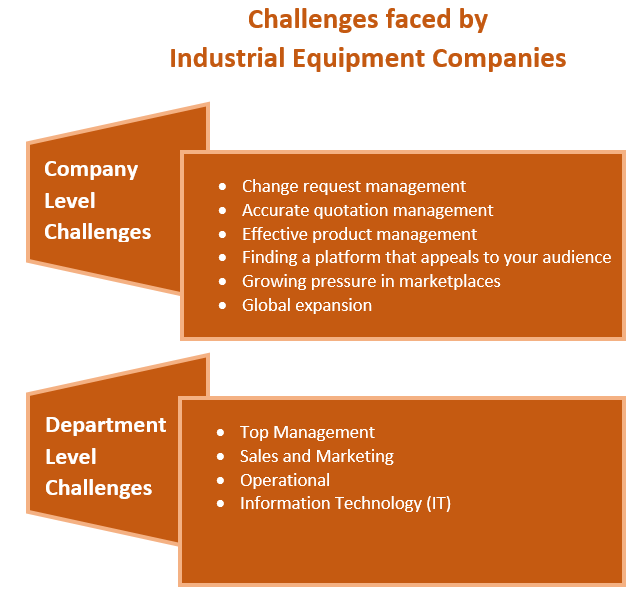
Let’s see what types of challenges the Industrial equipment companies are dealing with at different levels.

Challenges faced by Industrial Equipment Companies

Company level challenges of Industrial Equipment companies

Change request management

You must be receiving a lot of change request management from the customers. Especially, when you have designed and manufactured certain equipment for particular companies.

The most common process for change request management involves generating the receipt, recording the change, and implementing the changes.

Most of the Industrial Equipment companies are dealing with the engineering change requests manually. It becomes confusing and complex as the number of change requests increases. You cannot bifurcate which requests are addressed and which are under process.

For the effective management of change requests, you need to establish a structured flow. It helps you streamline the change request management process and attend to each request more accurately and efficiently. Also, you need to take care that all the requests are tackled quickly.

Accurate quotation management

Better revenue and profit are the bottom line for the survival of any business. And, it starts with a quotation.

With an incorrect quotation and pricing, you either don’t make a profit as you haven’t considered all the required elements or you will lose the customers for charging the wrong price.

Make sure your sales team has access to all details related to the pricing so they can provide the correct estimation or quotation to the customers.

Effective product management

There are different types of Industrial Equipment companies available in the market. Some are producing and selling 10-15 products while others are dealing with thousands of equipment. Almost all of them are using the ERP system or spreadsheet for managing the product data.

This could work if you have a limited number of products to deal with. But, when you manage thousands of products with their hundreds of attributes, it becomes extremely difficult to store, manage, syndicate, aggregate, and find certain product information when needed.

Finding a platform that appeals to your audience

Analyze your digital presence thoroughly.

Most of the resellers or organizations browse the internet for selecting partners for equipment trading. If you are not having a powerful online presence and poor visibility on the search engines, then you are losing a great deal of business.

Without an online platform, you might be earning money from local clientele but it won’t help you to penetrate the global business landscape.

Thus, if you don’t have a digital platform, focus on building one.

If you already have an online platform, then you need to check its effectiveness amongst your target audience by analyzing

  • What impact will the potential customers get while they visit your website?
  • Is it updated?
  • Is it mobile-friendly?
  • Is it difficult to navigate through your solution?
  • Do you have the right social media strategy to promote your brand and engage the target audience?
  • Are you considering Google Ads and other digital media options?

Make sure you have a robust online platform to communicate and sell your offerings to the customers.

Growing pressure in marketplaces

To enable customers with more value, you need to identify their pain points and address them by producing and offering them the right set of equipment.

The marketplaces that are specifically selling industrial equipment are highly competitive. So, you need to make sure you are selling the most trending and relevant equipment with the correct product information display. You can also utilize the media asset capability of the marketplace to display the product pictures, videos, usage documentation, etc.

All these media assets trigger the challenges of your customers and connect them with your brand.

Additionally, whether it’s about responding to the changing government administration or complying with the new safety standards, there are always some external factors that affect the Industrial Equipment domain.

Global expansion

Every business intends to expand from a street to an area to a city to a state to a country to the globe.

As your business expands in different countries, you need to consider a multilingual platform. It allows you to present your website in the native language of the country and customers you are planning to target.

If you do not present the information in the native language of the target audience, the chances are higher they won’t engage with your brand, and your conversion rate decreases.

Department level challenges of Industrial Equipment companies

Different departments of the Industrial Equipment companies are facing challenges related to varied processes and activities. Let’s have a look into it.

Top Management

Top management does not need each detail of each department and process. What they require is efforts, time, and money invested in certain activities and the results gained out of them.

Basically, they need a strategic overview of business data that helps them to understand the efficiency and inefficiency in the business and make the right strategic decisions.

Challenges that top management of the Industrial equipment companies faces involves

  • Centralized management of different organizational data (suppliers, retailers, customers, employees, accounts, etc.)
  • Attain faster time-to-market of the equipment
  • Achieve faster turn-around time of the order processing
  • Creating and delivering extraordinary customer experience
  • Creating a single source of truth for all equipment with a consolidated and aggregated view

Sales & Marketing Department

The marketing department of an Industrial Equipment organization has to take various actions to increase brand awareness, engage the prospects and convert them into customers.

The sales team needs to sell the products/services to them by providing correct pricing.

The challenges of the sales and marketing team of your organization consist of

  • Offering discounts to certain customers
  • Slower time-to-market of equipment catalog as the data is scattered across the disconnected systems
  • Keep updating equipment quantity
  • Needed to perform repetitive tasks manually while creating a custom quotation for each customer
  • Sharing updated technical specification of equipment
  • Determining pricing based on the customer segment
  • Enabling customers with all product variants or options in an interactive way
  • Managing promotions for the specific customer segment
  • Sharing and managing in-stock quantities of each equipment

Operational Department

The operational team of an Industrial Equipment Company deals with the challenges like

  • Gathering and aggregating different data from suppliers
  • In the absence of a centralized system, it becomes challenging to create quotation of distributors and dealers on-time
  • Effective management of thousands of equipment along with its hundreds of attributes
  • Continuous updating of product catalogs due to higher product churn rate
  • Sharing updated product pricing information across the company

Information Technology (IT) Department

The job of the IT department is the most crucial one as they are responsible for the effective and secure management of data. They face challenges like

  • Data cleaning a data merging
  • Integrating existing enterprise systems and different third party application
  • Enable different departments of the organization with the relevant and required data
  • Management of database and disparate systems
  • Product data enrichment due to lack of system interface
  • Inability to generate MIS reports on a regular basis
  • Data duplication across different data silos
  • Update/aggregate the dealer/supplier data in a single system

What is a Digital Platform?

The digital platform is a technology-enabled business model that helps Industrial Equipment companies to drive value for the organization by allowing the exchange of information between different independent user groups.

Industrial Equipment companies streamline their various business processes through a digital platform. There are different types of digital platforms available in the market. Some of them are ready to use and some allow for custom development as per your specific business needs.

Industrial Equipment organizations can leverage the digital platform for product data management, media asset management, customer data management, content management, eCommerce activity management, managing the data of different business entities (such as suppliers, vendors, employees, accounting, etc.), and more.

Do you want to dig deep into the Digital Platform? Read What is a Digital Platform? Everything You Need to Know about Digital Platforms.

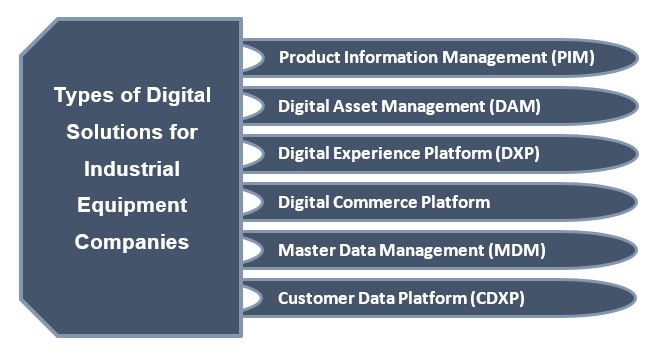
6 types of solutions Industrial Equipment companies can build using Digital Platform

Types of Digital Solutions for Industrial Equipment Companies

There are numerous digital platforms available in the markets. Choose the right one that meets your specific business requirements and allows you to build award-winning digital solutions.

Let’s understand the highly popular and widely used digital solutions.

Product Information Management (PIM)

Product Information Management allows Industrial Equipment organizations to manage all their products in a single location. It allows you to collect, store, manage, aggregate, enrich, consolidate, syndicate, and distribute the product information across different sales and marketing channels.

With Product Information Management, you can seamlessly harmonize your sales, marketing, and technical product information for varied departments. Integrating PIM with your existing enterprise systems or third-party applications, you can manage data effectively across all your systems.

Core features of Product Information Management (PIM)

Basic features

  • Product Data Modeling
  • Product Data Management
  • Data Quality Management
  • Workflow Management
  • Digital Asset Management
  • Omnichannel Publishing
  • Apps and Data Integration

Enterprise-class features

  • Product Experience Portal
  • Product Data Syndication
  • Marketplace Integration
  • Product Feed Management
  • Enterprise Translation Management
  • Microsoft/Adobe Integration
  • Enterprise Print Publishing

Extended feature set of Product Information Management (PIM)

Basic Features of Product Information Management (PIM)Enterprise-class Features of Product Information Management (PIM)
Product Data Modeling

  • Visual Data Modeling
  • Multi-domain Support
  • Powerful Data Support
  • Multi-lingual Data Management
  • Intelligent Data Relations
  • Classification Standards
  • Hierarchy Management
  • Product Variant Support
  • Built-in Digital Asset Management (DAM), and more…
 Product Experience Portal

  • Marketing and Sales Content Hub
  • Product Data Search and Filtering
  • Product Data Views
  • Product Data Downloading
  • Product Data Sharing
  • Product Data Collection
  • Reports and Analytics
  • Unlimited Data pools
  • Security and Permissions
  • Configuration Magic, and more…
Data Management

  • Data Editing
  • Batch Editing
  • Users and Rights Management
  • Data Validation
  • Publishing and Versioning
  • Customized View, and more…
Product Data Syndication

  • Connect with Multiple Channels
  • Data Integration and Standardization
  • Content tailoring
  • Customization and Optimization
  • Product Catalog Distribution, and more…
Data Quality Management

  • Data Quality and Completeness
  • Auditing and Versioning
  • Custom Reports, and more…
Marketplace

  • Complete Cross-channel Connectivity
  • Multi-channel Order Synchronization
  • Robust Data Syndication, and more…
Workflow Management

  • Flexible Workflow
  • Customized View
  • Workflow Messaging and Notifications
  • End-user Workflow, and more…
Product Feed Management

  • Complete Product Feed Control
  • Product Data Syndication, and more…


Digital Asset Management

  • File Management
  • Metadata Management
  • Image and Video Conversion
  • Work with any file type
  • Workflow Management
  • Digital Asset Delivery, and more…
Enterprise Translation Management

  • Real-time Translation Memory System (TMS) Integration
  • Complete elimination of manual translation, and more…


Omnichannel Publishing

  • Built-in Digital Commerce
  • Product Configurators
  • Built-in DXP and CMS
  • Print Publishing
  • Headless PIM
  • Product Experience Portal, and more…
Microsoft/Adobe Integration

  • Adobe Creative Cloud Integration
  • Microsoft Office Integration


Apps and Data Integration

  • APIs to Connect Anything
  • Microsoft Excel Integration
  • Product Data Syndication
  • Marketplace Integration
  • Product Feed Management, and more…
Enterprise Print Publishing

  • Automated Database Publishing
  • InDesign Integration, and more…


Challenges that Industrial Equipment companies Can Address through Product Information Management (PIM)

  • Slower time-to-market of products and product catalogs due to disconnected systems and scattered data of products
  • Access to the single source of truth for all product information
  • Creating extraordinary product experiences
  • Management of product data across disparate systems and database
  • Product data cleaning and data merging
  • Product data duplication across the different data silos
  • Integration with your existing enterprise systems and third-party application
  • Product data enrichment due to lack of system interface
  • Collecting and aggregating product data from suppliers
  • Consistent product catalog updating due to higher churn rate
  • Effective management of thousands of products along with hundreds of attributes
  • The growing pressure of marketplaces
  • Providing relevant & required product data to the other departments of the organization (Sales, Marketing, Operations, and more)
  • Enabling customers with all the product options or variants in an interactive way
  • Sharing the updated technical specifications of products

Capabilities of Product Information Management (PIM) that are leveraged by Industrial Equipment companies

  • Product information enrichment
  • Eliminate data duplication in the different silos
  • Sharing and managing in-stock quantities of products
  • Integrate third-party systems
  • Update the product quantity constantly
  • Manage all the product information with digital assets in a logical structure and a centralized repository
  • Manage thousands of products along with their hundreds of attributes
  • Perform data merging and data cleaning
  • Effective product information management in the database and disparate systems
  • Enable the different departments with the relevant and requirements product information

Digital Asset Management (DAM)

Management of the media assets is one of the biggest issues for Industrial Equipment companies. These organizations have to manage the media files such as images, videos, audios, 3D files, animations, graphics, documentation, presentations, excel sheets, and more.

Digital Asset Management allows you to store, manage, and aggregate your digital assets in a centralized location. You can also distribute your assets across multiple customer touchpoints.

With feature-rich Digital Asset Management, you can improve customer experience by distributing relevant, resized, and reformatted media files that look perfect on all your preferred output channels.

Industrial Equipment companies can store, manage, and consolidate any number of digital assets within the DAM.

Core features of Digital Asset Management (DAM)

Basic features

  • File Management
  • Metadata Management
  • Image & Video Conversation
  • Works with any file type
  • Workflow Management
  • Digital Asset Delivery

Enterprise-class features

  • Asset Experience Portal
  • Microsoft and Adobe Integration
  • Direct Edit
  • Enterprise Print Publishing
  • Enterprise Metadata

Extended feature set of Digital Asset Management (DAM)

Basic Features of Digital Asset Management (DAM)Enterprise-class Features of Digital Asset Management (DAM)
File Management

  • Asset Organization and Management
  • Asset Collection
  • Asset Search and Filtering
  • Advanced Right Management
  • Publishing and Versioning
  • Adding PIM/MDM Intelligence, and more…


 Asset Experience Portal

  • Marketing and Sales Content Hub
  • Asset Search and Filtering
  • Asset Data Views
  • Asset Metadata Management
  • Asset Upload
  • Asset Sharing
  • Asset Collection
  • Reports and Analytics
  • Security and permission
  • Configuration Magic
  • Easy to Customize and Extend
  • Ready to White Label DAM, and more…
Metadata Management

  • Central Metadata
  • Custom Metadata
  • Enterprise Metadata
  • Adding PIM/MDM Intelligence, and more…
Microsoft and Adobe Integration

  • Adobe Creative Cloud Integration
  • Microsoft Office Integration


Image and Video Conversion

  • Multi-channel Publishing
  • Image and Video Conversation
  • Digital and Responsive
  • Print and CMYK, and more…
Direct Edit

  • Better and Faster Workflows, and more…


Works with any file type

  • Bitmap and Vector Images
  • Office Documents and PDFs
  • Video Conversation, and more…
Enterprise Print Publishing

  • Automated Database Publishing
  • InDesign Integration, and more…


Workflow Management

  • Flexible Workflows
  • Workflows States and Actions
  • Workflow Messaging and Notifications
  • End-user Workflows, and more…
Enterprise Metadata

  • Advanced UI
  • Metadata Components, and more…


Digital Asset Delivery

  • Content Delivery Networks (CDN)
  • Integrated Publishing Channels
  • Headless DAM Publishing
  • Asset Experience Portal, and more…
Microsoft/Adobe Integration

  • Adobe Creative Cloud Integration
  • Microsoft Office Integration


Challenges that Industrial Equipment Companies Can Address through Digital Asset Management (DAM)

  • Creating an aggregated single source of truth for all digital assets
  • Managing all the digital assets in a centralized repository
  • Management of digital assets in disparate systems and database
  • Digital asset data duplication
  • Digital asset data cleansing and merging
  • Integration of different systems where digital assets are stored and managed
  • Providing relevant & required digital asset data to the internal departments of the organization (Sales, Marketing, Operations, and more) and external users (suppliers, customers, etc.)
  • Digital Asset enrichment due to lack of system interfaces
  • Effective management of millions of your digital data in a single location

Capabilities of Digital Asset Management (DAM) that are leveraged by Industrial Equipment companies

  • Easy and consistent correction as well as metadata management of digital assets
  • As all your media assets are stored in a single platform you do not need to deal with the scattered data available across all your disconnected systems
  • DAM manages all types of metadata including
    • Process metadata (project, status, approver, etc.)
    • Technical metadata (glossary, database, etc.)
    • Administrative metadata (geographic parameters, licensing details, date created, expiration date, etc.)
    • Descriptive metadata (file type, keywords, title, etc.)
  • Resize the image in an appropriate format for the different output channels
  • Leverage automatic product image editing, tagging, versioning, scheduling, face recognition, VR/360 images
  • Centralized management of metadata that consists of asset-specific clarification
  • Structured management of digital assets with a grid interface for easy and fast access to the data
  • Supports 220+ different media file formats such as PNG, JPEG, GIF, vector, PDFs, bitmap, Office documents, many different video codecs, and more.
  • To create metadata in your preferred language, DAM provides multilingual support
  • Store and manage the digital asset metadata in a structured way
  • Automated image and videos resizing and formatting
  • Change request management

Digital Experience Platform (DXP) /Content Management System (CMS)

Personalization is the key ingredient to leverage success in this competitive world. But, it’s harder to achieve.

Implementation of Digital Experience Platform (DXP) allows Industrial Equipment companies to create and deliver customized experiences to each buyer across multiple customer touchpoints. You can create, manage, deliver, and optimize the contextual digital experiences continuously with the help of robust customer data management and analytics.

Through the DXP, you can enable your customers to access all product options and varieties in an interactive way.

Core features of Digital Experience Platform (DXP)

  • Web Content Management
  • Multi-channel Delivery
  • Personalization and Analytics
  • Print Publishing
  • Integrated PIM Module

Extended feature set of Digital Experience Platform (DXP)

  • Web Content Management
    • WYSIWYG and Usability
    • Multi-lingual
    • Multi-site Management
    • Personalization
    • Content Commerce
    • SEO and Marketing Toolbox
    • Mobile-Friendly, and more…
  • Multi-channel Delivery
    • Multi-channel Publishing
    • Mobile Marketing
    • Print Publishing
    • Marketing Automation
    • Content-as-a-Service
    • Commerce Integration, and more…
  • Personalization and Analytics
    • Behavioral Targeting
    • User Profiling & Data Collecting
    • Analytics Integration
    • Big Data Analytics, and more…
  • Print-Publishing (Web2Print)
    • Compatible with your Workflow
    • Adobe InDesign Integration, and more…
  • Integrated PIM modules
    • Data Modeling
    • Data Management
    • Data Quality Management
    • Workflow Management
    • Digital Asset Management
    • Omni-channel Publishing
    • Apps and Data Integration, and more…

Challenges that Industrial Equipment companies can address through Digital Experience Platform (DXP)

  • Create and deliver extraordinary and personalized customer experiences
  • Centralized management of all your content
  • Global expansion
  • Managing promotions for specific customer segments
  • Providing discounts to specific customers
  • Enrichment of website content
  • Keep updating promotions and discounts as per the changing business requirements

Capabilities of Digital Experience Platform (DXP) that are leveraged by Industrial Equipment companies

  • Distribute high-quality data across the different output channels
  • Manage commerce, communication, and content under a single roof
  • Manage millions of digital assets, pages, and products that are edited by hundreds of editors and visited by millions of users in a month
  • Connect the Digital Experience Platform with any of your existing enterprise systems and third-party application
  • Create and deliver personalized content to the customers

Digital Commerce Platform

These days, selling the products offline won’t help you taste the immense success when your rivals are embracing the potential of the digital world. You have to consider the online platform as well. You can either develop your own eCommerce platform or sell the products through popular marketplaces.

The digital platform enables Industrial Equipment companies with a Digital Commerce Platform that allows you to build feature-rich B2B, B2C, and B2B2C portals and connect with intended target groups. The more customers you gain the more revenue you generate.

Along with eCommerce, the Digital Commerce solution also allows you to create and deliver highly personalized shopping experiences to the buyers. By choosing a component-based digital framework like Pimcore, you can reduce product time-to-market and increase your sales.

B2B Portals

Business to Business has complex business models. It enables Industrial Equipment companies with

  • Secured checkout process
  • Management of complex product and pricing structures
  • Product reviews
  • Currencies
  • Multiple catalogs
  • Price lists

Moreover, the Digital Commerce solution allows the IE organizations to leverage flexible promotion, multiple frontend apps, and more as per your specific business needs.

B2C Portals

Leveraging the Digital Platform, you can also develop a powerful and customer-centric eCommerce solution. The B2C solution allows you to interact with your target audience and engage them by delivering highly personalized experiences in a real-time omnichannel environment.

Core features of Digital Commerce Platform

  • B2B & B2C eCommerce Framework
  • Customer Experience Management
  • PIM for eCommerce

Extended feature set of Digital Commerce Platform

  • B2B & B2C eCommerce Framework
    • Framework Driven Approach
    • Digital Storefront
    • Product Search and Filtering
    • Price Calculation and Availability
    • Shopping Cart
    • Product Promotions
    • Checkout process
    • Order Management, and more…
  • Customer Experience Management
    • CMS Integration
    • Content Commerce
    • Personalization
    • Multichannel Support, and more…
  • PIM for eCommerce
    • Data Management
    • Configure/Price/Quote tools (CPQ), and more…

Challenges that Industrial Equipment companies can address through Digital Commerce Platform

  • Enabling customers with all the product options or variants in an interactive way
  • Required to perform a lot of manual work to create custom quotations
  • Defining pricing based on customer segments
  • Delay in creating quotations for dealers and distributors in the absence of a centralized system
  • Sharing updated pricing information across the organization
  • Attaining faster turnaround time of the order processing

Capabilities of Digital Commerce Platform that are leveraged by Industrial Equipment companies

  • Determine product pricing based on the customer segment
  • Share the updated pricing information across the company
  • Manage promotions for the particular customer segment
  • Update the product catalog regularly to reduce the product churn rate
  • Offer discounts to specific customers
  • Improve time to market of product catalog as the digital platform manages product and customer data in a centralized repository. Due to seamless integration, all the different systems are connected to the Digital Platforms
  • Generate custom quotation quickly with minimal manual efforts

Master Data Management (MDM)

Master Data Management is the solution that allows Industrial Equipment organizations to manage all types of data such as products, customers, employees, human resources, sales, marketing, dealers, vendors, accounts, etc. in a single repository.

It allows you to create and add custom fields in your different data. Thus, if you are not able to find certain fields and modules in your PIM, DAM, DXP, Digital Commerce, and CDP, then you can harness the potential of Master Data Management to determine your set of fields and modules.

Along with managing the different data, the MDM allows you to manage all the different elements of master data that consist of data validation, hierarchy, structure, and versioning along with attributes, translation, documentation, descriptions, and other related data.

Core features of Master Data Management (MDM)

Basic features

  • Data Modeling
  • Product Data Management
  • Data Quality Management
  • Workflow Management
  • Digital Asset Management
  • Omnichannel Publishing
  • Apps and Data Integration

Enterprise-class features

  • Product Experience Portal
  • Product Data Syndication
  • Marketplace Integration
  • Product Feed Management
  • Enterprise Translation Management
  • Microsoft/Adobe Integration
  • Enterprise print Publishing

Extended set of features of Master Data Management (MDM)

Basic Features of Master Data Management (MDM)Enterprise-class Features of Master Data Management (MDM)
Data Modeling

  • Visual Data Modeling
  • Multi-domain Support
  • Powerful Data Modeling
  • Multi-lingual Data Management
  • Intelligent Data Relations
  • Classification Standards
  • Hierarchy Management
  • Product Variant Support
  • Built-in Digital Asset Management (DAM), and more…
 Product Experience Portal

  • Marketing and Sales Content Hub
  • Product Data Search and Filtering
  • Product Data Views
  • Downloading
  • Sharing
  • Collection
  • Reports and Analytics
  • Unlimited Data Pools
  • Security and Permissions
  • Configuration Magic, and more…
Data Management

  • Data Editing
  • Batch Editing
  • Users and Rights Management
  • Data Validation
  • Publishing and Versioning,
  • Customized View, and more…
Data Syndication

  • Connect with Multiple Channels
  • Data Integration and Standardization
  • Content tailoring
  • Customization and Optimization
  • Distribution, and more…


Data Quality Management

  • Data Quality and Completeness
  • Auditing and Versioning
  • Custom Reports, and more…
Marketplace

  • Complete Cross-channel Connectivity
  • Multi-channel Order Synchronization
  • Robust Data Syndication, and more…
Workflow Management

  • Flexible Workflow
  • Customized View
  • Workflow Messaging and Notifications
  • End-user Workflow, and more…
Product Feed Management

  • Complete Product Feed Control
  • Product Data Syndication, and more…


Digital Asset Management

  • File Management
  • Metadata Management
  • Image and Video Conversion
  • Work with any file type
  • Workflow Management
  • Digital Asset Delivery, and more…
Enterprise Translation Management

  • Real-time Translation Memory System (TMS) Integration
  • Complete elimination of manual translation, and more…


Omnichannel Publishing

  • Built-in Digital Commerce
  • Product Configurators
  • Built-in DXP and CMS
  • Print Publishing
  • Headless MDM
  • Product Experience Portal, and more…
Microsoft/Adobe Integration

  • Adobe Creative Cloud Integration
  • Microsoft Office Integration


Apps and Data Integration

  • APIs to Connect Anything
  • Microsoft Excel Integration
  • Product Data Syndication
  • Marketplace Integration
  • Product Feed Management, and more…
Enterprise Print Publishing

  • Automated Database Publishing
  • InDesign Integration, and more…


Challenges that Industrial Equipment companies can address through Master Data Management (MDM)

  • Collect and aggregate different data from suppliers
  • Generate MIS reports on time
  • Update/aggregate dealer/supplier data in a single platform
  • Integrate different third party systems
  • Effective management of millions of data securely
  • Scattered data across various systems
  • Data cleansing and data merging
  • Data duplication across different data silos
  • Providing relevant & required data to the other departments of the organization (Sales, Marketing, Operations, and more) and external users (customers, suppliers, etc.)

Capabilities of Master Data Management (MDM) that are leveraged by Industrial Equipment companies

  • Enrich the master data record across any of the data domain
  • Extremely flexible data models effectively handle the most complex data
  • Easily manage your millions of records with thousands of attributes
  • Determine the custom fields and models to add extra information about the different business data of your business
  • Manage all the additional information with greater efficiency and security
  • Single source of truth of all organization information

Customer Data Platform (CDP)

Customer Data Platform manages all your customer information in a centralized platform. It collects, stores, manages, and aggregates customer information and provides you a 360-degree view of each customer.

By collecting customer information from the different customer touchpoints, the Customer Data Platform enables the Industrial Equipment companies with a consistent and unified view of all the related data.

Core features of Customer Data Platform (CDP)

  • Customer Data Integration
  • Profile Unification
  • Customer Data Modeling
  • Real-time Personalization
  • Automation

Extended feature set Customer Data Platform (CDP)

  • Customer Data Integration
    • Connect with any Customer Data
    • CSV Import/Export
    • Marketing Automation, and more…
  • Profile Unification
    • Search for Customers
    • Duplicates Index
    • Duplicated View, and more…
  • Customer Data Modeling
    • Class Definition
    • Data Management
    • Geographical Fields, and more…
  • Real-time Personalization
    • Personalization Engine
    • Personalization Emails/Newsletters
    • Personalized Mobile Push Notifications, and more…
  • Automation
    • Trigger
    • Condition
    • Action, and more…

Challenges that Industrial Equipment companies can address through Customer Data Platform (CDP)

  • Creating an outstanding customer experience
  • Define customer segments to define pricing, discounts, and promotions
  • Customer data duplication across the different silos
  • Customer data merging and data cleaning
  • Scattered customer data across the systems
  • Integrating existing enterprise systems and third-party applications
  • Aggregate/update customer data in the single system
  • Customer data enrichment

Capabilities of Customer Data Platform (CDP) that are leveraged by Industrial Equipment companies

  • Store, manage and aggregate each and every customer data from multiple offline or online sources in real-time
  • Customer data modeling allows Industrial Equipment companies to manage the customer data in a classified and structured way along with all the needed attributes
  • Connect the CDP with multiple devices to determine unique customers and avoid data duplication
  • With the help of customer data management tools, IE companies can predefine the rules and automate any actions linked to the customer data
  • Enabling you with customer segmentation and on-site behavioral targeting, CDP allows you to create personalized customer experiences through real-time explicit and implicit

Widely used features of Digital Platform for Industrial Equipment companies

Key Features of Digital Platform for Industrial Equipment Companies

Multi-lingual support

When Industrial Equipment companies want to expand their business out of their geographical boundaries, it becomes difficult for them to get customers’ attention in the new region.

One way to grab customer attention is by providing them the product or service information in their native language through different online and offline mediums. This makes it easy for the brands to penetrate the new market and engage with the target audience as well.

With DXP, it becomes a piece of cake for the companies to present the content in the preferred language. A platform like Pimcore supports multiple languages so the IE companies can expand their business across every corner of the world. It allows you to translate any of your websites into different languages.

Cloud-based platform

Most Industrial Equipment companies look for cloud-based digital platforms that enable them with extreme flexibility and scalability.

The biggest plus point for considering a cloud-based digital platform is your team can access the data at any point in time from anywhere across the globe. All they need is internet connectivity.

Many of the cloud-based digital platforms are available in the market that enables a future-proof environment for your solution.

Web2Print

Industrial Equipment companies need to create marketing material and product catalogs on an ongoing basis. Not only that, they need to take a printout of marketing collaterals and product catalogs to share with the customers whenever needed.

There are some advanced digital platforms like Pimcore that allow you to store and manage the digital copy of different marketing material and product catalog as well as take the print out of it from the same solution by embracing Web2Print capabilities.

Product data model

Product data modeling is the most essential feature for Industrial Equipment companies that have a large range of products to offer. The more products you have, the more product information you need to manage for websites, catalogs, marketplaces, etc.

Product data modeling allows you to manage the product data in a structured and organized way. It also manages hundreds of product attributes in a centralized repository seamlessly.

Responsive website development

With the help of Digital Experience Platform (DXP), Industrial Equipment Organizations can design and develop responsive, stable, and high-performing websites and online catalogs according to the requirement and usage habits of your target audience.

By creating responsive websites, you can reach out to a wider customer base as it offers device compatibility. It means your website looks perfect in different screen sizes regardless of desktop, laptop, tablet, or smartphone. So you can grab the attention of all the device users.

The website or online catalog contains all the required information about the products that help customers to make instant buying decisions.

White Labeled Solution

Almost every Industrial Equipment organization has a bunch of resellers and partners. If you want to develop a white-label solution for your dealers or other partners, then the feature-rich digital platform allows you to design and develop such solutions.

By implementing the preferred company logo, standard language, and contact information, your resellers or partners can use the functionality of your online catalog to sell your products under their branding.

Product cataloging

This is the must-have feature of any product-driven organization so that it is essential for Industrial Equipment companies too. Using digital platforms like Pimcore, you can create the online product catalog effectively and quickly with minimal effort and human intervention.

Levering the PIM solution, companies can add new product groups into the online catalogs within a very short time.

eCommerce solution development

Industrial Equipment companies can build end-to-end eCommerce web and mobile solutions using a digital platform like Pimcore.

Customers can select the products, add them to the cart, and make a purchase using the eCommerce web or mobile solution.

The eCommerce solutions contain capabilities of simplified order processing, add multiple shopping carts, create different product groups, define customer-specific pricing, online order placement, and more.

QR code/Barcode scanning

This is a mobile-specific feature. Almost every Industrial Equipment company has its warehouse to manage stock of their different products. Most of the companies manually enter all the article numbers in the solution. But with a mobile app, it becomes quite easier.

As we have discussed every product has a unique article number. You need to display that number through a barcode or QR code. Your warehouse team can scan the barcode or QR code with the help of a mobile app. Later on, they can send the product numbers to the eCommerce team or they can directly upload the products in the shopping app.

Thus, the life of the warehouse team becomes way easier and the data entry of article numbers becomes error-free.

Integration with different systems

Almost all the digital platforms available in the market allow you to integrate different systems with your digital solution. Some of them support the limited number of software while others support almost all your existing enterprise systems and any of the third-party applications or software you are using for different purposes.

For example; you are managing pricing structure for each customer, complete customer information, sales data, marketing data, procurement information, and more in your ERP system. ERP can send all this data to the digital solution developed using the leading digital platform. The solution sends orders and offers data to ERP. Not only that, you can send the data to other systems such as customer systems, payment providers, mail providers, and more.

If you consider a digital platform like Pimcore, you can set up unidirectional or bi-directional data flow to keep all the enterprise systems, third-party applications, and digital solutions up-to-date with updated data.

Multi-domain data management

While selecting a digital platform, you need to make sure that it allows you to manage different types of data related to products, customers, digital assets, eCommerce, sales, marketing, employees, procurement, and more.

Multi-domain data management helps you to store, manage, aggregate, syndicate, and consolidate all your business data. It makes sure all your team members have access to the updated data.

Easier and faster data search

Almost all the digital platforms offer advanced search and filter options to find the required data quickly. But, to make the data searchable, it is very essential to store the data with proper metadata.

Order management

The order management enables the Industrial Equipment companies with an overview of previous and present orders. It contains all the orders placed by your customers regardless of any platform such as telephone, webshop, mobile app, EDI, or fax. You can see all your orders under Order Management.

You can also check the status of all your orders and take the required actions as needed. If the customers need to place the order of the spare parts again then it can be done with just a few clicks.

Managing individual order data

With the help of digital platforms, Industrial Equipment companies can store and manage the orders and article numbers in the shopping cart along with useful notes. All the orders have individual numbers and the customers can get an overview of their orders in the online store. This helps a lot in generating the receipt and verifying the invoices.

Benefits of Digital Platform for Industrial Equipment Companies

Benefits of Digital Platform to Industrial Equipment Companies

Quicker integration of any system/application

Advanced digital platforms allow Industrial Equipment companies to integrate the data of webshop or online catalog or eCommerce stores with their customers’ (resellers, suppliers, etc.) systems.

The companies can leverage seamless data flows across the webshop and customer systems in an automated way that allows them to avoid the tedious tasks of manual data entry in different systems.

While your competitors spend weeks integrating customers’ systems with their webshop, digital platform implementation allows your team to perform the same task within minutes. They just do a few clicks and copy and paste efforts.

Reduction in manual efforts

Due to the seamless integration facility, IE organizations can easily distribute the data in different enterprise systems, digital solutions, or third-party applications as per their specific requirements. This eliminates all the efforts of manual data entry across the different systems.

Moreover, manual entry of product identification numbers and other details can be eliminated by developing a mobile app. You can simply cover all the information in a barcode and QR code, take a print of the code, and emboss them on each product. This one-time effort makes the lives of your employees way easier when they are counting, searching, or distributing the products.

Effective order management

There are digital platforms available in the market that support multiple shopping cart systems. It allows Industrial Equipment companies to create multiple shopping carts at the same time for varied product groups. When the customers place an order, your team receives a notification about the placed order through an e-mail.

Excellent customer experience

With the help of digital platforms, Industrial Equipment companies can design, develop, and implement varied digital solutions such as websites, eCommerce stores, mobile apps, enterprise applications, and more.

You can be sure of having a stable, responsive, scalable, and high-performing digital solution with an engaging user interface and the right set of features and functionality.

Moreover, beyond providing a robust digital presence, it makes sure the digital solution appeals to your target audience and meets their expectations.

Simplified operation processes

Most of the operations of the Industrial Equipment companies are related to products. The more products you have, the more complex the data structure you need to manage. Implementation of a cutting-edge Product Information Management solution not only simplifies your operational processes but also enables you with a single point of access to all your product data.

A PIM platform with an intuitive user interface is easier to adopt by your users. Moreover, it becomes easy for you to add a new product group to your online catalog quickly.

Leverage global business expansion

The Digital Experience Platform supports multiple languages and currencies. So, you can expand your business in other countries and regions. You can represent your website, mobile app, eCommerce store, marketing collaterals, documentation, etc. in the different regional languages.

This helps you not only to expand your customer base but also increase the number of resellers in each region.

Print process optimization

To increase brand awareness, offline marketing and promotions are equally important as online.

Considering a digital platform that allows you to manage and use the data only in online mode increases a lot of tasks for your team when they need to use some digital assets or product catalog offline.

Go with the digital platform that supports the Web2Print feature. It allows you to take print of any of your digital catalog or any other document. To get a print of your intended file, all you need is to connect your printer with the system and press a few clicks to transform your digital copy into a physical one.

3 Exciting Use Cases of Digital Platform for Industrial Equipment Companies

Credencys works with Pimcore, a leading and widely popular digital platform. We excel in developing next-generation digital solutions by using the different frameworks offered by Pimcore. Here, we are going to share the 3 use cases from Pimcore.

It helps you to understand the exceptional capabilities of Pimcore in the context of your Industrial Equipment business.

Ludwig MeisterImage

Ludwig Meister - Use Cases of Industrial Equipment Company

Image Credit: Pimcore

Platform: Web

Solution Type: eCommerce Solution

Client: Ludwig Meister is a Germany based company. It is a renowned brand for distributing power transmission, fluid and tooling products, and bearing. They mainly deal with B2B customers. They also provide a comprehensive range of services for its technical buyers and resellers.

Business Requirement:

  • The challenge for the brand was to connect their existing Enterprise Resource Planning (ERP), Procurements, and other enterprise systems with the webshop in order to achieve seamless and easy access to a wide variety of products (over 2.5 million SKUs)
  • They wanted to implement
    • Tailored pricing per customers
    • Customer-related assortment backend powered by strong search functionality
    • Personalized offering for each customer

Solution:

A robust B2B/B2C eCommerce solution is developed using Pimcore. The client utilized the open-source structure, tremendous flexibility, and great website features in the solution development. Moreover, the solution is capable of handling many products along with webshop and website within one system.

Along with the excellent feature set, Pimcore enables the client with flexible integration opportunities too. It helps clients to create and deliver engaging user experiences as well as fast and lean launch.

The solution successfully handles product data, customer data, media files, order data, pricing information, and more.

The client used to manage the pricing structure for each customer, relevant product data, customer data, and other information in the ERP system. They wanted to integrate the Website with the ERP system so the webshop can send and offer data to ERP systems. ERP system is also integrated with other applications such as customer systems, payment gateways, email service providers, and others.

The new eCommerce solution contains the features like advanced search, order management, individual order data management, and more.

Result:

The different customer systems are managed through a self-service tool. The customers of Ludwig Meister can handle such systems by themselves.

The rivalry of the client used to take weeks and months in order to integrate their webshop with customer systems. Ludwig Meister can utilize the sled developed tools and integrate the webshop with customer systems in a matter of minutes with a few clicks and copy and paste efforts.

MEFA

MEFA - Use Case of Industrial Equipment Company

Image Credit: Pimcore

Platform: web and mobile

Solution Type: B2B eCommerce shop and scanning app

Client: MEFA is the market leader in producing and selling mounting systems for air-conditioning, ventilation, sanitary, and heating technology. They also hold a powerful establishment in plant construction and engineering across Europe for over 70 years.

Business Requirements:

  • The client was using a website with a complicated navigation structure with several filters to manage the products.
  • They had a complex ordering process.
  • When used to prepare the product data manually for different media platforms such as an online shop, price list, and catalog. It was a time-consuming and error-prone task.

Solution:

B2B shop

The B2B store is developed using the Pimcore platform. The solution involves

  • Product Information Management (PIM)
  • Digital Asset Management (DAM)
  • Customer Data Platform (CDP)
  • Web2Print
  • Omnichannel publishing
  • Fast Algolia search
  • MEFAscan app

MEFAscan app

  • It is an intuitive and user-friendly mobile app that supports multiple languages such as German and English.
  • MEFA customers (resellers, retailers, etc.) can scan the EAN numbers by scanning the articles via barcode labels. The customers can add the articles without putting any manual effort into entering all the products along with the article numbers.
  • The app also helps the client in simplifying the ordering process as it is connected with the B2B responsive shop through which the order is placed.
  • The app contains multiple shopping cart systems that allow MEFA to create several shopping carts for varied product groups.
  • The MEFA customers can see the customer-specific pricing and place the order by login in to their accounts through their email address and password.
  • New MEFA customers can register by adding their complete details.
  • MEFA customers can send the articles that they have saved in the MEFAscan app shopping cart through email.

Results:

The production employees of MEFA customers who work in warehouses and need MEFA products can take the benefit of through the MEFAscan app. They can quickly scan all the articles and add them to the shopping cart using the app. It eliminates the mundane task of manually adding all the article numbers and saves a lot of time for the employees.

  • To see the customer-specific pricing, the MEFA customers need to login through the B2B shop.
  • Numerous shopping carts can be created through the multiple shopping cart system. The app sends a message to the MEFA customers for placing an order through an email.
  • The shopping cart data is stored in Pimcore to ensure the security of the data.

Rohde AG

Rohde - Use Case of Industrial Equipment Company

Image Credit: Pimcore

Platform: Web

Solution Type: Website

Client: Rohde AG is a leading brand that supplies a wide variety of industrial handles and surface technology to industrial companies. Established in 1925, the company has a team of 135 employees and is having an annual turnover of 15M euros.

Business Requirements:

Requirement 1: Data model development

The client is having a wide range of products so they have to deal with a large amount of product information every day and maintain the data for the website and online catalog. For simplified, easier, and effective product information management, the client wanted to build a data model for their new website and online catalog.

By developing a data model, the client wanted to ensure the proper structure, order, and clarity of product data. They also wanted to have easy and centralized maintenance of all product information including each product attribute.

While digging deep into Rohde AG’s database, the following requirements were identified.

  • Only a few products have identical properties.
  • Data model ensures efficient and effective maintenance of different product information.
  • The data model should allow editors to maintain selective technical attributes for each product in a tabular form.
  • Each table needs a different number of rows and columns.

Requirement 2: Website development

The client wanted to develop a new website that has the below-listed set of requirements.

  • An intuitive interface of the website requires the easy configuration of the tables to generate accurate output as per the changing requirements.
  • They wanted to expand their business out of their regional boundaries so they need to develop a website that should be translatable into 13 different languages.
  • The website should be responsive to ensure the optimal presentation of content on different screen resolution

Requirement 3: White-labeled solution

Rohde AG wanted a white-labeled solution for its dealers who sell Rohde products across the globe.

Solution:

Website design & development

A website and online shop are developed using Pimcore. The website and online shop support multiple languages as well as display and maintain very heterogeneous article data.

The wireframes of all the important page types were created with the help of Rohde AG. While creating the design of the website, the user experience was taken care of and made sure that the navigation and flow match with the user behavior and habits.

Data model creation

  • A flexible data model is defined and implemented based on analysis of Rohde AG’s database and their business needs.
  • All the product information is migrated from MS-SQL to Pimcore objects and a classification store.
  • To ensure the data quality, data and model errors were identified and corrected.

Table generator

A table generator is created to ensure the effective presentation of all the product variants in a tabular form in a responsive online catalog and website. With the help of table generators, the Rohde team can easily maintain their high complexity product data.

Online Catalog

The heart of the new website is the online catalog. It answers all the product-related questions of the customers, provides model data for download, and offers a contact option that involves a form for requesting samples.

White-labeled solution

To enable the Rohde AG with the white-labeled solution, the objects for the global sales partners were created and configured in Pimcore. The corresponding company can add their logo, contact details, and standard languages and utilize the functionality of Rohde AG’s online catalog to sell the products under their own branding.

Results:

  • A high-performing, stable, and responsive website is created by embracing the potential of Pimcore. It meets the expectation of the target audience.
  • Implementation of Product Information Management creates a single source of truth for all product information and streamlines operational processes.
  • The intuitive user interface of the website is widely accepted by business users. They can easily add the new product groups to the online catalog within a short period.
  • Rohde AG customers can order seamless industrial handles through the forms easily. The same form helps the clients in creating new business contacts.

In a nutshell

Credencys has hands-on experience in working with the Pimcore technology. We have successfully, developed and implemented the product digital solution to varied businesses from different industry domains.

The tailored digital solutions help the clients streamlines and automate the various data-driven business processes as well as generate the new revenue stream.

Do you want to stay ahead in the competition by developing a cutting-edge digital solution? Book a free 30 minutes consultation with our experts to discuss the challenges and objectives of your Industrial Equipment business.

Product Information Management: How PIM’s Workflow Management Boost Productivity?

Over the years, businesses around the globe managed their business data manually but now the situation has changed dramatically. The manual method of managing business data becomes time-consuming and obsolete. Literally, it becomes impossible to keep track of all those thousands of data records and to provide a better customer shopping experience with those track records.

To sort out those difficulties, modern businesses prefer to manage their vast amount of data electronically / with the aid of technology. That’s where the concept of PIM (Product Information Management) software evolved and very soon it became the most convenient method of storing, retrieving, and accessing all the business data in quick time.

Let have an overview of the points that we are to cover in this post.

Table of content

  • What is a Product Information Management (PIM)?
  • What types of data managed by the Product Information Management solution?
  • Challenges faced by businesses on not having a proper workflow
  • Benefits of implementing workflow management
  • What Is PIM Workflow Management?
  • PIM workflow management – key highlights
  • How PIM workflow management boost business productivity?
  • Purpose of Product Information Management
  • Boost productivity through Product Information Management workflow
  • Simplification of productive activities

What is a Product Information Management (PIM)?

PIM (Product Information Management) is one of the platforms which is specially designed to store and manage all types of product information.

A PIM system uses a variety of feeds for storing and retrieving the desired business data. All those feeds are listed below for your reference.

  • Excel sheets/Spreadsheets
  • Enterprise Resource Planning Systems (ERPs)
  • Product Lifecycle Management (PLMs)

A PIM system is specially designed to collate all product data in one location and to distribute those via various channels like an online eCommerce store, apps, and so. Having a PIM system will be really useful for any business because it improves business productivity and boosts the conversion rate significantly through streamlined workflow and reduced product time-to-market. Besides, businesses can achieve greater ROI by handling product data effectively.

What types of data managed by the Product Information Management solution?

As mentioned earlier, a PIM system is designed to store and manage all types of product-related data. Here we have enlisted a few of them for your reference.

  • Attributes of all business products (including product descriptions, titles, and so)
  • Product images or videos
  • All product’s marketing information
  • Product specification details (size, shape, materials, and so), and more…

By offering a platform to store and manage all these product data, PIM delivers efficient workflow management. The workflow management of a PIM system helps business authorities or managers to create or customize their business workflow in order to boost organizational productivity.

Yes! You heard it right, PIM boosts productivity through its efficient workflow management.

Challenges faced by businesses on not having a proper workflow

It is essential for every business to follow certain protocols and workflows in order to run the business operation smoothly. Without workflow management, businesses may fall into a typical situation where it requires facing severe management challenges. Here we have listed a few challenges for your references.

  • Difficulties to manage product data consistency
  • Complexity in distributing the quality and consistent product data across multiple teams within an organization
  • High risk of getting miscommunication between teams or across an organization. This may affect business planning processes.
  • Having improper communication within the team regarding product/business data may lead to affect the production timeline and planning schedule.

Apart from those, it would be really hard for the product managers and for the marketers to create an efficient campaign without having consistent product/business data. Also, improper product information creates confusion for the customers while they interact with the products. Eventually, it affects customers’ overall shopping experience.

Benefits of implementing workflow management

Visibility: Detailed product information along with relevant documents gets desire visibility in multiple devices. Besides, proper communication and progress reporting can be done within multiple devices at any time without any hassle.

Control: Workflow Management reduces risk and boosts work efficiency by offering desire control on the proper distribution of workload in-between teams based on their capabilities.

Efficiency: Improves work efficiency of an organization by streamlining business workflow along with the implementation of automated operations like approval, reporting, and so on. By doing so, unnecessary delays caused due to manual operation is eliminated.

Flexibility: Having Workflow Management will enable managers to receive day-to-day reports. Besides, it offers a business strategy to the manager that needs to be taken in time to increase the chances of improving business operation.

What Is Product Information Management workflow management?

Product Information Management Workflow Management is a coded system that allows business authorities to implement, manage, and execute business workflow comprehensively. Moreover, the workflow management in PIM is driven by an automated engine that simply eliminates all the hassles of manual operations, especially on giving approvals and sending reports.

PIM Workflow management gives the manager the power to set custom business workflow as per the business need.

Product Information Management workflow management – key highlights

The workflow management in the PIM solution allows enterprises to set their own business workflow and modify the workflow right from drop-down selections. Thus, it will be easier for enterprises to keep up with their business operations.

Here are a few more key highlights of PIM’s workflow management

1. PIM workflow configuration

PIM’s workflow configuration allows enterprises to configure multiple workflows based on the available PIM elements. The entire configurations of the PIM workflow take place on the basis of the Symfony configuration tree.

2. Events

Managers can get several events from PIM’s workflow management and all those events are customizable and extendable according to the desired functionality.

3. User Notifications

It has a feature of sending notifications to the users whenever a transition occurs through email or PIM system.

4. Workflow History

The Pimcore system has the option right under the “Notes & Events” tab where users can easily get the list of entire actions taken over the object.

Workflow History

Image Credit: Pimcore

5. Workflow Overview

The system provides an additional tab for every workflow configured for a PIM element. In that additional tab, workflow details like place, graph, and all other details will be listed.

Workflow Overview

Image Credit: Pimcore

How Product Information Management workflow management boost business productivity?

A workflow is a program that identifies tasks in the process sequence, which informs team members when a task is essential. When an individual completes his role, the workflow is shown to be complete so that more work can be carried out and authorized.

Automation, efficiency, and productivity are the core concepts of a workflow. Everybody in the workflow has access to other activities so that projects are carried out promptly.

Product Information Management (PIM) Software can be interpreted and periodically updated by members of the company. PIM’s workflow allows companies to store and update information for everyday tasks when required.

Purpose of Product Information Management Workflow

Product information remains consistent across multiple channels through you process the data from a single platform. For instance, advertisers and manufacturers use the same data. If a user modifies the product data, it reflects in real-time, and all the users can access the updated information.

PIM software may also schedule reminders for companies using these data.

The purpose of integrating these data is to allow all parties involved in the distribution and marketing process to access them easily. This function improves the cross-channel distribution and minimizes errors.

PIM software can be very useful for large companies with high amounts of data. Also, small businesses would be astounded as the PIM Boost productivity.

PIM boost conversions and revenue

PIM will increase the conversion rate by 20-50 percentages, which leads to substantially higher profitability, sales, and success. PIM boosts productivity since one of the critical ways of driving a customer’s sales is to maintain a consistent impression and experience across multiple sales and marketing channels as described earlier.

The provision of the same product experience for a consumer through social media, ads, websites, and stores is vital for brand image and customer loyalty. It is very essential for the success of any retail business.

Flexible workflow management with PIM

PIM’s workflow management contains an automated engine that lets you describe, manage, and operate the workflows. It enables product managers to identify and model workflows according to their needs, set a deadline, have a better view of information flow, undertake an audit trail, minimize risks, and increase timeline estimation.

Effective workflow management of PIM allows managers to build and customize workflows as required to increase accuracy and productivity.

Product information workflow management

Brands have a better chance to communicate with consumers directly. But the growing number of touchpoints raises the risk that consumers will become frustrated or confused by too much conflicting product content.

Product data is typically hierarchical. Accessing product data must be supervised among product managers, legal teams, marketing and sales teams, etc. Workflow management is essential for aligning procedures, schedules, and workflows across teams.

Boost productivity through Product Information Management workflow management

1. Start reducing the use of spreadsheets

It will take hours to import the product description data into a spreadsheet manually. This method causes human errors due to incorrect information being entered. PIM helps in making product data accurate.

By entering mass product data and building workflows, users save time with PIM. For instance, you can set up a PIM workflow for authorization to update critical attributes. This allows you to share the correct information across the respective departments in a simplified way.

2. Keep in touch with group members

Cooperation among team members is necessary for any business to improve organizational performance. Users can interact across the departments in a PIM structure. This allows team members to update user details and ensures that all members are on the same page.

3. Automation is excellent

A significant benefit of PIM technology is automation. Companies can automatically generate information from various sources instead of manually extracting data.

It would be best if you focus on writing informative descriptions instead of worrying about where the data are. In this way, you can create better product experiences. This results in improved experiences with consumers and greater returns on investments.

PIM automation facilities also include the creation of customized networks. The channels can operate from eCommerce sites. PIM’s workflow management makes it simple if you want a new product to be distributed for a track.

4. The life cycle of a single product can be observed

Businesses must look at a product from the beginning to the end, to maximize their data power. Users will see the degree of completeness for a product through PIM technology. The PIM framework guides users through every step of a product life cycle ranging from image updates to SEO titles.

This methodical idea makes product data more accessible. Before an item goes to the market, businesses should have all the necessary information. This will lead to higher efficiency for companies. This is because they have full control over the life cycle of a product.

PIM also provides dashboards that display every product in a complete overview. Users will see what products are available for sale immediately. If it’s a product on Amazon or through the smartphone, your visibility is perfect.

5. Cost saving

Accurate data decreases the risk of incorrect product sharing of information. The data in PIM are configured through delivery methods, procurement procedures, and stored stock. As PIM solutions are easy to incorporate and allow to automate most of the workflows, businesses save money on management and manual ways of marketing.

Simplification of productive activities

Workflow management framework enables businesses to take advantage of powerful automation technologies. For example, manual data entry tasks are replaced by an automation solution, which collects and enters data into a centralized data management system.

A process management system greatly improves employee efficiency besides saving time and reducing errors. You are secure with understanding what tasks you have to do and enjoy working on tasks that make the business more profitable. Employees are now better able to control their time and communicate efficiently around the organization.

Bottom line

Organizations face more complexity and challenges than ever before. Using an integrated solution, such as workflow management they can experience unmatched flexibility and reliability for their businesses.

The centralization of product data & images is extremely important and helps in various ways to speed up the process. If several users and multiple teams work together to create the product content in the PIM solution, the proper workflow is necessary.

Why is Pimcore the Right Platform to Ensure the Success of Your Online Business?

When it comes to digital business, organizations are having cut-throat competition. Obviously, it is tough to attain remarkable success and maintain it without the right digital strategy.

Embracing the right digital platforms like Pimcore that are powered by advanced technologies, brands can definitely stay competitive and deal effectively in the ever-changing digital space.

The right digital solution changes the way you operate across the company. Most importantly, it helps organizations to work in more agile, faster, and communicative ways.

For the success of an online business, you need the right set of solutions for not only the operational department but also for other departments too. Here, I mean it is equally essential to consider the latest digital platform to support your sales and marketing activities.

So basically, you need a set of solutions for your online endeavor.

Where Pimcore fits in?

Pimcore is a data and experience management platform. It enables brands and startups with end-to-end and robust digital solutions to address their varied business requirements.

It allows companies to build solutions like

  • Product Information Management (PIM) – manage all the product data in a centralized repository
  • Master Data Management (MDM) – manage all the organizational data in a single platform
  • Digital Asset Management (DAM) – manage the media assets centrally
  • Customer Data Platform (CDP) – manage all your customers’ data in a single location to get a 360° view of each customer
  • Customer Experience Platform (DXP) – create the contextualized content for each customer to deliver the personalized experiences
  • Digital Commerce Platform – manage all your eCommerce related data in a commerce solution and create the product catalog effortlessly

Companies utilize one or more solutions from the above list to meet the different needs of various departments. It helps your varied teams like eCommerce, sales, and marketing in managing the massive organizational data seamlessly and creates compelling experiences for the customers.

Apart from allowing companies to manage the data, Pimcore enables them with the flexibility to distribute the product information across the online and offline channels. This philosophy of Pimcore allows companies to act quickly and in an agile way.

Let’s understand the contribution of Pimcore in making your online business successful.

11 Reasons that proves Pimcore is the right fit for the growth of your online business

1. Complete elimination of data silos, manage a master record of all the data

Data is the crux of today’s business world to gain a competitive edge.

When you manage your product data, customer data, marketing and analytics data, and other business data in different systems, it becomes challenging to collect, manage, syndicate, aggregate, consolidate and distribute them as and when required.

Most of the companies ignore the potential centralized data management where the data can be reused and merged easily. Eventually, it helps you to create and deliver a consistent brand experience that is the most beneficial factor from a marketing perspective.

Through flawless and uniform communication, it is possible to influence positively on the external stakeholders such as customers, vendors, suppliers, partners, etc., and thus improve the company image.

Pimcore manages all your data in a centralized system to eliminate the problems of data silos. While considering Pimcore, it is essential to analyze your system landscape and check out which existing data you can successfully connect, automate, and publish. Also, you need to make sure how you need to use the data and where.

Along with managing the data, it is essential to improve data quality. Before implementing a digital solution, you need to ask yourself in what form and where you need to improve the data quality. Pimcore allows you to keep enriching the data quality on the go seamlessly.

2. Ensured data privacy enables brands with secured data management

When it comes to data, the privacy of essential business information is always the topmost concern.

Pimcore enables companies with next-level data security. It also makes sure that your organizational and customer data are neatly managed in a single place in an aggregated manner.

Additionally, it allows you to decide in which system and where the data gets collected.

Implementing Pimcore, you can

  • Manage all the organizational, product, and customer data in compliance with data privacy laws
  • Provide information about the stored data rapidly
  • Delete the data automatically or manually if required

3. Rapid development of digital solutions

Pimcore allows organizations to develop advanced digital platforms by offering a holistic and flexible approach.

The flexibility of Pimcore lies in the variety of solutions it offers within a single platform to enable the brands with a complete system that simplifies the business processes and operations for your varied teams.

Moreover, Pimcore allows companies to create custom and complex data models as per their different requirements. As the importance of data is recognized everywhere, the benefit of custom data model creation seems quite relevant to the companies.

Do you want to understand the practical implementation of Pimcore’s data model capabilities?

Let’s get clarity on it through an example.

In 2020, when all the major events were banned across the globe due to the COVID outbreak, we converted an event platform into a delivery service. This happened within the two weeks’ time span. To achieve this, we connected Pimcore’s available layout components to a new data model of a delivery platform.

4. Use of Artificial Intelligence and Machine Learning open up the new opportunities

Pimcore has started integrating the latest technologies like Artificial Intelligence and Machine Learning by harnessing the potential of Google TensorFlow.

A general example of AI implication in Pimcore is the intelligent duplicate recognition of videos, images, and text. The recognition and search of object features in images. You can utilize the technologies for automatic product data enrichment from your online store.

5. Define a customized layout for your content for your specific target audience

Combine your marketing, customer, and business data with the behavioral data to create tailored content for your website to address the specific needs of the customers in order to enable them with a personalized experience.

Let’s get better insights into this with an example.

Provide a bunch of articles to specific target groups of your online store on different topics but relevant to your offerings. Analyze the users’ activities on your articles with the help of advanced marketing tools. Based on the analysis, you can easily define the target groups.

Then, send the offers to the respective target groups as per their interest and make sure that the targeted customers find it on the entry age.

While analyzing, you will realize that outdoor enthusiasts will explore the latest tent and hiking tools. While, on other hand, sports lovers will check out the details of sports related goods.

Apart from enabling your target audience with their expected products or services, it helps the organizations to increase conversion rates.

By delivering the right product or offer to the right customer, you can ensure the success of your online business. Also, you can increase customer engagement on your website by displaying the relevant products and offers immediately. If the customers won’t find the information they are looking for, they leave the store in a few seconds.

Personalization is the core offering of Pimcore. So, once you implement Pimcore’s Digital Experience Platform solution, practicing the DXP is not rocket science. In fact, it becomes your daily business.

6. Email marketing becomes more efficient and successful

As far as email marketing is concerned, you can send emails and high-quality newsletters by utilizing the email components of Pimcore. You do not require to integrate any other applications. Many organizations have implemented the DXP platform to automate their email marketing efforts.

MailChimp, the most popular and highly used email marketing tool across the globe. Pimcore allows you to integrate an n number of marketing tools including MailChimp.

There is a large customer base who are using MailChimp as their email software and highly admire its features. They prefer to utilize the possibilities of MailChimp or other email software that they are using explicitly.

To address such requirements, Pimcore allows brands to aggregate the data (customer segments, information about the newsletter lists, content, customer data including registration, address, and subscription) and synchronize the data continuously with MailChimp bi-directionally.

While hiring a firm like Credencys as your technology partner, we analyze and define which system is for which applications. This practice is essential so that Pimcore could deliver completely created templates or serve as a database to MailChimp.

Brands can unveil unlimited possibilities and implement Pimcore’s DXP as the customer wishes. Thus, it is no longer only about the companies who have to adopt the technology, but the technology too that needs to adapt to the business.

7. Leverage digitalization of your services

Along with accessing the newly integrated AI and ML technologies, it is recommended to consider all the solutions and features that have already proven themselves during the practices. It helps you to attain success fasters. One of such proven practices is the digitization of your most important services.

Let me clear this point to you through an example.

You need to implement an online pool planner that your customers use directly to compile their desired pool online or inspire themselves. For your business, this will work as a marketing instrument. But, for your customers, it also supports their decisions by providing partial automation of project planning and simplifying preliminary clarifications.

Pimcore enables you with a set of components that helps you to build an online pool planner. In such use cases, extensive use of the web-to-print component of Pimcore becomes quite essential. And, in case, your requirements are not satisfied with the standard components of Pimcore, you can use the freely available plugins that are developed and provided by the large tech community out there or you can build your own plugin.

8. Automate your most important media processes

Pimcore plays a vital role in automating your various business processes. When it comes to marketing automation, either you can use your familiar environment if you are using any or you can automate all the marketing processes by implementing the workflow of Pimcore.

Most importantly, Pimcore automates multi-channel publishing for organizations. Leveraging Pimcore’s capabilities, you can automatically use the product data to create the online and print catalog and send it to the right customer at the right time in the right format.

All your media and content are available in various quality, formats, sizes, and levels based on rules and then distribute or publish on social media.

Whenever you need to perform the same process again and again, then you should consider the automation for sure.

9. Your website can handle the mass rush efficiently

Marketing and other activities on a website is a constantly going process. These activities are continuously increasing at the regional or national level. It is a very common scenario for digital solutions that they have to perform excellently while they need to handle tens of thousands of users at the same time.

Using any random platform, your website won’t be able to respond to thousands of user requests efficiently.

Pimcore helps you deal with this probably by addressing the concept and modern development frameworks like MVC. In layman languages, implementing Pimcore, you can use data, media, function, and information in a resource-saving way.

Moreover, the platform also offers a backup of content delivery networks to outsource a large amount of information, especially the media assets. When it comes to hosting, Pimcore allows you to outsource the solutions to infrastructures of the leading internet service providers such as Google or Amazon or web services.

10. Manage your website in multiple languages

Localization is essential to growing your online business. It enables organizations with a lot of opportunities from a commercial perspective.

It may happen to you many times that you won’t be able to connect and engage the customers from other regions just because your website supports a single language. And, of course, customers from other regions won’t be able to understand your website languages.

But, language is no more a barrier to the growth of your business as Pimcore is here to help you.

Pimcore allows you to expand your business regardless of geographical boundaries. It helps you achieve internationalization or localization by offering multiple solutions for the translation of content or other data.

For instance, if you want to convert a website page into a different language, it is quite easy with Pimcore. You can simply copy and rearrange the content in another language in terms of content and appearance.

11. Website maintenance becomes easier like never before

Pimcore allows you to build the website using blocks so that website maintenance becomes easier and flexible. You can design the website as per your wish like you can arrange the text, functions, or graphic elements.

As the Pimcore allows to build the website in “Bricks”, it simplifies the implementation of complex use cases and adherence to structural or graphical concepts.

All set for your digital success story

Pimcore is an en source platform that allows you to develop and implement varied solutions using the different frameworks or create one solution using one or more or all the frameworks. The value that the platform delivers is incredible that is why the industry experts have started adopting and admiring the modern digital platform.

Credencys helps you pave the path of digital success faster

Credencys is a Silver Partner of Pimcore who has helped businesses for different industry domains by developing end-to-end digital solutions by offering a variety of digital platform development services.

We have proven expertise in utilizing all frameworks and capabilities of Pimcore to enable the companies with a complete software solution.

Harnessing the potential of Pimcore, we have helped the brands like IronLists and Kenmare by using PIM, DAM, MDM, DXP, digital commerce, and CDP of Pimcore.

We coordinate with the organizations, understand their business objectives or challenges, and suggest to them the right mixture of different frameworks of Pimcore. It helps them to achieve expected business growth through a single digital solution in a cost-effective way.

An Ultimate Guide to Digital Asset Management (DAM)

Digital assets are a crucial part of any organization. It helps them to attain maximum user engagement by offering rich media files such as images, videos, user guides, etc. Read out this Digital Asset Management guide to discover all the DAM-related aspects.

You might be managing all your digital assets in disparate systems. And, if you are practicing it for a long time that means you might be comfortable operating in that way.

But, are you aware of what you are losing by not considering centralized digital asset management?

I am sure you have no idea about it.

With the right Digital Asset Management (DAM), you can provide better customer services, create omnichannel experiences, and drive scalability within a specified time to attain remarkable expansion and substantial business growth.

Also, DAM manages all digital assets such as images, videos, documents, graphics, and other media files in a single location to allow you to reuse the data while creating new marketing material for your business.

In this post, we are going to explore each aspect of Digital Asset Management. Some of them are known to you and some of them are not.

Have a quick look at the points we are going to cover in this blog.

The journey seems pretty long. So, shall we get started?

What are Digital Assets?

The definition of digital assets keeps changing as more and more things go digital. It varies from source to source.

Usually, digital assets refer to images, videos, and other media content that represent a brand.

In addition to that, we can use the term digital asset for the digital knowledge base such as guidelines, training courses for new employees, books, and more. Along with that, documents, software, and many other things that hold considerable value for a company can be considered digital assets.

Here’s the list of the most common digital assets

Videos, photos, graphics, text documents, PDF files, audio files, spreadsheets, patents, slide decks, logos, animations, illustrations, audiovisual media, electronic mail, websites, etc.

You might have some assets that are not digitized from the beginning but later on, you need to turn them into digital format. For instance; you create a book and newspapers in printed form and later on you can turn them into digital files using the different digital publishing software available in the market.

What is Digital Asset Management?

Digital Asset Management (DAM) is a platform that allows brands to store, organize, find, share, publish, and retrieve digital contact. It allows you to create a centralized digital library that is accessible by internal and external stockholders.

You can enable your employees, partners, clients, vendors, and others to control your digital assets including photos, creative files, videos, documents, presentations, audio, and more.

Implementation of Digital Asset Management (DAM) helps organizations to drive efficiency in distributing content across the organization. It is a single source of truth for your media assets where you can allow your internal and external users to store, manipulate, share, and analyze all the branded content.

Considering a full-scale DAM solution for your organization, you can address several business challenges like

  • Asset duplication
  • Poor asset performance
  • Misplaced assets
  • Lack of brand consistency and version control
  • Underutilized and waste assets
  • Unintended sharing or misuse of unapproved assets
  • Time-consuming asset search

An advanced DAM solution can be integrated with any existing enterprise software and third-party applications used within your organization to work seamlessly in your existing workflow.

Before implementing a DAM solution, it is highly essential to plan taxonomy – the system of metadata and keywords. It helps brands effectively organize all media files so that the search for a specific file becomes simpler and faster.

Why is Digital Asset Management important to organizations?

Benefits of Digital Asset Management

Streamlined file repurposing and creation

Leverage the flexibility to create an asset once, edit the existing assets, and distribute the required assets rapidly through multiple output channels by developing a robust DAM solution. It streamlines file repurposing and creation for you.

Reduced file search time

DAM allows you to use metatags for each asset file. It simplifies the life of users as they find what they need faster. Also, it eliminates the requirements of recreating unfound assets.

Accurate analytics

DAM makes it easier to collect, interpret, and manage data from various sources. Empowering companies with powerful analytics, the solution allows them to make accurate predictions and take effective business decisions.

Enhanced brand consistency

DAM is highly used by companies specializing in content production and marketing teams. Enabling all your specialists (both internal and external users) with the same material, you can easily maintain brand consistency and style across all the different sales and marketing channels you are using for brand awareness and promotion.

Effective collaboration

DAM allows for smoother and faster data distribution and facilitates a set of tools for managing tasks such as assigning tasks to enterprise individuals, setting up deadlines, and more. It helps you to define the responsibilities of everyone and improve the collaboration amongst colleagues and teams who work remotely.

Accelerated processes

Digital Asset Management solution saves a lot of time for your employees that they spend on searching for the needed assets and eliminates most of the additional tasks related to finding an asset.

When a file cannot be found, we either upload the old file one more time or create the new one. It eats considerable working hours of your team and creates a duplicate file in the system.

While managing digital assets in the DAM, you can find your required asset data easily and quickly.

Improved time-to-market

Better collaboration and streamlined processes accelerate product time-to-market, updates, ad campaigns, etc. It helps you gain a competitive edge and improve products by considering customers’ feedback.

Provide a highly efficient workflow

Introducing automated workflows, DAM allows teams to keep projects moving forward and sends alerts to the stockholders so they can achieve their targets to meet deadlines for approvals and reviews.

Simplified license compliance

Now when you have all the assets in front of you with all the required information, it becomes easy for you to check the compliance with licenses that might have expired or changed. It keeps you updated with the required renewal of the documents.

What are the benefits of Digital Asset Management?

Benefits_of_Digital_Asset_Management

Digital Asset Management Development most commonly known as DAM has offered valuable business management techniques and reach techniques are highly preferred by the businessman who can easily organize, manage and share the information collected for marketing purposes.

Digital Asset Management is mainly useful in managing business activities that help in getting the attention of the end users and managing the business financially by keeping the operational costs in control. It offers a set of benefits while managing digital content letters discusses the advantages in brief:

1. Management of resources

DAM offers the best tools & techniques that help in digital Asset Management. It helps in collecting and organizing the data in a creative format. The organized data can be utilized by every professional working in the business organization.DAM offers the best techniques that maintain the intuitive hierarchy and store the assets perfectly well. It awards repeated entries of the data as well as the safety of data.

2. Useful metadata

Digital asset management tools categorize the information and organize it in the form of metadata. The metadata can be effectively used for brands and business promotional activities. DAM allows access to information at a high speed which is the main advantage.

It allows accessing hundreds of files and thousands of pages with ease and as per the specifications. The metadata can search the particular information and data relating to digital assets. You can make use of keywords to be tagged while searching the data.

3. Integrity & consistency

When handling multiple digital assets, the tools of DAM remain well-focused and consistent. It can allow outdated assets to be a part of the brand image building. The low-quality assets are also considered outdated.

DAM always looks for creating a brand image of the company by having a professional and harmonious approach. Integrating various tools and techniques, consistent efforts for brand building are made. According to a recent report, consistent brands are in demand by 20% more than inconsistent brands.

4. Higher efficiency

DAM offers a set of the most modern tools and the most effective techniques to be used and it helps quick search functionality, reuse of digital assets, and prompt decision-making. The digital assets establish the content by adding a graphical effect. It allows the metadata to be stored centrally. It can be allowed to be used for various functionalities such as quick search and re-usage of assets.

To boost efficiency and capability DAM doesn’t allow one-off design requests. The focus will be on creating new designs that can be duplicated from the already available designs.DAM offers the assets to be shared among the employees and displays them in real time.

5. Security

DAM offers internal security and it can allow authenticated users to access the assets. Digital asset management makes sure that permissions should be given to the users at different levels while accessing the assets, tools, and designs. The DAM system also sets expiry dates and sets limits on access to the employees. It makes the marketing team members feel relieved because all the assets remain well secured.

6. Usage analytics of assets

The assets analytics is useful in keeping the track of every asset and design. It makes it easy to understand that the assets are highly useful in marketing campaigns. The performance and usefulness of the assets help the management and the team members in making business plans & strategies.

7. Scalability of assets

Digital assets make the business effective and it also enhances flexibility while using various resources for business management. DAM also focuses on every activity of the business and makes the business run smoother.DAM offers equal benefits to small, medium, or bigger-sized business organizations and also helps in managing the business well.

8. Enhances the creative skills

DAM with its highly powerful business management skills can allow various effective techniques to be used. DAM offers various digital assets and creative designs to be a part of marketing complaints and can be used for effective business operations. DAM shares a significant part of the information among the other employees and departments and it gets beneficial for the business.

9. Reduces the cost of marketing

It is the main benefit of DAM that it keeps the marketing budget lower while planning and executing business promotional activities and while managing the business successfully. It offers a centralized approach and it allows important data to be shared as required.

10. Higher marketing turnouts

DAM tools and techniques help in expanding the business and extending the customer network. It manages businesses of different sizes by offering the most suitable business techniques and marketing activities. The business will grow consistently and will get support from the local market and new customers.

Who needs Digital Asset Management in an organization?

Who_Needs_Digital_Asset_Management

Sale and marketing professionals

By implementing a Digital Asset Management solution, you help sales and marketing teams drive efficiency in their day-to-day operations.

Marketing

Marketing and omnichannel professionals can create and store the different types of marketing material in the DAM system.

Sales

The sales team can be sure that they access the approved assets only and use them for their sales pitches. This helps them make sure the delivery of targeted and creative assets to the end clients.

Product managers

Product managers coordinate internally using the DAM to create marketing materials and gain authorizations from suppliers.

eCommerce manager

Digital Asset Management can be easily integrated with Product Information Management solutions, internal apps, content management systems, marketing resource management tools, product management tools, etc. It helps eCommerce managers to transfer the products in the webshop seamlessly.

Creative personals

Graphic designers of an organization can access DAM to upload new assets and access the already uploaded assets as and when required. Integration of creative tools like PhotoShop, Illustrator, etc. becomes easier that eventually increases the overall productivity of designers.

Communications managers

Communications managers are using the DAM to operate a press portal and automate the press release publications on the website.

IT professionals

Digital Asset Management is used by different teams of the organization including metadata managers, asset owners, archivists, and DAM managers. Based on the requirements of different teams, IT professionals need to configure the DAM system and assure their ingestion with proper information.

The IT team can assure the involvement of the right media asset-related data in the integration of DAM with other assets as well.

Moreover, DAM frees up the IT team, abolishes the FTP server, ensures compliance with security regulations, and unloads mail servers.

Documentation managers

A good DAM solution works as a centralized repository of all the documents for the documentation managers. They can share the same documents across the organizations and with all the employees by providing access privileges.

Which industries require to implement Digital Asset Management?
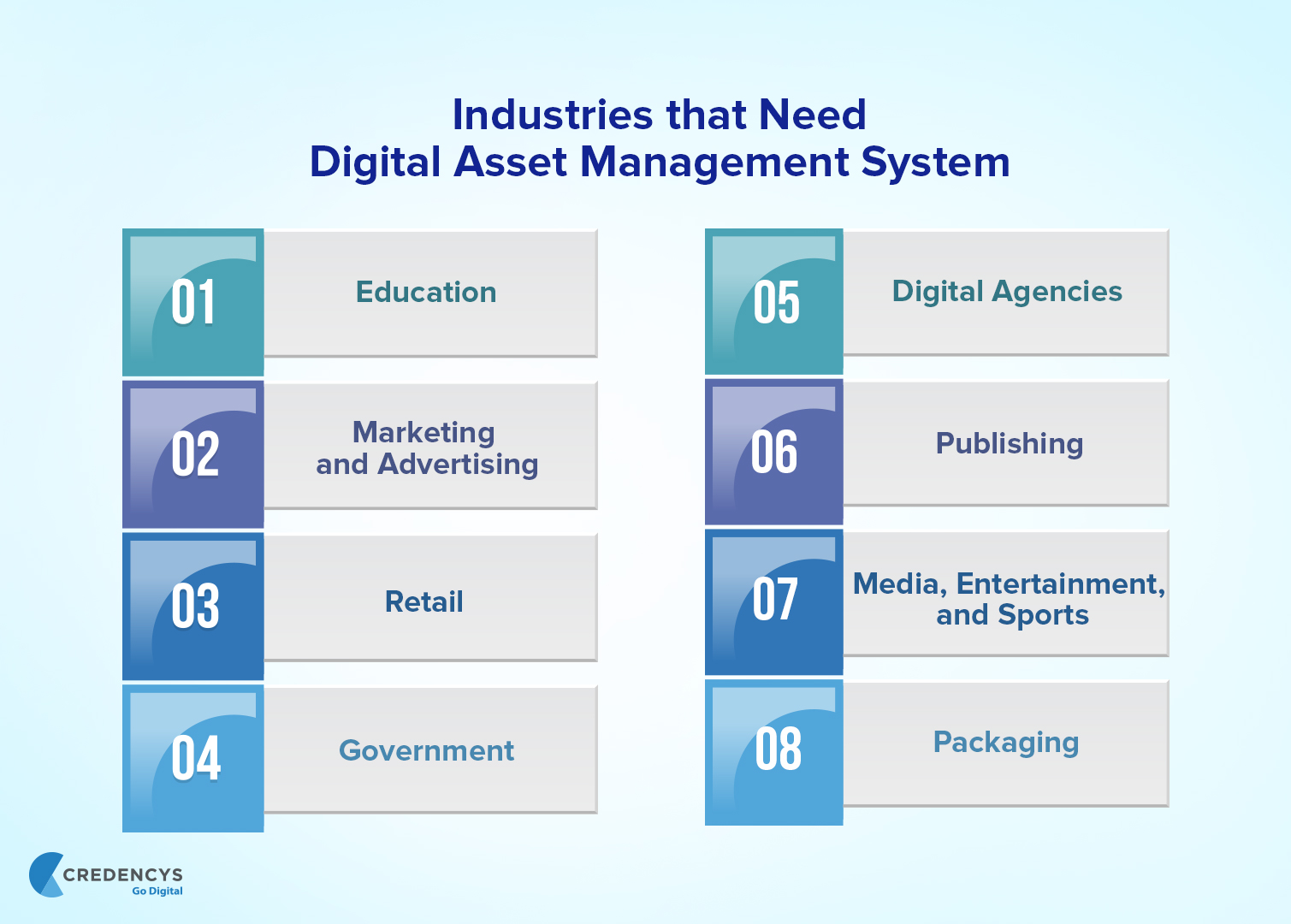
Industries_that_Need_Digital_Asset_Management_System

Education

Education institutes can implement Digital Asset Management to create targeted and customized communications quickly as well as use the material to outreach alumni or students. DAM also allows them to share event updates on varied educational platforms to gain acknowledgment and attention.

Marketing and advertising

DAM allows marketing and advertising agencies to automate product tasks so that they can create and share creative assets with their end customers securely.

Retail

Retailers that aim to improve customer engagement consider Digital Asset Management solutions to create more personalized and targeted communications that empower the loyalty and relationship of customers with their brands.

Government

DAM allows you to repurpose assets more easily. So, government agencies distribute creative materials quickly to the constituents in their regional languages.

Digital agencies

DAM simplifies the approval process of newly developed campaign assets for digital agencies. The solution provides extensive support to the agencies to access brand guidelines, lifestyle images, and logos to use as an integral part of campaigns.

Publishing

Publishers can leverage the proofing and approval capabilities of DAM and convert assets into different formats quickly.

Media, Entertainment, and Sports

Digital Asset Management allows the brands of these industries to ensure brand consistency and maintain brand control.

Packaging

Implementation DAM helps the packaging team to store and manage the packing assets in a centralized repository. It assists them to create and access updates with speed and agility.

14 Core features and functionality of Digital Asset Management

Key Features of Digital Asset Management

1. File management

Digital Asset Management contains the feature of file management that allows business administrators to store, edit, and share digital assets that include videos, graphics, documents, and audio files from an integrated and centralized location.

Asset Search

The Asset Search feature is the most robust and valuable component of file management. Specifically, it facilitates locating assets and quick search features that help users avoid recreating missing assets.

2. File access and sharing

It allows for the secure sharing of files across internal and external teams. You do not need to depend on CDs, shared servers, FTP, or send attachments via email. For access controls, DAM allows you to configure permission levels.

3. File search

DAM enhances the file search through the categorization and retrieval of AI-based tagging and metadata.

4. Workflow automation

Considering Digital Asset Management, you can get access to the exclusive functionality that streamlines the production and creation of assets by replacing the manual process completely and establishing an automated workflow.

The automated workflow feature of DAM enables the facility of project tracking. It helps business administrators with an assurance of project completion. Parallelly, it also ensures that no approval or proofing process is missed at any level.

5. Simple asset organization

DAM allows you to store and manage the assets in a centralized repository and share it with your internal and external stakeholders. You can organize the assets in folders, subfolders, permission-based, and collections as per the defined access control rules.

6. Digital publishing & distribution

DAM can be easily integrated with different applications or software as well as multiple output channels. So, you can distribute and publish digital assets on social media platforms, third-party distribution services, marketing automation solutions, content management systems, and so forth through advanced Content Delivery Networks (CDNs).

7. Rich media asset management

The media asset management feature focuses on managing images, videos, and audio files in both digital and analog formats. It allows organizations to store rich media assets including dynamic online ads, downloaded apps, and streaming videos.

Using Digital Asset Management, it becomes easy for you to update, store, tag, and run analytics on audio, video, and image files. It allows you to get video and image previews.

An advanced DAM also supports almost all file formats including PDF, JPEG, PNG, GIF, PSD, FLV, WebP, FLIF, HLS, documents, and more.

8. Remote proofing and approvals

The assets are easily available to collaborators to edit, review, and approve quickly at any time from anywhere. DAM digitizes the approval process which saves a lot of time and effort for the partners for performing the redundant tasks of sharing and approving drafts manually.

This process is possible to perform from remote locations so the team members who want to perform the approval and proofing process from a distance can easily do it.

9. Brand management

Leverage the features of brand management to manage your brand integrity efficiently. Actually, it is a by-product of digital asset management. It ensures the message, tone, and voice of brand assets across different delivery platforms and in multiple languages.

Harnessing the extensive potential of DAM, companies can gain maximum return out of the time, effort, and money inserted into marketing and communications.

10. Version control

DAM verifies the right version of those assets that are in use. It also allows for retention and tracking of version history.

11. Collaboration

Offering functionality like collaboration, Digital Asset Management empowers the teams and users of an organization to work together for asset development.

Implementation of the DAM not only stimulates collaboration across the groups but also increases productivity, drives efficiency, and enhances cooperation. Moreover, the feature of collaboration allows your team to create a project in real-time more often.

12. Marketing operations management

With the marketing operations management features, you can optimize the marketing activities that involve analytical content management and strategic planning. Organizations can use this feature of DAM in planning, managing, and analyzing the markets for their brand and the response of their customers. Eventually, marketing operations management ensures the companies attain brand consistency.

13. User access and authentication

Security of all digital assets is the prime responsibility of every system and user. DAM enables organizations with advanced layers of protection against data breaches. Administrators of the solution can set up permission-based access for the different users based on their department, role, location, and other criteria.

14. Metadata editing

To make the asset file search quicker and easier, Digital Asset Management provides the metadata editing feature to the users. It is more efficient to work with legacy metadata schemas. Allowing users to customize and edit the asset metadata, DAM helps companies to simplify their searches and make sure that the brands generate expected results.

6 Types of Digital Asset Management Systems
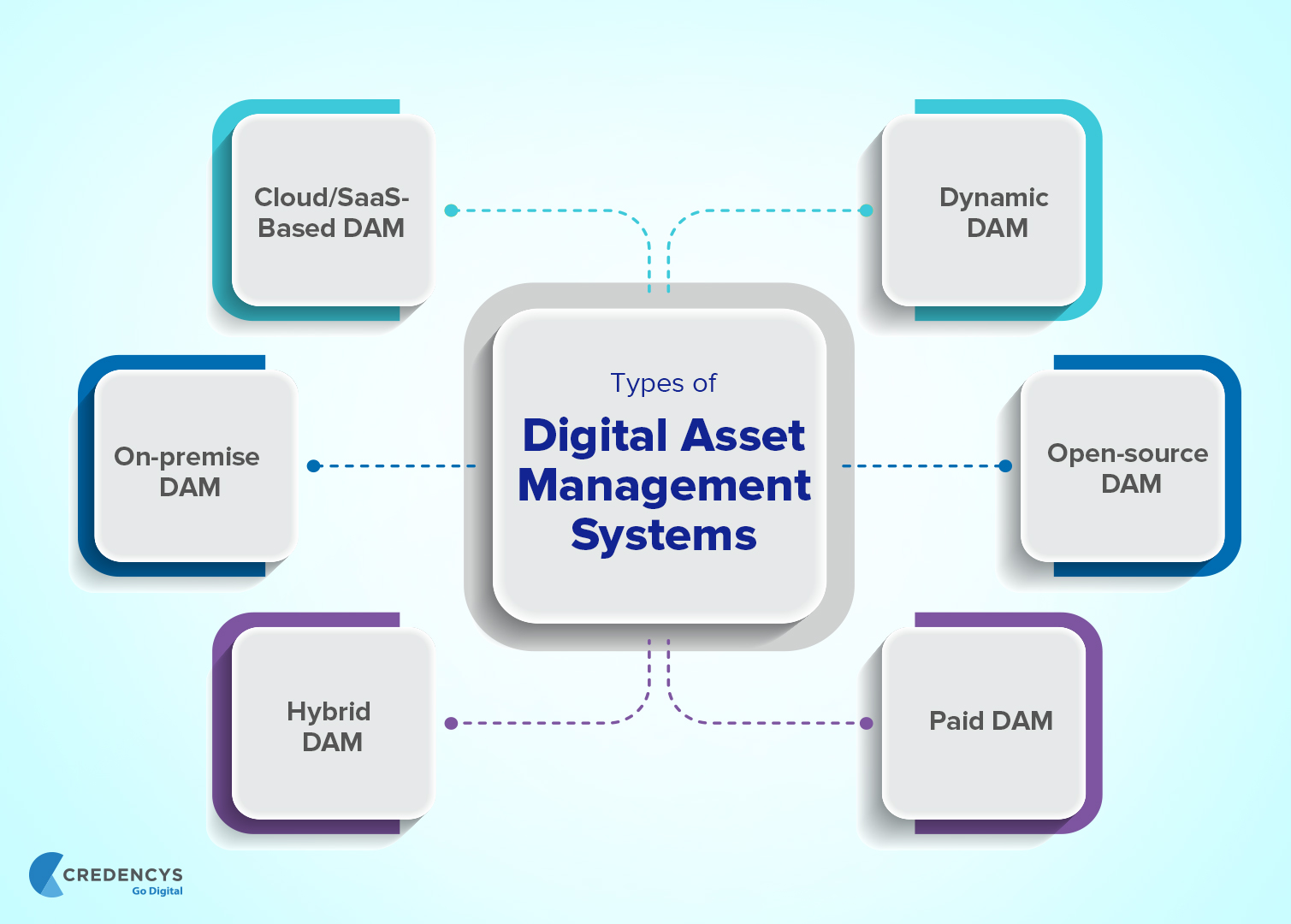
Types_of_Digital_Asset_Management_Systems

When it comes to selecting the right type of DAM, you have multiple options to choose from. Well, we provide you with a brief about the different types of DAM systems to help you to pick the most suitable one. So, let’s start.

1. Cloud/SaaS-based DAM

This is a widely used and highly advanced DAM technology. Most organizations prefer the cloud/SaaS-based DAM platform that enables you with the benefits of cost-effectiveness, least maintainability, and scalability.

Key considerations of Cloud/SaaS-based DAM

  • A web-based solution interface makes it easier for your team to use and learn the system.
  • User authentication is quite simple. You can easily add or remove any user with no intervention from the in-house IT team. It also enables vendors and partners with quick access to digital assets.
  • As the solution is web-hosted, deployment of it is easier and faster.
  • It required no hardware integration. So, cloud-based DAM is the most cost-effective option for you. You can also consider a subscription model to operate effectively.

2. On-premise DAM

Are you a company that needs access to the extensive DAM features? If yes, then on-premise DAM is the right option for you to pick. Have a look at the essential information on on-premise DAM.

Key considerations of on-premise DAM

  • On-premise DAM requires IT maintenance and management to take care of security updates and system backup.
  • On-premise DAM solutions do not fully depend on internet connectivity. So, it eliminates the risk of downtime in a situation like an outage.
  • You can get support for the custom functionality in the on-demand DAM. Of course, you need to pay extra for that.

3. Hybrid DAM

You can opt for both cloud/SaaS-based DAM and on-premise DAM by considering Hybrid DAM.

For instance; you can manage marketing material and financial records in the Hybrid DAM which enables you to the benefits of the cost-effectiveness of the cloud-based DAM and higher uptime of the on-premise DAM platform.

Key considerations of Hybrid DAM

  • Providing asset access to the vendors and partners is simple
  • The DAM vendors manage all system backups, maintenance, and all upgrades seamlessly.
  • Hybrid DAM solutions do not fully depend on internet connectivity. So, it eliminates the risk of downtime in a situation like an outage.
  • As the Hybrid DAM contains a few cloud abilities, it matches your lower budget requirements too.

4. Dynamic DAM

By implementing Dynamic DAM, organizations maximize asset value, optimize visual experiences, and streamline asset workflow across all the different touchpoints.

Key considerations of Dynamic DAM

  • The single cloud platform provides a cloud-scale architecture that enables the brands to higher performance of the system.
  • Allows for API integration with different tools like Product Information Management (PIM), Content
  • Management Systems (CMS), and other project management tools
  • Helps you improve customer experience by creating contextual digital content and delivering it through the DAM.
  • Dynamic DAM automates the process of creating multiple versions of videos and images with no dependencies or delay.
  • Allow your creative, development, and marketing teams to collaborate seamlessly on the DAM to maximize the value of assets.

5. Open-source DAM

There are many open-source DAM platforms available in the market. They come with zero licensing costs. So, all you need to pay for is the implementation and customization of the platform. This definitely addresses your budgetary constraints.

Though it is cost-effective, it doesn’t mean at all that you need to compromise on features and functionality. By selecting the right DAM platform like Pimcore that covers all the basic and advanced features, you can build a robust solution. Moreover, you can easily integrate it with your existing enterprise systems and third-party applications.

The modern open-source DAM solution contains modules like workflow management, digital asset delivery, digital asset consolidation, metadata management, asset portal extensions, and more.

6. Paid DAM

Apart from the open-source, the rest including cloud-based DAM, Hybrid, Dynamic, and on-premises are paid platforms. The price may vary as per the features and effectiveness of the platforms.

4 most common Digital Asset Management use cases

1. File management

The widely experienced use case of DAM is file management. Digital Asset Management solution stores, manages, and catalogs videos, images, and other media assets. It allows you to search asset files by title, keyword metadata, and descriptions. DAM enables you with customized file management systems according to color, branding, and font preferences.

2. Enterprise brand management

The brand is not merely a logo. It is a perception of people about your organization that they have created through the interaction with your brand. Through effective brand management, you can gain higher business values. While poor brand management leads to customer loss, slow business growth, and lower sale.

DAM helps you tell your customers a consistent brand story by distributing media assets such as ads, presentations, videos, images, and other marketing content. Using Digital Asset Management, you can manage your brand well, connect with your audience effectively, and gain a competitive edge.

3. Creative workflow management

The asset creation ability of DAM plays a vital role for the brands that operate in an omnichannel and distributed way. The design and marketing teams can store and use digital assets across different media types with a simple conversion process.

Some of the DAM solutions are not so advanced when it comes to design creation. So, designers create the artwork with advanced design tools and store, manage, and organize them in a Digital Asset Management solution.

Though the DAM doesn’t provide any graphic design tool or creative suite to designers, it helps in the asset creation process by covering assets in appealing forms.

However, DAM streamlines marketing operations significantly by working as a centralized repository for the varied components of marketing campaigns.

4. Product marketing management

A robust Digital Asset Management with an advanced product database can capture detailed specifications, weight, SKUs, product data, and distribution channels. You can also link the DAM to different product literature such as branding material, packshots, and advertisements. Product marketing management is ideal for managing and sharing product information with distributors and retailers.

Real-time user stories of Digital Asset Management

Kenmare

Before Digital Asset Management implementation

Kenmare is used to manage the large volume of digital assets in disparate systems across multiple locations. There was no easy way for sharing, tagging, and tracking all the assets.

When they want to add media assets to a Product Information Management solution, they need to perform a manual search for the assets from the different systems and add them to the PIM.

It was a time and effort-consuming process for the Kenmare team.

To learn about this use case in detail, visit Kenmare.

After the Digital Asset Management implementation

Digital Asset Management implementation allows Kenmare to store and manage product images, documents, PDFs, excel sheets, and other product-related documents in a single platform.

Kenmare implemented Pimcore-based DAM which was quite easy to integrate with their PIM solution. Integration of PIM and DAM solutions streamlines the process of adding the required media assets from DAM to PIM.

Ironlist

Before Digital Asset Management implementation

IronList is in the business of importing and export of heavy equipment and machinery. They used to manage the data in local computers in different folders. They were looking for an effective way to store, manage, and organize the media assets of heavy equipment and machinery products.

After the Digital Asset Management implementation

Integrating Digital Asset Management in the web portal, IronList has simplified the storage and management of every digital file in a well-organizational and logical folder structure. Integration of the Category Image Management feature allows the client to manage the images under the relevant categories.

To learn about this use case in detail, visit IronList.

9 Best Digital Asset Management practices from experts

Digital Asset Management Practices

1. Audit your assets

Before moving ahead with the Digital Asset implementation process, you need to collect all your existing assets from the different locations and create a comprehensive inventory of them. You need to analyze all the assets to get clarity on

  • What assets do you have
  • Who is accessing the assets
  • Who creates new assets
  • What assets are being used for
  • Where assets are stored

Without the above-listed information, you cannot have an effective transition of your digital assets in the DAM.

This information is also required to define your DAM objectives and select the right Digital Asset Management solution with suitable features for your workflow.

For instance; if you have a large volume of media assets including videos, images, etc. that you want to distribute across multiple output channels, DAM implementation enables you with the built-in distribution that is an invaluable productivity tool. Also, the solution provides approval and workflow capabilities to ensure the quality of the assets.

2. Integrate DAM into your workflows

Implementation of DAM definitely changes your existing workflow as you set the new system as the center of your asset use. All the users who need to access the solution are required to be trained on how to use the new solution.

Also, redefine your access procedure to make sure productivity does not get affected negatively.

Ensure the new workflow is proficient to identify

  • Who is notified of use or changes
  • Acceptable file sizes and formats
  • How files are accessed, saved, and modified
  • How to track requests or changes

3. Leverage analytics

Some of the DAM solutions come with built-in analytics and enable brands with plenty of meaningful information. Companies can make informed business decisions about digital asset production.

Apart from that, with DAM, it becomes easy to find the asset you need at any point in time. You can also track who used an asset, for what purpose the asset was used, when it was last used, etc.

Modern DAM platforms contain the capabilities of Artificial Intelligence that help users with identifying, recommending, and tagging the value of assets.

So, whenever you need to create new digital assets, utilize DAM analytics to get insights about what media assets your marketing and sales teams are using the most. You can also have a quick audit of your existing assets to identify the gaps and define what is needed.

4. Standardize meta-tagging and naming conventions processes

To gain maximum benefit from the DAM’s search capabilities, you need to define a consistent and clear protocol for creating metadata and categorization of digital assets. By establishing a uniform process for tagging and categorization of assets for each user, you can enable the users with the required information on the fly.

Do you want to know how to define categories or meta-tags for your digital assets?

Here’re a few popular tactics to consider while categorizing or creating meta-tags for the asset file. You can use

  • Date
  • Campaign name
  • Metadata
  • Keywords or other tags

While considering dates as the file names for proper categorization or meta-tagging, make sure the date format is consistent. You can either use a particular date or a range of dates.

Considering the categorization and meta-tagging, you can leverage a highly organized, searchable, and refined database of assets.

5. Collaborate within DAM

One of the biggest benefits that you can leverage from implementing the DAM solution is it allows your teams to collaborate in context. Instead of relying on email communication that requires endless streams of back-and-forth, the built-in collaboration tools of DAM allow your team to communicate about assets in real time as they are being created, edited, and used.

6. Consider access control and alerts to avoid copyright issues

If you want to manage rights-managed stock photos procured for specific campaigns with security, DAM allows you to restrict access to only a few team members who need to access and use them. This helps you reduce the chances that an asset is being used for a non-approved purpose. This eventually decreased copyright infringement issues significantly.

If your DAM solution contains the feature of Alert, configure it in your solution so that the authenticated user whose license is expired can get intimation in advance. So, they can take the required actions to renew their license if needed.

7. Introduce role and permission-based access

In most organizations, varied professionals from different departments are allowed to access digital assets. Introducing role and permission-based access to the DAM, you can leverage

  • An added layer of security
  • Make DAM easier to use

For example; your different teams are working on multiple campaigns. You need to provide access rights to certain team members who are involved in a specific campaign. DAM allows you to provide access to the limited users who are involved in the specific campaign. So, only authorized users can access the assets related to that campaign.

DAM allows you to prevent users from accessing digital assets that are not approved yet for use or are currently under development.

Utilize the versioning capabilities of DAM that involve check-out and check-in functionality that ensures your teams that they are using the latest and approved version of every asset.

8. Automated workflow

Automation is the key requirement of every business these days.

Do you want to know how Digital Asset Management automates the manual and redundant processes of asset management?

Modern DAM solution contains the Workflow Engine to automate the varied processes of digital asset management. It saves considerable time and effort for your team by automating the tasks like converting images into different file formats, distributing the media assets across multiple output channels, and more.

9. Asset versioning

Over a period of time, companies accumulate multiple versions of digital assets. These versions could be related to marketing campaigns, branding, and others.

DAM allows you to manage the assets by creating versions. While creating the versions make sure that all versions are preserved and that you can distinguish between the versions. The easiest way to maintain versioning is by applying numbers for each version. For example: v1.0, v1.1, etc.

How Digital Asset Management contributes to your business?

DAM systems offer the most effective solutions to all types of problems that do not control the assets properly.

Following the given steps will help you to organize the assets and also the users.

Understand workflow

DAM defines various hierarchies and allocates the tasks. It allows effective work slow that streamlines the entire system.

Restricting access and permissions

DAM keeps track of every activity including sharing of assets among the employees. That it can be secured well by offering restrictions to access. Individuals are given permission based on time duration.

Effective usage of metadata

Metadata can be effectively used by setting tagging and also managing the Asset information conversion. The designs in form of text images, audio, video infographics, and other types of data can be used in the marketing campaign.

Training Schedule

Every user can be offered training to make use of DAM services. The users should understand the various techniques for managing and sharing assets.

Support services

When you decide to buy the system or when you subscribe to a useful model. You can choose the best suitable model for your business. You can change the system according to the requirements of your business requirements.

Do you really need Digital Asset Management?

Undoubtedly, the DAM enables all organizations with robust features and functionality that drive tremendous value by streamlining the asset management processes for an organization. Still, the companies need to analyze, do they really need to implement a Digital Asset Management solution.

Rather than just putting blind trust in the solution provider, as a business owner, you need to identify and understand the needs related to asset management within your company.

I would like to help you by suggesting in which situation you can consider a DAM solution.

  • Tracking marketing projects seems difficult to your teams
  • Complex asset approval and version creation process
  • Uncertainty whether your different teams use an approved version of the asset
  • The problem in finding assets and utilizing them one time one
  • Uncertainty about the use of digital assets by external partners
  • The problem in converting digital assets into the different formats needed for varied campaigns
  • You need to create too many versions of assets or have version control issues
  • If your teams need to collaborate from remote locations
  • You require regular downloading of media in different formats and sizes on the fly
  • If you have confusion related to user permissions/access
  • You are losing 5 or fewer assets annually
  • You have budgetary constraints for investing in an enterprise-class DAM solution
  • Digital assets being used are not brand-consistent
  • The free solutions such as Google Drive or Dropbox or Box, etc. that you are using don’t have the functionality you need
  • There is difficulty in tracking how assets are used and by whom
  • Constantly increasing number of delivery delays and missed deadlines
  • Manual process for sending out assets
  • You do not want to appoint any resource for an Asset/Metadata Manager role
  • You are dealing with errors or discrepancies in distributed creative
  • You are losing 30 or more assets annually
  • Your DAM requirements are not handled by your existing document management system well
  • You need to deliver contextual content to different audiences across multiple channels
  • You have too long approval processes
  • You are using a DAM of a digital creative agency by paying them the required proportion
  • You are having creative assets that are primarily text-based
  • You are using a web CMS that allows you to resize, upload, and publish images and other assets
  • Your marketing team produces large volumes of marketing content
  • You realize that you are purchasing too many new assets

How to select the right DAM system for your organization?

To select a suitable DAM, you need to consider different aspects. Here’s the process you should use to choose the best one.
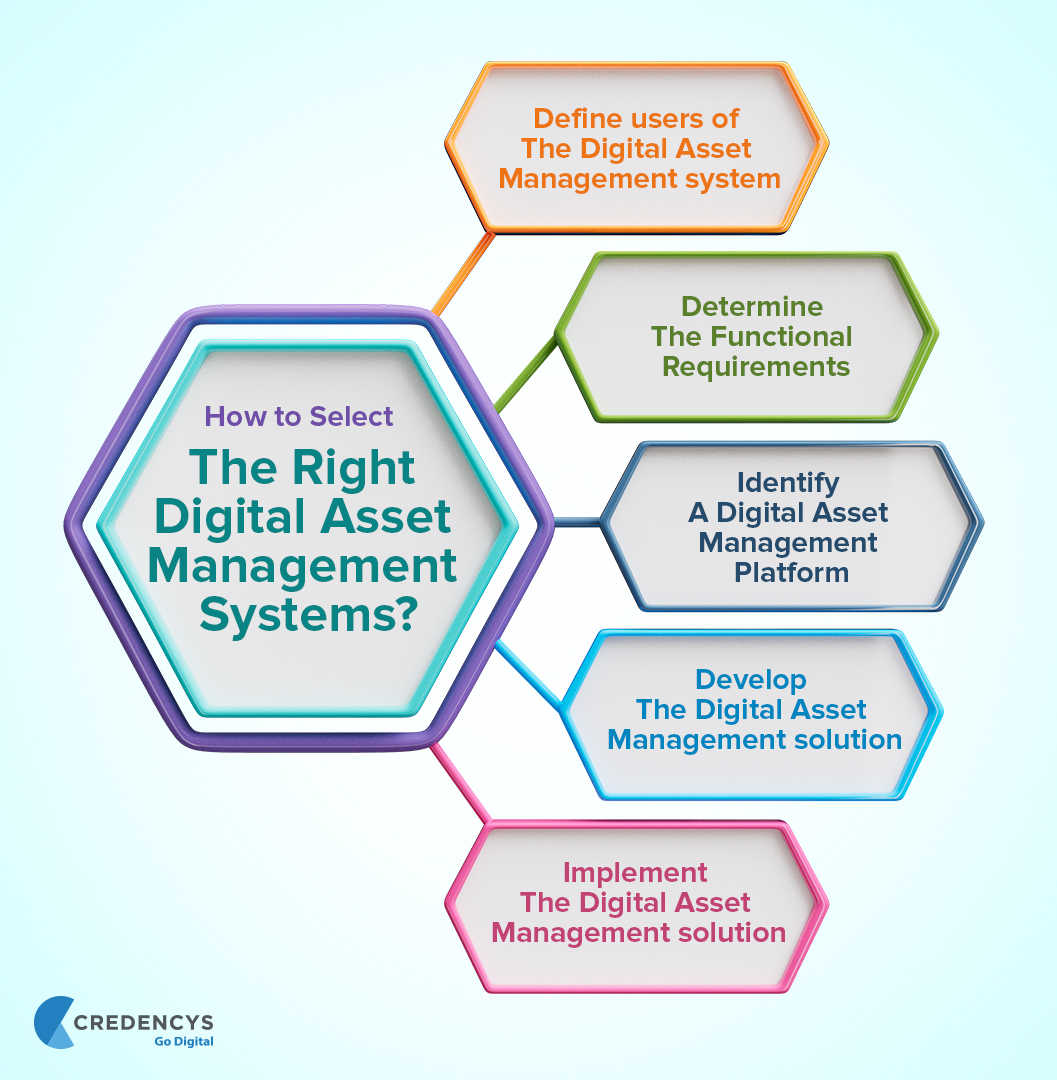
How_to_select_the_right_Digital_Asset_Management_system

5 Top Digital Asset Management platforms

1. Pimcore
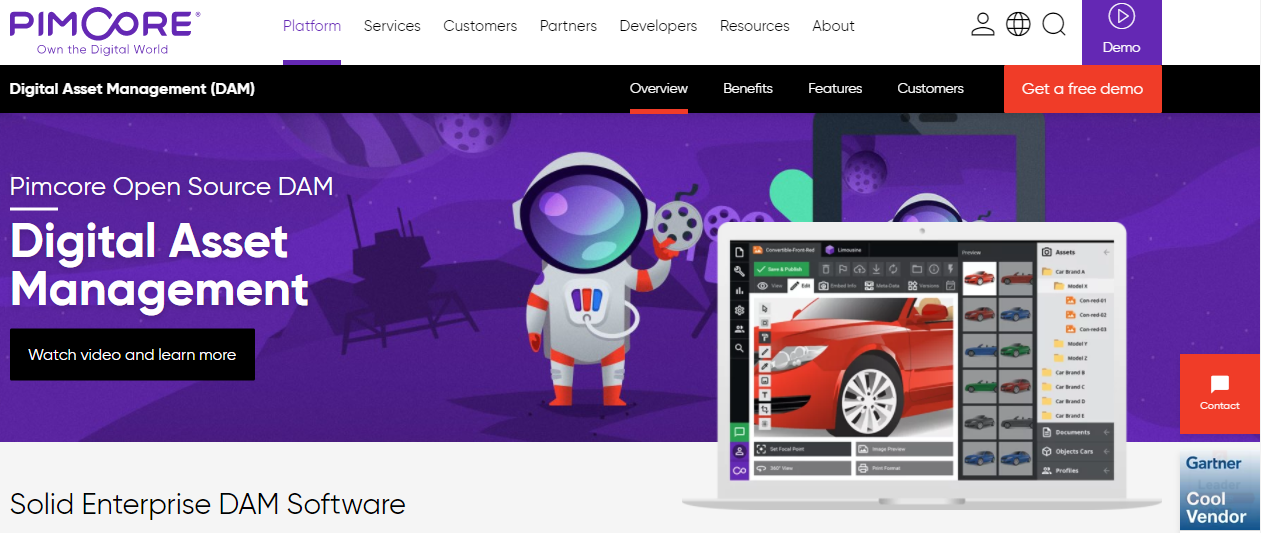
Pimcore DAM

Pimcore is one of the most reliable digital platforms that enables you with six different frameworks. One of the most essential frameworks of Pimcore is Digital Asset Management.

It allows brands to leverage centralized management of all your media assets such as images, videos, documents, graphics, and other media content. It enables organizations with the benefits of attaining brand consistency, creating a compelling customer experience, and removing data Silos.

Key features of Pimcore’s DAM

  • Digital asset consolidation
  • Metadata management
  • Workflow management
  • Digital asset delivery
  • Works with any file type
  • Image and video conversions

It provides a set of enterprise-class solution features such as Enterprise Metadata, Pimcore Direct Edit, Brand Hub & Asset Sharing, Asset Experience Portal, Enterprise Print Publishing, and Microsoft and Adobe Integration.

2. Adobe Experience Manager
Adobe Experience Manager DAM

Adobe Experience Manager is a cloud-native DAM platform that allows companies to manage thousands of digital assets at any scale. Being a robust and feature-rich DAM platform provider, Adobe Experience Manager enables users with features like asset automation to utilize AI capabilities to automate the process of asset distribution, file tagging, image cropping, and more.

Adobe allows the brands to perform the varied asset management tasks in minutes that usually take hours to be completed.

Key Features of Adobe Experience Manager

  • Asset collections
  • Brand portal tools
  • Asset check-out
  • File version history
  • Multilingual asset management
  • Asset insights
  • Support for advanced file types including panoramic, AR, VR, 3D, etc.

3. Bynder
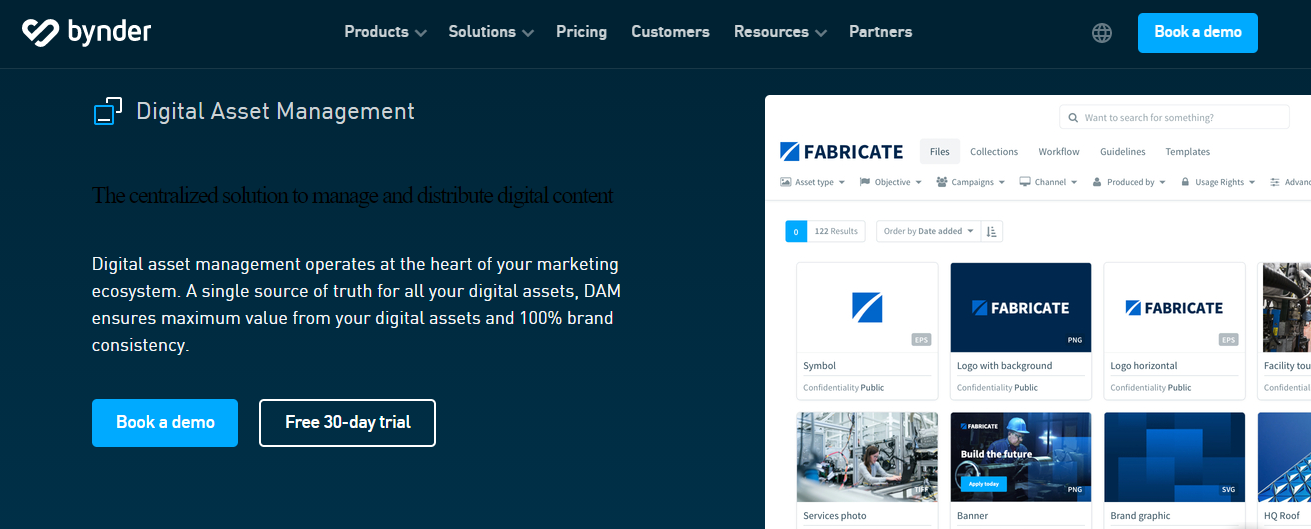
Bynder Digital Asset Management

Bynder is a renowned digital asset management software used by popular brands such as Canon, Spotify, Puma, etc. You can automate creative workflows with annotations, customizable approval paths, and versioning.

It allows users to create marketing content by leveraging easy-to-use brand templates. Moreover, Bynder supports third-party integration such as Google Analytics, Magento, and more.

Key features of Bynder

  • Intuitive filter
  • Access and usage permissions
  • File sharing
  • File downloading in varied format
  • Automated content distributions

Bynder enables you with the advantages of an organized and easy search for the files, control usage, and access rights, quick sharing of files externally and internally, download your files in the desired format, and automated distribution of content across multiple customer touchpoints.

4. Canto

Canto DAM

Canto is the pioneer in the Digital Asset Management domain. It was founded 25+ years ago and during such a long journey they have grown its DAM platform extensively to meet the changing market needs and customers’ requirements.

Canto DAM is used by many leading organizations including NASA, United Airlines, Harvard University, etc. It allows the users to add digital assets by creating folders and albums and organizing the different files such as documents, presentations, videos, images, and other types of file formats automatically.

Key features of Canto DAM

  • Advanced search tools
  • User permissions
  • Security features
  • Custom shared libraries
  • Visual previews
  • Collaboration tools
  • Reporting, and more…

5. Cloudinary

Cloudinary DAM

Cloudinary is considered the best Digital Asset Management platform by 6000+ businesses. Peloton, Lyft, Petco, Under Armor, Sony, Whole Foods, and many other brands have trusted and utilized the platform.

Well, the platform is paid. You are allowed to access the limited features of Cloudinary’s DAM platform for free. To use the advanced features, you need to purchase a subscription plan.

Moreover, the Cloudinary contains Artificial Intelligence capabilities that help you in asset tagging. Organizations can utilize the automated tagging feature by facial recognition, object, and color. The assets stored on the Cloudinary DAM can be manipulated in real-time.

Key features of Cloudinary DAM

  • File sharing and access
  • File search
  • Asset organization
  • Media asset management
  • Digital distribution and publishing
  • Version control
  • Brand management

How Digital Asset Management helps you maximize ROI?

Implementation of Digital Asset Management helps you increase your Return on Investment. For that, you need to have the right strategic planning in place.

Determine what asset management activities cost you without implementing the DAM. To know that, you need to evaluate that cost for

  • Asset searches
  • Asset distribution
  • Asset re-creation

After the successful DAM implementation, analyze the revenue factors that get affected by the introduction of DAM.

  • New revenue streams
  • Resource availability

Once you start working with your DAM, identify how long it will take for your DAM platform to pay for itself.

Verdict

Empower your internal teams and external users by creating a centralized repository of all your digital assets. Along with storing and managing the assets, you can utilize the DAM to streamline and automate the various asset management processes.

Pimcore enables you with a highly trusted and widely adopted DAM platform that ensures the brands with robust yet cost-effective Digital Asset Management solutions.

Book a 30 minutes free consultation with our DAM experts to get personalized consultation on your DAM requirements.

15 Best Practices for Successful Product Information Management (PIM) Solutions

Growth of the eCommerce domain is increased by leaps and bounds with each passing year as it allows manufacturers, retailers, and wholesalers to sell their products regardless of geographical limitations.

To sell the products online, you either prefer to sell on the marketplaces or develop your own Pim eCommerce solution. But, in both cases, the product information is the key. You need to ensure the customers receive relevant and updated product information to make the right decision at the right time.

Here is where Product Information Management (PIM) comes into the picture.

Let’s start exploring the core aspects of Product Information Management.

What Is Product Information Management?

Product Information Management is used to manage massive product data in a centralized platform. It allows entrepreneurs to collect, manage, enrich, syndicate, and distribute product data through a single place.

It allows brands to create a product catalog and keep them updated with the latest product information. So, when you distribute the catalog across the online and offline platforms, your target audience gets access to the latest information only.

Moreover, PIM allows you to manage all the information related to products such as name, title, descriptions, SKUs, UPCs, materials, measurements, warranties, ingredients, certifications, spreadsheets, assembly instructions, designer notes, style sheets, videos, images, documents, and much more.

To get exclusive insights on PIM, read What is PIM? – An Ultimate Guide for Product Information Management.

Rise of Product Information Management Market

According to MarketsandMarkets, “It is expected that the global Product Information Management (PIM) market size to grow from USD 7.0 billion in 2019 to USD 11.4 billion by 2024.

Every business that wants to centralize the product information, restrict data control personnel, increase overall productivity, and enhance data experiences prefer the PIM implementation for sure. Thus, it is expected that the PIM market will reach new heights by 2024.

Before moving ahead let me clear that you have to consider different practices before and during PIM implementation and after the PIM implementation. By following these practices thoroughly, you certainly taste the tremendous success that you are expecting from a Product Information Management system.

10 Best practices for Effective Product Information Management (PIM) Implementation [Before & Through]

1. Consolidate all product information

This is the first step of establishing an infrastructure to manage product information across your company from a single location. PIM is the system that manages all your product data in a centralized platform.

Using the PIM solution, your team members can manage, access, and publish the product data to one or multiple locations. Along with consolidating all the data in a single location, it is important to create consistency in terms of sharing the product data in a pre-defined structure.

Consolidation of all the product data enables you with several benefits such as

  • Reduced errors and fewer redundancies in the product information
  • Greater scalability in terms of adding new sales channels quickly and easily
  • Improved traceability
  • Better control over how products are managed

2. Understand your business objective for implementing a Product Information Management (PIM)

Do not make a decision to implement a PIM just because your competitors are doing it or someone suggested you implement it. If you do so, there are full chances that you might end up taking the wrong decision.

Before considering PIM, you need to analyze your business objectives and conduct a detailed study about how the PIM system helps you to accomplish your business goals.

It helps you to determine the parameters that help you define success and set expectations. Keep your objectives in the mind and develop your PIM that supports your eCommerce strategy.

Check out the below-listed objectives. If you are having any or many or all of them, then PIM will definitely help you to achieve them.

Accelerate time-to-market

Improve new product onboarding time and deliver the updated content faster across multiple channels including online marketplaces, eCommerce stores, mobile platforms, websites, print, catalog, and more.

Improve customer experience

Drive tremendous customer engagement by enabling them with complete product information including detailed product descriptions and images that establish an emotional consistency across different sales channels.

Deliver high-quality product data

Leverage the bulk editing tools and streamlined workflow of PIM to manage the product information in a complete, comprehensive, and error-free way across all the output channels.

Expand to new channels

PIM allows you to sell and market your wide range of products on the new sales channels. The solution enables you with several advanced capabilities that allow you to populate the product data automatically to these new channels with rich product information.

Enhance team collaboration

Increase the participation of the functional team to improve the quality of product data.

Boost marketers’ productivity

When the data is scattered across the different spreadsheets, it becomes a challenging job for the marketers to collect and syndicate the product data in order to get a unified view of all product information.

Moreover, PIM enables you with an efficient process and a guided interface that saves a lot of effort and time when it comes to product catalog management across different output channels.

Faster vendor data onboarding

Do you want to streamline the product data gathering process for your internal team and the suppliers?

PIM allows your suppliers to update their data directly in the system. With the flexible supplier information onboarding, you can improve vendor collaboration by allowing them to provide your required product data in your preferred format.

Market your products across new regions

Advanced translation and workflow management make localization more efficient and much faster than ever before.

3. Set up your Product Information Management (PIM) requirement and implementation plan

Based on your collected product information and business objectives, you need to define your PIM implementation plan. You need to determine

  • Do you want to manage your products from scratch?
  • Do you want to model your entire catalog?
  • Do you want to consider the “land and expand” approach to begin with, where you can start with a subset of your products, brands, channels, locales?

You need to make the right decision by analyzing your business objectives for PIM implementation and the maturity and complexity of your company.

To ensure the expected success through PIM, it is crucial to design your PIM project for all your existing and upcoming requirements, regardless of project size.

Small approach

Adoption of a small approach is the best way for large-scale organizations. It becomes easy for you to implement and test the PIM connections and processes with your other existing business applications and ensures everything works as expected.

Starting with a small approach, organizations can launch a single product line in a single region to test the market response for that product. Instead of taking the risk of introducing an entire range of products to a new region, it is a smart and cost-effective approach to analyze single product performance in the new location first.

Based on the response of the target market, you can roll out other product lines one by one or/and expand to the other areas of the specific region one after another.

Full-blown approach

Organizations also choose a large approach where they roll out all that products in one go. With this approach, you can realize the benefit of the PIM solution and experience the centralized data management capabilities of it.

Whatever approach you consider, you need to make sure the PIM implementation is right for your business objectives. To ensure that, ask these questions to yourself before making a concrete decision.

  • Should we tackle the entire catalog?
  • Can we start with a subset of products?
  • How crucial time-to-market for our PIM implementation initiative?
  • Which channels are most essential for our business?
  • Which regions/locals are more important for us than others to focus on at the initial phase?

4. Identify the right Product Information Management (PIM) platform

Once you determine the business objectives and PIM requirements of your organization, the next step is to select the right PIM platform.

Before coming to any conclusion, you need to thoroughly understand the existing condition of your business and determine all your needs that are connected to a PIM. You need to make a choice of a PIM platform that fulfills the expected gaps in your product ecosystem and helps you achieve your business goals.

Investing in the right PIM platform is the best Product Information Management strategy that allows you to set the right expectations, measure PIM’s effectiveness, and develop advanced eCommerce capabilities.

A lot of options available to you when it comes to the PIM platform. All you need to do is analyze all the options in detail and then make a perfect choice for your organization. Here’s the list of most popular PIM platforms:

  • Pimcore
  • Akeneo
  • EnterWorks
  • Agility Multichannel
  • PIMworks
  • Salsify
  • inRiver
  • Informatica
  • Plytix
  • Stibo Systems
  • Syndigo

Do you want to get detailed insight into the key features and core benefits of each platform listed above? Read Top 11 Product Information Management (PIM) Platforms to Consider in 2020 & Beyond.

5. Select the right Product Information Management (PIM) Team

Before moving towards defining a process, it is very essential to select a team that takes a charge to develop and implement the PIM solution as per your business-specific needs.

Make sure they have all the required data about your products, eCommerce channels requirements, and desirable catalog format.

Choose an experienced PIM solution development company like Credencys Solutions Inc. that has a team of skilled professionals who have successfully developed and implemented PIM solutions for the clients like Kenmare and IronLists from different industry domains.

The core purpose of PIM implementation is to help your marketing, sales, and eCommerce teams by simplifying, automating, and centralizing the management of multiple products and their attributes. So, identify your key team members who are going to use the PIM solution to manage the product data as well as save time and effort.

6. Define the process

Now that you have chosen your team, you need to focus on establishing the process that helps you realize the most product information management benefits. Start figuring out the best information management enrichment practices and analyze how your teams fit in the process.

Make sure all your team members are domain experts who have profound knowledge of how the workflow should function. Furthermore, as per the suggestion of your professionals, you need to enhance the process as moving forward.

To leverage the successful PIM implementation, ask your team to perform only high-value tasks, and leave the mundane activities of product information management.

For example; your team can sidestep repetitive tasks like attending complex datasets to computers. Instead, they can focus on establishing an emotional connection with the customers by writing compelling product descriptions.

7. Determine roles and responsibilities

Product content impacts customers’ buying decisions a lot. Thus, allow your teams to collaborate directly within the PIM solution to eliminate the content errors and speed up the workflow significantly.

To enable the customer with the right and updated, add your eCommerce managers, marketing executives, and external collaborators like wholesalers, vendors, distributors, etc. in the process of producing the product content.

Selecting a PIM system that allows you to create different roles with various access levels at minimal risk is critical work. PIM platforms like Pimcore allow you to include as many access levels as you want including admin, product management, publishers, read-only, and more. All the users consist of a set of default permissions based on their roles and responsibilities.

With Pimcore, you can be more granular to allow your users to perform only certain actions.

Internal users

With granular permission, your respective users can

  • Create product attributes
  • Update product attributes
  • Read product attributes
  • Delete product attributes

There are many other permissions too that you can define in the PIM solution based on roles and responsibilities such as

  • Update products
  • Sync products
  • Request approval for product
  • Publish products and more…

External users

Invite your wholesalers, suppliers, vendors, distributors, and other external users to collaborate on the product content. Ensure the external users provide you with the right data in the desired format.

You have full liberty to define how much access you want to provide to your internal or external users. The PIM system also allows you to keep a history of every action performed within it and revoke the access permissions if required.

8. Provide training to your team for Product Information Management (PIM) adoption

To leverage the utmost benefits of PIM, you need to provide training to your team and make them understand how the system works and how it streamlines their day-to-day operations. The success of PIM implementation depends on how smoothly and effectively your team adopts it.

Your employees are well worse with the existing system so they might resist this new change. Moreover, the adoption of new platforms requires establishing new habits and understanding of new processes. Thus, it is very obvious they won’t be ready to work with the new system.

You can address this issue by providing thorough technical and functional training to boost the confidence of your team about working with a new system.

Technical training

Provide technical training to your technical team where you can explain the technical implementation system integration and performance tuning.

Functional training

Enable your marketing and catalog management teams with functional training where you can cover day-to-day operations and use of PIM. You can make them understand how they can organize products, manage media assets and attributes, and create a catalog using the PIM.

Every new change seems tough to adopt at the first glance. So, support your team in adopting the new ecosystem of product data management seamlessly and ensure a successful implementation of the PIM that maximizes your operational and monetary benefits.

9. Avoid managing product data in multiple systems

According to research, more than 50% of the firms are managing their product data in more than 5 systems. With such scattered data, it becomes difficult for you to consolidate, syndicate, and enrich the product information as and when required.

Also, if you want to get a unified view of your product information, you need to invest a lot of time and effort in order to collect the data and organize them well.

Without a centralized system, you won’t be able to manage the massive product information effectively.

If you are thinking of managing all your product data in a database, then you are making a big mistake as you can store and manage the data in the database but it won’t allow you to view and access your data without a user interface. Thus, you need to build a front-end UI.

Eventually, you end up spending on a solution development that connects the database and provides you the output through a UI that costs you more than a PIM system.

10. Data integration with different systems and platforms becomes easier

Data integration with existing enterprise systems

If you are already managing the product data in multiple existing enterprise systems, then you might be hesitant to implement a PIM solution by thinking that integration of your massive product data will be problematic.

Moreover, you want to want to continue managing the product data on different platforms due to some business purpose.

Well, an advanced PIM solution allows you to integrate all the data available in your different enterprise systems like ERP, CRM, excel sheet/spreadsheet, any custom build system, etc. So you can easily import the product data from any or all of your current enterprise systems.

Not only that, but you can also export the updated product data from PIM to other systems by establishing seamless data integration.

Data integration with external sales channels

With a PIM platform offered by Pimcore, you can also distribute the product data from the PIM system to external sales channels like eCommerce stores, websites, marketplaces, etc. You can distribute the product data as per the defined format and data structure of your external channels.

5 Best Practices of Product Information Management (PIM) [After Implementation]

1. Product information enrichment

Product information is the key asset to engage the customers and helps retailers to gain a competitive edge. Thus, it is very essential to keep enriching the product data as per the customer’s expectations.

Are you confused about how to enrich your product data using PIM?

It’s very simple. With PIM, you can write high-quality content for the product description, use high-quality images, add HD quality videos, and more.

All these product elements are often overlooked by the brick and mortar stores while they are shifting their physical store to digital platforms. Apart from considering these standards, it is also important to utilize the tools and processes that make PIM usage more efficient.

It enables you with increased revenue, better conversions, improved customer loyalty and engagement, and stronger differentiation.

2. Product performance optimization

Product Information Management is more useful than simply managing the product data. It is not only about managing the data in a cartelized platform but also optimize the performance of your products across all the sales channels.

The success of an eCommerce platform is judged based on two factors.

  • Driving high-quality traffic
  • Converting visitors into customers

Product information impacts a lot on product performance and the above-listed factors. To improve product performance, you have to focus on the four below listed areas.

  • Strategize your product information and apply A/B testing to improve the conversions.
  • Create rich and SEO friendly product information to attract highly qualified buyers and increase traffic.
  • Create customized product information to better cater to the specific needs of the different market segments and sales channels that help you to increase the conversion rate.
  • Monitor product performance across all the output channels. Keep updating the product information moving forward.

3. Product information standardization

Managing all the product data in a centralized repository, PIM enables you with a unified view of product data where you can update, search, and publish the product content across multiple sales and marketing channels.

It also allows you to set validation rules to impose the common standard format on product categories and attributes. Effective data validation is required to ensure the consistency of your product catalog and safeguard. This helps you to generate a completely error-free product catalog.

Apart from product data format, product information standardization helps retailers to establish eCommerce relations between different products. Using a feature-rich PIM platform like Pimcore, you can utilize the cross-selling and up-selling of potential products by ensuring a faster time-to-market at the same time.

4. Design catalog structure

Your product catalog gets featured on various sales and marketing channels and locals as well as reflects the varied peculiarities of the product. Especially, when you are offering a wide range of products, catalog structuring matters the most.

When I say catalog structure, do not confuse it with product profiling. PIM is far beyond just a database interface. You can do much more than that. In fact, you can utilize the PIM potential as much as you can.

Product catalog creation is not everyone’s cup of tea. You need experienced marketing or eCommerce executives to do this job who have thorough knowledge about the profiled product.

Each product belongs to a product category, so there is a product family, product attributes, and product variants. Your team should be capable of analyzing the products based on the properties to design the robust catalog.

While creating a product catalog with PIM, you should consider varied factors like:

  • Product families, attributes, variants, categories, and families
  • Defined associations and relationships between different products
  • Manage channel specific attributes such as more images for marketplaces and eCommerce site or shorter
  • product description for mobile apps seamlessly
  • Product enrichment requirements to be considered “Fulfilled”
  • Locale specific attributes such as metrics, currencies, and more

5. Product Information Management (PIM) improves customer experiences

According to a survey, 96% of the respondents said that customer experience would impact if they purchase again from you and 83% of the respondents refer your brand to others as a result of a positive experience.

These statistics make it clear that customer experience is the crux to grow your business. And, PIM implementation ensures you improve the customer experience consistently. Also, it adds significant value to your B2C and B2B efforts.

PIM allows you to create and manage a whole body of content for your each and every product with different versions that allows you to enable your customer with the relevant information at the varied stage of their journey.

It simplifies multichannel sales for you as it allows you to present every sales channel where your customers are likely to make a purchase from you.

Last but not the least, PIM enables you to create error-free product content as well as empowers your team to focus on creating relevant product stories that drive tremendous customer engagement.

All these prove that PIM is a critical component of your customer experience strategy that helps you to boost your brand presence and sell products.

In nutshell

I guess now you are clear how you can leverage PIM to avail most benefits out of it. By following these practices you can not only manage your product information in a structured, meaningful, and unified way but also you can market and sell them with a greater impact like never before.

Are you ready to skyrocket your online business by implementing a robust PIM? Book 30 minutes free consultation with our PIM experts who help you to design, develop, and implement a custom Product Information Management solution that helps you to meet your specific business needs.