CMS vs. DXP – How Both are Different From Each Other?

At the time, when the Content Management System (CMS) was introduced it became popular so quickly and delivered a great solution for the web content management system. But, since the Digital Experience Platform (DXP) has started overtaking the trend, CMS in the recent past.

We can see a huge transformation among developers and businesses as they are shifting from CMS to DXP. CMS in the long-run has long morphed into a Web Content Management (WCM) system, with multiple users working on the same content.

Later WCM was able to get through the challenges that CMS could not address. It allows the front-end interface to publish and control the entire content.

Where do both CMS and DXP take into consideration, and what is the key difference between CMS and DXP? Let’s discuss it in detail throughout this post.

Difference between CMS and DXP

This section brings you the key differences between CMS and DXP as well reveals some important aspects where CMS fails to address the challenges but DXP does pretty well.

Personalization

CMS comes with its own set of limitations. In today’s scenario, the world is running super fast behind high-end digitized technologies and therefore the demand for personalization across all touch-points has become a mandated thing. This is one reason that organizations that were using CMS now do not consider the platform to be so powerful.

Customer experience

On the other hand, DXP provides a plethora of benefits to businesses, supporting brand enhancement, and producing digital experiences with the help of websites, portals, IoT devices, apps, etc. Therefore, businesses aim to provide an integrated and modernized framework to deliver a cohesive and contextual digital customer experience.

Wider digital exposure

DXP offers businesses a seamless digital experience and helps them to reach the target audience with extensive web and mobile optimization, social media marketing, product information management for eCommerce, organic searches for WebPages, and more, in which CMS lacks.

Current trends in Digital Experience Platform (DXP)

1. CMSs are quickly evolving into DXPs

CMS allows users to manage documents, perform multi-author editing, and multi-user participation. In other words, CMS acts as a database repository to protect data such as metadata, content, and other types of information.

Rather than completely omitting CMS, businesses prefer CMS along with DXP to ensure complete visibility and accessibility of information.

DXP performs one step beyond CMS by connecting the complete data architecture and platforms included in the chain. With the rising customer expectations, businesses have to opt for digital experiences rather than just the CMS since integrated architectures highly favor customer expectations.

2. Hybrid headless approach is likely the future of DXP

CMS depends on headless content architecture and does not care about how and where the content is being displayed. This had been the biggest challenge for CMS users, which is now replaced by DXPs providing head-to-head optional capabilities as per the business need. Now users can manage their content display in the way they want since DXP is highly capable of doing timely segregation of the front-end and back-end layers.

Moreover, DXP highly emphasizes interoperability and cross channel continuity to provide customers a smooth experience when using digitalization. Prominently, DXP offers a suite of solutions to handle complexity in brand promotion and lead generation. DXP has the potential to manage inventory across different locations and integrate all analytic tools seamlessly.

3. The demand for architecture and infrastructure agility

With the increasing demand for modernized CMS solutions, the need for innovation is focused more on phasing it out. Organizations expect a high-level architecture that can deliver a global, anytime accessible, and high-end security service from the cloud i.e. more of a native cloud.

Therefore DXP is the end-to-end digitalized solution for addressing the instantaneous needs of users, offering experience composition and orchestration, delivery and management, and customer data management & analytics.

What are the core capabilities of a Digital Experience Platform (DXP)?

Let’s look at the capabilities of DXP from different angles.

1. Experience

  • Rich and responsive orchestration
  • Overall analytics and optimization based on customer touch-points
  • Customization based on context
  • Extensive search, navigation, and discovery

2. Management

  • A one-stop solution for managing product information, website content, eCommerce, and others
  • Makes Content-as- a-Service (CaaS) in the front-end
  • Provides complete access control and security administration
  • Easy collaboration and knowledge database

3. Platform

  • Scalable and flexible architecture and application development
  • APIs-based integration, extensibility, and interoperability
  • Headless approach
  • Multichannel support at different levels

What categorizes a DXP and a non-DXP?

  • DXP is a centralized platform that provides continuous utilization of information across any channel to the customers through their purchasing cycle. Whereas a non-DXP can be a club of new or existing platforms/technologies but fail to address the challenges involved in the integration.
  • API integration is enabled across different channels in DXP. The integration happens in the other way i.e. one-at-a-time focused such as a website, responsive mobile website, or a mobile app.
  • DXP is a great platform to support headless, head-optional, hybrid delivery, DevOps, and microservices. But, a non-DXP may support only a head-to-head approach which makes it difficult for users to manage their web content management system.
  • DXP enables an interactive and continuous conversation with customers across different types of channels, whereas the latter provides a unidirectional flow of communication channels like a plug-in and plug-out basis into your system for an instant reaction.
  • It combines both the business and IT developers to work for a common purpose i.e. customer experience. Other than DXPs work for either an IT system or a marketing system.

Advantages of having a Digital Experience Platform (DXP) system established

1. Large-enterprise management

As businesses grow over a period of time, large enterprises cannot handle a huge amount of content with CMS.

Therefore, an effective solution like DXP allows for multi-channel communication and instant access to content modification according to the changing requirements of the target audience. Even in security aspects, users prefer something more than new or creative to achieve their organizational goals.

2. Extreme customization

With DXP, organizations can extensively personalize omnichannel campaigns deep down. Also, digitalization makes the data centralized and easily accessible. So, organizations can twist and turn personalized data and make it contextually correct and reach the target customers.

3. Enhanced productivity

A DXP takes away excuses from employees in terms of data unavailability for the work progress to slow down/stop where they are. However, by doing so, it results in improved productivity of your organization, thereby focusing more on customer experience.

4. Enabling time-to-market in no time

DXP extensively supports eCommerce websites and has many features to boost such sites. These features can be integrated easily with CMS rather than needing individual integrations with eCommerce solutions that happen in the traditional model.

How to know if your business needs a Digital Experience Platform (DXP)?

  • You have all systems in place but with high restrictions for marketing and development teams that stop you from achieving your organizational goals.
  • When you do not have access to customer information.
  • When you cannot deliver customized experiences to your customers as per their needs.
  • You may have audiences from different demography and preferences when they try to connect with you through multiple channels.

What are the benefits of preferring an open-source Digital Experience Platform (DXP)?

DXP is a highly manageable modernized solution that addresses almost all pain points of the customer lifecycle. On the other hand, many DXP options fail to address the challenges in operations. Some of the understandable reasons can be lack of flexibility, very limited configurability, and added hidden costs too.

Users can easily avoid this stage by preferring open-sourcing because open-source DXPs offer great advantages over traditional solutions.

1. Flexibility

If your business focuses on extreme scalability and future optimizations, according to the increase in demand, then open-source DXP systems can greatly help. Right from APIs integration or adding up a specific feature to an enterprise-level strategy, a regular DXP platform cannot yield many results when surrounded by restrictions in the ecosystem.

Therefore, to enable and enhance multi-platform communication and to manage a wide range of enterprise-level data, you require open-source DXPs as per the need.

2. Innovation

The primary point of a DXP is to grow along with changing times. Since it is a dynamic platform, it has to be lean and agile to provide benefits to customers in many ways such as continuous and timely access to required information, applications, and interactions seamlessly.

Open-sourcing DXP can fulfill these requirements by allowing you to develop quick strategies and saving huge time, money, and effort when trying to execute from the start, independently. Moreover, open-source DXPs provide universal access to technology and prototyping tools for enabling and driving highly creative and innovative ideas, enhancing within no time.

3. Cost

Open-source DXPs allows businesses to have a clear-cut edge over traditional software with respect to costs involved in licensing, development, and operations.

Moreover, if you look at the result that these open-source DXPs have produced in the long run, it has reduced the total cost of ownership on businesses. Having open-source DXP implemented keeps away the vendor lock-ins and lets you own the intellectual property.

Final Verdict

Technology keeps changing and upgrading depending on the rising customer demand like how CMS has been taken over by DXP which is the largest trend in demand. Therefore from the business aspect, it is ideal that you implement the latest one to retain your customers.

How Product Information Management (PIM) Decides the Success of Your Retail Business

Information about anything helps people to make a decision about it, and the decision of buyers determines the success of the retail sale of any product. Isn’t it?

The management of information on a particular product plays an important role in its ultimate fate and can be a difference between success and failure. The marketing managers felt extreme pressure on how to manage the content of a product to make the product more desirable and ultimately successful in the retail market.

The issue with the product information management is not only related to the technical and complex nature of products but also with the small goods such as FMCG or Fastly Moving Consumer Goods.

So, let’s attempt to have a deep dive and an understanding of the concept of product information management in the success of a particular product with the help of this writeup in an extended manner.

However, before rushing into the theme of the topic, here is some more information about Product Information Management.

What is product information?

Typical product information includes many components. It consists of a catalog that contains various attributes of the product. The catalogs also have audio-visuals and pictures, descriptions of the product, and many other aspects as a merchandising element of the product.

These key facts about the product enhance the sale of the product across multiple platforms, both online and offline.

The availability of these important facts maintain the credibility of the product, and it maintains the brand visibility and consistency. The elegant representation of all these elements together is known as Product Information Management (PIM).

What is Product Information Management (PIM)?

In this highly detailed world, each product available in the market carries a variety of information along with it. This information is capable of impacting the decision of a buyer whether to choose the product or not. Therefore, you should not undermine the importance of information management in any given business, as it can make or break the deal of a buyer who makes a decision after thorough research before buying a product.

When a seller has to deal with a wide range of products along with its associated data and attributes manually, things become much more difficult. In such a case, streamlined product data has an integral role in ensuring the steady demand and growing consumer base of the product.

Especially during window shopping, it is the product information that persuades a buyer to choose the product. If the presentation of product information would not be in place, there is nothing to advertise about.

Product Information Management is more than this. To get detailed insights into PIM, visit What is PIM? – An Ultimate Guide for Product Information Management.

Role of Product Information Management (PIM)

These days, the retail sector has emerged as a very dynamic industry where the 4Ps of the Product could be altered and renewed daily, and hence the time-to-market is the need of the hour. Now, this marketing is taken care of by the Product Information Management solution.

The Product Information Management system basically links between different sources and channels of the product. Here are several examples to understand the concept in a better way.

  • Generally, sellers find it difficult to establish a real-time data link between the warehouse and logistics. As a result, an effective PIM connects data of warehouse or POS systems with digital channels of the third party, which may be the supplier or delivery logistics portals.
  • The centralized product description helps the sellers to procure the product on the basis of its market statistics and plan it accordingly.
  • PIM also takes care of customer engagement in electronic and print media.

Customer engagement and interest could be improved in the following ways:

  • The capability of Analysation: – When the correct and complete product information is accessible to the buyers, they can make the right purchase decision quickly.
  • Integrated and centralized system: – When the same information about a product is available across the multiple customer touchpoints, it generates credibility among the buyers in the long run.
  • Strong operational capability: – The efficacy of day-to-day operations could be improved by using master data.

PIM also has viable solutions for the dynamic nature of the retail market. Effective Product Information Management creates compelling packages and creates an environment that comforts each user regardless of their technical skills.

By managing the product data efficiently, workflow management becomes faster, and product visuals are crystal clear. Such management is done by integrating description with content tools like WCM, DAM, and e-commerce, etc.

Benefits of Product Information Management

There are numerous benefits of using capable Product Information Management for your business. A few are listed below

  • The product information lifecycle can be synchronized well with an effective PIM and MDM platform.
  • PIM enables the buyers to have a single source of detailed information on products, which increases the reliability of the product.
  • As the data across the platform and devices (i.e., website, mobile app, social media, and stores) remains the same, the level of customers’ trust increases further.

To learn more about the benefits of a PIM, check out What Are the Benefits of PIM (Product Information Management) Systems?

Challenges to Product information Management:

The informed class of the new age consumer has posed new expectations on sellers. Let’s have a look at a few of the challenges associated with Product Information Management.

  • The addition of numerous products on a daily basis.
  • The range of products for a seller creates more challenges, especially when the price list varies across different locations.
  • The difficulty in collaborations of internal and external departments.
  • Error-prone and less accurate updates about the product.
  • Low-grade product branding and merchandising.
  • Inefficiency in product processing often increases the cost of the product and management too.
  • Unnecessary information about the product.
  • Previous bad experiences of the consumer from the same or different brands.
  • Shortage or excess inventory in stocks

Do you want to know about more challenges related to product information management? Don’t miss to read the post on Most Common Product Information Management Challenges.

How can Product Information Management (PIM) be effective?

As you might get a basic idea about the advantages of Product Information Management, let’s discuss more the effectiveness of PIM.

Reliance on the product

Reliable systems are required to manage the complexity of product information. You need a platform (e.g., Pimcore) that supports any kind of data management and publishing requirements as it takes care of end to end connectivity.

The effective Product Information Management capability of the platform enables a seller to maintain the flexibility and quality of the product data, which results in an enhanced ability to improve the relationship of the brand with its customers. Such platforms bring entire product data and information in one place. This allows the sellers to manage and enrich the product information at a single location.

The product data can be managed by viewing the same data from different frames, i.e., a spreadsheet view, bulk update, and so on. Hence the data could be transformed, enriched, and localized.

Enhanced efficiency by reducing the manual entries

Effective PIM saves the time of the seller or the store manager by simplifying all the manual data entry. Besides, digitalization frees up the associated human force for your firm as well.

As per the researched data, the introduction of a PIM solution in your existing workflow reduces the work of more than 17% of the staff by 2 hours. Previously, they used to enter and validate the product data manually.

Precise and consistent information

Implementation of the PIM solution reduces the labor cost by 70% from an operational perspective. The enhanced accuracy further emboldens the trust of the buyer in the product. As data compiling and organizing is the primary job of the PIM system, users need to feed the correct information only.

Improvised logistics and associated savings

The money saved in one place could be easily utilized in another. The PIM saves money by accuracy which could improvise the logistics and supply chain.

Who must use Product Information Management (PIM)?

Any store with at least 50 items and with the possibility to grow more in terms of product range and varieties must go for a reliable PIM. As the growth of business expands, the inventory addition and management of new products becomes a full-time job. Hence manual entry would never satisfy the purpose.

With Product Information Management (PIM), the size of the company remains insignificant, and everything will become super easy.

Large companies with hefty amounts of data can expect a great outcome from an efficient PIM solution. The ideal PIM for your business is the one that allows

  • Selling and marketing a wide range of products.
  • Working with multiple channels to sell items.
  • Comprising numerous items.
  • Enhancing communication among employees and channels.

How does the PIM enhance the performance of a business?

PIM reaches its ultimate capability for a business when it is utilized for not only supply chain operations but also as an asset to enhance the performance of the business.

Such benefits include expanding the markets in new locations and spaces, where the business did not have a reach in the earlier days. Getting products faster to the market helps retailers to tackle the changing market demand.

PIM also enhances sales by allowing the entire team access to documents and publish the correct, accurate, and relevant information across multiple channels. It helps in the social media campaign of a firm too.

Product information management can help every business regardless of size. It makes an impact by following parameters

Organization

PIM reduces the wastage of productive time on unnecessary file shifting. PIM allows the user to access the information quickly. This minimizes the proximity to errors and promotes the product among the consumers, right from the organization level.

Unit growth

PIM also assesses the growth and efficiency of teams and units. E.g., if certain teams are doing well, their data can be shared with less efficient units to improvise their growth.

Marketing and multi-channel distribution

The quick access to product information and description helps the marketing team to establish a relationship with consumers. Such information allows the store to gather specific reviews, feedback, and suggestions too. With proper marketing and single-point information, PIM could easily update the same to different channels.

Convenience

PIM makes it easy to search, access, update, find and share the documents. They offer seamless collaborations, which make the life of employees happier by making the product data management easier.

Grievance redressal

The easy access to the document helps the team to take care of all probable grievances of the customer. Effective data management of PIM could also help the store in case of any eventuality of a consumer forum litigation, as the store can quickly gather the proof and prepare for the defense.

Future-oriented approach

The progress of a business was a long time hindered by an overwhelming amount of scattered data. An effective PIM unfolds the avenue of an easily manageable and easy to work database. The effective PIM solutions help the business to plan strategies for future consumers as well.

Summing up

The aware and informed consumer of modern times is assisted by smart devices, which not only help them to make decisions but also impacts their decision making. Here comes the role of Product Information Management (PIM).

An effective PIM not only encourages the buyers from going for a product but also improves the branding of the organization because of easily available information. The store and sales manager needs to work in sync to update the product information accurately and make PIM effective.

A PIM not only saves time for your team and increases sales, but it also prepares the ground for the product and sets up the base where a new product can also be launched. The reduced cost of unnecessary work helps the planners to direct the money to enhance the logistics and supply chain.

The efficiency of PIM coupled with logistics further improves the reliability of products and stores among the buyers. It helps customers make the right decision for the same product or choose from the wide range of products offered by the same store. Book a free call with us to understand how PIM can help you in your retail business.

What Is Product Information Management (PIM): [Purposes + Goals + Advantages]

There was a time when businesses were heavily dependent on manpower in order to offer a reliable solution, but the same is not the case today. The introduction of modern technology with the business sphere has made things relatively easier and efficient as well.

Product Information Management (PIM) is one such technology that is transforming the entire business world, and with the passage of time, more firms are adopting this particular software for better management of their store.

Here, in this blog, you will know each and every aspect of Product Information Management (PIM) and how it can help your business to grow further. But, before rushing to the theme of this article, let’s take a closer look at this framework.

What is Product Information Management (PIM)?

In the last few years, Product Information Management (PIM) has become extremely popular in the retail sector. As the name suggests, this particular software manages the entire data related to all the products available in a store. For example, it manages data like product catalogs, weights, sizes, reviews, descriptions, certification, and the list will go on.

Let’s take a look at different popular information management software that are helpful for different purposes.

1. PXM: PXM, also known as Product Experience Management, does the exactly similar job like Product Information Management (PIM). However, the software often used for centralizing information chains enhances the experience of the user in the long run. As your users are not going to get an in-hand feel of the product until they buy them online, it is important to provide the relevant information related to the product, and in that case, the importance of PXM increases further.

2. PDM: PDM, also known as Product Data Management, is often used for internal product data sharing. Here, most of the information is used by the product designers and engineers of the internal team.

3. PCM: PCM, also known as Product Content Management, is an add-on used in various e-commerce sites. Mostly, PCM is used for easy enrichment of products. PCM does not aggregate info from different sources, and therefore, it is often not considered as the right form of solution. However, PCM can handle multiple formats of product info, and it is capable of syncing across different channels from an SSoT.

4. MDM: MDM, also known as Master Data Management, has evolved as an efficient internal information management system for enterprise-level businesses. Where Product Information Management (PIM) is mostly focused on the marketing part of product and services, MDM manages the systems that are related to employees, processes, machinery, and so on. The cost of accessing MDM is significantly more than that of Product Information Management (PIM).

Analyzing the Major Purpose of Product Information Management (PIM) Software

Product Information Management (PIM) can easily be integrated with many eCommerce platforms, such as Shopify, Magento, WooCommerce, and so on. There are a number of advantages of Product Information Management (PIM) for e-commerce, and let’s explore them one by one.

These days, Product Information Management (PIM) has emerged as an essential multichannel marketing software extension, which allows the owners to maintain full control over all possible areas of the e-commerce strategies.

Every business owner understands the advantages of accessing the real-time data about each of their products, and Product Information Management (PIM) will do this job for you. Advantages of PIM  has the ability to track the real-time inventory data and send them to the right sales channel in the correct format. Besides, by using API, Product Information Management (PIM) also ensures automated syncing to the channel.

You need to understand that not every Product Information Management (PIM) solution includes all the connectors that you are required to launch your multichannel strategy in a quick manner. As Product Information Management (PIM) uses open-source code, the team is required to configure and establish connections to outbound and inbound channels.

Mostly, SaaS solutions like Pimcore’s Product Information Management (PIM) provide a significantly better user-friendly approach. It helps the connections to be maintained in the background by the assigned team.

The Basic Goal of Product Information Management (PIM)

Though there are a number of problems faced by businesses, nothing is more difficult than maintaining an information management system efficiently. Any product-based business needs to maintain a capable team in order to pass relevant information. The product information is required to pass to multiple sales channels, distributors, retailers, individual teams, and the long list will go on and on.

But, lately, Product Information Management (PIM) has emerged as a great solution in order to centralize the data that are scattered across the organizations in different systems, and the best part is each of the stakeholders can access the real-time information about a particular product effortlessly.

Thanks to Product Information Management (PIM), now you can manage all your data in a single repository, and you can easily manage a million sets of data quite easily. As a result, it is safe to say that Product Information Management (PIM) has taken a big part in the ongoing digital transformation of the business world.

But, it is obvious that you will develop a question of how Product Information Management (PIM) manages these complex affairs with so much ease. So, let’s explore these parts, and therefore, you will be able to get a rough idea about the mechanism of this particular software.

Generally, Product Information Management (PIM) helps business owners by storing and updating all the relevant information that is related to the existing product catalog. Product Information Management (PIM) is a cloud-based solution that provides a centralized information chain, and in the long run, it helps the business to grow further by increasing its productivity.

The system also ensures the information to reach the right person at the right place at the right time by going through the right channel. Therefore, the increasing shift towards cloud-based SaaS models in Product Information Management (PIM) solution has forced the business owners to think about this technology in a serious manner.

Here are the Advantages that You Can Expect from a Product Information Management (PIM) Solution

As a business owner, you must have known about ERP software that stores the data files across a company.

However, this software is quite complex and inefficient. But, by going with a reliable Product Information Management (PIM) solution, you can effectively sync the product information from the ERP; as a result, the Product Information Management (PIM) manages all your ERP data within it. So, without delaying further, here are some of the major advantages that you can expect by opting for a Product Information Management (PIM) solution.

  • It will identify all the available materials and will channel them to the right places.
  • Product Information Management (PIM) enriches the product datasheet.
  • It also detects the error present on the datasheet.
  • Product Information Management (PIM) plays a big part in improving Search Engine Optimization (SEO) for each of the pages by including the relevant keywords.
  • A reliable Product Information Management (PIM) solution improves the image of the brand and provides a better brand value.
  • It helps to create a significantly better impression for your product on the online customers.
  • By going with a Product Information Management (PIM) solution, you can improve the conversion rate for your business.
  • It reduces cart abandonment.
  • Product Information Management (PIM) will effectively synchronize images, product descriptions used by your brand in all channels.
  • Product Information Management (PIM) ensures the automatic update of products. It helps to improve the
  • shopping experience of your customers during the catalog renewal process.
  • By using a Product Information Management (PIM), each and every stakeholder will be able to access all the required information through a single source of truth.
  • Before releasing in public channels, Product Information Management (PIM) validates the content. As a result, it eliminates the chances of any potential public embarrassment.

Catalog Structure

One of the major advantages of Product Information Management (PIM) is its capability to aggregate the required information in different formats. A number of platforms ask for strict adherence to their catalog structures in order to offer continuity in their existing customer experience. In such cases, a Product Information Management (PIM) solution can work for you as it can automatically send multiple information to different channels.

A Product Information Management (PIM) solution, especially in the e-commerce sector, ensures a coordinated effort in the marketing team. After reviewing the new content, it also provides quality reports on them. By opting for a Product Information Management (PIM), you can also access the past record of modifications; therefore, you can easily track the changes and edits carried out in the catalog.

Data Centralization

By using a Product Information Management (PIM) solution, you can organize and separate your products according to your requirements. You can update the data, in case you need, and then as mentioned earlier, it provides up-to-date real-time catalog data to all necessary channels.

By using catalog printing and design connectors, you can eliminate any chances of a potential mismatch between the physical catalog and its digital counterpart. Products of the same collection are going to appear with similar info whether they are print-based or web catalog.
Many people do not realize that the process of centralization also includes the translation of the content in your website into other languages of your target region.

As a result, you can increase your business sphere considerably, which will have a positive impact on the revenue growth of your firm. Besides, a capable Product Information Management (PIM) solution also easily adapts to different marketplace norms.

In simple words, a Product Information Management (PIM) solution guarantees you to offer complete information about available products to all sales channels in a precise manner. Irrespective of the location, the data will be available to all members of your company on a real-time basis.

What Type of Firm Needs Product Information Management (PIM)

Many business owners make the mistake of assuming that Product Information Management (PIM) is relevant for the big firms in the market only. However, in reality, the same is not the case. Earlier, advanced hi-tech technology like Product Information Management (PIM) was exclusively available for the market leaders.

As a result, most of the small and medium scale firms were unable to access this kind of software. But, as time progresses, software like Product Information Management (PIM) is easily available for small-scale corporations as well.

Product Information Management (PIM) is extremely important for those firms who are expecting big growth in the next few years. When a business deals with a large volume of products and SKUs, the necessity of Product Information Management (PIM) can be felt for a smooth and efficient operation. Product Information Management (PIM) improves the performance of any form of business, be it vendor, retailer, manufacturer, distributor, etc.

The bigger the business size, the more you realize the importance of software like Product Information Management (PIM). In case of a larger catalog, the chances of error, and mismatch increases considerably. As a result, you need an efficient solution, like Product Information Management (PIM).

Even for an entry-level business, Product Information Management (PIM) is absolutely relevant. By integrating a hi-tech solution like Product Information Management (PIM), you can nullify the error counts and promote a modern technology-driven solution.

Here is the Information that a Product Information Management (PIM) Manage

These days, Product Information Management (PIM) is transforming the business approach as far as product data is concerned. Firms are now able to access a single database in order to manage the product information efficiently. Here are some of the important info that can be managed using Product Information Management (PIM).

  • Basic data like names and titles
  • Specifications of product
  • Relevant technical data
  • SKUs
  • Product description
  • Categories
  • Price of the products
  • Logos
  • Videos
  • Photos
  • Product classifications
  • Translations
  • Sales and marketing documents
  • User reviews and ratings
  • Search Engine Optimization (SEO) data for marketing requirements
  • Certificates
  • Stock data
  • Labels
  • Identifier codes
  • Product resources, such as instructions and guides

Wrapping it off

Now you must have understood the importance of a SaaS-based solution like Product Information Management (PIM). The software improves the efficiency of a firm considerably. By using an advanced solution like Product Information Management (PIM), you can easily handle a large amount of product data in thousands of categories.

Besides, you will get the option to customize the products according to your convenience. Therefore, in conclusion, PIM can change the way of your business for sure.

How to Increase ROI with Pimcore’s PIM

Most of the small to mid-scale organizations prefer to manage the product data in different systems and files manually. Eventually, they end up dealing with scattered data.

Managing the product data in ERP, spreadsheets, PDF, and other formats may help you to save the cost of developing and implementing a Product Information Management solution at the first sight. But, later on, you need to invest a lot of time and effort to get an insightful and unified view of all your product data.

Have you ever experienced this?

While managing the product data in a conventional way, it becomes difficult for you to aggregate the data seamlessly and get actionable insights on various product-related aspects.

Opting for a reliable PIM solution, you can collect and manage thousands of products efficiently in a centralized platform.

What is Product Information Management (PIM)?

Product Information Management is a centralized repository of all your product data. It collects, stores, manages, enriches, and distributes product data across the different sales and marketing channels. It allows you to create catalogs on the go to convert your prospects into customers.

Using PIM, brands can tell a consistent product story across the varied touchpoints and create and deliver compelling product experiences.

What are the Outstanding Capabilities of Pimcore’s PIM?

The very first reason for considering Pimcore’s PIM is, it is an open-source platform. That means, there is no licensing cost. All you need to consider is the cost of PIM implementation and customization.

Compared to other PIM systems, Pimcore provides an extreme level of flexibility by allowing organizations to integrate any number of tools and systems regardless of third-party software and existing enterprise systems.

Allowing to integrate other systems, Pimcore ensures to manage all the relevant data in PIM solutions. Not only that, the solution enables you with aggregated, consolidated and meaningful insights about the all data available in the product information management solution.

Core Capabilities of Pimcore’s Product Information Management

  • Manage product data effectively in a centralized repository
  • Integrate different third-party systems and database seamlessly
  • Manage product information in a well-structured and logical way
  • Eliminate data duplication
  • Update product quantity on the go
  • Allow different teams to access updated product information on the go
  • Perform data merging, data cleaning, and data enrichment
  • Manage and share the available quality of products
  • Provide an aggregated and consolidated view of all product data

To enable organizations with all these advanced capabilities, Pimcore’s PIM contains robust features like data management, data modeling, data quality/semantics, workflow management, and data integration and delivery.

Want to get more insights about Pimcore’s Product Information Management? Click here to know more

Integration with Other Pimcore Frameworks

You can integrate the PIM with the other Pimcore frameworks to empower your product and data related operations. You can integrate Pimcore’ Product Information Management with

Digital Asset Management (DAM)

Manage all the product-related media assets such as images, videos, documents, graphics, intellectual properties, etc. in a centralized repository.

Master Data Management (MDM)

Add and manage all the custom attributes of products in the MDM.

Digital Experience Platform (DXP)

DXP allows you to promote and sell the right product to the right customer at the right time through the right channel. Basically, it allows you to enable each customer with a personalized journey and experience.

Digital Commerce Platform

As the name suggests, it allows you to build B2B, B2B, and B2B2C portals where you can sell your products to your target audience.

Customer Data Platform

Allows you to leverage personalized marketing of the products by providing a 360-degree view of each of your customers. You can manage, consolidate, and segment customer profiles.

You can utilize all the capabilities and feature sets of Pimcore’s PIM as well as integrate them with other Pimcore frameworks as per your business needs with the help of an internal IT team, Pimcore, and Pimcore’s partners like Credencys.

By implementing a robust PIM solution, you can leverage a lot of benefits. And, one of the most important advantages is increased ROI.

Is it something that you are interested in?

Let’s delve into how Pimcore’s PIM boosts your inflow.

How Pimcore’s PIM Helps You Generate Better ROI?

The product information management system handles all the product-related data in an accurate, up-to-date, and complete manner with all required attributes. This empowers collaboration amongst your internal teams, improves governance, and provides syndication to all your sales and marketing channels to deliver persuasive product experiences.

Eventually, you end up achieving a new revenue stream and optimizing the existing ones.

Improved Product Time-to-Market

Product data enrichment capability of PIM accelerates new product onboarding. It allows you not only to save money but also to generate revenue by addressing the biggest pain point of all merchandisers that is a long and complex new product launch cycle.

Before moving ahead, let me ask one question.

How much time it will take to onboard a new SKU merchandise?

The most common answer to this question is around 6 or more than that. The reason behind such a long time duration is the complex or manual product data enrichment process that involves collection of the right product info, adding all relevant attributes, validation of data, and distribution of updated data on multiple output channels.

In this scenario, merchants have the products that are ready to ship, but due to the complicated and time-consuming data enrichment cycle, they need to wait until their products get launched on different digital platforms.
During this time, they have to pass through monetary loss.

The more new product SKUs you want to launch, the more downtime you need to face.

Without a PIM, the product onboarding will take around 6 weeks and more. But implementing Product Information Management, you can launch the products in almost half of the time that is in 3 weeks.

You can improve the product time-to-market as the PIM system streamline and automate many of your product onboarding processes.

To check the value of improved time-to-market, you should start by counting the number of products you release every year and the average sales price of those SKUs. It helps you to get an estimated value that these SKUs add to your each business day. Ultimately, multiply the value by the number of days a PIM like Pimcore reduces product onboarding time provides you better ROI.

Improved Data Quality [H3]

Product Information Management allows you to create and deliver compelling product experiences. But, of course, you won’t be able to achieve it with inconsistent and inaccurate product data.

Organizations that manage the data in spreadsheets or PDFs deal with a lot of errors when they try to aggregate, syndicate, and consolidate the product data. As multiple teams working in silos at the same time, the problems quickly multiply.

When you have a PIM solution in place, it becomes easy for you to manage the data centrally by improving the product data quality. You can update the data easily and access them quickly. This directly eliminates silos and error-prone tasks.

With better data quality,- you can boost the productivity of your team and improve the customer experience that indirectly helps you to generate greater ROI.

Efficient Product Data Enrichment

Time is money. For merchants, this is not just an adage. It’s a fact of their life. Especially, when they have to stay competitive in today’s omnichannel world.

Pimcore’s PIM allows startups to brands to accelerate the product enrichment process by engaging fewer resources.

As we all know product enrichment is closely associated with employee productivity cost, merchants need to analyze how many employees they need in order to manage the data in the defined format. Later on, they need to consider how much time the employees take for product data enrichment.

Let’s take an example; you engage your 10 employees for the product data enrichment tasks who invest 25% of their time in the task. It costs you approx. $250,0000.

Using Pimcore’s PIM you can faster your product data enrichment cycle by 50% and reduce your data enrichment costs up to $125,000 approximately.

Grow Your Business with PIM System

To increase product sales, what do you need?

You need to launch your products quickly on your website, eCommerce store, marketplaces, and other output platforms. Is it true?

PIM allows you to do the same by managing all the product-related data in a single platform.

Yes! You can manage product data, images, translations, etc. in the product information management system.

Moreover, PIM permits you to link the adapter to the market places for automated and quicker data syndication.
PIM allows you to update the required content and go live.

When the companies can update the product data on the go and publish it with no delay, they can increase online conversion by 10-20% through content completeness. Thus, PIM directly contributes to increasing sales, eventually, the revenue.

Multiple Catalog Management

Do your conventional ways of product information management allow you to expand your product line quickly?
Obviously, not.

PIM system enables you with endless capabilities that allow you to expand your product line in no time as well as create and manage multiple product catalogs.

Pimcore’s PIM solution allows you to create product catalogs for your suppliers, vendors, customers, marketplaces, etc. You can manage big stocks and better product lines effectively with the PIM. Moreover, it provides flexibility to the merchants to manage and sell more products across the different output channels.

For example; in the next four quarters, you are planning to expand your catalog by roughly 10,000 SKUs, 2500 in each of them. You need to estimate what these new SKUs means to your business.

If you earn $30,000,000 with 70,000SKUs, then how much return can you expect with 80,000 SKUs?

Using Pimcore’s PIM, you can earn approximately $1,40,000 as new revenue-based whether you’re selling main products or accessories and when the products are released.

Better Conversion Rate

Enabling customers with complete and quality product information, merchants can ensure them about the product they are planning to buy. Gradually, they can start generating better ROI.

Allowing you to manage product information in a better way, PIM improves Google indexing and search

functionality that helps you to increase the number of orders and conversion rates. Let’s have an example of this.

For example; your eCommerce site gets 20,000,000 annually. If you are getting a 2% conversion rate, you can generate 400,000 orders throughout the year.

Implementing the Pimcore’ PIM, you can give a relative lift of up to 6%. Suppose you are able to increase the conversion by 4.06%. Then, you can increase the number of orders by 406,000.

To calculate the revenue lift through the PIM system, you need to multiply the difference of 6000 by your AOV (Average Order Value). In this scenario, with $200 AOV, the merchant can expect an additional $1,200,000 revenue per year using the PIM.

Reduced Product Return

When you provide complete information about the product to customers, they feel confident about the products they purchase. The more customers are convinced the more they are satisfied with the product. This reduces the product return rate.

Product return is the burning issue for the merchants. According to a survey, up to 40% of the online orders are returned by customers that have an average cost of $25 per return. Calculate the loss of merchants.

Reduced rate of product return impacts your bottom line. The reason for the product returns could be the customers cannot understand the product they are buying. Law quality product information delivers poor product experiences that increase return rates.

Leveraging the advanced capabilities of PIM, merchants can deliver better product experiences. Pim implementation allows merchants to reduce the product return by up to 10% and boost the ROI.

For example; if you are making 400,000 transactions per year and 30% of the customers are sending their purchased items back that means 1,200,000. If we consider $25 per return the merchants have to bear a considerable amount as loss. With PIM, you can reduce the number of returns by 12,000. So approximately, you can save $300,000.

Verdict

Implementation of Product Information Management not only helps you generate a better ROI but also manages the product effortlessly by maintaining the data quality at the same time.

I hope the number mentioned here gives you a rough idea about how a PIM solution contributes to increasing your ROI either by saving operational costs and generating extra revenue streams.

How to Update Product Catalogs with a PIM Automatically?

Product catalogs play an important role in any type of business to showcase which products are available for customer display. This is one of the main reasons for successful sales conversions and a predominant influencing factor of customer’s buying behavior. Since products keep adding to a business, you will be required to update the product catalog more often.

Product Information Management (PIM) can make it possible effortlessly and customers find the PIM product catalog very informative and accurate since it is its specialty. Product catalogs ensure the smooth functioning of your operations.

This post will help you know how to update your product catalog using PIM. There are some tips on how to design your online product catalog in the end.

How Important is Product Catalog Management in Your Business?

Product catalogs are the main source of influencing customer’s purchasing behavior not only online but even on prints as well. Retail and B2B consider product catalogs so crucial to their businesses. Any customer would know about your product only if you have listed them somewhere with all the required details that they want to know.

Since your product catalogs come with images, product specifications, descriptions, and prices, customers find it easy to get what they want. In recent days, many vendors have started using digital product catalogs to attract customers online.

At the same time, print catalogs are also popular among people which makes them show more interest in buying retail products (e.g. Brochures distributed in supermarkets).

Updating and controlling product catalogs can be a critical factor in customer satisfaction and service level. But, it can mess up everything if there are more online and offline channels involved in sales and promotion. With this, on one hand, third-party data from suppliers and vendors is one of the biggest issues on the other hand.

The pain point would be in receiving such data in various file formats which can slow down the update of the product catalog. There are chances of mismatched or missed data when doing it in a hurry. This is where PIM takes the place fulfilling all gaps in product catalog management.

Advantages of Having an Online Product Catalog

  • The online product catalog is cheaper to maintain than that of a manual preparation; therefore, it saves you cost in every aspect
  • Improved launch times of your products
  • Not worrying about the space or materials for the catalog
  • Easy customer behavior analysis
  • Quick distribution across multiple sales channels and social networks
  • Great scope for a wider audience and newer markets
  • Intensive interaction with users
  • Instant catalog fixes
  • More flexible and omnichannel marketing
  • More agile and effective, extensive customer service

What Consequences Arise if Vendors Use Obsolete Product Catalog Management Methods?

When most parts of the world quickly adapt to technology, it is ideal for every business person also to adapt to it. Vendors may find it very difficult if they are far away from updating their business with the latest technology for product catalog management. These are the issues vendors may experience with using outdated product catalog management:

  • Retrieving data from various sources
  • Sending frequent emails to other vendors and suppliers
  • Copying and pasting revised information into catalog files
  • The aforementioned process is not done on-time, data becomes obsolete
  • Product catalogs are delayed or possess old information
  • Introducing unnecessary errors in your product catalogs

Due to high expectations of customers in terms of accuracy and in providing the right product information, companies that still use the manual method of updating the catalog cannot take a chance. Therefore, poor catalog management can result in the following:

  • Customers receive wrong products
  • Customers pay the incorrect price for the products
  • Product return from customers

If you do not update the product catalog using PIM, it will create a negative impact on your business.

How Can You Use PIM as an Alternative to Your Product Catalog Management Issues?

To update your product catalogs on time automatically, implementing a PIM system is an ideal solution. PIM comes with multiple benefits to vendors, suppliers, distributors, online and physical sales channels, and other platforms to update the following product information in the catalog before it gets published for customers view:

  • Images – You can use photos, diagrams, or other visuals of your products
  • Prices
  • Videos – You can upload product demos or explainer videos
  • Multiple Languages – Translation of languages when you sell your products across countries
  • Multi-Currency – Support different currency to simplify the sales for you in the different regions
  • Any other data which is useful from the customer-aspect

Some PIM systems contain an in-built report designer that lets you customize your catalogs the way you want, whereas with some other PIM systems you can integrate product information with your InDesign files. Product catalog management becomes way easy with PIM systems because it is not time-consuming, at the same time, not too expensive as well.

The main purpose of businesses using a PIM system is automation; therefore, you don’t incur too many errors and focus on how to take your business to the next level.

Benefits of a Good PIM Solution

A PIM system provides a plethora of benefits in which knowing the important ones can get you the clarity of why PIM.

  • It saves your time and money by automating varied processes and activities.
  • It shows improvement in product data quality.
  • It allows you to deal with complexity in language variations in product data and lets you include multiple languages for various markets.
  • It enhances the speed and accuracy of catalog publication.
  • It helps you in streamlining product catalog management.
  • PIM enables customization of any product-related information you create, such as images, videos, pricing, and descriptions for specific customers or a group of customers.
  • It allows you to send multiple and various product catalogs to different customers at a time.

With all the aforementioned benefits, PIM can let you create responsive product catalogs, as well as price lists, whenever you wish to. Depending on what your business needs, you should decide upon which PIM system can benefit you extremely high.

Tips to Design a Product Catalog Online

The following basics can help you with creating a new product catalog or improvising your existing catalog. Before that, you should begin by asking yourself a few questions.

  • Why do you want to design a catalog at first?
  • Are you completely transforming into a digital product catalog or keep a combination of both online and manual catalogs?
  • What kind of response do you wish to receive?
  • Do you expect a change in your brand image or want to drive in more sales?

Once you have all answers ready, you have to know who your right audience is. After that you need to create engaging content to publish it online; get the PIM system implemented for excellent product catalog management and equip yourself with product catalog design tools, which is possible with the PIM system end-to-end.

Tips for Presenting Your Products in an Online Catalog or PIM

If you want your products to attract customers, you should present them in a visually appealing way by following certain aspects when developing your online product catalog:

  • Which needs more weightage – the product images or information?
  • Should you require a professional for a product photoshoot?
  • Which color can be set as the background that favors your products?
  • Will your product catalog have more visual resources like videos, 3D simulations, etc.?
  • How many images have you planned to show in each product?
  • Which will be the best way to present the product so that customers get visually more attracted?

Having answers ready for these questions can help you realize how to design your product catalog.

Step by Step Approach to Creating an Integrated Product Catalog with PIM

Step 1: It starts with product selection allowing you to select the product (s) of your choice, making it easier to handle multiple products and import all the information of all your selected products.

Step 2: The next step would be designing your product datasheet. PIM allows you to fill in whichever fields you need for each product, choose any complementary material to be included, and easily let your data fit between draft mode and public mode at any time.

Step 3: The third step is to optimize your descriptions and technical data. PIM allows you to check the quality of the information in your product catalog and ensures no inconsistencies seen between similar products.

Step 4: The last step would be connecting with multiple platforms like several sales channels, online channels, social media platforms, etc. as per their required format. PIM also supports different types of file formats so vendors, suppliers, and other users can upload the data in their preferred format.

Conclusion

A product catalog will always be the start point of your product selling; therefore, it is mandated that you should update the product catalog often. To update the product catalog using PIM, you should deploy the right Product Information Management system as a great tool for product catalog management.

Hoping this blog has given you good detailing of why PIM for product catalog management. If our information has instilled an interest in you, come back to this pace to read more and know more.

Impact of Digital Transformation in Driving Customer Experience & Business Growth

Digital transformation is a new reality, which is becoming an integral part of businesses. Companies are adopting the ongoing transformation and gradually getting the result. However, here, instead of companies, the customer is driving this change.

These days, customers expect to see relevant content on a particular platform all the time, irrespective of the platform they choose, the region they are located, or the time they browse. As a result, it has to be the journey of customers that dictate the strategy-making of the firms. In order to offer an unmatched experience for potential customers, firms are forced to take the help of the latest and best in class technologies.

So, here in this article, you will know why businesses need digital transformation and how the ongoing digital transformation is helping the customers to get a significantly better experience on a particular platform.

Here is Why the Digital Transformation is Essential for Businesses to Grow Faster

If you look closely, you will notice that the majority of the successful firms put the customer first policy while developing their business strategies. As a result, most of the reputed firms realized the importance of digital means and started taking the digital transformation seriously.

A recent mass-scale global survey from a reputed agency revealed that a major chunk of Global 2,000 firms started focusing more on digital strategies against the traditional strategies in order to improve the customers’ experience. Among the top 2,000 global firms, more than 34% of the firms believe that they will completely transform digitally by the end of this year.

The growing interest in digital transformation also leads to more expenditure. The survey calculates the net global spending on the digital transformation was around one trillion USD for the year 2018. It predicts the number to rise two times by 2022. In fact, the COVID 19 pandemic has forced the firms to spend more budget on digital transformation.

Though you might get a feeling that the world is on the verge of a complete digital adaptation, the reality speaks something different. Another report from a credible source revealed that 47% of the firms are yet to start their digital transformation, and among them, around 60% are worried about being late in the ongoing transformation.

The study also confirms that businesses that are yet to be involved in digital transformation will start losing their existing market share in the upcoming 12 months.

Twelve months is not a lot of time, and if you are one among that 47% of firms who are yet to invest in digital transformation, there are plenty of reasons to be worried. However, there is good news for you as you can transform your business digitally within the span of a year.

So, let’s introduce you to the world of digital transformation and how you can transform your business by taking the help of technology and offer a significantly better customer experience.

What is digital transformation?

“What is digital transformation” is a very common question in the business sphere today. Digital transformation is nothing but the integration of digital tech into all domains of a particular business, which eventually force changes in business operations.

In the long term, the digital transformation helps a business to add value to its customer by offering quality personalized services.

In simple words, as the name suggests, digital transformation changes the traditional way of interaction for a business with its customers. It also enables the firms to provide a consistent experience for their potential users, wherever or whenever they need it.

In the last few years, it has been seen that most of the firms take customer experience and customer satisfaction as the leading factor while implementing their digital transformation strategies.

Digital transformation boosts the sales number of a business considerably, and studies also confirm the same.

A recently concluded study revealed that digital transformation has a positive impact on customer engagement. By going with digital transformation, you can improve the chances of buying a new product or service six times by your loyal customer.

Besides, more often than not, they will refer your brand to their friend, family, and close circle.

As mentioned earlier, digital transformation creates a highly engaged customer base for you. As a result, they spend significantly more time on your platform, and therefore, you can expect a better revenue return in the long term.

For example; Microsoft took more than five years in order to digitally transform itself, and in return, it has experienced a growth rate of whooping 257% in stock price. Similar is the case for other firms like Target, Nike, Honeywell, who have opted for complete digital transformation. Besides, digital transformation also plays an important role in your firm’s brand building.

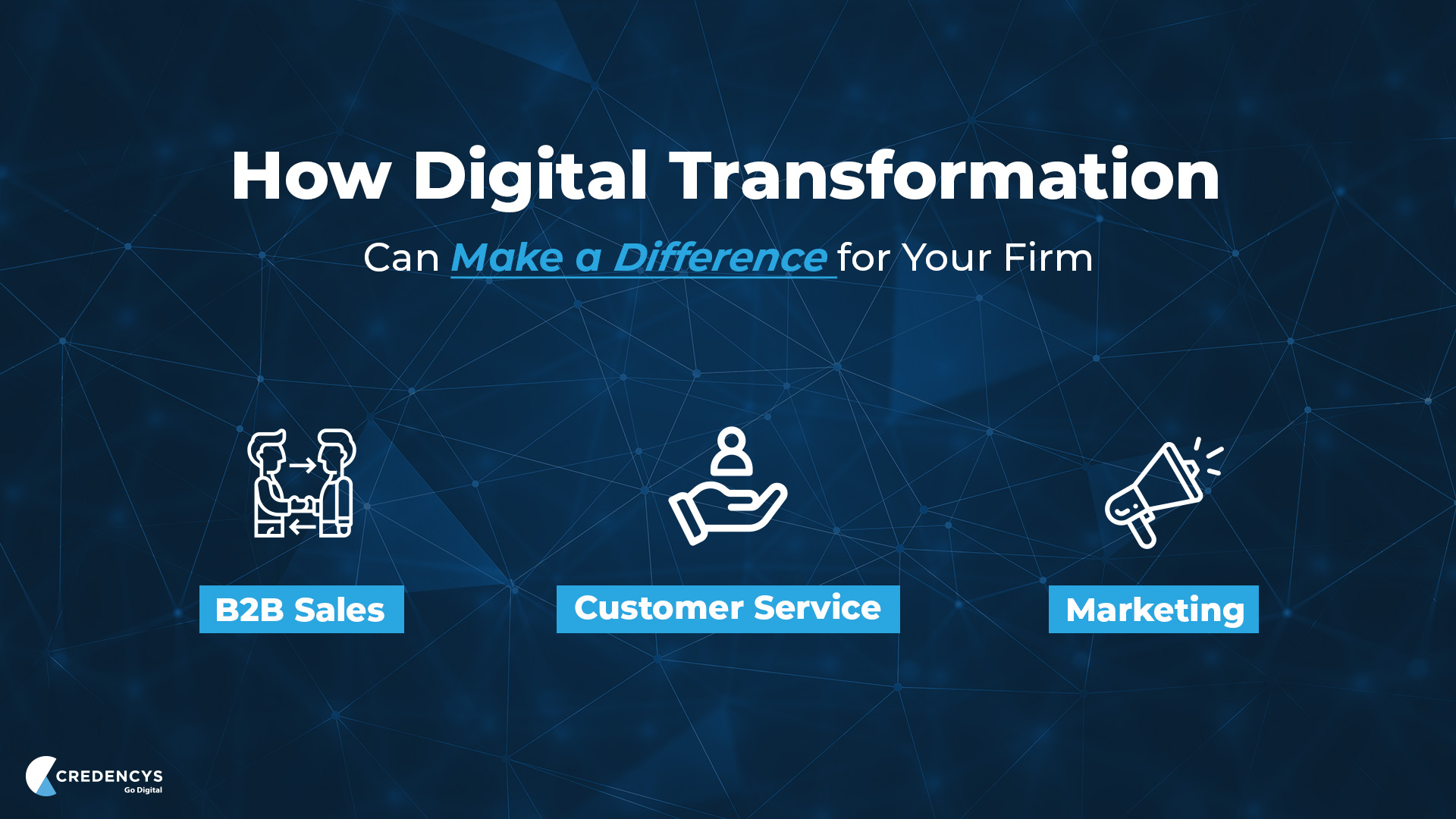
Here is How Digital Transformation can Make a Difference for Your Firm

Here is How Digital Transformation can Make a Difference for Your Firm

It is a well-known fact that technology is getting better and better with the passage of time. The evolution of smartphones, applications, automation, machine learning, and artificial intelligence allows the firms to offer a solution for their customers in order to provide the exact data that they want to see or they need.

The rapid implementation of these sophisticated digital technologies has expanded your customers’ expectations, resulting in the creation of a completely new kind of buyer.

As a result, customers are now able to judge the experience offered by your platform from the very beginning itself. If you are not offering the same, more often, they will shift to your rivals who are already implementing the same on their platforms.

Therefore, you need to revisit your existing strategies and figure out the best way to communicate with your existing and potential customers. Here are some of the basic ideas that you can implement for efficient management and, ultimately, better return.

B2B Sales

You can replace the traditional cold calling with social selling for your B2B sales. As most of your customers are active in social media, it is a no-brainer to switch to these platforms for your advantage. As a result, you are not required to wait until they contact you, as you can reach out to them in the first instance. On these platforms, you can share relevant information and personalized solutions for their problems.

Marketing

For your marketing, you can easily reduce the budget that you are currently spending on various traditional marketing activities, like billboard ads, TV or Newspaper ads, and so on. You can opt for highly target-oriented digital channels through digital transformation, such as email marketing, account-based marketing, search engine-based marketing, and the list will go on.

Customer Service

These days, the traditional reactive form of customer service is not expected from a top-rated professional firm. Waiting for your customers to ring the call and expect a response from you should not be the ideal way of customer service.

You need to be extremely proactive in your approach for standing a step ahead of the crowd. For that matter, you can take the support of a wide range of channels, such as communities, forums, social media, and so on, in order to offer an efficient solution.

Frequent Mistakes That You Should Avoid While Going with Digital Transformation

Digital transformation enables organizations to decode the requirements of modern-day buyers and offers the required solution that can match their expectations. Though the concept of digital transformation is becoming popular day by day, it is important to know the ideal approach. But, sadly, due to a lack of correct information, many firms are wasting their hard-earned money.

As mentioned earlier, in 2018, more than one trillion USD, 1.3 trillion to be precise, was invested in digital transformation. However, the survey also suggested that most of the invested amounts failed to deliver the expected result.

So, a question might arise as to why some efforts are successful and why some are failed. So, let’s try to address some of the most frequent mistakes that organizations make while implementing a complete digital transformation.

Here are three major aspects that you should focus on in order to maximize the result from digital transformation.

A Fast and Flexible IT Environment

Having the right technology helps a firm to strategize the digital transformation in an efficient manner. But, sadly, 45% of the firms tend to believe that their firms neither require technology nor have the expertise in this field.

In such a scenario, it is quite difficult to implement a highly advanced digital solution for the firm. However, in order to implement an efficient digital solution, you can take the help of an experienced firm having some kind of experience in this particular field.

On the other hand, you can also start making an effort to create a fast and flexible IT environment. Besides, you also need to recognize the right technology required by your firm.

Personalized Solution

The time has changed, using a single solution, you can address the specific expectations of all the customers. Every individual is unique, and they deserve their own personalized solution based on their preferences and history.

A recent study confirmed that 75% of the customers like to buy products or services from a company that can recognize people based on their name and recommends items based on their purchase history.

The best part about the study is definitely the usage of personal data. These days, when personal data management is a controversial issue, the study confirms that the majority of the people are happy to provide their personal data and get a personalized solution in return. As a result, you should take advantage of this ongoing trend by offering a personalized solution to your customers.

However, in order to offer a personalized solution, you need to invest a considerable amount of sum in relevant technology like CRM. Without opting for CRM, it is virtually impossible to distinguish your customers on an individual level.

By opting for a CRM system, you will be able to analyze the customer data based on their past interactions with your brand. Once you are able to get a reasonably good idea about the customers’ shopping patterns, you can easily offer a personalized solution for each of your customers.

Multi-Channel Experience

You need to understand that customers as a group have emerged as the most important entity in the business circle. These days, thanks to technology, and the number of available options, customers are empowered enough to demand what they want at any given time. Therefore, you need to treat them well for the best possible result.

The study found that the majority of the customers expect the firm to respond within a span of one hour, even during the weekend as well. As a result, you need to be accessible 24/7 in order to retain the maximum number of customers. In order to do that in an effective manner, you are required to collect all interactions and merge into a single digital profile.

Wrapping it off

Now, you must have understood that Digital transformation driving customer experience, which was never seen earlier. In this first moving world, firms are forced to implement a successful digital transformation strategy if they are not already into this business. Digital transformation offers a modern solution to engage the buyers more and improves the experience of the customers by offering a personalized solution.

You must go with a cloud-based solution and CRM for providing a seamless experience to your buyers. However, implementation plays a big part in the final outcome.

As a result, if you feel that your firm does not have the expertise or experience to handle such a complex project, you can go with a reliable third-party solution.

Though there are a number of firms offering complete digital transformation solutions, very few are reliable enough to trust. Therefore, it is highly recommended to carry out extensive research before making your final call.

ERP vs PIM – Which System Should Lead in 2023 and Beyond?

ERP vs PIM is an interesting topic to discuss and many people often seem to be confused between ERP (Enterprise Resource Planning) and PIM (Product Information Management). The fact is both ERP and PIM serve different purposes but under one category i.e. data management.

Most of us are familiar with ERP software, which organizes and collects business data through an integrated software suite. It integrates data of all the departments functioning in a business, such as accounts, human resources, production, sales, marketing, and more.

What is PIM?

What-is-PIM

PIM stands for product information management that acts as an end-to-end solution for integrating your product database with your eCommerce, social, and marketing channels for customers to view it effortlessly.

Be it you are a producer, wholesaler, or retailer, you can centrally collect, process, and manage product data as well as deliver your partners and distributors with the available information using several outputs and online channels through PIM.

PIM can be used dedicatedly to subscribe to content from external sources and publish it to multiple channels such as print, website(s), a native mobile commerce app, or a marketplace.

Capabilities of a PIM

Now that you know how PIM is extremely different from ERP, and it is important to provide high-quality information through content/catalog, it is necessary to know the benefits that PIM can offer to you.

  • Product Information Management is completely automatized
  • Easy management of related product content
  • Connects to other systems in a unidirectional and bi-directional manner
  • Straight access to digital and printed catalog design applications
  • Uses multiple file-formats for specific data export
  • Automated connection with Amazon, AliExpress Walmart, etc. like marketplaces
  • Automated connection with Shopify, Magento, BigCommerce, etc. which are the best and giant eCommerce platforms
  • Enables creation of instant catalogs using a public or private access
  • Language translation of product information
  • Analysis and shooting of errors and omissions in data quality

Benefits of PIM

  • Offers User-Friendly Environment
  • Delivers Better Product Data Management
  • Improves Customer Experience
  • Reduced business operations and supply chain costs
  • Improved product time-to-market
  • Easy to Integrate with Business Enterprise Systems
  • Maintain product data consistency and quality across all the output channels

Want to know more about the benefits of PIM? Read What Are the Benefits of PIM (Product Information Management) Systems?

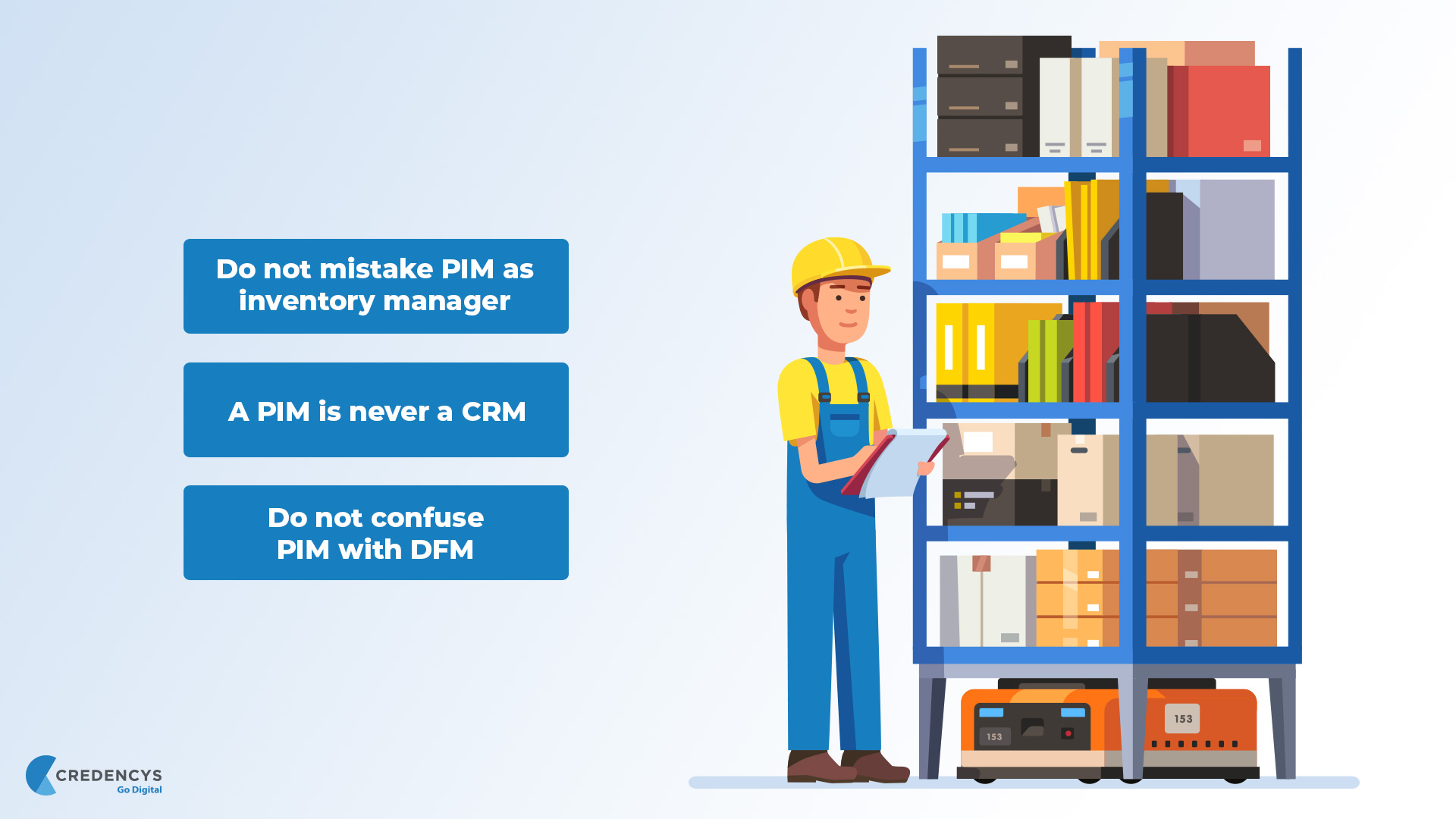
Factors That You Should Not Confuse with PIM?

Factors-That-You-Should-Not-Confuse-with-PIM

1. Do not mistake PIM as inventory manager

An inventory manager takes the responsibility of monitoring the warehouse materials, catalog stock levels, and supplies. The primary responsibility of an inventory manager would be updating information about product stock and the recent status of orders and warehouses. In this way, the inventory manager ensures the availability of product data across the online store, marketplaces, physical stores, and other sales channels.

2. A PIM is never a CRM

CRM is ideally designed for customer service teams to manage the customer database, especially for buyer data. However, PIM also plays a crucial role in customer acquisition and loyalty by providing accurate and product information and relevant content, to positively influence your customer’s browsing and buying experience.

3. Do not confuse PIM with DFM

Data feed manager is an extension which spreads the company’s catalog across multiple shopping platforms and search engines, thereby servicing e-marketing campaigns as well. In this platform, a PIM passes on the required information to DFM and collates all product information, orders, sales, and stock across various marketplaces.

What is ERP?

ERP (Enterprise Resource Planning) one of the software tools widely used by industrial organizations for centralizing their company’s database information and to make their business operations in a simplified manner.

Apart from that, the ERP tool helps organizations to automate their routine tasks and optimizes the employee’s work time. The main objective of this software tool is to increase the company’s revenue and to boost work efficiencies.

Capabilities of ERP

  • ERP solution offers strong financial features which that companies/industries can ensure meeting their financial goals
  • With the ERP system, the company’s Human Resource department can avail of high benefits with full scope.
  • Managing CRM (Customer Relationship Management) becomes easier with the ERP tool.
  • ERP system helps management to keep everything happening inside the organization up-to-date. This includes both back and front office functions.
  • The advanced features of the ERP solution help your business to move faster with effective sales and marketing along with better supply chain management (SCM).

Benefits of ERP

  • Enhances Business Reporting
  • Improved Customer Service
  • Enhances Business Cash Flow
  • High-level Cloud & Data Security
  • Standardize Modern Business
  • Delivers Effective Supply Chain Management

Type of Data Hosted in ERP

  • Product manufacturing
  • Inventory
  • Human Resources i.e. employees and recruitment process
  • Company accounting
  • Big data and business performance analytics
  • Warehouse and distribution network
  • Customer database, the key to Customer Relationship Management

PIM vs ERP – A Complete Analysis

PIM is completely product information-oriented and for direct customer-facing, and ERP is more transactionally oriented. ERP can nicely structure and optimize your sales-related business, and if your organization has more processes like ledger maintenance and stock inventory.

In simple words, a compatible PIM provides extended support in maximizing the capabilities you have created in ERP for your business. When both ERP and PIM functions together, it improves the efficiency and sales of your business. ERP can collect all the raw data of your business and integrate the information across all departments of your organization for internal purposes.

Well if you look at ERP from the high level, it is just a structured collection of files. ERP provides the collection of raw product data more of a generalized view, whereas PIM is more of a data maintenance system that allows your customers to view direct product information in an integrated manner.

Compared to ERP, PIM has a customer-centric approach towards networking, along with exhibiting certain functionalities and compatibilities that are available by default. A simple way to understand ERP vs PIM is with PIM you can subscribe to incoming data sources, produce them to listening systems and ensure your data quality management with more ease, thereby making monitoring possible through ERP.

A PIM has a high potentiality to receive, transfer, and enrich the data for marketing and sales purposes and ensures a unified approach to all vendors, marketers, wholesalers, etc. With PIM ineffective, the ERP receives the sales from the online channels which are later recorded in bookkeeping.

Even though the product management can be done using ERP, it requires great effort since the level of automatization required for configurations is lower than that required for a PIM. It may either end up in extreme customized work or may not work properly even after an ERP upgrade or change in interfacing systems.

ERP vs PIM is a never-ending war unless you understand from the deep down of its concept. ERP focuses on collecting data of every department in an organization and makes it available across teams for better productivity and business growth, with ease of accessing internal data.

PIM focuses more on product information and ensures any disparate data of ERP is also captured and listed chronologically, enabling product teams to work and collaborate on different types of data displayed for customer’s view with high quality.

ERP vs PIM: A Tabular Comparison

Key AspectsEnterprise Resource Planning (ERP)Product Information Management (PIM)

Core Purpose

ERP systems are designed to streamline an organization’s business processes, integrating functions like finance, HR, inventory, procurement, and more.

PIM systems focus specifically on managing product-related data, attributes, and specifications to enhance product offerings.

Data Scope

ERP manages a wide array of organizational data, from financial transactions to inventory levels and sales orders.

PIM manages product data, encompassing detailed attributes, variations, hierarchies, and relationships.

Data Complexity

ERP handles structured data from diverse business operations, often emphasizing financial and transactional information.

PIM manages intricate product attributes, specifications, images, videos, enabling richer product data representation.

Data Customization

ERP offers customization to align with varied business processes and industry needs, often via configuration or customization.

PIM allows extensive customization to cater to various product attributes, structures, and industry-specific requirements.

Catalog Structure

While ERP may include products within a broader inventory or sales context, they generally offer limited focus on detailed product data.

PIM excels in comprehensive product categorization, attributes, variations, facilitating rich and granular data.

Product Attributes

ERP commonly handles basic product attributes such as name, SKU, price, and quantity, with less emphasis on detailed product data.

PIM manages an array of product attributes, specifications, images, videos, enhancing product data quality and accuracy.

Data Enrichment and Quality

ERP emphasizes data accuracy, compliance, and auditability in financial and transactional data.

PIM prioritizes accurate product data, consistency across channels, improving data quality and consumer experiences.

E-commerce Integration

ERP offers e-commerce functionalities like order processing, inventory management, and sales tracking.

PIM integrates with e-commerce platforms for seamless product data exchange, ensuring consistent and updated product data.

Sales and Order Management

ERP supports sales processes, order creation, invoicing, and inventory control.

PIM streamlines product sales, data management, catalog creation, optimizing customer experiences.

Inventory Management

ERP manages inventory levels, replenishment, and order fulfillment.

PIM handles product attributes, variations, enabling accurate inventory tracking, and efficient management.

Manufacturing Processes

ERP integrates manufacturing workflows, production scheduling, and resource planning.

PIM concentrates on product data, specifications, enabling better product information management.

Customer Relationship Management (CRM)

ERP often includes basic CRM functionalities to track customer interactions, contact information, and sales activities.

PIM enhances customer experiences with accurate product data, even though not primarily focused on CRM functionalities.

Analytics and Reporting

ERP provides financial reporting, operational analytics, and business intelligence.

PIM offers insights into product performance, trends, channel effectiveness, leveraging robust product data analytics.

Workflow Automation

ERP automates business processes, approvals, and task assignments.

PIM streamlines product data enrichment, approvals, publishing workflows, ensuring timely and accurate data.

Localization and Multilingual Support

ERP supports multilingual operations for global business.

PIM handles multilingual product data, translations, region-specific information, catering to diverse markets.

Scalability

ERP scales to manage various departments’ data across enterprises.

PIM accommodates substantial structured product data, scaling as product portfolios expand.

Integration with Third-party Systems

ERP integrates with external systems like HR, finance, supply chain, etc.

PIM offers APIs for seamless integration with e-commerce, CRMs, marketplaces, enhancing data flow across platforms.

Data Security and Compliance

ERP prioritizes data security, compliance, and adherence to regulatory standards.

PIM ensures data accuracy, consistency, brand compliance, offering reliable product data for customer trust.

User Access Control

ERP implements role-based access control for data security.

PIM provides role-based access control, maintaining data accuracy, integrity, and data security.

API Integration

ERP offers APIs for third-party system integration.

PIM provides APIs for third-party integrations, syndication, ensuring efficient data flow across systems.

User Training and Support

ERP offers training and support for using the system.

PIM provides training, support for effective utilization, ensuring efficient product data management.

Industry-specific Focus

ERP caters to diverse industries, adapting to various business operations.

PIM offers significant value for industries with complex product data needs, like retail, manufacturing.

How PIM can help ERP to be fit for purpose around product data?

1. Playing competitively equal to each other’s strengths

ERPs are an essential source to input static data into the software. You can use ERP for filling stock and analyze the whereabouts of products. But forcing it to do the things that it does not fit into can create problems. While PIM gives complete freedom to ERP to focus on its purpose, it takes the responsibility of all rich product data like images, videos, technical specifications, PDFs, and detailed product descriptions.

PIM is a beneficial solution in terms of time management and sales aspects as well. Businesses need not spend time tracking product information within the ERP; instead, it is now within the platform itself. Since the sales data appear unique to your company, you can easily focus on higher sales conversions by differentiating your competitors easily.

2. Streamlining data as a single database

Sometimes ERP can be quite complicated because some companies tend to work with multiple ERPs to maintain their product information. Therefore, it becomes a costly solution since the data is spread across areas. Along with that, the company has to bear the implementation, customer support, software price, and the cost of training. Additionally, running multiple ERPs can lead sometimes to the loss of data as well.

This is where PIM streamlines the process by centralizing all disparate data into a single location.

3. Enhances the quality of product data

PIM allows viewing the entire lifecycle of a product from the beginning to the end in every small aspect. PIM ensures a product goes through all stages; it has to be covered through text, images, videos, or more and passes on to the relevant teams step by step and provides an accomplished product data, distributing to all sales channels in a limited time period.

4. Opportunities for new sales channels

Another way to show that PIM can be the best fit for ERP is the expansion of new sales channels. PIM performs exceptionally well by linking its platforms to various eCommerce systems, resellers, and retailers. Sales channels can claim huge benefits by doing so. For example, a technology retailer can think of selling their software/hardware on Amazon, but unfortunately, their ERP system may not allow the functionality to open a new channel.

By integrating PIM with ERP, the seller can easily place their product on Amazon. Moreover, multiple brands can distribute a plethora of their products quickly by implementing PIM in their system and help increase online conversions extremely well.

Final Verdict

Depending on your business need, you can have either PIM/ERP or both in the system, to boost sales and ensure higher online conversions. However, PIM is one step ahead of ERP by performing diversified functionalities. Having PIM implemented in your system can help streamline the entire product data collectively in a single database.

Keep reading our blogs for more information or clarifications of PIM if you are stuck in the middle and need some help.

Product Information Management (PIM) System: What is it? Why PIM Solution Is Important for Business?

Online product comparison and purchase is the talk of today’s trend. In a survey conducted by a retail dive, it is realized that over 65% of consumers do intensive research in terms of price, offers, and availability of a product online before they step into a store.

Likewise, over 55% of consumers visit stores before they intend to buy a product online and gain knowledge on the same factors as aforementioned.

Therefore, businesses started adopting digital marketing strategies due to changing consumer behaviors and ensuring a seamless shopping experience for them.

With consumer’s expectations towards consistency in product information, it has become a mandate for businesses to keep their product information up-to-date and accurate as well. This is where product information management (PIM) comes into place.

Now let us look into the detailing of questions you may have in mind about what PIM is and how PIM solutions can effectively work for businesses.

What is Product Information Management (PIM)?

The purpose of a product information management solution is it acts as a one-stop place to gather, control, and enrich your product information, along with creating a product catalog and distributing it to your eCommerce and sales channels.

PIM solutions are widely used by online merchandisers, marketers, eCommerce managers, and product managers who want to make their product information management easy and simple with a great tool.

To know why PIM, there are several reasons for businesses adopting it. For example, we all know Amazon is a giant eCommerce company that allows consumers to access lakhs and lakhs of products from multiple merchandisers. They have their customized PIM solutions since it is highly necessary for managing the customer-facing product strategy.

PIM System Goal

Providing accurate product information to consumers is one of the biggest challenges faced by marketers, especially in a product-focused business. Though the product team works on the information part, it has to undergo several supervisions and cross-checks before it goes live.

PIM gets you over this problem by converting manual paperwork into digital product documentation. It makes product data update and enrichment quite easier and quicker. Updated product information ensures that your consumers get the right and related information about the product they search for.

PIM solutions basically have a cloud-based storage repository that highly facilitates centralization and productivity to its extreme. With the right move towards the SaaS models, made PIM a cutting-edge technology benefiting online marketplace sellers and eCommerce platforms to the core.

Why Product Information Management (PIM) is Essential for Business?

Well, if you are a product-based start-up, you may not need PIM initially. But, if you have plans to expand your business online, then to maintain your product information PIM software can be of great help. If you are an established eCommerce business and new to PIM, here are the benefits that PIM solution can get to your business.

1. To grow heights

With PIM you can quickly make your product accessible and available to your consumers and enhance sales instantly. This takes away the bottleneck situation for your company and helps you grow.

2. Customization and localization

PIM allows your global teams to create highly targeted product experiences exclusively for different channels, languages, and locales.

3. Brings quick success to go-to-market

You can mold the reach and sale of your products according to your consumer preferences and behavior. PIM provides streamlined product creation and enrichment methods to showcase new products and seasonal collections and enables faster marketing.

What Type of Companies Need PIM Solution?

When PIM was introduced, it was reachable only to large corporations due to several factors. But now, it is easily accessible to small and medium enterprises as well. Based on the growth and demand of businesses, the demand for PIM solutions also grows in the same ratio.

PIM is a necessary solution if your company handles a high volume of products and SKUs. Mostly, vendors, retailers, manufacturers, distributors, and brands use PIM solutions to see their products updated in all sales and eCommerce channels and going live instantly, along with observing the product performance.

Depending on the problem you face with your product display, PIM can offer you relevant solutions.

Product Information Managed by PIM Solution

PIM makes it easy for marketers to access all their data in a single database, which is custom-designed as well, and efficiently handle the following product information in the software:

  • Names, titles
  • SKUs
  • Identifier codes
  • Product variants
  • Data captured in other marketplace templates
  • Descriptions
  • Categories
  • Technical data such as measurements, ingredients, materials, etc.
  • Product specifications
  • Price
  • Pictures
  • User reviews
  • Translations
  • SEO data for marketing purposes
  • Certificates
  • Logos
  • Videos
  • Labels
  • Stock availability
  • Product user guide
  • Marketing and sales documents

How to Find Best PIM Solutions for Your Business?

Two types of PIM Solutions are available in the market, such as customizable and standard ones. In a customized PIM solution, you can tailor your products display as per your need, whereas in standard, you get standard features at standard pricing.

Compared to a customized PIM solution, standard solutions can be less in cost, since you do not invest in developing any specific features. But, if you want to include high-end technical features, scalability, and flexibility, then you must go with custom PIM.

One of the main reasons for considering PIM is effective product data management. You can easily update your sales and marketing channels instantly with any product information if you integrate a PIM solution with your current system.

PIM is a highly scalable solution since it grows as your business grows. Investing in PIM is a one-time and one-stop solution and does not let you search for another solution in product information management. Plan how to use an effective solution like PIM for now and in the future as well.

Product information management (PIM) is an effective tool for any product-based business type and size since accurate product information plays a key role in gaining consumers and product sales as well. You can find many companies offering PIM solutions as per your business needs and type, based on which you can see yourself growing once you adopt PIM in your business.

Check out the 11 best product information management systems that you can consider to manage your massive product data.

Top 10 Good Reasons to Invest in PIM System

Product information management is crucial for every eCommerce-based business of any type. Therefore, businesses find investing in PIM solutions very beneficial and see-through high growth opportunities in the long run. Let us get deep into the topic and understand how PIM solutions help businesses achieve heights.

#1: Complete control over product information

Streamlining your product information process with an integrated PIM system enables full control over the product information. PIM system allows you to set multiple criteria and ensures that required attributes are accomplished before your product goes to the online store for consumers’ views.

Therefore, it becomes easy for each department to manage important product specifications and preview all the characteristics of the PIM cycle.

#2: Better usage of product relationships

PIM software allows you to make better relationships between a product and its relatedly usable product to ensure better sales and consumer satisfaction at the end. When your consumer views a particular product, on the same page, below the original product description, you can display products bought together.

Therefore, it leaves a good impression on consumers about the value and quality of the product with the way it is described. This will make you introduce all your products to consumers. For example, if a customer visits your online store to buy face cream, along with you can show the same brand products for additional usage such as face wash, face serum, soaps, and more.

#3: Keeping more focus on customers

If you have an integrated PIM solution in your system, you can provide an overview of multiple products to customers to compare and buy their preferred one. Since it allows different vendors in abundance to sell their products on a single platform, customers can get what they are looking for, in the product.

PIM solutions support customers with a quick comparison of products of different brands and make a quick decision.

If you have provided relevant information about all your products, it enhances your customer satisfaction, which leads to high sales.

#4: High consistency

A PIM system ensures consistency of your brand across demography and multiple marketing channels since it maintains all the information of all your products in a single database. The customer-based centralized database makes certain that the product data is boosted, updated, and complete across channels and for everybody.

The product information management software lets you maintain a consistent image of your brand across various channels such as online sales, social media platforms, communications, events, printed materials, and trade shows, on the whole.

#5: Integrated social media

No online business serves customers without showing involvement in social media platforms such as Facebook, Instagram, Pinterest, etc. These channels are highly focused and utilized by businesses. Because they help gain loyal customers through good sales.

With PIM integrated system, whatever you post in one social media platform can be used over another platform as well with content/images changed whenever needed.

#6: Omnichannel captures the future market

Brands need enough online space to compete with the market and competitors’ sales channels. A product information management system allows businesses to add new online sales like Amazon, eBay, Rakuten, Alibaba, etc., and any huge or small marketplace where you think your brand can find better growth.

Preferring to communicate in an online space that is already established and popular among customers can get quick attention to your products. All you have to do is export the right information fields from the PIM to a file to make it the same and send it to any marketplace.

#7: Give high priority to customer service

More than what you sell, it leaves a positive impression on customers about your brand when their silly questions are being answered patiently. It is common that customers may have doubts about the product catalog, since they may not find some information sometimes. In such cases, your customer service should have complete access to the database for reference.

Like how you have a warehouse, your employees need the PIM system to ensure correct orders are filled, through which the customer service team can highly benefit from the PIM software and retain customers and develop loyalty.

#8: Boost performance

PIM solution is not only about product management but also about maximizing your team’s productivity. A good PIM solution can keep your team from doing redundant work, rework, and repetition.

Moreover, it supports not depending on error-prone and complex spreadsheets and makes you follow uncomplicated workflows.

A PIM can help you with streamlining your market launch activities and ensure continuous workflow. Due to all product information maintained in a single database, you do not have to spend much time searching the product details.

#9: Product improvement through customer feedback

By implementing a PIM system for your product data management, you can focus more on what customers think of your products. Most customers, while trying a new brand, will look for reviews of other customers about the particular product/brand. The PIM solution allows your customers to write about their opinion on the product they have used for new customers to know about the pros and cons.

#10: Optimized SEO

Any product quickly reaches customers if relevant and accurate information is provided that, in turn, enhances the chances of more people looking at your product pages.

Since transferring content to all channels becomes easy with the PIM solutions, the marketing team finds new SEO opportunities for product improvements and adapts the information in line with the new marketing needs.

With PIM, you can create and send personalized content more, which is liked by most users since it has their favorite searches and related products as well. In one way, it saves their time by displaying the required products consecutively.

Conclusion

The benefits of product information management solutions are not limited just to these factors, and as an eCommerce company, you have to take every small benefit as a reason for investing in PIM solutions. If you are interested in knowing more about PIM, wait for this space to give you some more new information.

On-Demand Dog Walking App Development: How to Develop a Dog Walking App?

Dog walking services have a huge demand since the majority of the people in the world grow dogs as pets and treat them like family. Dog caring is not an easy job and controlling and taking them for a walk, especially for people in old ages, is highly difficult.

In a way to help pet care owners take better care of their beloved dogs, dog-walking app development goes on demand. For the benefit of developers, this blog serves as a guide for on-demand dog walking app development.

Table of Content

  • How Does An On-demand Dog Walking App Work?
  • Current Market Values Of On-demand Dog Walking Apps
  • How to Create An On-demand Dog Walking App?
  • Must-Have Features of an On-demand Dog Walking App
  • Core Components of On-demand Dog Walking App
  • Top 8 Best On-demand Dog Walking Apps for Dog Lovers in 2020!!!
  • How Much Does It Cost to Make an On-demand Dog Walking App?

How Does An On-demand Dog Walking App Work?

A dog walking app allows pet owners to include detailed notes about their dogs, mainly on vets and medications, harness, collars, etc.

The on-demand dog walking app works in a wonderful way that users after registering can book a walk or check whether a nearby dog walker is available to take care of the dog in cases where the pet owners could not deal with the same. Uber’s X dog walking model has made it easier for pet owners and dog walkers as well.

More than the service motto, a dog walking app helps dog walkers to earn good money as well as spend time hanging out with dogs. Therefore, on-demand dog walking app development can be ideal for both dog walkers and pet owners.

Current Market Values Of On-demand Dog Walking Apps

According to a survey report, the average industry growth of on-demand dog walking app development has increased to 3.2% between 2015 and 2020. The US Bureau of Labor Statistics reports that Americans own more pets than any other country in history. Therefore, around 188 million pets have occupied the houses of more than three-quarters of US households, which should be noted.

If you look at the amount that pet owners spend in taking care of dogs in all aspects come close to $70 billion mostly on pet-related products and services. Keeping these factors in mind, the prediction of dog walking services for the next five years will definitely increase.

How to Create An On-demand Dog Walking App?

How to Create An On-demand Dog Walking App

To create a dog walking app, as a developer you need to follow certain steps and implement them with great effort. The following steps can be a simple and step-by-step guide towards on-demand dog walking app development.

1: Develop a solid business plan

Know the dog walking process completely and make a solid business plan before you intend to develop a dog walking app. Know who your clients are and then keep your step forward into the app development. Get some suggestions from industry experts and also from other on-demand apps with a shared economy such as food delivery, taxi booking, and similar apps.

2: Keep an estimation of your potential earnings and revenue

Pre-calculation of your potential earnings and revenue after your dog walking app goes live is always good, since you can be well-prepared to manage your profits and losses in good/bad times. If you are running the operation by yourself, then you should consider the overall costs of your dog walking app development, trademarks registration, filing of licenses, and administering your clientele using a mobile app.

3: Diversification and employees

If you want to grow online, think of the expenses you should be bearing in terms of hiring new employees, since branching out can be a little hefty but beneficial as well. Moreover, going online involves more expenses for promotions and publicity. Therefore be ready to accept such expenses you may incur and plan for expansions.

4: Market research

This plays the foremost role in any on-demand app development for that case. You should do intensive research on the current competition both locally and nationally. Some questions mentioned here can help you with the best research.

  • Are there any individuals competing in your area for your business idea? If so, try to understand how they manage and operate successfully.
  • How much does your competitor charge the pet owners for dog walking services?
  • Is there a contract to be signed or it is a one-time service?
  • Does your competitor have an office locally for dog walking services or do they operate online as well across locations?
  • What techniques did your competitors follow to reach their target audience?
  • What promotional strategies did they follow?
  • Do they provide additional services like dog sitting and dog cleaning after walks?
  • How good are the apps of your competitors and what can you additionally add to them?
  • Which social media marketing platform is your competitors promoting their brand/app?

5: Launch your marketing campaigns

Once you have crystal clear information and analysis of how your competitors are performing in the market and what features they have in the app, it is your time to build buyer personas for your app and focus on your target audience considering several factors that will influence them towards your dog walking app.

Organize third-party based social media campaigns since the dog walking app could be a common requirement to man people, and you never know how many of them actually have dogs.

6: Make blogs and social media to your comfort

Use social media and blogging to your extreme advantage and know people’s interest in the dog walking business. Use powerful social media platforms and share photos and videos of the services you provide in your on-demand dog walking app to your potential customers and create user engagement.

These are the simple steps that you can follow to create a dog walking app, but make sure it does not go wrong while implementing any of the processes.

Must-Have Features of an On-demand Dog Walking App

Must-Have Features of an On-demand Dog Walking App

Dog walking services are quite common and popular in the USA since the majority of the population grow dogs as pets. The necessity of dog walking app development comes in place when pet owners leave their house for some days and no one is available to take care of their dogs. Knowing this need, few companies developed a dog walking app, which is in high usage.

If you are a developer and wish to create a dog walking app, these are the must-have features you should add in your app.

1: GPS tracking

This feature is an excellent option for dog owners to track their dogs while walking. Owners stay away from day-time worries by tracking the movement of their dog right from the place they are. Additionally, if you can include the dog’s live walk feature to your app, it adds more value to it.

2: Feedback

The review/rating feature can work both ways. One is for users to rate your app and provide genuine feedback and the other one is for users to look at the review of the app and use it. You should provide users an option to link their social media accounts and post the review about your service. In one way it helps you get new pet owners on to the app.

3: Login with social media

Make the sign-in process too simple and smooth to your users, so they do not spend much time with the login. Enable high-level security to their personal details, since data is more sensitive than that of other factors. Provide them two flexible login options through a social media account or with their email credentials.

4: In-app payment

You should be able to provide multiple payment options such as credit card, debit card, PayPal, bank wire, and wallet payments and make it convenient and easy for users to pay as per the mode of option available with them. This facility helps both pet owners and pet sitters with a high level of convenience.

5: In-app message

The in-app message feature enables conversation through chat between pet owners and pet sitters, in order to create trust in pet sitters. It becomes an easy platform for pet owners to clarify their doubts and ask any questions, say their concerns, or talk about their dog’s behavior and about the service as well, before booking the dog-walking service with pet sitters.

With these premium features, your dog walking app should prominently gain a competitive edge over the existing app. Moreover, when it comes to on-demand dog walking app development, there are certain other features such as finding a dog walker, security to pets, etc. should be included as well.

Core Components of On-demand Dog Walking App

Core Components of On-demand Dog Walking App

However, a basic on-demand dog walking app consists of 3 main components.

  • Customer’s App
  • Dog Walker’s App
  • Admin

App UsersApp Features
Customer
  • Search & Filters
  • Profile
  • Option to Upload Photos
  • Tracking
  • Reports
Dog Walker
  • Profile Creation
  • Accept/Reject Option
  • Scheduling Option
Admin
  • Customer & Walker Management
  • Job Allocating Settings
  • Viewing Reports/Reviews
  • Payment Management

1. Customer’s App:

Here are a few vital features that every top dog walking app includes under its customer’s component.

  • Search & Filters
  • Profile
  • Option to Upload Photos
  • Tracking
  • Reports

2. Dog Walker’s App

Here are the lists of few top features that every dog walking app must have under its Dog Walker’s component.

  • Profile Creation
  • Accept/Reject Option
  • Scheduling Option

3. Admin

Here are the lists that every dog walking app has under its Admin component

  • Customer & Walker Management
  • Job Allocating Settings
  • Viewing Reports/Reviews
  • Payment Management

Refer to your competitor apps and create a dog walking app with more unique features that serve more than your competitor apps. Anyhow, you should carry out intensive research upon several factors that may add value/impact your dog walking service business and then make certain about features to be included.

Top 8 Best On-demand Dog Walking Apps for Dog Lovers in 2020!!!

Dog’s are the best friend of the Man’s. It is quite difficult to disagree with such a statement. The popularity of the dog-walking applications is on its hype. As per American Pet product Associations, Americans have spent more than $23.04 billion on pet’s food.

The majority of the folks don’t have a significant amount of time to take care of their beloved god. Therefore, a dog walking application is the right solution for them. If you are also searching for the best Dog walking application, then you should read the following paragraphs carefully.

AppsKey FeaturesApp Store LinkPlay Store Link
Host a Pet
  • Pet Training
  • Pet Transportation
  • Day Care
iOSAndroid
Wag
  • In-app messaging
  • GPS Tracking
  • Dog Training
iOSAndroid
Rover
  • Instant Alerts
  • Daycare Reports
  • Experienced Caregivers
iOSAndroid
PetBacker
  • Social Media Support
  • ID Verification
  • Real-time Tracking
iOSAndroid
Fetch! Pet Care
  • Free in-home consultation
  • Insurance Coverage
  • Fixed Standard Rates
iOSAndroid
PetSitters.care
  • House Sitting
  • Sublet
  • Day Care
  • Boarding
iOSAndroid
SitterCity
  • Option to post a job
  • Instant Notification
  • Background checks
  • Direct Message to sitters
iOSAndroid
Pawshake
  • Insurance coverage
  • 24/7 Support
  • Public Reviews
  • Quick Messaging Services
iOSAndroid

1. Host a Pet

When it comes to a great dog walking app, then Host a Pet is a first name that comes in our mind. They are offering a variety of great services that include lie daycare, walks, training, transportation, boarding, and others. This platform is featuring a premium coverage plan that will protect the client’s pet and hosts.

Just in case any kind of accident happened while working, then you will able to get reimbursement up to $1000. If you are becoming a pet site with the host a pet, then you will surely be able to get $15 to $18 per hour. If you are using a host a pet then you can access the following features-

Key Features:

  • You can browse the profiles of the different kinds of pet hosts.
  • A person can receive the videos & pictures of the dogs or cats at least 3 times a day.
  • You will get 24×7 customer service.

2. Wag

Nothing is better than Wag that is sharing a considerable amount of similarities with the rover. They are featuring the best services like boarding’s, sittings, daycare, and drop-ins. The company has already introduced a variety of great safety features like WAG Tag that is considered a smarter dog.

This application is available for Android and IOS. They are paying $13 to $17 per hour. When you are using Wag then you can do the following things

Key Features:

  • Track the Live Dog’s walk
  • Quick pictures of the Dog’s Live Walk
  • Enable the pet owners to write testimonials for the Dog walkers

3. Rover

If you are looking for the best dog walking application, then you should opt for Rover that was founded in 2011. This platform has already reached milestones. It comes with one of the best communities of the Petsitters.

It is really a great application that is recommended to the established and beginner pet sitters. They are also providing training for pet sitters. You will able to earn money with dog boarding, doggy daycare, house sitting & drop-in visits. You can earn $1000 per month with Rover.

Key Features:

  • Rover is working with Rover cards.
  • It will enable the owners to track and share important details regarding Pee, poo, and water activity.

4. PetBacker

The popularity of the PetBacker is on its hype. It is considered one of the great dog walking job applications. They are offering a variety of services like pet sitting, dog walking, pet boarding, pet daycare, dog walking, and pet grooming as well.

Nothing is better than PetBacker when it comes to offering a better environment for pet owners to look to hire a pet sitter, groomer, or dog walker with full safety features. It is proven to be a great pet care application that allows pet owners to share their pet photos and to allow them to hire a trusted sitter for their pets.

With the intention of creating a community for pet owners and for sitters who look for pet sitting jobs in major cities, the app allows both owners and sitters to communicate without sharing their phone numbers to protect their privacy until the owner hires a pet sitter.

Key Features:

  • Supervise the Dog walk
  • Get the pictures of the dog instantly
  • Comes with premium insurance coverage
  • 100% Reservation Guarantee
  • Free Cost Estimates
  • Safe Community for Pet Lovers

5. Fetch! Pet Care

A variety of great Dog walking applications are out there, and Fetch! Pet Care is one of them. This application was founded in 2002. It is a particular application that is serving the pet parents, pes, and pet sitters.

To become a professional sitter with Fetch, then it doesn’t require any professional training. They are offering a variety of great services like cat playtime, puppy care, dog walk in a variety of locations. If you are a beginner pet sitter, then you should opt for the Fetch! Pet care. If you are becoming a pet sitter with the Fetch, then you can also earn $9 to $10 per hour.

Key Features:

  • Review the information on pet
  • Communicate with beloved clients
  • Send the messages and pictures to clients

6. PetSitters.care

Nothing is better than PetSitters.care that is considered one of the great self-service agencies. They aren’t offering the insurance, run the background checks. Any person will be able to register on the website. You will have to read the issues and get prepared for the problems that are coming your way. It is one of the great platforms that is already creating lots of opportunities for the pet sitters that are living in smaller towns and rural areas.

They are offering a variety of great services like dog sitting, cat sitting, pet boarding, pet grooming, and others. If you want to use such an incredible application, then you should be 13 years old. You will be able to earn $15 – $40 per day. This particular app is incorporated with the following features

Key Features:

  • Great GPS reporting
  • Bulk Email
  • Comprehensive list of the client

7. Sittercity

If you are looking for a great dog walking application, then you should opt for Sittercity that will be able to create a variety of caregiver profiles. It is a particular platform that doesn’t run any kind of background checks on all the sitters-to-b automatically.

On the profile, a particular badge will surely appear to show the status. This particular platform has already created the guideline on how to create an interesting profile. A pet sitter will be able to earn $8 to $11 per hour.

Key Features:

  • Option to create profiles
  • Background check
  • Neighborhood check

8. PawShake

One of the popular names among pet owners. The app allows pet owners to hire reliable pet sitters. The PawShake app starts offering its services right from the year 2013. Unlike other pet care or pet sitter finding apps, the PawShake accepts caretaker only after running a professional background check.

Because of that, the reliability factor is high on the PawShake app when compared with several other pet care apps. Both pet owners and pet caretakers are able to avail of 24/7 professional customer care support from the app which is hard to find among other pet care applications.

Key Features:

  • Comes with insurance coverage while booking
  • Background check for a pet caretaker
  • Reviews on pet caretakers
  • Messaging services between pet owners and pet caretakers

These are some on-demand dog walking app development companies that are offering a considerable amount of benefits to dog owners. In case you are searching for the best dog walking application, then you should check this list.

Before creating an account on any application, you should pay close attention to the features. Make sure that you are choosing the best application where you will be able to earn a decent amount of money. These are really great applications for supervising the overall fitness of the Dog.

How Much Does It Cost to Make an On-demand Dog Walking App?

The time and cost involved in an on-demand dog walking app development totally depend on the customized features you wish to implement in the dog walking app. If you plan for simple app development with minimal features, it may not take much time. But considering the present competition if you wish to add more customized features, then it may take up to 3 or 4 months solid.

For example, you can calculate the dog walking app development cost as below:

The time required to develop the app X Developer’s hourly charges = The dog walking app development cost.

There are several ways to develop an on-demand app like dog walking. Moreover, there are different dog walking services’ models available in the market like a clone app, which you can make use of. Otherwise, you can hire a developer dedicatedly for your dog walking app development and get it done. You can also approach an app development company with prior experience in relevance.

Depending on your budget, you can prefer any suitable app development method.

Conclusion

The on-demand dog walking app development is on the brighter side since many pet lovers find it difficult to take care of their dogs. In a way, it benefits dog walkers with creating employment at good earnings, and at the same time, the pet owners as well. If you have plans to create a dog walking app after reading this blog, get in touch with an expert developer/company that has already worked on it.

Frequently asked questions

1. What do I require to start a dog walking business?

Here are the simple steps you can follow to begin with your dog walking business:

  • Ensure a perfect business plan and decide on what kind of services you wish to bring into your dog walking business.
  • Get the necessary resources for your business by allocating a certain amount of budget towards it.
  • Apply for licensing, insurance, and get the necessary documents done.
  • Focus on dog walking app development and a website.
  • Choose your app promoting channel and start your business.

2. How profitable is the dog walking business?

With the increase in the number of dogs in the households of Americans, the dog walking service business is expected to double the improvement it has shown in the past five years. Making proper strategies and effective marketing, it is possible for you to make the most out of this on-demand dog walking app and gain profits.

3. How to create a dog walking app?

Creating a dog walking app involves plenty of steps and unless you are on the development side, it is crucial for you to understand technically how it works. If your idea is great, you can put it to a Dog Walking App Development Company or hire an app developer exclusively for your app, and get it done.

4. Which is the best-A cloning dog walking app or a newly developed one?

A cloned app can save your time, cost, and effort you put in an on-demand dog walking app development, whereas a newly developed one can take more time than a cloning one since you add customized features. But you can go for a clone app and customize it further accordingly, which should be cost-effective.

5. List a few Top on-demand dog walking apps that exist in the market?

There are many on-demand go walking apps available in the market, but these four apps are pretty well used by pet lovers.

  • Wag
  • Rover
  • Pawshake
  • PetBacker

16 Reasons Why Enterprises Need a Robust Pimcore Platform

Thanks to digitalization, the world is becoming efficient, and it is changing the way of living. The process of digitalization is a continuous process and keeps evolving with time. In a dynamic sector like the software industry, change is the only constant.

In this blog, you will know 16 advantages of Pimcore, a revolutionary digital platform that has helped varied industry domains to transform their business operations, product experience, and customer experiences in a better way.

But, before rushing into the theme of this post, let’s discuss more Pimcore.

What is Pimcore?

Pimcore is an open-source experience management platform that enables users to create and manage apps released under a BSD license.

Pimcore provides six frameworks that consist of Product Information Management, Master Data Management, Digital Experience Platform, Digital Commerce Platform, Customer Data Platform, and Digital Asset Management.

As discussed earlier, the platform is open source, organizations are allowed to access the source code of all these frameworks for free. So, you can use one or more frameworks out of the six as per your business needs.

All of these frameworks contain outstanding capabilities and feature sets. On the technical term, the Pimcore framework is based upon, MySQL database, PHP, and Zend Framework.

The platform has shown immense growth in the last few years. Over the years, it has transformed itself into a consolidated platform for content, commerce, a community across the industries.

Read more: What is Pimcore

Advantages of Pimcore

There are a number of advantages of going with Pimcore. Here are some of the major aspects Why Pimcore is the right choice for your requirements.

1. Training is Relatively Easier

The latest version of Pimcore is based on Symfony 3, an extremely popular and easy-to-use framework. In comparison to Magneto, the additional code layer offered by Pimcore is microscopic. The plain and simple architecture of Pimcore is responsible for building an easy to use platform.

For a comparative study, it takes only a couple of weeks to train a Pimcore developer against three months to train a Magento developer.

2. The Integration of Modern Technology

As mentioned earlier, the latest version of Pimcore (5) is based on Symfony 3. This particular technology is often considered as efficient and easy to develop. Therefore, in the market, it is relatively easier to find and hire a developer having Symfony 3 knowledge. Thanks to Symfony 3, the Pimcore framework is equipped with all the latest technology, and it is compatible with the integration of third-party applications.

3. A Small Yet Vibrant Community

If you compare the Pimcore community against other CMS communities, you will find its community is relatively smaller. Many will count it as a disadvantage; however, the same is not true always, especially in the case of Pimcore.

A small community often open to cooperating with each other. You can create bonding on a personal level and take each other’s help in order to complete a project together. Some of the major active community partners are Ateles, MDS, OSS Cube, Basilicom, Youwe, Incoxx, Swiss Dev, Rio Digital, Active Publishing, Brunner, Creating Web, Grey Digital, and so on.

4. All in One Platform

One of the major advantages of Pimcore is that you can develop a single digital solution by combining PIM, DAM, DXP, MDM, CDP, and eCommerce. This particular feature is highly convenient, and it helps to keep the cost significantly lower for the business owners. Besides, Pimcore has a definite advantage when it comes to integration with any number of third-party applications and tools as well as existing enterprise systems.

5. Exceptional UX for Editors and Admins

In order to make changes in the layout, you must have some experience in hiring frontend-developers. But, in Pimcore, editing is super easy, and it looks exactly what you intended. As a result, you do not need to hire any developer for layout changes. Though the Pimcore-based systems are flexible in nature, they are quite easy to get familiar with.

6. The Management of Workflow

While processing data, Pimcore supports workflow management. Pimcore enables you to map the internal processes of the client. For example, you can initiate with the DAM module and process all the photos of your client for a particular product, organize them in the required manner, and edit them as well.

7. Ideal for B2B and Fashion

Once you connect PIM with eCommerce and CMS, you will create an ideal platform for B2B and fashion. The best part is these two are two of the fastest-growing eCommerce segments in the industry. Therefore, you can address both these segments by using this one solution.

8. Open Source PIM

Though there are a number of open-source CMS and eCommerce platforms, you will find a limited choice as far as open-source PIMs, which is another plus point of Pimcore. If you compare the traditional PIMs that many firms are still using with Pimcore, Pimcore will win every bet.

The addition of added flexibility and easy to use features make Pimcore a reliable choice to trust. As a result, by going with this particular framework, you can easily manage and up to date the enterprise data on a consistent basis.

9. Smooth Customer Experience

By opting for Pimcore, you can enjoy a comprehensive User Experience on your platform. Without taking the help of any third-party solutions, here, you can personalize your content efficiently. The reason being, you have only a single source of product information and usage of complex tools for segmentation and target users.

10. Agile Nature

Pimcore is also known for its fast operation. The framework is faster than the majority of its counterparts. Pimcore data model carries “connect anything” architecture, which is often regarded as one of the best in the market. The architecture is performance-oriented, highly flexible, and agile in nature. It can handle tens of millions of products at one go very efficiently. It is virtually impossible to measure the limit of Pimcore.

11. Feature Rich

You can take advantage of numerous features on Pimcore. Some of the key features are:

  • Smooth and natural support for the smartphone platform
  • Drag & drop interface
  • Magnificent graphic editor
  • Well personalized tools
  • Super easy data integration mechanism
  • Multi-language support
  • Multi-domain support

12. Data Privacy

Privacy is a sensitive topic in the market today. When you deal with data, sooner or later, you will be questioned on privacy. In that case, choosing a platform that offers a safe house for your data is always counted as an additional advantage. Luckily, Pimcore complies with all the privacy laws as far as data is concerned.

13. Personalized Experience

Pimcore is specialized in combining data related to businesses and customers with behavioral data. As a result, you will get a fair idea about your customers’ actual necessity, and therefore, you can offer a highly personalized solution to them. By quickly showing the right product on your platform, you can significantly improve the chances of converting your leads into customers.

14. Usage of Artificial Intelligence

These days, Pimcore is trying hard to integrate futuristic technologies, such as machine learning and artificial intelligence, on its platform. As a result, in the near future, it will help the business owners to enrich the product data automatically that is missing today.

15. Effective Email marketing

Email marketing needs no introduction. It still remains one of the most efficient ways to increase your customer count. Pimcore effectively integrated MailChimp into the platform.

As a result, by going with the Email component of Pimcore, you can send personalized emails and newsletters to your customers without opting for any further integration of any third-party plugins.

16. Handling a Mass Rush Effectively

Once your platform becomes popular, it is obvious to face a mass rush, tens of thousands of people at one particular time period, on a certain occasion, and more often than not, your platform will face an impact of that rush.

However, by going with Pimcore, you can easily avoid such performance lapse. In such scenarios, Pimcore will automatically switch to a resource-saving way in order to handle the extreme situation in a smooth manner.

Wrapping it off

Now, you must have reasonable answers to the million-dollar question, Why Pimcore is the right choice for you. It has so many advantages that cannot be ignored. You can write your own digital success story by going with Pimcore.