


Zero Data Movement: The Biggest Win of Native MDM in Snowflake
Did you know that data teams spend up to 40% of their time simply moving and cleaning data, rather than analyzing it?
For enterprises working with massive datasets, every extra step of data transfer not only delays decision-making but also increases costs and risks.
That’s where Master Data Management (MDM) natively built for Snowflake changes the game. Instead of shuffling critical customer, product, or supplier data back and forth between external MDM platforms and Snowflake, businesses can now manage master data directly inside the data cloud. This means no redundant pipelines, no delays, and most importantly, zero data movement.
This blog will explore why zero data movement is the biggest win, how it drives down total cost of ownership (TCO), and what it means for enterprises aiming to make their data work harder for growth.
What You’ll Learn
By the end of this blog, you’ll understand:
- Why reducing data movement is critical for efficiency, security, and cost savings in modern data ecosystems.
- How native MDM in Snowflake works and why it eliminates traditional integration pain points.
- Business outcomes such as lower TCO, faster insights, and stronger compliance.
- Real-world use cases of organizations improving data accuracy, customer experience, and decision-making with Snowflake-native MDM.
- Why Credencys is the trusted partner for enterprises adopting MDM inside Snowflake.
What is Native MDM in Snowflake?
Master Data Management (MDM) is the discipline of ensuring that critical data—such as customer records, product catalogs, or supplier information—remains accurate, consistent, and trusted across the enterprise. Traditionally, MDM solutions have been positioned outside the data warehouse, necessitating constant synchronization with Snowflake or other cloud platforms. This adds complexity, latency, and costs.
Native MDM in Snowflake changes that model. Instead of managing data externally, it allows businesses to create, govern, and enrich master data directly inside Snowflake’s Data Cloud. By eliminating extra integration layers and pipelines, enterprises gain a single source of truth without having to move data out of Snowflake.
The Problem with Data Movement
Enterprises handling petabytes of data understand that every transfer counts. Moving master data between systems creates three big challenges:
- Rising Costs: Extra pipelines and integrations inflate TCO. Gartner reports that poor data quality costs organizations an average of $12.9 million annually [Gartner].
- Data Latency: Copying data between systems introduces delays, making it nearly impossible to achieve “real-time insights”.
- Security & Compliance Risks: Each data movement point increases the risk of breaches and non-compliance with regulations like GDPR and CCPA.
These challenges make it difficult for businesses to fully leverage the value of their data. That’s why reducing data movement isn’t just an IT concern; it’s a business-critical priority.

Stop Moving Data. Start Moving Faster.
Adopt Native MDM in Snowflake to cut costs, strengthen compliance, and accelerate decision-making across your enterprise.
Benefits and Business Outcomes of Native MDM in Snowflake
When enterprises adopt Native MDM inside Snowflake, they unlock tangible improvements across cost, speed, and decision-making.
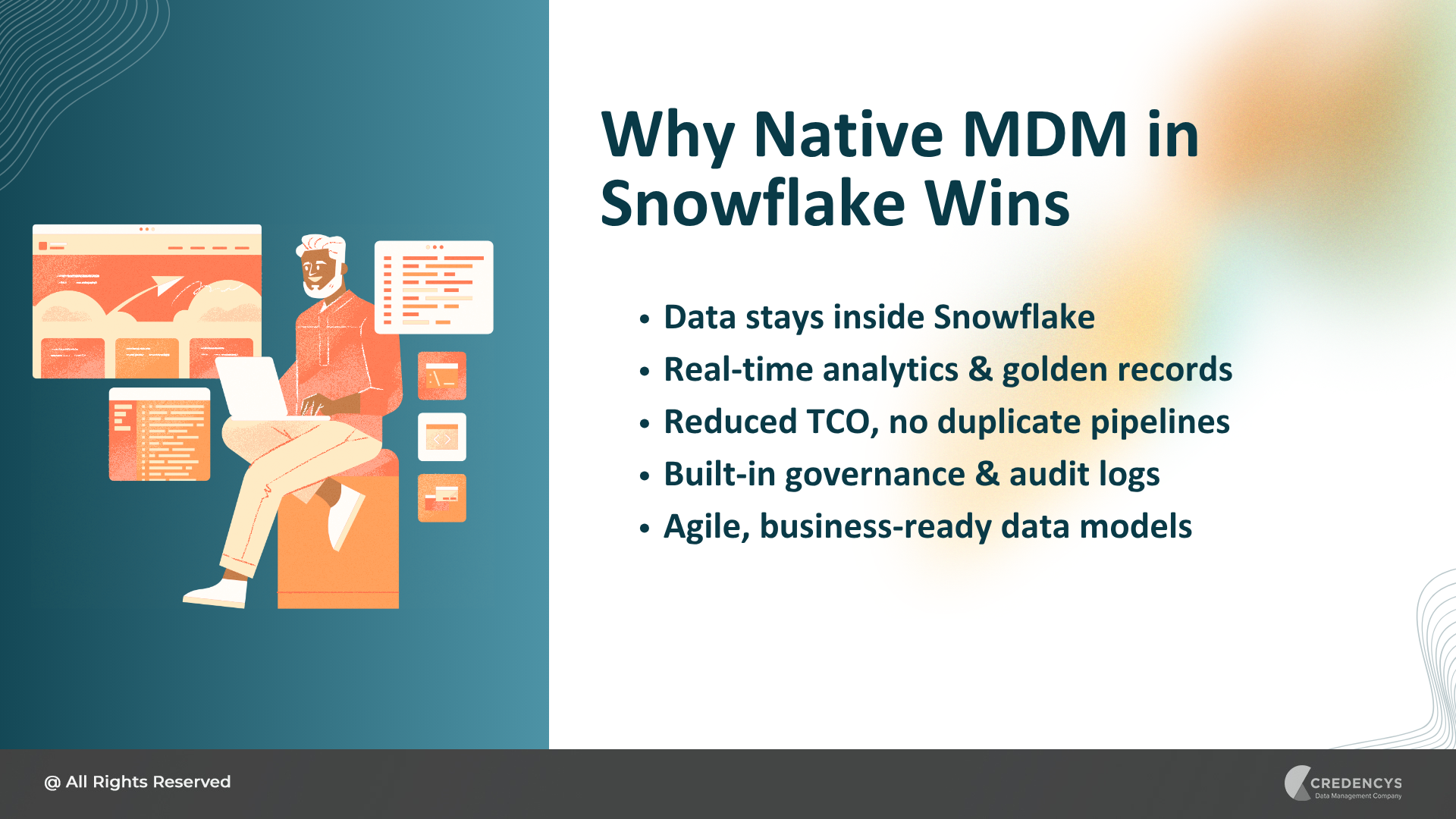
The biggest win is zero data movement, but the ripple effects go much further.
1. Lower Total Cost of Ownership (TCO)
By removing the need for external MDM platforms and complex ETL pipelines, businesses save significantly on infrastructure and integration costs. According to Forrester, organizations that modernize their data management stack can cut operational costs by up to 30% through streamlined architectures [Forrester].
2. Real-Time, Trusted Insights
Because data lives and is governed directly within Snowflake, there’s no lag between management and analytics. Executives and data teams can access real-time golden records for customers, suppliers, and products—supporting faster and more accurate decision-making.
3. Stronger Compliance and Governance
Each additional data transfer creates risk. With native MDM, sensitive data remains within Snowflake, simplifying compliance with regulations such as GDPR, HIPAA, and CCPA. This builds enterprise-wide trust in data integrity.
4. Agility and Scalability
Enterprises no longer need to wait for IT-heavy integration cycles. Business teams can quickly adapt MDM models within Snowflake to support new initiatives—whether launching into a new market, onboarding suppliers, or rolling out personalized customer campaigns.
5. Improved Business Outcomes
- Faster time-to-market for data-driven initiatives
- Higher revenue through more accurate insights and targeted strategies
- Lower risk of compliance violations and reputational damage
- A future-ready data foundation that grows with the enterprise
Real World Success Stories
Case Study 1: Industrial Equipment Retailer
Problem: Legacy MDM outside of Snowflake resulted in high costs, data duplication, and slow analytics. Data teams spent months reconciling inconsistent records.
Solution: Credencys deployed Semarchy MDM natively in Snowflake, enabling pushdown processing, golden record creation, and built-in governance without extra pipelines.
Business Impact:
- 38% faster insights
- 25% less analytics time
- $400K annual savings in operations
Case Study 2: Global Consumer Goods Retailer
Problem: Customer and product data were fragmented across channels, hurting personalization, forecasting, and marketing ROI. On-prem MDM was costly and rigid.
Solution: Credencys unified customer 360 and product data directly inside Snowflake, leveraging pushdown processing and governance workflows to create AI-ready golden records.
Business Impact:
- 15% lift in marketing ROI
- 22% better demand forecasting
- 80% improvement in product catalog consistency
Common Challenges with Traditional MDM and How Native MDM in Snowflake Solves Them
| Challenge | Traditional MDM / External Tools | Native MDM in Snowflake Advantage |
|---|---|---|
| High Data Movement Costs | Requires constant movement in and out of Snowflake, driving up integration and infrastructure costs. | Data stays inside Snowflake, reducing TCO and eliminating duplicate pipelines. |
| Latency & Delayed Insights | Data transfers create lags, blocking real-time analytics. | Golden records and analytics run directly in Snowflake for faster insights. |
| Governance Gaps | Multiple touchpoints increase compliance risk (GDPR, HIPAA, CCPA). | Governance rules, stewardship, and audit logs are enforced natively in Snowflake. |
| Slow Adaptability | Long IT cycles are needed to change MDM models or workflows. | Flexible, business-ready models inside Snowflake enable rapid adjustments. |
| Scalability Issues | Legacy systems often struggle with growth and readiness for AI/ML. | Snowflake’s elastic compute + storage ensures seamless enterprise scalability. |
Wrapping Up
By adopting Native MDM in Snowflake, businesses eliminate redundant pipelines, cut costs, and gain real-time, AI-ready insights. From improved compliance to faster decision-making, the benefits extend beyond IT, driving measurable business growth.
As seen in global retail and industrial equipment brands, reducing data movement is not just a technical win; it’s a strategic advantage. As a trusted partner of Semarchy and Snowflake, Credencys brings you the power of Semarchy MDM running directly within the Snowflake AI Data Cloud.
Unlock the Power of Native MDM in Snowflake
Eliminate redundant pipelines, lower TCO, and enable real-time, AI-ready insights—all inside Snowflake.
Frequently Asked Questions
1. What is Native MDM in Snowflake?
It is the ability to create, govern, and enrich master data directly inside Snowflake’s Data Cloud, without relying on external MDM systems.
2. How does Native MDM reduce costs?
By eliminating external tools and unnecessary pipelines, enterprises can reduce their infrastructure, integration, and maintenance costs, thereby lowering their total cost of ownership (TCO).
3. Is Native MDM secure?
Yes. Since data never leaves Snowflake, compliance with regulations like GDPR and CCPA is simplified, and security risks associated with data transfers are minimized.
4. Can it support AI and advanced analytics?
Absolutely. With clean, governed, and real-time master data inside Snowflake, enterprises can build accurate AI/ML models faster.
5. What industries benefit most?
Retail, CPG, industrial equipment, healthcare, and financial services—all sectors dealing with high volumes of customer, product, or supplier data.
6. How fast can it be implemented?
Unlike legacy systems that can take months or years to deploy, native MDM in Snowflake can be deployed in weeks with the right expertise.
7. What business outcomes can I expect?
Typical outcomes include faster insights, improved forecasting, higher marketing ROI, stronger compliance, and reduced operating costs.






Tags: