


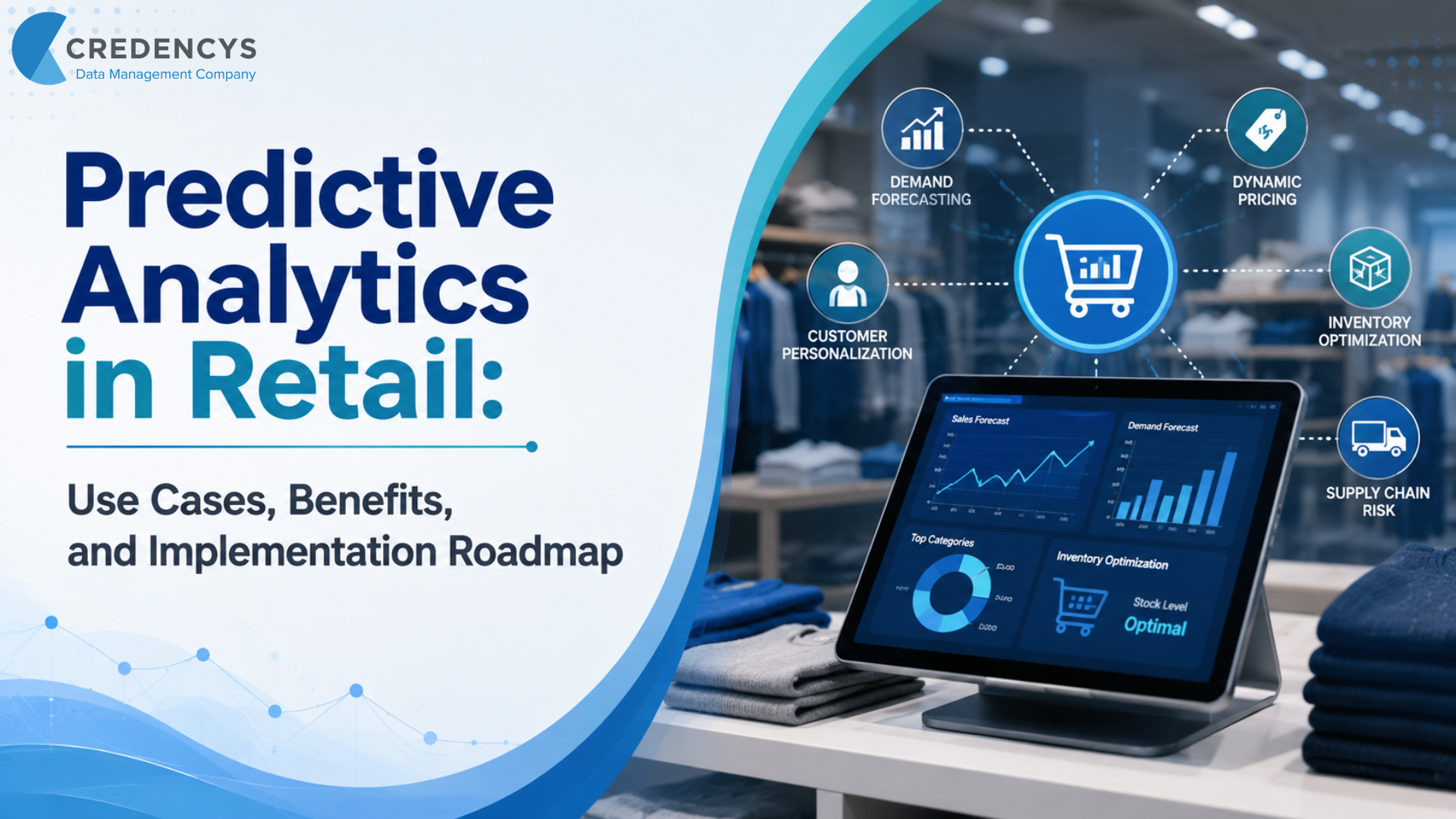
Predictive Analytics in Retail: Use Cases, Benefits, and Implementation Roadmap
Retailers generate data across stores, eCommerce, inventory, promotions, loyalty, fulfillment, and customer service. Yet many decisions are still based on reports that explain what happened after the opportunity to act has passed.
Predictive analytics in retail helps teams use historical, current, and external signals to anticipate demand, customer behavior, inventory risk, and operational issues before they affect revenue, margin, or customer experience.
What is Predictive Analytics in Retail?
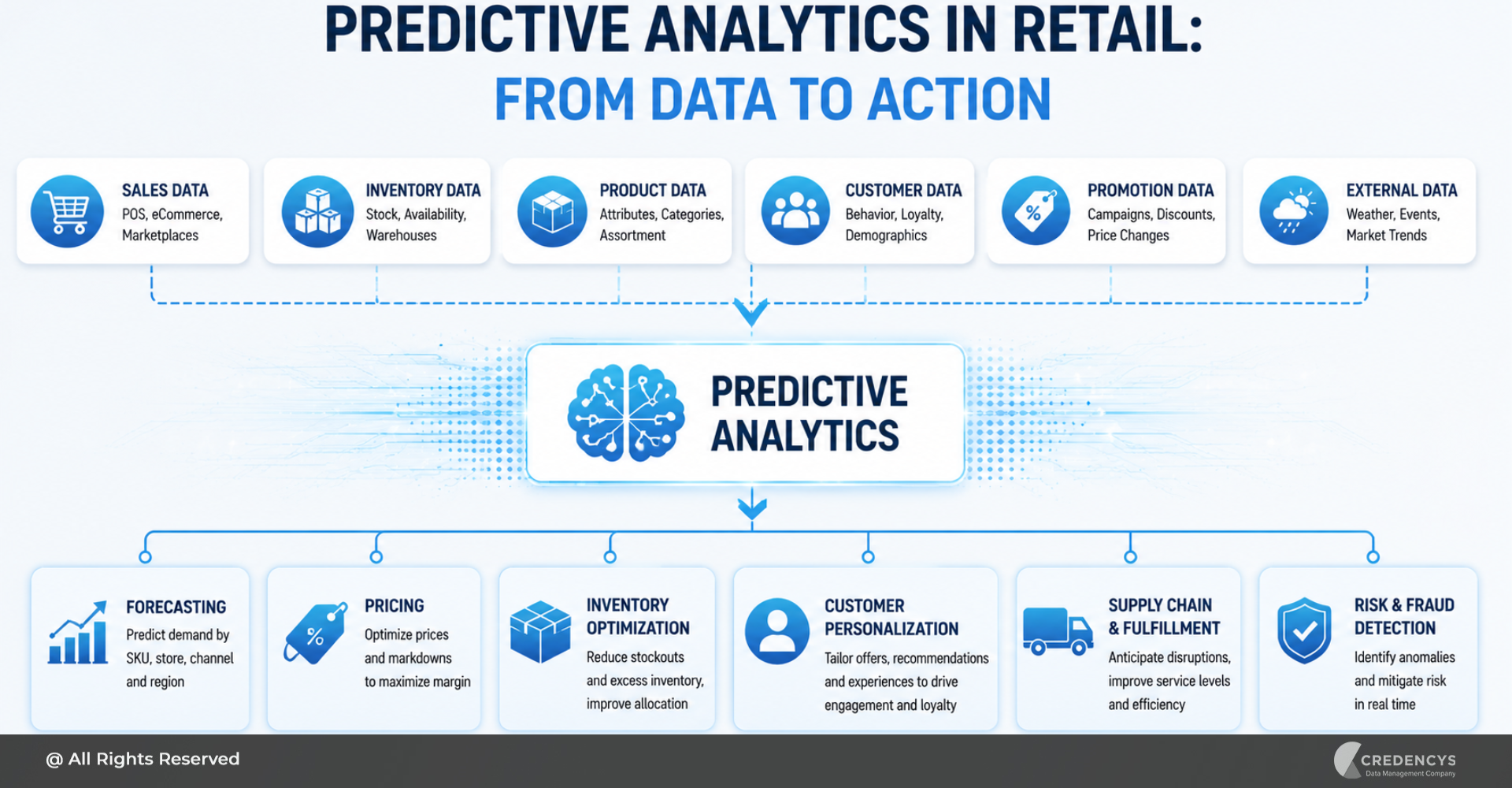
Predictive analytics in retail uses historical, real-time, and external data to identify patterns and predict likely future outcomes. These may include product demand, stockout risk, customer churn, promotion performance, pricing response, supplier delays, or unusual transactions.
It combines statistics, machine learning, AI, and business rules. The aim is not to predict every event.
It is to improve decisions that have a material commercial or operational impact. Retailers can use predictive analytics to answer questions such as:
- Which products are likely to stock out next week?
- Which customers are likely to buy again or disengage?
- Which promotion may create demand without eroding margin?
- Which SKUs need a replenishment, transfer, or markdown action?
- Which suppliers or orders may create fulfillment risk?
Predictive analytics helps retailers move from reactive reporting to proactive decision-making.
Predictive Analytics vs. Descriptive and Prescriptive Analytics
| Type of Analytics | Main Question | Retail Example |
|---|---|---|
| Descriptive Analytics | What happened? | Which category had the highest sales last month? |
| Diagnostic Analytics | Why did it happen? | Why did sales decline in a specific region? |
| Predictive Analytics | What is likely to happen? | Which products are likely to face stockout next week? |
| Prescriptive Analytics | What should we do? | How should inventory be reallocated to reduce stockouts? |
Descriptive analytics explains past performance. Diagnostic analytics identifies drivers.
Predictive analytics estimates likely outcomes, while prescriptive analytics recommends a response. Together, these capabilities help teams move from observing a problem to acting before it affects results.
Significance of Predictive Analytics for Retailers
Retail conditions can change quickly. Customer preferences, pricing, promotions, weather, local events, inventory availability, supplier lead times, and channel behavior can all influence results.
Without predictive analytics, teams often spot issues after they affect sales, margins, or customer satisfaction. A stockout becomes visible after demand is lost.
A promotion underperforms after inventory has been allocated. A loyalty risk is noticed after engagement declines.
Predictive analytics helps retailers identify likely risks earlier and focus teams on exceptions that require attention. Key benefits include:
- Better retail demand forecasting and replenishment planning
- Fewer stockouts and lower excess inventory
- More relevant promotions and customer offers
- Smarter pricing and markdown decisions
- Improved supplier and fulfillment visibility
- Faster exception management
- Stronger margin and working-capital control
For retail leaders, this changes the planning conversation. Instead of asking why a result changed after the reporting period closes, teams can identify emerging risk, evaluate options, and intervene while inventory, pricing, and customer actions can still influence the outcome.
The value comes from predicting the decisions where earlier action can create measurable business impact.
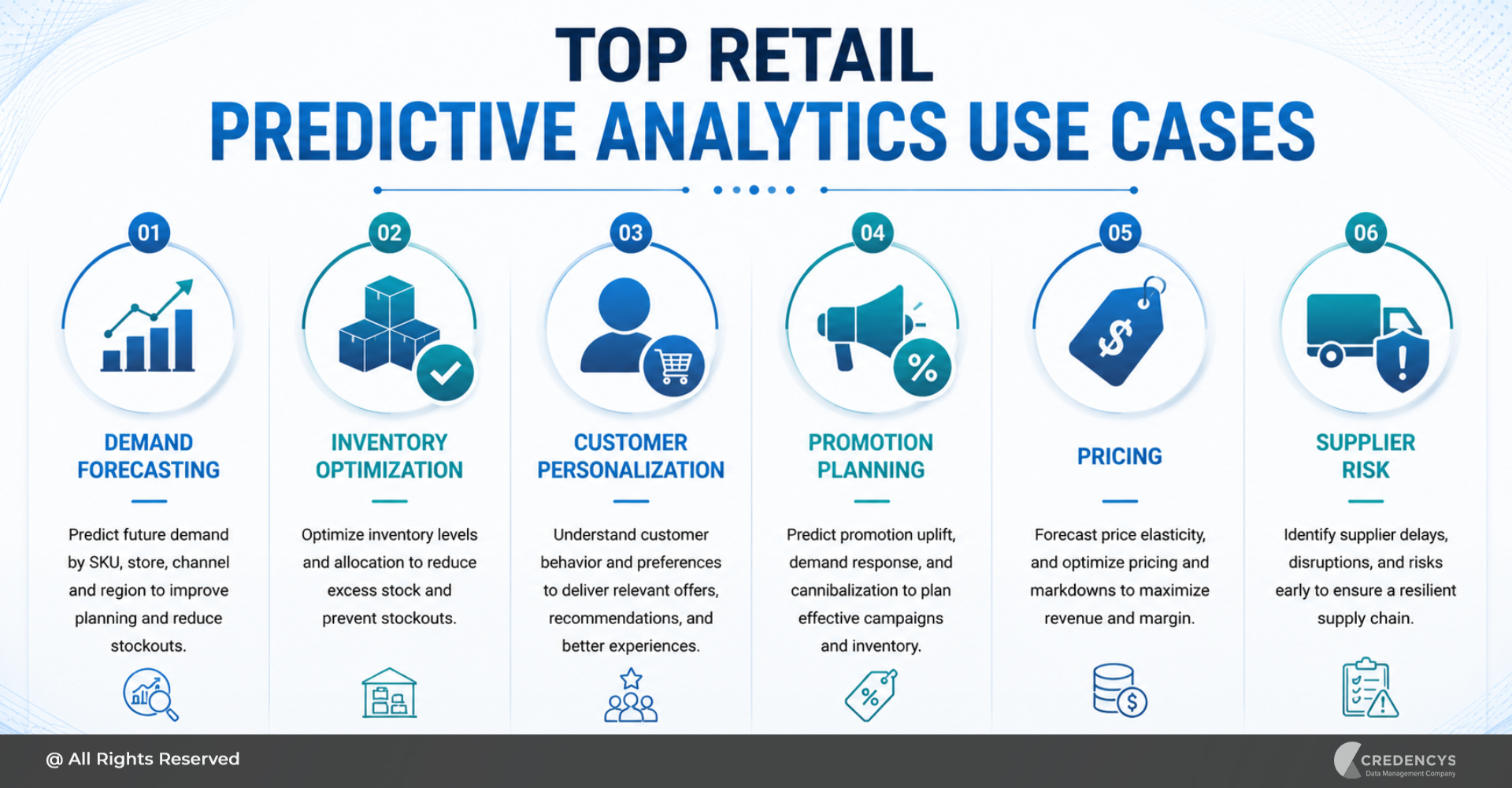
Key Use Cases of Predictive Analytics in Retail
1. Retail Demand Forecasting
Retail demand forecasting predicts demand at the SKU, store, channel, region, or customer segment level. Models can use sales history, inventory, promotions, pricing, product attributes, seasonal trends, customer behavior, supplier lead times, weather, and local events.
This supports stronger replenishment, allocation, assortment, and seasonal planning. A retailer can identify where demand is likely to increase before a stockout occurs.
It can also avoid using the same inventory allocation for locations with different demand patterns.
2. Inventory Optimization and Stockout Prevention
Inventory optimization combines expected demand, inventory position, supplier lead times, and fulfillment signals to identify where risk is building. It can flag:
- Products at risk of stockout
- Slow-moving or excess inventory
- Locations with inventory imbalance
- SKUs needing a transfer or replenishment adjustment
- Products facing markdown pressure
Teams can then adjust safety stock, transfer inventory, change purchase quantities, or plan markdowns before excess stock becomes a margin problem.
3. Customer Segmentation and Personalization
Predictive analytics can group customers by behavior, purchase frequency, channel preference, product affinity, offer response, and expected future value. Common use cases include next-best-product recommendations, personalized offers, customer lifetime value prediction, loyalty engagement, and churn-risk identification.
A connected Customer 360 solution makes these predictions more useful by bringing together signals from stores, eCommerce, loyalty, marketplaces, marketing, and customer service.
4. Promotion and Campaign Performance Prediction
Not every promotion creates profitable growth. Some shift demand forward, reduce margin, or cannibalize sales from another product.
Predictive models can estimate likely promotion lift, demand response, substitution risk, margin impact, and post-promotion behavior. Teams can decide which products to promote, which audiences to target, and how much inventory to reserve before launch.
5. Dynamic Pricing and Markdown Optimization
Predictive analytics can estimate how demand may respond to price changes. Models can consider demand, inventory, seasonality, customer segments, competitor signals, cost, and margin targets.
This supports better decisions on pricing, markdown timing, and sell-through. AI-driven pricing should operate within commercial rules, approval workflows, and human oversight for high-impact changes.
6. Product Recommendations and Cross-Sell Opportunities
Retailers can predict what a customer may purchase next using browsing behavior, purchase history, product affinity, basket patterns, customer context, and inventory availability. This supports eCommerce recommendations, cross-sell and upsell offers, bundles, personalized emails, store-associate suggestions, and post-purchase communications.
Recommendations need current product, customer, and inventory data supported by strong Product Information Management. Recommending an unavailable or irrelevant item weakens the customer experience.
7. Customer Churn and Loyalty Risk Prediction
In retail, declining purchase frequency, basket size, loyalty activity, browsing behavior, or response to communications can signal disengagement. Predictive models can flag customers who may need attention.
Retailers can respond with relevant offers, service outreach, loyalty incentives, or more useful communications instead of applying the same retention offer to everyone.
8. Fraud, Returns, and Transaction Anomaly Detection
Predictive analytics can identify unusual transaction patterns, potentially fraudulent orders, abnormal returns behavior, or suspicious payment activity. Risk scoring helps loss-prevention and customer-service teams prioritize investigations while reducing unnecessary friction for legitimate customers.
9. Supplier, Fulfillment, and Supply Chain Risk Prediction
Retailers can predict late-delivery risk, supplier disruptions, fulfillment bottlenecks, demand-supply gaps, and availability issues. For example, a model may flag increasing lead-time variability or order patterns likely to create an inventory issue.
This supports stronger purchasing, supplier collaboration, and customer communication. Connected operational data and ERP modernization help retailers improve visibility into supplier, inventory, fulfillment, and purchasing risks.
Business Benefits of Predictive Analytics in Retail
| Business Area | Predictive Analytics Benefit |
|---|---|
| Inventory | Fewer stockouts, reduced excess stock, and stronger allocation decisions |
| Merchandising | Better assortment, category, and product lifecycle planning |
| Pricing | More informed price, promotion, and markdown decisions |
| Customer Experience | More relevant offers, recommendations, and communications |
| Supply Chain | Better supplier planning, fulfillment visibility, and risk response |
| Marketing | Higher campaign relevance and improved customer targeting |
| Finance | Better margin visibility, demand planning, and working-capital control |
| Operations | Faster exception management and more efficient decision-making |
These benefits reinforce each other. Better demand visibility improves inventory decisions, which improves availability, customer experience, and revenue protection.
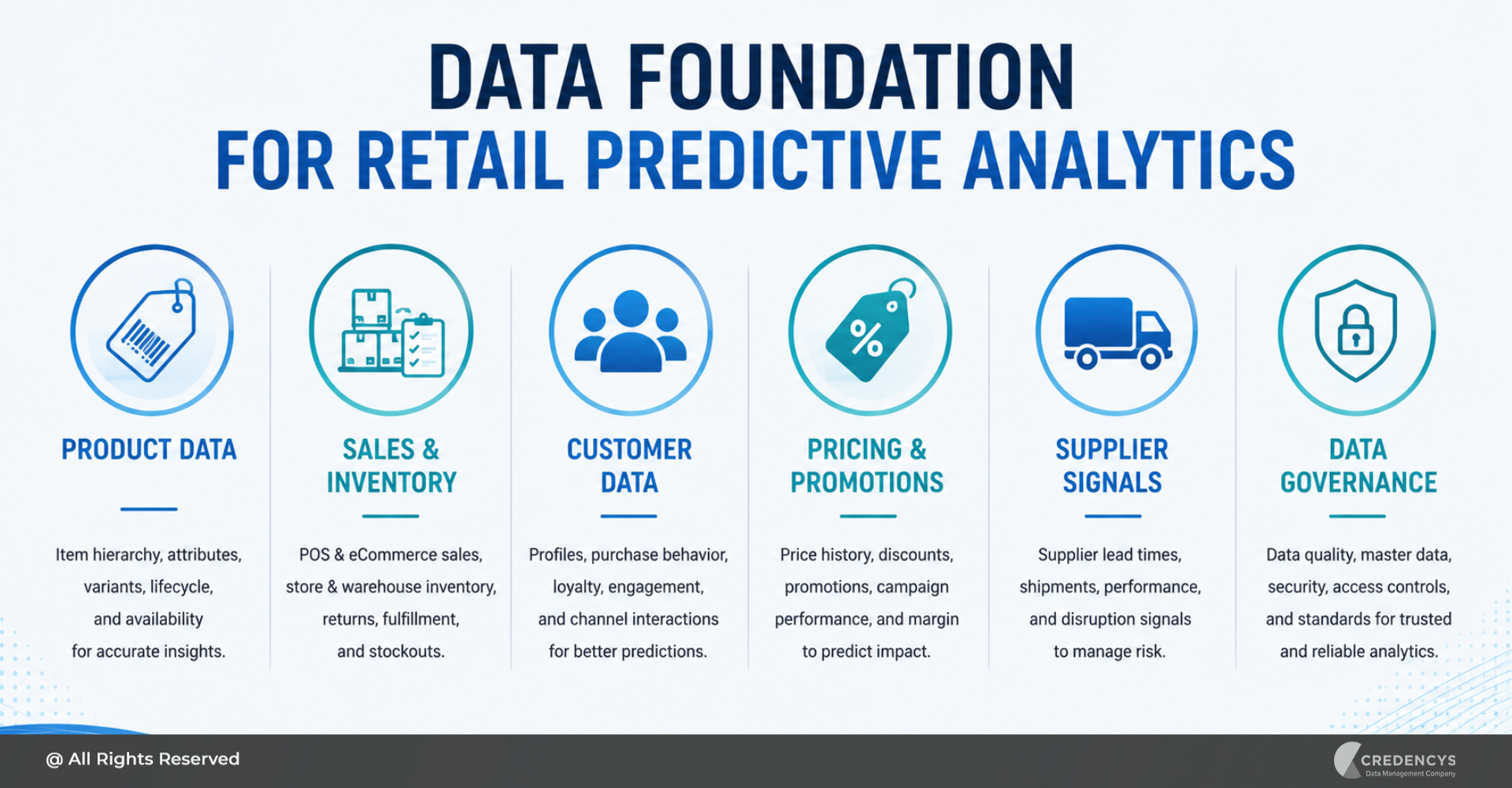
Data Foundation Required for Retail Predictive Analytics
Predictive analytics is only as reliable as the data behind it. Retailers need connected, governed, and current data across the value chain.
Product and Assortment Data
Models need consistent product categories, hierarchies, variants, sizes, colors, specifications, availability, lifecycle status, and assortment information. Master Data Management and Product Information Management help standardize this information across products, categories, suppliers, and locations.
It gives models consistent context for new products, alternatives, and category patterns.
Sales, Inventory, and Fulfillment Data
Important sources include POS transactions, eCommerce sales, store and warehouse inventory, returns, order cancellations, stockouts, replenishment history, and fulfillment activity. Without this context, a model may misinterpret lost sales due to unavailable inventory as weak customer demand.
Customer and Channel Data
Retailers need connected customer behavior across stores, eCommerce, loyalty, marketplaces, marketing, and customer service. This helps models understand channel preference, purchase cadence, offer responsiveness, product affinity, and churn risk.
Pricing, Promotion, and Campaign Data
Models need price changes, discounts, campaign timing, offer response, promotion data, and margin information. This helps differentiate sustained demand from temporary promotion-driven uplift and reveals whether an offer has created incremental value.
Supplier and External Data
Supplier lead times, shipment status, weather, local events, market conditions, and regional trends can improve predictions when they are relevant to the use case. The focus should remain on the signals that improve the decision, not on collecting every possible data point.
Integration, Data Quality, and Governance
Retail data is commonly spread across ERP, POS, eCommerce, WMS, CRM, PIM, DAM, loyalty, supplier, and marketing systems. Data engineering services, reusable integrations, and real-time data pipelines make this data available for analytics and AI.
Strong data quality for AI practices adds shared definitions, ownership, quality checks, access controls, freshness monitoring, and issue resolution. Master Data Management supports trusted records for products, customers, suppliers, locations, and other critical domains.
Practical Implementation Roadmap
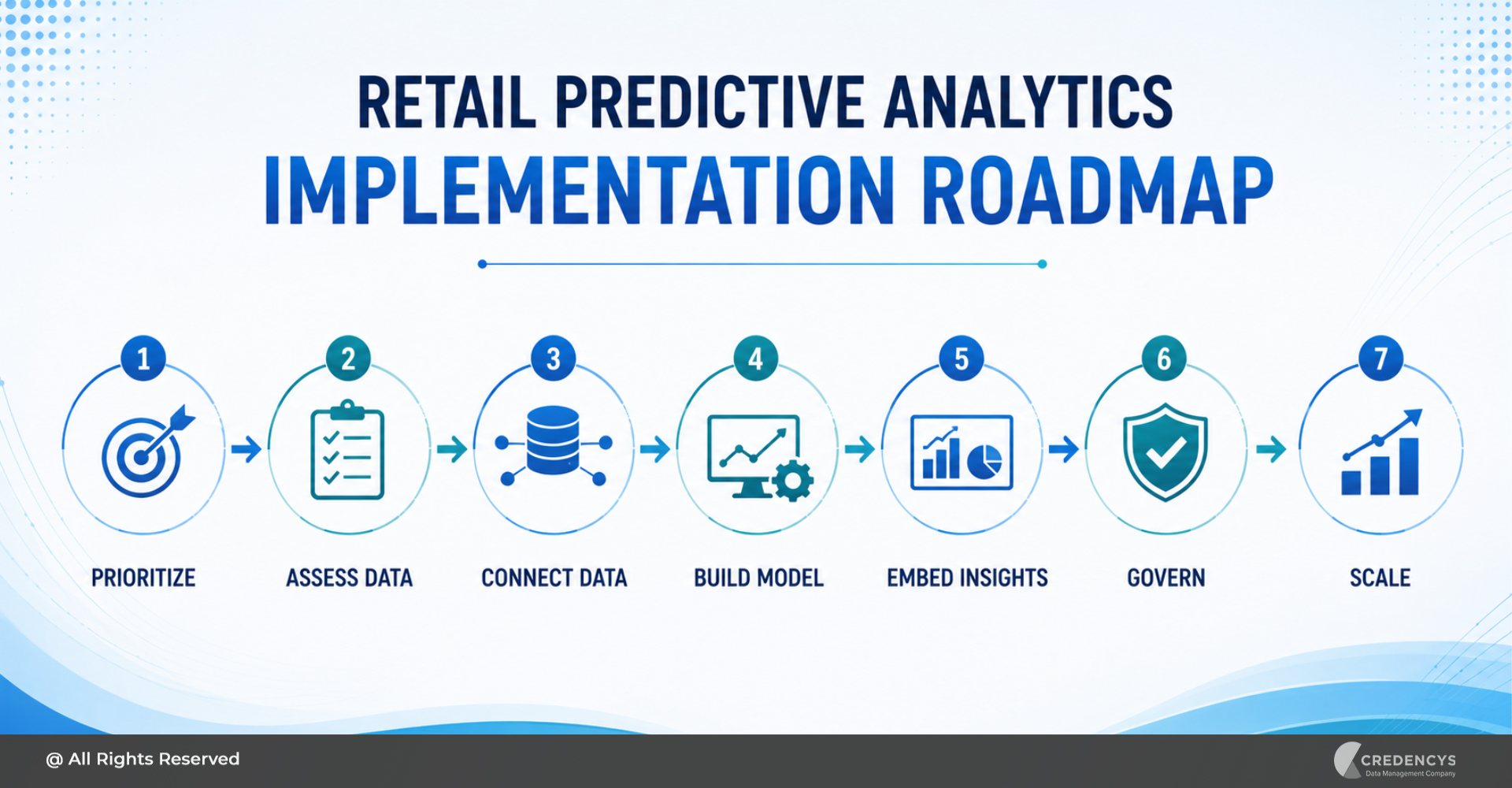
1. Start With a High-Value Retail Decision
Choose a use case where a better prediction can create measurable value, such as reducing stockouts, improving promotion planning, lowering markdowns, or identifying customer churn risk. Avoid beginning with a broad “retail AI transformation” program.
A focused problem creates clearer success measures.
2. Assess Data Readiness
Review the availability, quality, freshness, granularity, ownership, and integration of the required data. Identify gaps before selecting or training a model.
A data-readiness assessment prevents teams from building a strong model on unreliable inputs.
3. Build a Connected Retail Data Layer
Connect key sources through APIs, data pipelines, cloud platforms, and governed data models. Build a reusable foundation rather than a disconnected pipeline for each project.
4. Select the Right Predictive Model
Choose the approach based on the business objective, data availability, prediction horizon, explainability needs, and workflow requirements. Prioritize reliable, understandable output over algorithmic complexity.
5. Embed Predictions into Workflows
Predictions should appear where people make decisions. Replenishment teams need stockout alerts in planning workflows.
Merchandising teams need product signals in assortment decisions. Marketing teams need propensity scores in campaign platforms.
Supply chain teams need supplier-risk alerts in operational dashboards.
6. Establish Governance and Human Oversight
Define ownership for the data, model, output, decision, action, and exception process. Strong AI data governance helps define these controls before predictive models are embedded into important retail workflows.
Set access boundaries, approval requirements, performance measures, and monitoring responsibilities. Human review is especially important for customer-facing, high-margin, high-cost, or high-risk decisions.
7. Measure, Improve, and Scale
Track both model and business performance. Key measures may include forecast accuracy, demand bias, stockout rates, excess inventory, markdowns, campaign response, margin impact, customer engagement, planner overrides, and user adoption.
Use the results to improve inputs, workflows, and operating processes. Scale-after-the-initial-use-case demonstrates measurable value.
Common Challenges in Retail Predictive Analytics
Fragmented Data and Limited Visibility
Disconnected systems limit visibility into products, customers, inventory, and demand. This weakens model inputs and slows decision-making.
Poor Product and Customer Data
Incomplete product attributes, duplicate records, fragmented customer identities, and stale inventory data can produce unreliable predictions. Data quality must be part of the initiative.
Lack of Business Ownership
Predictive analytics needs joint ownership across merchandising, supply chain, marketing, finance, IT, and data teams. A model cannot succeed when it is owned only by a technical team.
Models Not Embedded in Workflows
A prediction does not create value if it stays in a dashboard no one uses. Insights must link to real workflows, decision rights, and action paths.
Weak Monitoring and Governance
Retail conditions change quickly. Models need to be monitored for data changes, performance drift, unexpected outcomes, access issues, and evolving business requirements.
How Credencys Helps Retailers Implement Predictive Analytics
Credencys helps retailers build the data, analytics, and AI foundation required for practical predictive analytics initiatives. Our capabilities include retail data strategy, data engineering and integration, data quality and governance, Product Information Management, Customer 360, Master Data Management, real-time data pipelines, analytics and BI, AI/ML solutions, demand forecasting, dynamic pricing, personalization, recommendation engines, and cloud data platform modernization.
For retailers modernizing their cloud data and AI foundation, Credencys also provides Databricks consulting and Snowflake consulting services. We help retailers connect fragmented data and embed predictions across inventory, merchandising, marketing, pricing, supply chain, and customer operations workflows.
The focus is not on deploying an isolated model. It is on building a scalable capability that supports faster, more informed retail decisions.
Conclusion
Predictive analytics in retail is not about replacing retail expertise with algorithms. It helps teams identify likely outcomes earlier, understand where intervention is needed, and make more informed decisions across inventory, pricing, customer experience, supply chain, and operations.
Retailers that combine trusted data, practical AI/ML capabilities, and workflow adoption can move from reactive reporting to proactive decision-making. The result is better availability, more relevant customer experiences, stronger margins, and more resilient retail operations.
Frequently Asked Questions
What is predictive analytics in retail?
Predictive analytics in retail uses historical, real-time, and external data to forecast likely outcomes such as demand, inventory needs, customer behavior, promotion performance, and operational risks.
What are the main uses of predictive analytics in retail?
Common use cases include retail demand forecasting, inventory optimization, customer segmentation, churn prediction, pricing, promotions, recommendations, fraud detection, and supplier-risk monitoring.
How does predictive analytics improve inventory management?
It helps retailers anticipate stockout risk, excess inventory, demand changes, and replenishment need before they affect sales, margins, or customer experience.
What data is required for retail predictive analytics?
Retailers need connected data across products, sales, inventory, customers, pricing, promotions, suppliers, fulfillment, and relevant external signals.
How can retailers get started with predictive analytics?
Start with a high-value retail decision, assess data readiness, connect relevant sources, build a focused model, embed insights into workflows, and measure business outcomes.


Tags: