

Complex Product Data is Slowing Industrial Distribution Growth
Industrial distributors and MRO suppliers manage large, complex catalogs, but product data is often scattered across ERPs, spreadsheets, PDFs, portals, and legacy systems.
Without a centralized PIM, teams struggle to maintain accurate specifications, onboard products quickly, and deliver consistent information across channels.
Fragmented Supplier Data
Manufacturers provide product information in different formats, structures, naming conventions, and units of measurement, making standardization difficult and time-consuming.
Incomplete Technical Product Information
Missing specifications, dimensions, certifications, compatibility details, images, documents, and product relationships make MRO products harder to search, compare, and purchase.
Slow Product Onboarding
Catalog teams spend significant time cleaning supplier files, mapping attributes, attaching technical documents, and preparing products for digital channels.
Poor Product Discovery
Customers and sales teams cannot easily find the correct industrial product using manufacturer part numbers, technical specifications, applications, or alternative references.
Inconsistent Information Across Channels
Product details may differ across e-commerce websites, customer portals, marketplaces, PDF catalogs, and internal sales tools, reducing trust and increasing the risk of errors.

How Much is Your Product Data Costing You?
Get Your Score +90 days action plan in 3 minutes.
Check Your ScoreEnd-to-End PIM Services for Industrial Distributors
Credencys provides strategic, implementation, integration, and data management services to help industrial distributors and MRO suppliers establish a scalable product information foundation.

PIM Consulting and MRO Data Strategy
We assess your catalog structure, supplier data sources, business systems, workflows, digital channels, and growth priorities to define a practical PIM strategy for industrial distribution.
- Evaluate ERP, DAM, supplier, catalog, and e-commerce data flows
- Identify product data quality, ownership, and governance gaps
- Create a phased PIM implementation and adoption roadmap

PIM Implementation for Industrial Distributors
Our PIM implementation services are designed around complex industrial catalogs, manufacturer data, technical classifications, enrichment workflows, user roles, and channel requirements.
We configure and implement PIM solutions around your catalog size, technical product categories, supplier ecosystem, enrichment workflows, user roles, and channel requirements.
- Configure product families, attributes, workflows, and user permissions
- Support manufacturer, distributor, and customer-specific identifiers
- Establish validation, approval, completeness, and publishing processes

Industrial Product Taxonomy and Data Modeling
We design structured product hierarchies, category-specific attributes, units of measurement, and technical data models for complex MRO catalogs.
- Structure technical categories, product classes, and attribute groups
- Standardize dimensions, materials, ratings, finishes, and applications
- Align data with ETIM, UNSPSC, internal, or customer-specific taxonomies
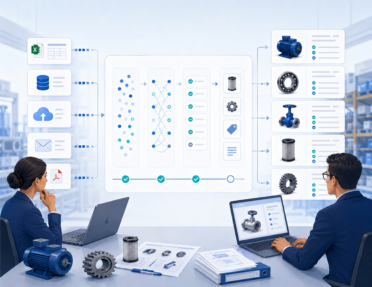
Supplier Data Onboarding and Product Enrichment
We transform supplier spreadsheets, APIs, PDFs, portals, and legacy records into standardized, enriched, and PIM-ready product information.
- Map supplier terminology to a common industrial product model
- Enrich products with specifications, images, manuals, and certificates
- Identify missing attributes, duplicate products, and incomplete records

PIM Integration and Channel Enablement
We connect PIM with ERP, DAM, e-commerce, search, supplier portals, marketplaces, procurement systems, and customer-facing applications.
- Synchronize SKU, supplier, inventory, and operational information
- Deliver enriched product content to websites, portals, and sales tools
- Support APIs, middleware, batch feeds, and event-driven integrations

Product Data Governance, Support, and Optimization
We establish governance processes and continuously optimize the PIM ecosystem as catalogs, suppliers, acquisitions, and digital channels expand.
- Implement ownership, approval, quality, and completeness standards
- Maintain Safety Data Sheets, certificates, manuals, and technical assets
- Improve workflows, integrations, data quality, search, and AI readiness
Is Your MRO Product Data Ready to Support Digital Growth?
Discover where fragmented supplier data, incomplete technical attributes, disconnected systems, and manual catalog processes are limiting your operations and digital sales.
Get a Free Product Data AssessmentMRO Product Data Capabilities for Industrial Distributors
The implemented PIM solution gives industrial distributors the capabilities needed to automate catalog operations, improve product discovery, and scale accurate product information across suppliers, systems, and channels.
Automated Supplier Data Mapping
Automatically ingest supplier spreadsheets, CSV files, APIs, and portal exports, map incoming fields to a common data model, and identify missing or incorrectly formatted information.

Match supplier fields with internal product attributes

Normalize terminology, values, and units of measurement

Identify missing, invalid, or incorrectly formatted data
Standards-Aligned Product Classification
Organize products using category-specific attributes and classifications aligned with ETIM, UNSPSC, internal taxonomies, and customer-specific catalog requirements.

Align product data with ETIM and UNSPSC structures

Support internal and customer-specific taxonomies

Standardize dimensions, materials, ratings, and applications
Automated Data Quality Controls
Use validation rules, completeness scoring, duplicate detection, and workflow alerts to identify incomplete or conflicting product information before publication.
Apply category-specific validation rules

Measure product completeness and channel readiness
Detect duplicate, conflicting, or incomplete records
Product Relationship and Cross-Reference Management
Connect manufacturer part numbers, distributor SKUs, replacement products, alternatives, accessories, kits, superseded items, and compatible components.

Link manufacturer part numbers with distributor and customer SKUs

Manage alternatives, replacements, and superseded products

Associate accessories, kits, components, and spare parts
Channel-Specific Product Publishing
Transform approved product information into the formats, attributes, and content structures required by websites, marketplaces, customer portals, sales tools, and account-specific catalogs.

Publish content to e-commerce platforms and customer portals
Support marketplaces, sales tools, and procurement channels
Manage customer-specific catalogs and approved product lists
AI-Ready Product Discovery
Provide structured attributes, governed content, and connected product relationships for semantic search, natural-language discovery, recommendations, sales copilots, and automated enrichment.

Support semantic and natural-language product search
Improve recommendations and product substitutions

Provide trusted data for sales and customer-service copilots
Measurable Business Outcomes from Better MRO Product Data
Credencys helps industrial distributors measure product data improvements against commercial, operational, and customer experience goals.

Reduce Supplier Onboarding Time
Shorten the time required to collect, map, validate, enrich, approve, and publish new supplier products.Increase Digitally Sellable SKU Coverage
Improve the percentage of the catalog containing the descriptions, technical attributes, images, documents, and relationships required for digital sales.Reduce Catalog Enrichment Effort
Decrease the manual hours spent correcting supplier files, filling attribute gaps, attaching assets, and preparing channel-specific content.Improve Product Search Success
Increase the ability of customers and sales teams to find the correct product using technical specifications, part numbers, applications, and compatibility information.Accelerate New Category and Channel Launches
Reuse governed product data to introduce new product categories, supplier catalogs, marketplaces, websites, and customer portals more quickly.Reduce Product Data Support Requests
Lower the number of customer service and sales requests caused by missing specifications, inconsistent descriptions, incorrect documents, and unclear product relationships.A Practical PIM Implementation Approach for Industrial Distributors
Build a trusted product-data foundation that accelerates manufacturer onboarding, improves catalog accuracy, strengthens digital commerce, and prepares your business for AI-powered product discovery.
01
Assess
Review product catalogs, supplier data, systems, workflows, data quality, and business priorities.
02
Design
Define product hierarchies, technical attributes, identifiers, relationships, and standards such as ETIM or UNSPSC.
03
Configure
Set up the PIM platform, user roles, validation rules, completeness checks, approval workflows, and publishing processes.
04
Migrate
Clean, deduplicate, standardize, enrich, and migrate product data from ERP systems, spreadsheets, supplier files, and legacy platforms.
05
Integrate
Connect PIM with ERP, DAM, e-commerce, search, supplier portals, marketplaces, and customer applications.
06
Optimize
Launch in phases and continuously improve catalog completeness, onboarding speed, data quality, product discovery, and user adoption.
Ready to Build a Scalable PIM Foundation?
Start with a focused assessment of your product data, supplier workflows, system integrations, and digital catalog readiness. Get practical recommendations for improving data quality, accelerating implementation, and reducing risk across your PIM journey.
Get a Product Data AssessmentReal Business Impact from Connected Product Data
Global Industrial Solutions Leader
70%
Reduction in Manual Workload
By centralizing 14,000 SKUs across four brands, automating bulk product operations, and integrating PIM with Dell Boomi, the client reduced manual item setup and improved product data accuracy.
Read MoreWhy Leading Enterprises Choose Credencys
Credencys helps enterprises turn complex data into trusted insights, intelligent operations, and measurable business growth. Here’s what makes us a preferred data and AI partner:

End-to-End Data Expertise
From data strategy to AI deployment, we cover the entire spectrum—Data Management, Engineering, Insights, and Intelligence—to ensure your data drives measurable business outcomes.

Domain-Focused Solutions
Whether you're in retail, automotive, or manufacturing, our purpose-built platforms solve industry-specific challenges with precision and speed.

Enterprise-Grade Partnerships
We collaborate with the best in the business to deliver future-ready, scalable, and secure solutions.

AI-First
We help you move beyond dashboards—accelerating AI readiness, deploying GenAI and enterprise AI agents, and enabling intelligent automation across your data ecosystem.
50+
Enterprise Clients
100%
Certified Consultants
15+
Years Experience
4.9/5
Client Satisfaction
Turn Your MRO Product Data into a Growth-Ready Asset
Identify the gaps in your supplier data, product taxonomy, technical attributes, integrations, and catalog workflows that may be limiting digital sales and operational efficiency.
Get a clear view of your current product data maturity and the priority actions needed to build a scalable PIM foundation for industrial distribution.
Frequently Asked Questions About PIM for Industrial Distributors
PIM for industrial distributors is a centralized system for collecting, organizing, enriching, governing, and distributing complex product information. It helps distributors manage MRO product data, technical specifications, supplier files, images, documents, part numbers, and product relationships across e-commerce, sales, ERP, and customer channels.
MRO distributors need PIM because product information is often scattered across supplier spreadsheets, ERP systems, PDFs, portals, and legacy databases. A PIM standardizes technical attributes, improves data quality, accelerates supplier onboarding, and makes industrial products easier to search, compare, and purchase.
PIM improves industrial product search by structuring categories, technical attributes, manufacturer part numbers, dimensions, applications, compatibility data, and product relationships. This supports better filtering, product comparison, faceted search, semantic search, and AI-powered product discovery.
Yes. PIM can integrate with ERP, DAM, e-commerce platforms, supplier portals, marketplaces, search tools, procurement systems, and customer portals. The ERP manages operational data such as pricing and inventory, while the PIM manages enriched, customer-facing product information.
PIM creates the structured, complete, and governed product data required for AI-powered search, recommendations, sales copilots, automated enrichment, and customer-service assistants. Without accurate MRO product data, AI systems may generate incomplete, irrelevant, or unreliable product responses.
Trusted by Best
Choosing Credencys means partnering with a team that’s deeply committed to unlocking the true value of your data. Here’s why industry leaders trust us:
Our Valued Clientele


Send us a Message
