


How Electrical Distributors Use Data Standardization to Align Manufacturer Product Information
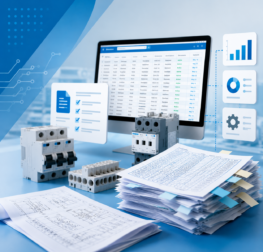
Electrical distributors manage product data from dozens or even hundreds of manufacturers. Each supplier may provide information in a different format, with different attribute names, units, abbreviations, category structures, and levels of completeness.
One manufacturer may use “Rated Voltage,” another may use “Voltage Rating,” and a third may simply use “V.” Although all three fields describe the same technical characteristic, they can enter the distributor’s catalog as separate attributes.
The result is a fragmented product-data environment that requires constant manual cleanup. Catalog teams spend time renaming fields, converting units, checking values, and correcting product records before they can be published.
Data standardization provides a more scalable approach. It converts inconsistent manufacturer information into a common, governed structure that can support e-commerce, ERP, branch systems, customer portals, sales applications, and AI-driven product discovery.
Without a scalable electrical product data management process, catalog teams must repeatedly transform manufacturer information before it can support digital channels.
Why Manufacturer Product Data is Difficult to Align
Electrical distribution involves a large number of technical products, manufacturers, and data sources. Product information may arrive through spreadsheets, CSV files, APIs, supplier portals, IDEA Connector, ERP exports, PDF specification sheets, digital catalogs, or email attachments.
Every source may use a different structure. A circuit breaker manufacturer may organize products by frame size and trip type.
Another may organize similar products by voltage and amperage. A lighting manufacturer may provide lumen output, color temperature, and wattage in separate fields, while another may include several of those values in one description.
The problem becomes more complex when distributors manage multiple product categories, including:
- Switchgear
- Circuit protection
- Wire and cable
- Wiring devices
- Controls
- Enclosures
- Lighting
- Power distribution equipment
- Industrial automation components
Each category requires a different set of technical attributes. A distributor cannot apply the same completeness rules to a cable, an enclosure, and a contactor.
Manufacturers may also use different abbreviations, units, naming conventions, and packaging structures. These differences make it difficult to compare products, create consistent filters, and publish accurate information across channels.
Without a standardized approach, catalog teams must interpret each supplier file independently.
What Data Standardization Means for Electrical Distributors
Data standardization is the process of converting incoming product information into consistent rules for attributes, values, formats, units, identifiers, categories, packaging, descriptions, and product relationships. For electrical distributors, that may include standardizing:
- Attribute names
- Unit abbreviations
- Numeric formats
- Product descriptions
- Category assignments
- Manufacturer identifiers
- Packaging levels
- Controlled values
- Technical documents
- Product relationships
For example, a manufacturer may provide voltage values as:
- 120 V
- 120V
- 120 volts
- Voltage: 120
A standardized catalog may store all four values as: Voltage: 120 V
The goal is not to remove meaningful manufacturer-specific information. It is to ensure that comparable product characteristics follow a common structure.
A molded-case circuit breaker and a miniature circuit breaker may legitimately require different attributes. Data standardization preserves those technical distinctions while ensuring that shared properties, such as voltage, amperage, and pole count, follow consistent definitions.
Common Product Data Inconsistencies in Electrical Catalogs
Electrical distributors typically encounter several types of product-data inconsistency.
Inconsistent Attribute Names
Manufacturers may use different names for the same property. Examples include:
- Amperage and current rating
- Pole count and number of poles
- Enclosure rating and environmental rating
- Mount type and mounting method
- Conductor size and wire gauge
When these values are stored as separate fields, search, filtering, comparison, and reporting become less reliable.
Different Units and Value Formats
Technical values may be submitted in different units or formats. Examples include:
- Inches versus millimeters
- Feet versus meters
- Watts versus kilowatts
- Celsius versus Fahrenheit
- Numeric values stored as text
- Values with and without unit symbols
A dimension recorded as “25.4 mm” and another recorded as “1 inch” may represent the same size, but the system may not recognize them as equivalent without normalization.
Inconsistent Product Categorization
Manufacturers may classify similar products differently. A circuit breaker may be placed under:
- Circuit protection
- Breakers
- Molded-case circuit breakers
- Low-voltage protection
- Electrical distribution equipment
If these categories are imported directly, the distributor’s catalog can become fragmented and difficult to navigate.
Unstructured Product Descriptions
Manufacturer descriptions are often designed for internal systems rather than digital commerce. They may contain:
- Technical abbreviations
- Inconsistent word order
- Missing differentiating attributes
- Brand-specific terminology
- Packaging information mixed with product specifications
These descriptions may be difficult for contractors, buyers, and search engines to understand.
Missing Mandatory Attributes
A product record may exist in the ERP but still be unsuitable for e-commerce because important information is missing. Depending on the category, missing fields may include:
- Voltage
- Amperage
- Frequency
- Material
- Dimensions
- IP or NEMA rating
- Certifications
- Mounting type
- Lumen output
- Color temperature
- Conductor gauge
Inconsistent Packaging and Units of Measure
Electrical products may be bought, stocked, and sold as:
- Each
- Pack
- Box
- Case
- Reel
- Spool
- Coil
- Foot
- Meter
If packaging and unit-of-measure data are inconsistent, distributors risk incorrect pricing, ordering, inventory, and product presentation.
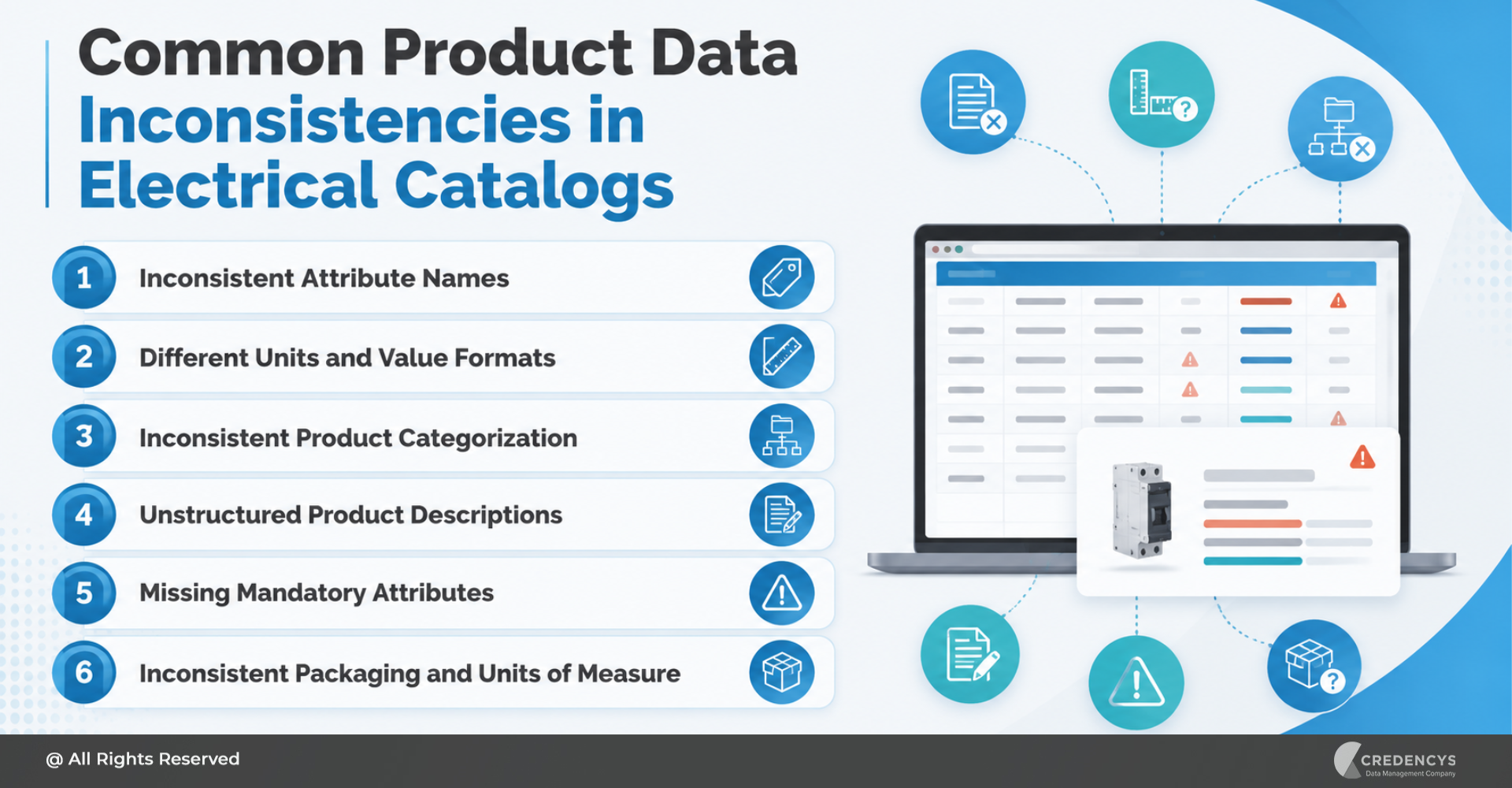
These inconsistencies collectively weaken product data quality, making records less reliable for search, comparison, integration, and publication.
Why Manual Data Standardization Does Not Scale
Many catalog teams rely on spreadsheets, formulas, lookup tables, one-time scripts, and manual copy-and-paste to standardize manufacturer data. These methods may work for a small number of suppliers.
They become difficult to maintain as the catalog grows. Manual processes create several problems:
- Standardization rules are scattered across files.
- Teams repeat the same corrections during every update.
- Knowledge remains with individual employees.
- Errors are difficult to trace.
- New manufacturers require new manual mappings.
- Different team members may standardize similar values differently.
- Changes in category requirements are difficult to apply consistently.
A spreadsheet can convert “120 volts” to “120 V,” but it does not provide a governed process for handling unexpected values, missing fields, conflicting identifiers, or category-specific validation. Catalog growth should increase product availability, not multiply manual data-maintenance work.
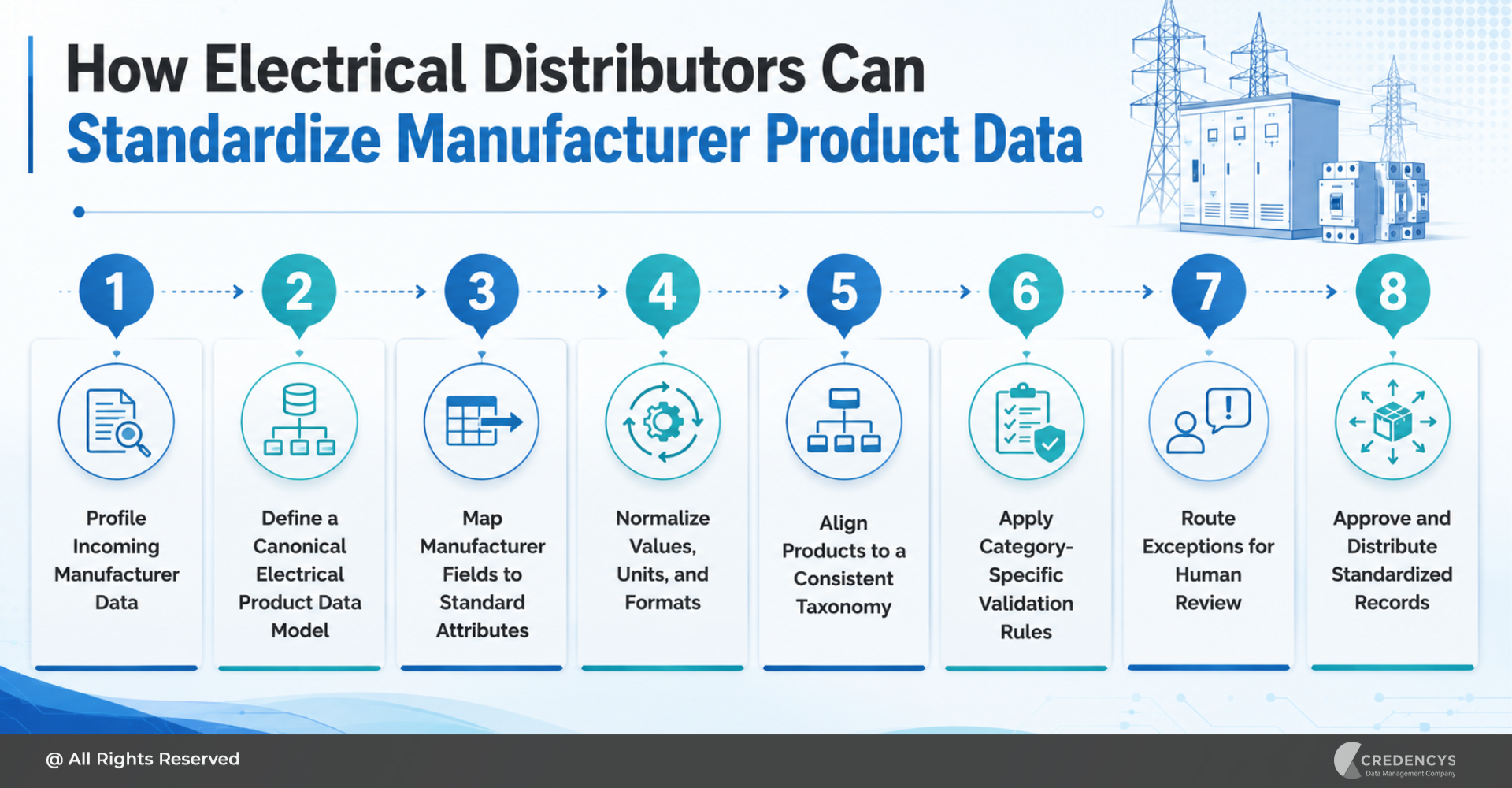
How Electrical Distributors Can Standardize Manufacturer Product Data
A scalable data standardization process should combine data profiling, a common product model, reusable mappings, validation rules, and governed exception handling.
1. Profile Incoming Manufacturer Data
Before transforming a supplier file, distributors should understand what it contains. Data profiling should review:
- Available attributes
- Missing mandatory fields
- Duplicate records
- Value formats
- Units of measure
- Category structures
- Product identifiers
- Image and document availability
- Packaging information
- Potential data-quality issues
This process reveals how each manufacturer’s data differs from the distributor’s required structure. It also helps teams estimate the amount of mapping, enrichment, and review required before publication.
2. Define a Canonical Electrical Product Data Model
A canonical data model provides the common structure into which manufacturer information will be mapped. It should define standards for:
- Product identifiers
- Technical attributes
- Categories
- Units
- Packaging
- Documents
- Digital assets
- Product relationships
- Channel-specific information
The model should reflect the needs of each electrical category. For example, breakers may require voltage, amperage, interrupting capacity, and pole count.
Wire and cable products may require conductor material, gauge, insulation, and voltage rating. Lighting products may require wattage, lumen output, color temperature, and dimming compatibility.
The canonical model becomes the distributor’s defined way product information should be organized.
3. Map Manufacturer Fields to Standard Attributes
Once the target model is defined, data mapping connects manufacturer-specific fields with the distributor’s standard attributes.
- Volt_Rating → Voltage
- Amp Capacity → Amperage
- No_of_Poles → Number of Poles
- Housing Material → Enclosure Material
- Color Temp → Color Temperature
These mappings should be reusable. When a manufacturer submits a future file using the same structure, the system should apply the existing mapping rather than requiring the catalog team to repeat the process.
Reusable mappings reduce onboarding time and make product updates easier to manage.
4. Normalize Values, Units, and Formats
After fields are mapped, their values must be standardized. Normalization may include:
- Converting units
- Applying decimal rules
- Standardizing yes-or-no values
- Formatting dimensions
- Converting dates
- Standardizing technical abbreviations
- Applying controlled vocabularies
- Separating values from unit symbols
Examples include:
- “Y,” “Yes,” and “1” becoming “Yes”
- “Millimeters” and “mm” becoming “mm”
- “120 volts” and “120V” becoming “120 V”
- “Three Phase” and “3PH” becoming “3-phase”
Normalization should be governed by category and attribute rules. A value that is valid for one category may be invalid for another.
5. Align Products to a Consistent Taxonomy
Manufacturer categories should be mapped to the distributor’s internal taxonomy. That taxonomy may support:
- ERP category structures
- E-commerce navigation
- ETIM classification
- Reporting hierarchies
- Marketplace requirements
- Customer-specific catalogs
The same product may need to appear under different channel categories, but it should remain connected to one governed product record. A consistent taxonomy improves navigation, search, filtering, analytics, and product-data governance.
6. Apply Category-Specific Validation Rules
Validation rules should check whether each product contains the required information for its category. For example:
- Breakers may require voltage, amperage, pole count, and interrupting capacity.
- Wire and cable may require gauge, conductor material, insulation, and voltage rating.
- Enclosures may require dimensions, material, and environmental rating.
- Lighting products may require wattage, lumen output, and color temperature.
Validation should also check formats, allowed values, ranges, identifiers, images, and documents. This prevents incomplete or invalid records from being published automatically.
7. Route Exceptions for Human Review
Automation should handle predictable transformations, but it should not silently accept questionable data. Records should be routed for review when they contain:
- Missing mandatory attributes
- Unrecognized units
- Conflicting identifiers
- Invalid ranges
- Unmapped categories
- Possible duplicates
- Unsupported values
- Contradictory technical information
Catalog specialists can review these exceptions, correct the record, and update the standardization rule where appropriate. This creates a controlled feedback loop rather than a recurring manual problem.
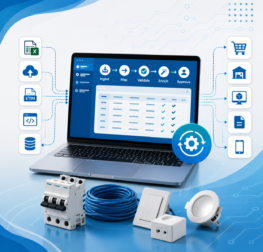
8. Approve and Distribute Standardized Records
Once records are mapped, normalized, enriched, validated, and approved, they can be distributed to:
- E-commerce platforms
- ERP systems
- Branch systems
- Customer portals
- Sales applications
- Digital catalogs
- Marketplaces
- Mobile applications
- AI-powered discovery tools
A governed product data syndication process helps distribute approved attributes, descriptions, documents, and relationships to every required destination. Standardizing information before distribution reduces channel-specific corrections and helps every system receive a consistent product record.
How PIM Supports Scalable Data Standardization
Product information management provides a central environment for managing manufacturer data, standardization rules, enrichment, validation, approvals, and distribution. A PIM platform can support:
- Multi-source data intake
- Reusable manufacturer mappings
- Attribute normalization
- Category-specific data models
- Taxonomy management
- Validation rules
- Enrichment workflows
- Approval processes
- Product relationships
- Data-quality scoring
- Multichannel publishing
Instead of maintaining transformation logic across spreadsheets and import scripts, distributors can govern it centrally. Reusable mappings are especially valuable.
Once a supplier’s fields are connected to the distributor’s standard attributes, those rules can be applied to future files and updates. PIM also supports category-specific requirements.
A lighting product, cable, breaker, and enclosure can each follow different completeness and validation rules within the same platform. However, PIM should not be treated as a tool that automatically invents every missing technical value.
It creates the structure, workflows, controls, and visibility needed to manage incomplete or questionable information consistently. Human review remains important for exceptions that require technical judgment.
Distributors evaluating the broader role of PIM can also review the essential PIM capabilities for electrical distributors, including ingestion, taxonomy, enrichment, governance, and multichannel distribution.
Business Outcomes of Standardized Electrical Product Data
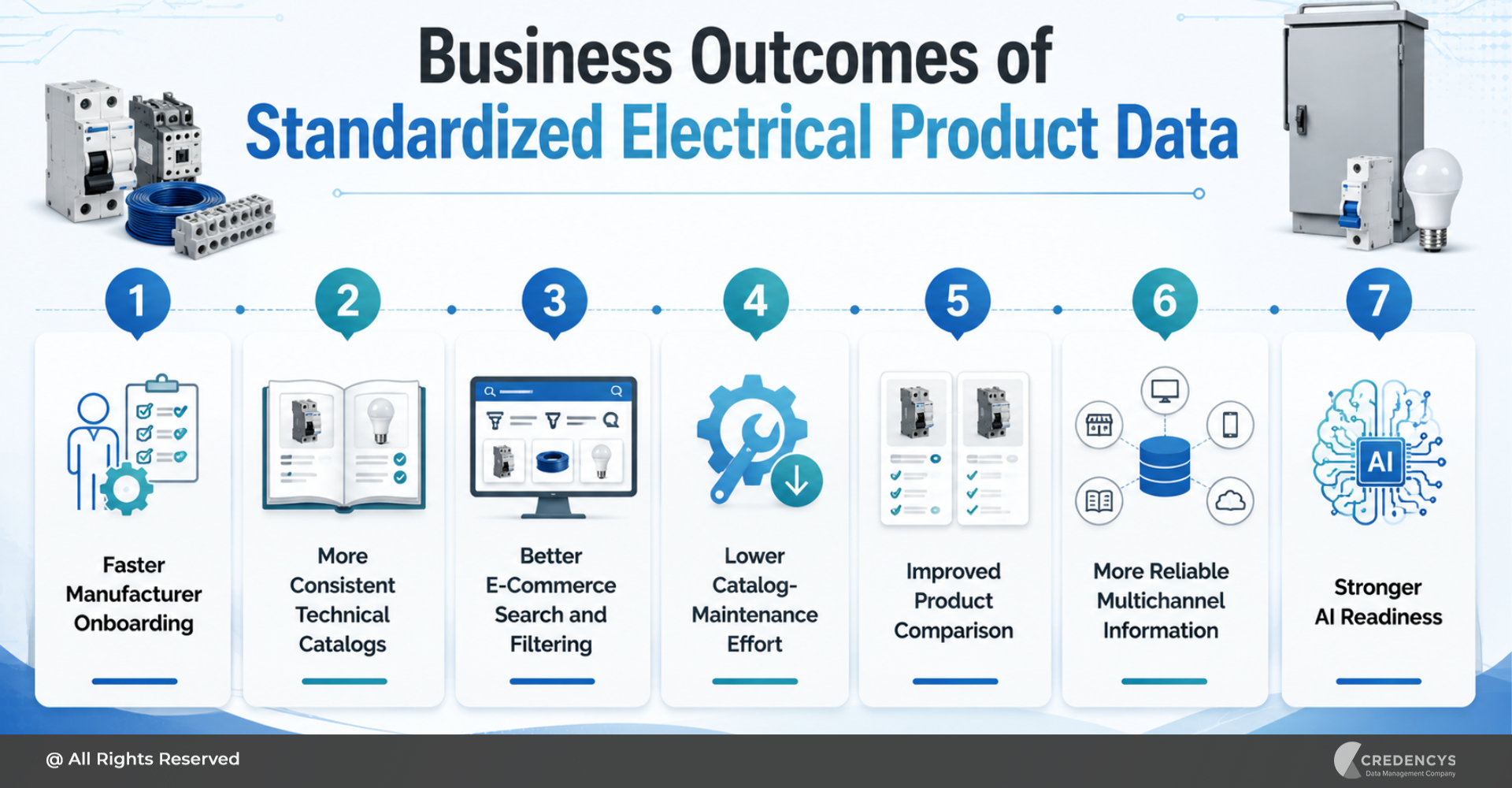
Data standardization creates value beyond cleaner product records.
Faster Manufacturer Onboarding
Reusable mappings and transformation rules reduce repetitive work when new supplier files arrive.
More Consistent Technical Catalogs
Comparable products use common attributes, units, values, and category structures.
Better E-Commerce Search and Filtering
Customers can filter products accurately by voltage, amperage, dimensions, material, certifications, environmental rating, and other technical characteristics.
Lower Catalog-Maintenance Effort
Teams correct information within a governed process instead of fixing the same issue separately in multiple systems.
Improved Product Comparison
Standard attributes make it easier to compare similar products across manufacturers.
More Reliable Multichannel Information
ERP, e-commerce, branch systems, sales tools, and customer portals receive consistent product records.
Stronger AI Readiness
Structured, normalized, and relationship-rich product data gives AI search and recommendation systems more reliable context. Teams can use a PIM and AI readiness checklist to identify gaps in data quality, governance, infrastructure, and implementation preparedness.
Metrics for Measuring Data Standardization
Electrical distributors should measure both operational efficiency and catalog usability. Useful metrics include:
- Percentage of manufacturer fields automatically mapped
- Percentage of standardized attribute values
- Number of unmapped attributes
- Validation exception rate
- Product-data completeness score
- Duplicate detection rate
- Manufacturer onboarding time
- Time from product receipt to publication
- Percentage of products ready for e-commerce
- Number of channel-specific corrections
- Search-filter coverage by category
These metrics help teams identify which manufacturers, categories, and workflows require the most improvement.
Build a Scalable Foundation for Electrical Product Data
Electrical distributors do not need every manufacturer to submit identical files. They need a repeatable process for converting varied manufacturer information into a consistent, governed product-data model.
Effective data standardization can help distributors onboard manufacturers faster, reduce manual catalog work, improve technical product discovery, publish consistent information across channels, and prepare product data for AI-driven experiences. The first step is understanding where inconsistencies currently exist and which categories, suppliers, and systems create the most friction.





Tags: