



PIM for Electrical Distributors: Capabilities, Use Cases, and Implementation Considerations
Electrical distributors manage some of the most complex product catalogs in B2B commerce. A single catalog may include switchgear, circuit protection products, wire and cable, lighting, controls, enclosures, power distribution equipment, and industrial automation components from hundreds of manufacturers.
Each manufacturer may use different attribute names, category structures, units of measure, file formats, and completeness standards. Product information can arrive through spreadsheets, portals, PDFs, APIs, data pools, and internal systems.
The challenge is not simply storing more SKUs. It is transforming fragmented manufacturer data into complete, standardized, searchable, and channel-ready product information.
A PIM helps electrical distributors create that foundation. It centralizes product information, supports enrichment and validation, manages technical relationships, and distributes approved content to e-commerce, sales, branch, and customer-facing systems.
This article explains the capabilities electrical distributors should expect from PIM, the highest-value use cases, and the implementation decisions that influence results.
Why Electrical Product Data Is Difficult to Manage
Electrical products contain far more than a name, description, image, and price. Buyers often need detailed technical information to determine whether a product is suitable for a specific application.
Depending on the category, that information may include:
- Voltage, amperage, wattage, frequency, and phase
- Number of poles, wire gauge, conductor material, and insulation type
- Dimensions, mounting type, enclosure rating, and environmental protection
- Certifications, compliance information, and technical documents
- Product family, compatible accessories, replacements, and alternatives
- Packaging levels, units of measure, and manufacturer identifiers
When these attributes are incomplete or expressed inconsistently, customers cannot reliably search, filter, compare, or select products. The problem becomes more difficult as the distributor adds manufacturers.
One supplier may use “rated voltage,” another “voltage rating,” and a third “operating voltage.” The values may also appear in different formats or units.
Electrical catalogs change continuously. Manufacturers introduce new SKUs, revise specifications, update documents, discontinue products, and announce replacements.
Catalog teams must keep this information current across multiple systems and channels. Industry standards can help, but they do not remove the need for internal data management.
ETIM provides a standardized classification model for technical products, while IDEA Connector supports syndicating product and transactional data between electrical manufacturers and distributors. Distributors still need to map, validate, enrich, govern, and operationalize that information inside their own technology environment.
Where Traditional Product Data Processes Break Down
Many electrical distributors still rely on a combination of ERP records, spreadsheets, shared drives, supplier portals, and e-commerce databases. This creates several recurring problems.
Manufacturer Onboarding Remains Manual
Every new manufacturer can introduce another set of files, fields, categories, and content rules. Catalog teams spend time:
- Collecting and reviewing source files
- Renaming and mapping attributes
- Converting measurements and formats
- Matching products to internal categories
- Identifying missing information
- Correcting errors before publication
The same work is often repeated whenever the manufacturer sends an update.
ERP Contains Only Part of the Product Record
ERP systems are essential for transactional information such as SKU numbers, suppliers, inventory, cost, price, and units of measure. However, they are not typically designed to manage rich descriptions, category-specific attributes, digital assets, compatibility relationships, completeness rules, approvals, and channel-specific content.
As a result, teams create additional spreadsheets, databases, or custom applications to fill the gaps.
Different Systems Show Different Information
Marketing may update descriptions in e-commerce. Operations may maintain identifiers in ERP.
Product teams may manage specifications in spreadsheets. Branches may keep local records.
Without a governed product-information layer, there is no reliable answer to a basic question: Which system contains the trusted product record?
Catalog Publication Slows Down
Products may exist in the ERP but remain unavailable online because specifications, images, documents, or categories are missing. This delays digital assortment expansion and forces teams to correct records after publication.
What is PIM for Electrical Distribution?
PIM for electrical distributors is a centralized system for collecting, standardizing, enriching, validating, and distributing technical product information received from manufacturers and internal systems. It helps distributors create complete and consistent product records for e-commerce, customer portals, sales tools, branch systems, and digital catalogs.
For an electrical distributor, the flow may look like this:
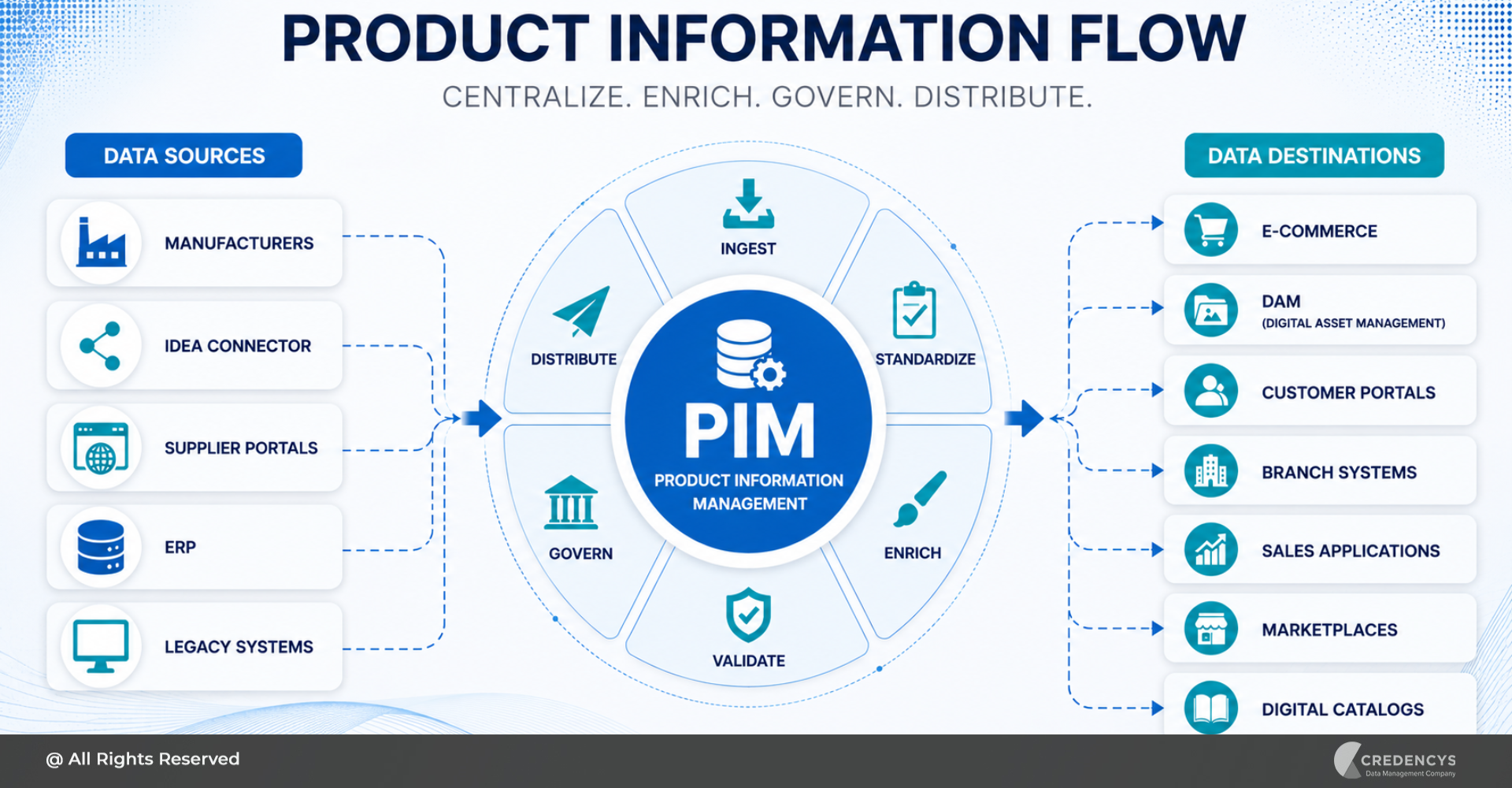
PIM does not automatically replace ERP, DAM, commerce platforms, or industry data sources. Each system has a different role.
- ERP manages transactional and operational records.
- DAM manages images, documents, videos, and other digital assets.
- PIM manages complete, enriched, and channel-ready product information.
- E-commerce presents products and supports digital transactions.
- Industry data sources help exchange manufacturer and distributor data.
The value comes from connecting these systems through a governed data model, repeatable workflows, validation rules, and clear ownership.
Core PIM Capabilities Electrical Distributors Need
Multi-Source Data Ingestion
A PIM should accept information from spreadsheets, APIs, supplier portals, ERP systems, legacy databases, data pools, and asset repositories. Instead of manually reworking every file, teams can create reusable mappings and supplier-specific import processes.
Records that fail validation can be routed to an exception queue for review.
Attribute Mapping and Normalization
PIM helps map different manufacturer terms to one governed attribute structure. It can also normalize:
- Units of measure
- Controlled values
- Field formats
- Naming conventions
- Data types
- Abbreviations
This creates consistency across products without requiring every manufacturer to use the distributor’s internal structure.
Product Classification and Taxonomy
Electrical distributors may need to support several classification structures at the same time:
- Internal product hierarchies
- E-commerce categories
- ETIM classes
- UNSPSC codes
- Manufacturer categories
- Customer-specific classifications
ETIM uses product groups, classes, features, and values to structure technical information. A PIM can map incoming data to that model and connect it with the distributor’s internal and customer-facing taxonomies.
Data Quality and Completeness
PIM can apply category-specific validation rules. For example, a circuit breaker may require voltage, rated current, poles, interrupting rating, certifications, images, and technical documents before it is approved for e-commerce.
Completeness dashboards can show missing information by:
- Product
- Category
- Manufacturer
- Channel
- Attribute group
- Publication status
This helps teams prioritize records that create the greatest commercial impact.
Product Enrichment
Manufacturer data may be technically correct but not ready for every channel. Internal teams can enrich records with:
- Standardized titles and descriptions
- Application information
- Search terms
- SEO fields
- Images and technical documents
- Localized content
- Channel-specific descriptions
- Customer-facing benefits
Product Relationship Management
Electrical products are frequently sold through relationships rather than as isolated SKUs. A PIM should support:
- Accessories
- Compatible components
- Replacements
- Alternatives
- Product families
- Kits and bundles
- Required add-ons
- Obsolete and successor products
These relationships improve product discovery and help customers complete an order without relying on a sales representative.
Workflow and Governance
PIM can assign ownership and route products through review, enrichment, approval, and publication stages. Governance capabilities may include:
- Role-based permissions
- Attribute ownership
- Approval workflows
- Change history
- Exception handling
- Publication controls
- Audit trails
Multichannel Syndication
Once approved, product information can be distributed to websites, portals, mobile applications, sales tools, branch systems, marketplaces, and digital catalogs. This reduces repeated channel-level maintenance and helps every customer touchpoint use the same governed information.
High-Value PIM Use Cases for Electrical Distributors
Automating Manufacturer Data Onboarding
PIM can convert manufacturer onboarding from a repeated manual exercise into a controlled workflow. Supplier-specific mappings transform incoming fields into the distributor’s data model.
Validation rules identify missing or invalid values. Exceptions are assigned to the right team instead of remaining hidden in spreadsheets.
This can reduce repetitive work and make onboarding performance measurable.
Improving Catalog Completeness
PIM helps teams identify which products are ready for a particular channel. A record may be complete for an internal sales system but incomplete for e-commerce because it lacks images, documents, or searchable attributes.
Channel-specific completeness rules make that distinction visible.
Operationalizing ETIM and IDEA Data
ETIM and IDEA Connector solve different but complementary problems. ETIM defines how technical product information can be classified, while IDEA Connector enables industry data syndication.
PIM helps the distributor use that information internally by:
- Mapping it to the distributor’s data model
- Applying quality rules
- Adding internal or customer-facing content
- Connecting it with ERP and DAM
- Publishing it to the required channels
Improving E-Commerce Search and Filtering
Search tools depend on the information available to them. When electrical attributes are standardized, customers can filter by exact technical requirements, compare similar products, and identify appropriate alternatives.
Structured relationships also support accessory recommendations, replacement guidance, and application-based discovery.
Consolidating Catalogs After Acquisitions
Acquisitions may introduce different ERPs, identifiers, taxonomies, supplier records, and e-commerce structures. PIM provides a governed layer for matching duplicate products, harmonizing classifications, preserving source identifiers, and creating one customer-facing catalog.
Managing Obsolescence and Replacement Products
When a product is discontinued, removing the page can create a dead end for customers. PIM can preserve the relationship between the obsolete product and its recommended successor, compatible alternative, or required accessory.
Preparing Product Data for AI
AI-powered search and product assistants need structured, current, and governed information. An AI system cannot reliably recommend a replacement breaker, compatible connector, or suitable cable when specifications and product relationships are incomplete.
PIM creates the product intelligence layer that supports more reliable AI experiences.
Business Outcomes Electrical Distributors Can Pursue
A well-designed PIM program can support three groups of outcomes.
Operational Outcomes
- Faster manufacturer onboarding
- Less manual mapping and enrichment
- Better catalog completeness
- More consistent classification
- Clearer ownership and approval
- Improved visibility into data quality
Commercial Outcomes
- Faster digital assortment expansion
- Better search and filtering
- More reliable product comparisons
- Increased customer self-service
- Consistent omnichannel information
- Stronger foundation for recommendations and AI
Technology Outcomes
- Clearer roles for ERP, PIM, DAM, and commerce
- Fewer disconnected data processes
- More scalable integrations
- Reduced dependence on custom scripts
- Better support for acquisitions and new channels
The results depend on source-data quality, governance, scope, platform configuration, integration design, and user adoption. PIM should be treated as a business and data transformation program, not only a software installation.
PIM Implementation Considerations
Begin With a Defined Business Problem
Do not start with a list of platforms. Identify the primary objective first.
It may be faster supplier onboarding, better website search, ETIM adoption, catalog consolidation, reduced manual work, or AI readiness. A clear objective helps determine the first product categories, integrations, users, and success metrics.
Define System Responsibilities
Document which information belongs in ERP, PIM, DAM, commerce, and other applications. For example:
- ERP may remain authoritative for SKU, price, cost, inventory, and supplier.
- PIM may own enriched attributes, descriptions, relationships, classifications, and publication status.
- DAM may own files and asset metadata.
- Commerce may consume approved product information.
Without this clarity, the new PIM can become another conflicting system.
Design the Electrical Product Data Model
The model must support category-specific attributes, measurements, identifiers, variants, relationships, documents, certifications, lifecycle status, and channel requirements. Avoid creating one oversized attribute template for every electrical product.
Wire, lighting, switchgear, and industrial controls require different structures.
Prioritize Categories
Migrating the entire catalog at once increases risk. Start with categories that have high digital demand, significant revenue potential, severe data-quality issues, or strategic manufacturer relationships.
A focused pilot helps validate the model and workflow before expansion.
Assess Source-Data Quality
Review completeness, duplicates, formats, taxonomies, identifiers, documents, and relationships before migration. PIM can expose and control quality problems, but it cannot automatically determine every missing technical value.
Plan Integrations Early
Integration design should cover ERP, commerce, DAM, manufacturer feeds, IDEA Connector, search platforms, customer portals, and sales applications. Determine the direction, frequency, ownership, and error-handling process for every data flow.
Establish Governance
Define who owns each category and attribute, who approves changes, what makes a record publishable, and how exceptions are resolved. Technology can automate workflow, but it cannot replace organizational accountability.
Define Measurable Success
Useful metrics may include:
- Time to onboard a manufacturer
- Time to publish a new SKU
- Percentage of channel-ready records
- Number of manual corrections
- Products with required technical documents
- Search zero-result rate
- Use of online product comparison
- Customer self-service adoption
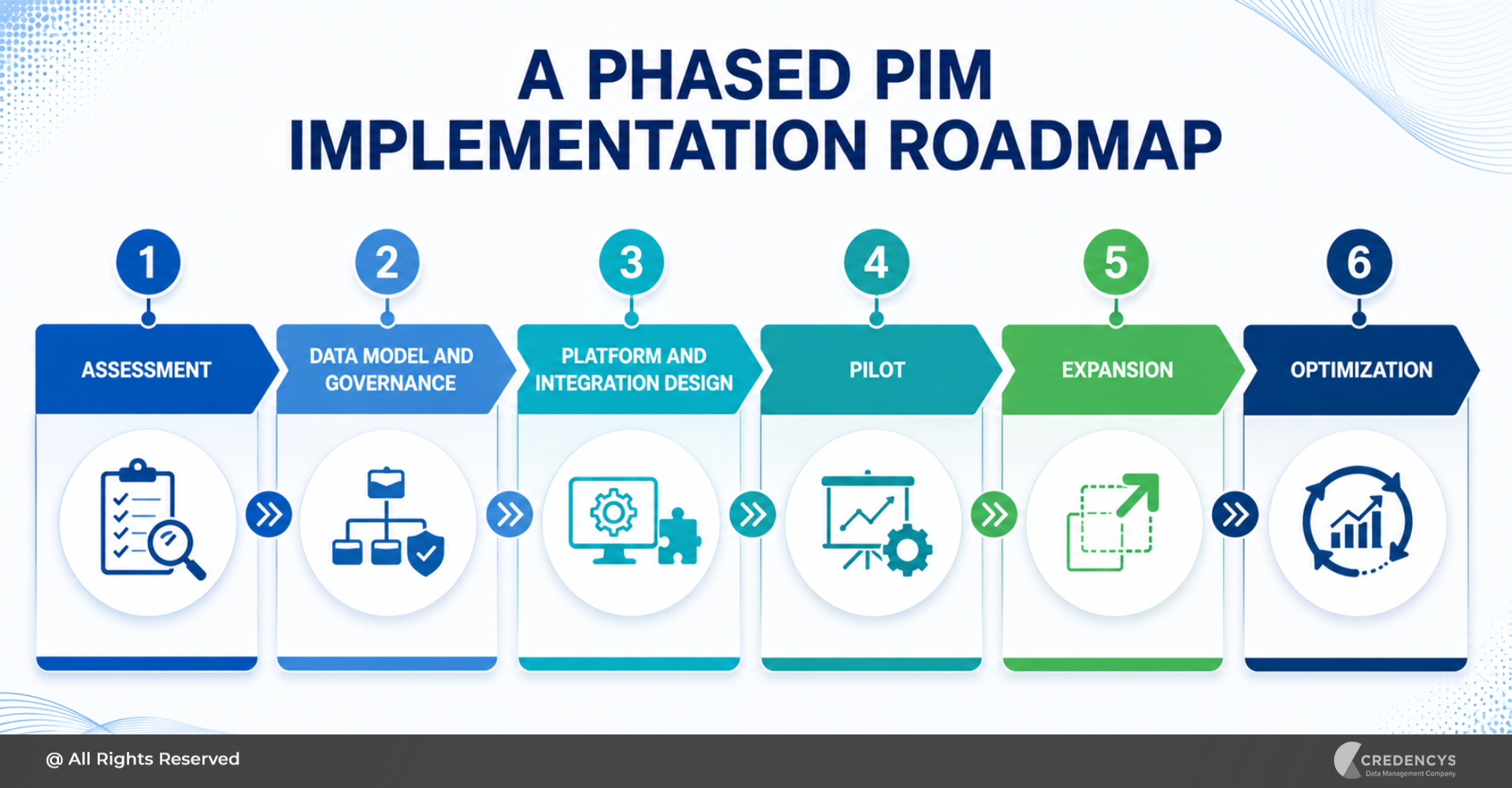
A Practical Implementation Roadmap
- Phase 1: Assessment – Audit data sources, systems, workflows, catalog quality, and business objectives.
- Phase 2: Data Model and Governance – Define attributes, classifications, standards, ownership, validation rules, and publication criteria.
- Phase 3: Platform and Integration Design – Configure the PIM and design data flows across ERP, DAM, manufacturer sources, and channels.
- Phase 4: Pilot – Launch selected product categories, manufacturers, users, and channels.
- Phase 5: Expansion – Extend the proven model to more categories, suppliers, branches, and digital experiences.
- Phase 6: Optimization – Track completeness, onboarding time, adoption, search performance, and business outcomes.
When Should an Electrical Distributor Consider PIM?
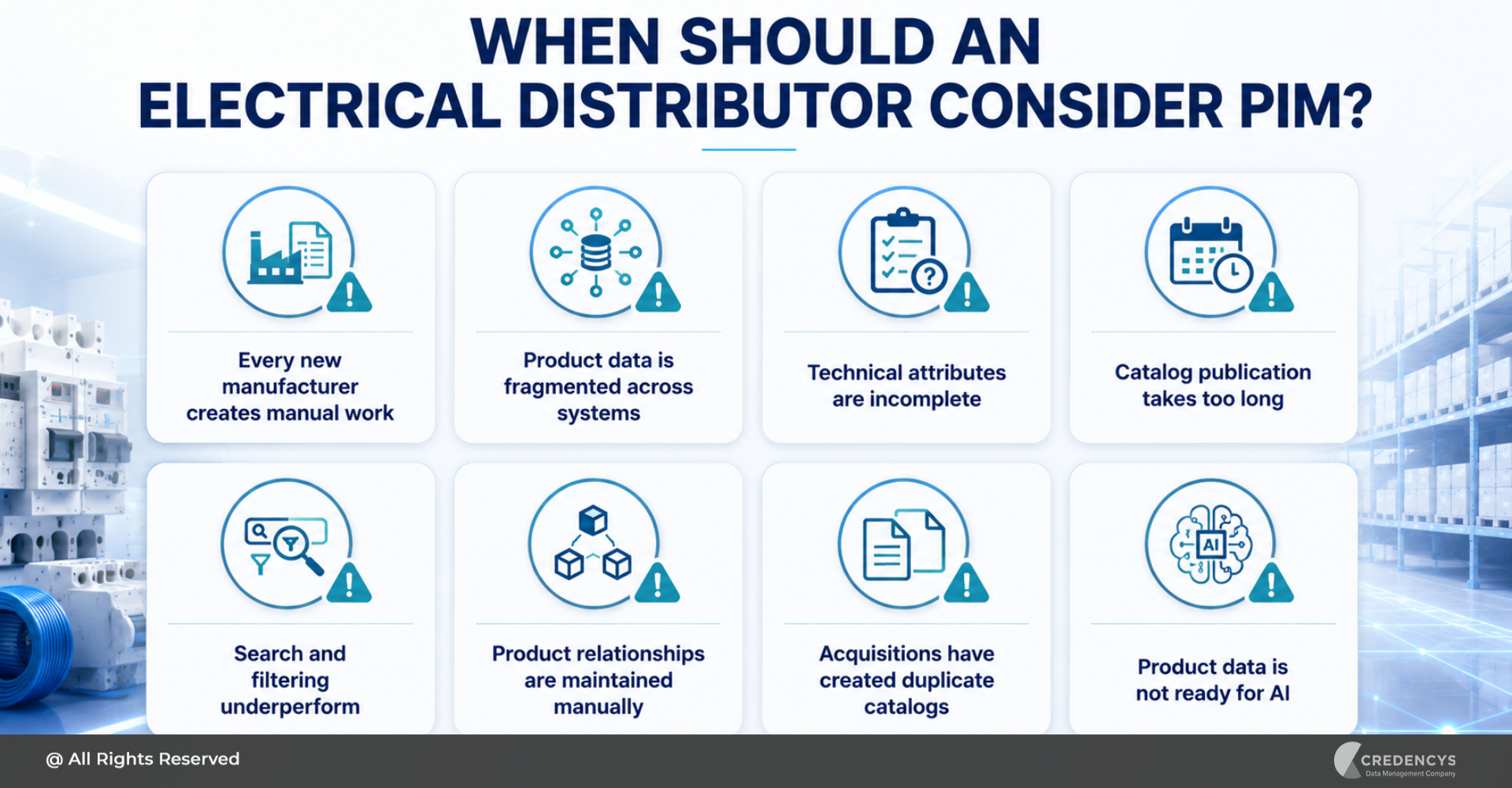
PIM should be evaluated when:
- Every new manufacturer creates extensive manual work
- Product information is fragmented across multiple systems
- ERP contains only basic product records
- Technical attributes are incomplete
- Website search and filtering underperform
- Catalog publication takes too long
- Product relationships are maintained manually
- Teams cannot identify the trusted record
- Acquisitions have created duplicate catalogs
- AI initiatives are blocked by poor product data
Not every distributor needs the same implementation scale. The right approach depends on catalog complexity, business priorities, technology architecture, and current data maturity.
How Credencys Helps Modernize Electrical Product Data
Credencys helps distributors move from fragmented product information to a governed, scalable data foundation. Our capabilities include:
- Product-data maturity assessment
- PIM strategy and platform evaluation
- Electrical product data model design
- PIM implementation and modernization
- Manufacturer data onboarding
- ETIM mapping and taxonomy management
- Data cleansing and enrichment
- ERP, DAM, and e-commerce integration
- Data quality and governance
- Search and product-discovery enablement
- AI-readiness planning
Credencys has implemented centralized product-data and workflow solutions involving complex attributes, multi-source information, ERP integration, digital assets, and multichannel distribution.
Build a Scalable Foundation for Electrical Product Information
Electrical distributors cannot scale digital catalogs through manual file correction and disconnected systems. PIM helps transform inconsistent manufacturer inputs into complete, standardized, governed, and channel-ready product information.
It improves catalog operations while creating a stronger foundation for digital commerce, integrations, acquisitions, and AI-powered product discovery. Successful implementation requires more than selecting software.
It requires a clear business case, practical data model, defined system ownership, governance, phased delivery, and measurable outcomes.







Tags: