
The Scale and Complexity of Construction Product Data
Construction product manufacturers, building-material suppliers, and distributors manage highly technical information across product families, specifications, applications, certifications, digital assets, markets, and sales channels. As portfolios expand, fragmented product data, inconsistent classifications, missing technical documentation, and frequent product changes make products harder to manage, specify, and sell.
Related: PIM for equipment manufacturers and PIM for manufacturing.
Complex Technical Product Information
Construction products require detailed attributes such as dimensions, materials, performance ratings, finishes, installation requirements, environmental conditions, compatibility, and application-specific specifications.
Fragmented Product Data and Documents
Specifications may exist in ERP and PLM, technical documents in shared repositories, BIM and CAD files in separate platforms, images in DAM, and commercial content in websites, spreadsheets, and catalogs.
Inconsistent Product Classification
Different systems and teams may classify the same products differently, making it harder to organize catalogs around construction standards, applications, product types, and specification requirements.
BIM and Digital Asset Complexity
Architects, engineers, contractors, and specifiers may require drawings, BIM objects, CAD files, datasheets, installation guides, certificates, EPDs, SDS documents, and other assets alongside structured product information.
Constant Product and Compliance Changes
Product improvements, new certifications, specification updates, discontinued items, sustainability documentation, revised installation instructions, and replacement products create continuous product-data maintenance.

How healthy is your product data?
8 questions: a score, your two weakest areas and a 30/90-day plan.
Check my product dataThe Strategic Role of PIM in Construction
PIM gives construction product manufacturers, suppliers, and distributors a governed foundation for managing technical product information across systems, product families, specification environments, markets, and sales channels. It helps standardize product data, improve specification readiness, connect technical documentation, accelerate product launches, and make construction products easier to discover and evaluate.
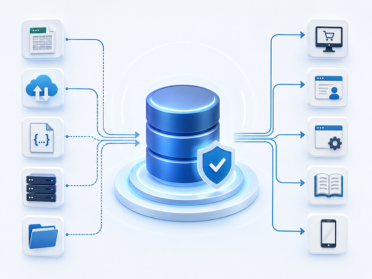
The Single Source of Truth
PIM creates one governed foundation for technical specifications, product descriptions, materials, dimensions, performance data, classifications, certifications, images, documents, and channel content. It enables product, engineering, marketing, specification, eCommerce, and sales teams to work with consistent product information.
- Consolidate product information from ERP, PLM, spreadsheets, DAM, and legacy systems
- Reduce duplicate and conflicting product records
- Maintain governed information across product families, markets, and channels

Standardized Construction Product Information
Construction categories require very different data structures. Doors, flooring, insulation, roofing, fasteners, plumbing products, electrical equipment, coatings, windows, structural materials, HVAC equipment, and other building products cannot be effectively governed through one generic attribute model.
- Define category-specific product and attribute models
- Standardize dimensions, materials, ratings, terminology, and units
- Maintain controlled values and required technical attributes

Classification and Specification Readiness
Construction products must be organized so architects, engineers, contractors, distributors, and digital platforms can understand what the product is, where it is used, and which requirements it meets. PIM provides structured classification and product properties that can support construction-industry standards and specification workflows.
- Map products to relevant construction classifications
- Support structures aligned with MasterFormat, OmniClass, or other required frameworks
- Maintain product categories, applications, properties, and specification attributes

BIM, Technical Documents, and Digital Asset Management
Structured product data alone is not enough for construction buyers and specifiers. Products may also require BIM objects, CAD drawings, technical datasheets, certificates, installation guides, warranty information, environmental documentation, images, and videos.
- Associate technical documents with the correct products and variants
- Connect BIM and CAD assets with governed product records
- Manage certificates, EPDs, SDS documents, and installation information

Digital Product Discovery and AI Readiness
Architects, contractors, distributors, and buyers increasingly research construction products digitally before contacting manufacturers or sales representatives. Structured PIM information provides richer product context for search, comparison, specification, and emerging AI applications.
- Improve technical product search and faceted filtering
- Enable product comparison based on performance and application attributes
- Support specification-oriented product discovery
Our Approach to PIM Implementation Services
From initial assessment to final deployment, we follow a proven four-step process to deliver a scalable PIM solution aligned with your construction product catalog, technical-data, specification, and digital-channel priorities.
01
Assessment and Planning
Analyze your product portfolio, technical attributes, ERP and PLM landscape, classifications, BIM and digital assets, documentation, workflows, channels, and business priorities to define a clear PIM implementation roadmap.
02
Customization and Configuration
Design construction-specific product models, categories, technical attributes, product relationships, classification structures, validation rules, workflows, user roles, asset relationships, and integrations.
03
Enrichment and Governance
Cleanse and migrate existing information, standardize technical attributes, associate product documents and BIM assets, establish ownership, and configure enrichment, validation, review, and approval workflows.
04
Deployment and Training
Launch PIM across priority product categories, business units, markets, and channels, train internal teams, monitor adoption and data quality, and provide ongoing post-deployment support.
Business Impact of PIM for Construction
PIM transforms fragmented construction product information into a governed business asset. It reduces manual data work, improves specification readiness, strengthens technical product accuracy, and makes products easier for architects, contractors, distributors, and buyers to find and evaluate.



Ready to Modernize Your Construction Product Data?
Build a trusted product-data foundation that standardizes technical specifications, connects BIM and product documentation, improves specification readiness, and makes construction products easier to discover across every channel.
Book a Free ConsultationWhy Leading Enterprises Choose Credencys?
Credencys helps enterprises turn complex data into trusted insights, intelligent operations, and measurable business growth. Here’s what makes us a preferred data and AI partner:

End-to-End Data Expertise
From data strategy to AI deployment, we cover the entire spectrum—Data Management, Engineering, Insights, and Intelligence—to ensure your data drives measurable business outcomes.

Domain-Focused Solutions
Whether you're in retail, automotive, or manufacturing, our purpose-built platforms solve industry-specific challenges with precision and speed.

Enterprise-Grade Partnerships
We collaborate with the best in the business to deliver future-ready, scalable, and secure solutions.

AI-First
We help you move beyond dashboards—accelerating AI readiness, deploying GenAI and enterprise AI agents, and enabling intelligent automation across your data ecosystem.
50+
Enterprise Clients
100%
Certified Consultants
15+
Years Experience
4.9/5
Client Satisfaction
We Build PIM Solutions for


Frequently Asked Questions
PIM for Construction is a centralized approach to collecting, structuring, enriching, governing, and distributing information about construction and building products. It helps product manufacturers, suppliers, and distributors manage technical specifications, materials, dimensions, performance attributes, classifications, certifications, product relationships, BIM assets, technical documents, images, and channel-specific content.
Construction product information is often spread across ERP, PLM, engineering databases, spreadsheets, DAM, websites, BIM libraries, PDFs, and other systems. Different teams then manually maintain specifications, descriptions, documents, classifications, and digital assets.
PIM creates a governed product-information layer where that information can be standardized and reused across specification, sales, distribution, and digital channels.
Yes. PIM can maintain mappings between products and relevant MasterFormat classifications. MasterFormat provides a standardized framework used across North American construction documentation to organize project requirements and product-related information.
PIM can manage the product-to-classification relationship but does not replace the licensed CSI standard itself.
Yes. OmniClass provides a broader construction classification framework covering multiple aspects of the built environment, including products, materials, properties, spaces, and other information. PIM can maintain relevant OmniClass references as part of the product-data model when they are required by the business.
MasterFormat primarily organizes construction work results and specification-related information. OmniClass is a broader classification framework designed to organize information throughout the built-environment lifecycle.
The appropriate classification depends on the organization’s product catalog, market, BIM requirements, customers, and downstream systems.
Yes. BIM files can be linked to products as assets, and the product attributes in the PIM can feed the data that BIM objects carry, so both stay consistent.
Yes. Certificates, declarations of performance and test reports are linked to products with their validity dates, and published to customers and partners with the product data.
Yes. A PIM can hold ETIM classes and features for building and installation products alongside MasterFormat or OmniClass, and export them to distributors.
Trusted by Best
Choosing Credencys means partnering with a team that’s deeply committed to unlocking the true value of your data. Here’s why industry leaders trust us:
Our Valued Clientele


Send us a Message
