
The Product Data Challenges Behind Growing Magento Catalogs
Magento and Adobe Commerce provide powerful commerce capabilities, but as product catalogs, suppliers, markets, and channels grow, managing product information directly within the commerce platform becomes increasingly complex. Businesses often need to coordinate product data across ERP, supplier feeds, spreadsheets, DAM, PIM, marketplaces, and Magento, creating duplication, manual effort, and inconsistent customer experiences.
Product Data Scattered Across Systems
Product attributes, descriptions, identifiers, images, specifications, pricing inputs, and supplier information may reside across ERP, spreadsheets, DAM, supplier systems, and Magento. Without a governed product-data layer, different teams can end up maintaining different versions of the same product.
Complex Product Attributes and Variants
Configurable products, parent-child relationships, categories, attributes, bundles, grouped products, and store-specific content can become difficult to govern as catalogs expand. Adobe Commerce supports multiple product types including simple, configurable, grouped, bundle, virtual, and downloadable products, making consistent product modeling increasingly important for complex catalogs.
Manual Product Enrichment
Commerce teams often spend time copying descriptions, specifications, images, attributes, categories, and other product information into Magento instead of focusing on merchandising and customer experience.
Multi-Store and Multi-Market Complexity
Different websites, store views, countries, languages, and brands may require localized product content, regional assortments, different attributes, and channel-specific information.
Slow Product Launches
Missing attributes, disconnected approvals, incomplete assets, manual data mapping, and repeated product updates can delay the time required to make products ready for Magento and other channels.

How Much is Your Product Data Costing You?
Get Your Score + 90-day action plan in 3 minutes.
Check Your ScoreThe Strategic Role of PIM in Magento & Adobe Commerce
PIM creates a governed product-data layer between upstream enterprise systems and Magento or Adobe Commerce. Instead of using the commerce platform as the primary location for product enrichment, PIM centralizes product information, applies governance and validation, and delivers approved commerce-ready data downstream.
PIM manages product truth. Magento and Adobe Commerce deliver the commerce experience.
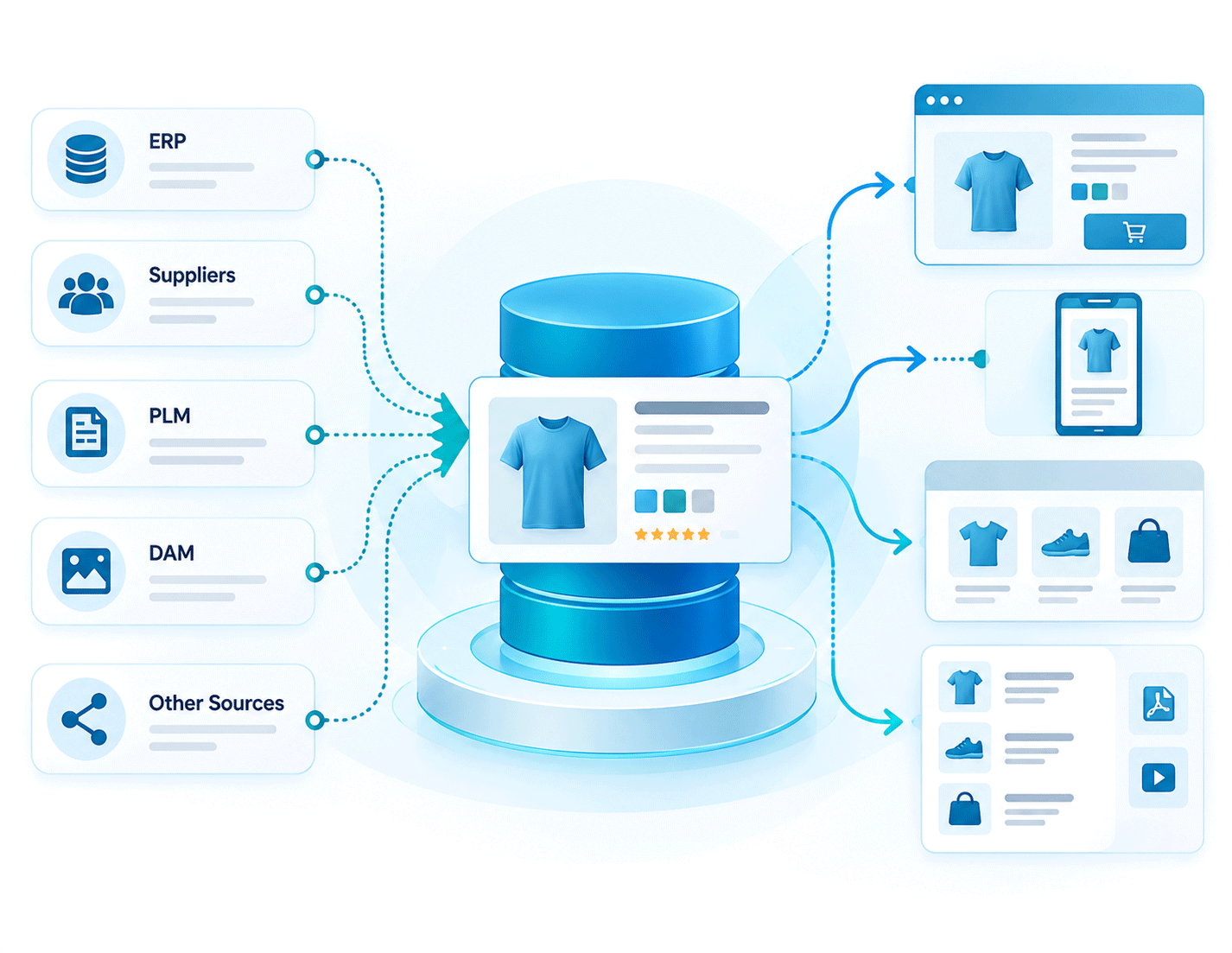
Centralized Product Information
Create a single governed foundation for product titles, descriptions, identifiers, technical specifications, categories, attributes, relationships, localization, and other product content.
- Consolidate product data from ERP, suppliers, spreadsheets, PLM, and legacy systems
- Reduce duplicate product records
- Maintain standardized attributes and values
- Deliver approved product information to Magento
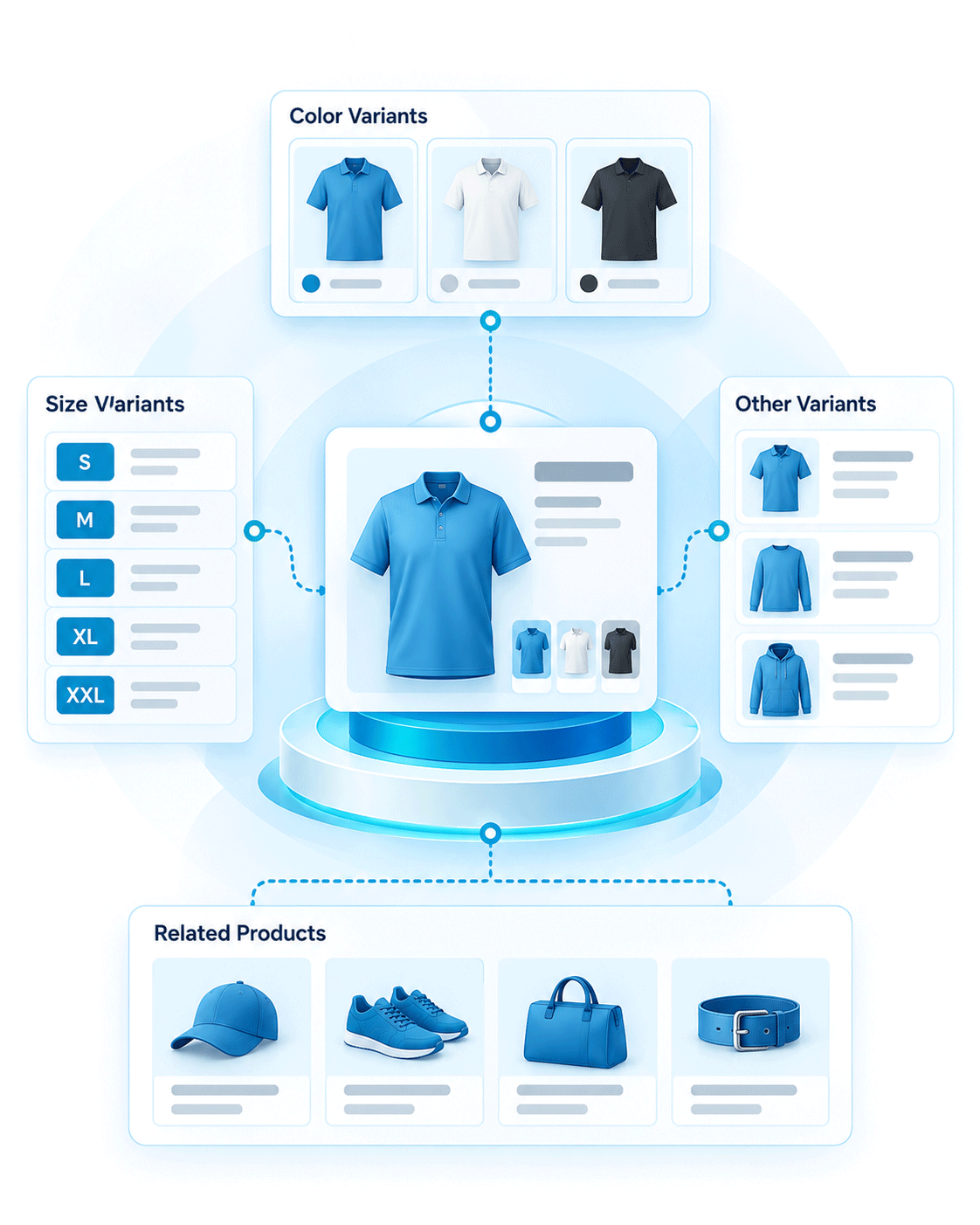
Product Variant and Relationship Management
Manage complex product structures centrally before they reach the commerce platform.
- Parent-child product relationships
- Configurable product variants
- Related products
- Accessories
- Replacement products
- Bundles
- Cross-sells and upsells
- Product families
Adobe Commerce configurable products use individual simple-product SKUs for each variation, which makes correct mapping between the PIM product model and Commerce catalog structure particularly important.
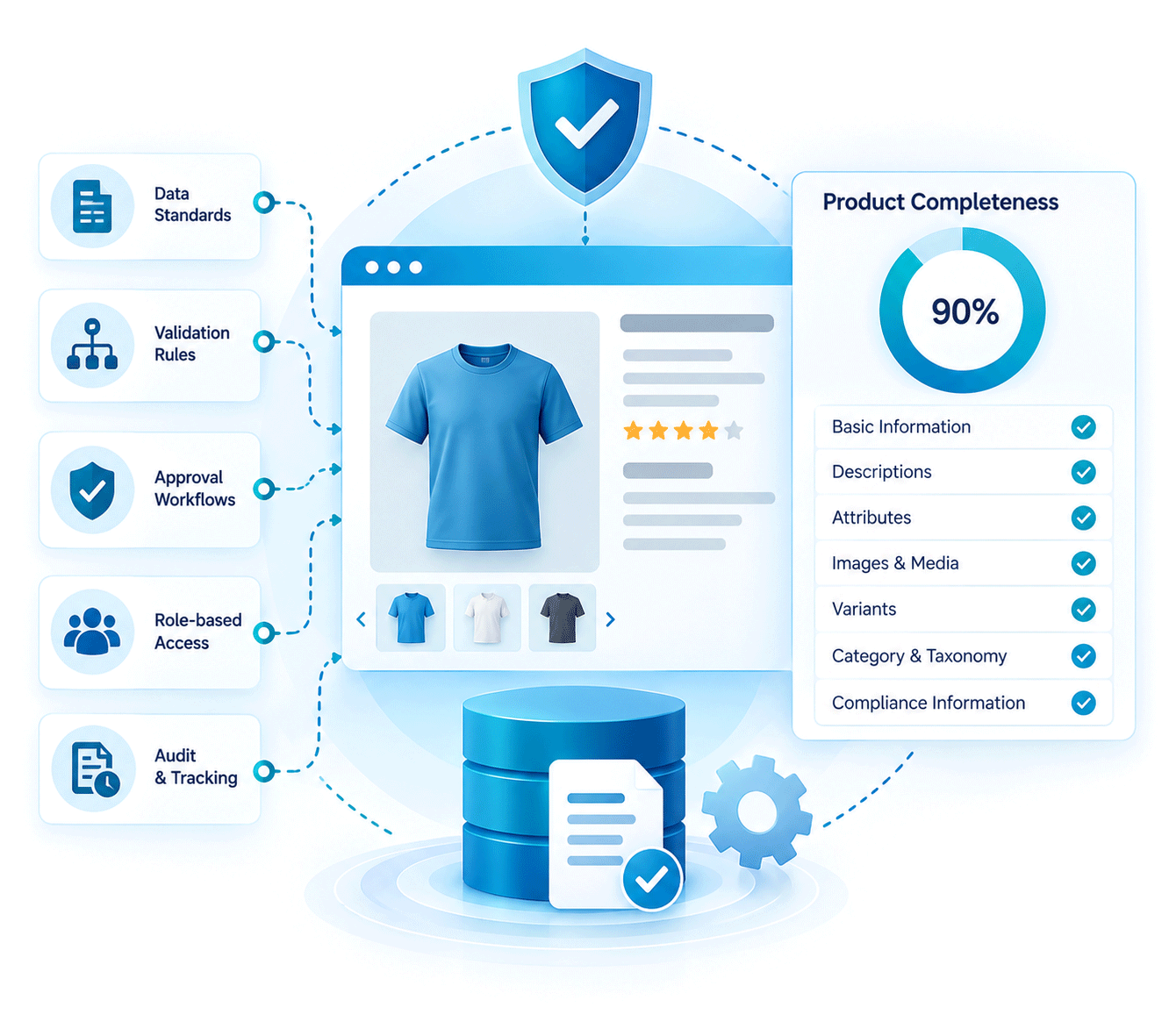
Product Completeness and Governance
Configure validation, enrichment, review, and approval workflows so incomplete or incorrect product information is identified before publication.
- Required attribute validation
- Product completeness rules
- Role-based workflows
- Approval processes
- Data-quality controls
- Channel-readiness checks
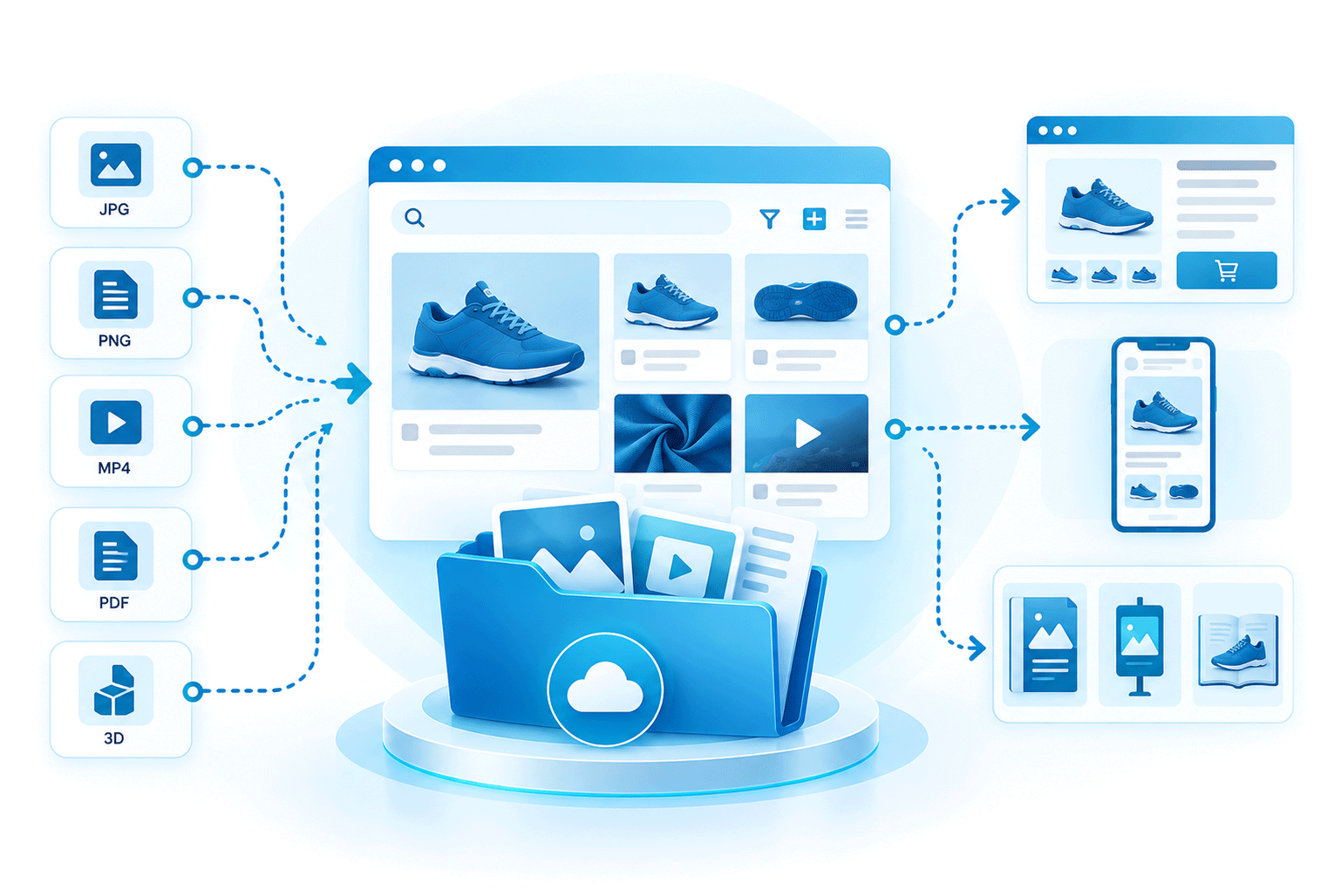
Digital Asset Management
Connect products with approved images, videos, documents, manuals, certificates, swatches, and other media assets. A PIM/DAM architecture helps ensure that the correct assets remain associated with the correct products and variants before they are synchronized with Magento.

Multi-Store Commerce Enablement
Manage a global product record while supporting store-specific information.
- Multiple Magento websites
- Multiple store views
- Languages
- Localized descriptions
- Market-specific attributes
- Regional assortments
- Brand-specific content
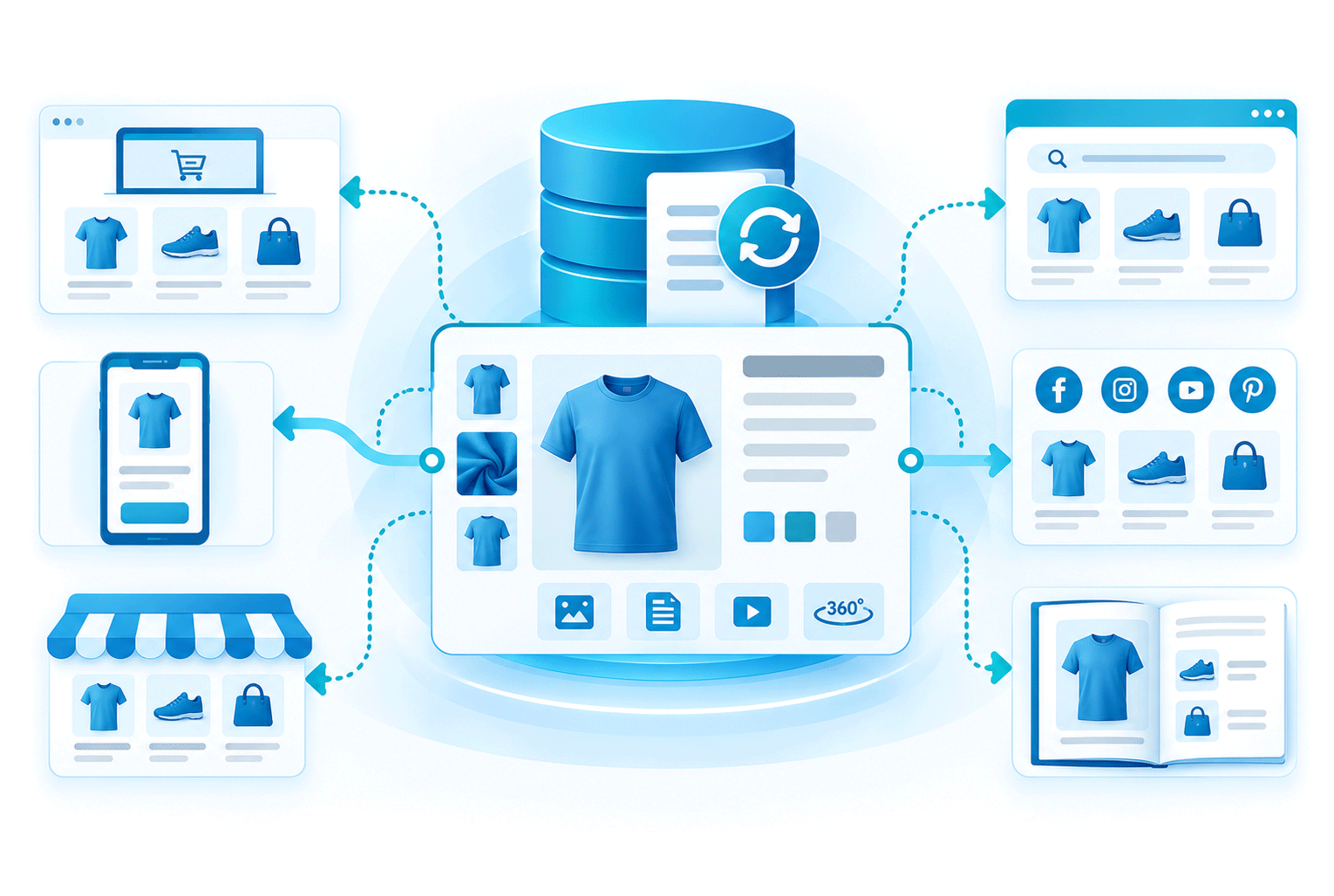
Product Content Syndication
Use the same governed product information to support Magento alongside marketplaces, retailer feeds, B2B portals, and other digital channels. Instead of maintaining a separate version of product content for every destination, PIM becomes the upstream source for channel-ready product data.
Our Magento / Adobe Commerce PIM Integration Services
As part of our broader PIM integration services, Credencys helps enterprises design, implement, and optimize Magento and Adobe Commerce integrations around their product-data architecture, catalog complexity, upstream systems, and downstream commerce requirements.
We determine:
- Which system owns each data domain
- How product information should flow
- What data should be synchronized
- Synchronization frequency
- Error-handling requirements
- Product lifecycle workflows
This can include:
- Categories
- Attribute sets
- Attributes
- Product types
- SKUs
- Variants
- Parent-child relationships
- Product associations
- Custom fields
- Localized content
Integration can support:
- New product creation
- Product updates
- Categories
- Attributes
- Product descriptions
- Product relationships
- Media references
- Store assignments
- Status changes
Synchronize approved product media from PIM/DAM into Magento.
- Product images
- Variant images
- Videos
- Documents
- Certificates
- Technical files
- Marketing assets
Depending on the implementation, this may include:
- REST APIs
- GraphQL
- Middleware
- Event-driven integration
- Message queues
- Scheduled synchronization
- Custom connectors
- Batch data processing
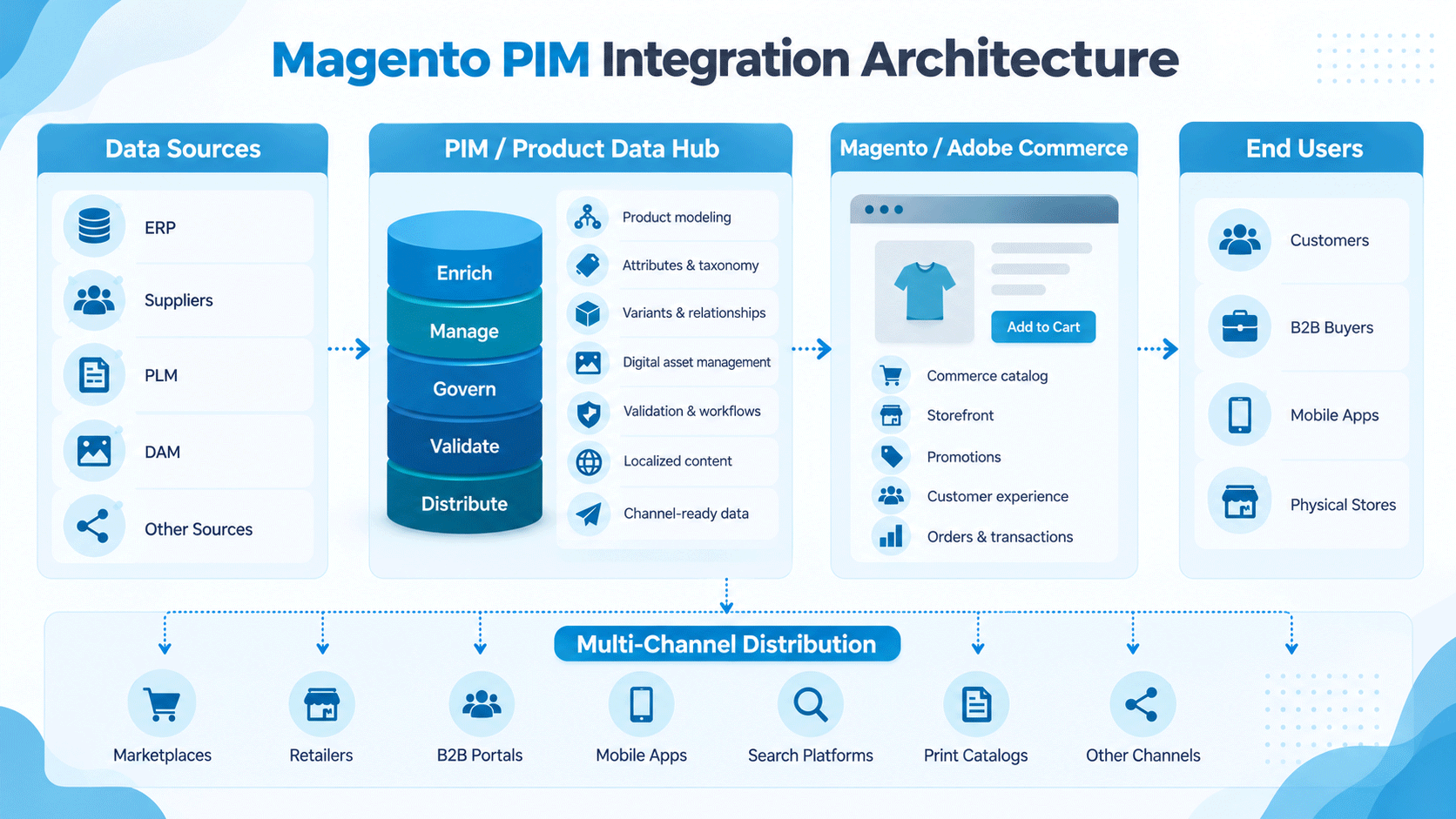
Magento PIM Integration Architecture
A well-designed architecture separates product-information ownership from commerce transactions.
How a Magento PIM Integration Works
01
Load
Product data comes into the PIM from your ERP, suppliers and existing Magento catalog.
02
Validate and enrich
The PIM checks completeness and rules, and teams add content, images and translations.
03
Map
PIM attributes, families and categories map to Magento attribute sets, attributes, categories and store views.
04
Publish
Approved products sync to Magento as simple, configurable or bundle products. Only the changes are sent.
05
Monitor
Failed products are logged and reported, so the catalog never goes out of sync silently.
Using Pimcore? Read our
Pimcore Magento integration guideProduct Data We Can Synchronize with Magento
Magento PIM integration can support a wide range of product-data domains.
Core Product Data
- SKU
- Product name
- Product descriptions
- Brand
- Product status
- Product identifiers
Categories & Attributes
- Product categories
- Attribute sets
- Specifications
- Technical attributes
- Controlled values
- Custom attributes
Product Relationships
- Parent-child relationships
- Variants
- Related products
- Accessories
- Cross-sells
- Upsells
- Replacement products
Digital Content
- Product images
- Variant images
- Videos
- Manuals
- Technical documents
- Certificates
- Rich product content
Localization
- Languages
- Localized descriptions
- Regional attributes
- Store-specific content
Commerce-Ready Content
- SEO metadata
- Product URLs
- Search attributes
- Product labels
- Merchandising content
PIM governs enriched product information. Shopify remains responsible for the commerce experience and transactional capabilities such as storefront functionality, cart, checkout, and commerce operations.
Magento Product Types We Support
The PIM data model can be mapped to the product structures used by Adobe Commerce and Magento Open Source.
Simple Products
Manage individual SKUs and their associated attributes, descriptions, assets, and relationships.
Configurable Products
Structure parent products and their individual variant SKUs based on attributes such as size, color, material, capacity, or configuration.
Grouped Products
Maintain associations between individually sellable products that are presented together within Magento.
Bundle Products
Manage product information and relationships for customizable sets composed of multiple child products.
Virtual Products
Maintain product information for non-physical items such as services, warranties, memberships, or similar offerings.
Downloadable Products
Manage descriptive product information and metadata associated with digitally delivered products.
Adobe Commerce officially supports these product types, with additional gift-card functionality available in Adobe Commerce.
Business Impact of Magento PIM Integration
Connecting Magento with a governed PIM foundation reduces the operational complexity of managing large, fast-changing product catalogs.

Faster Product Onboarding
Automate product-data intake, enrichment, validation, and synchronization to make new products commerce-ready faster.
Improved Product Data Accuracy
Reduce incorrect attributes, inconsistent values, duplicate information, and missing product content before publication.
Faster Catalog Updates
Update approved product information centrally and distribute changes to Magento without repeating manual maintenance across systems.
Reduced Manual Data Entry
Replace spreadsheet- and admin-driven product updates with governed workflows and automated synchronization.
Better Product Search & Filtering
Provide Magento with structured categories and attributes that support richer navigation, filtering, product comparison, and search experiences.
Consistent Multi-Store Content
Maintain global product information while supporting store-specific content, localization, and regional requirements.
Faster Market Expansion
Reuse governed product models and content when launching new stores, regions, languages, or commerce channels.
Improved Marketplace Readiness
Use the same PIM foundation to prepare product information for Magento as well as marketplaces and other downstream destinations.
Scalable Commerce Operations
Separate product-data enrichment from commerce operations so catalogs can grow without creating proportionate manual effort.
AI-Ready Product Information
Structured, contextual, and governed product data provides a stronger foundation for semantic search, recommendations, conversational shopping, and AI-assisted commerce.

Our Approach to Magento / Adobe Commerce PIM Integration
01 Discovery & Architecture
Assess your current Magento environment, product catalog, PIM, ERP, DAM, supplier systems, integrations, workflows, product ownership, and downstream channels. Define the target integration architecture and data-governance model.
02 Product Data Modeling & Mapping
Design categories, attributes, variants, relationships, localization structures, data mappings, transformations, and validation rules. Map PIM structures to the appropriate Magento product and attribute model.
03 Integration & Synchronization
Build and configure APIs, connectors, middleware, mapping logic, workflows, synchronization rules, and error handling. Test product creation, updates, relationships, assets, categories, and localization.
04 Validation, Deployment & Optimization
Validate product-data accuracy and performance before deployment. Monitor synchronization, failed records, data quality, scalability, and operational adoption after launch.
Common Magento PIM Integration Use Cases

Real Business Impact: Magento PIM Integration Success Stories
Global Jewelry Retailer
40%
Faster Data Syndication
Credencys implemented a centralized PIM and product-data syndication solution for Malabar Gold & Diamonds, an enterprise managing more than 4 million products across over 260 showrooms in 10 countries. The solution centralized product information and enabled syndication to the company's Magento eCommerce site, retail stores, Amazon, Flipkart, and Myntra.
Read MoreAutomotive Aftermarket Manufacturer & Distributor
3X
Faster Operations
Credencys implemented a centralized PIM solution for Rough Country, which sells through a Magento-based eCommerce platform, marketplaces, and dealer channels. The implementation centralized product and digital-asset information, integrated ERP and ACES data, automated fitment mapping, strengthened governance, and enabled product-data syndication across downstream channels.
Read MoreLeading U.S. Lighting Products Company
100K+
Products Centralized
Credencys implemented PIM and DAM for a business managing more than 100,000 lighting products and receiving product information, inventory updates, and pricing updates from over 300 vendors. The solution standardized incoming vendor information, automated data mapping, and integrated Pimcore with ERP, reporting tools, marketplaces, and the client's Magento eCommerce platform.
Read MoreWhy Integrate PIM Instead of Managing Everything Directly in Magento?
Magento and Adobe Commerce are powerful commerce platforms. PIM solves a different problem.
Capability
Magento / Adobe Commerce
Magento + PIM
Storefront & transactions
Core capability
Magento remains responsible
Product enrichment
Available
Dedicated enrichment environment
Supplier onboarding
Typically, external/manual
Centralized and standardized
Product governance
Commerce-oriented
Dedicated roles, validation and approvals
Product completeness
Requires configuration/process
Centralized completeness rules
Complex data modeling
Commerce-focused
Flexible upstream modeling
Multi-channel syndication
Commerce ecosystem
Magento + marketplaces + retailers + other channels
Localization
Centrally governed across channels
Supported
Digital assets
Commerce media management
Central PIM/DAM governance
Product-data ownership
Can become fragmented at scale
Defined centralized product-data layer
PIM should complement Magento, not duplicate its transactional and storefront responsibilities.
When Should You Integrate PIM with Magento?
A dedicated PIM becomes particularly valuable when:
- Your Magento product catalog is growing rapidly
- Product information comes from multiple systems
- Several suppliers provide product data
- Teams maintain product information in spreadsheets
- Product attributes and variants are becoming difficult to govern
- You operate multiple Magento stores or markets
- Products are sold through Magento and marketplaces
- Product launches take too long
- Product content requires extensive localization
- Digital assets are disconnected from product records
- Commerce teams spend excessive time maintaining catalog data
- Product information differs across channels
- Magento is becoming the unintended master system for enterprise product data
If several of these conditions apply, the problem is often no longer simply Magento catalog management, it is product information architecture.
Assess Your Magento PIM Architecture
Why Choose Credencys for Magento PIM Integration?
Credencys combines product-information management expertise with enterprise integration experience to solve complex product-data challenges across commerce ecosystems.

End-to-End Data Expertise
From data strategy to AI deployment, we cover the entire spectrum—Data Management, Engineering, Insights, and Intelligence—to ensure your data drives measurable business outcomes.

Domain-Focused Solutions
Whether you're in retail, automotive, or manufacturing, our purpose-built platforms solve industry-specific challenges with precision and speed.

Enterprise-Grade Partnerships
We collaborate with the best in the business to deliver future-ready, scalable, and secure solutions.

AI-First
We help you move beyond dashboards—accelerating AI readiness, deploying GenAI and enterprise AI agents, and enabling intelligent automation across your data ecosystem.
50+
Enterprise Clients
100%
Certified Consultants
15+
Years Experience
4.9/5
Client Satisfaction
Frequently Asked Questions
Magento PIM integration connects Magento or Adobe Commerce with a Product Information Management system so product information can be collected, enriched, governed, and approved centrally before being synchronized with the commerce platform. PIM typically manages enriched product data, while Magento remains responsible for commerce and storefront functionality.
PIM becomes valuable when product information comes from multiple systems, catalogs become complex, multiple teams enrich products, or product data needs to be published across Magento and other channels. It reduces repeated catalog maintenance and gives teams one governed product-data foundation.
Magento and Adobe Commerce are commerce platforms designed to manage storefront experiences, catalogs, promotions, customers, carts, checkout, and transactions. PIM is designed specifically to collect, structure, enrich, govern, validate, and distribute product information.
The two systems complement each other.
Yes. For smaller or relatively simple catalogs, Adobe Commerce can manage product information directly.
A dedicated PIM becomes more valuable when catalogs contain large numbers of products, complex variants and attributes, multiple suppliers, multiple markets, several enrichment teams, or multiple downstream channels.
Common indicators include:
- Large or rapidly growing catalogs
- Complex product attributes
- Numerous variants
- Multiple suppliers
- Product data spread across systems
- Multiple Magento stores
- Marketplace distribution
- Manual enrichment processes
- Localization requirements
- Slow product launches
Third-party connectors exist. Whether one fits depends on your product types, store views and other systems. We assess the options and build a custom integration where a connector falls short.
A focused first release typically takes 3 to 6 months; larger multi-store programmes run in phases over 6 to 12 months or more.
Ready to Simplify Product Data Across Magento & Adobe Commerce?
Build a governed product-data foundation that centralizes enrichment, automates Magento catalog updates, improves data quality, and supports growth across stores, markets, marketplaces, and emerging commerce channels.
Talk to a Magento PIM ExpertTrusted by Best
Choosing Credencys means partnering with a team that’s deeply committed to unlocking the true value of your data. Here’s why industry leaders trust us:
Our Valued Clientele


Send us a Message
