


Short answer: Choose Stibo Systems STEP if you are a large enterprise that needs governed master data across products, customers, suppliers, and locations, as a SaaS service. Choose Pimcore if you want PIM, MDM, and DAM in one flexible, open-core platform, with control over the data model, hosting, and cost.
Pimcore and Stibo Systems STEP both go beyond PIM into master data management, which is why they are often compared for complex, multi-domain programs. They differ in architecture, flexibility, cost model, and the type of organization they suit best.
Disclosure: Credencys is a Pimcore Strategic Partner (80+ certified Pimcore experts) and a Syndigo partner. We also advise on platforms we don’t implement and recommend them when they are a better fit.
Pimcore vs Stibo STEP at a Glance
| Pimcore | Stibo Systems STEP | |
|---|---|---|
| Type | Open-core platform: PIM, MDM, DAM, DXP/CMS, commerce | Enterprise multidomain MDM and PIM platform |
| Deployment | Self-hosted, private cloud or Pimcore PaaS | SaaS on Microsoft Azure; quarterly releases (2026.x) |
| Data domains | Any domain, in one flexible model | Product, customer, supplier, location and asset domains |
| Strengths | Flexibility, custom experiences, integrated DAM, control over cost | Enterprise governance, matching and data quality across domains |
| Customisation | Extensive (PHP/Symfony), developer-led | Configuration within the STEP platform |
| Typical buyers | Mid-market to enterprise manufacturers, distributors, retailers | Large global enterprises with mature data governance |
| Pricing model | Open core: free Community Edition under conditions; paid editions | Quote-based enterprise subscription |
What Is Pimcore?
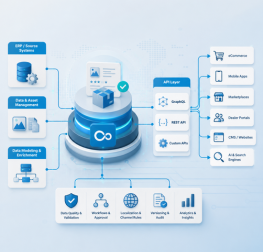
Pimcore is an open-core data and experience platform on PHP and Symfony. It combines PIM, MDM, DAM and a digital experience platform, so product data, assets and websites or portals run on one data model.
Pimcore is open core: since version 2025.1 it ships under the Pimcore Open Core License (POCL). The Community Edition is free for non-production use, academic and non-profit organizations, and companies with annual revenue under EUR/USD 5 million; other companies need a paid Professional, Enterprise, or PaaS edition.
What Is Stibo Systems STEP?
Stibo Systems STEP is an enterprise master data management platform with strong PIM capabilities. It manages product, customer, supplier, location, and asset data with matching, survivorship, and data quality, and is delivered as a SaaS service on Microsoft Azure with quarterly releases.
See our Stibo STEP implementation consulting. Still comparing vendors?
Our PIM platform selection service gives you an independent recommendation, and the PIM platform comparison matrix compares ten platforms across 40 criteria.
Key Differences Between Pimcore and Stibo STEP
1. Scope and depth of MDM
Both are multi-domain. STEP is built around enterprise MDM processes, such as cross-domain matching and survivorship. Pimcore offers MDM in a flexible framework that you configure and extend.
2. Flexibility and experiences
Pimcore’s data model and DXP make it easy to build custom portals, websites, and apps on the same data. STEP focuses on the master data itself and integrates with separate experience platforms.
3. Deployment and operations
STEP is SaaS, so Stibo runs the infrastructure and updates. Pimcore can be self-hosted or run on Pimcore PaaS, which gives more control but more responsibility.
4. Cost model
STEP is a quote-based enterprise subscription. Pimcore’s license is usually a smaller part of total cost; implementation and hosting matter more.
5. Time to value
Both are enterprise implementations. Pimcore projects can start small and grow; STEP programs often start larger because they span several domains.
Feature-by-Feature Comparison
Our ratings on the 40 criteria in the PIM platform comparison matrix (Strong, Good, Partial or add-on, Not offered), based on public information and our project experience, October 2026.
| Area | Criterion | Pimcore | Stibo STEP |
|---|---|---|---|
| Data model | Flexible attributes and families | Strong | Strong |
| Variants and configurable products | Strong | Strong | |
| Relationships and bundles | Strong | Strong | |
| Languages and markets | Strong | Strong | |
| Complex B2B and technical data | Strong | Strong | |
| Workflow and governance | Approval workflows | Strong | Strong |
| Completeness rules | Good | Good | |
| Data validation | Good | Strong | |
| Roles and permissions | Strong | Strong | |
| Versioning and audit trail | Strong | Strong | |
| Digital assets | Built-in DAM | Strong | Good |
| Asset-to-product linking | Strong | Good | |
| Asset renditions | Strong | Good | |
| Rich media and enhanced content | Good | Partial / add-on | |
| External DAM integration | Good | Good | |
| Syndication and channels | Retailer and marketplace syndication | Partial / add-on | Good |
| GDSN data pools | Partial / add-on | Strong | |
| Channel-specific content | Strong | Good | |
| eCommerce connectors | Good | Good | |
| Print and catalog output | Good | Good | |
| Integration and APIs | REST API | Strong | Good |
| GraphQL API | Strong | Partial / add-on | |
| Import and export tools | Strong | Strong | |
| ERP integration | Good | Strong | |
| Events and webhooks | Good | Good | |
| Automation and AI | AI attribute extraction and classification | Good | Good |
| Automation rules | Strong | Strong | |
| AI included in license vs paid credits | Good | Good | |
| AI agent / LLM API access | Good | Good | |
| Ease of use for business users | Good | Partial / add-on | |
| Deployment and security | SaaS option | Good | Good |
| Self-hosted or private cloud | Strong | Strong | |
| Open source | Partial / add-on | Not offered | |
| Typical time to first release | Good | Partial / add-on | |
| Scale for large catalogs | Strong | Strong | |
| Vendor and ecosystem | Implementation partner network | Good | Good |
| App and connector marketplace | Partial / add-on | Partial / add-on | |
| Supplier onboarding | Good | Strong | |
| Master data beyond products | Strong | Strong | |
| Digital shelf analytics | Partial / add-on | Partial / add-on |
Implementation: What to Expect
- Pimcore: Pimcore projects need a data model designed for your products, developers or a partner for configuration and integrations (Data Hub, bundles), and a hosting decision: self-hosted, your cloud or Pimcore PaaS.
- Stibo STEP: STEP programs usually span several data domains, with matching and survivorship rules, data stewardship roles and enterprise integrations; they are run as multi-phase programs.
- For both: start with a few weeks of discovery and a data audit, design the data model before configuring screens, and plan integrations (ERP, eCommerce, DAM, channels) early.
- Timeline: A focused first release typically takes 3 to 6 months; larger programs run in phases over 6 to 12 months or more.
Talk to us about PIM implementation or moving between platforms.
How They Are Priced
Both are bought differently, so compare pricing models and total cost of ownership, not a single number.
| Pimcore | Stibo STEP | |
|---|---|---|
| Licence model | Open core (POCL): free Community Edition under conditions; paid Professional, Enterprise and PaaS editions | Enterprise subscription (SaaS), quote-based |
| What drives the price | Edition, hosting, support level, plus implementation | Data domains, data volume, modules and environments |
| Free option | Yes: Community Edition, for eligible organizations | No |
Implementation, integrations, data migration, and support usually cost more than the first year’s license. Size your project with the PIM Cost & Business Case Builder.
See Pimcore pricing explained for the editions and what each costs.
Which One Do You Need?
Choose Stibo STEP if
- You are a large enterprise with mature data governance across several domains.
- Matching and survivorship of customer, supplier, and location data are central.
- You want an enterprise SaaS platform run by the vendor.
Choose Pimcore if
- You need flexible product data plus DAM and digital experiences on one platform.
- You want control over hosting, customization and total cost.
- You want to start with PIM and add MDM domains over time.
Results from our projects
- Global industrial solutions leader: 85% better data accuracy, 70% less manual work
- US wholesale distributor: Pimcore upgrade, 40% faster backend processing
Frequently Asked Questions
What is the difference between Pimcore and Stibo STEP?
Stibo STEP is an enterprise multidomain MDM and PIM platform delivered as SaaS, with strong cross-domain governance. Pimcore is an open-core platform that combines PIM, MDM, DAM, and digital experiences, valued for its flexibility and control.
Is Stibo STEP SaaS?
Yes. Stibo Systems delivers STEP as a cloud-native SaaS service on Microsoft Azure, with releases identified by year and quarter, such as 2026.3.
Is Pimcore cheaper than Stibo STEP?
The license is usually lower, and eligible organizations can use the free Community Edition. Total cost depends more on implementation, hosting, and support, so compare the full cost of ownership for your scope.
Which is better for multi-domain MDM?
Stibo STEP is built for enterprise multi-domain MDM with deep matching and governance. Pimcore supports multiple domains in a flexible model and suits companies that want PIM, MDM and DAM together.
How long do Pimcore and Stibo STEP implementations take?
A focused first release typically takes 3 to 6 months; larger programs run in phases over 6 to 12 months or more. Multidomain MDM programs usually run in phases by domain.





Tags: