


A Definitive Guide to Product Information Management (PIM) for Fashion Retail
Fashion product data becomes complex quickly. A single style can expand into multiple colors, sizes, fits, materials, markets, and sellable SKUs. Each variation may require its own identifiers, imagery, attributes, size information, availability context, and channel-specific content.
At the same time, product information may originate from PLM, ERP, suppliers, spreadsheets, DAM, and other systems before it reaches eCommerce platforms, marketplaces, retailers, stores, and regional websites. Product Information Management (PIM) provides fashion brands, retailers, manufacturers, and distributors with a structured way to manage this complexity.
It creates a governed product-data foundation where fashion teams can organize styles and variants, standardize supplier information, enrich product content, connect digital assets, validate completeness, and distribute approved information across channels. Organizations evaluating a complete product-data solution can also explore Credencys’ PIM for Fashion offering.
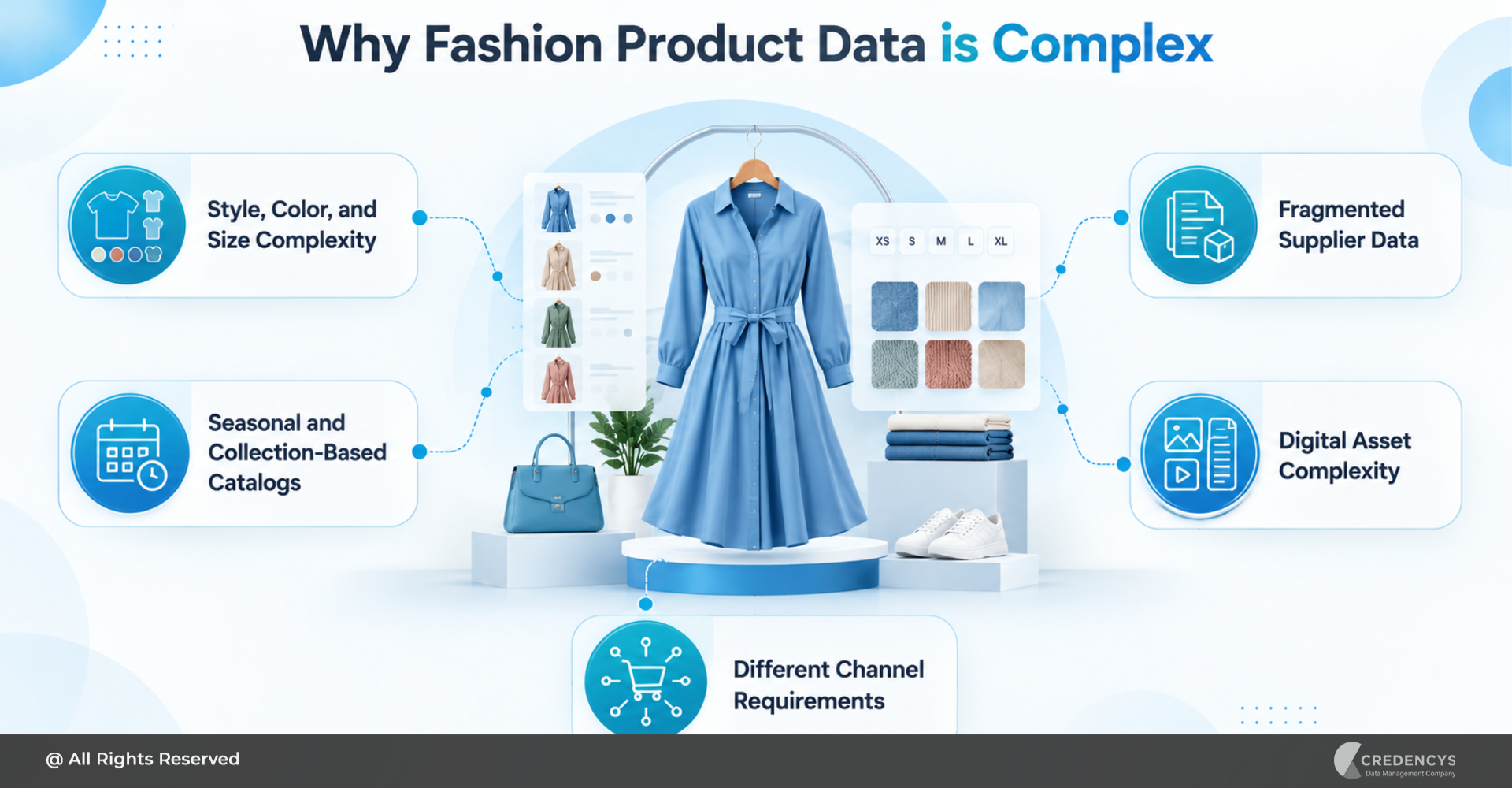
Why Fashion Product Data is Complex
Fashion businesses do not simply manage individual products. They manage interconnected product structures that change continuously across seasons, collections, suppliers, markets, and channels.
A typical fashion catalog may include:
- Styles
- Colorways
- Sizes
- Fits
- Materials
- Fabric compositions
- Collections
- Seasons
- Product families
- Related accessories
- Digital assets
- Market-specific descriptions
- Marketplace attributes
- Localized content
- Product identifiers
- Care information
Managing these relationships becomes increasingly difficult as product volume grows. Several product-data challenges are particularly common in fashion.
Style, Color, and Size Complexity
One style may be available in five colors and ten sizes, creating 50 individual sellable SKUs. Maintaining every SKU as an isolated record creates unnecessary duplication and makes updates difficult.
Fashion businesses need a product-data model that understands relationships between the core style and its variants.
Seasonal and Collection-Based Catalogs
Fashion assortments change frequently. Businesses may simultaneously manage:
- Current collections
- Upcoming collections
- Carryover products
- Seasonal ranges
- Capsule collections
- Collaborations
- Regional assortments
- Discontinued styles
Product information must remain accurate as products move through these different lifecycle stages.
Fragmented Supplier Data
Product information may arrive from factories, vendors, brands, and suppliers in spreadsheets, CSV files, APIs, PDFs, portals, or other formats. Different suppliers may describe the same information differently.
For example, one supplier may use:
- Navy
while another uses:
- Dark Blue
- Midnight
- Navy Blue
Without standardization, inconsistent values quickly affect filtering, search, reporting, and channel feeds.
Digital Asset Complexity
Fashion is highly visual. A product may require:
- Product photography
- Model imagery
- Color-specific images
- Detail photography
- Swatches
- Videos
- Size charts
- Care guides
- Campaign assets
- Lookbook imagery
Those assets must remain associated with the correct style, colorway, and sometimes individual SKU.
Different Channel Requirements
Each destination may expect product information in a different structure. An eCommerce site, marketplace, wholesale portal, retailer, social-commerce channel, and regional website may each require different:
- Categories
- Attributes
- Titles
- Descriptions
- Images
- Character limits
- Identifiers
- Variant structures
- Localization
Maintaining these requirements independently creates significant manual work.
What is Fashion PIM?
Fashion PIM is the use of a Product Information Management platform to centralize, structure, enrich, govern, and distribute product information for fashion and apparel products. Instead of storing separate versions of product information for every channel, PIM creates a governed master of enriched product content.
Depending on the organization, this may include:
- Product names
- Marketing descriptions
- Style information
- Colors
- Sizes
- Fits
- Material composition
- Care instructions
- Collections
- Seasons
- Product relationships
- Categories
- Taxonomies
- Identifiers
- Digital-asset references
- Localized content
- Channel-specific attributes
PIM isn’t just for storing information. It provides processes for ensuring product information is complete, standardized, approved, and ready for downstream systems.
For a broader introduction to the technology, read What is PIM (Product Information Management).
How Fashion PIM Structures Styles, Colorways, Sizes, and SKUs
One of Fashion PIM’s most important capabilities is modeling product relationships properly. Rather than duplicating every piece of information across every SKU, PIM can structure a fashion product hierarchy.
A simplified model may look like this:
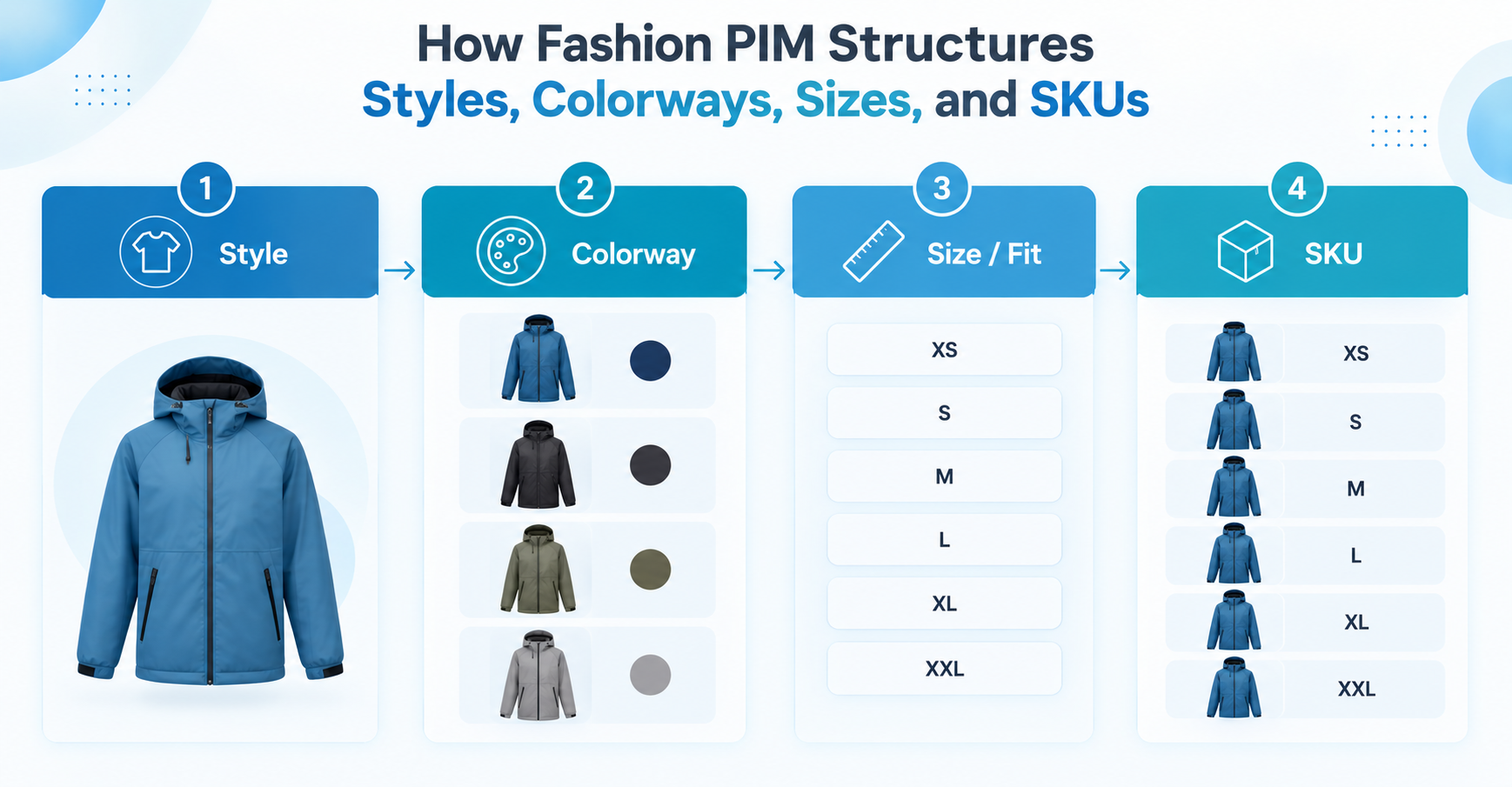
You can then maintain different information at the appropriate level.
Style-Level Information
Information shared by the complete product family may include:
- Product name
- Brand
- Collection
- Season
- Category
- Material composition
- General product description
- Care information
- Product family
Colorway-Level Information
Information specific to a particular color or pattern may include:
- Color name
- Color code
- Swatch
- Pattern
- Color-specific description
- Color-specific imagery
- Campaign photography
SKU-Level Information
The sellable SKU may contain information such as:
- Size
- Fit
- Length
- SKU number
- GTIN
- Dimensions
- Weight
- Market-specific identifiers
This structure lets common information be inherited instead of maintained repeatedly across every variant. If the material composition changes at the style level, for example, teams do not need to manually update dozens of separate SKU records.
Key Fashion Product Data PIM Should Manage
The exact information structure varies by business model and category, but a Fashion PIM commonly manages several groups of product information.
Core Product Information
This may include:
- Product names
- Product descriptions
- Brands
- Categories
- Collections
- Seasons
- Product types
- Gender or audience
- Product relationships
Variant Information
Fashion PIM may structure attributes such as:
- Color
- Size
- Fit
- Length
- Pattern
- Material
- Finish
- Style
- Width
Material and Composition Data
Depending on the category, businesses may maintain:
- Fabric
- Fiber composition
- Material percentages
- Lining
- Trim
- Filling
- Sole material
- Care instructions
- Country of origin
Merchandising Content
Marketing and merchandising teams may enrich products with:
- Long descriptions
- Short descriptions
- Feature highlights
- Styling recommendations
- Collection stories
- Product benefits
- Related products
- Cross-sell relationships
Digital Asset References
PIM can connect products with assets stored in a DAM or another media repository, including:
- Product imagery
- Videos
- Swatches
- Size charts
- Documents
- Lookbooks
- Campaign media
Channel-Specific Information
Different downstream destinations can receive:
- Marketplace-specific titles
- Retailer-specific attributes
- Localized descriptions
- Channel categories
- Regional content
- Required identifiers
This enables businesses to maintain a trusted global record while supporting destination-specific requirements.
PIM vs. PLM vs. ERP vs. DAM in Fashion
Fashion businesses often already use several systems that contain product-related information. PIM should not replace all of them.
Each platform should remain authoritative for the type of information it manages best.
| System | Primary Role |
|---|---|
| PLM | Product design, development, sourcing, materials, samples, and lifecycle information |
| ERP | Purchasing, financials, inventory, pricing, and transactional information |
| DAM | Authoritative images, videos, documents, and other digital assets |
| PIM | Governed, enriched, and channel-ready product information |
| Commerce Platform | Customer-facing shopping experience and transactions |
PLM and PIM
PLM generally manages the development phase of a fashion product. It may contain information about:
- Design
- Materials
- Technical specifications
- Samples
- Sourcing
- Product development
- Manufacturing
Once that information is approved, relevant product data can flow into PIM for commercial enrichment. PIM adds the content required to market, discover, compare, and sell the finished product.
ERP and PIM
ERP usually remains authoritative for transactional information such as:
- Purchasing
- Financial information
- Inventory
- Cost
- Pricing
- Orders
PIM can consume selected ERP information where downstream channels require it, but it should not become the master system for fast-changing transactional data.
DAM and PIM
DAM manages authoritative media. PIM provides the product context required to connect those assets to the appropriate style, colorway, SKU, collection, or channel.
Together, PIM and DAM can provide downstream commerce systems with both structured product information and the correct digital media.
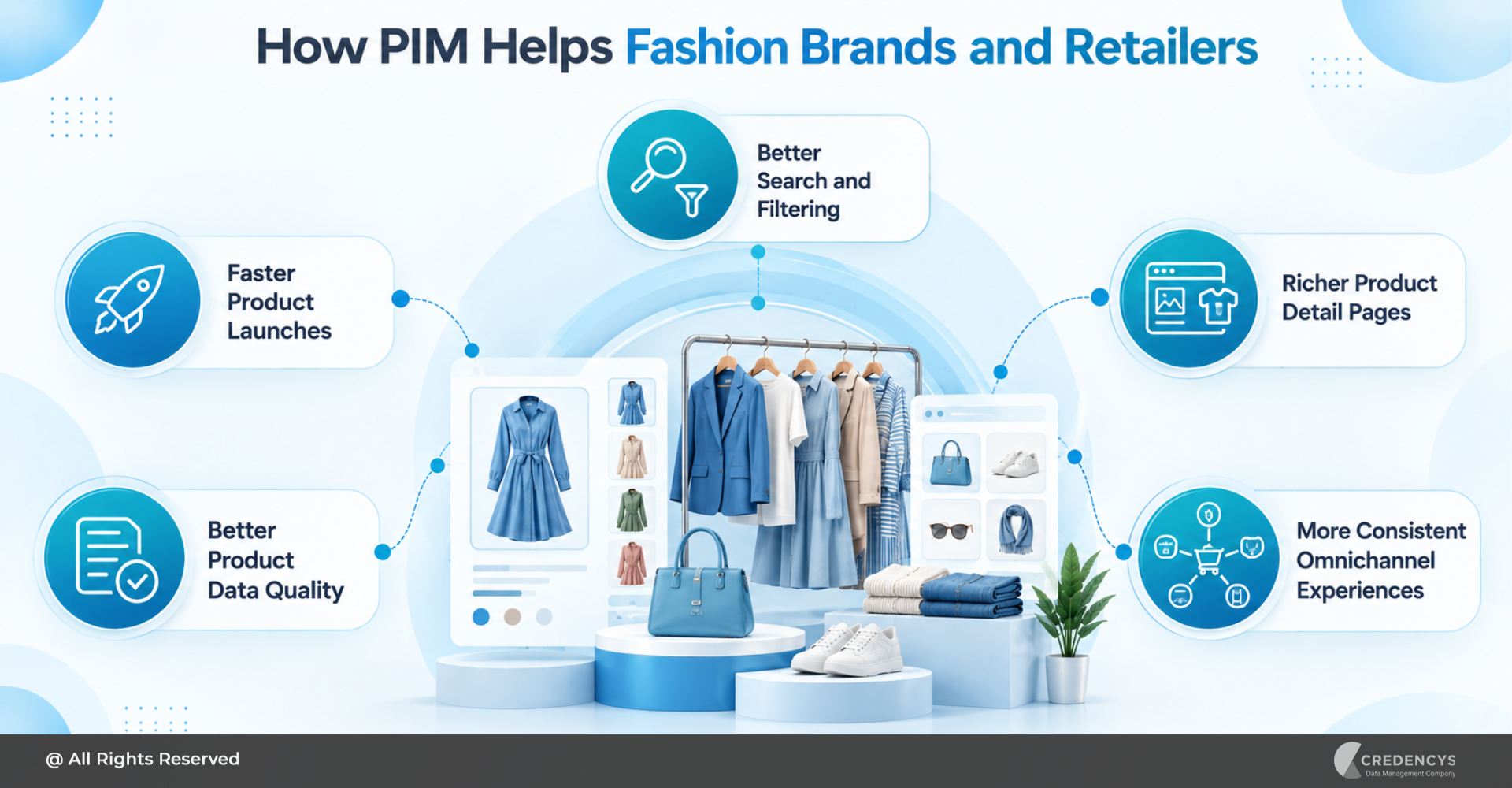
How PIM Helps Fashion Brands and Retailers
When implemented correctly, PIM improves the way teams prepare and distribute product information. For a deeper look at these outcomes, explore the Benefits of PIM for Fashion.
Faster Product Launches
Fashion launch windows are often short. Teams may need to prepare hundreds or thousands of products for a seasonal launch.
PIM can reduce manual work by providing:
- Bulk enrichment
- Validation rules
- Completeness tracking
- Approval workflows
- Reusable product structures
- Channel mappings
Instead of discovering missing information shortly before launch, teams can identify incomplete products earlier.
Better Product Data Quality
Different systems and suppliers frequently use different terminology. PIM allows businesses to establish:
- Controlled values
- Required attributes
- Validation rules
- Standardized units
- Data ownership
- Approval processes
This reduces conflicting and incomplete product information.
Better Search and Filtering
Fashion shoppers commonly refine products using characteristics such as:
- Size
- Color
- Fit
- Material
- Style
- Category
- Pattern
- Collection
These experiences depend on structured product attributes. If one product is tagged “navy,” another “dark blue,” and another “midnight,” product filtering becomes less reliable.
PIM helps normalize these values so search and navigation systems receive consistent information.
Richer Product Detail Pages
Product pages can combine structured data with merchandising content such as:
- Descriptions
- Product features
- Size information
- Care instructions
- Swatches
- Product photography
- Videos
- Related products
This helps customers evaluate products with greater confidence.
More Consistent Omnichannel Experiences
Without PIM, companies may maintain information separately across eCommerce, marketplaces, retail feeds, and internal systems. PIM lets these channels pull approved product information from a governed source.
That reduces inconsistencies between channels.
Supplier Product Data Onboarding in Fashion
Supplier product data is one of the most operationally challenging areas for fashion organizations. Each supplier may use different:
- Field names
- Categories
- Units
- Attribute structures
- Color terminology
- Size conventions
- File formats
PIM can provide a controlled onboarding process.
Step 1: Ingest Supplier Information
Data may be received through:
- Excel
- CSV
- XML
- APIs
- Supplier portals
- Databases
- Structured feeds
Step 2: Map Supplier Attributes
Map incoming fields to the organization’s standardized PIM data model. For example:
Supplier field: Fabric Type
→ PIM attribute: Material
Supplier field: Colorway
→ PIM attribute: Color
Step 3: Normalize Values
Map supplier terminology to standardized values. For example:
Midnight Blue
Dark Navy
Navy Blue
can all be normalized to an approved value where appropriate.
Step 4: Validate Completeness
PIM can check whether required product information is available. A jacket, for example, may require:
- Material
- Color
- Size
- Fit
- Care instructions
- Product imagery
- Description
Products missing required information can be prevented from reaching downstream channels.
Step 5: Enrich and Approve
Merchandising, marketing, product, or eCommerce teams can enrich the information and route it through defined review and approval processes.
Fashion PIM and Omnichannel Commerce
Fashion brands increasingly sell through multiple destinations. These may include:
- Brand eCommerce sites
- Online marketplaces
- Department stores
- Wholesale portals
- Physical stores
- Social-commerce platforms
- Mobile applications
- Regional websites
Each destination may require a different version of the product record. One marketplace may require a specific set of fashion attributes.
Another retailer may use its own category hierarchy. A brand’s own eCommerce site may require richer storytelling, styling content, and collection relationships.
PIM lets businesses maintain one governed core record while creating channel-specific extensions as needed. This lets teams reuse trusted product information instead of recreating every channel feed manually.
For a deeper look at this use case, read our guide to Fashion PIM for Omnichannel Marketing.
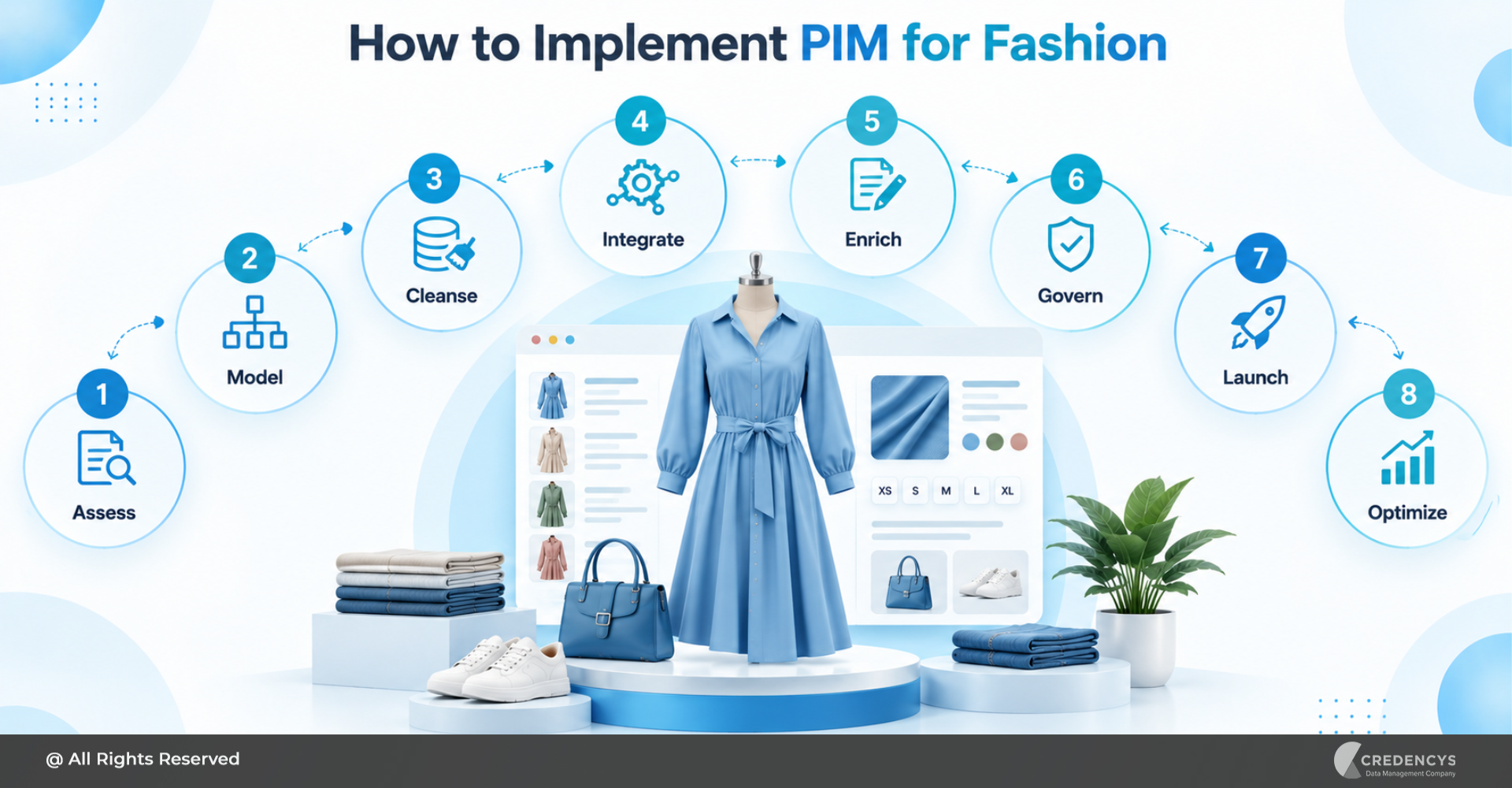
How to Implement PIM for Fashion
Successful Fashion PIM implementation requires more than installing software. The underlying product-data model, governance structure, integrations, and workflows need to reflect how the business actually operates.
A practical implementation can be summarized in eight stages.
1. Assess
Document:
- Existing systems
- Product categories
- Suppliers
- Product-data sources
- Current workflows
- Data-quality problems
- Channels
2. Model
Define how fashion products should be represented. This includes:
- Styles
- Colorways
- Sizes
- SKUs
- Categories
- Collections
- Attributes
- Relationships
3. Cleanse
Before migrating product information, identify:
- Duplicate records
- Missing information
- Invalid values
- Inconsistent terminology
- Outdated products
4. Integrate
Determine which systems should exchange information with PIM. These may include:
- PLM
- ERP
- DAM
- Supplier systems
- eCommerce
- Marketplaces
- CMS
5. Enrich
Define how product information will be enhanced with:
- Marketing copy
- Attributes
- Images
- Relationships
- Localized content
- Channel-specific information
6. Govern
Establish:
- Data owners
- Approval workflows
- Permissions
- Validation rules
- Completeness requirements
7. Launch
Rather than migrating every product and channel simultaneously, many organizations benefit from starting with a defined category, market, or channel.
8. Optimize
After launch, monitor:
- Data quality
- Workflow bottlenecks
- Product completeness
- User adoption
- Channel errors
- Supplier data quality
For a more detailed Fashion-specific implementation discussion, read Fashion PIM Implementation.
Organizations looking for hands-on support can also explore PIM Implementation Services.
How to Choose the Right PIM for Fashion
Not every PIM platform handles fashion complexity equally well. When evaluating a PIM solution, consider whether it can support your specific catalog structure and enterprise ecosystem.
Variant Modeling
Can the platform represent relationships between:
Style → Colorway → Size → SKU?
Can shared attributes be inherited without unnecessary duplication?
Fashion-Specific Attributes
Can teams easily manage:
- Materials
- Sizes
- Fits
- Patterns
- Collections
- Seasons
- Care information
Supplier Onboarding
Can teams import, map, normalize, validate, and enrich supplier information efficiently?
PLM, ERP, and DAM Integration
The PIM should fit into the existing enterprise architecture rather than creating another isolated system.
Workflow and Governance
Evaluate whether teams can configure:
- Data ownership
- Approval workflows
- Validation
- Permissions
- Completeness rules
Localization
Global fashion businesses may require:
- Multiple languages
- Market-specific content
- Regional imagery
- Market-specific attributes
Channel Syndication
The platform should support the destinations important to the business, whether directly or through integrations.
Scalability
Evaluate whether the platform can support:
- SKU growth
- More suppliers
- More markets
- More users
- More channels
Total Cost of Ownership
Consider more than licensing. A realistic PIM evaluation should include:
- Implementation
- Data migration
- Integrations
- Configuration
- Training
- Support
- Ongoing operations
Choosing the right platform depends on both technical requirements and the organization’s operating model.
Organizations comparing platforms can also use Credencys’ PIM Platform Selection & Advisory Services to structure requirements, evaluate vendors, compare total cost of ownership, and define implementation readiness.
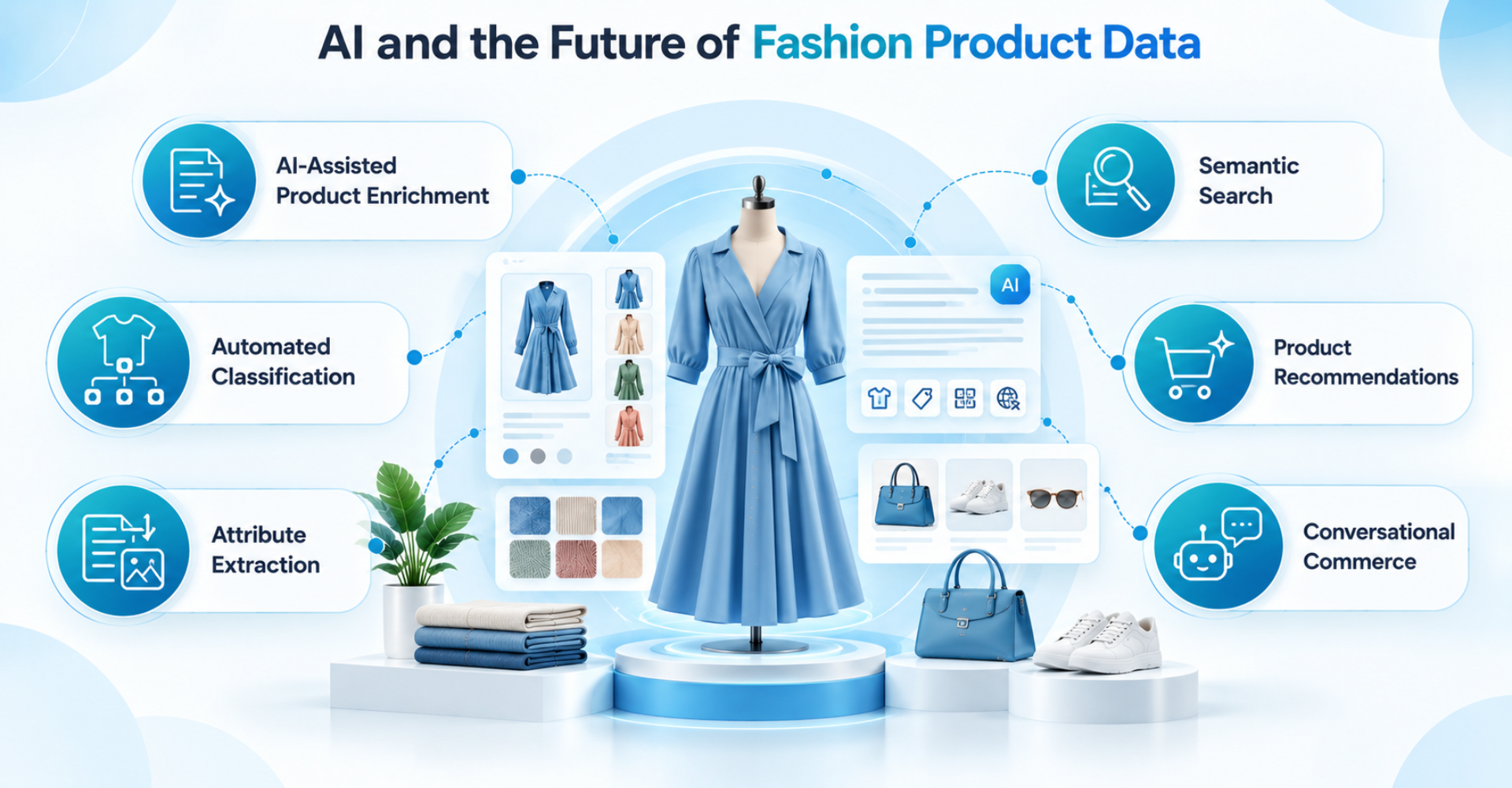
AI and the Future of Fashion Product Data
AI is becoming increasingly relevant to fashion product-data operations. However, AI does not eliminate the need for structured product information.
It makes reliable product data even more important.
AI-Assisted Product Enrichment
AI can help generate or suggest:
- Product descriptions
- Attribute values
- Categories
- Product tags
- Marketing content
Human-defined validation and approval should still govern what reaches customers.
Automated Classification
Machine-learning models can help map products into categories based on existing attributes, images, and descriptions.
Attribute Extraction
AI can help extract attributes from:
- Supplier descriptions
- Product documents
- Images
- Existing catalogs
Semantic Search
Structured Fashion PIM data can provide context for search experiences that understand concepts rather than relying only on exact keywords. A shopper might search for a lightweight black jacket for rainy weather and receive more useful results when material, color, category, fit, and product characteristics are properly structured.
Product Recommendations
Reliable relationships between products, collections, styles, colors, and categories can improve the context available to recommendation engines.
Conversational Commerce
AI shopping assistants need accurate information about:
- Products
- Variants
- Materials
- Sizes
- Relationships
- Availability context
PIM provides a governed product-information foundation that these systems can consume. The principle remains simple: Better AI experiences start with better product data.
How Credencys Helps Fashion Businesses Build Better Product Data Foundations
Fashion PIM projects require product-data modeling, platform expertise, system integration, migration, governance, and industry understanding. Credencys helps fashion brands, retailers, manufacturers, and distributors design product-data ecosystems that support complex catalogs and multichannel commerce.
Our PIM capabilities include:
- PIM strategy and consulting
- Product-data modeling
- Style and variant modeling
- Supplier-data onboarding
- Product-data migration
- ERP, PLM, DAM, and commerce integration
- Workflow and governance implementation
- Product content syndication
- Platform implementation and optimization
- AI-enabled product-data workflows
If your organization is managing complex styles, variants, collections, suppliers, and digital channels, explore our PIM for Fashion solution.
Conclusion
Fashion product information becomes harder to manage as catalogs, suppliers, variants, markets, and digital channels grow. Spreadsheets and disconnected systems may work for smaller catalogs, but they become increasingly difficult to govern as product complexity increases.
Fashion PIM creates a structured foundation for managing styles, colorways, sizes, collections, supplier information, digital assets, localization, and channel-ready content. The greatest value comes from treating PIM not simply as another product database, but as the governed product-information layer connecting PLM, ERP, DAM, suppliers, and downstream commerce.
With that foundation in place, fashion businesses can reduce manual product-data work, improve consistency, launch collections faster, and prepare their catalogs for increasingly intelligent digital commerce experiences.
For a leading fashion retailer, an AI-powered Pimcore PIM cut time to market by 30% and centralised more than 75,000 media assets. See also PIM for fashion.
PIM for Fashion Retail: FAQ
What is PIM for fashion retail?
A product information management system that manages styles, colourways and sizes, seasons, imagery and channel content for fashion retailers and brands.
How does a PIM handle style-colour-size variants?
Shared content sits on the style, colour-specific content and images on the colourway, and sizes on the SKU, so data is entered once and inherited.
Can a PIM feed fashion marketplaces?
Yes. A PIM maps your data to each marketplace’s requirements, such as Zalando, Myntra or Amazon Fashion.
How long does a fashion PIM project take?
A focused first release typically takes 3 to 6 months; larger programmes run in phases over 6 to 12 months or more.







Tags: