


Automotive Cross-Selling and Upselling: What a PIM Really Does
Short answer: Automotive cross-selling means offering a parts buyer the related items the same vehicle also needs, such as rotors with brake pads or a gasket set with a water pump. Upselling offers a better version of the same part. A PIM (product information management system) is the system that holds the product data cross-selling depends on: links between related parts, kits and upgrades, fitment by year, make and model (ACES data), and complete attributes, descriptions and images for every channel (PIES data). The PIM does not pick what each shopper sees: your store or recommendation engine does that, and your ERP holds price and stock.
Updated November 2026
In the automotive aftermarket, parts brands, distributors and online parts retailers are continuously seeking practical ways to boost their sales and enhance customer satisfaction. One of the most effective strategies to achieve this is through cross-selling and upselling.
These tactics not only help increase the average order value but also improve the overall customer experience by offering tailored solutions that meet the specific needs of each customer and each vehicle. This post is for eCommerce and product data teams with large parts catalogs. It explains which parts of cross-selling a PIM really handles, and which belong to your store, your recommendation engine and your ERP.
When Automotive Cross-Selling Breaks Down in a Parts Catalog
Automotive cross-selling usually breaks down because of product data, not because the store lacks a recommendation feature. Parts sellers with large catalogs tend to hit these five problems first:
- Interchange numbers, supersessions and alternatives sit in spreadsheets, so the store cannot show the replacement for a discontinued part.
- Fitment data covers only part of the catalog, so “fits with” suggestions on the product page are switched off or show parts for the wrong vehicle.
- Kits and accessories are set up by hand on Shopify, eBay and Amazon, and each channel ends up with different related items.
- ACES and PIES files go to customers and the online catalog, but the links between parts never make it into the files.
- With tens of thousands of SKUs or more, nobody can check by hand which parts should be sold together.
Each of these is a product data problem before it is a sales problem, and that is the part a PIM fixes.
Cross-selling and Upselling in the Automotive Aftermarket
Cross-Selling
Cross-selling involves recommending additional, complementary products to customers based on their current purchase. For example, if a customer is buying new tires, suggesting tire accessories such as valve caps, TPMS service kits or a tire repair kit would be a cross-selling tactic.
The objective is to provide added value by offering related products that enhance the primary purchase and fit the same vehicle.
Upselling
Upselling focuses on encouraging customers to buy a more expensive or upgraded version of the product they are interested in. For instance, if a customer is considering a basic brake pad set, proposing a premium ceramic pad set that includes new hardware and a longer warranty is an upselling strategy.
The goal is to increase the transaction value by highlighting the benefits of premium products or services.
Why Automotive Cross-Selling and Upselling Matter
Automotive cross-selling and upselling matter because they raise the value of each order, help the buyer get every part a repair needs in one purchase, and cut returns, as long as each suggested part fits the buyer’s vehicle. The four main benefits:
- Revenue Growth: Implementing cross-selling and upselling strategies effectively can raise sales by increasing the average order value. These methods allow businesses to generate more revenue from existing customers, reducing the reliance on new customer acquisition for growth.
- Customer Retention: Effective cross-selling and upselling can enhance customer satisfaction by providing complete solutions tailored to their needs. This personalized approach helps build strong customer relationships, fostering loyalty and encouraging repeat business, which is essential for sustained success in the automotive aftermarket.
- Enhanced Customer Experience: By offering relevant and useful recommendations, businesses can improve the overall buying experience. Customers appreciate suggestions that help them make better-informed decisions, leading to higher satisfaction and a greater likelihood of future purchases.
- Fewer Wrong-Fit Returns: A suggestion is only useful if the part fits. Related parts checked against fitment data mean fewer orders for parts that do not fit the customer’s vehicle.
What a PIM Does for Automotive Cross-Selling, and What It Does Not
A PIM supports automotive cross-selling by storing the relationships between parts (accessories, required parts, kits, replacements and upgrades), the fitment that keeps those relationships correct for each vehicle, and the attributes, images and copy each channel needs. It does not analyze shoppers, run promotions or decide when a suggestion appears.
| Cross-sell or upsell type | Auto parts example | Product data the PIM holds |
|---|---|---|
| Accessory (“fits with”) | Tires and valve caps or TPMS kits | Accessory link plus shared fitment |
| Required part (“needed with”) | Water pump and gasket set | Required-with link per part number |
| Kit or bundle | Brake job kit: pads, rotors, hardware | Kit structure, component SKUs, kit content |
| Replacement | Superseded or discontinued part | Interchange and supersession numbers |
| Upgrade (good-better-best) | Standard vs ceramic brake pads | Upgrade link and comparable attributes |
| Add-on service | Installation or extended warranty | Service item and its description |
| “Customers also bought” | Spark plugs, then ignition coils | Not a PIM job: built from order data |
The rest of the work sits in other systems. Your eCommerce or B2B platform (Shopify, BigCommerce, Adobe Commerce and others) shows the suggestions on the page and in the cart. A recommendation engine or customer data platform uses purchase history to rank them. Your ERP holds price, stock and discounts. The PIM feeds all of them the same related-part links and fitment, and exports the same data in ACES and PIES, the catalog standards maintained by the Auto Care Association. For more on the data itself, see automotive fitment data and managing ACES and PIES data.
Automotive Cross-Selling Opportunities Using PIM
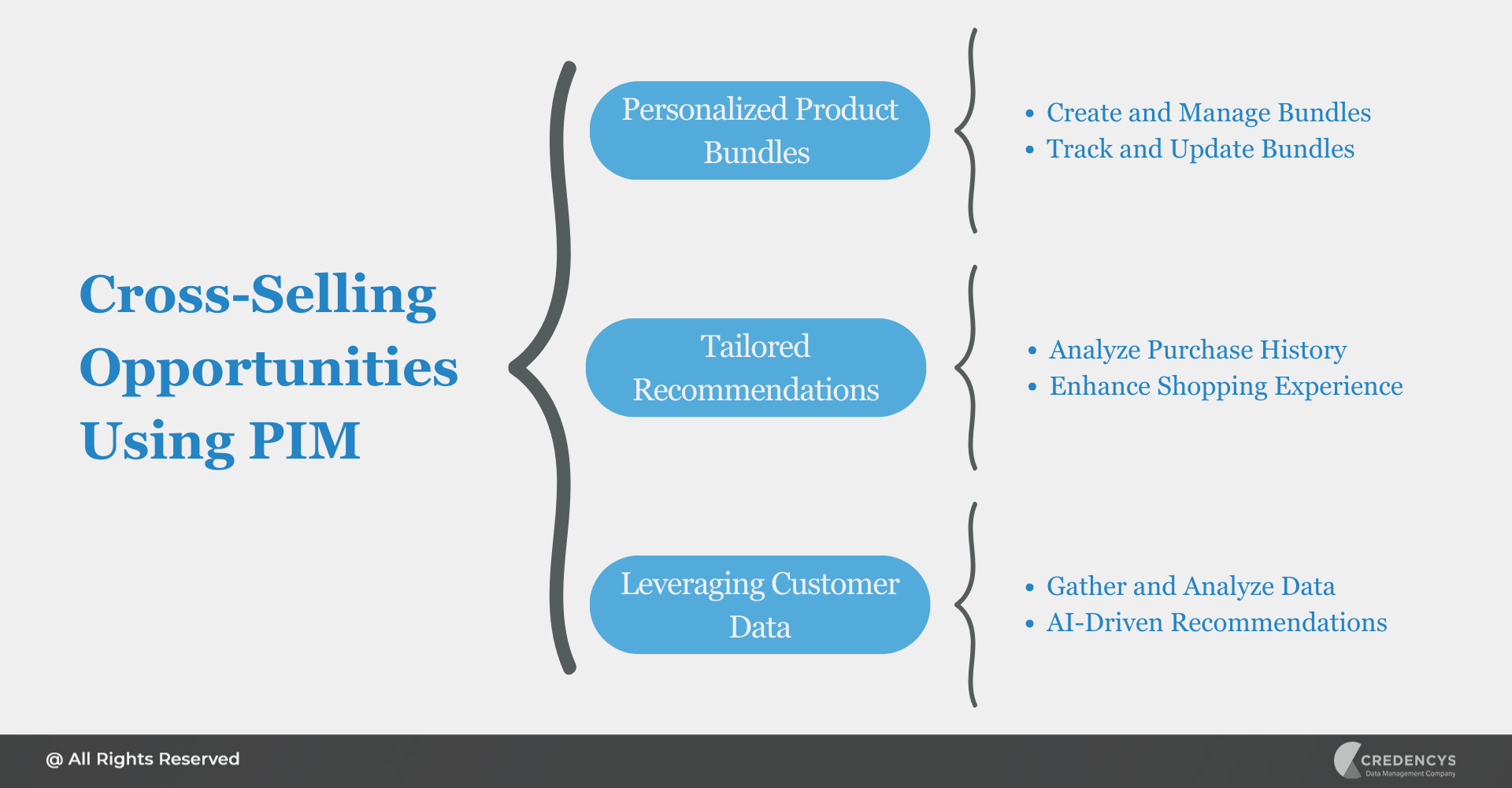
A PIM opens three automotive cross-selling opportunities: product bundles and kits defined once for every channel, recommendations limited to parts that fit the vehicle, and complete product data for the tools that use customer data. The store and the recommendation engine then decide what each shopper sees.
1. Product Bundles and Kits
- Create and Manage Bundles: PIM systems allow businesses to create and manage product bundles that cater to the specific needs of their customers. For example, a tire bundle might include new tires, a TPMS service kit, and a tire repair kit. These bundles can enhance the perceived value of the purchase and encourage customers to buy more items at once.
- Update Bundles: With PIM, it’s easy to update product bundles when a component is superseded or a kit changes, so the bundles remain correct and appealing to customers on every channel. Sales of each bundle are tracked in your eCommerce analytics or ERP, not in the PIM. For instance, if a particular bundle is selling well, that report shows the trend, and the PIM makes it quick to create similar bundles to build on it.
2. Tailored Recommendations That Fit the Vehicle
- Recommendations from Purchase History: Your eCommerce platform or recommendation engine, not the PIM, analyzes customers’ purchase histories to identify patterns and preferences. The PIM supplies the related-part links and fitment those tools use to make tailored product recommendations during checkout. For example, if a customer frequently buys car maintenance products, suggesting related items such as premium oil filters or high-performance brake pads for the same vehicle can be very effective.
- Enhance Shopping Experience: Personalized product suggestions improve the shopping experience by making it easier for customers to find what they need. When customers see relevant recommendations based on their previous purchases or items currently in their cart, and every suggested part fits their vehicle, they are more likely to add those items to their order.
3. Using Customer Data Alongside the PIM
- Gather and Analyze Data: Customer data is collected and analyzed in your eCommerce platform, CRM or customer data platform, not in the PIM. This data can be used to understand customer behavior and preferences, which is essential for effective cross-selling. For instance, if data shows that customers who buy spark plugs often buy ignition coils with them, this insight can inform cross-selling strategies, and the PIM makes sure both parts carry the fitment and attributes needed to link them.
- AI-Driven Recommendations: AI-driven recommendation engines in your store can further enhance cross-selling efforts. AI can analyze large datasets to identify patterns and make recommendations that are relevant to each customer. These engines only suggest the right accessories or upgrades for the items in a customer’s shopping cart if the product data behind them is complete; AI inside a PIM is used for that product data, for example to draft descriptions or fill missing attributes.
By using PIM to manage product bundles, related-part links and fitment, and by feeding that data to the tools that work with customer data, automotive aftermarket businesses can improve their cross-selling strategies. These approaches can increase sales and also enhance the overall customer experience, leading to greater customer satisfaction and loyalty.
Upselling Strategies Supported by PIM
A PIM supports automotive upselling by holding three kinds of data the store needs: links from standard parts to premium versions with comparable attributes, add-on services such as installation or extended warranties, and consistent product content behind promotions. Prices, discounts and the timing of offers stay in the store and the ERP.
1. Premium Product Highlighting
- Showcase Higher-End Products: PIM systems hold the links to premium products or upgraded versions of items that customers are viewing, with attributes that can be compared side by side. For instance, if a customer is looking at a standard set of brake pads, the store can use that link to also display a premium option that offers better performance and durability. This strategy not only increases the visibility of high-margin items but also helps customers make more informed decisions by presenting them with superior alternatives.
2. Add-On Services
- Offer Additional Services: When selling parts, it’s beneficial to offer add-on services such as installation, extended warranties, or maintenance packages. PIM systems can manage these add-ons as linked service items with their descriptions, so the store can present them to customers at the right time during the purchase process. For example, if a customer is buying a new car battery, the store can suggest an installation service or an extended warranty, enhancing the value of the purchase and increasing the overall transaction value.
- Timing and Relevance: Your eCommerce platform decides when add-on services are suggested, such as during checkout. The PIM makes sure the service descriptions are complete and correct when that moment comes.
3. Incentives and Limited-Time Offers
- Create Urgency: Limited-time promotions and discounts can create a sense of urgency that encourages customers to make quicker purchasing decisions. These offers are set up and applied in your eCommerce platform or ERP pricing, not in the PIM. For example, the store can display a limited-time discount on premium brake pads, and the PIM supplies the product content the offer points to.
- Consistency Across Channels: PIM ensures that the product information behind promotional offers is consistent across all platforms, whether it’s the company’s website, a marketplace, or a dealer catalog. This consistency helps maintain customer trust and encourages them to take advantage of the offers, knowing they will see the same part details regardless of how they shop.
By using PIM to hold upgrade links, add-on services and consistent product information, automotive aftermarket businesses can effectively support their upselling strategies. These tactics not only increase sales but also improve customer satisfaction by providing them with more valuable and relevant options.

Getting Your Product Data Ready for Automotive Cross-Selling
Getting product data ready for automotive cross-selling means defining the relationships between parts, completing fitment for every part in those relationships, and publishing both from one PIM to every channel before recommendations are switched on.
Implementing a PIM system offers substantial advantages for businesses in the automotive aftermarket, particularly when it comes to cross-selling and upselling strategies. The integration of a PIM system into your business operations gives every channel the same related-part links, kits, upgrades and fitment, which is what cross-selling and upselling opportunities depend on.
By centralizing product information and connecting it to your store, ERP and customer data tools, PIM systems provide a solid foundation for a successful sales strategy. Start with the data, in this order:
- List the relationship types you need: accessories, required parts, kits, replacements, upgrades and add-on services. Start from what you already have, such as supersessions in your ERP and interchange data in your own or your suppliers’ PIES files.
- Check fitment coverage for every part in those relationships.
- Fix the gaps in the PIM and send the same links and fitment to every channel and to your ACES and PIES files.
- Switch on recommendations in the store only after that.
Credencys is a PIM consulting and implementation firm and a Pimcore and Syndigo partner that builds PIM for automotive aftermarket businesses. In one Credencys PIM project, an automotive aftermarket business saw 3x faster operations; the project covered ERP, DAM and ACES. You can find more guides in our PIM resources hub, or talk to our PIM team about your catalog.
Automotive Cross-Selling: Common Questions from Parts Sellers
What is automotive cross-selling and upselling?
Automotive cross-selling is offering a parts buyer related items for the same vehicle, such as a gasket set with a water pump. Automotive upselling is offering a better version of the part they chose, such as ceramic brake pads instead of standard pads. Both raise order value and help the buyer finish the job.
How does a PIM help cross-sell auto parts?
A PIM helps cross-sell auto parts by storing the links between related parts, kits, replacements and upgrades, checking them against fitment, and sending the same data to the website, marketplaces and ACES and PIES files. The store or recommendation engine then chooses which of those linked parts each shopper sees.
What are examples of cross-selling auto parts?
Common auto parts cross-sells are rotors with brake pads, a gasket set with a water pump, valve caps or TPMS kits with tires, filters with an oil change kit, and terminals with a battery. Each one only works if both parts fit the same year, make and model.
What tools do parts distributors use for cross-selling?
Parts distributors usually combine three systems for cross-selling: a PIM for related-part links, kits and fitment; an eCommerce or B2B platform that shows the suggestions; and an ERP for price and stock. Some add a recommendation engine that ranks suggestions from order history.
How do you avoid recommending auto parts that do not fit?
A store avoids recommending parts that do not fit by checking every related part against the vehicle’s fitment before showing it. That requires fitment for both parts, kept in one place (often the PIM, in ACES format) and sent to every channel, rather than separate fitment lists per channel.
What are ACES and PIES?
ACES (Aftermarket Catalog Exchange Standard) and PIES (Product Information Exchange Standard) are the automotive aftermarket catalog data standards maintained by the Auto Care Association. ACES carries fitment: which part fits which year, make, model and engine. PIES carries product attributes, descriptions, packaging, part interchange and references to images and other digital assets. For cross-selling, ACES data keeps suggestions limited to parts that fit the same vehicle.
How do I personalize auto parts suggestions on Shopify?
Personalizing auto parts suggestions on Shopify starts with the shopper’s vehicle: fitment apps add year, make and model search, and the theme or a recommendation app shows related products that fit that vehicle. A PIM supplies those apps with the same related-part links and fitment you send to eBay, Amazon and ACES files. See choosing a PIM for Shopify.
How long does it take to set up a PIM for aftermarket product relationships?
A first PIM release, including product relationships and fitment for an aftermarket catalog, typically takes 3 to 6 months. Larger programs with many brands, channels and ERP connections take 6 to 12 months or more.

Enhance Your Cross-Selling and Upselling Strategies with our PIM System – DRIVE





Tags: