


Top Data Warehouse Tools in 2026: Features, Comparisons & How to Choose the Right Platform
Data is growing at an unprecedented pace, and so is the demand to turn that data into real-time, actionable insights. Today, businesses can no longer rely on delayed reports or batch processing.
Around 58% of companies now use real-time data pipelines to enable faster decision-making, highlighting how quickly real-time analytics is becoming the norm.
This surge in demand has fundamentally transformed how data is stored and processed. Modern systems are built to handle massive data volumes, support real-time analytics, and seamlessly integrate with AI and machine learning workloads.
However, with a growing number of platforms and architectural choices, selecting the right data warehouse tool has become increasingly complex. A poor choice can lead to performance bottlenecks, rising expenses, and limited innovation potential.
In this guide, we simplify that decision-making process. You will discover the top data warehouse tools in 2026, explore a side-by-side comparison of their capabilities, and learn a practical framework to choose the right platform based on your business needs.
What Are Data Warehouse Tools?
Data warehouse tools are platforms designed to collect, store, and analyze large volumes of structured data from multiple sources in a centralized repository. They serve as the foundation for business intelligence, reporting, and advanced analytics, enabling organizations to make data-driven decisions with confidence.
At their core, these tools bring together data from systems like CRM, ERP, marketing platforms, and transactional databases, transforming raw data into a format optimized for querying and analysis.
Key Capabilities of Data Warehouse Tools
Modern data warehouse platforms go far beyond simple storage. They provide:
- Data Ingestion: Seamlessly collect data from multiple sources, including cloud apps, databases, and streaming systems
- Data Storage: Efficiently store structured and semi-structured data at scale
- Data Processing: Enable fast query execution using distributed computing and columnar storage
- Analytics & Querying: Support SQL-based analysis and integration with BI tools like dashboards and reporting platforms
- Integration: Connect easily with ETL/ELT pipelines, data lakes, and AI/ML tools
Why Choosing the Right Data Warehouse Tool Matters
Selecting a data warehouse tool is a strategic decision that directly impacts your organization’s ability to scale, innovate, and compete in a data-driven world. The right platform can accelerate analytics, reduce costs, and empower teams with faster insights.
The wrong choice, however, can lead to inefficiencies, rising expenses, and long-term limitations.
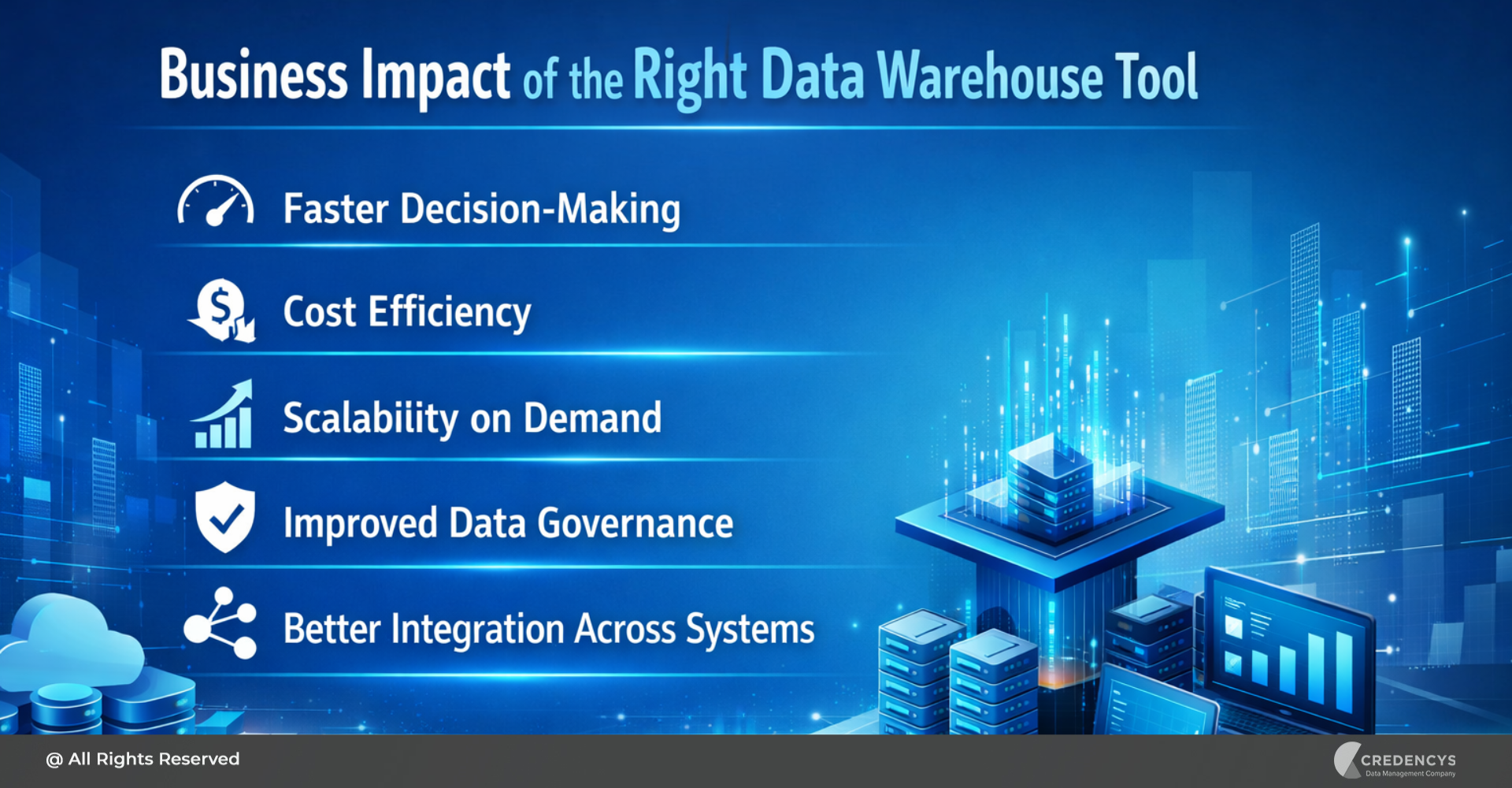
Business Impact of the Right Data Warehouse Tool
A well-aligned data warehouse tool enables:
- Faster Decision-Making: High-performance query engines and real-time processing allow teams to access insights instantly rather than waiting hours or days
- Cost Efficiency: Modern cloud platforms offer flexible pricing models (pay-per-query, on-demand compute), helping optimize infrastructure costs
- Scalability on Demand: Easily scale storage and compute resources as your data grows without major infrastructure investments
- Improved Data Governance: Built-in security, access controls, and compliance features ensure data is accurate, secure, and accessible to the right users
- Better Integration Across Systems: Seamless connectivity with BI tools, ETL pipelines, and AI/ML platforms enables a unified data ecosystem
Risks of Choosing the Wrong Platform
On the flip side, an ill-suited data warehouse tool can create significant challenges:
- High Total Cost of Ownership: Hidden costs from inefficient queries, over-provisioned resources, or licensing models
- Performance Bottlenecks: Slow query execution and limited concurrency can delay insights and frustrate teams
- Vendor Lock-in: Limited flexibility to migrate or integrate with other platforms
- Complex Integrations: Difficulty connecting with existing tools and data sources
- Limited Future Readiness: Inability to support advanced use cases like real-time analytics or AI/ML workloads
The right data warehouse tool becomes a growth enabler, while the wrong one turns into a long-term constraint. That’s why organizations must evaluate their options carefully based on business goals, data needs, and future scalability requirements.
Top Data Warehouse Tools in 2026 (Expert Picks)
In a rapidly evolving data ecosystem, several platforms have emerged as leaders in data warehousing. Each tool offers unique strengths, ranging from scalability and performance to advanced analytics and AI capabilities.
Below are the top data warehouse tools in 2026 that enterprises are trusting for modern analytics:
1. Snowflake
A fully managed, cloud-native data warehouse known for its separation of storage and compute, enabling high scalability and performance.
Key Features:
- Multi-cluster shared data architecture
- Near-zero maintenance (fully managed)
- Secure data sharing across organizations
- Supports structured and semi-structured data
Best For:
- Enterprises looking for scalability, ease of use, and multi-cloud flexibility
Limitations:
- Can become expensive with heavy usage
- Limited built-in ML capabilities compared to lakehouse platforms
2. Google BigQuery
A serverless, highly scalable data warehouse designed for real-time analytics and big data processing.
Key Features:
- Serverless architecture (no infrastructure management)
- Pay-per-query pricing model
- Built-in machine learning (BigQuery ML)
- Real-time analytics capabilities
Best For:
- Organizations handling large-scale analytics with unpredictable workloads
Limitations:
- Cost unpredictability with high query volumes
- Less control over infrastructure
3. Amazon Redshift
A powerful, fully managed data warehouse service within the AWS ecosystem, optimized for large-scale data processing.
Key Features:
- Deep integration with AWS services
- Columnar storage for faster queries
- RA3 instances for scalable storage
- Supports structured and semi-structured data
Best For:
- Businesses already invested in the AWS ecosystem
Limitations:
- Requires tuning for optimal performance
- Can be complex for beginners
4. Databricks
A unified analytics platform that combines data warehousing and data lake capabilities through the lakehouse architecture.
Key Features:
- Delta Lake for reliable data storage
- Unified support for BI, data engineering, and ML
- Strong AI/ML and real-time analytics capabilities
- Open and flexible architecture
Best For:
- Organizations looking to unify data warehousing with AI/ML workloads
Limitations:
- Steeper learning curve
- Requires strong data engineering expertise
5. Microsoft Azure Synapse Analytics
An integrated analytics service that combines data warehousing, big data analytics, and data integration.
Key Features:
- Unified experience across data pipelines and analytics
- Integration with Power BI and Azure services
- Serverless and dedicated resource options
- Strong enterprise security
Best For:
- Organizations using the Microsoft ecosystem
Limitations:
- Can be complex to configure
- Performance tuning required
These tools represent the best-in-class data warehouse platforms in 2026, each catering to different business needs, architectures, and ecosystems.
| Tool | Deployment Type | Pricing Model | Scalability | Best Use Case | Key Strength |
|---|---|---|---|---|---|
| Snowflake | Cloud (multi-cloud) | Pay-per-use (compute + storage) | Very high | Enterprise BI & data sharing | Separation of compute & storage |
| Google BigQuery | Cloud (Serverless) | Pay-per-query | Very High | Real-time analytics, big data | Serverless & fast queries |
| Amazon RedShift | Cloud (AWS) | Instance-based + storage | High | AWS-based analytics workloads | Deep AWS integration |
| Databricks | Cloud (multi-cloud) | Usage-based | Very High | AI/ML + unified analytics | Lakehouse architecture |
| Microsoft Azure Synapse Analytics | Cloud (Azure) | Pay-per-query + dedicated | High | Enterprise analytics (Microsoft stack) | Unified analytics platform |
This comparison gives you a high-level view, but the right choice ultimately depends on your specific use case, budget, and long-term data strategy.
How to Choose the Right Data Warehouse Tool
Choosing the right data warehouse tool means selecting one that aligns with your business goals, data strategy, and future scalability needs. Here’s a practical framework to help you make the right decision:
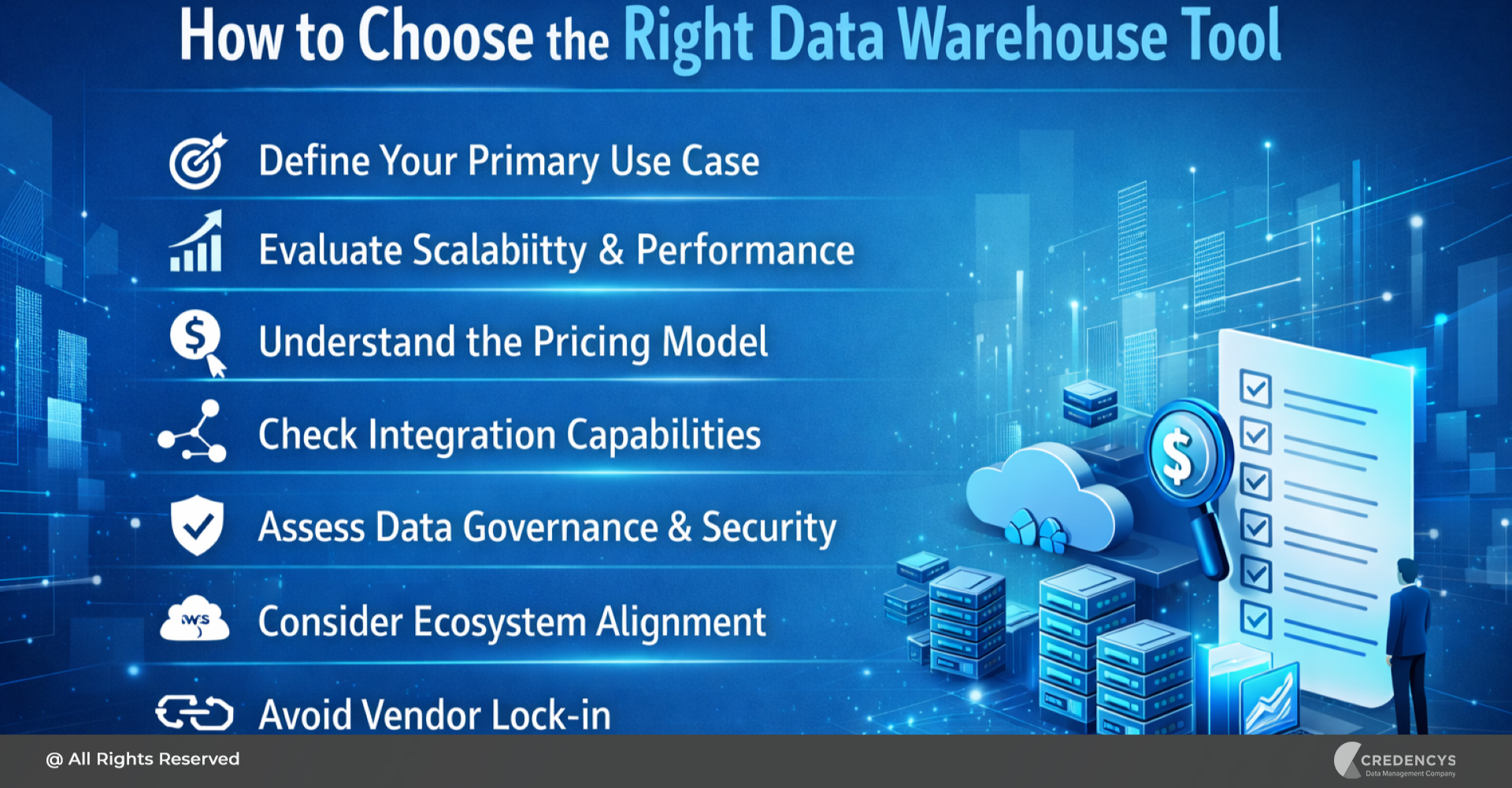
1. Define Your Primary Use Case
Start by identifying what you want to achieve with your data:
- Business Intelligence & Reporting: Choose tools optimized for fast SQL queries and dashboards
- Real-Time Analytics: Look for platforms with streaming and low-latency capabilities
- AI/ML Workloads: Consider unified platforms like Databricks
Your use case will quickly narrow down the most suitable tools.
2. Evaluate Scalability & Performance
Your data will grow, and your platform must grow with it.
- Can it handle increasing data volumes without performance degradation?
- Does it support high concurrency (multiple users/queries)?
- Does it separate compute and storage (like Snowflake)?
Scalability ensures long-term viability.
3. Understand the Pricing Model
Cost structures vary significantly across tools:
- Pay-per-query: Google BigQuery
- Compute + storage separation: Snowflake
- Instance-based pricing: Amazon Redshift
Ask:
- Is pricing predictable?
- Can you optimize costs based on usage?
The wrong pricing model can lead to unexpected cost overruns.
4. Check Integration Capabilities
Your data warehouse should fit seamlessly into your ecosystem.
- Does it integrate with your existing data sources (CRM, ERP, APIs)?
- Does it support your BI tools (Power BI, Tableau)?
- Can it connect with ETL/ELT pipelines?
Strong integration reduces implementation complexity.
5. Assess Data Governance & Security
For enterprises, this is non-negotiable.
- Role-based access control
- Data encryption
- Compliance (GDPR, HIPAA, etc.)
- Data lineage and auditing
Tools like Microsoft Azure Synapse Analytics offer strong enterprise-grade governance.
6. Consider Ecosystem Alignment
Choosing a tool that aligns with your existing cloud ecosystem simplifies operations:
- AWS users → Amazon Redshift
- Azure users → Microsoft Azure Synapse Analytics
- Google Cloud users → Google BigQuery
This reduces integration effort and improves performance.
7. Avoid Vendor Lock-in
Flexibility is key to long-term success.
- Does the platform support multi-cloud or open formats?
- Can you migrate data easily if needed?
Platforms like Databricks offer greater openness than tightly coupled ecosystems.
8. Evaluate Ease of Use & Team Expertise
Even the best tool fails if your team can’t use it effectively.
- Does it require heavy technical expertise?
- Is there a learning curve?
- Are there enough community and support resources?
Balance capability with usability.
There is no one-size-fits-all data warehouse tool. The right choice depends on your use case, scale, budget, and long-term data strategy.
If you are unsure, working with an experienced partner can help you evaluate options, avoid costly mistakes, and implement the right architecture from day one.
Why Choose Credencys as Your Data Warehouse Partner
Selecting the right data warehouse tool is only half the battle; the real value comes from how effectively it is implemented, optimized, and aligned with your business goals. That’s where Credencys comes in.
As a trusted data and analytics consulting partner, Credencys helps organizations design and deploy modern data warehouse solutions that are scalable, cost-efficient, and future-ready.
1. Deep Expertise in Modern Data Platforms
Credencys brings hands-on experience across leading platforms like Snowflake and Databricks. This multi-platform expertise ensures you get unbiased recommendations tailored to your specific use case, not tied to a single vendor.
2. End-to-End Data Warehouse Services
From strategy to execution and beyond, Credencys covers the entire lifecycle:
- Strategy & Consulting: Define the right data architecture aligned with your business objectives
- Data Architecture Design: Build scalable, high-performance data models and pipelines
- Migration & Modernization: Seamlessly move from legacy systems to cloud-native platforms
- Integration & Optimization: Connect your data ecosystem and continuously improve performance and cost efficiency
3. Industry-Focused Expertise
Credencys understands the unique data challenges across industries:
- Retail & eCommerce: Customer 360, personalization, dynamic pricing
- CPG: Demand forecasting, supply chain optimization
- Manufacturing: Operational analytics, predictive maintenance
This domain expertise ensures faster implementation and more relevant outcomes.
4. A Proven, Business-First Approach
Credencys goes beyond technology implementation by focusing on business impact:
- Business-first strategy aligned with measurable outcomes
- Scalable architecture designed for long-term growth
- Faster time-to-value with agile and efficient execution
This integrated expertise allows you to move from data to insights, and from insights to action, faster.
Conclusion
There is no one-size-fits-all when it comes to choosing the right data warehouse tool. Each platform, whether it’s Snowflake, Google BigQuery, or Databricks, offers unique strengths tailored to different use cases, architectures, and business goals.
That’s why a structured decision framework is essential. By clearly defining your use case, evaluating scalability, understanding pricing models, and aligning with your existing ecosystem, you can confidently select a platform that supports both your current needs and future growth.
The key is to think beyond short-term requirements and make a strategic, long-term investment in your data infrastructure. The right choice will not only improve analytics performance but also unlock innovation, efficiency, and competitive advantage.






Tags: