


Magento Pimcore Connector: How It Helps Retailers Centralize Product Data
Retailers manage product data across multiple systems, suppliers, and digital channels, making consistency a major challenge. According to industry research, poor product data quality can lead to higher return rates, lost sales opportunities, and increased operational costs.
As product catalogs grow, retailers need a scalable way to centralize product data across systems, teams, and commerce channels. This is where the Magento Pimcore Connector helps.
The Magento Pimcore Connector connects Pimcore with Magento or Adobe Commerce, enabling retailers to centralize product data in Pimcore and publish accurate, enriched, and commerce-ready information to Magento. For CTOs and IT teams, this integration provides a scalable foundation for product data management, digital commerce, and omnichannel retail operations.
What is a Magento Pimcore Connector?
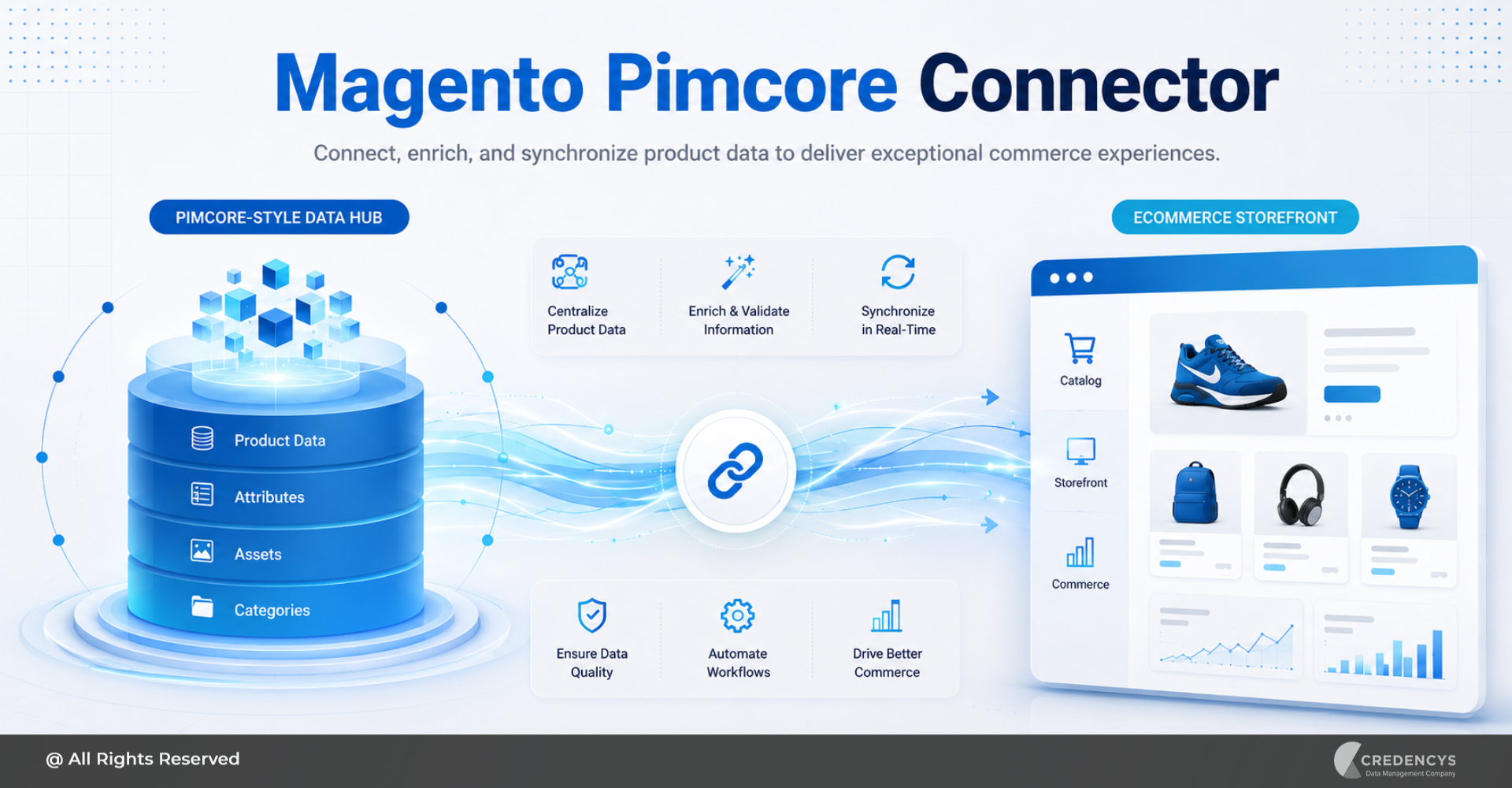
A Magento Pimcore Connector integrates Pimcore with Magento or Adobe Commerce, enabling product data, categories, attributes, and digital assets to sync between the two platforms. Pimcore serves as the central product data management system, while Magento powers the eCommerce storefront.
Retailers can manage, enrich, and approve product information in Pimcore, then automatically publish it to Magento. Working with a trusted Pimcore implementation partner can help define the right connector strategy, data model, and synchronization approach.
This helps centralize product data, reduce manual effort, improve data consistency, and more efficiently support large catalogs and multiple stores.
Why Retailers Struggle with Product Data in Magento
Magento is a powerful eCommerce platform. It helps retailers manage online storefronts, shopping carts, checkout, promotions, customer accounts, and transactions.
However, Magento is not always the best platform for managing complex product data at scale. Retailers often manage thousands or even millions of SKUs.
Each product may have multiple attributes, categories, images, documents, descriptions, variants, pricing rules, and localization requirements. When this data is maintained directly inside Magento or through spreadsheets, complexity increases quickly.
These issues often point to a larger need for stronger product data quality and governance across the retail technology ecosystem. Common challenges include:
- Product data stored across ERP, supplier systems, spreadsheets, DAM tools, and Magento
- Inconsistent product attributes across categories
- Duplicate or outdated product records
- Manual product uploads and repetitive data entry
- Delayed product launches due to approval bottlenecks
- Difficulty managing product images, videos, and documents
- Limited governance over who can edit, approve, or publish product data
- Poor data quality affecting search, filters, recommendations, and conversions
For retail IT teams, these problems create operational pressure. Every product update, new collection, seasonal campaign, or marketplace launch becomes dependent on manual coordination.
For customers, the impact is evident in incomplete product pages, missing images, incorrect specifications, limited filtering options, and inconsistent product descriptions. This is why retailers need a centralized product data management approach.
How Pimcore Centralizes Product Data for Retailers
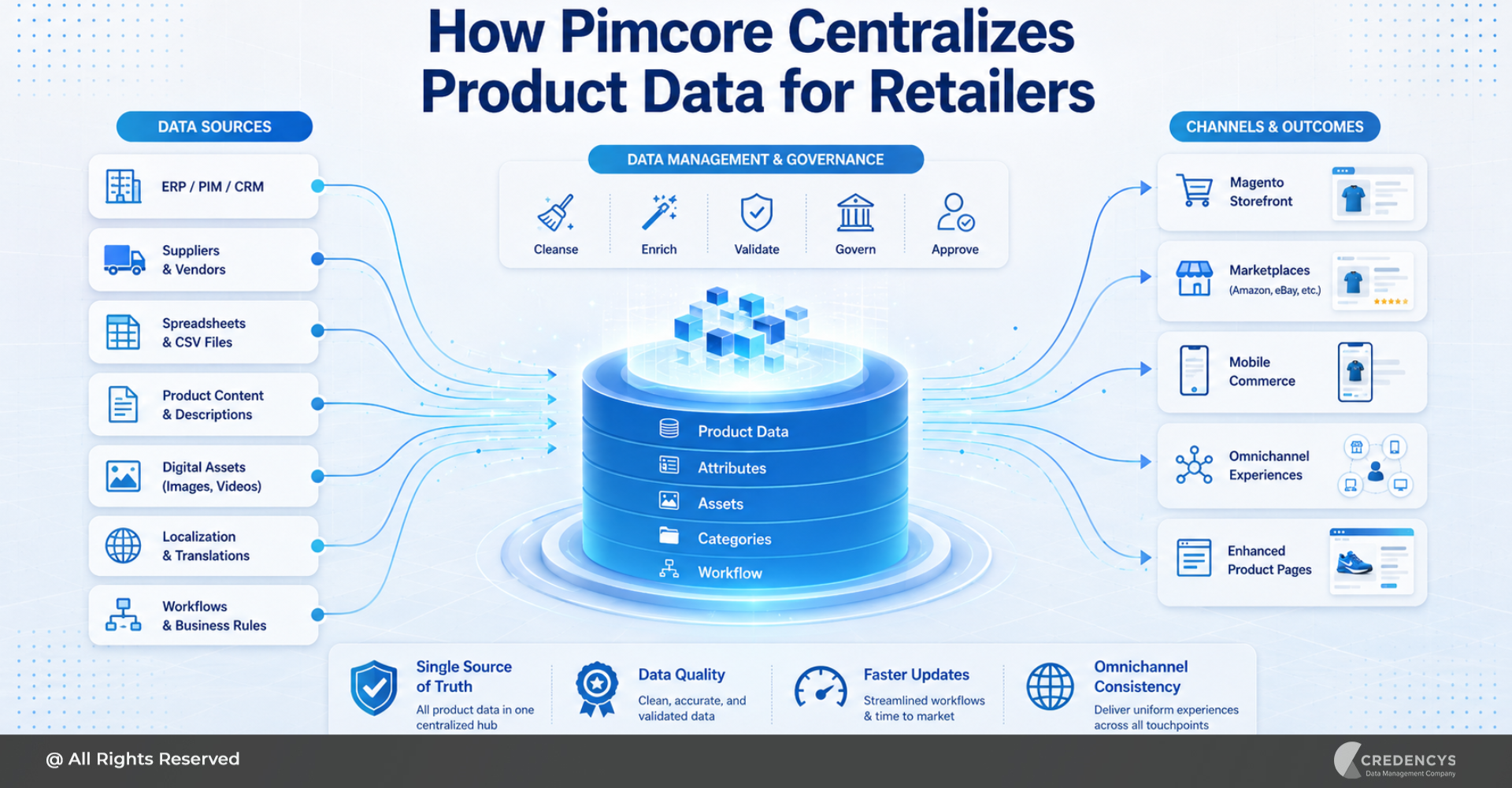
Pimcore helps retailers manage product information, digital assets, and master data from one central platform. It can serve as a single source of truth for product data before it is published to Magento and other digital channels.
With Pimcore, retailers can manage:
- Product titles and descriptions
- Technical specifications
- Product attributes
- SKU and variant data
- Category structures
- Product relationships
- Images, videos, PDFs, and manuals
- Supplier data
- Localization and translations
- Approval workflows
- Data quality rules
This centralization is important because retail product data rarely comes from one source. For example, product pricing may come from ERP.
Product images may come from creative teams. Technical specifications may come from suppliers.
Marketing descriptions may come from content teams. Category mapping may be handled by merchandising teams.
Without a central platform, this data remains scattered. Teams work in silos, and Magento often becomes overloaded with data management responsibilities.
Pimcore solves this by bringing product data, digital assets, and workflows into one governed environment. Once the information is complete, accurate, and approved, the Magento Pimcore Connector sends it to Magento for customer-facing commerce.
To understand the broader role of Pimcore in product data management, read our detailed guide on Pimcore Product Information Management.
How Magento Pimcore Connector Works
The Magento Pimcore Connector establishes a structured connection between Pimcore and Magento. A typical data flow looks like this:
- ERP, suppliers, spreadsheets, and internal systems send product data to Pimcore.
- Pimcore cleans, enriches, structures, and governs the product data.
- The Magento Pimcore Connector maps Pimcore data fields with Magento attributes, categories, and product types.
- Approved product data is synchronized with Magento.
- Magento displays the updated product information on the storefront.
This integration reduces the need to manually enter or update product data in Magento. For example, if a retailer updates a product description, image, size chart, or technical specification in Pimcore, the updated information can be pushed to Magento based on defined synchronization rules.
This helps IT teams maintain better control over data flows while allowing commerce teams to work faster. The connector can support different types of product data synchronization depending on the business requirement.
Some retailers may need one-way synchronization from Pimcore to Magento. Others may require two-way data exchange for selected information.
The connector can also be customized based on catalog complexity, Magento setup, Pimcore data model, business workflows, and integration needs. For a deeper technical view, explore how Pimcore Magento integration architecture works across APIs, middleware, connectors, and custom integration models.
Key Capabilities of Magento Pimcore Connector
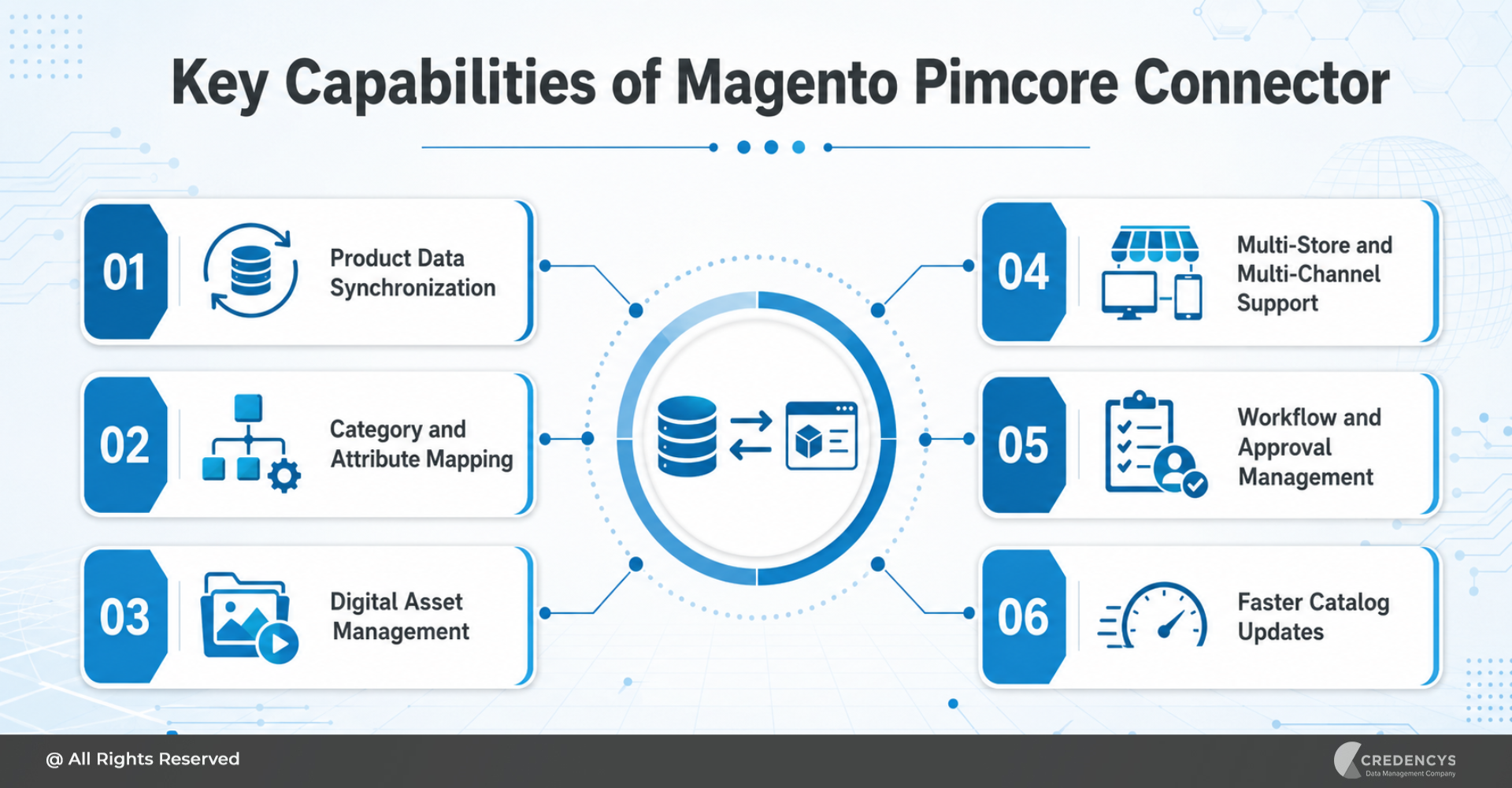
1. Product Data Synchronization
The most important capability of a Magento Pimcore Connector is product data synchronization. Retailers can manage product titles, SKUs, short descriptions, long descriptions, specifications, variants, and other product information in Pimcore.
Once approved, this data can be published to Magento. This helps reduce manual uploads and ensures Magento always receives structured and updated product information.
For IT teams, it also improves control over how data flows between systems. Instead of depending on ad hoc exports and imports, teams can define rules for what data should move, when it should move, and how it should be transformed.
2. Category and Attribute Mapping
Retail catalogs often have complex category structures. A fashion retailer may manage products by gender, collection, size, color, season, and style.
An electronics retailer may manage products by brand, specifications, compatibility, model number, and warranty. The Magento Pimcore Connector helps map Pimcore product structures with Magento categories, attributes, and product types.
This ensures product information is displayed correctly on the Magento storefront. It also supports better filtering, product search, navigation, and product discovery.
Without proper attribute mapping, customers may struggle to find the products they need. For example, if size, color, material, or compatibility attributes are missing or inconsistent, filters become unreliable.
A well-configured connector helps solve this problem.
3. Digital Asset Management
Product data is not limited to text and numbers. Retailers also need to manage product images, videos, manuals, lookbooks, packaging images, size guides, and other digital assets.
Pimcore includes digital asset management capabilities that allow teams to centralize, organize, and manage these assets. Through the Magento Pimcore Connector, approved digital assets can be linked with the right products and published to Magento.
This helps maintain consistency between product information and product visuals. For retailers, this is especially useful during seasonal launches, campaign updates, and large catalog refreshes.
4. Multi-Store and Multi-Channel Support
Many retailers operate multiple Magento stores across brands, regions, languages, or customer segments. Managing product data separately for each store can become difficult.
The Magento Pimcore Connector helps retailers centrally manage product data and distribute it across multiple Magento stores. For example, a retailer can maintain one master product record in Pimcore and adapt it for different markets.
Product descriptions, images, pricing rules, or category placements can be customized based on region, language, or store requirements. This reduces duplication and improves consistency across digital commerce channels.
5. Workflow and Approval Management
Product data often passes through multiple teams before it goes live. Product managers, merchandising teams, marketing teams, legal teams, and IT teams may all be involved.
Pimcore allows retailers to define workflows and approval processes for product data. This means product information can be reviewed, enriched, approved, and published in a controlled manner.
The Magento Pimcore Connector then ensures that only approved product data is synchronized with Magento. For CTOs and IT teams, this improves governance.
It reduces the risk of incomplete, incorrect, or unapproved product information appearing on the storefront.
6. Faster Catalog Updates
Retail is fast-moving. New products, promotions, price changes, seasonal collections, and inventory-linked campaigns need quick execution.
When product updates depend on manual uploads or disconnected spreadsheets, teams lose speed. The Magento Pimcore Connector helps retailers update catalogs faster by automating the movement of approved product data from Pimcore to Magento.
This helps reduce time-to-market and enables retailers to respond more quickly to market demand, promotional opportunities, and customer expectations.
Benefits of Magento Pimcore Connector for Retailers
1. Centralized Product Data Management
The biggest benefit of the Magento Pimcore Connector is centralized product data management. Retailers can manage product information in one place instead of relying on scattered systems and spreadsheets.
Pimcore becomes the trusted source for product content, attributes, assets, and related information. This gives IT teams better control and gives business teams better visibility into product data readiness.
Once product data is centralized, retailers can focus on product data enrichment to improve product descriptions, attributes, images, and customer-facing content.
2. Improved Product Data Accuracy
Inaccurate product data can damage customer trust. Incorrect dimensions, missing images, incomplete descriptions, or inconsistent attributes can lead to poor buying decisions and higher returns.
By managing product data centrally in Pimcore and synchronizing it with Magento, retailers can improve data accuracy across the storefront. This supports better product pages, better search results, and better customer confidence.
3. Faster Time-to-Market
Retailers need to launch new products quickly. However, product launches often get delayed because teams are waiting for descriptions, images, attributes, translations, or approvals.
With Pimcore and Magento connected, teams can prepare product data centrally and publish it faster once it is approved. This is especially valuable for retailers managing seasonal collections, flash sales, new brand launches, or large SKU updates.
4. Better Customer Experience
Customers expect accurate, rich, and consistent product information. They want clear descriptions, high-quality images, complete specifications, and useful filters.
When product data is centralized and governed, Magento can deliver better product experiences. Customers can find products faster, compare them more easily, and make more confident purchase decisions.
For retailers, this can support higher engagement, better conversions, and reduced product-related confusion.
5. Reduced Manual Work for IT and Commerce Teams
Manual catalog management consumes time and increases the risk of errors. IT teams often spend time fixing data issues, troubleshooting imports, correcting attribute mismatches, and supporting business teams with repeated catalog updates.
The Magento Pimcore Connector reduces this manual dependency. It automates product data movement between Pimcore and Magento, allowing teams to focus on higher-value work.
6. Scalable Catalog Management
As retail businesses grow, product catalogs become more complex. More SKUs, more suppliers, more brands, more regions, and more digital channels create more data management pressure.
Magento alone may not be enough to manage this complexity efficiently. By using Pimcore as the central product data platform and Magento as the commerce engine, retailers can create a more scalable architecture.
This allows the business to expand product lines, launch new stores, support localization, and manage omnichannel commerce more effectively.
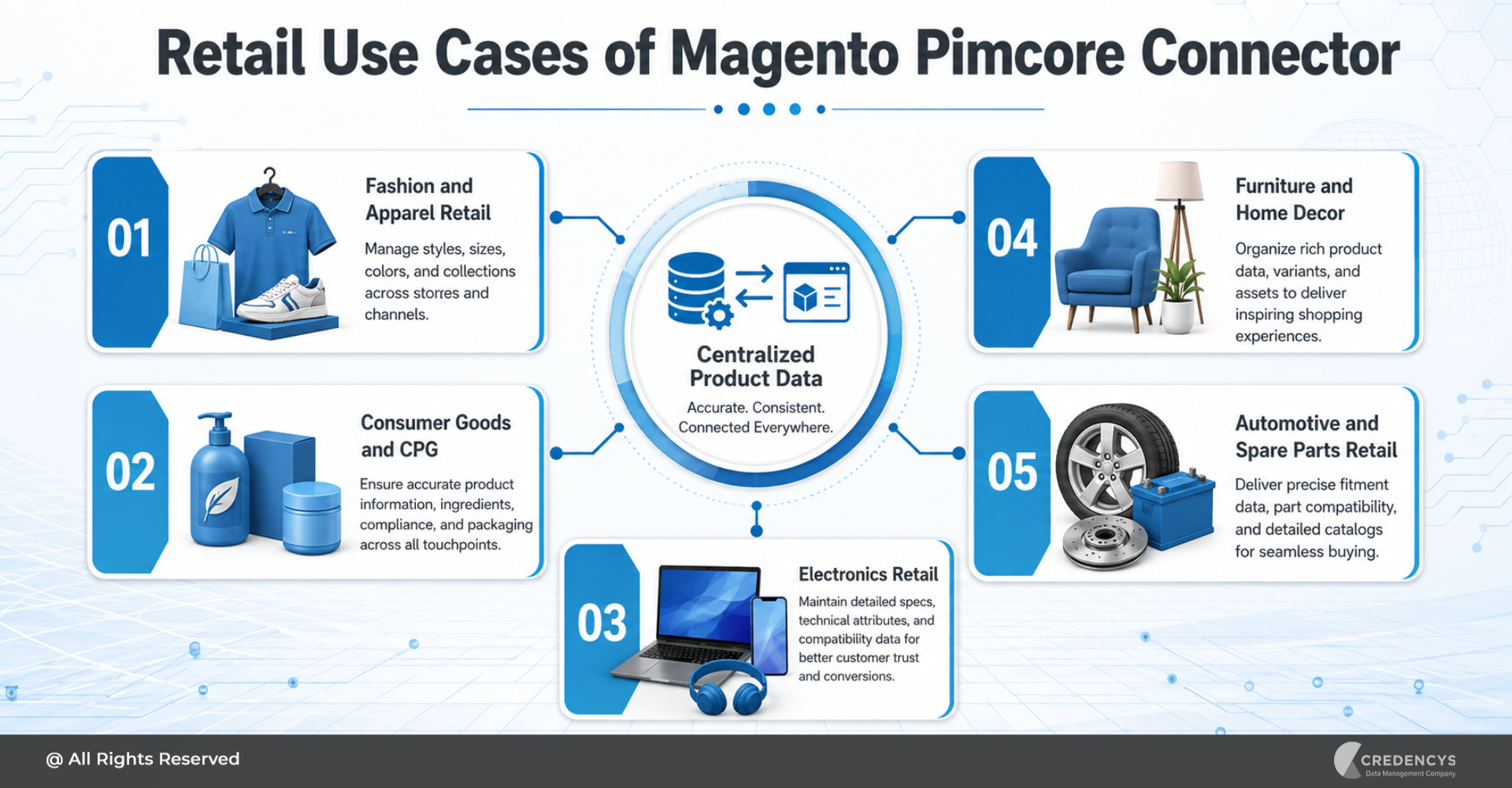
Retail Use Cases of Magento Pimcore Connector
1. Fashion and Apparel Retail
Fashion retailers manage large numbers of variants across sizes, colors, styles, fabrics, collections, and seasons. The Magento Pimcore Connector helps centralize this product data in Pimcore and publish accurate product information to Magento.
Teams can manage product images, size charts, style descriptions, collection details, and seasonal launches more efficiently.
2. Consumer Goods and CPG
CPG brands and retailers need to manage packaging details, ingredients, product claims, certifications, usage instructions, and compliance-related information. With Pimcore, this information can be governed centrally.
The connector then ensures that accurate and approved product data is available on the Magento storefront.
3. Electronics Retail
Electronics retailers manage technical specifications, warranty details, manuals, accessories, compatibility information, and comparison data. The Magento Pimcore Connector helps structure this data and publish it to Magento in a consistent format.
This improves search, filtering, product comparison, and customer decision-making.
4. Furniture and Home Decor
Furniture and home decor retailers handle dimensions, materials, colors, finishes, lifestyle imagery, room settings, and delivery information. Pimcore helps manage rich product content and digital assets.
Magento displays that information to customers in a commerce-ready format.
5. Automotive and Spare Parts Retail
Automotive and spare parts retailers often manage complex product relationships, fitment data, part compatibility, technical documentation, and supplier information. The Magento Pimcore Connector helps centralize and structure this complex data before publishing it to Magento.
This helps customers find compatible products faster and reduces the risk of incorrect purchases.
Magento Pimcore Connector vs Manual Product Data Management
This comparison shows why retailers with growing catalogs should consider moving product data management outside Magento and into a dedicated platform like Pimcore.
| Area | Manual Magento Product Management | Magento Pimcore Connector |
|---|---|---|
| Product updates | Requires manual uploads and edits | Automates approved data sync from Pimcore to Magento |
| Data accuracy | Higher risk of errors and inconsistencies | Centralized governance improves accuracy |
| Catalog scalability | Difficult to manage large SKU volumes | Supports complex and growing catalogs |
| Asset management | Images and documents may be managed separately | Assets can be managed centrally in Pimcore |
| Workflow control | Limited approval structure | Supports structured workflows and approvals |
| Multi-store support | Requires repeated updates across stores | Enables centralized management for multiple stores |
| Time-to-market | Slower due to manual coordination | Faster product launches and catalog updates |
When Should Retailers Consider a Magento Pimcore Connector?
Retailers should consider a Magento Pimcore Connector when product data management becomes too complex to handle manually. Common signs include:
- The business manages thousands of SKUs
- Product information comes from multiple systems or suppliers
- Teams rely heavily on spreadsheets for catalog updates
- Product attributes are inconsistent across categories
- Magento stores require frequent product updates
- Product images and assets are difficult to manage
- Multiple Magento stores need localized product content
- New product launches take too long
- IT teams spend too much time fixing catalog data issues
- Customers face poor search, filtering, or product discovery experiences
If these problems are common, a Magento Pimcore Connector can help create a more organized and scalable product data foundation.
Key Implementation Considerations for CTOs and IT Teams
Implementing a Magento Pimcore Connector requires more than connecting two systems. CTOs and IT teams should evaluate the broader product data architecture.
The first step is to assess the current Magento setup. This includes Magento version, product types, extensions, customizations, store structure, and integration dependencies.
Next, teams need to define the Pimcore data model. This includes product classes, attributes, categories, variants, relationships, and asset structures.
Attribute and category mapping is another important step. Pimcore fields must be correctly mapped to Magento attributes and product structures.
Poor mapping can lead to incorrect product displays, broken filters, or incomplete product pages. Retailers should also review product data quality before implementation.
If inaccurate or duplicate data is pushed into Pimcore and Magento, the connector will only move poor-quality data faster. Other key considerations include:
- Sync frequency and performance requirements
- One-way or two-way data flow
- ERP, DAM, CRM, and supplier system integrations
- Workflow and approval rules
- Multi-store and localization requirements
- Error handling and monitoring
- Security and access control
- Custom connector requirements
- Long-term support and optimization
A successful implementation requires both technical integration expertise and product data management experience.
How Credencys Helps Retailers Implement Magento Pimcore Connector
Credencys helps retailers implement Pimcore and Magento integrations that support centralized product data management, scalable commerce operations, and better customer experiences. Our teams help businesses design the right product data architecture, configure Pimcore, connect it to Magento, and customize the connector to meet business needs.
Credencys supports retailers across the full implementation journey, including:
- Pimcore consulting and implementation
- Magento and Adobe Commerce integration
- Product data model design
- Attribute and category mapping
- Connector configuration and customization
- Product data migration and cleansing
- Digital asset management setup
- Workflow and approval configuration
- Multi-store and omnichannel implementation
- Ongoing support and optimization
With deep expertise in Pimcore, data management, and enterprise commerce integrations, Credencys helps retailers move from scattered product data to a centralized and scalable product experience foundation.
Conclusion
Retailers cannot deliver consistent digital commerce experiences when product data is scattered across systems, spreadsheets, teams, and channels. As catalogs grow, manual product data management becomes slow, error-prone, and difficult to scale.
The Magento Pimcore Connector helps solve this challenge by connecting Pimcore with Magento. Pimcore centralizes, enriches, governs, and manages product data. Magento uses that data to power the online storefront.
For retailers, this means more accurate product data, faster catalog updates, an improved customer experience, and reduced manual work. For CTOs and IT teams, it creates a scalable integration architecture that supports modern retail commerce, multi-store operations, and omnichannel growth.
By implementing the Magento Pimcore Connector, retailers can build a stronger product data foundation and deliver consistent, commerce-ready product experiences across digital channels.
FAQs
What is Magento Pimcore Connector?
A Magento Pimcore Connector is an integration that connects Pimcore with Magento or Adobe Commerce. It helps synchronize product data, categories, attributes, and digital assets between both platforms.
Why do retailers need Magento Pimcore Connector?
Retailers need a Magento Pimcore Connector to centralize product data, reduce manual catalog updates, improve data accuracy, and manage large product catalogs more efficiently.
Can Pimcore manage product images for Magento?
Yes. Pimcore can manage product images, videos, manuals, documents, and other digital assets. These assets can then be linked to the appropriate products and published to Magento.
Is Magento Pimcore Connector useful for large product catalogs?
Yes. It is especially useful for retailers managing large SKU volumes, complex attributes, multiple stores, frequent product launches, and product data from multiple sources.
Does Magento Pimcore Connector replace Magento?
No. Pimcore does not replace Magento. Pimcore manages and enriches product data, while Magento continues to power the eCommerce storefront, checkout, and customer-facing commerce experience.







Tags: