

The Scale and Complexity of Equipment Product Data
Equipment manufacturers manage complex product information across engineering systems, ERP, product families, configurations, components, spare parts, documentation, sales channels, and service networks. As portfolios expand, keeping technical specifications, product relationships, compatible parts, digital assets, and commercial content accurate and synchronized becomes increasingly difficult.
Fragmented Product Data Across Systems
Engineering data may reside in PLM and CAD, transactional information in ERP, technical documents in shared repositories, and commercial content in spreadsheets, portals, and eCommerce systems.
Complex Products and Configurations
Equipment often includes multiple models, options, accessories, materials, capacities, power ratings, dimensions, and application-specific configurations that must remain correctly connected.
Engineering and Commercial Data Disconnect
Engineering teams structure products around design and manufacturing requirements, while sales, dealers, distributors, and customers need simplified, enriched, commercially usable product information.
Spare Parts and Compatibility Complexity
Replacement parts, accessories, kits, compatible components, alternatives, and superseded parts must remain associated with the correct equipment models and configurations throughout the product lifecycle.
Large Volumes of Technical Content
Equipment products require specifications, manuals, drawings, datasheets, certificates, installation information, service documentation, images, videos, and other assets that must remain connected to the correct product and version.

How Much is Your Product Data Costing You?
Get Your Score + 90-day action plan in 3 minutes.
Check Your ScoreThe Strategic Role of PIM in Equipment Manufacturing
PIM gives equipment manufacturers a governed product-information foundation connecting engineering-approved data with the commercial, digital, channel, and service information required across the business. It helps manufacturers manage complex product structures, improve data quality, accelerate product launches, support aftermarket sales, and make accurate product information easier to access.
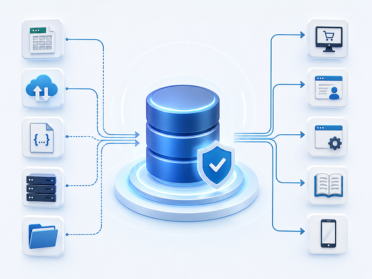
The Single Source of Truth
PIM consolidates approved technical specifications, commercial attributes, product descriptions, documents, images, product relationships, and channel content into one governed product-information layer. It enables product, marketing, sales, eCommerce, distributor, and service teams to work with consistent information.
- Consolidate product information from ERP, PLM, spreadsheets, DAM, and legacy systems
- Reduce duplicate and conflicting product records
- Maintain governed information across product families, brands, regions, and channels
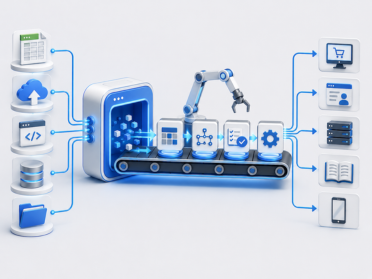
Complex Product and Configuration Management
Equipment portfolios often include multiple models, capacities, options, accessories, materials, and configurations. PIM structures these commercial product relationships so teams and customers can understand which options, components, and accessories belong with each product.
- Manage product families, models, variants, options, and accessories
- Define compatible and incompatible product relationships
- Connect configuration data with CPQ, commerce, and sales systems

Standardized Technical Product Information
Technical attributes may be defined differently across product lines, engineering teams, plants, and legacy systems. PIM creates standardized structures for specifications such as dimensions, capacities, ratings, materials, performance data, operating conditions, and other category-specific attributes.
- Standardize technical attributes, terminology, units, and formats
- Define category- and equipment-specific product models
- Apply validation and completeness rules before publication

Spare Parts and Aftermarket Enablement
Equipment may remain in operation for years or decades, creating long-term demand for replacement parts, service kits, accessories, and technical documentation. PIM helps connect equipment with the parts and information required to support customers throughout the product lifecycle.
- Link spare parts, accessories, kits, and replacements to equipment
- Manage alternate and superseded part relationships
- Support searchable digital spare-parts catalogs and service portals

Digital Commerce and AI Readiness
Digital buyers increasingly expect to search, filter, compare, configure, and evaluate complex equipment without depending entirely on sales representatives or printed catalogs. Structured PIM data makes equipment information more usable for digital commerce and future AI applications.
- Improve technical search, filtering, comparison, and product selection
- Support attribute- and application-driven product discovery
- Prepare structured product information for natural-language search and AI applications
Our Approach to PIM Implementation Services
Our PIM implementation services help equipment manufacturers structure complex product models, technical specifications, configurations, spare-parts relationships, and downstream integrations.
01
Assessment and Planning
Analyze your product portfolio, ERP and PLM landscape, product structures, technical attributes, workflows, documentation, channels, and business objectives to define a practical PIM implementation roadmap.
02
Customization and Configuration
Design equipment-specific product models, categories, technical attributes, product relationships, configuration structures, user roles, validation rules, workflows, and integrations.
03
Enrichment and Governance
Cleanse and migrate existing product information, standardize technical attributes, define data ownership, and configure enrichment, review, approval, and product-change workflows.
04
Deployment and Training
Launch PIM across priority product families, brands, markets, and channels, train internal users, monitor adoption, and provide ongoing post-deployment support.
Business Impact of PIM for Equipment Manufacturers
PIM transforms fragmented equipment product information into a governed business asset. It reduces manual data work, improves technical product accuracy, accelerates product launches, strengthens distributor and aftermarket operations, and enables manufacturers to scale digital sales without increasing product-data complexity.



Real Business Impact: PIM Success Stories in Equipment & Manufacturing
Leading Aviation Solutions Provider
48%
Improvement in Operational Efficiency
Credencys delivered a unified digital commerce solution that standardized product and packaging information, streamlined complex workflows, and improved collaboration across airline and retail operations.
Read MoreLeading Sports Equipment Manufacturer
50%
Improvement in Data Consistency
Credencys implemented a centralized PIM solution to manage more than 10,000 products with 200+ attributes, automate product review and validation workflows, and syndicate accurate product information to the company’s eCommerce platform.
Read MoreAutomotive Aftermarket Parts Manufacturer
40%
Faster Data Syndication
Credencys implemented a centralized PIM solution to unify fragmented product information, automate data validation and updates, support ACES and PIES requirements, and streamline product-data distribution across retailers, distributors, and eCommerce channels.
Read MoreReady to Modernize Your Equipment Product Data?
Build a trusted product-data foundation that connects technical information with sales, distributors, digital commerce, spare parts, and service, without replacing the ERP and PLM systems your engineering and operations teams already rely on.
Book a Free ConsultationWhy Leading Enterprises Choose Credencys?
Credencys helps enterprises turn complex data into trusted insights, intelligent operations, and measurable business growth. Here’s what makes us a preferred data and AI partner:

End-to-End Data Expertise
From data strategy to AI deployment, we cover the entire spectrum—Data Management, Engineering, Insights, and Intelligence—to ensure your data drives measurable business outcomes.

Domain-Focused Solutions
Whether you're in retail, automotive, or manufacturing, our purpose-built platforms solve industry-specific challenges with precision and speed.

Enterprise-Grade Partnerships
We collaborate with the best in the business to deliver future-ready, scalable, and secure solutions.

AI-First
We help you move beyond dashboards—accelerating AI readiness, deploying GenAI and enterprise AI agents, and enabling intelligent automation across your data ecosystem.
50+
Enterprise Clients
100%
Certified Consultants
15+
Years Experience
4.9/5
Client Satisfaction
We Build PIM Solutions for


Frequently Asked Questions
Product Information Management for equipment manufacturers is a centralized approach to managing, enriching, governing, and distributing the commercial and customer-facing information associated with equipment, components, accessories, and spare parts. It helps manage technical specifications, product families, configurations, compatibility relationships, descriptions, documents, images, spare-parts relationships, and channel-specific product content.
ERP, PLM, and PIM serve different but complementary purposes. PLM typically manages engineering definitions, product development, CAD relationships, engineering changes, and BOMs.
ERP manages transactional and operational information such as materials, inventory, procurement, pricing, and orders. PIM consumes approved information from these systems and turns it into governed, enriched product information that can be used by sales, distributors, dealers, eCommerce, digital catalogs, service teams, and customers.
Yes. PIM can model product families, models, options, variants, accessories, relationships, and commercial compatibility rules.
For highly configurable equipment, PIM can also integrate with CPQ, PLM, ERP, or dedicated configuration engines so product information remains consistent throughout the selling process.
Yes. PIM can consume approved product, component, and relationship information derived from engineering and service structures managed in PLM or ERP.
However, PIM should not normally replace the engineering system responsible for authoritative EBOM or MBOM management. Its role is to make relevant approved information usable across commercial, digital, and service channels.
PIM can connect equipment models with replacement parts, service kits, accessories, compatible components, alternate products, and superseded parts. These relationships can then power spare-parts catalogs, dealer portals, service applications, eCommerce experiences, and internal sales tools.
Trusted by Best
Choosing Credencys means partnering with a team that’s deeply committed to unlocking the true value of your data. Here’s why industry leaders trust us:
Our Valued Clientele


Send us a Message
