

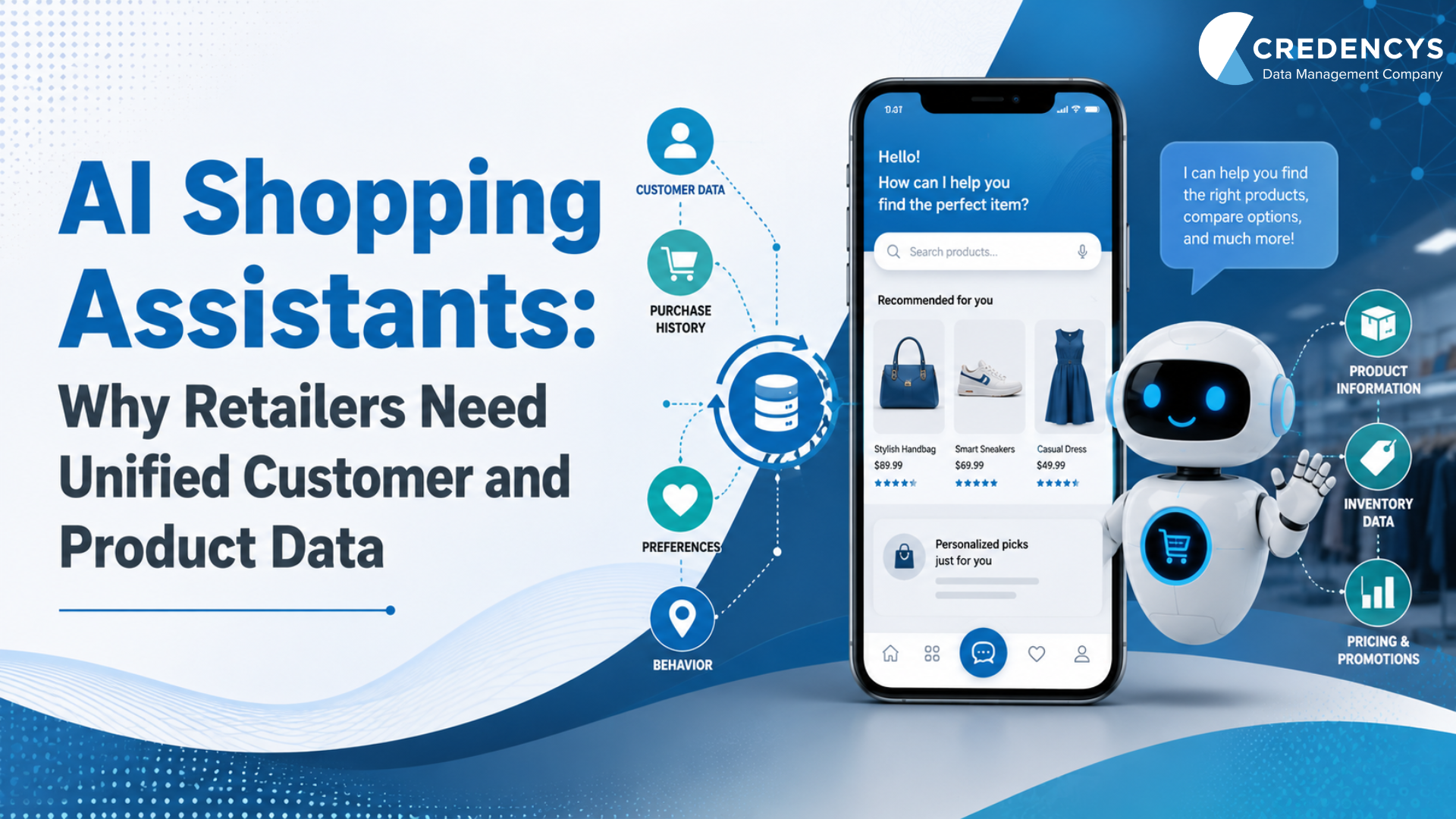
AI Shopping Assistants: Why Retailers Need Unified Customer and Product Data
Retail customers do not think in SKUs, product taxonomies, or database fields. They express needs in their own words.
A shopper may ask for a lightweight jacket for a September trip or a replacement part compatible with an appliance bought two years ago. They expect an AI shopping assistant to understand the request and recommend the right option.
Producing a natural-sounding answer is the easy part. Producing an answer that is accurate, personalized, available, and commercially valid is much harder.
The assistant needs product, customer, inventory, pricing, and order data. This information often remains divided across ecommerce, ERP, PIM, loyalty, and customer platforms.
AI shopping assistants cannot overcome that fragmentation on their own. They need a connected data foundation.
PIM provides trusted product intelligence. Customer 360 provides trusted customer context.
When these foundations connect with real-time commerce systems, retailers can move from basic conversational search toward reliable agentic commerce.
What Are AI Shopping Assistants?
AI shopping assistants are conversational systems that help customers find, evaluate, and purchase products. Instead of relying only on keywords and filters, shoppers can explain what they want using natural language.
Depending on their capabilities, these assistants can interpret intent, discover and compare products, recommend bundles, check availability, and support checkout or post-purchase activities. The most advanced assistants are part of a broader shift toward agentic commerce.
These agents can reason across several sources, plan steps, and take approved actions on behalf of a customer or retailer.
AI Shopping Assistants vs. Traditional Retail Chatbots
Traditional chatbots follow predefined questions and workflows. AI shopping assistants are expected to understand a broader goal and maintain context throughout the interaction.
| Traditional Retail Chatbot | AI Shopping Assistant |
|---|---|
| Responds to predefined questions | Understands broader shopping intent |
| Uses scripted answers and workflows | Reasons across customer and product data |
| Handles one request at a time | Maintains context throughout the journey |
| Provides links or basic suggestions | Compares products and recommends next steps |
| Operates within a narrow system | Coordinates information across retail platforms |
The difference is not only the AI model. It is the quality and range of data available to the assistant.
Why Agentic Commerce Changes Retail Data Requirements
Traditional eCommerce places most of the discovery work on the customer. Shoppers enter keywords, apply filters, open multiple product pages, and manually compare specifications.
An AI assistant changes that interaction. A customer may simply say: “Find a lightweight, waterproof jacket in my size for a September trip, under $150, and available for delivery this week.”
To respond correctly, the assistant may need to know:
- The customer’s size, fit, and preferences
- The destination and weather conditions
- Verified product features and available variants
- Current price and applicable promotions
- Inventory, delivery feasibility, and location
Each part of the request maps to a different data domain. Preferences may live in loyalty, attributes in PIM, prices in ERP or commerce, and availability in inventory systems.
The more responsibility retailers give an assistant, the less tolerance there is for incomplete or contradictory information.
The Data Problem Holding Back AI Shopping Assistants
Most retailers did not design their architecture for agent-led shopping. Product data may be distributed across PIM, ERP, supplier portals, and ecommerce.
Customer information may sit separately in CRM, CDP, loyalty, point-of-sale, and service systems. Different identifiers, definitions, formats, and update cycles may result in the assistant having several versions of the same customer or product.
This fragmentation creates practical problems:
- Recommendations rely on incomplete product attributes.
- An assistant suggests an item that is unavailable.
- Prices or promotions differ from the ecommerce platform.
- Duplicate customer records lead to inconsistent personalization.
- Product comparisons omit important specifications.
- Consent preferences are not applied consistently.
- The assistant cannot explain why it selected a product.
Generative AI can make these problems difficult to detect because the response may still sound confident and helpful. A fluent answer is not necessarily a correct answer.
Inaccurate recommendations can lead to abandoned carts, avoidable returns, higher service costs, and lower trust.
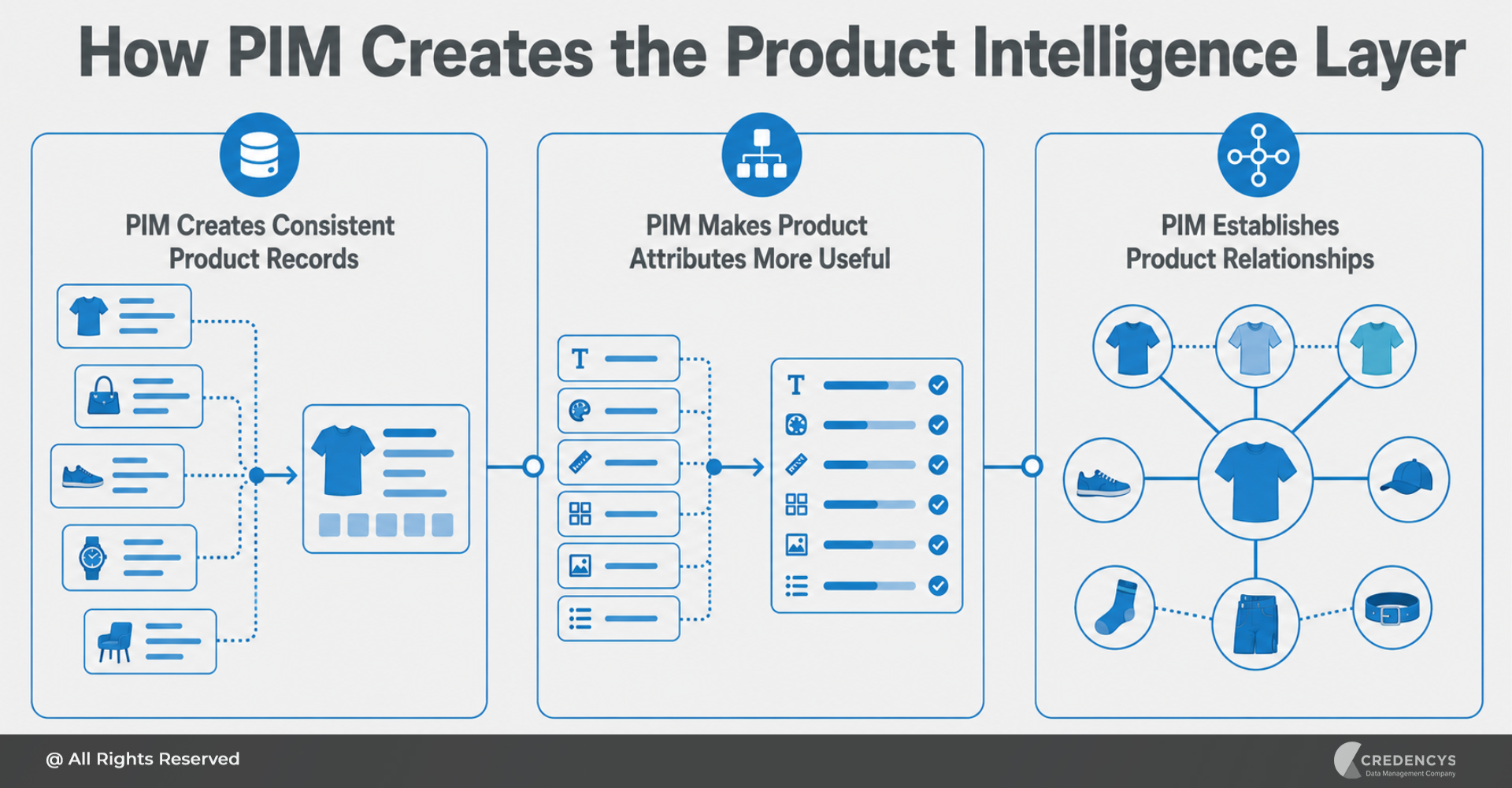
How PIM Creates the Product Intelligence Layer
A PIM platform creates a governed source for enriched product information. Structured attributes help the assistant understand what a product is, how it differs from alternatives, and when it is suitable.
Depending on the retail category, this information may include:
- Names, descriptions, categories, and taxonomies
- Technical specifications, materials, or ingredients
- Sizes, colors, variants, and dimensions
- Usage, care, regulatory, and compliance information
- Product media and localized content
- Compatibility, substitutes, associations, and bundles
1. PIM Creates Consistent Product Records
Product information arrives from suppliers and internal systems in various formats and with varying levels of completeness. PIM consolidates and standardizes it, giving the assistant a consistent structure for finding and comparing products.
2. PIM Makes Product Attributes More Useful
Customers often search by need rather than category. Detailed attributes help the assistant translate that intent into product criteria.
When attributes are missing, the assistant may infer information the retailer has not verified.
3. PIM Establishes Product Relationships
PIM can also manage compatibility and product relationships. This helps the assistant identify which accessory fits a device, which refill belongs to a dispenser, or which part works with an earlier model.
PIM does not usually have all the information needed for a purchase. Real-time inventory, dynamic pricing, promotions, and delivery estimates may remain in other systems.
PIM must therefore connect with commerce and operational platforms rather than becoming another isolated repository.
How Customer 360 Provides the Customer Context
Accurate product information explains what the retailer sells. It does not explain which product is right for a specific customer.
Customer 360 creates a connected view of each customer across identities, interactions, transactions, and preferences. It brings together records from online and offline channels so the assistant can work with consistent customer context.
Subject to the customer’s consent, that view may include:
- Identity and contact information
- Purchase and service history
- Browsing behavior and stated preferences
- Product affinities and loyalty status
- Preferred channels, location, and language
- Privacy and consent preferences
1. Customer 360 Resolves Customer Identities
The same shopper may appear under different email addresses, loyalty identifiers, devices, or store records. Identity resolution connects those records into a trusted profile that can be used consistently.
2. Customer 360 Preserves Journey Context
Shopping journeys rarely happen in one session. A connected profile allows the assistant to continue a journey across mobile, stores, service, and ecommerce, rather than treating each interaction as new.
3. Customer 360 Supports Responsible Personalization
A governed Customer 360 foundation helps the assistant use preferences and purchase history while respecting consent, eligibility, privacy, and usage policies.
Why Retailers Need PIM and Customer 360 Together
PIM and Customer 360 solve different parts of the same shopping problem.
PIM answers: What do we know about this product?
Customer 360 answers: What do we know about this customer?
The AI shopping assistant connects the two to answer the question: Which product is most appropriate for this customer in this context? Consider a returning customer looking for a replacement skincare product.
The assistant can use Customer 360 to understand previous purchases, stated preferences, and known sensitivities. It can then use PIM to compare ingredients, product benefits, sizes, and usage instructions.
Inventory, pricing, and fulfillment systems confirm whether the product is available at the right price and can be delivered when needed.
Without PIM, the assistant lacks dependable product knowledge. Without Customer 360, it lacks individual context.
Without operational integrations, it cannot confirm whether its recommendation can be fulfilled. Unified data does not mean moving everything into a single application.
It means establishing trusted records, shared definitions, connected identifiers, clear governance, and reliable access across systems. That distinction matters.
Retailers need a coordinated data ecosystem, not another large repository that recreates existing silos.
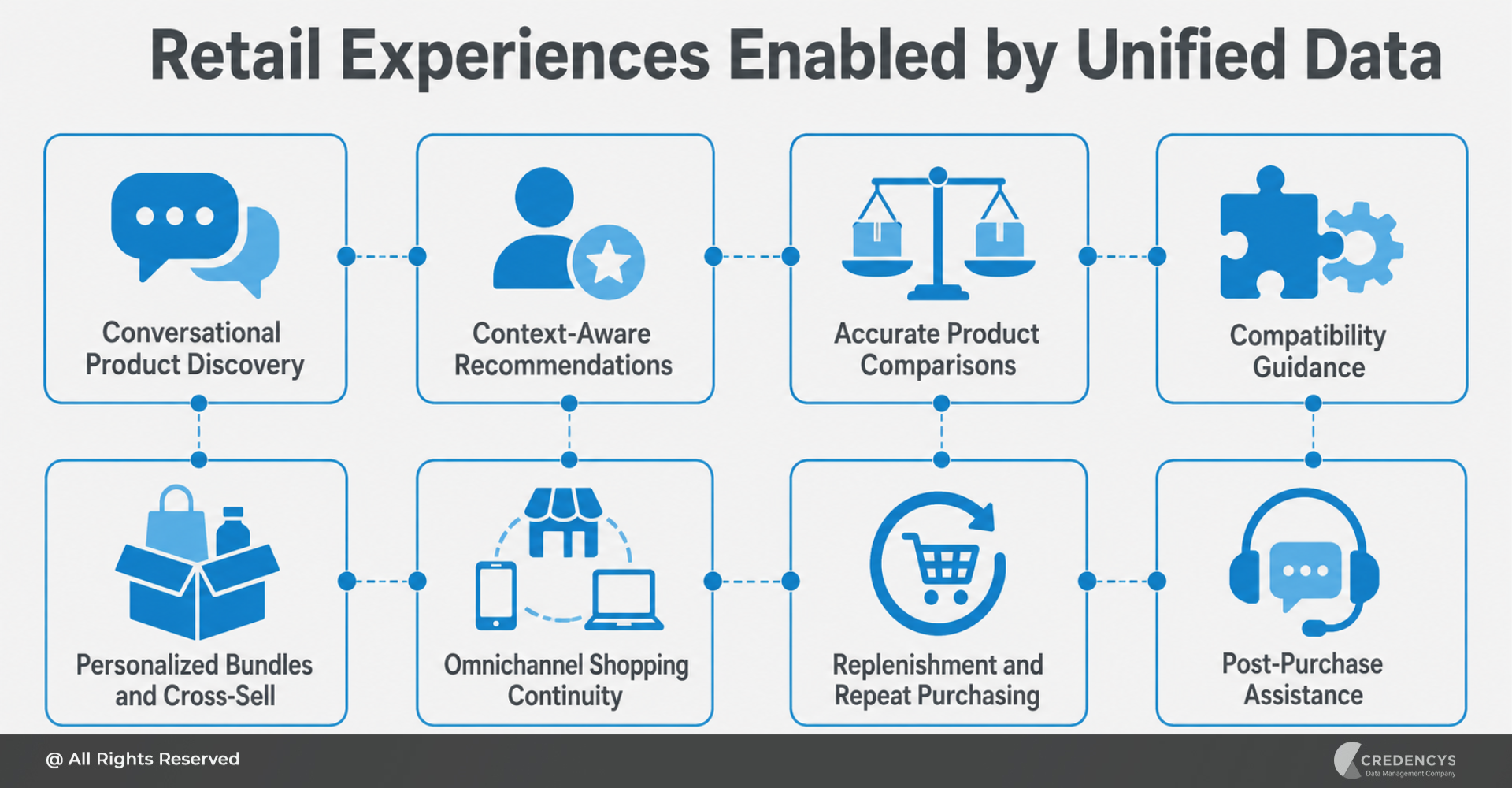
Retail Experiences Enabled by Unified Data
Connected product and customer data supports several high-value shopping experiences.
1. Conversational Product Discovery
Customers describe an outcome or constraint without knowing the product name. The assistant maps that intent to product attributes and returns a relevant shortlist.
2. Context-Aware Recommendations
Recommendations can reflect purchases, preferred brands, sizes, budget, location, and current intent, rather than relying on generic suggestions.
3. Accurate Product Comparisons
Standardized attributes allow the assistant to compare products on relevant criteria and explain the differences.
4. Compatibility Guidance
Product relationships and purchase history help customers select compatible accessories, refills, replacement components, or parts.
5. Personalized Bundles and Cross-Sell
The assistant can combine product relationships with customer context to build bundles that complete the intended use case.
6. Omnichannel Shopping Continuity
Customers can begin online and continue on mobile, via a contact center, or with a store associate without losing context.
7. Replenishment and Repeat Purchasing
Purchase history helps identify items that may need to be reordered. The assistant can verify the current version, availability, and suitable alternatives.
8. Post-Purchase Assistance
Product instructions, warranty details, order data, and service history can support setup, troubleshooting, returns, and replacements.
The Data Architecture Behind an AI Shopping Assistant
The conversational interface is only the visible layer. Behind it sits a network of data, integration, intelligence, and governance components.
The foundation may include:
- PIM for product information
- Customer MDM, Customer 360, and CDP for identity and behavioral signals
- ERP, order management, and inventory systems for operational data
- DAM for product media
- eCommerce platforms for cart and checkout
APIs and event-driven integrations make this information available to the assistant. Retailers also need AI-ready data pipelines to keep product, customer, and operational information accurate and accessible.
A retrieval layer identifies relevant records, while business rules control what information can be used and which actions are permitted. The AI model then interprets intent and generates a response grounded in approved sources.
Agent orchestration can coordinate multistep tasks, but confirmation controls should remain in place for purchases, substitutions, cancellations, and other high-impact actions. Retailers should be able to trace the data behind a recommendation and investigate incorrect responses.
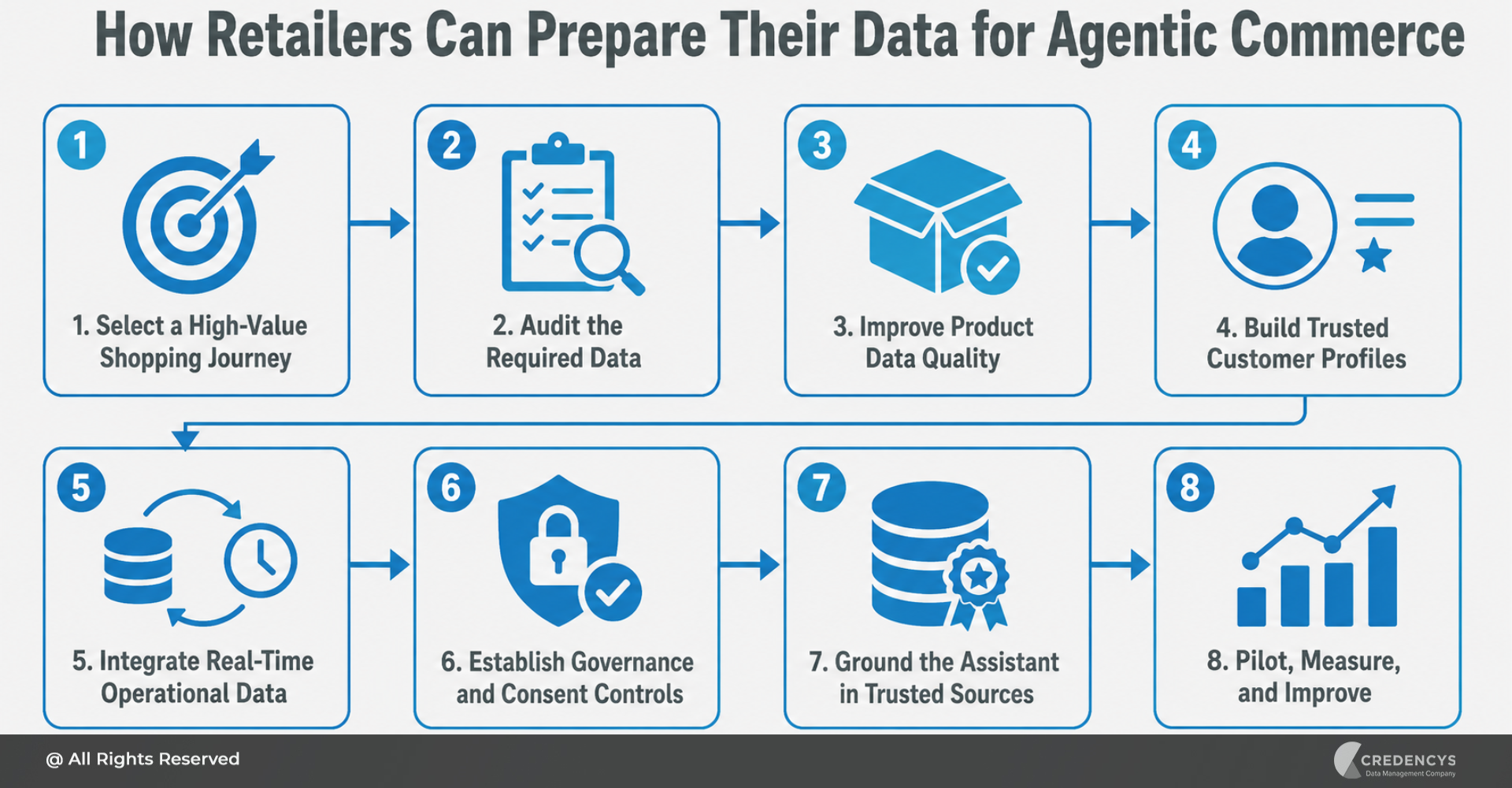
How Retailers Can Prepare Their Data for Agentic Commerce
Retailers do not need to connect every system before testing an assistant. They do need a defined use case and dependable data for the selected journey.
1. Select a High-Value Shopping Journey
Begin with a problem where conversational assistance can create measurable value. Define the decisions the assistant will support and the actions it can take.
2. Audit the Required Data
Map the required product, customer, inventory, pricing, order, and policy data. Identify ownership, quality issues, update frequency, and access restrictions.
3. Improve Product Data Quality
Standardize attributes, resolve duplicates, define category requirements, and address missing values. The data should answer the questions customers actually ask.
4. Build Trusted Customer Profiles
Connect customer records and establish identity resolution rules. Determine which profile data is reliable, permitted, and valuable for personalization.
5. Integrate Real-Time Operational Data
Connect inventory, pricing, promotion, order, and fulfillment systems so recommendations reflect current commercial conditions.
6. Establish Governance and Consent Controls
Define which data the assistant can access, how long context is retained, and which actions require confirmation. Involve security, privacy, and regulatory teams early.
7. Ground the Assistant in Trusted Sources
Use retrieval and business rules to ground answers in approved data. The assistant should acknowledge missing information rather than inventing a product fact or policy.
8. Pilot, Measure, and Improve
Test within a controlled category. Review recommendations, handoffs, and outcomes before expanding to more products, channels, or actions.
Key Risks Retailers Must Address
Greater AI capability also creates greater operational responsibility. Retailers should address several risks before scaling an assistant.
- Inaccurate recommendations: Do not fill missing attributes with unsupported assumptions.
- Outdated information: Keep inventory, price, promotion, and delivery data current.
- Customer privacy: Align personalization with consent and regulation.
- Biased ranking: Monitor merchandising and recommendation logic.
- Limited explainability: Make recommendations understandable.
- Excessive autonomy: Set limits, confirmations, and escalation paths.
Governance should not be added after the assistant is deployed. It should be designed into the data, integration, and agent architecture from the beginning.
How to Measure AI Shopping Assistant Performance
Traffic and conversation volume do not show whether an assistant is helping customers make better decisions. Retailers need a balanced set of experience, commercial, and data-quality metrics.
Customer experience metrics may include:
- Recommendation relevance
- Discovery success and conversation completion
- Customer satisfaction and human handoff rate
- Commercial metrics may include:
- Assisted conversion and average order value
- Bundle acceptance and cart abandonment
- Product return rate
- Data and AI quality metrics may include:
- Product completeness and identity match rate
- Incorrect recommendation rate and data freshness
- Response accuracy and latency
These measures help retailers separate an engaging demonstration from a shopping capability that produces sustainable business value.
How Credencys Helps Retailers Build the Data Foundation
Building an AI shopping assistant is not only a model development project. It requires product data management, customer data integration, master data governance, real-time connectivity, and responsible AI design.
Credencys helps retailers establish this foundation by bringing together data strategy, PIM, Customer 360, MDM, data engineering, integration, and AI capabilities.
Our teams can help retailers:
- Identify use cases and assess data readiness
- Implement or modernize PIM and Customer 360
- Improve data quality and governance
- Integrate commerce and operational platforms
- Develop, pilot, and scale agentic shopping experiences
The goal is not to deploy another disconnected interface. It is to build an assistant that can use trusted enterprise data to support accurate, relevant, and actionable shopping decisions.
Better Shopping Assistants Begin with Better Data
AI shopping assistants are changing how customers discover, compare, and purchase products. As these systems become more capable, the data behind them becomes more important.
PIM provides accurate and enriched product intelligence. Customer 360 provides trusted customer context.
Inventory, pricing, order, and fulfillment systems add the real-time information needed to act. When these components work together, retailers can deliver AI shopping experiences that are personalized without becoming unreliable, and automated without losing governance.
Retailers that address the data foundation now will be better prepared to move beyond basic conversational assistance and participate confidently in agentic commerce.
Frequently Asked Questions
What is an AI shopping assistant?
An AI shopping assistant is a conversational system that helps customers find, compare, and select products. Advanced assistants can also coordinate tasks such as checking availability, creating bundles, and supporting checkout or post-purchase requests.
Why does an AI shopping assistant need PIM?
PIM provides structured, enriched, and governed product information. It helps the assistant understand product attributes, variants, categories, relationships, and compatibility, rather than relying on incomplete descriptions.







Tags: