


PIM Implementation Consulting: A Complete Guide to to Implement a PIM System
Did you know that inconsistent product data costs businesses an average of 3.5% of their annual revenue? [Source: Gartner]
Millennials and Gen Z consumers expect accurate, personalized, and up-to-date product information across every channel, managing product data manually or in spreadsheets is no longer sustainable.
That’s why your business needs a Product Information Management (PIM) implementation consulting comes in. A PIM system serves as a single source of truth for all product-related content, streamlining data collection, enrichment, and distribution to eCommerce platforms, marketplaces, and sales channels. Done right, PIM not only eliminates errors and duplication but also speeds up time-to-market and enhances customer experience.
In this blog, we’ll walk through what PIM implementation consulting really means, why it has become essential for modern businesses, the steps to implement it successfully, the challenges companies often face, and how organizations like yours can unlock measurable value by adopting the right PIM strategy.
What you’ll learn in this article
- The business problems PIM implementation consulting solves
- A step-by-step roadmap to implement PIM successfully
- Real-world use cases and business outcomes
- Key challenges and how to overcome them
- Why Credencys is a trusted partner for PIM implementation
PIM Implementation Consulting Plan for Your Business
A strong PIM implementation consulting plan aligns business goals, people, processes, and platforms so your teams can publish accurate product content at scale. Think of it as a roadmap that moves from discovery to value realization without disrupting day-to-day operations.
Plan overview
- Define vision and success metrics: Set the business case, scope, and measurable targets such as faster time to market, higher data completeness, and fewer returns.
- Audit current product data: Map sources, owners, formats, and quality. Identify duplicates, gaps, and governance risks.
- Design the target data model and taxonomy: Define attributes, hierarchies, variants, bundles, localization, and compliance fields that your channels require.
- Blueprint integrations: Decide how PIM will connect with ERP, eCommerce, DAM, CMS, pricing, and marketplaces. Prioritize the highest value flows first.
- Configure workflows and governance: Create roles, permissions, validations, and enrichment steps to enable teams to collaborate with clear accountability.
- Prepare data for migration: Profile, cleanse, standardize, de-duplicate, and map legacy data to the new model. Plan test loads and rollbacks.
- Pilot and user acceptance: Run an end-to-end pilot with a meaningful product slice and a few channels. Capture feedback and tune workflows.
- Readiness and cutover: Finalize training, support, and communications. Plan freeze windows, delta loads, and go-live checklists.
- Hypercare and continuous improvement: Monitor KPIs, resolve issues quickly, and iterate on the backlog of enhancements and new channel syndications.
Steps to Successfully Implement a PIM System: End-to-End PIM Implementation Consulting
These steps turn the plan into action and are written in plain language for business and technical leaders.
Step 1: Design your PIM for the business you run
Meet with stakeholders across merchandising, marketing, operations, and IT. Capture the real-world data flows from supplier to shelf. Agree on the single source of truth, who owns which attributes, and what good product content looks like for each channel.
Step 2: Build a future-ready data model
Translate requirements into a structured model. Define product families, variants, attributes, reference data, and localization rules. Keep it flexible enough for new categories and markets without constant rework.
Step 3: Configure the platform and workflows
Set up roles, permissions, validation rules, and enrichment stages. Automate repetitive checks so users focus on quality content rather than manual policing. Configure versioning and audit trails for trust and compliance.
Step 4: Integrate with your ecosystem
Connect PIM to ERP for master data, to DAM for media, to eCommerce for storefronts, and to marketplaces for syndication. Use well-documented APIs and event-driven updates where possible. Start with the integrations that unlock the most value.
Step 5: Migrate and enrich your data
Import product data from spreadsheets and legacy systems. Cleanse, standardize, and de-duplicate. Fill mandatory attributes, attach the right assets, and complete category-specific specs so products are truly ready for publication.
Step 6: Test end-to-end with a real product set
Validate completeness, approvals, publishing, and round-trip updates. Include performance and error handling checks. Fix root causes, not just symptoms.
Step 7: Train people and enable change
Provide role-based training for product managers, marketers, and data stewards. Share quick reference guides and office hours. Appoint champions who can coach teams after go-live.
Step 8: Go live with confidence
Execute the cutover plan, monitor data pipelines, and keep a rapid response channel open for the first weeks. Track KPIs such as time to publish, data completeness, and incident volume daily.
Step 9: Operate, measure, and improve
Schedule regular data quality reviews, expand to new channels, and refine workflows. Use dashboard insights to prove ROI and to guide the next phase of enhancements.
The Business Problems PIM Implementation Consulting Solves
Every growing business eventually hits the same wall: product data chaos. Product information lives in scattered spreadsheets, ERP systems, supplier files, and marketing documents. Teams waste hours chasing the “right” version of a product detail, while customers often see outdated or inconsistent information across channels.
According to a McKinsey study, poor data quality leads to 20–30% of revenue losses for companies that fail to maintain clean and consistent product information.
Without a structured system like PIM, these problems only grow as product catalogs expand. Here are the most common challenges businesses face before PIM implementation consulting:
1. Fragmented Data Sources
Product information is often siloed across multiple systems, ERP, DAM, spreadsheets, and supplier portals, making it difficult to create a single version of truth.
2. Inconsistent and Error-Prone Data
Manual data entry leads to errors, duplicates, and outdated product information, causing mistrust among both customers and internal teams.
3. Slow Time-to-Market
Launching new products or updating catalogs takes weeks because information must be collected, cleaned, and distributed across many channels manually.
4. Poor Omnichannel Experience
Customers expect seamless and accurate information, whether they are shopping on an e-commerce store, a marketplace, or in-store. Inconsistent data creates friction and damages brand credibility.
5. Limited Scalability
As businesses expand to new regions, languages, and channels, the lack of a centralized system makes managing localization and multi-channel syndication overwhelming.
How PIM Implementation Consulting Solves These Problems
- A properly implemented PIM centralizes all product information into a single, authoritative repository. This allows teams to:
- Reduce manual effort and eliminate costly errors.
- Automate product data distribution to all sales and marketing channels.
- Support faster product launches and quicker market expansion.
- Enable consistent customer experiences across every touchpoint.
PIM Implementation Consulting Methodology
Every business has its own product data challenges, but a well-defined methodology ensures PIM adoption is structured, predictable, and ROI-driven. A typical PIM implementation consulting methodology blends strategy, technology, and governance into a phased approach.
1. Discovery & Business Alignment
Before configuring anything, stakeholders define why PIM is needed and what success looks like. This includes aligning KPIs like faster time-to-market, improved data quality, or streamlined channel syndication.
2. Data Assessment & Modeling
An in-depth audit of existing product data highlights inconsistencies, gaps, and redundancies. This informs the design of a flexible data model and taxonomy tailored to your business.
3. Solution Design & Integration
The PIM platform is configured to match workflows, roles, and approval processes. Integration blueprints are created for ERP, eCommerce, marketplaces, DAM, and CRM systems.
4. Migration & Enrichment
Clean, validate, and migrate legacy product data into the new PIM. Simultaneously, enrich content with attributes, digital assets, and localized details to prepare for omnichannel use.
5. Pilot, Testing & Training
A controlled pilot ensures that workflows, integrations, and publishing are working seamlessly. Teams are trained in real-world scenarios to build confidence before full roll-out.
6. Go-Live & Continuous Optimization
Launch is followed by hypercare support and ongoing improvements. Performance is tracked with measurable KPIs, and the system evolves with new channels, product lines, or business models.
Why Should You Consider Consulting and Implementing a PIM System?
In today’s digital-first economy, customers expect accurate, consistent, and rich product information across every touchpoint—whether they’re shopping online, in-store, or on a marketplace. Managing this at scale with spreadsheets or disconnected systems is nearly impossible. That’s where a PIM system becomes essential.
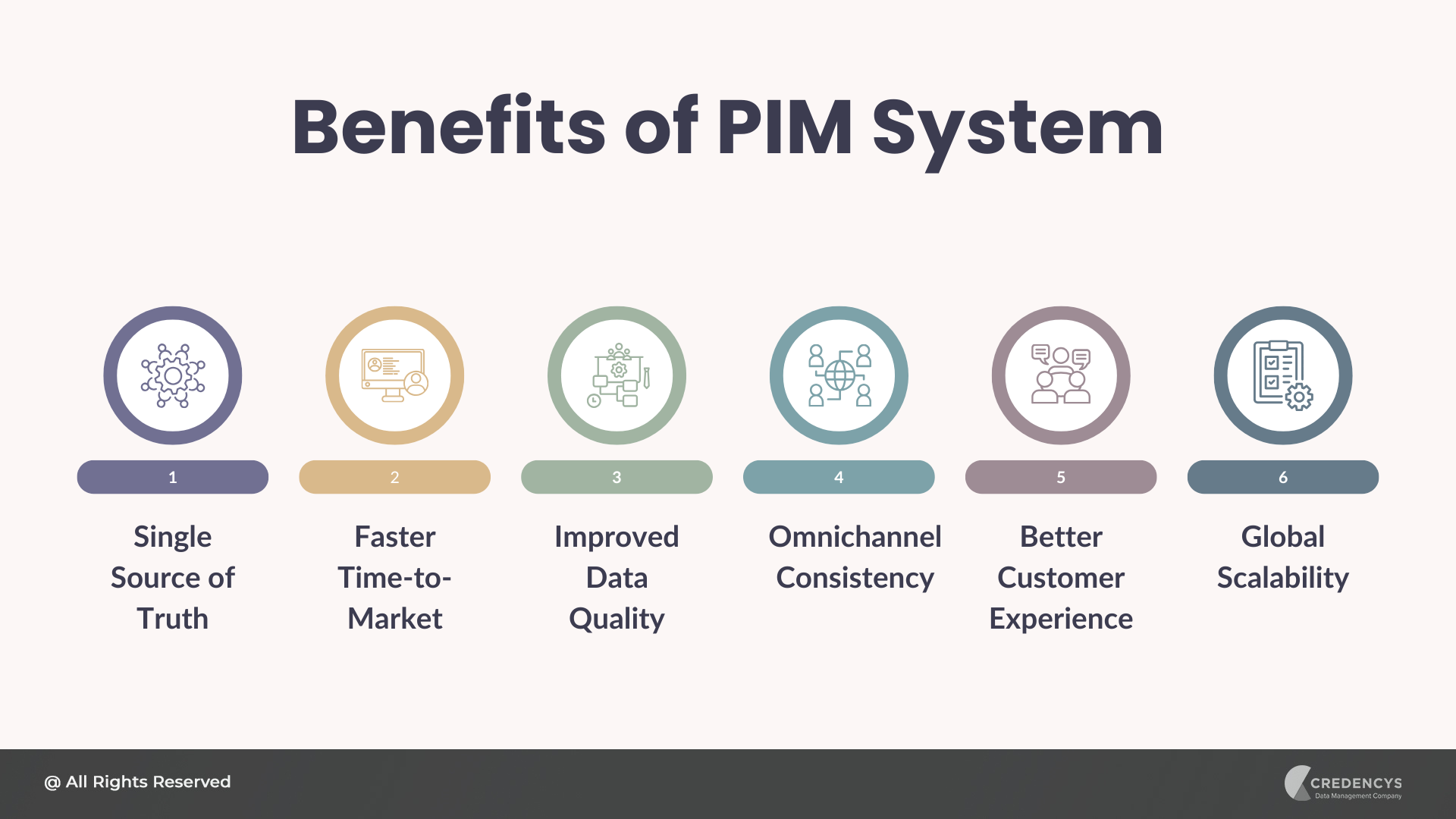
Key reasons to implement a PIM system:
1. Single Source of Truth
Eliminate silos by consolidating product data from ERP, suppliers, and internal systems into one central hub. This ensures every team works with the same, accurate information.
2. Faster Time-to-Market
By automating workflows and streamlining data enrichment, PIM helps launch products across multiple channels much faster—an edge that’s critical in competitive markets.
3. Improved Data Quality
Standardized attributes, validations, and governance rules ensure your product data is complete, consistent, and compliant across all touchpoints.
4. Omnichannel Consistency
PIM enables seamless syndication to eCommerce stores, marketplaces, catalogs, mobile apps, and in-store systems, ensuring customers get a unified experience everywhere.
5. Better Customer Experience & Conversion
Rich content—complete specs, accurate descriptions, localized details, and high-quality images—reduces returns and boosts conversion rates.
6. Global Scalability
For brands expanding into new geographies, PIM supports localization, translations, and region-specific compliance, making global product rollouts smoother.
7. Efficiency & Cost Savings
By reducing manual data entry, rework, and errors, PIM frees up teams to focus on growth-driven initiatives instead of firefighting data issues.
How to Implement a PIM System: Steps to Follow for PIM Implementation and Consulting
Proper implementation of the PIM system in the organization gives a range of benefits. You have to spend enough time researching how to implement a product information management system. Do not forget that you require a PIM for your business and use every option to implement this system according to your needs.
1. Focus on the Outcome
You must know the basics of the project before determining which categories of data belong where. You must define the PIM strategy goals first and determine the target you aim to achieve through the PIM system implementation.
Your personnel may struggle to access a single source of truth for the overall product information in your business, or you may wish to enhance the data quality by validating product information against current data standards.
A right PIM implementation consulting can fulfill the requirements of customers who demand that you publish product information to a data pool.
You can use the professional method to scope the project and follow suggestions to keep the first phase of your product delivery small. This is to prevent business misalignment and run the project within the budget.
If the early phase of the project to implement the product information system is successful, then you can gain the necessary confidence and interest to develop the next phase of the project with new goals and scope.
2. Align the Business
Often, the overall business struggles to gather necessary data. Marketing teams cannot find the product outcomes, and other teams, such as the data management team, struggle to collect product details from the in-house systems when there is no PIM system properly implemented.
The complete product data in a spreadsheet includes errors, and product suppliers notify us of these errors and send corrections. This lengthy process ends in both irritation and frustration.
It is a suitable time to implement a PIM system and ensure that the business and management are on board. You must be very conscious of the work method and the overall recording of responsibilities before going to the next step.
3. Set up the System
All beginners to the Pimcore Implementation guidelines must focus on setting up the PIM system. If you make certain who to involve and what data you require, then you have to think about how to successfully start the process to set up the PIM system.
You can create an inventory of all your processes and the setup needs for the product information management system. A PIM is vital as it makes it easy for the organization to gather and maintain product information and relate master data faster than the current methods, reducing errors.
The three buckets associated with the process of dividing the business requirements are the must-have, the should-have, and the could-have. You can hold complete interviews in the company with each department related to the process, and take note of a list of demands and wishes.
You have to divide the wishes into buckets and execute the PIM system from the phases, starting with the must-have to the could-have.
If you have done it, then you can define the data model you require. A personalized data model from PIM experts offers numerous benefits to business people. Once you have defined the data model, the data processing workflow must be in place.
You have to focus on which unit is responsible for processing the product information and which team is involved in the process to enrich the data. Do not forget to ensure that each piece of data has its owner. If you expect better than ordinary data, then the accountability of data quality is very important.
4. Import Product Information
Now, you have to get down to business and transfer available product information to the product information management system. You must fill an empty Product Information Management implementation system with data accessible from every source in your business manually or automatically.
Proper integration with the top ERP systems gives exceptional benefits to all users. You can import data via API, XML, and Excel at your convenience. The data must be de-duplicated, standardized, and validated against the system’s requirements.
5. Testing
There is nothing that can go wrong at all times. The test phase of the project is designed to identify and eliminate errors. In this phase, the data synchronization is thoroughly checked and designed to ensure that the overall system is fully functional to publish data to suppliers or data pools.
6. Go Live and Continuity
The designated users within the business can test the PIM implementation consulting before going live on the PIM system. This is because not all individuals can understand the PIM system right away in large-scale projects.
Test users give their feedback, and you have to incorporate this feedback into the PIM system. Once the PIM system starts going live, you must ensure the continuity and usage of this system. You must get prompt support to efficiently use the PIM system running in your organization.

Are you looking for a reliable PIM solution provider that follows the above-listed steps to ensure successful PIM implementation and optimize your PIM operations?
What To Do With Your Data While Implementing a PIM System?
The success of a PIM system heavily depends on the quality of the data you put into it. If poor, inconsistent, or incomplete product information is migrated, the system will fail to deliver its true value. That’s why data preparation and governance should be a top priority during implementation.

Key Actions for Managing Data During PIM Implementation Consulting
1. Audit Existing Data Sources
Identify where your product data currently lives—ERP, spreadsheets, supplier catalogs, DAM, or eCommerce platforms. Map the flow of data across these systems.
2. Cleanse & Standardize Data
Correct errors, remove duplicates, and apply consistent formats (e.g., units, naming conventions, SKUs). A clean dataset ensures smoother migration and higher reliability.
3. Fill Data Gaps
Enrich missing attributes such as technical specifications, product descriptions, or digital assets. This is also the stage to localize content for different markets.
4. Define Data Governance Rules
Establish ownership and responsibilities for data accuracy. Assign roles for who can create, approve, and update product information.
5. Prioritize High-Value Data
Not all products need to be migrated at once. Start with bestsellers or priority categories to speed up time-to-value, then phase in the rest.
6. Validate Before Migration
Run trial migrations and validation checks to ensure data is complete, compliant, and aligned with the PIM data model before final import.
7. Set Up Continuous Quality Monitoring
Post go-live, monitor product data quality with automated validations and dashboards to keep your “single source of truth” trustworthy.
Treat data migration as a business-critical step, not a technical afterthought. Well-prepared data ensures your PIM delivers long-term consistency, compliance, and customer satisfaction.
Do you want to perform all your product data operations quickly and effectively through a single platform? PIM implementation is the primary need of your business.
Common Challenges in PIM Implementation Consulting (and How to Overcome Them)
While PIM offers undeniable value, many businesses face hurdles during implementation. The key lies in anticipating these challenges and designing a roadmap that minimizes risks.
1. Data Silos and Fragmentation
Challenge: Product information often lives across ERP, CRM, spreadsheets, and multiple legacy tools, making consolidation complex.
How to Overcome: Begin with a data audit to identify overlaps, gaps, and inconsistencies. Establish a phased integration plan to centralize data without disrupting existing workflows.
2. Resistance to Change from Internal Teams
Challenge: Merchandising, marketing, and IT teams may hesitate to adopt a new system due to training needs or fear of disruption.
How to Overcome: Conduct early stakeholder workshops and provide role-based onboarding. Show measurable quick wins—like reduced manual effort or faster catalog updates—to build confidence.
3. Data Quality and Governance Issues
Challenge: Poor-quality data entering a PIM only scales errors faster. Missing attributes, duplicate entries, and inaccurate descriptions are common pitfalls.
How to Overcome: Define data governance rules and automated validation checks within the PIM. Assign data stewards to ensure accountability for product accuracy.
4. Integration with Existing Systems
Challenge: PIM must connect seamlessly with ERP, DAM, CMS, marketplaces, and digital storefronts. Complex integrations can slow adoption.
How to Overcome: Use API-driven integration and prioritize high-impact connections first (e.g., eCommerce platforms). Build a modular approach for scaling to future systems.
5. Measuring ROI and Business Impact
Challenge: Without clear KPIs, it becomes difficult to prove PIM’s value to leadership.
How to Overcome: Define metrics like time-to-market reduction, product return rates, operational efficiency, and data consistency upfront. Use dashboards within PIM to track and showcase improvements.
Success Stories of PIM Implementation Consulting
These case studies illustrate how PIM implementation consulting delivers impactful results across industries—boosting efficiency, governance, and time-to-market with real numbers and tangible improvements.
Use Case: SM Retail: Transforming Omni-Channel Product Management
Client Overview: The Philippines’ leading omni-channel retail brand, SM Retail, operates over 1,300 stores nationwide.
Problem: Their legacy PIM struggled under scale—leading to delays in pricing updates, inconsistent product information, and weak data governance.
Solution: Within just four months, Credencys deployed a modern PIM backed by Digital Asset Management (DAM) and CMS frameworks. The solution included role-based access, automated pricing updates, and strict data validation workflows
Business Impact:
- 80% reduction in pricing update time (59% faster, more precisely)
- 50% improvement in operational efficiency (47% in internal processes)
- Stronger data governance, accuracy, and customer trust
Use Case: Quick Commerce Leader – Accelerating Product Launches Across 580+ Cities
Client Overview: A premier quick-commerce and delivery platform in India, serving over 580 cities
Problem: Heavy reliance on Excel for product and workflow data caused human errors, slowed data sharing, and made brand partner collaboration inefficient
Solution: Credencys built a brand portal for streamlined product submissions, a central admin interface, and integrated PIM with DAM. The solution included automated workflows for approvals, enrichment, pricing, mapping, and API-based catalog integration
Business Impact:
- Reduced time-to-market by 29% due to faster automation
- 41% reduction in manual effort across workflows
- 32% improvement in data consistency, driving accuracy, and trust
Are you facing any challenges in your daily product data management operations after implementing a PIM system? Credencys would love to help you.
Conclusion: Why Credencys is the Right PIM Partner
Product Information Management isn’t just about centralizing product data—it’s about unlocking agility, accuracy, and scalability in an increasingly competitive digital marketplace. As seen in real-world examples from SM Retail and a leading quick-commerce platform, businesses that implement PIM with the right strategy achieve measurable results: reduced time-to-market, stronger governance, improved efficiency, and greater customer trust.
At Credencys, we bring over a decade of experience in designing and deploying enterprise-grade PIM solutions tailored to each client’s ecosystem. Our approach combines:
- Strategic Consulting: We assess your current product data maturity, identify gaps, and craft a phased roadmap.
- Seamless Implementation: From system integration (ERP, DAM, CMS, eCommerce) to data governance rules, we ensure a smooth rollout.
- Faster ROI Delivery: Our proven accelerators help businesses achieve measurable improvements—often within the first few months.
- Cross-Industry Expertise: Whether retail, e-commerce, CPG, or quick commerce, we’ve helped global brands transform product data into business growth.
With Credencys as your PIM partner, you don’t just implement a tool—you enable a foundation for consistent, scalable, and future-ready product experiences.
Frequently Asked Questions (FAQs)
Q1. What is Product Information Management (PIM) and why is it important?
A PIM system centralizes all product-related data—such as descriptions, images, pricing, and attributes—into a single source of truth. It ensures consistent, accurate, and up-to-date product information across sales channels, improving customer trust and reducing manual errors.
Q2. How does PIM improve time-to-market?
By automating workflows like data enrichment, approval, and publishing, PIM eliminates manual bottlenecks. Businesses can launch new products faster, update catalogs in real time, and respond quickly to market demands—leading to a measurable reduction in time-to-market.
Q3. What are the common challenges in PIM implementation and consulting?
Challenges include data silos, poor data quality, system integration issues, and team resistance to change. These can be overcome with a phased rollout, clear governance rules, stakeholder training, and API-based integrations.
Q4. Who benefits the most from implementing PIM?
PIM is most impactful for retailers, e-commerce businesses, CPG companies, and distributors managing large and complex product catalogs. Marketing, merchandising, and IT teams benefit by saving time, reducing errors, and improving collaboration.
Q5. How do I measure ROI from a PIM system?
Key ROI metrics include reduced time-to-market, lower product return rates, improved data accuracy, faster pricing updates, and operational efficiency gains. Many businesses see tangible improvements within the first 3–6 months of implementation.
Q6. Why should I choose Credencys as my PIM implementation partner?
Credencys brings over a decade of expertise in enterprise-grade PIM and MDM solutions. With proven success stories like SM Retail and leading quick-commerce brands, we specialize in delivering faster ROI, scalable integrations, and tailored solutions that fit your business ecosystem.




Tags: