


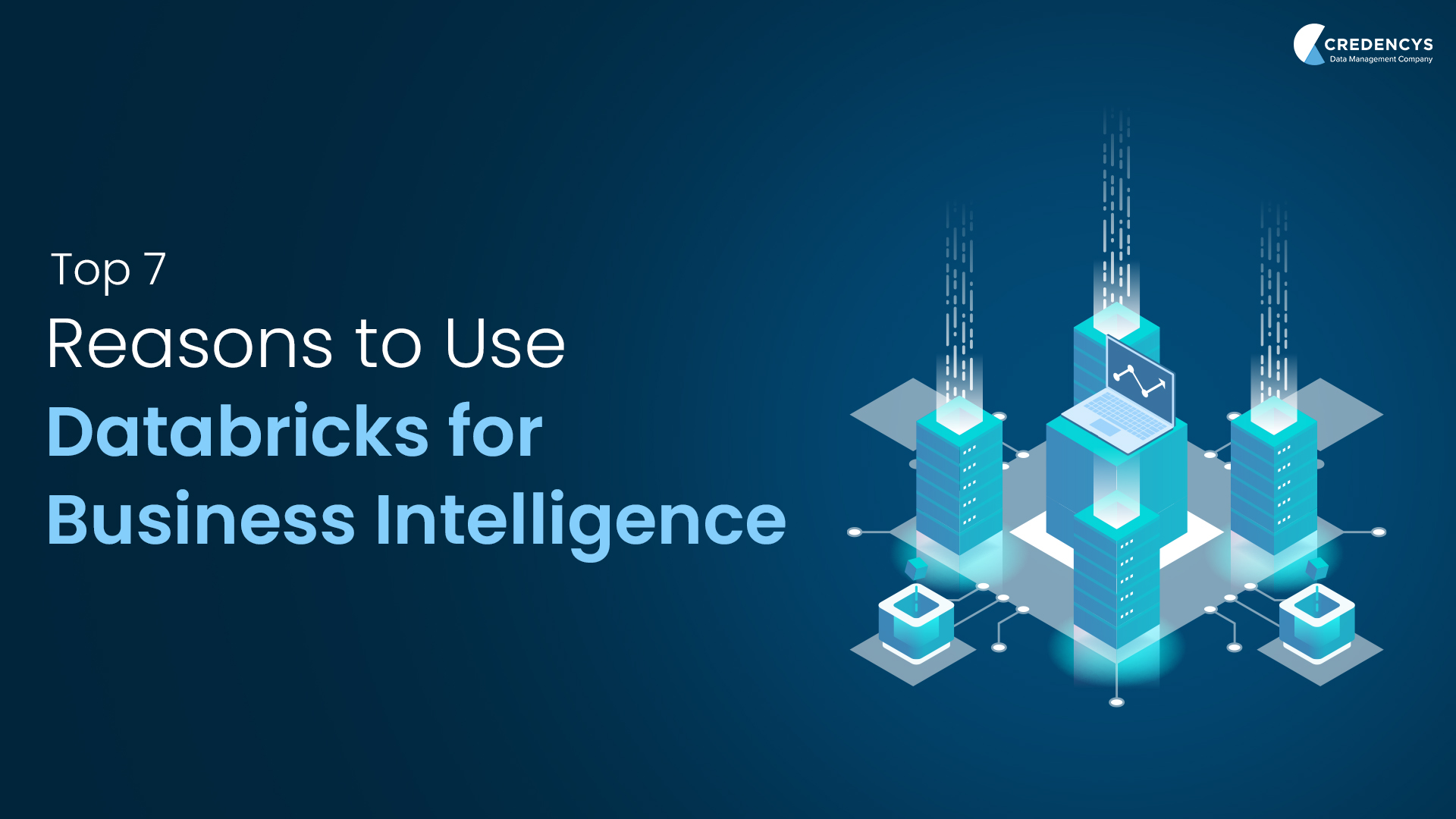
Top 7 Reasons to Use Databricks for Business Intelligence
Business Intelligence plays a pivotal role in shaping decisions that impact revenue, operations, and customer experience. Yet, many organizations still rely on legacy BI tools that were built for simpler, siloed data environments struggling to keep pace with the scale, speed, and diversity of modern enterprise data.
According to Forrester, nearly 87% of organizations say data is the most underutilized asset in their business.
This highlights a pressing gap: while data volume is exploding, traditional BI systems are failing to convert it into timely, actionable insights. That’s where Databricks comes in.
Databricks is a powerful data and AI platform built on a Lakehouse architecture, combining the flexibility of data lakes with the performance of data warehouses. For organizations seeking faster insights, unified data access, and AI-driven intelligence, Databricks is redefining what’s possible in business intelligence.
In this blog post, we will explore the top 7 reasons why Databricks is becoming the platform of choice for modern BI and how it helps decision-makers unlock deeper, real-time insights from their data.
Reason 1: Unified Data for Consistent and Accurate Insights
One of the biggest roadblocks to effective business intelligence is fragmented data. When data is scattered across departments, applications, or storage systems, it becomes nearly impossible to generate reliable insights.
BI dashboards end up showing outdated or conflicting results, leading to misinformed decisions. Databricks solves this by offering a unified platform where all your data, structured, semi-structured, and unstructured, can live together in a centralized Lakehouse architecture.
It combines the flexibility of data lakes with the performance and governance of data warehouses, giving teams a single source of truth.
Key Benefits
- No more data silos: All teams access the same version of data, ensuring consistency across reports.
- Supports any data type: From transactional records and CSVs to images, logs, or IoT streams.
- Unified access layer: Analysts, engineers, and data scientists can work collaboratively on the same platform.
This unified approach not only improves data accuracy but also reduces the time and cost of data movement between systems, making your BI workflows faster and more reliable.
Reason 2: Scalable Architecture for Any Data Volume
Traditional BI systems often crumble under the weight of growing data, leading to slow queries, failed reports, and constant infrastructure headaches. As your business collects more data from more sources, scalability becomes non-negotiable.
Databricks is built on Apache Spark, a distributed computing engine designed to process massive datasets in parallel across clusters. Whether you are analyzing gigabytes or petabytes, Databricks scales automatically to meet the demand without compromising performance.
Why It Matters
- Pay-as-you-go model: Only pay for the compute and storage you use, keeping costs predictable and optimized.
- Elastic scaling: Easily scale up or down based on workload requirements.
- Cloud-native infrastructure: Built to run efficiently on AWS, Azure, or GCP.
This architecture ensures that your BI workflows can keep up with business growth, whether it’s a spike in real-time web traffic, a surge in IoT data, or expanding global operations.
With Databricks, you won’t have to worry about outgrowing your BI platform; it grows with you.
Reason 3: Lightning-Fast Query Performance with Delta Lake
Slow queries are the silent killers of business intelligence. When dashboards take minutes to load or reports lag behind real-time events, decision-makers are forced to rely on outdated or incomplete information.
Databricks eliminates these bottlenecks through Delta Lake, its optimized storage layer built on top of Apache Spark. Delta Lake brings ACID transactions, schema enforcement, and intelligent indexing to your data lake, delivering fast, reliable, and scalable query performance.
What Makes It Fast
- Support for batch and streaming: Run queries on both historical and real-time data without duplicating infrastructure.
- Caching and indexing: Frequently accessed data is intelligently cached for speed.
- Optimized storage format: Columnar storage and data skipping reduce I/O.
With Delta Lake, BI tools like Power BI and Tableau can generate dashboards and reports in seconds, even when querying billions of rows. This means your analysts and business teams can act on data in real time, without waiting for overnight refreshes or batch jobs.

Ready to Supercharge Your Dashboards with Blazing-fast Queries on Massive Datasets?
Reason 4: Accelerated Collaboration Across Data and Business Teams
Modern BI isn’t just about dashboards, it’s about collaboration. Yet in many organizations, data scientists, engineers, and business analysts work in silos, using disconnected tools and speaking different “data languages.”
Databricks bridges this gap with a collaborative environment where technical and non-technical teams can work together seamlessly. Shared workspaces, interactive notebooks, and built-in visualization tools allow stakeholders to co-create and iterate on insights, all within a single platform.
Collaboration in Action
- Role-based access: Business users can securely explore curated datasets without the risk of breaking pipelines.
- Shared notebooks: Engineers and analysts can build, annotate, and run queries together.
- Built-in visualizations: Instantly explore data without exporting it to another tool.
This collaborative approach reduces handoffs, shortens the analytics cycle, and fosters a culture of data-driven decision-making where everyone has access to the same data, tools, and insights.
Reason 5: Built-In Governance and Security with Unity Catalog
As data becomes more valuable and more regulated, governance is no longer optional. Business intelligence must be built on data that is not only accurate but also secure, auditable, and compliant.
Databricks addresses this through Unity Catalog, a unified governance layer that centralizes metadata management, access controls, and data lineage across your entire data estate.
Key Features of Unity Catalog
- Fine-grained access control: Define who can access what, down to the table, column, or row level.
- Centralized metadata: A single catalog to manage and discover all data assets across workspaces.
- Audit trails: Track who queried what data, when, and how, ensuring transparency and accountability.
This built-in governance means your BI environment stays secure and trustworthy, even as data usage scales across departments and business units.
Reason 6: Real-Time and Streaming Analytics
Insights delayed are opportunities missed. Whether it’s detecting fraud, adjusting prices, or responding to customer behavior, real-time intelligence is a competitive necessity.
Databricks supports native streaming capabilities that enable you to process and analyze data as it arrives. Using Structured Streaming, Databricks lets you build real-time pipelines that feed directly into your BI tools, so your dashboards and reports are always up to date.
Technical Advantage
- Instant refresh: Dashboards reflect the latest data within seconds or minutes.
- Unified batch + streaming: No need to maintain separate pipelines
- Scalable processing: Handles thousands of events per second with ease.
With Databricks, your BI ecosystem evolves from reactive reporting to proactive decision-making.
Reason 7: Seamless Integration with Popular BI Tools
One of Databricks’ biggest strengths is that it doesn’t ask business users to abandon the tools they already know. Instead, it seamlessly integrates with leading BI platforms, empowering teams to analyze data using familiar interfaces while still benefiting from Databricks’ speed and scalability under the hood.
Key Integration Highlights
- Auto-refresh support: Dashboards can be set to auto-refresh with the latest data from Databricks in near real-time.
- SQL Endpoints: Databricks provides native SQL warehouses that BI tools can connect to via JDBC/ODBC drivers.
- Direct connectors: Built-in connectors for Power BI and Tableau ensure easy, secure access to data.
Powering the Next Generation of Databricks Business Intelligence
Traditional BI platforms are no longer enough. Decision-makers need access to real-time, trusted, and scalable insights delivered through platforms that unify people, data, and tools.
Databricks delivers on this promise.
From unifying siloed data and accelerating queries to enabling real-time dashboards and enforcing enterprise-grade governance, Databricks transforms BI from a reporting function into a strategic asset.
If you are ready to break free from legacy limitations and unlock the full potential of your business data, Databricks offers a future-proof foundation for intelligent, collaborative, and impactful decision-making.
Ready to Modernize Your BI with Databricks? Let’s Talk About Your BI Goals and Explore How Databricks can Elevate Your Data Strategy





Tags: