


Top Databricks Use Cases That Are Changing the Game in Business Analytics
Recent analyses indicate that approximately 90% of the world’s data has been generated within the past two years, and according to IDC, the volume of data stored globally is doubling approximately every four years.
That’s the projection from IDC’s Global DataSphere Forecast, and it underscores the urgent need for businesses to make sense of rapidly expanding data volumes. This is where Databricks shines.
It’s a unified platform that offers data engineering, AI, and analytics in one place. Powered by Apache Spark for processing, Delta Lake for data reliability, and MLflow for managing AI/ML workflows, Databricks turns data chaos into clarity and fast.
According to Databricks, over 60% of Fortune 500 companies rely on its platform to fuel data-led transformation.
For modern enterprises, especially CIOs, CTOs, and data leaders, Databricks isn’t just another tool; it’s the strategic advantage that can turn raw data into real business value.
Key Takeaways from This Blog
By reading on, you’ll discover:
- Why Databricks is fast becoming the cornerstone for data-driven leadership.
- High-impact use cases across supply chain, retail, eCommerce, and manufacturing.
- Real-world case studies that demonstrate how Databricks helps solve critical business challenges.
- Why a trusted partner like Credencys can maximize the platform’s impact for your business.
Databricks Use Cases in Supply Chain Management
A resilient supply chain has become a boardroom priority. Uncertain demand patterns, rising logistics costs, and global disruptions expose businesses to risks that directly impact revenue and customer satisfaction.
Traditional supply chain systems often struggle with siloed data, limited visibility, and reactive decision-making. Databricks helps supply chain leaders move from reactive firefighting to proactive resilience.
By unifying data from suppliers, warehouses, logistics providers, and external signals like weather or geopolitical events, it provides a single platform for real-time visibility, advanced forecasting, and anomaly detection.
1. Risk Mitigation and Anomaly Detection
Supply chains are increasingly exposed to risks ranging from shipping delays to fraud. With Databricks, organizations can analyze historical data and external signals to spot early warning signs.
Machine learning models flag anomalies, whether unusual supplier performance, fraudulent orders, or sudden spikes in demand. So, decision-makers can intervene before small issues become costly disruptions.
2. Inventory Management
For many enterprises, inventory optimization is a balancing act between understocking and overstocking. Databricks enables predictive demand forecasting and real-time tracking to strike this balance.
Businesses can reduce carrying costs while ensuring products are available where and when customers need them.

Databricks Use Cases in Retail Industry
Retail has entered an era where customer expectations shift faster than traditional systems can adapt. Shoppers expect personalized experiences, seamless availability, and secure transactions.
Meanwhile, retailers face shrinking margins and fierce competition from both established players and digital-first disruptors. Databricks enables retailers to turn customer and operational data into actionable intelligence.
By consolidating data from eCommerce platforms, POS systems, loyalty programs, and external signals, it equips retail leaders with real-time insights to enhance personalization, optimize inventory, and safeguard transactions.
1. Fraud Detection
The rise of digital transactions has amplified risks like payment fraud, account takeovers, and return fraud. Databricks processes millions of transactions in real time to detect unusual patterns and flag high-risk activity.

Protect your Business from Evolving Fraud Risks with Real-time AI-powered Insights on Databricks. Stay one Step Ahead of Threats.
2. Personalized Customer Experience
Personalization has moved beyond product recommendations; it’s now about tailoring the entire shopping journey. Databricks’ AI/ML models analyze browsing history, purchase behavior, and customer demographics to deliver hyper-relevant offers.
3. Demand Forecasting
Forecasting demand is critical for avoiding both stockouts and overstocking. Databricks integrates historical sales data, promotions, seasonality, and external variables like weather to predict demand more accurately.
Real-World Credencys Case Study
Client: A Global Retail Enterprise
The client is a global retail enterprise with a diverse presence across markets, serving millions of customers through both online and offline channels. Managing vast volumes of financial, sales, and marketing data across geographies made data-driven decision-making complex and time-consuming.
Challenge
The organization was weighed down by outdated analytics infrastructure, fragmented reporting, and siloed data across business units. This led to inconsistent financial reporting, slow insights, and weak visibility into marketing performance.
Solution
Credencys collaborated with the client to modernize analytics using Databricks:
- Unified data platform: Integrated disparate data sources into a central hub for consistency and accuracy.
- Self-service dashboards: Gave business teams real-time, interactive reporting, reducing their reliance on IT.
- Advanced marketing analytics: Enabled campaign-level measurement to assess co-branding and marketing effectiveness.
Business Impact
- Improved data accuracy by 47%, ensuring reliable insights across the enterprise.
- Reduced reporting time by 51%, enabling faster decision-making.
These changes created operational efficiency and empowered teams to act quickly with accurate insights, driving confident decisions.
Databricks Use Cases in eCommerce
For eCommerce businesses, customer expectations evolve daily. They want personalized shopping journeys, dynamic pricing, and instant product recommendations.
At the same time, businesses face pressure to maximize margins and adapt quickly to competitor moves. Traditional analytics systems often fall short because they can’t process vast amounts of customer and market data in real time.
Databricks equips eCommerce leaders with the ability to analyze massive datasets instantly and apply AI/ML models to optimize every stage of the customer journey. From segmentation to pricing to product recommendations, it helps businesses unlock growth and improve customer satisfaction.
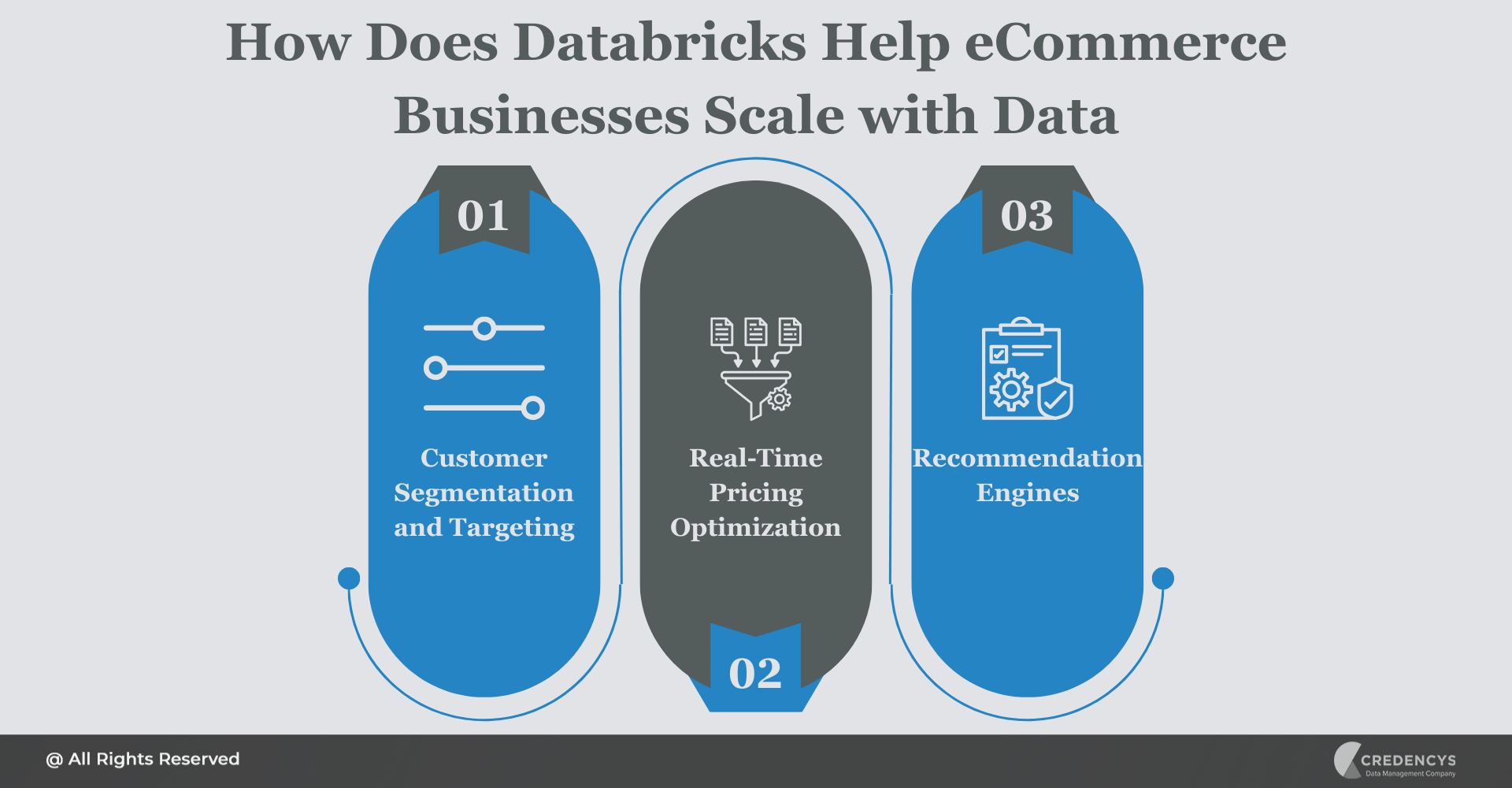
1. Customer Segmentation and Targeting
Understanding who your customers are and how they behave is the foundation of digital commerce. Databricks uses AI-powered clustering to segment customers based on demographics, browsing patterns, and purchase history.
This allows businesses to tailor campaigns for maximum impact.
2. Real-Time Pricing Optimization
Static pricing no longer works in a highly competitive digital marketplace. Databricks enables dynamic pricing by analyzing competitor prices, demand signals, and historical buying patterns in real time.
3. Recommendation Engines
Shoppers expect intelligent suggestions that feel natural, not forced. Databricks processes user behavior, preferences, and transaction data to power recommendation engines that increase cart value and retention.
Databricks Use Cases in Manufacturing
Manufacturers today operate in a world where efficiency and uptime directly determine competitiveness. From complex supply chains to data-heavy production lines, leaders face rising costs, demand volatility, and pressure to innovate faster.
Traditional systems struggle to manage the massive streams of IoT, sensor, and operational data being generated on the factory floor. Databricks helps manufacturers turn this raw, unstructured data into actionable insights.
By processing data from machines, quality systems, and external variables in real time, it enables smarter decisions that improve productivity, reduce downtime, and strengthen supply chain resilience.
Unlock the Full Potential of Your Manufacturing Data with Databricks. Discover How Credencys can Help you Accelerate Efficiency and Innovation
1. Predictive Maintenance
Unplanned equipment failures are costly, not just in repairs but also in lost production time. Databricks leverages sensor data and maintenance records to predict when machines are likely to fail, so teams can schedule proactive servicing.
2. Supply Chain Resilience
Manufacturers depend on stable supply chains, but disruptions can delay production and increase costs. Databricks consolidates IoT data, supplier performance metrics, and external signals like weather or raw material prices to forecast risks.
3. Production Optimization
Even small inefficiencies in a production line can scale into significant costs. Databricks integrates assembly line data, machine logs, and quality control inputs to uncover inefficiencies and bottlenecks.
Real-World Credencys Case Study
Client: A Global Manufacturer of Heavy Machinery
A global manufacturer of heavy-duty, precision-engineered machinery, operating across automotive and aerospace sectors, with demanding production cycles and tight quality standards.
Challenge
The client was navigating frequent breakdowns, manual maintenance scheduling, inefficient workflows, and poor visibility into supply chain operations due to outdated systems.
Solution
Credencys implemented:
- Databricks Lakehouse architecture for unified, scalable data processing.
- Predictive maintenance models to foresee equipment issues before they occur.
- Real-time production analytics to identify bottlenecks and accelerate workflows.
- Embedded supply chain dashboards to monitor and optimize resource dependencies.
Business Impact
- 28% reduction in unplanned equipment downtime
- 18% increase in production efficiency
- Faster, data-informed management decisions through live workflow insights
Driving Business Growth with Databricks
Across industries, Databricks is proving to be more than just a data platform, it’s a growth enabler. By unifying analytics, AI, and real-time decision-making in one environment, it helps organizations:
- Boost profitability by cutting waste, reducing fraud, and maximizing margins
- Strengthen resilience with predictive insights into supply chain risks
- Enhance customer engagement with hyper-personalization and smarter recommendations
- Improve operational efficiency by optimizing production and inventory
From retail to manufacturing, the common thread is clear: businesses using Databricks are turning data into a strategic advantage.
Why Partner with Credencys for Databricks
Implementing Databricks effectively requires more than just technology; it demands expertise, strategy, and execution tailored to your business needs.
As a trusted Databricks consulting partner, Credencys helps enterprises unlock the platform’s full potential. Our team combines deep technical know-how with industry expertise to design solutions that deliver measurable business outcomes.
Our capabilities include:
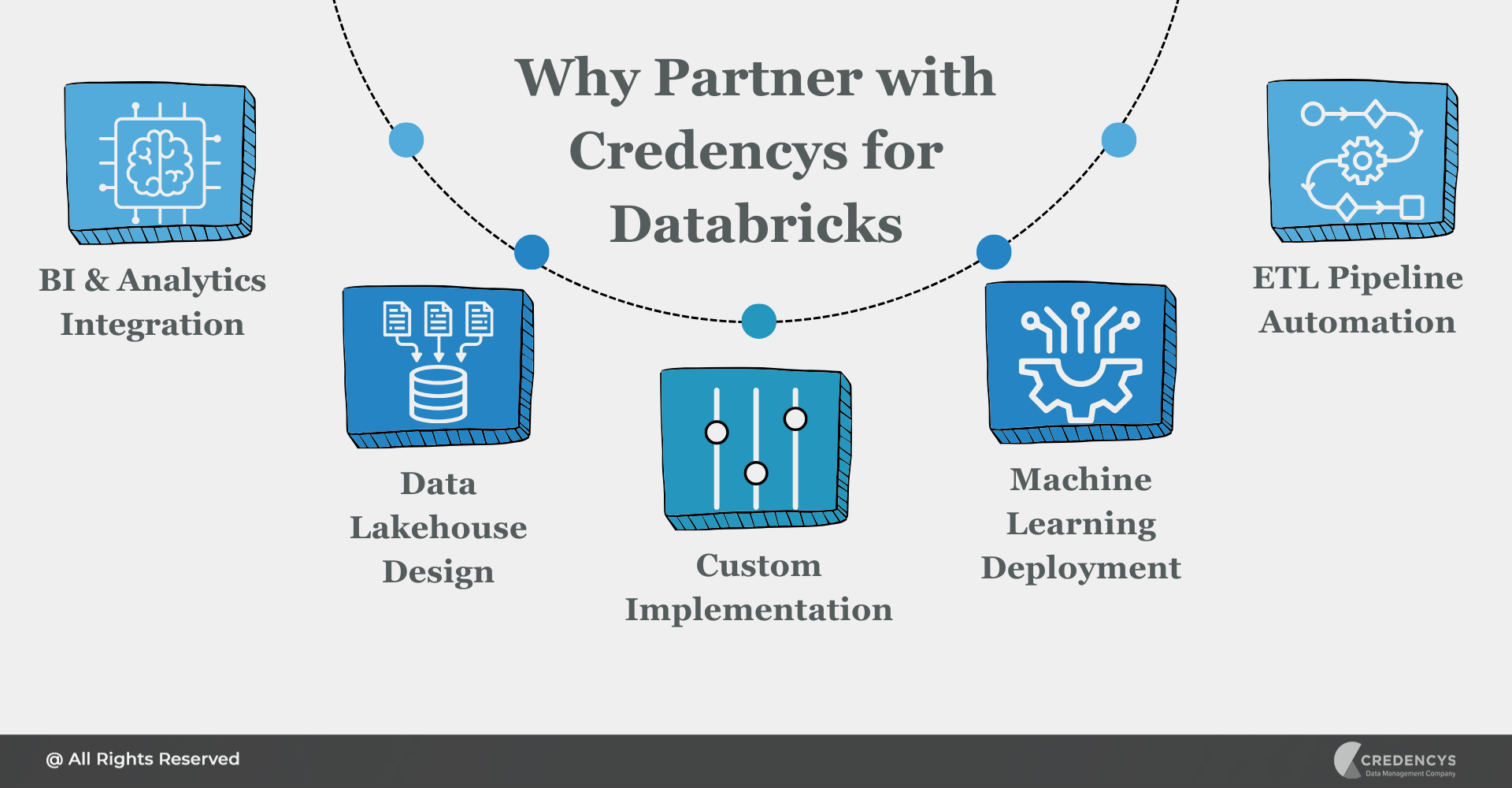
- BI & Analytics Integration: Connecting Databricks with leading BI tools for faster, smarter reporting.
- Data Lakehouse Design: Building scalable, unified architectures that merge data lakes and warehouses.
- Custom Implementation: Tailoring Databricks to fit your business goals and data ecosystem.
- Machine Learning Deployment: Operationalizing AI/ML models for predictive and prescriptive insights.
- ETL Pipeline Automation: Streamlining data workflows for efficiency and cost savings.
At Credencys, we don’t just set up Databricks, we make sure it drives real-world impact. Whether your goal is to improve efficiency, enhance personalization, or build AI-driven resilience, our experts guide you from strategy to execution.
Summary
Databricks is changing the way businesses harness data. Whether it’s improving personalization in retail, reducing waste in supply chains, predicting equipment failures in manufacturing, or optimizing eCommerce pricing, the platform consistently delivers measurable impact.
For enterprises, the challenge isn’t whether to adopt Databricks but how to implement it strategically. With Credencys as your consulting partner, you gain not only the platform but also the expertise to turn data into growth, resilience, and competitive advantage.
Ready to Unlock the Full Potential of Databricks for Your Business? Connect with Credencys to Begin your Journey.
Frequently Asked Questions
1. Is Databricks better than a traditional data warehouse?
Databricks is not a replacement for a traditional data warehouse but an evolution. It combines the best of data lakes and data warehouses in a lakehouse architecture, enabling both large-scale data storage and advanced analytics/AI use cases.
2. Can Databricks support AI and machine learning use cases?
Yes. Databricks provides a unified platform where teams can build, train, and deploy machine learning and generative AI models directly on enterprise data without heavy integrations.
3. What types of data can Databricks handle?
Databricks supports structured, semi-structured, and unstructured data from customer transactions to IoT sensor data, making it versatile across industries like retail, manufacturing, supply chain, and eCommerce.
4. How quickly can enterprises see ROI with Databricks?
With the right implementation partner, enterprises often start seeing measurable benefits like faster insights, cost reduction, and improved decision-making within months of adoption.
5. Is Databricks only for large enterprises?
No. While Fortune 500 companies use it extensively, mid-sized and fast-growing businesses also benefit from Databricks because of its scalability and flexible cloud pricing models.
6. Can Databricks be integrated with existing BI tools?
Absolutely. Databricks connects seamlessly with popular BI platforms like Power BI, Tableau, and Looker, enabling decision-makers to visualize insights effectively.
7. What industries benefit the most from Databricks?
Industries such as retail, manufacturing, supply chain, healthcare, financial services, and eCommerce are using Databricks to improve efficiency, resilience, and customer experiences.
8. How secure is Databricks?
Databricks provides enterprise-grade security features including role-based access control, data encryption, compliance certifications, and governance tools like Unity Catalog.
9. Why should I choose Credencys as my Databricks partner?
Credencys brings proven expertise in Databricks consulting, implementation, and optimization. We tailor solutions to your business needs and ensure your investment translates into long-term value.



Tags: