


Electrical Product Data Management: Why Cleanup Takes So Long
Electrical distributors receive product information from dozens or even hundreds of manufacturers. Much of this information already exists.
Yet catalog teams still spend significant time cleaning files, standardizing attributes, verifying specifications, finding missing documents, and preparing products for publication. The issue is not simply poor supplier data.
The larger problem is that every manufacturer structures, formats, and distributes product information differently. Without a scalable electrical product data management process, catalog teams must repeatedly transform this information before it can support e-commerce, sales, branch operations, customer portals, and digital catalogs.
As the number of manufacturers, SKUs, and channels grows, manual cleanup becomes increasingly difficult to sustain. Learn how PIM for electrical distributors creates a governed foundation for managing technical product information.
Why Manufacturer Data Requires So Much Cleaning
Manufacturers create product information according to their own systems and terminology. One may provide a detailed spreadsheet with technical attributes and documents.
Another may send only basic ERP fields. Even when two manufacturers sell similar products, they may describe the same specification differently.
For example:
- Rated voltage may appear as “Voltage,” “Operating Voltage,” or “Nominal Voltage”
- Current may be stored as “20 A,” “20A,” “20 Amp,” or simply “20”
- Dimensions may use inches, millimeters, or unstructured text
- Certifications may appear in dedicated fields, descriptions, PDFs, or images
- Product names may follow completely different conventions
These inconsistencies prevent distributors from loading manufacturer data directly into their catalog. Catalog teams must interpret each value, standardize its format, and verify that it meets internal requirements.
This work is often repeated for every manufacturer and category.
1. Manufacturer Data Arrives Through Too Many Sources
Electrical product information rarely arrives through one controlled channel. Catalog teams may receive it through:
- Excel and CSV files
- Email attachments
- Manufacturer portals
- APIs and data feeds
- ERP exports
- IDEA Connector
- Industry data pools
- Technical PDFs
- Manufacturer websites
- Shared folders and image libraries
Each source may contain a different part of the product record. A spreadsheet may hold part numbers and dimensions, while technical specifications, images, and instructions sit elsewhere.
Catalog employees must bring these fragments together before publication. The task becomes harder when different sources contain conflicting values.
The ERP file may show one unit of measure, the website another, and the technical document a third variation. Receiving more data does not always create a better product record.
In many cases, it creates more versions of the same information that must be reconciled.
2. Spreadsheet Dependency Creates Repetitive Manual Work
Spreadsheets are familiar, flexible, and easy to exchange. They may work for one manufacturer, but not when a distributor maintains separate templates and cleanup rules for hundreds of suppliers.
Common spreadsheet challenges include:
- Manual copying and pasting
- Formula errors
- Duplicate files
- Version-control problems
- Inconsistent columns
- Limited validation
- No controlled approval process
- Missing change history
- Difficult collaboration
- Dependence on individual employees
Every new supplier introduces another file structure. Every new product category introduces more attributes.
Every sales channel may require different fields. Instead of reducing work as the catalog grows, spreadsheet-led processes create more work with every addition.
3. Electrical Attributes Are Difficult to Standardize
Electrical catalogs contain highly technical information. Depending on the category, a product record may require:
- Voltage
- Amperage
- Wattage
- Frequency
- Phase
- Number of poles
- Wire gauge
- Conductor material
- Enclosure or IP rating
- Mounting type
- Dimensions
- Temperature rating
- Certifications
- Application
- Compatibility
- Packaging information
These attributes must be structured consistently for search, filtering, and comparison, but manufacturers may use different field names, units, and value formats. One manufacturer may provide “120 V,” another “120V,” and another “120 volts.”
A system may treat them as separate values even though they represent the same specification. Technical details are also frequently embedded inside descriptions.
A person may understand the information, but an e-commerce filter, comparison tool, or AI assistant cannot reliably use it. Catalog teams must extract these details and convert them into structured attributes.
Without a standard data model, the work continues product by product.
4. Classification and Taxonomy Mapping Consume Time
Manufacturers organize products according to their own structures. Electrical distributors must map those products to:
- Internal categories
- ERP product groups
- E-commerce categories
- ETIM classes
- UNSPSC codes
- Marketplace taxonomies
- Customer-specific structures
This mapping is rarely straightforward. A manufacturer may use a broad category such as “Electrical Accessories,” while the distributor needs detailed groups for cable glands, connectors, terminals, and enclosure components.
Products may fit multiple categories, and acquired companies may use different structures. Catalog teams must repeatedly decide where products belong and which attributes should apply.
Classification is therefore not a one-time project. It requires ongoing governance as products, standards, and channels evolve.
5. Missing Data Forces Teams into Reactive Work
Manufacturer files are often incomplete. When important information is missing, catalog employees may need to:
- Visit manufacturer websites
- Open technical data sheets
- Review installation manuals
- Compare similar products
- Contact supplier representatives
- Search image libraries
- Verify certifications
- Locate warranty documents
- Identify replacement products
A simple upload can turn into days of follow-up. Inferring values from similar products also creates risk when customers use technical data for product selection.
A PIM platform can identify missing information, apply validation rules, and route incomplete records through enrichment workflows. However, PIM cannot automatically determine every missing technical value. Distributors still need authoritative sources and clear ownership for resolving data gaps.
6. Repetitive Validation Slows Product Onboarding
Before a product can be published, catalog teams may need to confirm that:
- Required attributes are populated
- Values follow approved formats
- Units of measure are standardized
- Product identifiers are unique
- Categories are correct
- Images meet channel requirements
- Technical documents are current
- Certifications are available
- Accessories and replacements are connected
- Product status is accurate
These checks are essential, but many distributors perform them manually across multiple systems. A record may be reviewed in a spreadsheet, ERP, and e-commerce platform before and after publication.
Effective product data quality management centralizes completeness rules, formats, units, documentation requirements, and publication criteria. This increases onboarding time and makes quality dependent on individual attention.
7. Product Updates Create Ongoing Maintenance Work
Catalog cleaning does not end when a product is published. Manufacturers continuously update:
- Specifications
- Dimensions
- Packaging
- Images
- Certifications
- Technical documents
- Product status
- Replacement models
- Brand information
- Compatibility details
The distributor must identify these changes and apply them across every relevant system and channel. This is difficult when a manufacturer sends a complete replacement file without showing what changed.
Teams may compare thousands of rows and decide which fields should overwrite enriched content. If updates are missed, customers may see outdated specifications, discontinued products, or old documentation.
8. Disconnected Systems Create Multiple Versions of Product Truth
Electrical product information may exist across:
- ERP
- E-commerce
- PIM
- DAM
- Branch systems
- Customer portals
- Sales applications
- Digital catalogs
- Shared spreadsheets
- Legacy databases
A well-designed PIM and ERP integration defines which system owns transactional data and which manages enriched, channel-ready product information. The ERP may contain part numbers, pricing, inventory, and units of measure.
The e-commerce platform may contain descriptions and categories. The DAM may hold images and documents.
A spreadsheet may contain corrected attributes that have not reached the other systems. When systems are disconnected, teams correct the same issue multiple times.
A value may be fixed on the website but remain incorrect in a customer portal. A new document may be uploaded to the DAM but not connected to the product record.
The result is uncertainty about which system contains the correct information.
The Hidden Business Cost of Constant Data Cleaning
Catalog cleaning is an operational task with consequences across the business.
1. Slower Product Onboarding
New manufacturers and products take longer to become available across digital channels.
2. Lower Employee Productivity
Skilled employees spend time copying values, correcting formats, and searching for documents instead of improving governance and catalog quality.
3. Weak Search and Filtering
Search engines and filters depend on complete, structured attributes. Missing values prevent customers from narrowing products by technical requirements.
4. Limited Product Comparison
Customers cannot confidently compare similar products when specifications use different formats or fields.
5. Increased Sales Support
Sales teams must answer questions the digital catalog should handle, such as specifications, compatibility, replacements, and documentation.
6. Delayed Digital Growth
Adding manufacturers, categories, marketplaces, and customer portals becomes difficult because every expansion creates more cleanup work.
7. Poor AI Readiness
AI-powered search, recommendations, and shopping assistants require structured and governed product information. Incomplete data creates unreliable results.
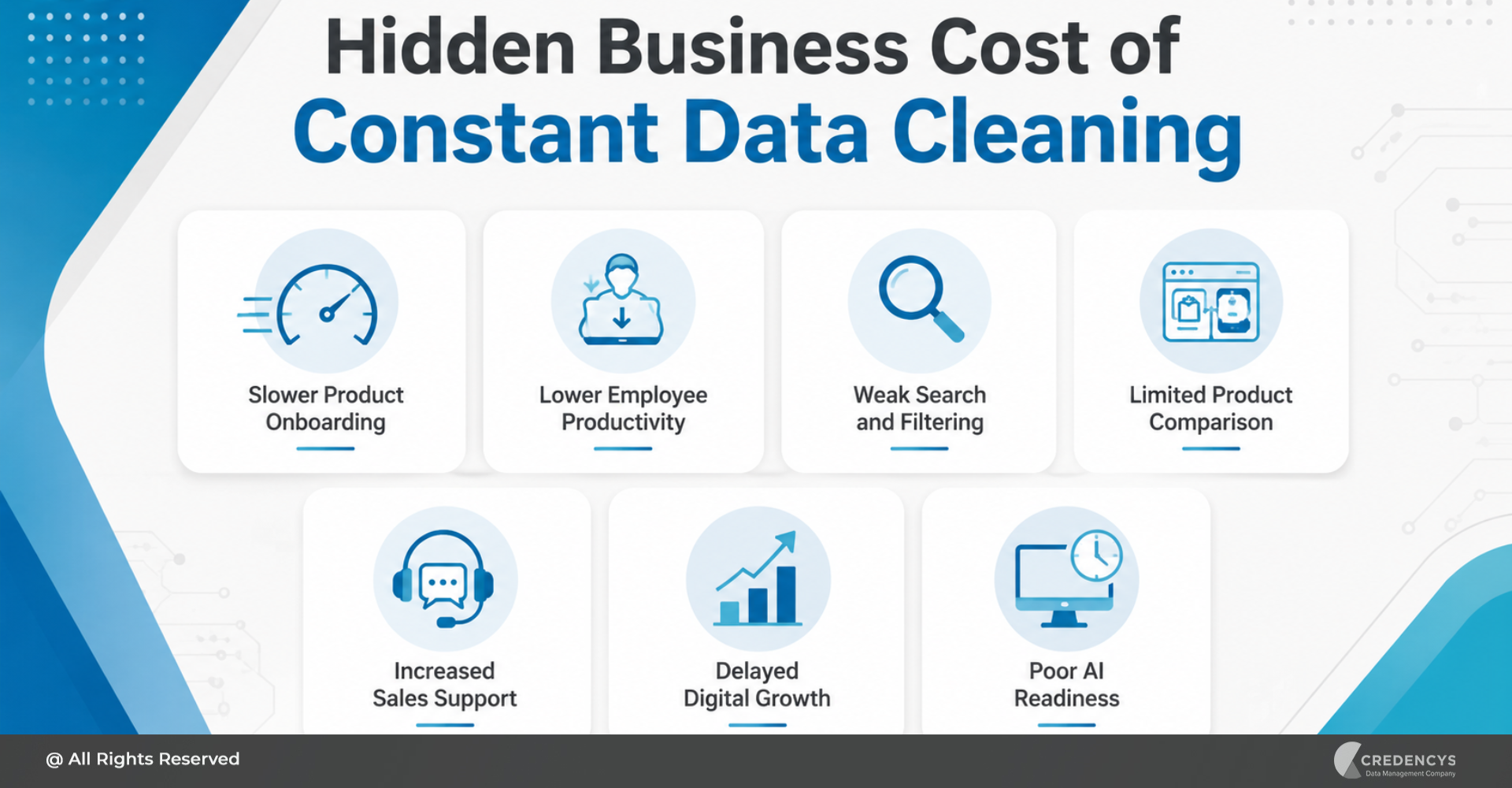
The cost is therefore not limited to employee hours. It also includes delayed product availability, weak customer experiences, higher service costs, and missed revenue opportunities.
Why Adding More People Does Not Solve the Problem
When catalog backlogs grow, distributors may add employees or outsource enrichment work. This increases short-term capacity but does not resolve the underlying causes.
More people still work with:
- Inconsistent supplier files
- Manual mappings
- Fragmented systems
- Weak validation rules
- Duplicate records
- Unclear ownership
- Repetitive approvals
As the catalog expands, the organization must continue adding resources simply to maintain quality. The objective should be to reduce repetitive manual cleaning.
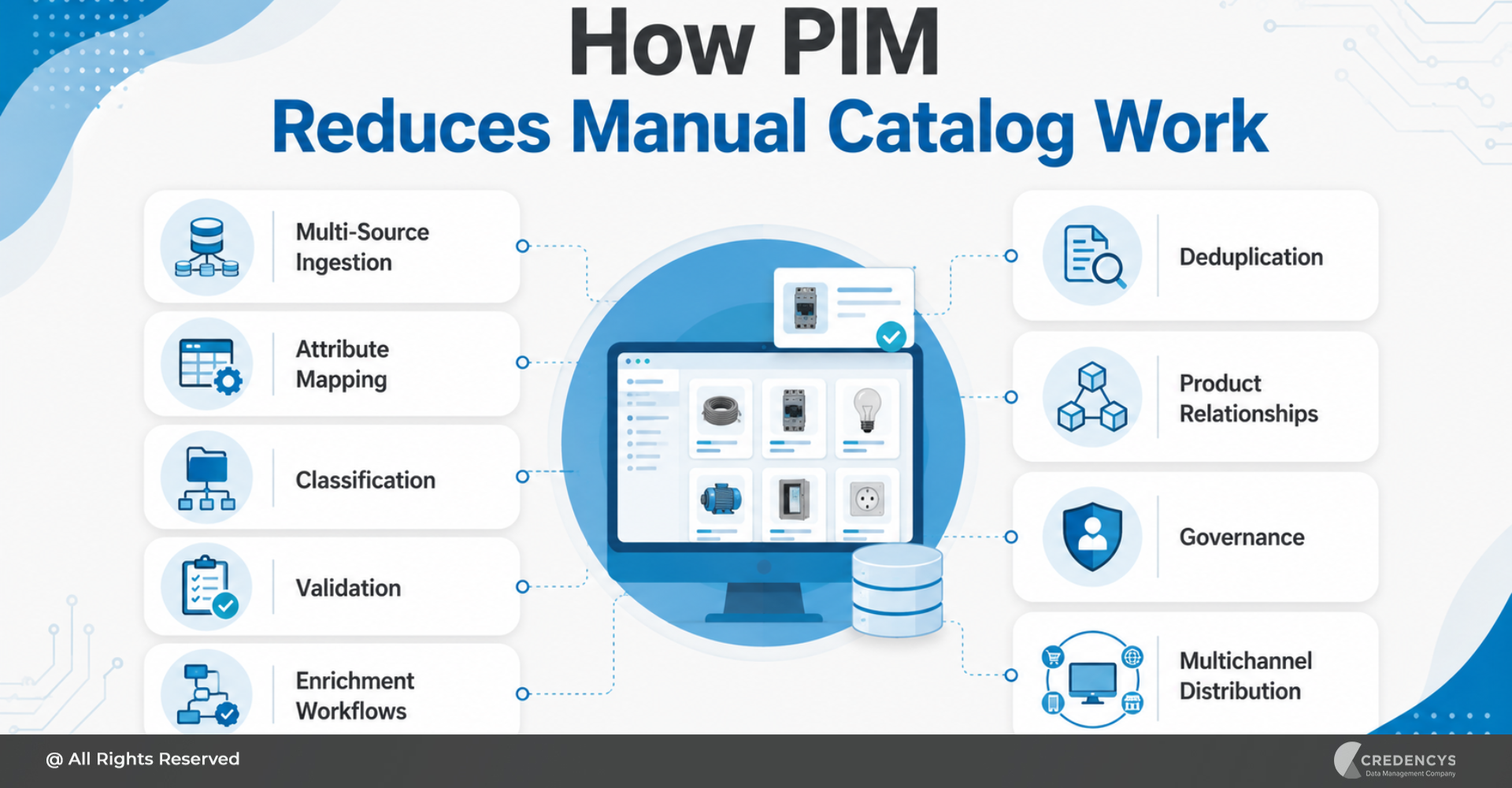
How PIM Reduces Manual Catalog Work
A PIM creates a controlled environment for turning manufacturer information into standardized, channel-ready product records.
1. Multi-Source Ingestion
PIM can collect information from spreadsheets, APIs, manufacturer feeds, ERP, portals, and industry data sources.
2. Attribute Mapping
Manufacturer-specific fields can be mapped to a standardized distributor data model. Reusable mappings reduce repeated setup work.
3. Classification
Products can be assigned to internal categories and structures such as ETIM. The selected class can determine which attributes are required.
4. Validation
PIM can apply rules for required fields, approved formats, units, identifiers, value ranges, images, documents, and publication readiness.
5. Enrichment Workflows
Incomplete records can be routed to the right people for review, correction, and approval.
6. Deduplication
Potential duplicate records can be identified using manufacturer numbers, identifiers, names, and matching rules.
7. Product Relationships
Teams can manage accessories, alternatives, replacements, compatible products, kits, and product families.
8. Governance
The platform can maintain ownership, approval history, data-quality status, and change records.
9. Multichannel Distribution
Approved information can move through controlled product data syndication workflows to e-commerce, portals, sales tools, marketplaces, and other channels.
What Electrical Distributors Should Standardize First
Distributors should not try to clean the entire catalog at once. A practical starting point includes:
- High-revenue product categories
- Frequently searched products
- Categories with the most incomplete attributes
- Manufacturers with high onboarding volumes
- Products that generate frequent customer questions
- Categories requiring technical comparison
- Products with accessory or compatibility dependencies
- Assortments needed for digital expansion
Starting with a focused category makes it easier to define the data model, establish validation rules, test workflows, and measure results. The process can then expand across additional manufacturers and product families.
Signs Your Catalog-Cleaning Process is Not Scalable
Your current process may need modernization if:
- Every manufacturer requires a new spreadsheet template
- New products take weeks to publish
- Technical values are stored mainly as free text
- Catalog knowledge depends on a few employees
- Issues are corrected in multiple systems
- Categories differ across channels
- Supplier updates are difficult to identify
- Data completeness cannot be measured
- Search filters return too few products
- Discontinued products remain visible
- Customers frequently request basic product clarification
- Each new manufacturer increases manual work
When several of these issues occur together, the distributor has usually outgrown spreadsheet-led catalog management.
How to Assess the Current Product Data Process
Before selecting technology, electrical distributors should understand where manual effort and data-quality risk are concentrated. The assessment should examine:
- Manufacturer data sources
- File formats
- Onboarding steps
- Manual touchpoints
- Attribute completeness
- Taxonomy consistency
- Validation rules
- Product relationships
- Systems of record
- Approval workflows
- Data ownership
- Publication timelines
- Channel inconsistencies
- Integration dependencies
The goal is to identify why gaps continue to appear and which process, system, or governance issue is responsible.
Conclusion
Electrical catalog teams spend too much time cleaning manufacturer data because incoming information is inconsistent, technical attributes are difficult to standardize, validation is repetitive, and records are spread across disconnected systems. Spreadsheets and manual effort may support a limited catalog.
They become increasingly difficult to sustain as the distributor adds manufacturers, SKUs, branches, and digital channels. A governed PIM foundation can help standardize manufacturer data, reduce repetitive cleanup, improve catalog completeness, accelerate onboarding, and publish consistent information across every channel.
The objective is not to eliminate every data-quality task. It is to replace reactive catalog maintenance with a scalable process for turning fragmented manufacturer content into trusted product information.






Tags: