


How Electrical Distributors Can Improve Supplier Onboarding with Automated Product Data Intake
A new manufacturer should expand an electrical distributor’s catalog and revenue opportunities. It should not create weeks of spreadsheet work for the catalog team.
Yet supplier onboarding often becomes a manual data-processing exercise. Every manufacturer sends product information in a different structure, uses different attribute names, and provides different levels of completeness.
Before products can appear online, teams may need to clean files, map attributes, assign categories, match assets, validate technical values, and resolve missing information. Automated manufacturer product data intake creates a repeatable way to receive, standardize, validate, enrich, and approve supplier information before distributing it to ERP, e-commerce, branch, and sales systems.
For electrical distributors managing technical, multi-manufacturer catalogs, this creates a more scalable approach to electrical product data management.
Why Supplier Onboarding is Difficult for Electrical Distributors
Electrical product onboarding involves more than importing a manufacturer name, SKU, description, and price. Distributors may manage circuit protection, wire and cable, switchgear, lighting, controls, enclosures, wiring devices, power distribution equipment, and industrial automation components.
Each category has its own technical requirements. A circuit breaker may require voltage, amperage, interrupting rating, number of poles, trip type, mounting style, and compatible panel information.
A cable may require conductor material, gauge, insulation, voltage rating, temperature rating, shielding, certifications, and packaging length. The information may arrive through:
- Spreadsheets and CSV files
- Manufacturer portals
- Email attachments
- APIs and data feeds
- PDF catalogs and specification sheets
- Shared drives
- ERP exports
- Industry product-data platforms
Even similar products may be described differently. One supplier may use “rated voltage,” while another uses “voltage rating.”
“Number of poles” may appear as “pole count.” Values also vary.
One manufacturer may write “120 V,” another “120VAC,” and another simply “120.” Without normalization, these differences affect filtering, comparison, and downstream integration.
The challenge is not only product volume. It is the lack of consistent structure across manufacturers, categories, and sources.
These challenges are part of the wider product-data complexity that a purpose-built PIM for electrical distributors must address.
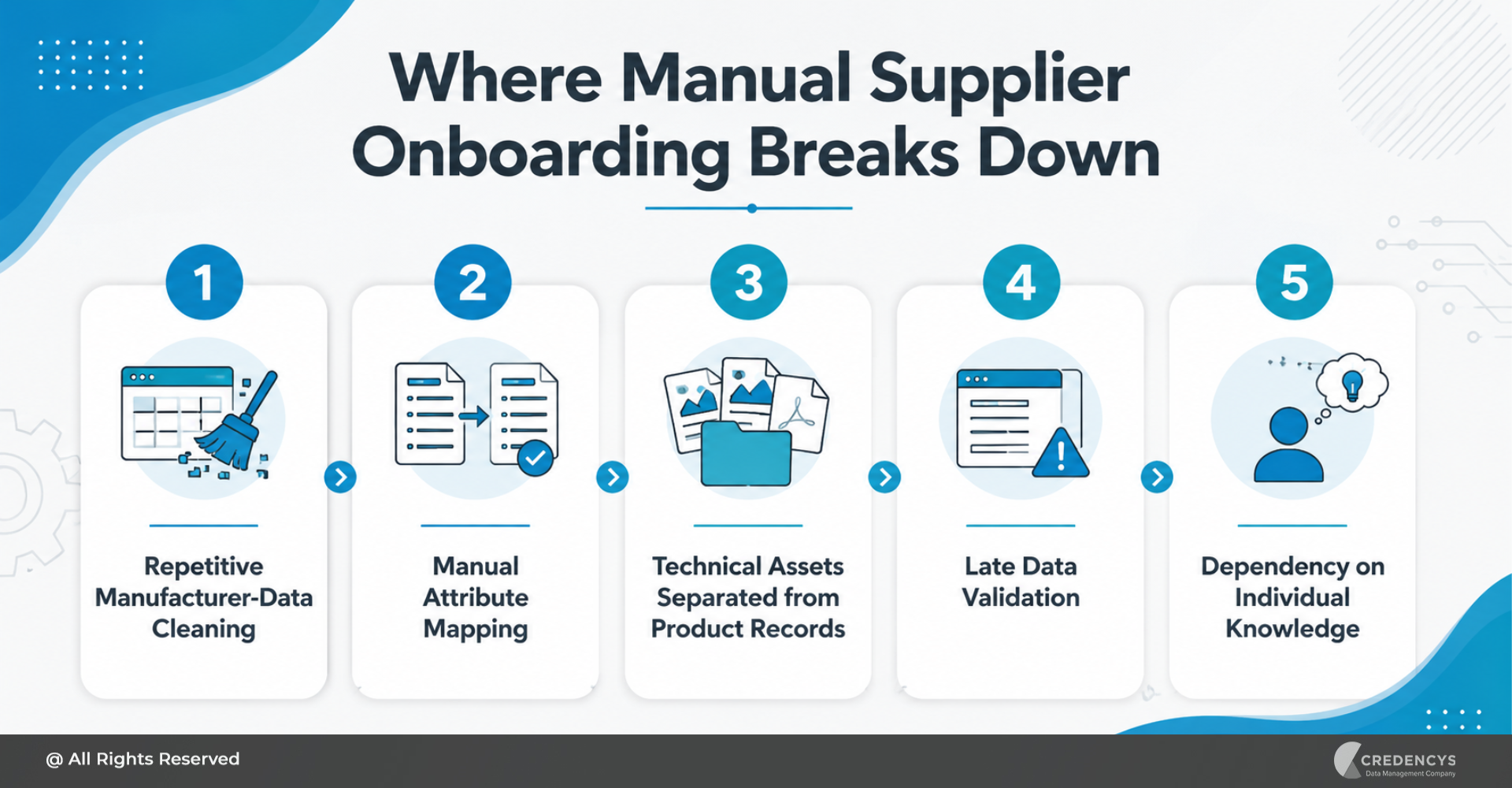
Where Manual Supplier Onboarding Breaks Down
Many distributors still depend on spreadsheets to receive and prepare manufacturer data. A supplier sends a file to purchasing, merchandising, or a catalog employee.
The file is reviewed, reformatted, and passed between teams until someone determines that the records are ready for ERP or e-commerce. This approach creates several recurring problems.
Repetitive Manufacturer-Data Cleaning
Catalog employees may need to correct:
- Inconsistent naming conventions
- Missing mandatory fields
- Invalid units and formats
- Abbreviated descriptions
- Duplicate records
- Unsupported category values
- Inconsistent identifiers
- Empty image or document links
The same corrections may return with every updated file.
Manual Attribute Mapping
Manufacturer columns rarely match the distributor’s data model. Teams must decide how each field maps to internal attributes, e-commerce filters, ERP fields, and category requirements.
A governed product data model in PIM provides the target structure for these mappings. A supplier’s “housing” field may map to “enclosure material.”
A field called “type” may mean product type, mounting type, or connection type depending on the file. When these decisions remain in spreadsheets or employee knowledge, onboarding is difficult to repeat consistently.
Technical Assets Separated from Product Records
Images, installation manuals, certificates, drawings, safety documents, and warranty files often arrive separately. Employees must match every asset to the correct manufacturer part number and determine where it should be published.
Incorrect matching can leave products without essential documentation.
Late Data Validation
Errors may remain hidden until products reach downstream systems. The e-commerce team may discover incomplete filters.
Sales representatives may find that descriptions do not distinguish similar products. Customers may encounter missing specifications.
Correcting the problem then requires additional coordination and republishing.
Dependency on Individual Knowledge
Experienced employees often know which files need special handling and which values require correction. When that knowledge is not captured in reusable rules, supplier onboarding becomes slower whenever workloads increase or responsibilities change.
The Business Impact of Slow Supplier Onboarding
Manual supplier onboarding delays the point at which a new manufacturer or product line can contribute to digital sales. Products may exist in ERP for purchasing and inventory purposes but remain unavailable online because customer-facing information is incomplete.
Delayed Time to Revenue
Until records contain required attributes, descriptions, assets, and categories, the distributor may not be able to publish them confidently. The commercial opportunity exists, but the catalog is not ready.
Higher Catalog – Management Costs
Every new manufacturer introduces new files, mappings, checks, and exceptions. As the assortment grows, workload can increase faster than team capacity.
More employees may be needed to maintain the same speed.
Weak E-Commerce Discovery
Missing attributes affect search, filtering, comparison, and product recommendations. A customer looking for a three-pole breaker with a specific voltage and interrupting rating cannot find the right item if those values are absent or inconsistent.
Greater Dependence on Sales Teams
When digital catalogs cannot explain products clearly, buyers contact sales representatives to identify compatible items, compare alternatives, or confirm specifications. This limits digital self-service and keeps sales teams involved in routine discovery questions.
Limited Catalog Scalability
Supplier onboarding should be repeatable. When every manufacturer becomes a custom data project, catalog growth creates operational complexity instead of competitive advantage.
What Automated Manufacturer Product Data Intake Means
Automated product data intake is a structured process for receiving, interpreting, validating, transforming, and routing manufacturer information with limited manual intervention. It does not mean accepting every supplier value automatically.
Instead, automation applies defined rules to repetitive activities and routes uncertain or noncompliant records for review. A well-designed process can include reusable mappings, standard transformations, required-field checks, duplicate detection, category assignment, completeness scoring, exception workflows, approvals, and channel-readiness rules.
Catalog specialists can then focus on technical decisions and exceptions instead of reviewing every field in every record.
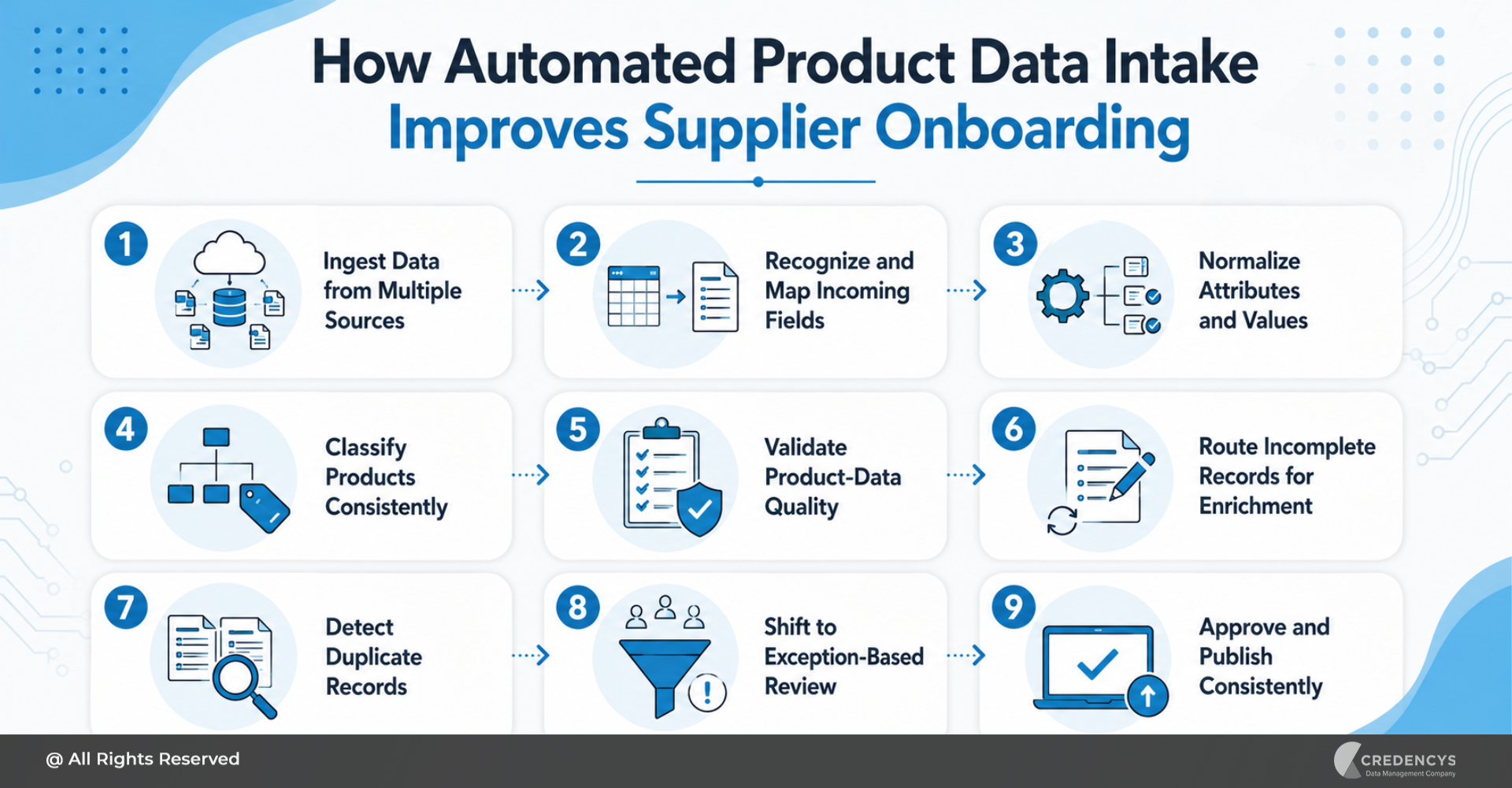
How Automated Product Data Intake Improves Supplier Onboarding
Automation improves supplier onboarding by creating one controlled process across different manufacturers and file types.
1. Ingest Data from Multiple Sources
The intake layer should receive data from spreadsheets, CSV files, APIs, portals, ERP feeds, shared repositories, and relevant industry platforms. IDEA Connector is an electrical-industry product-data syndication platform used to distribute product and transactional information between manufacturers and distributors.
It can be an important source, but distributors may still need to map, validate, enrich, and govern the information for internal systems and digital channels. Flexible ingestion prevents teams from rebuilding the workflow for every source.
2. Recognize and Map Incoming Fields
The system can map manufacturer columns to the distributor’s approved data model. Common fields include manufacturer part number, brand, product family, descriptions, voltage, amperage, material, dimensions, certifications, country of origin, and packaging information.
Mappings can be stored by supplier and reused when updated files arrive. Low-confidence mappings can be flagged instead of placing questionable information into the catalog.
3. Normalize Attributes and Values
Automation can convert supplier-specific terminology into approved formats. This may include standardizing units, expanding abbreviations, formatting dimensions, aligning Boolean values, normalizing capitalization, and mapping source values to controlled lists.
For example, “Y,” “Yes,” “Included,” and “1” may all need to become one approved value. Voltage values may require consistent spacing and unit labels.
Normalization makes products easier to compare, filter, and exchange across systems.
4. Classify Products Consistently
Incoming products can be assigned to internal categories, e-commerce categories, product families, or industry classifications. ETIM provides a standardized model for technical products using groups, classes, features, values, and units.
This structure can support more consistent product descriptions and data exchange across the electrical channel. Automation can recommend classifications based on source categories, product names, attributes, and previous mappings.
High-confidence records can move forward, while unclear records go to a catalog specialist.
5. Validate Product-Data Quality
Validation rules can check:
- Mandatory attributes
- Accepted formats and ranges
- Identifier patterns
- Unit consistency
- Duplicate manufacturer part numbers
- Category-attribute compatibility
- Image availability
- Required technical documents
- E-commerce readiness
A structured product data quality management framework helps automate completeness checks, standardization, validation, matching, and exception detection. Rules should vary by category.
A wiring device and an industrial control component should not be assessed using the same completeness requirements.
6. Route Incomplete Records for Enrichment
Products that fail completeness checks should enter a defined enrichment workflow. Tasks may include completing descriptions, adding technical attributes, connecting images and documents, verifying certifications, creating product relationships, and preparing channel-specific content.
This gives teams visibility into why a product is not ready and who owns the next action.
7. Detect Duplicate Records
Incoming products can be compared with existing records using manufacturer part numbers, GTINs, UPCs, brands, supplier SKUs, names, attributes, and packaging information. The workflow should distinguish true duplicates from alternate supplier records, packaging variants, and legitimate product variations.
This prevents duplicate products from affecting search results, inventory connections, and reporting.
8. Shift to Exception-Based Review
The most important operational change is moving from record-by-record processing to exception-based review. Products that meet mapping, validation, completeness, and classification rules can continue through the workflow.
Employees review only records with missing values, conflicting information, uncertain classifications, duplicate risks, or unusual technical requirements. This reduces repetitive work without removing human control.
9. Approve and Publish Consistently
Once records meet the required standards, they can move through approval and distribution workflows. Approved information can be sent to ERP, eCommerce, DAM, branch systems, customer portals, digital catalogs, sales applications, marketplaces, and mobile applications.
Effective product data syndication ensures each destination receives accurate information in the required format. The same governed product record supports every channel, reducing conflicting information.
Electrical Product Data Requirements Automation Must Support
Generic file automation is not enough for electrical distribution. The onboarding process must understand technical product information.
Category-Specific Attributes
Switchgear may require ratings, configurations, standards, and mounting details. Wire and cable require conductor, insulation, gauge, length, and temperature information.
Lighting products require wattage, color temperature, lumen output, controls, dimensions, and certifications. The data model must define which attributes are required, optional, repeatable, or dependent on other values.
Units of Measure and Packaging
Electrical products may be purchased, stocked, and sold by each, pack, box, case, foot, meter, coil, reel, or spool. The system must distinguish product dimensions, selling units, packaging quantities, and conversion factors.
Incorrect packaging data can affect ordering, pricing displays, fulfillment, and customer expectations.
Product Relationships
Electrical catalogs need structured relationships for compatible accessories, required components, replacement products, substitutes, superseded items, repair parts, product families, and cross-sell opportunities. These relationships help customers find complete solutions and alternatives when products are unavailable.
Industry Classifications and Sources
The intake process may need to reconcile IDEA Connector data, ETIM classifications, manufacturer schemas, internal taxonomies, and channel requirements. The goal is to map these sources into a governed structure that downstream systems can use consistently.
Technical Assets
Products may need images, specifications, drawings, installation guides, certificates, warranty files, and safety documents. Automation should connect assets to product identifiers, validate required file types, and route missing assets for follow-up.
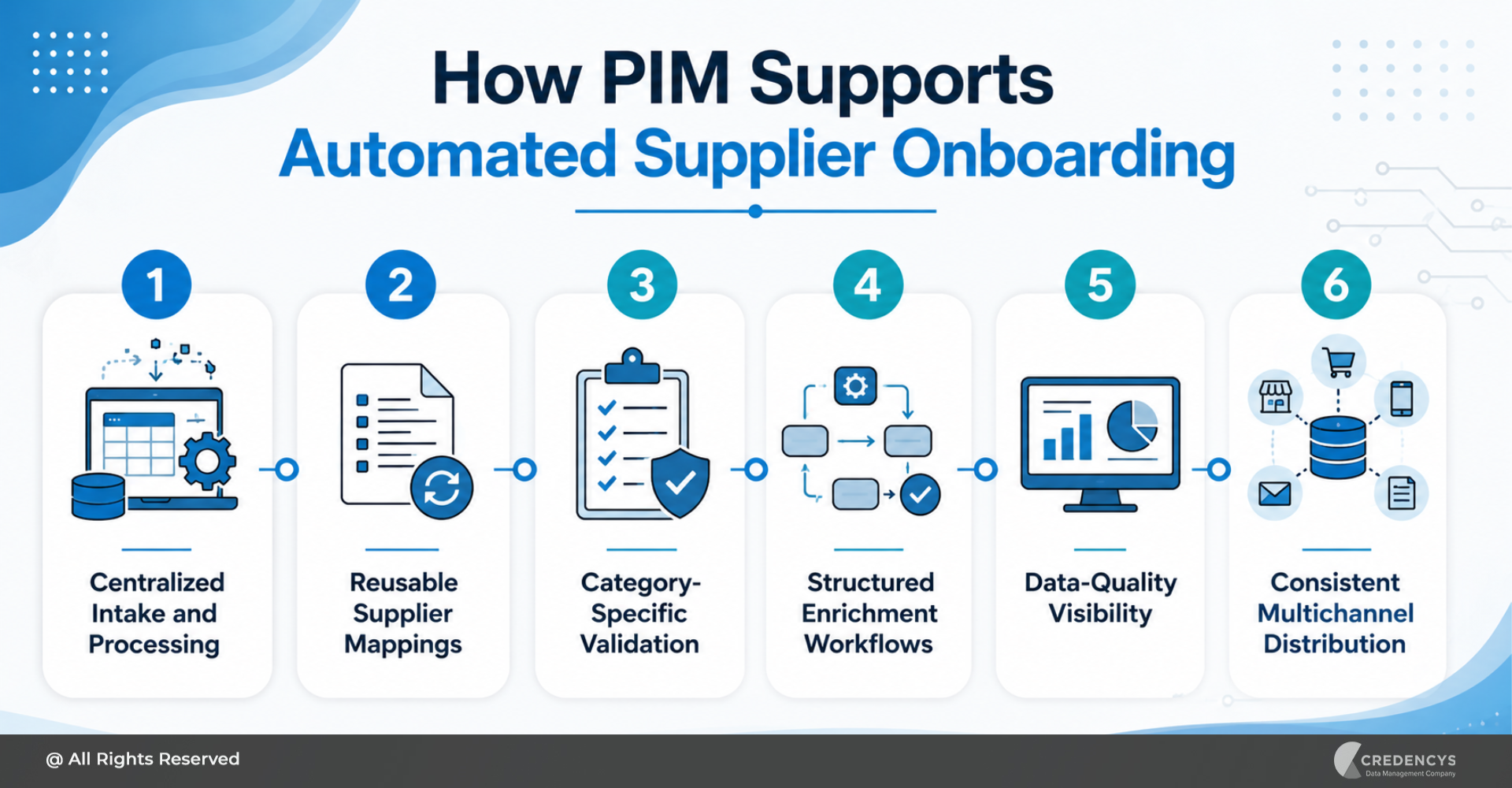
How PIM Supports Automated Supplier Onboarding
Experienced Product Information Management consulting can help distributors define the data model, integrations, workflows, governance, and implementation roadmap required to support this process.
Centralized Intake and Processing
PIM brings source data, mappings, attributes, categories, assets, and workflow status into one controlled environment. Teams can see what was received, what changed, what failed validation, and what remains incomplete.
Reusable Supplier Mappings
Supplier-specific mappings and transformation rules can be retained and reused. Teams do not need to repeat every decision when the same manufacturer submits an update.
Category-Specific Validation
PIM can apply different completeness and quality rules to different product categories. It can also distinguish between basic ERP readiness and richer e-commerce readiness.
Structured Enrichment Workflows
Records can move through clear stages:
- Received
- Mapped
- Validated
- Enriched
- Reviewed
- Approved
- Published
This reduces reliance on disconnected emails and spreadsheets.
Data-Quality Visibility
Teams can monitor completeness and exceptions by manufacturer, category, attribute, file, or channel. This makes it easier to identify suppliers that repeatedly provide incomplete information and categories that require excessive manual work.
Consistent Multichannel Distribution
Once approved, product information can be distributed to connected systems in the format each channel requires. PIM complements ERP, DAM, e-commerce, and industry platforms rather than replacing them.
ERP manages transactional and operational records. DAM manages rich media.
IDEA Connector supports electrical-industry syndication. PIM governs the complete, enriched product information used across customer-facing channels.
How to Implement Automated Supplier Onboarding
Automation should begin with a controlled process, not a technology-first rollout.
Step 1: Document the Current Workflow
Identify manufacturer data sources, file formats, manual activities, approvals, common errors, onboarding delays, and downstream systems. This shows where automation can create the most value.
Step 2: Prioritize Manufacturers
Good pilot candidates may have high SKU volumes, frequent updates, significant revenue contribution, inconsistent data quality, or heavy manual cleanup. Avoid beginning with the most complex supplier unless the required rules and data model are already understood.
Step 3: Define the Electrical Product Data Model
Establish the categories, attributes, units, controlled values, relationships, documents, and identifiers required for the selected product lines. Also define what is required for ERP, e-commerce, sales tools, and other channels.
Step 4: Build Reusable Mappings
Map manufacturer fields and values to the approved data model. Store these mappings as reusable supplier templates, including transformations for units, labels, formats, categories, and controlled values.
Step 5: Define Validation and Readiness Rules
Determine what makes a product record acceptable. Rules should identify missing information, invalid formats, duplicate risks, unsupported values, absent assets, and channel-specific gaps.
Step 6: Pilot with a Controlled Supplier Group
Test the workflow with a limited number of manufacturers and categories. Confirm that it maps fields correctly, identifies exceptions, preserves technical accuracy, and creates channel-ready records.
Step 7: Scale Through Repeatable Patterns
Apply successful templates to similar suppliers and categories. Continue adding reusable mappings, exception rules, and enrichment workflows as the catalog evolves.
The objective is a common framework that supports supplier variation without returning to manual processing.
Make Supplier Growth Easier to Scale
Electrical distributors need new manufacturers and product lines to expand selection, serve customers, and grow digital revenue. However, catalog growth becomes difficult when every supplier introduces another manual cleaning and mapping project.
Automated product data intake standardizes incoming information, identifies quality issues earlier, reduces repetitive work, and gives catalog teams clear exception and approval workflows. With a governed PIM foundation, distributors can connect manufacturer data to complete product records and publish reliable information across ERP, e-commerce, branch, customer, and sales channels.
The result is not simply faster file processing. It is faster access to accurate, searchable, and commercially usable electrical product information.






Tags: