


Reduce Time-to-Market with AI-Driven SKU Onboarding & Supplier Data Ingestion
According to a Ventana Research study, over 67% of retailers say manual supplier data processing delays product launches by at least two weeks.
When every supplier sends product information in different formats, Excel sheets, PDFs, spec sheets, or even catalog images, merchandisers and data teams spend countless hours manually extracting, cleaning, and standardizing thousands of SKUs before they reach the PIM system. For large retailers and marketplaces, these delays mean slower time-to-market, inconsistent catalog data, and missed sales opportunities, especially during crucial retail moments like Black Friday, back-to-school, or festive launches.
AI and automation are eliminating this bottleneck. By combining Optical Character Recognition (OCR) with AI-driven data enrichment, retailers can now transform supplier spreadsheets and images into clean, structured, and validated product records in hours instead of weeks.
This not only accelerates catalog readiness but also ensures faster time-to-market, improved product accuracy, and seamless omnichannel consistency, giving retailers a decisive edge in today’s fast-moving digital marketplace.
The Traditional SKU Onboarding Process and Its Limitations
For most retailers, product onboarding starts long before items appear on shelves or eCommerce sites. It begins with suppliers submitting product data, usually in spreadsheets, PDFs, or catalog images, all in different formats, levels of detail, and data quality.
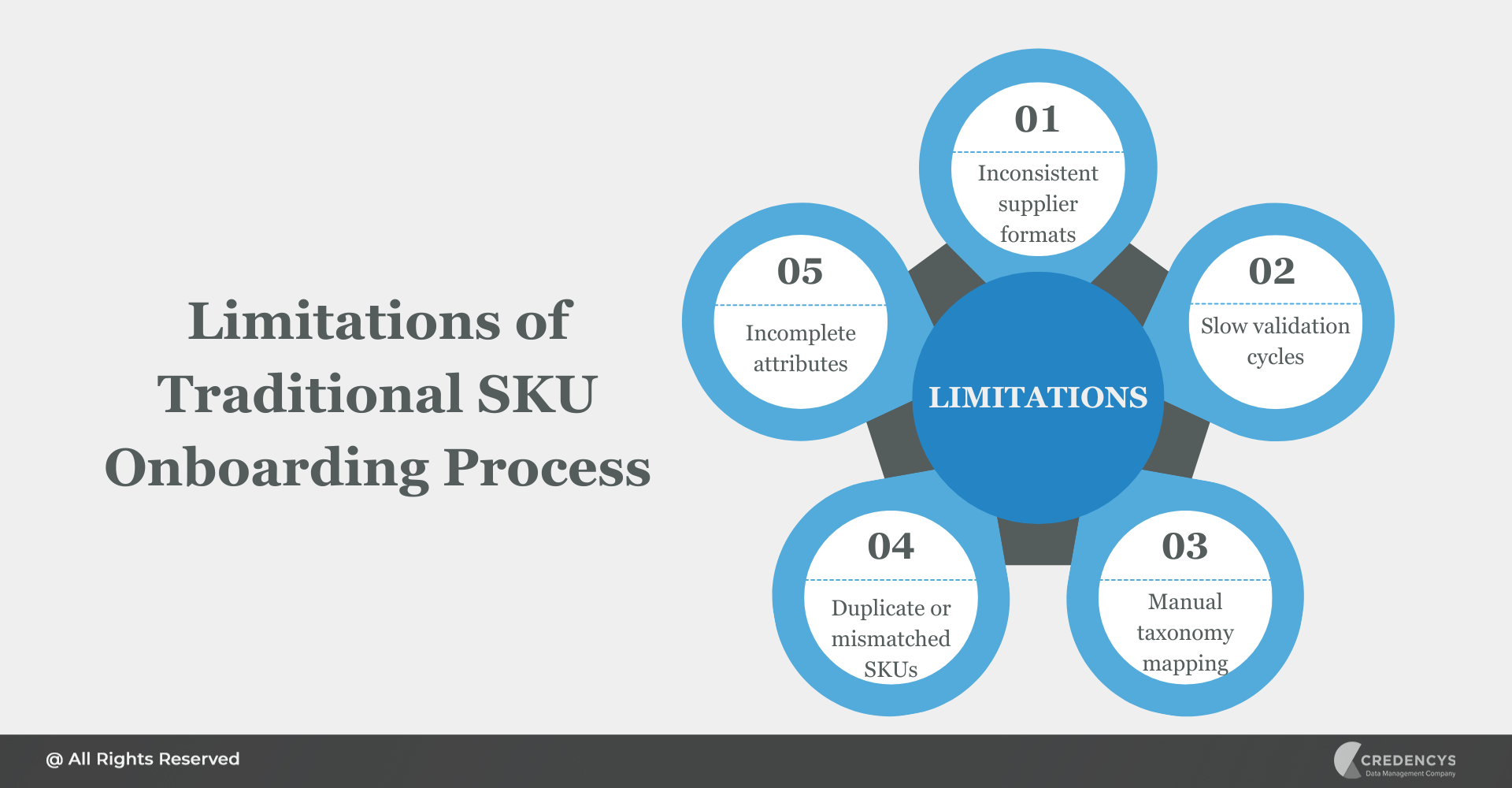
What should be a simple transfer of information often becomes a manual, time-consuming, and error-prone task for merchandising and catalog teams due to:
- Inconsistent supplier formats: One supplier might share an Excel sheet with color and size details, while another sends a PDF product spec with embedded images.
- Slow validation cycles: Each product must be reviewed, approved, and cleaned before entering the PIM, a process that can take days or even weeks.
- Manual taxonomy mapping: Teams must manually map product categories (e.g., “Men’s Shoes” vs. “Footwear/Male”) to match internal retail hierarchies.
- Duplicate or mismatched SKUs: Lack of standardized identifiers (like GTINs) leads to data duplication and catalog confusion.
- Incomplete attributes: Missing fields like material, dimensions, or price create delays and require multiple supplier follow-ups.
The impact is significant. Retailers lose precious time during key sales seasons when new SKUs need to go live quickly.
A single supplier onboarding delay can cascade across the entire product launch schedule causing missed promotions, inventory mismatches, and slower revenue realization. As retail moves toward real-time catalog updates and omnichannel experiences, the traditional manual onboarding model simply can’t keep up.

Manual Onboarding is Holding Your Retail Growth Back; It’s Time to Automate and Accelerate. Discover How AI can Cut Weeks From Your Product Launch Cycles.
AI-Driven SKU Onboarding: How It Works
AI transforms the slow and manual SKU onboarding process into a streamlined and automated workflow, one that ingests supplier data from any format, standardizes it instantly, and delivers ready-to-sell SKUs to your PIM systems. Here’s how the process works in a typical retail environment:
1. Supplier Data Ingestion
Suppliers submit product data in diverse formats: Excel spreadsheets, PDFs, product spec sheets, or even catalog images. The ingestion layer accepts all these formats and routes them into a centralized processing pipeline.
2. OCR Extraction
Using Optical Character Recognition (OCR), the system scans PDF or image-based files and extracts relevant product details such as title, SKU code, brand, and technical specifications. This removes the dependency on manual copy-paste from vendor documents.
3. AI-Based Parsing & Mapping
AI models interpret the extracted data and map it to the retailer’s internal catalog schema, such as product name, size, color, category, material, or price. The system recognizes variations in naming and aligns them with predefined attribute standards.
4. AI Enrichment
The system uses AI enrichment models to fill missing fields and improve data completeness. This can include auto-generating short and long descriptions, extracting image tags, and applying taxonomy classification based on similar SKUs.
5. Validation & Quality Checks
Before final onboarding, business rules ensure every record meets retail standards, verifying attributes like price range, mandatory fields, image availability, and taxonomy alignment. Outliers or incomplete SKUs are flagged for human review.
6. Automated PIM Onboarding
Once validated, clean and enriched product data automatically flows into the retailer’s PIM system. From there, SKUs are ready for publishing across online stores, mobile apps, and marketplaces, ensuring fast, consistent catalog rollout.
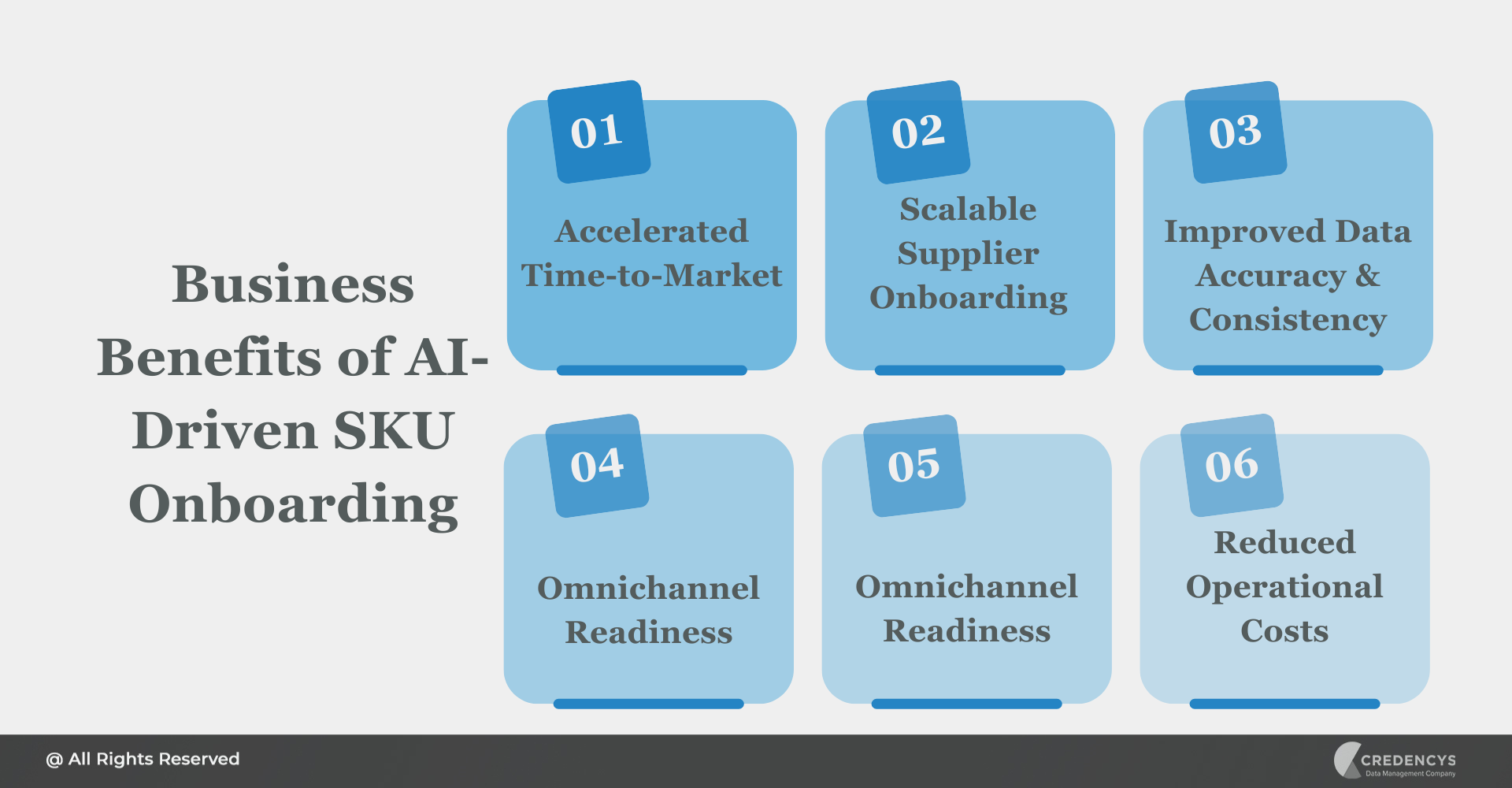
Business Benefits of AI-Driven SKU Onboarding
AI-powered SKU onboarding delivers measurable impact across the retail value chain, from faster catalog updates to higher product data accuracy and more efficient supplier operations. Here’s how it transforms the way retailers manage their product information.
1. Accelerated Time-to-Market
Manual onboarding often takes days or even weeks to process supplier files. With AI and OCR automation, retailers can reduce SKU onboarding time by up to 80%, bringing new products to market within hours.
Result: Launch new collections, vendor catalogs, and promotions faster to stay ahead of seasonal demand.
2. Scalable Supplier Onboarding
Retailers no longer need to expand catalog or merchandising teams as SKU volumes grow. AI pipelines can handle thousands of SKUs or hundreds of suppliers simultaneously, maintaining data quality at scale.
Result: Seamless onboarding of new vendors and categories without bottlenecks or quality trade-offs.
3. Improved Data Accuracy & Consistency
AI eliminates the errors that come from manual data entry and human interpretation. Every SKU is standardized and validated against predefined rules and taxonomies.
Result: Consistent product names, attributes, and categories across channels, ensuring customers always see accurate product details.
Ready to Deliver Consistent, High-Quality Product Data Across Every Channel? See How AI can Make Your Catalog Accuracy Effortless.
4. Omnichannel Readiness
Clean, structured data flows directly into the PIM and syncs across all retail channels, online stores, mobile apps, marketplaces, and in-store systems.
Result: Unified product experiences and faster updates across every sales touchpoint.
5. Enhanced Supplier Collaboration
Suppliers can submit data in their preferred formats without worrying about alignment or compliance. The AI layer standardizes everything automatically.
Result: Stronger supplier relationships and faster onboarding cycles, enabling collaborative retail growth.
6. Reduced Operational Costs
By automating data extraction, enrichment, and validation, retailers significantly cut down on manual labor costs and supplier coordination time.
Result: Lower operational overhead and faster ROI from catalog expansion initiatives.
In short: AI-driven SKU onboarding empowers retailers to launch faster, sell sooner, and scale smarter, turning supplier complexity into a competitive advantage.
How Credencys Helps Retailers
At Credencys, we help retailers modernize and accelerate their product onboarding workflows through a combination of AI automation, OCR intelligence, and robust PIM integration. Our goal is simple: to help you get accurate SKUs live faster, across every channel.
1. Retail-Focused Implementation Expertise
We’ve worked with marketplaces, fashion retailers, grocery chains, and CPG brands, helping them reduce onboarding cycles from days to hours. Our team understands retail taxonomy structures, data quality rules, and supplier onboarding complexities, ensuring solutions are practical, scalable, and retail-ready.
2. Seamless Integration with Leading PIM Platforms
As a trusted and reliable partner of Pimcore, Syndigo, and Semarchy, we help retailers implement or enhance their PIM systems. Our integration ensures all supplier data flows seamlessly into your PIM; validated, enriched, and ready for omnichannel publishing.
3. End-to-End AI-Powered Supplier Data Ingestion
Credencys builds AI-driven data pipelines that automatically capture, extract, and standardize supplier information, whether it comes from Excel sheets, PDFs, or product images. We enable retailers to eliminate manual processing and move toward fully automated SKU onboarding.
4. Custom Dashboards and Analytics
Credencys provides intuitive dashboards for monitoring onboarding speed, supplier performance, and data quality metrics. These insights help retailers continuously optimize their data operations and improve collaboration with suppliers.
Conclusion
AI-driven SKU onboarding is redefining how modern retailers manage product data. By automating ingestion, validation, and enrichment, retailers can launch products faster, maintain accuracy across channels, and scale operations effortlessly.
In a world where every second of product delay means lost revenue, AI turns SKU onboarding from a manual bottleneck into a strategic growth enabler. Partnering with Credencys helps you make this transformation real, combining AI intelligence, automation, and deep PIM expertise to help you stay ahead in a fast-moving retail landscape.
Accelerate Your Retail Catalog Launches with AI-Powered SKU Onboarding. Talk to Credencys Today to Automate Supplier Data Ingestion, Enhance Catalog Accuracy, and Shorten Time-to-Market for Every Product you Sell.






Tags: