
The Scale and Complexity of Book Publishing Metadata
Book publishers manage metadata across titles, editions, formats, contributors, series, imprints, territories, prices, rights, digital assets, retailers, distributors, and global markets. As catalogs grow, keeping every ISBN, format, description, classification, rights statement, price, and availability update accurate across the publishing supply chain becomes increasingly difficult.
Related: PIM for catalog production and product content management.
Fragmented Metadata Across Systems
Title information may be spread across editorial systems, spreadsheets, ERP, rights applications, DAM, distribution platforms, ONIX tools, and retailer portals, creating multiple versions of the same book record.
Complex Editions and Formats
A single work may exist as hardcover, paperback, EPUB, PDF, audiobook, translated edition, revised edition, large-print edition, or other formats, each requiring its own identifiers and product-level metadata.
Constant Metadata Changes
Titles evolve throughout the publishing lifecycle as publication dates, cover images, descriptions, contributors, reviews, prices, availability, rights, classifications, and marketing content change.
Different Channel and Market Requirements
Distributors, retailers, libraries, marketplaces, metadata aggregators, international partners, and digital platforms may require different metadata fields, classifications, formats, and validation rules.
Metadata Quality Impacts Discoverability
Incomplete subjects, keywords, contributor information, series data, descriptions, identifiers, and classifications can make titles harder for retailers, search systems, librarians, and readers to discover.

How Much is Your Product Data Costing You?
Get Your Score + 90-day action plan in 3 minutes.
Check Your ScoreThe Strategic Role of PIM in Book Publishing
PIM gives book publishers a governed foundation for managing title metadata across works, editions, formats, contributors, imprints, territories, channels, and stages of the publishing lifecycle. It helps improve metadata quality, simplify edition management, streamline ONIX syndication, accelerate title launches, and ensure distributors and retailers receive accurate and timely book information.
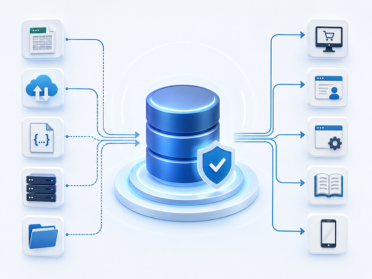
The Single Source of Truth
PIM creates one governed foundation for titles, subtitles, ISBNs, contributors, series, editions, formats, descriptions, classifications, rights, pricing references, availability information, and digital assets. It enables editorial, metadata, marketing, rights, sales, production, and digital teams to work with consistent title information.
- Consolidate metadata from editorial, ERP, rights, DAM, spreadsheets, and legacy systems
- Reduce duplicate and conflicting book records
- Maintain approved metadata across imprints, markets, and channels

Work, Edition, and Format Management
Publishers need to distinguish the intellectual work from the individual products through which readers consume it. PIM can connect related editions and formats while maintaining the appropriate ISBN and metadata for each manifestation.
- Manage relationships between works, editions, and formats
- Connect hardcover, paperback, eBook, audiobook, and other manifestations
- Maintain language, edition, publication-date, and format-specific information
- Reuse shared metadata without duplicating complete records

Standards-Ready Publishing Metadata
Publishing metadata must follow industry standards so information can move efficiently between publishers, distributors, retailers, libraries, and other trading partners. PIM provides a structured environment for governing the data required by those standards.
- Manage ISBNs and other publishing identifiers
- Structure ONIX-ready publishing metadata
- Maintain BISAC, Thema, keywords, and subject classifications

Rights, Pricing, and Availability Governance
Books may have different rights, availability, publication dates, prices, and market conditions by territory, format, or distribution arrangement. PIM can coordinate this commercial metadata with authoritative rights, ERP, distribution, and pricing systems.
- Maintain territorial and market-specific sales metadata
- Associate publishing status and availability with individual editions
- Consume pricing information from authoritative business systems

Discoverability, Syndication, and AI Readiness
Metadata determines how books are categorized, surfaced, compared, recommended, and presented across digital discovery environments. Structured PIM data provides richer context for both traditional book-discovery systems and emerging AI applications.
- Improve retailer and marketplace metadata completeness
- Strengthen subject, keyword, contributor, series, and audience-based discovery
- Support ONIX and channel-specific syndication
Our Approach to PIM Implementation Services
From metadata assessment to final deployment, we follow a proven four-step process to deliver a scalable PIM solution aligned with your publishing catalog, metadata standards, distribution ecosystem, and digital growth priorities.
01
Assessment and Planning
Analyze your title catalog, metadata sources, edition structures, workflows, ONIX processes, rights systems, digital assets, trading partners, and business priorities to define a clear PIM implementation roadmap.
02
Customization and Configuration
Design publishing-specific data models for works, editions, formats, contributors, series, identifiers, classifications, markets, workflows, validation rules, user roles, and integrations.
03
Enrichment and Governance
Cleanse and migrate title metadata, standardize classifications and identifiers, associate digital assets, establish data ownership, and configure enrichment, validation, review, approval, and publishing workflows.
04
Deployment and Training
Integrate PIM with publishing and distribution systems, launch priority catalogs and ONIX workflows, train internal teams, monitor adoption, and provide ongoing post-deployment support.
Business Impact of PIM for Book Publishers
PIM transforms fragmented publishing metadata into a governed business asset. It reduces manual metadata work, improves discoverability, simplifies edition management, accelerates title launches, and enables publishers to distribute accurate book information across more channels and markets.



Ready to Modernize Your Publishing Metadata?
Build a trusted metadata foundation that connects titles, editions, formats, contributors, rights, assets, and channels—so every book reaches distributors, retailers, libraries, and readers with complete and accurate information.
Book a Free ConsultationWhy Leading Enterprises Choose Credencys?
Credencys helps enterprises turn complex data into trusted insights, intelligent operations, and measurable business growth. Here’s what makes us a preferred data and AI partner:

End-to-End Data Expertise
From data strategy to AI deployment, we cover the entire spectrum—Data Management, Engineering, Insights, and Intelligence—to ensure your data drives measurable business outcomes.

Domain-Focused Solutions
Whether you're in retail, automotive, or manufacturing, our purpose-built platforms solve industry-specific challenges with precision and speed.

Enterprise-Grade Partnerships
We collaborate with the best in the business to deliver future-ready, scalable, and secure solutions.

AI-First
We help you move beyond dashboards—accelerating AI readiness, deploying GenAI and enterprise AI agents, and enabling intelligent automation across your data ecosystem.
50+
Enterprise Clients
100%
Certified Consultants
15+
Years Experience
4.9/5
Client Satisfaction
We Build PIM Solutions for


Frequently Asked Questions
PIM for Book Publishers is a centralized approach to collecting, structuring, enriching, governing, and distributing the metadata associated with books and other publishing products. It can manage ISBNs, titles, contributors, editions, formats, series, subjects, descriptions, rights-related metadata, pricing references, availability, cover assets, and channel-specific information across the publishing lifecycle.
Publishing metadata is often distributed across editorial systems, spreadsheets, ERP, rights applications, DAM, ONIX tools, distributor systems, and retailer portals. As catalogs grow, teams repeatedly update the same title information across different applications.
ONIX for Books is the international standard for representing and communicating book-industry product information electronically. PIM can maintain the structured metadata required for ONIX, validate required fields, apply publishing workflows, and generate or feed downstream ONIX processes.
The appropriate version depends on trading-partner requirements. The U.S. and Canadian markets have moved to ONIX 3, and BISG’s current resources focus on ONIX 3 rather than ONIX 2.1.
As of the latest BISG resource information, ONIX 3.1.2 is the current published version.
Yes. PIM can store, govern, validate, and associate ISBNs with the appropriate publishing products. However, PIM does not issue ISBNs.
Yes. Sales rights, territories and availability can be stored per title and format, and exported in ONIX so each retailer receives what it may sell.
Trusted by Best
Choosing Credencys means partnering with a team that’s deeply committed to unlocking the true value of your data. Here’s why industry leaders trust us:
Our Valued Clientele


Send us a Message
