


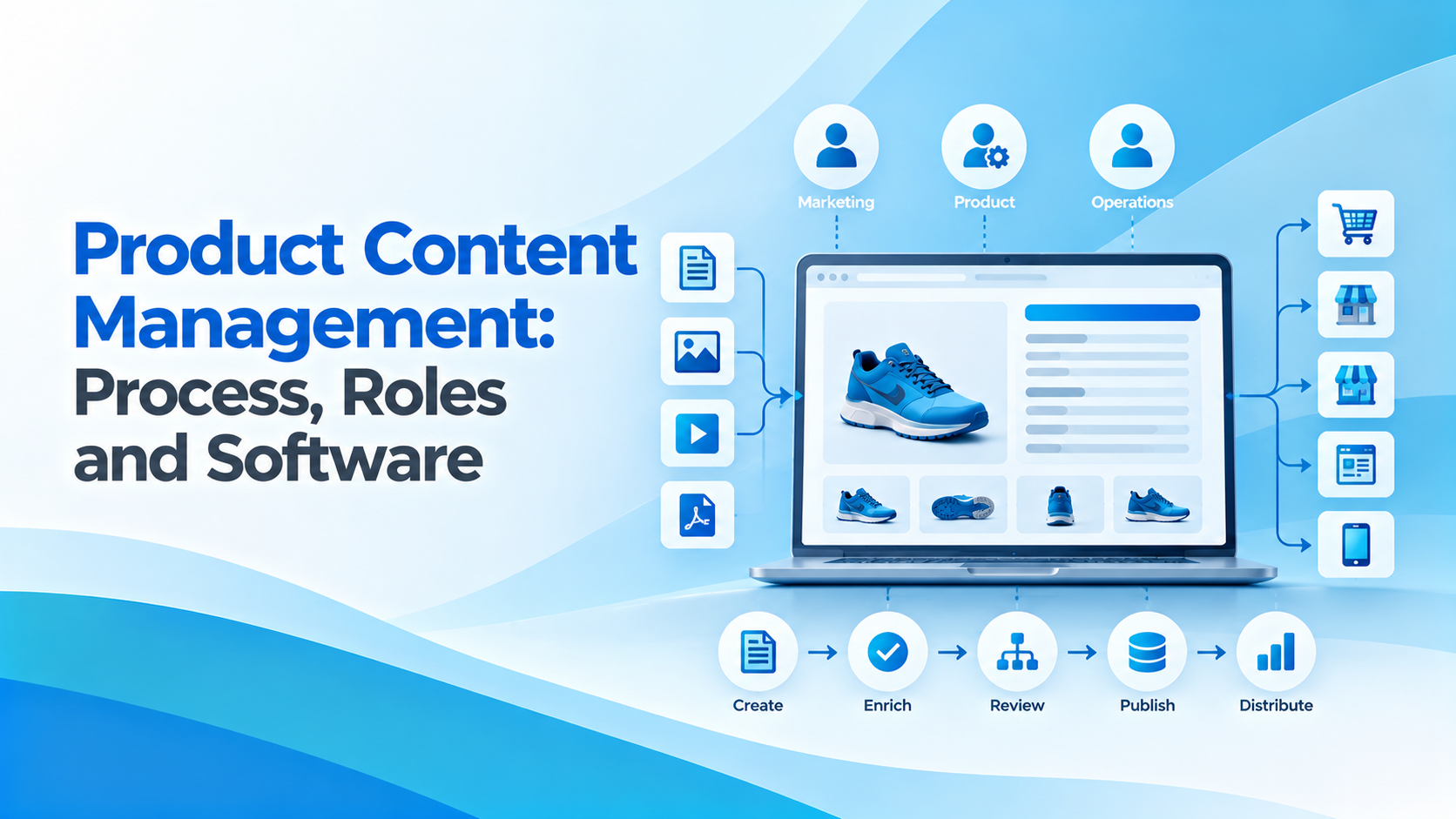
Product Content Management: Process, Roles and Software
Product content management is how a company plans, creates, approves, and publishes content that describes its products, including titles, descriptions, attributes, images, videos, and documents. Good product content management means every channel shows complete, accurate, and persuasive product content, without teams copying and pasting between systems.
This guide explains the process, roles, and software that run product content management at scale.
What Is Product Content Management?
Product content management covers everything a customer reads or sees about a product before buying it. It overlaps with product information management (PIM), but its focus differs.
PIM is the system and discipline for managing product data. Product content management turns that data into content that sells across every channel and language.
| Product data management | Product content management | |
|---|---|---|
| Focus | Accurate, structured facts | Complete, persuasive, channel-ready content |
| Examples | SKU, GTIN, dimensions, weight | Titles, bullets, descriptions, images, videos |
| Owner | Product, data and supply chain teams | eCommerce, marketing and content teams |
| Main system | ERP, PIM | PIM, DAM, syndication |
What Counts as Product Content
- Copy: titles, feature bullets, short and long descriptions.
- Attributes: the specifications shoppers use to filter and compare.
- Assets: product images, lifestyle images, videos, 360° views.
- Rich media: comparison charts and enhanced content on retailer sites.
- Documents: manuals, datasheets, safety data and certificates.
- SEO fields: meta titles, descriptions and keywords.
- Translations: the same content adapted for each market.
The Product Content Management Process
- Plan: decide what content each category and channel needs, and set standards.
- Collect: bring in data from suppliers, ERP, PLM, and existing catalogs.
- Enrich: write copy, add attributes, link images and documents, translate.
- Review: check content against the rules and approve it.
- Publish: send approved content to your website, marketplaces, retailers, and print.
- Measure: track completeness, time to publish, and the effect on conversion and returns.
The process works best when it runs in one system with clear steps. See PIM workflow design.
Roles in Product Content Management
| Role | Responsibility |
|---|---|
| Product content manager | Owns standards, priorities and the content calendar |
| Data steward | Keeps attributes, categories and data quality in order |
| Copywriter | Writes titles, bullets and descriptions to brand and channel rules |
| Digital asset specialist | Manages images, videos and documents in the DAM |
| Translator or localization lead | Adapts content for each language and market |
| Approver | Signs off content, for example product, legal or brand |
In small teams, one person may hold several roles. What matters is that each step has an owner.
Product Content Management Software
| Software | What it does in product content management |
|---|---|
| PIM | Holds the approved product record: attributes, copy, translations, and links to assets |
| DAM | Stores and manages images, videos and documents, with rights and renditions |
| PXM | Product experience management: tools focused on channel content and the digital shelf |
| Syndication | Sends content to retailers, marketplaces and data pools in their formats |
| AI content tools | Draft copy and suggest attributes, with human review |
Many platforms combine several of these. Pimcore, for example, includes PIM and DAM, while syndication platforms such as Syndigo focus on getting content to retailers.
Compare platforms in our PIM platform comparison matrix.
Using AI for Product Content, Safely
AI can write first drafts of titles and descriptions, suggest attributes, and translate at scale. It works when it is grounded in your approved product data, follows brand and channel rules, and a person reviews every batch.
Read more in AI product descriptions at scale, or see our AI product content service.
How to Measure Product Content Management
- Completeness: the share of products that have all required content for each channel.
- Time to publish: days from product creation to live on every channel.
- Content score: retailer or marketplace content scores, where available.
- Conversion and returns: the difference between products with full and partial content.
- Rework: how often content is rejected or corrected.
For a channel example of the attributes shoppers rely on, see Google Merchant Center’s product data specification.
Getting Started
- Pick one category and one channel that matter most.
- Define what complete content means for that category and channel.
- Measure where you are today.
- Put the content and its workflow in a PIM.
- Fix the gaps, then roll out to the next category and channel.
Product Content Standards
Standards turn good intentions into consistent content. Write them per category, so everyone knows what complete content looks like:
| Standard | Example for cordless drills |
|---|---|
| Title format | Brand + Product type + Voltage + Key feature |
| Required attributes | Voltage, battery type, chuck size, torque, weight |
| Bullets | Three to five, each starting with the benefit |
| Description length | 60 to 150 words, no unverified claims |
| Images | Main image on white, two in-use images, one of what is in the box |
| Documents | Manual and safety data sheet |
Product Content for Different Channels
| Channel | What it needs | Watch out for |
|---|---|---|
| Your website | Full content, rich media, SEO fields | Consistency with marketplaces |
| Marketplaces | Channel-specific titles, attributes and images | Strict rules and frequent changes |
| Retailers | Retailer templates or syndication | Each retailer has its own requirements |
| B2B portals | Technical data, documents, pack sizes | Customer-specific catalogs |
| Print catalogs | Short copy, high-resolution images | Layout and page limits |
The goal is one master record in the PIM, with channel-specific variations only where a channel needs them, not separate copies maintained manually.
Common Product Content Management Challenges
- Content in spreadsheets and inboxes: nobody knows which version is current.
- Supplier data of mixed quality: every supplier sends a different format.
- Too many channels: each with its own rules, so teams rewrite the same content.
- Slow approvals: content waits for email sign-off.
- Translation bottlenecks: new markets wait for content in their language.
- No measurement: nobody can show which content gaps cost sales.
Most of these come down to one fix: a single system for product content, with standards, workflows, and measurement built in.
Building the Business Case
The business case for better product content management usually rests on four numbers you can measure today: how long it takes to launch a product on every channel, how much time teams spend on manual content work, how often content errors cause rejections or returns, and how conversion differs between products with complete and incomplete content. Measure them for one category before and after, and the case usually makes itself.
The Product Data Readiness Assessment gives a quick starting point.
Product Content Management in Practice: An Example
Take a home improvement retailer adding 2,000 new products a season from 150 suppliers. Without a defined process, buyers forward supplier spreadsheets, copywriters work from emails, and images arrive by file transfer.
Products go live with missing attributes, and marketplaces reject a share of them. With product content management in place, the flow is different.
Suppliers submit data through a template with required attributes for each category. The PIM checks completeness on arrival and sends gaps back to the supplier.
Copywriters see a task list of products ready for copy, with the attributes they need on screen. Images go to the DAM and are linked to products automatically by GTIN.
A category manager approves each product, and the PIM publishes it to the website and marketplaces in each channel’s format. The team can see, at any moment, which products are blocked and why.
Product Content Management Checklist
- Content standards written for each category
- A single system of record for product content
- Supplier onboarding with required attributes and validation
- Task-based workflows with clear owners and approvals
- Assets in a DAM, linked to products
- Channel mappings maintained once, not per upload
- Completeness and time-to-publish measured every month
- A plan for AI-assisted drafting with human review
Few teams tick every box at the start. Pick the gaps that cost the most, usually supplier data and approvals, and fix those first.
Product Content Management: FAQ
What is product content management?
The process of planning, creating, approving, and publishing product content, such as copy, attributes, images, and documents, across every sales channel.
What is the difference between PIM and product content management?
PIM is the system and discipline for managing product information. Product content management turns that information into channel-ready content, usually within a PIM and DAM.
What software do I need for product content management?
Usually a PIM, a DAM (or a PIM with built-in DAM), and a way to syndicate content to channels. AI tools can help with drafting, but human review is still needed.
Who owns product content in a company?
Usually, eCommerce or marketing owns the content, while product and data teams own the underlying facts. A product content manager coordinates both.






Tags: