


PIM for Industrial MRO Distributors: A Complete Guide
Industrial distributors may manage hundreds of thousands of technical products across multiple suppliers, systems, locations, and sales channels. Yet the size of the catalog does not determine whether customers can successfully find, compare, evaluate, and purchase those products.
The real differentiator is the quality and structure of the product information supporting the catalog.
Supplier information often enters the organization through spreadsheets, PDFs, portals, APIs, ERP systems, shared drives, and legacy databases. Every source may use different naming conventions, category structures, attributes, values, units of measurement, and completeness standards.
As this information moves across e-commerce websites, customer portals, marketplaces, procurement systems, sales applications, and printed catalogs, inconsistencies increase. Catalog teams spend more time correcting product data, while customers and sales teams struggle to locate the right products.
This has become a commercial concern rather than only a catalog management problem.
A recent Industrial Buyer Report found that more than 60% of industrial buyers now purchase online and that digital channels account for nearly one-third of their purchases. The report also identified accurate product data as a non-negotiable part of the industrial buying experience.
At the broader B2B level, McKinsey found that buyers now use an average of ten channels during the purchasing journey. It also found that 71% of B2B companies offer e-commerce and that approximately one-third of revenue among those organizations flows through digital channels.
Industrial distributors therefore need more than a website connected to an ERP. They need a scalable product data foundation that can support product discovery, digital commerce, supplier onboarding, sales enablement, customer service, analytics, and artificial intelligence.
Product information management provides that foundation.
Credencys offers dedicated PIM solutions for industrial distributors to help businesses centralize fragmented supplier information, standardize technical product data, improve catalog quality, and deliver accurate information across digital and sales channels.
Why Traditional Product Data Processes Break at MRO Scale
Industrial product data becomes harder to manage as the number of products, suppliers, product categories, business systems, locations, and sales channels increases.
Processes that may work for a limited catalog frequently become difficult to control at scale.
Spreadsheets become larger and more fragmented. Data ownership becomes unclear. Teams maintain separate versions of the same information. Supplier files require repeated manual transformation. ERP records remain too limited for customer-facing use. Product assets become disconnected from product records.
Several underlying conditions make MRO product data management particularly challenging.
1. Supplier Data Arrives in Different Structures
Manufacturers and suppliers rarely provide information in one consistent format. Product information may arrive through:
- Spreadsheets and CSV files
- Supplier portals
- APIs
- PDFs and technical documents
- ERP exports
- Product databases
- Shared file repositories
- Legacy catalog systems
Each supplier may use its own attribute names, values, product hierarchies, field formats, terminology, and measurement standards. Before this information can be used, catalog teams must determine:
- What each field represents
- Which internal attribute it should match
- Whether the value is complete
- Whether the measurement is valid
- Whether the product already exists
- Which category should contain the product
- Whether the record has the required digital assets
- Whether the information meets channel requirements
This process often depends on manual review and individual product knowledge.
ETIM North America describes the same structural challenge for technical-product distributors: manufacturers send information using different formats, attribute names, structures, and completeness levels, leaving distributor teams to normalize and reformat the data before it can move into ERP, PIM, e-commerce, or customer systems.
2. Technical Attributes Differ Across Product Categories
Industrial catalogs do not use one universal set of attributes. Every technical product class requires its own:
- Specifications
- Dimensions
- Ratings
- Materials
- Standards
- Certifications
- Compatibility information
- Usage information
- Packaging data
- Documentation
The attributes required to identify one type of product may be irrelevant to another.
This creates a need for category-specific product models. Without those models, attributes are often entered into general text fields, distributed across spreadsheets, or managed inconsistently across product records.
Unstructured information may be readable by an experienced employee, but it cannot reliably support filtering, comparison, automated validation, semantic search, or AI-assisted discovery.
3. Minor Product Differences Can Have Major Consequences
Many industrial products appear similar while differing in technically important ways.
Incomplete or ambiguous attributes can make it difficult to determine whether a product meets the buyer’s operational, dimensional, performance, safety, or compliance requirements.
The issue is not simply whether a product description is well written. The catalog must accurately represent the technical characteristics that distinguish one product from another. When that information is missing or inconsistent, the distributor may experience:
- Incorrect product selection
- Additional customer service inquiries
- Longer quotation cycles
- Lower digital conversion
- More manual verification
- Increased returns
- Reduced customer confidence
- Greater reliance on experienced employees
Structured product data enables buyers and internal teams to make informed decisions using consistent information.
4. Product Knowledge Is Distributed Across Systems and Teams
Industrial product information frequently exists in several locations at once.
Operational information may be stored in ERP. Images and documents may be stored in DAM or shared drives. Technical specifications may remain in supplier files. Search terminology may be managed in the e-commerce platform. Product substitutions may exist only in sales or customer service knowledge.
This creates several versions of the product record. When ownership is unclear, teams may not know:
- Which system contains the approved value
- Where a correction should be made
- Which version has been published
- Whether every channel received the update
- Who is responsible for validating the information
- Whether a document is still current
The result is a fragmented product data environment in which updates require repeated coordination.
5. Channel Requirements Continue to Expand
Industrial distributors no longer publish product information through one channel. The same product record may support:
- E-commerce websites
- Customer portals
- Sales applications
- Procurement systems
- Marketplaces
- Mobile applications
- Dealer or distributor feeds
- Printed catalogs
- Digital catalogs
- Customer-specific assortments
- Search and recommendation systems
- AI-enabled experiences
Each channel may require different attributes, descriptions, images, file formats, naming conventions, and publishing rules.
Maintaining separate product records for every channel increases duplication and creates a higher risk of inconsistent or outdated information.
A centralized PIM system allows the organization to manage one governed product foundation while preparing information for the requirements of each destination.
These pressures expose the limits of managing product information separately across files, systems, and channels. PIM addresses the underlying issue by establishing a governed product data layer for the enterprise.
What is PIM for Industrial Distributors?
PIM for industrial distributors is a centralized system and operating framework for collecting, organizing, standardizing, enriching, validating, governing, and distributing complex technical product information.
It creates a controlled product data layer between source systems and customer-facing channels.
A PIM platform can receive information from:
- ERP systems
- Supplier files
- Manufacturer portals
- APIs
- Legacy databases
- DAM platforms
- Existing product repositories
- Industry data sources
The information can then be transformed into governed product records containing:
- Product hierarchies
- Technical attributes
- Approved values
- Units of measurement
- Product descriptions
- Identifiers
- Digital assets
- Product families
- Product relationships
- Channel-specific content
- Completeness information
- Approval status
Once approved, the information can be delivered to websites, portals, marketplaces, sales applications, procurement platforms, catalogs, search tools, and AI systems.
The purpose of PIM is not only to store more product information. It is to make that information usable, reliable, searchable, reusable, and scalable.
Where PIM Fits in the Industrial Distribution Technology Stack
One of the most important decisions in an industrial product data program is defining the responsibility of each enterprise system.
PIM should not duplicate every function of ERP, DAM, e-commerce, or search. Each platform should manage the information and processes for which it is best suited.
| System | Primary Responsibility | Information Managed |
|---|---|---|
| ERP | Operational and transactional management | Pricing, inventory, procurement, orders, warehousing, invoicing, and financial information |
| PIM | Product information management and governance | Classifications, technical attributes, descriptions, identifiers, relationships, completeness, and channel content |
| DAM | Digital asset management | Images, videos, manuals, drawings, certificates, safety documents, and other media |
| E-commerce | Digital buying and account experience | Navigation, product pages, customer accounts, pricing presentation, carts, checkout, and online orders |
| Search | Product discovery and relevance | Indexing, query interpretation, ranking, filtering, recommendations, and search analytics |
The Role of ERP
ERP remains essential to industrial distribution. It manages transactional and operational information, including:
- Product identifiers
- Inventory availability
- Pricing
- Purchasing
- Warehousing
- Orders
- Accounts
- Financial processes
However, ERP product records are usually designed to support operations rather than rich digital product experiences.
The ERP may know whether an item is available and at what price. It may not contain the complete technical attributes, product relationships, digital assets, search terminology, enrichment workflows, and channel-specific information required for digital commerce.
The Role of PIM
PIM manages the enriched and governed product record. It determines:
- How products are classified
- Which attributes are required
- Which values are approved
- Which information is missing
- Which products belong to a family
- Which products are related
- Which assets belong to each product
- Which content is ready for publication
- Which channels can receive the product
PIM becomes the product information layer connecting operational systems with customer-facing experiences.
The Role of DAM
DAM controls digital assets and their associated metadata.
A strong PIM-DAM relationship ensures that approved assets remain connected to the correct product records and can be published alongside the relevant technical information.
The Role of E-Commerce and Search
The e-commerce platform presents the buying experience. The search platform helps users navigate and discover the catalog.
Neither platform can independently correct incomplete product information.
Search, filtering, recommendations, comparisons, and product pages are only as effective as the data supplied to them.
The Product Data Problems PIM Solves for Industrial Distributors
With PIM’s role in the technology stack established, the next step is to identify the operational and commercial problems the program must solve.
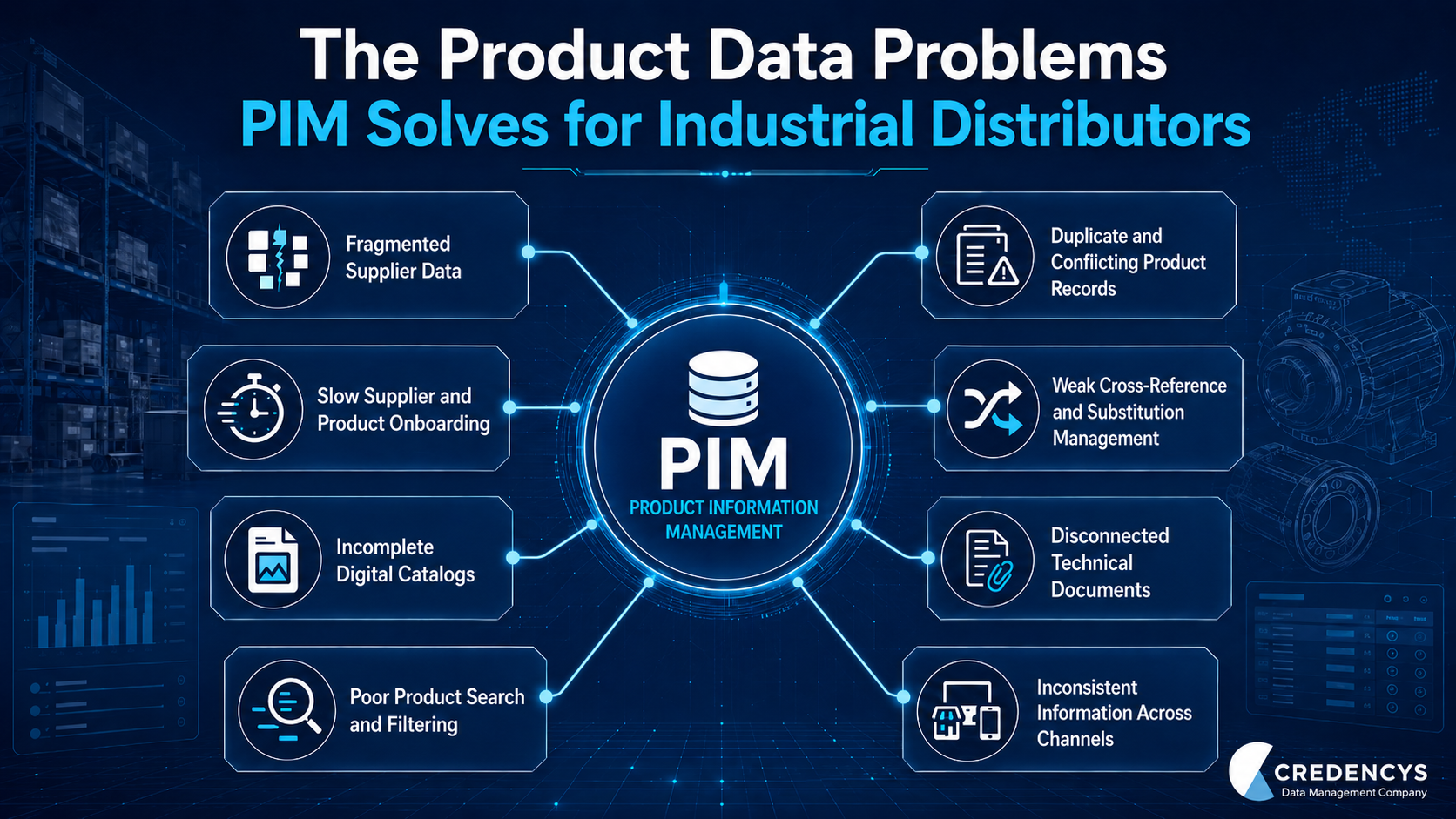
A PIM initiative should begin with clear business and data problems rather than a platform selection exercise.
For industrial distributors, the most common problems involve supplier onboarding, catalog completeness, product discovery, data consistency, and channel publishing.
1. Fragmented Supplier Data
The challenge is not simply that supplier formats differ. It is that every variation must be translated into a consistent internal structure before the information can support search, commerce, analytics, or downstream systems.
PIM provides a common product model for mapping incoming data, applying reusable transformation rules, and validating records before they move further into the organization. This reduces repeated interpretation while giving teams visibility into missing, invalid, or incorrectly formatted information.
2. Slow Supplier and Product Onboarding
Supplier onboarding often involves several disconnected activities:
- Collecting files
- Reviewing source fields
- Mapping attributes
- Assigning categories
- Standardizing values
- Checking duplicates
- Associating assets
- Validating technical content
- Approving records
- Preparing channel exports
When these steps rely on email, spreadsheets, and manual coordination, products may remain unavailable for weeks or months.
PIM brings these activities into a controlled workflow. Automation handles repeatable tasks, while exceptions are routed to the appropriate data owners. This enables the organization to reduce onboarding time without removing necessary technical and quality controls.
3. Incomplete Digital Catalogs
A product may exist in inventory but still be unready for digital sale. Digital readiness may require:
- Complete technical attributes
- Approved descriptions
- Correct classifications
- Images
- Documents
- Product relationships
- Packaging information
- Search fields
- Channel-specific fields
Without PIM, the organization may have limited visibility into why a product cannot be published.
PIM completeness rules can evaluate each record against category and channel requirements. Teams can then prioritize the information preventing products from becoming digitally sellable.
4. Poor Product Search and Filtering
Industrial buyers often use highly specific criteria when searching for products. Search quality depends on:
- Structured categories
- Complete technical attributes
- Standardized terminology
- Consistent values
- Product identifiers
- Search synonyms
- Product relationships
- Compatibility information
When specifications are stored in unstructured descriptions or supplier documents, they cannot reliably support faceted navigation or parametric search.
ETIM North America describes classification as a structured method for organizing technical product data and maintaining uniformity across shared product information. PIM enables industrial distributors to apply these structures consistently across the catalog.
5. Duplicate and Conflicting Product Records
Duplicate product records can originate from:
- Multiple suppliers
- Legacy platforms
- Acquired businesses
- Separate locations
- Different identifier structures
- Repeated imports
- Channel-specific databases
Duplicates increase maintenance effort and create uncertainty about which information is correct.
PIM can apply matching, validation, and governance rules to identify likely duplicates and resolve conflicting records before information is published.
6. Weak Cross-Reference and Substitution Management
Industrial buying often depends on the relationships between products. These relationships may include:
- Replacements
- Alternatives
- Compatible products
- Accessories
- Components
- Kits
- Superseded products
- Equivalent products
- Manufacturer and distributor identifiers
When these relationships are managed through notes, spreadsheets, or employee knowledge, they are difficult to use across digital channels. PIM provides a governed structure for maintaining and distributing product relationships.
7. Disconnected Technical Documents
Technical documents are essential to industrial product evaluation and use.
However, they are often stored separately from the product data they support. This can result in:
- Missing documents
- Incorrect product associations
- Outdated files
- Duplicate assets
- Manual publishing work
- Inconsistent channel availability
PIM and DAM integration allows product records and approved technical assets to remain connected throughout the publishing process.
8. Inconsistent Information Across Channels
When channels maintain independent copies of product information, updates become slower and inconsistencies become harder to detect. The same correction may need to be repeated across websites, portals, marketplaces, sales tools, and catalogs.
PIM replaces this channel-by-channel maintenance model with centrally governed information that can be adapted to each destination. Product content remains consistent at its source while channel-specific requirements are managed through publishing rules.
Solving these problems requires more than a central repository. The PIM environment must include the data modeling, quality, workflow, relationship, publishing, and integration capabilities needed to manage industrial product information at scale.
Essential PIM Capabilities for MRO Product Data
The effectiveness of PIM for MRO distributors depends on capabilities that support technical data complexity, supplier diversity, and large catalogs.
1. Supplier Data Ingestion and Mapping
A PIM environment should support multiple methods of receiving supplier data, including:
- File imports
- API integrations
- Supplier portals
- Scheduled feeds
- Manual uploads
- Connected data services
Incoming information should be mapped against an approved internal product model.
Mapping capabilities should support:
- Field matching
- Data transformation
- Value normalization
- Unit conversion
- Category assignment
- Identifier validation
- Exception detection
- Missing-data identification
The objective is to automate predictable transformations while giving product data teams visibility into records that require review.
2. Industrial Product Taxonomy
A product taxonomy defines how the catalog is organized. It establishes:
- Product groups
- Categories
- Classes
- Attribute groups
- Required attributes
- Allowed values
- Units
- Naming standards
- Search relationships
A scalable taxonomy must support technical depth without becoming unnecessarily difficult to maintain.
The structure may incorporate ETIM, UNSPSC, internal classifications, customer-specific requirements, or a combination of these approaches.
ETIM North America states that the standard is used in more than 20 countries and is available in over 17 languages, supporting uniform classes, features, values, and units for technical product data.
The classification standard does not replace PIM. It gives the PIM environment a consistent structure for receiving, managing, and exchanging technical information.
3. Attribute and Unit Standardization
Suppliers may use different terms for the same product characteristic.
PIM allows the organization to map supplier terminology to approved internal attributes and values. Standardization may include:
- Attribute naming
- Value formatting
- Units of measurement
- Decimal precision
- Abbreviations
- Controlled vocabularies
- Data types
- Required formats
Without standardization, filters, comparisons, analytics, and automated publishing become unreliable.
4. Data Quality and Completeness Controls
PIM should make product data quality measurable. Quality controls may evaluate:
- Required fields
- Data formats
- Allowed values
- Attribute dependencies
- Duplicate records
- Missing assets
- Invalid units
- Conflicting identifiers
- Channel requirements
- Approval status
Completeness scores show how much required information is available for a product, category, supplier, or channel.
These scores help teams move from reactive correction to structured quality management.
5. Product Family and Variant Management
Industrial catalogs often contain groups of closely related products.
A PIM data model should allow shared information to be managed at the family level while maintaining the distinct information required for each SKU.
This reduces unnecessary duplication and helps teams update related products consistently.
A structured family model also supports clearer navigation, comparison, and presentation across digital channels.
6. Product Relationships and Cross-References
Product relationships should be treated as governed data rather than unstructured notes. The PIM should support:
- Related products
- Alternatives
- Replacements
- Accessories
- Components
- Kits
- Supersession
- Compatibility
- Cross-referenced identifiers
These relationships strengthen product discovery and help customers, sales representatives, and customer service teams continue the buying process when the originally requested product is unavailable or unsuitable.
7. Workflow and Governance
PIM is not only a repository. It is also an operating environment for product data. Workflows should define:
- Who can create product records
- Who enriches attributes
- Who validates technical information
- Who approves content
- Who publishes products
- How exceptions are managed
- How changes are reviewed
- How quality problems are escalated
Governance establishes ownership and accountability. It reduces uncertainty around decisions, prevents uncontrolled edits, and ensures that product data remains reliable as the catalog expands.
8. Channel-Specific Publishing
A centralized product record may need to be adapted for different channels. PIM can apply channel rules governing:
- Required fields
- Naming conventions
- Description length
- Image requirements
- Document requirements
- Category mappings
- File formats
- Publishing schedules
The product remains centrally governed while its presentation is adjusted for each destination.
9. Enterprise Integration
PIM must function as part of the broader enterprise architecture. Common integration points include:
- ERP
- DAM
- E-commerce
- Search
- Supplier portals
- Marketplaces
- Procurement systems
- Customer applications
- Data platforms
- Reporting tools
The integration design should define:
- Which system owns each field
- How frequently information moves
- Whether updates are batch or real time
- How errors are reported
- How failed records are reprocessed
- How changes are synchronized
- How lineage is tracked
A well-designed integration model prevents PIM from becoming another disconnected platform.
Once these foundational capabilities are in place, their commercial impact becomes most visible in product discovery and supplier onboarding.
How PIM Improves Industrial Product Discovery
Product discovery is one of the most commercially important outcomes of MRO product data management.
Customers must be able to locate products using the information available to them, not only the terminology preferred by the distributor.
1. Structured Attribute Search
PIM organizes technical information into searchable fields.
This supports:
- Faceted search
- Parametric search
- Product filtering
- Technical comparison
- Category navigation
- Specification-based discovery
The search platform can only apply these capabilities when the required attributes are present and consistently structured.
2. Identifier-Based Search
Industrial products may be referenced through several identifiers. A governed identifier model helps search and internal applications connect:
- Manufacturer identifiers
- Distributor SKUs
- Legacy identifiers
- Customer identifiers
- Alternate references
- Superseded identifiers
This improves the likelihood that users can locate the correct record regardless of which approved identifier they possess.
3. Synonym and Terminology Management
Customers, manufacturers, sales teams, and internal systems may use different terminology for the same product or characteristic.
PIM can manage approved synonyms and terminology relationships, allowing search systems to interpret a broader range of queries.
4. Product Relationships
Search should not end when the exact product is unavailable. Governed product relationships allow digital channels and sales tools to surface:
- Alternatives
- Replacements
- Compatible items
- Related products
- Required components
This creates a more complete discovery experience.
5. Natural-Language and AI-Assisted Search
Natural-language search and product recommendations require more than descriptive text.
They rely on structured product knowledge, including:
- Attributes
- Categories
- Relationships
- Identifiers
- Compatibility
- Documents
- Approved terminology
McKinsey’s 2026 B2B Pulse found that market leaders were twice as likely as lagging organizations to report adopting generative AI, at 44% compared with 22%. The research also found that leaders were more likely to embed AI into core commercial workflows rather than confining it to isolated pilots.
For industrial distributors, this increases the importance of creating governed product data before scaling AI-assisted discovery. AI can improve how product knowledge is accessed. It cannot independently correct an incomplete or inconsistent product foundation.
How PIM Accelerates Supplier Onboarding
Supplier onboarding is often one of the clearest areas in which PIM can reduce manual effort. A PIM-enabled process typically includes:
- Receiving supplier information through an approved source.
- Identifying the supplier and relevant data structure.
- Mapping incoming fields to the internal product model.
- Standardizing values, terminology, and units.
- Assigning products to the appropriate classifications.
- Validating mandatory attributes and formats.
- Checking for duplicates and conflicts.
- Associating relevant digital assets.
- Routing incomplete records for review.
- Calculating product and channel completeness.
- Approving the product record.
- Publishing the approved information.
Automation does not eliminate product data governance. It allows teams to focus their attention on exceptions, technical decisions, and incomplete records rather than repeating the same transformations for every file.
Important supplier onboarding metrics include:
- Average onboarding time
- Average time to activate new SKUs
- Percentage of fields mapped automatically
- Number of exceptions requiring manual review
- Product completeness at initial publication
- Number of rejected records
- Manual effort per supplier
- Time from supplier approval to digital availability
These metrics connect product data work with operational and commercial outcomes.
Improvements in product discovery and supplier onboarding create value beyond the catalog team. They influence digital assortment, revenue activation, employee productivity, channel consistency, acquisition integration, and AI readiness.
The Business Value of PIM for Industrial Distributors
PIM should be evaluated according to the business improvements it enables, not only whether the platform has been deployed.
1. Increase Digitally Sellable SKU Coverage
A distributor may have products available in ERP that are not complete enough to publish online.
PIM helps identify the specific information preventing publication.
By systematically improving attributes, assets, classifications, relationships, and channel fields, the organization can increase the percentage of its catalog available for digital purchase.
This expands the digital assortment without requiring the distributor to add new inventory.
2. Improve Search Success
Structured product data helps search systems return more relevant products. Improved discovery can reduce:
- Zero-result searches
- Irrelevant results
- Abandoned searches
- Manual product verification
- Dependence on customer service
- Time required to locate products
Search analytics can also reveal which attributes, synonyms, and product relationships require further improvement.
3. Reduce Manual Catalog Work
Reusable rules, validation, workflows, and bulk operations reduce repetitive activities. Catalog teams can spend less time on:
- Reformatting supplier files
- Correcting field names
- Converting units
- Copying information between systems
- Identifying missing fields manually
- Recreating channel exports
- Updating the same record repeatedly
This allows specialists to focus on product data quality, taxonomy, governance, and strategic enrichment.
4. Accelerate Supplier Revenue
Supplier agreements do not generate digital revenue until the associated products become searchable and purchasable.
Reducing onboarding time shortens the gap between receiving product information and activating products across sales channels.
5. Improve Sales and Customer Service Productivity
Sales and customer service teams require fast access to reliable product information. PIM can provide connected access to:
- Technical specifications
- Documents
- Product relationships
- Approved identifiers
- Alternatives
- Replacements
- Compatibility information
- Current descriptions
This reduces the amount of time spent searching across supplier websites, internal files, and disconnected applications.
6. Increase Channel Consistency
PIM creates one governed foundation from which channel-specific content can be prepared. Updates can be made centrally and distributed according to predefined publishing rules.
This improves consistency without forcing every channel to display identical content.
7. Support Mergers and Acquisitions
Acquisitions often introduce additional:
- ERP systems
- Product identifiers
- Suppliers
- Taxonomies
- Catalog structures
- Websites
- Data quality standards
PIM can provide a common product data layer while the wider technology environment is consolidated over time.
It allows the organization to normalize and govern product information without requiring every operational system to be replaced immediately.
8. Prepare the Catalog for AI
McKinsey reports that market leaders most often associate generative AI with efficiency, customer experience, and innovation, while less mature organizations remain constrained by fragmented data and legacy technology.
PIM supports AI readiness by creating:
- Structured attributes
- Governed terminology
- Consistent classifications
- Connected relationships
- Approved content
- Reliable identifiers
- Accessible technical documentation
- Clear ownership
These capabilities improve the reliability of semantic search, recommendations, sales copilots, customer service assistants, and automated enrichment.
| Product Data Improvement | Operational Effect | Business Outcome |
|---|---|---|
| Automated supplier mapping | Less manual transformation and field matching | Faster supplier and SKU onboarding |
| Higher product completeness | More products meet channel requirements | Greater digitally sellable catalog coverage |
| Structured technical attributes | Improved filtering, comparison, and search | Better product discovery and buying experiences |
| Governed product relationships | Alternatives and replacements become accessible | Reduced lost sales and stronger service |
| Centralized channel publishing | Fewer independent product records | More consistent customer experiences |
| Standardized product knowledge | Search and AI receive more reliable information | Improved readiness for intelligent commerce |
Does Your Industrial Distribution Business Need PIM?
PIM may be appropriate when product data complexity has outgrown existing systems and processes. The following conditions may indicate a need for a more structured product data foundation:
- Product information comes from numerous suppliers.
- The catalog contains a large volume of technical SKUs.
- Supplier data requires extensive manual transformation.
- Teams rely on spreadsheets, PDFs, and shared drives.
- Product onboarding takes too long.
- Many stocked products remain unavailable online.
- Customers cannot search effectively using technical criteria.
- Product completeness cannot be measured.
- Duplicate and conflicting product records are common.
- Product alternatives depend on employee knowledge.
- Assets are disconnected from product records.
- Information differs across channels.
- Multiple ERP or commerce platforms are in use.
- Acquisitions have created overlapping catalogs.
- AI initiatives are limited by inconsistent product information.
- Data ownership and approval responsibilities are unclear.
The presence of one issue may not require a full PIM program. When several conditions occur together, the organization should assess whether the underlying gaps involve:
- Technology
- Taxonomy
- Data quality
- Governance
- Integration
- Supplier processes
- Workflow
- Channel readiness
A focused Product Data Assessment for industrial distributors can establish the current state and identify the highest-priority improvements.
How to Choose a PIM Platform for Industrial Distribution
The right PIM platform must support the complexity of industrial product data. Evaluation criteria should include:
- Large catalog scalability
- Flexible product hierarchies
- Category-specific attribute models
- Product family and variant management
- Supplier data ingestion
- Automated field mapping
- Value and unit standardization
- Data quality controls
- Completeness scoring
- Duplicate detection
- Identifier management
- Cross-references
- Product relationships
- Workflow configuration
- Role-based access
- DAM capabilities or integration
- Multichannel publishing
- API support
- ERP and commerce integration
- Search enablement
- AI readiness
- Reporting
- Audit history
Platform selection should follow the assessment and design stages.
Selecting software before defining product data requirements can result in:
- Misaligned data models
- Unnecessary customizations
- Weak adoption
- Incomplete governance
- Integration rework
- Limited business value
The platform must fit the product data strategy, not define it.
How Credencys Helps Industrial Distributors Build a Scalable PIM Foundation
Credencys helps industrial distributors create connected product data environments across strategy, implementation, integration, governance, digital commerce, and AI readiness.
Our approach begins with the business outcomes the organization needs to achieve.
We assess the current catalog, supplier ecosystem, systems, workflows, channels, data quality, ownership, and growth priorities. We then define a phased roadmap for creating a scalable product information foundation.
Explore our PIM services for industrial distributors to identify the improvements required across your supplier data, catalog structure, enterprise integrations, and digital channels.
Turn Product Data into a Scalable Growth Asset
Industrial distributors cannot scale digital commerce, supplier onboarding, product discovery, and AI initiatives on a fragmented product data foundation.
A new e-commerce platform cannot compensate for incomplete technical attributes. Search technology cannot filter or compare information that has not been structured. AI cannot deliver reliable recommendations when product relationships, terminology, and documentation remain inconsistent.
PIM gives industrial distributors the foundation required to:
- Standardize supplier information
- Improve catalog completeness
- Strengthen technical product discovery
- Reduce manual enrichment and publishing work
- Accelerate supplier and SKU onboarding
- Connect ERP, DAM, e-commerce, search, and customer channels
- Govern product information across teams and business units
- Prepare product data for AI-supported experiences
The objective is not simply to centralize product information. It is to make the catalog easier to manage, trust, search, distribute, and scale.
Frequently Asked Questions About PIM for Industrial Distributors
What Is PIM for Industrial Distributors?
PIM for industrial distributors is a centralized system for collecting, structuring, enriching, governing, and publishing complex technical product information. It helps manage supplier data, attributes, classifications, identifiers, assets, relationships, and channel content across digital and sales systems.
Why Do MRO Distributors Need PIM?
MRO distributors often manage large technical catalogs and product information from numerous suppliers. PIM helps standardize incoming data, improve catalog completeness, accelerate product onboarding, strengthen product discovery, and maintain consistent information across channels.
How Does PIM Differ From ERP?
ERP manages operational and transactional information such as inventory, pricing, procurement, orders, and finance. PIM manages enriched product information such as classifications, technical attributes, descriptions, relationships, digital assets, completeness, and channel-specific content.
How Does PIM Improve Industrial Product Search?
PIM structures categories, attributes, values, identifiers, synonyms, and product relationships. Search platforms can use this information to improve filtering, comparison, relevance, technical discovery, and natural-language search.
Can PIM Manage Manufacturer Part Numbers and Cross-References?
Yes. PIM can connect manufacturer identifiers, distributor SKUs, legacy identifiers, customer references, replacements, alternatives, and superseded products within a governed product record.
How Does PIM Accelerate Supplier Onboarding?
PIM can automate file ingestion, field mapping, value standardization, unit conversion, validation, duplicate detection, completeness checks, approval workflows, and channel preparation. This reduces the manual effort required to activate supplier products.
Can PIM Support ETIM and UNSPSC?
Yes. A PIM data model can align product information with ETIM, UNSPSC, internal taxonomies, and customer-specific classification requirements. The appropriate structure depends on the distributor’s product categories, markets, and data exchange needs.
Can PIM Manage Replacement and Superseded Products?
Yes. PIM can create structured relationships between discontinued products, current replacements, alternatives, compatible products, components, and accessories. These relationships can then be delivered to websites, portals, search, sales tools, and AI applications.
How Does PIM Support AI-Powered Product Discovery?
PIM provides structured attributes, governed classifications, approved terminology, product relationships, identifiers, and connected content. AI systems can use this foundation to deliver more reliable semantic search, recommendations, product substitutions, and conversational assistance.
How Much Does a PIM Implementation Cost?
PIM implementation cost depends on platform selection, catalog complexity, integrations, data migration, customization, supplier onboarding, workflow, channel requirements, and support needs. A Product Data Assessment provides the information required to estimate scope and investment accurately.







Tags: