


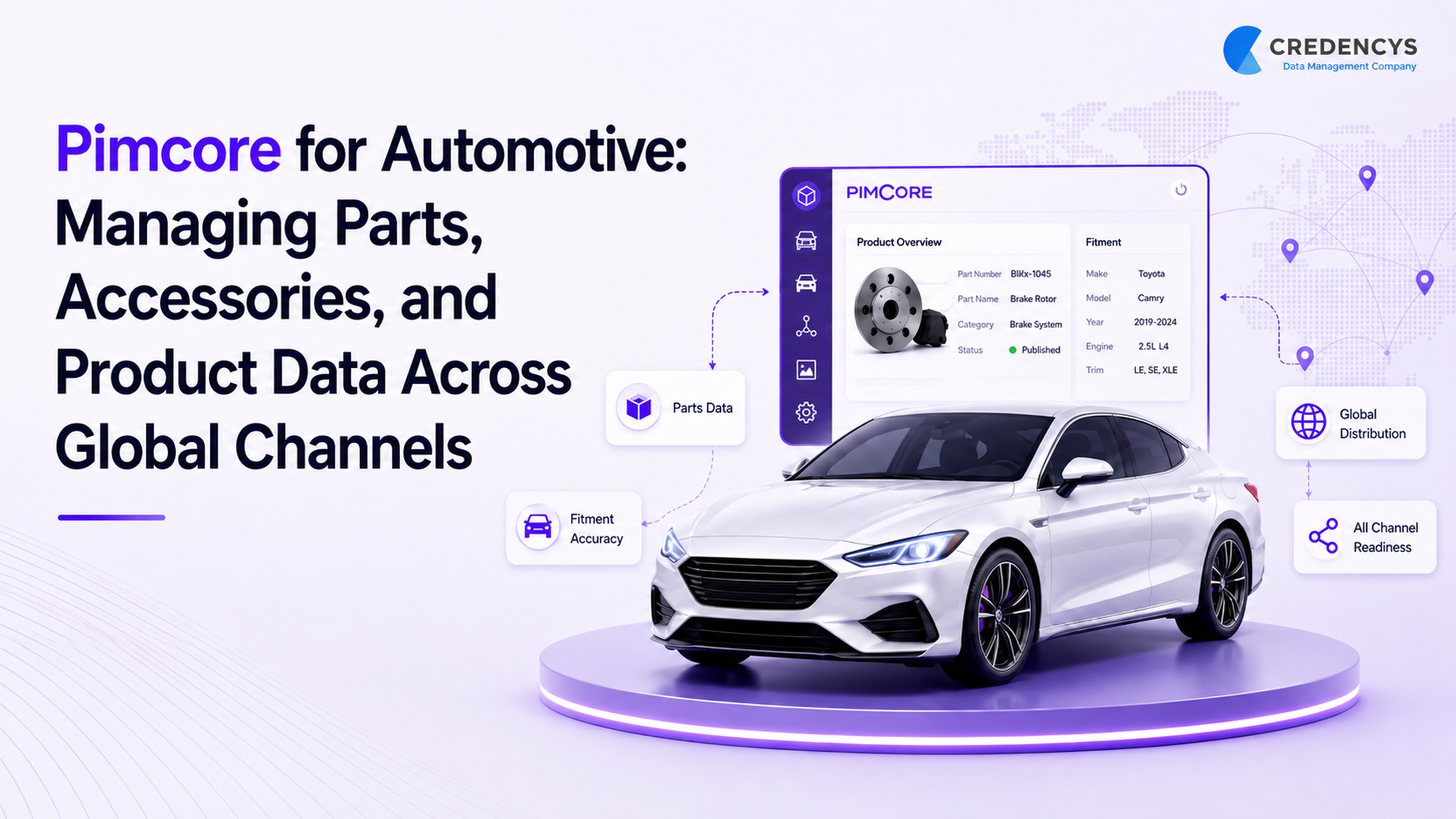
Pimcore for Automotive: Managing Parts, Accessories, and Product Data Across Global Channels
The automotive industry is moving through one of its most data-intensive phases. OEMs, aftermarket brands, parts manufacturers, distributors, retailers, and service networks are all under pressure to manage larger catalogs, faster product launches, complex fitment data, and region-specific channel requirements.
At the same time, the global automotive aftermarket continues to expand. Industry estimates show the market growing from hundreds of billions of dollars today to more than $600 billion by 2034.
Automotive eCommerce is also accelerating, with the eCommerce automotive aftermarket projected to grow strongly over the next decade as buyers increasingly search, compare, and purchase parts online.
This growth creates a major opportunity for automotive businesses. But it also creates a serious data challenge.
A single automotive part may need to carry hundreds of data points, including part numbers, specifications, dimensions, materials, images, installation guides, warranty details, compatibility information, regional compliance data, pricing, packaging information, and channel-specific content. For aftermarket businesses, the complexity becomes even higher because buyers need to know one critical thing before they purchase:
Will this part fit my vehicle?
That is where automotive product data becomes different from standard product data. It is not enough to describe the product well. Automotive companies must also manage fitment, compatibility, application data, product relationships, replacement parts, supersessions, accessories, kits, bundles, digital assets, and syndication requirements across multiple global sales channels.
The challenge becomes even more urgent as vehicles stay on the road longer.
In the US, the average age of light vehicles reached 12.8 years in 2025, which means more demand for replacement parts, maintenance products, accessories, and aftermarket services. For automotive brands and distributors, this creates a bigger need for accurate, searchable, and channel-ready product information.
However, many automotive companies still manage this data across ERPs, spreadsheets, supplier files, shared drives, legacy databases, eCommerce platforms, and regional systems. As a result, teams struggle with inconsistent product information, incorrect fitment, delayed catalog updates, incomplete digital assets, duplicate records, and slow channel onboarding.
This is where Pimcore for Automotive becomes valuable.
Pimcore helps automotive businesses centralize, manage, enrich, validate, and distribute product data from a single platform. It combines product information management, master data management, digital asset management, data modeling, workflow automation, and API-led integrations to support complex automotive data operations.
For companies managing parts, accessories, and product data across global channels, Pimcore provides the foundation to create a single source of truth and deliver accurate, consistent, and complete product experiences everywhere.
Why Automotive Product Data is More Complex Than Regular Product Data
Automotive product data is not limited to titles, descriptions, SKUs, prices, and images. It is a highly connected data ecosystem where one product may be linked to multiple vehicles, model years, engines, trims, regions, brands, categories, and sales channels.
For example, a brake pad, headlight, suspension component, battery, air filter, or accessory may look like a simple product from the outside. But behind that product, teams need to manage technical specifications, compatibility rules, installation information, safety details, product relationships, alternate parts, replacement parts, and channel-specific attributes.
This complexity increases because automotive businesses often sell across different types of channels, such as:
- OEM portals
- Dealer networks
- Distributor platforms
- Marketplaces
- Retail websites
- B2B commerce platforms
- Regional eCommerce stores
- Catalog systems
- Service networks
- Mobile apps
- Print catalogs
Each channel may require different data formats, naming conventions, attribute structures, image sizes, taxonomy rules, pricing logic, and localization requirements. A product that is ready for one channel may still be incomplete for another.
Automotive companies also need to manage fitment data with high accuracy. In the aftermarket industry, fitment data helps buyers identify whether a part is compatible with a specific vehicle. This usually involves details such as make, model, year, trim, engine, fuel type, body style, position, and other vehicle-specific qualifiers.
If this data is wrong, the impact is direct. Customers may order the wrong part. Returns may increase. Support teams may receive more queries. Distributors may reject product feeds. Marketplaces may suppress listings. Brand trust may suffer.
This is why automotive product data needs a more flexible and connected system than a basic PIM or spreadsheet-based process. Companies need a platform that can manage complex relationships between products, vehicles, assets, suppliers, channels, categories, and regions.
Pimcore is well suited for this environment because it allows automotive businesses to create flexible data models, define product relationships, manage digital assets, automate workflows, integrate with enterprise systems, and distribute enriched product data across global channels.
With Pimcore, automotive businesses can move from fragmented product data management to a governed, scalable, and channel-ready product information ecosystem.
How Pimcore Supports Complex Automotive Product Data Management
Automotive product data is rarely simple. A single part can be connected to multiple vehicle makes, models, years, variants, trims, regions, and selling channels. The same product may also need different descriptions, technical specifications, images, documents, pricing details, and compliance information depending on where and how it is sold.
Pimcore helps automotive businesses bring all this information together into one centralized product data platform.
Instead of managing product data across spreadsheets, ERP systems, shared folders, supplier files, and disconnected eCommerce tools, teams can use Pimcore to centralize, structure, enrich, validate, and distribute automotive product information from a single source of truth. This includes:
- Product information
- Part numbers and SKUs
- Vehicle fitment data
- Technical specifications
- Product categories and hierarchies
- Digital assets
- Installation manuals
- Warranty documents
- Product relationships
- Replacement and supersession data
- Supplier information
- Channel-specific content
- Localized product data
- Marketplace-ready attributes
What makes Pimcore valuable for automotive businesses is its flexibility. Automotive data models are rarely standard because every company has its own product structure, category logic, fitment rules, supplier formats, and channel requirements. Pimcore allows businesses to create custom data models that match the way their automotive product data is actually managed.
For companies handling parts, accessories, fitment data, and product information across global channels, Pimcore provides a strong foundation to improve data quality, accelerate catalog operations, and deliver consistent product experiences across every market.
With Pimcore, automotive businesses can:
- Manage product data for brake systems, suspension parts, lighting products, interiors, exteriors, engine components, and accessories
- Define category-specific attributes, validation rules, digital assets, and fitment requirements
- Standardize supplier data and enrich missing product information
- Map products to the right categories, channels, and regional catalogs
- Connect images, 360-degree views, manuals, diagrams, videos, and marketing assets with the right products
- Integrate with ERPs, eCommerce platforms, supplier portals, marketplaces, CRM tools, data warehouses, and third-party systems
- Reduce manual work by keeping product data synchronized across teams, systems, and channels
Key Automotive Data Challenges Pimcore Helps Solve
Automotive companies manage some of the most complex product data ecosystems. Parts, accessories, vehicle compatibility, technical specifications, product images, documentation, and channel-specific content often come from different teams, suppliers, systems, and regions.
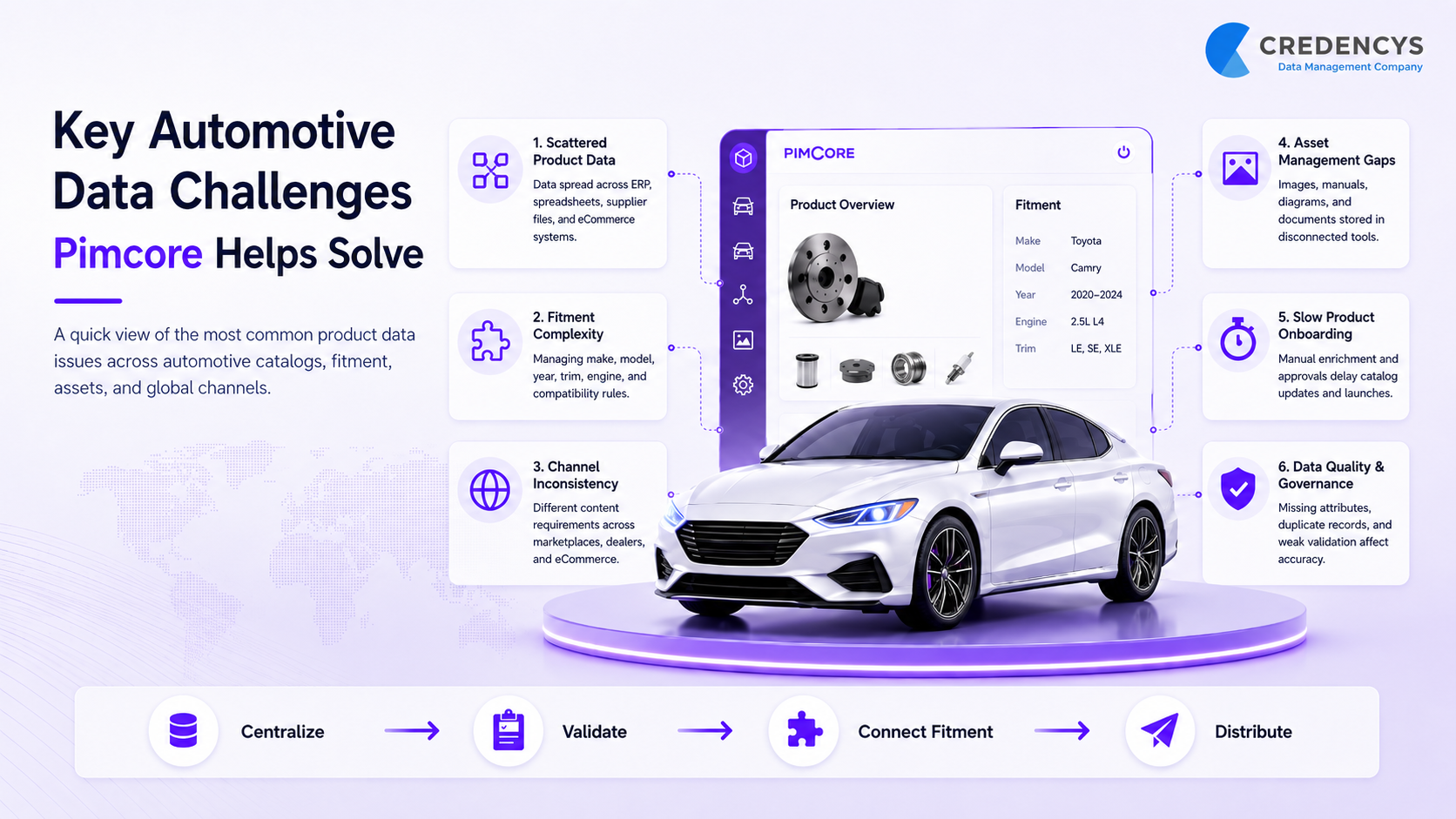
When this data is not governed properly, it creates delays across catalog management, eCommerce, distribution, dealer operations, and customer experience. Pimcore for Automotive helps address these challenges by centralizing product data, standardizing information, and creating structured workflows for enrichment, validation, and distribution.
1. Scattered Product Data Across Multiple Systems
Many automotive businesses still manage product information across ERPs, spreadsheets, supplier portals, shared drives, legacy databases, and eCommerce platforms. As a result, no team has a complete and reliable view of product data.
Product managers may maintain technical specifications in one system. Marketing teams may manage descriptions and images in another. Sales teams may use separate spreadsheets for regional catalogs. Suppliers may send product updates in different formats.
This fragmented setup makes it difficult to maintain accuracy and consistency.
Pimcore helps solve this by creating a centralized product data hub where all automotive product information can be managed in one place. Teams can connect product records with technical attributes, digital assets, fitment data, documents, categories, and channel-specific content.
This gives automotive businesses a single source of truth for parts, accessories, and related product data.
2. Complex Fitment and Vehicle Compatibility Data
Fitment is one of the biggest data challenges in the automotive industry. A customer does not just want to know what a part is. They want to know whether it fits their specific vehicle. This requires companies to manage compatibility data across multiple dimensions, such as:
- Make
- Model
- Year
- Trim
- Engine
- Body type
- Fuel type
- Transmission
- Position
- Region
- Application notes
If any of this information is missing or inaccurate, customers may buy the wrong part. This can lead to higher returns, more support queries, lower trust, and poor channel performance.
Pimcore allows automotive businesses to create structured data models for fitment and compatibility. Teams can connect products with vehicle attributes, define application rules, manage fitment relationships, and maintain accurate product-to-vehicle mapping.
This is especially useful for aftermarket brands, distributors, and retailers that manage large catalogs across multiple vehicle segments and regions.
3. Inconsistent Product Information Across Global Channels
Automotive businesses often sell through several channels at once. These may include dealer networks, distributor portals, eCommerce websites, marketplaces, print catalogs, mobile apps, and regional sales platforms.
Each channel may require different product titles, descriptions, specifications, image formats, taxonomy structures, and attribute fields. A product listing that works for one marketplace may not meet the requirements of another channel.
Without a centralized system, teams often create separate versions of product data manually. This increases the risk of outdated, incomplete, or inconsistent information reaching customers.
Pimcore helps businesses manage channel-specific product content from one platform. Teams can define what information is required for each channel, enrich product data accordingly, and distribute approved content in the right format.
This helps automotive companies maintain consistency while still adapting product content for different markets, regions, and sales channels.
4. Poor Digital Asset Management
Automotive products often require more than one image. A single part or accessory may need product photos, lifestyle images, installation diagrams, 360-degree views, videos, manuals, safety documents, warranty files, and technical PDFs.
When these assets are stored in shared folders or disconnected tools, teams struggle to find the right files, match them with the right products, and ensure that only approved assets are published.
This creates delays in catalog enrichment and can result in missing or incorrect assets across channels.
Pimcore’s digital asset management capabilities help automotive teams organize, manage, and connect assets directly with product records. Product images, manuals, diagrams, certificates, and videos can be linked to the right SKU, category, or product family.
This ensures that every product listing is supported with accurate, approved, and channel-ready digital assets.
5. Slow Product Onboarding and Catalog Updates
Automotive catalogs change frequently. New parts are launched. Existing products are updated. Older parts are replaced. Suppliers send new files. Fitment data changes. Regional teams request updates. Marketplaces introduce new listing requirements.
When product onboarding depends on manual processes, teams spend too much time collecting, cleaning, enriching, and approving product data.
This slows down time-to-market and affects revenue opportunities.
Pimcore helps streamline product onboarding with structured workflows, validation rules, and automated data enrichment processes. Teams can define approval steps, assign responsibilities, track completion status, and ensure that products are ready before they are published.
This improves collaboration between product, marketing, data, supplier, and eCommerce teams.
6. Lack of Data Governance and Quality Control
Automotive product data needs strong governance. Incorrect part numbers, missing specifications, duplicate records, outdated images, or incomplete fitment details can directly affect customer experience and operational efficiency.
Without data governance, teams may not know which fields are mandatory, who owns each data point, what needs approval, or whether a product is ready for a specific channel.
Pimcore helps businesses define clear data ownership, validation rules, workflows, and completeness checks. Teams can monitor product data quality, identify missing information, and prevent incomplete records from being distributed.
This helps automotive companies maintain better control over product accuracy, compliance, and channel readiness.
7. Difficulty Scaling Across Regions and Markets
Global automotive businesses need to manage product data for different countries, languages, currencies, compliance requirements, and regional catalogs. A product may need different descriptions, images, packaging information, or regulatory details depending on the target market.
Managing this manually becomes difficult as the business expands.
Pimcore supports localization, regional data structures, multilingual content, and market-specific product information. Teams can manage global product data centrally while allowing regional variations where needed.
This helps automotive businesses scale product data operations without losing control over consistency and quality.
8. Disconnected Supplier and Partner Data
Automotive companies often work with multiple suppliers, manufacturers, distributors, and partners. Each supplier may provide product information in a different format, with different levels of completeness and quality.
This creates a major challenge for data teams because they must standardize, clean, enrich, and approve supplier data before it can be used across channels.
Pimcore can help standardize supplier data intake and create workflows for review, enrichment, and approval. Businesses can map supplier attributes to internal data models, identify missing information, and maintain consistent product records across the organization.
This reduces manual work and improves the speed and quality of supplier product data management.
9. Limited Visibility Into Product Data Readiness
Many automotive teams do not have a clear view of which products are ready for launch, which products are missing key attributes, and which products are blocked due to incomplete content or pending approvals.
This lack of visibility creates delays and confusion across teams.
Pimcore helps businesses track product completeness, workflow status, approval progress, and channel readiness. Teams can quickly identify which products need attention and what information is missing.
This helps automotive businesses move from reactive data management to a more controlled and transparent product data process.
By solving these challenges, Pimcore for Automotive helps companies build a stronger foundation for product data management, catalog operations, fitment accuracy, digital asset control, and global channel syndication.
A Quick Summary of Automotive Data Challenges and Pimcore’s Role
| Automotive Data Challenge | What It Means for Automotive Businesses | How Pimcore Helps |
|---|---|---|
| Scattered product data across systems | Product information is often spread across ERPs, spreadsheets, supplier files, shared drives, eCommerce platforms, and regional systems. This makes it difficult to maintain one accurate version of product data. | Pimcore centralizes product information, technical attributes, digital assets, documents, categories, fitment data, and channel-specific content in one platform. |
| Complex fitment and vehicle compatibility data | Automotive companies need to manage product compatibility across make, model, year, trim, engine, body type, position, region, and other vehicle-specific details. | Pimcore allows teams to create flexible fitment data models and connect products with vehicle attributes, application rules, and compatibility relationships. |
| Inconsistent product information across channels | Dealer portals, marketplaces, distributor platforms, retail websites, and regional catalogs often need different product formats, attributes, and content structures. | Pimcore helps teams manage channel-specific product content, define required fields, and distribute approved product data in the right format. |
| Poor digital asset management | Product images, installation guides, manuals, warranty files, diagrams, videos, and technical documents are often stored separately from product records. | Pimcore DAM connects digital assets directly with products, SKUs, categories, and product families, making assets easier to manage and publish. |
| Slow product onboarding and catalog updates | New products, supplier updates, fitment changes, and marketplace requirements often slow down catalog readiness when handled manually. | Pimcore supports structured workflows, validation rules, approval processes, and data completeness tracking to speed up product onboarding. |
| Lack of data governance and quality control | Missing attributes, duplicate records, incorrect part numbers, outdated assets, and incomplete fitment details can affect sales, returns, and customer trust. | Pimcore helps define data ownership, mandatory fields, validation rules, approval workflows, and product completeness checks. |
| Difficulty scaling across regions and markets | Global automotive businesses need to manage multilingual content, regional catalogs, market-specific attributes, compliance details, and localized product data. | Pimcore supports localization, regional product variations, multilingual content, and centralized governance for global product data operations. |
| Disconnected supplier and partner data | Suppliers and partners often provide product information in different formats, creating extra work for data standardization and enrichment. | Pimcore helps standardize supplier data intake, map attributes to internal data models, and create workflows for review, enrichment, and approval. |
| Limited visibility into product data readiness | Teams may not know which products are complete, which are blocked, and which are ready for each channel or market. | Pimcore provides visibility into product completeness, workflow status, approval progress, and channel readiness. |
Managing Parts, Accessories, Fitment, and Vehicle Compatibility with Pimcore for Automotive
Automotive product data is complex because every part or accessory may be connected to multiple vehicles, model years, trims, engines, regions, and sales channels. This makes it difficult to manage product information as simple catalog records.
Pimcore helps automotive businesses create a connected data model where parts, accessories, technical specifications, digital assets, product relationships, and fitment details are managed in one place.
With Pimcore, teams can centralize key automotive product information, including:
- SKUs, part numbers, and OE numbers
- Product categories and subcategories
- Technical specifications and dimensions
- Warranty details and installation instructions
- Product images, manuals, and technical documents
- Replacement parts, related accessories, and supersessions
- Vehicle compatibility and fitment data
Pimcore also supports flexible data structures for different automotive categories. A tire, battery, brake pad, headlight, and suspension component may each require different attributes. Instead of forcing every product into the same format, Pimcore allows businesses to define category-specific fields, rules, and relationships.
For fitment and compatibility, Pimcore can help connect products with vehicle-specific details such as:
- Make
- Model
- Year
- Trim
- Engine
- Body style
- Fuel type
- Transmission
- Position
- Application notes
This helps customers find the right part faster and reduces the risk of incorrect purchases, returns, and support queries.
Automotive businesses can also use Pimcore to manage related parts, replacement products, kits, bundles, supersessions, and accessories. This is especially useful for aftermarket brands and distributors where buyers may search by old part numbers, OE references, or equivalent parts.
By managing parts, accessories, fitment data, and product relationships in one platform, Pimcore helps automotive companies improve catalog accuracy, product discovery, and channel readiness.
How Pimcore Supports Global Channel Syndication
Automotive companies rarely sell through one channel. They often distribute product data across dealer portals, distributor platforms, marketplaces, eCommerce websites, B2B commerce systems, regional catalogs, mobile apps, and print catalogs.
Each channel may have different requirements for product titles, descriptions, attributes, image formats, taxonomy, pricing, language, and compliance information.
Pimcore helps automotive businesses manage channel-specific product content from a centralized platform. Teams can define what each channel needs, enrich product data accordingly, and distribute approved information in the right structure.
This helps businesses avoid creating separate manual files for every channel. It also reduces the risk of outdated, incomplete, or inconsistent product data reaching customers, dealers, or marketplace partners.
For global automotive businesses, Pimcore can also support localization. Product information can be adapted for different countries, languages, currencies, regulations, and regional catalog needs while still maintaining one governed source of truth.
Pimcore for Automotive OEMs, Aftermarket Brands, Distributors, and Retailers
Pimcore for Automotive can support different types of businesses across the automotive value chain.
- For OEMs, Pimcore can help manage product data, vehicle-related information, digital assets, technical documentation, and dealer-ready content from a centralized system.
- For aftermarket brands, Pimcore can support complex parts catalogs, fitment data, product relationships, replacement parts, accessories, and channel-specific syndication.
- For distributors, Pimcore can help collect, standardize, enrich, and distribute product information from multiple suppliers. This is especially useful when supplier data comes in different formats and quality levels.
- For retailers and eCommerce businesses, Pimcore can improve product discovery, catalog completeness, search accuracy, and customer confidence by ensuring that product information is accurate and channel-ready.
In every case, the goal is the same: create a trusted product data foundation that supports faster operations, better customer experiences, and scalable digital commerce.
Key Capabilities of Pimcore for Automotive
Pimcore brings together several capabilities that are important for automotive product data management:
- Product Information Management to centralize and enrich product data
- Master Data Management to manage connected data such as products, vehicles, suppliers, categories, and regions
- Digital Asset Management to organize images, videos, manuals, diagrams, and documents
- Flexible data modeling to support complex automotive categories and attributes
- Workflow automation to streamline data review, approval, and publishing
- Data quality management to track completeness, accuracy, and readiness
- Localization support for multilingual and region-specific product content
- API-led integrations with ERP, eCommerce, marketplaces, supplier systems, and dealer portals
- Channel syndication to distribute product data across global touchpoints
These capabilities make Pimcore a strong fit for automotive businesses that need more than a basic PIM. It helps companies manage product data as a connected, governed, and scalable ecosystem.
Business Benefits of Pimcore for Automotive
Using Pimcore for Automotive can help businesses improve both operational efficiency and customer experience. Some key benefits include:
- Centralized product data across teams and systems
- Better fitment and compatibility accuracy
- Faster product onboarding and catalog updates
- Improved product data quality and completeness
- Easier management of digital assets and technical documents
- More consistent product information across global channels
- Faster marketplace and dealer portal syndication
- Reduced manual work for product, data, and eCommerce teams
- Better product discovery and search experience
- Lower risk of incorrect orders caused by incomplete product data
For automotive companies managing large catalogs, these benefits can directly support faster time-to-market, better channel performance, reduced operational friction, and improved customer confidence.
Why Choose Credencys for Pimcore Implementation?
Implementing Pimcore for Automotive requires more than platform knowledge. It requires a strong understanding of automotive product data, fitment complexity, catalog structures, integrations, workflows, and global channel requirements.
Credencys helps automotive businesses design and implement Pimcore solutions that are aligned with their product data operations and business goals.
As a Pimcore Strategic Partner, Credencys brings experience in PIM, MDM, DAM, data modeling, system integration, workflow automation, and product data governance. Our team helps automotive companies centralize product information, improve data quality, connect enterprise systems, and prepare product data for multiple digital channels.
Credencys can support automotive brands, distributors, and retailers with:
- Pimcore consulting and implementation
- Automotive PIM and MDM strategy
- Product and fitment data modeling
- DAM setup and asset governance
- ERP, eCommerce, and marketplace integrations
- Workflow and approval process setup
- Data migration and data quality improvement
- Channel syndication enablement
- Ongoing Pimcore support and optimization
With the right implementation approach, automotive businesses can use Pimcore to build a scalable product data foundation that supports current operations and future growth.
Final Thoughts: Pimcore for Automotive
Automotive product data is becoming more complex as businesses manage larger catalogs, growing digital channels, global markets, and higher customer expectations. Parts, accessories, fitment data, product relationships, digital assets, and regional content all need to work together to create accurate and consistent product experiences.
Pimcore for Automotive helps businesses bring this complexity under control.
By centralizing product data, managing fitment and compatibility, connecting digital assets, improving workflows, and enabling global channel syndication, Pimcore helps automotive companies build a stronger data foundation.
For OEMs, aftermarket brands, distributors, and retailers, this foundation can support faster catalog operations, better product discovery, improved customer confidence, and more scalable digital commerce.
FAQs on Pimcore for Automotive
Why is product data management important in the automotive industry?
Automotive product data is complex because every part may be connected to multiple vehicles, model years, trims, engines, regions, and channels. Accurate product data helps improve fitment accuracy, reduce incorrect orders, support faster catalog updates, and deliver better customer experiences.
How does Pimcore help manage automotive fitment data?
Pimcore can be configured to manage product-to-vehicle relationships using custom data models. Teams can connect products with vehicle attributes such as make, model, year, trim, engine, body style, position, and application notes.
Can Pimcore support automotive aftermarket businesses?
Yes. Pimcore is well suited for aftermarket businesses that manage large parts catalogs, accessories, fitment data, replacement parts, digital assets, supplier data, and multi-channel syndication requirements.
Why should automotive companies work with Credencys for Pimcore implementation?
Credencys is a Pimcore Strategic Partner with experience in PIM, MDM, DAM, data modeling, integrations, and product data governance. Credencys helps automotive businesses implement Pimcore solutions that support complex product data operations and global channel requirements.





Tags: