


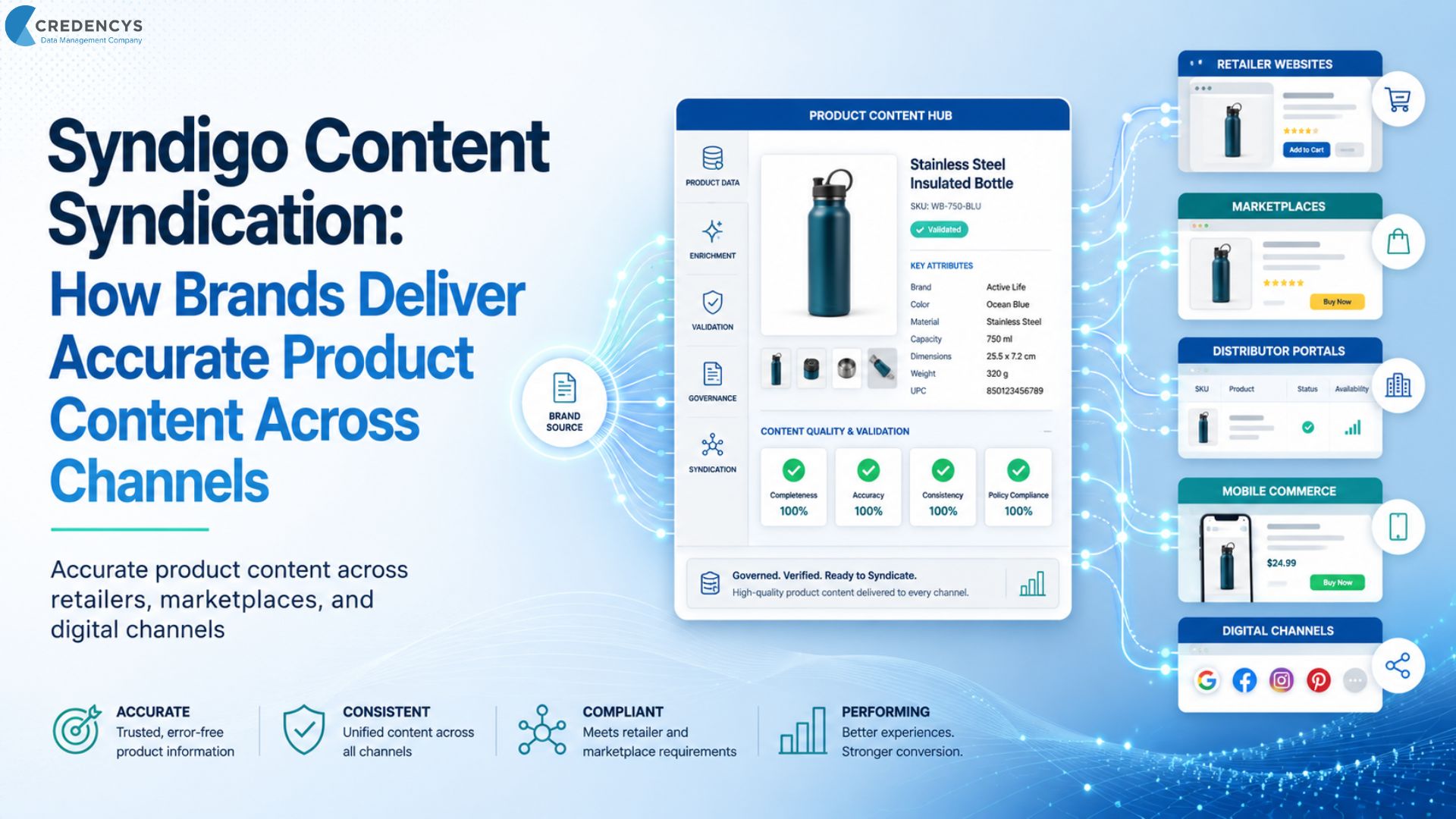
Syndigo Content Syndication: How Brands Deliver Accurate Product Content Across Channels
Product content is no longer published on a single website. Brands must deliver product information to retailer websites, online marketplaces, distributor portals, direct-to-consumer stores, digital catalogs, mobile applications, social commerce platforms, and emerging AI-powered shopping experiences.
Each channel may require a different combination of product titles, descriptions, technical specifications, images, videos, taxonomies, regulatory attributes, and formatting standards. A product record one retailer accepts may be incomplete or incorrectly formatted for another.
This creates a significant operational challenge for brands managing large catalogs. Product teams may spend hours adapting spreadsheets, completing retailer templates, uploading assets, correcting rejected submissions, and manually updating the same information across multiple platforms.
As product counts and channels grow, these processes become harder to manage and more error-prone. A product may have one description on a brand website, another on a marketplace, outdated packaging imagery on a retailer page, and incomplete specifications in a distributor catalog.
These inconsistencies can confuse customers, delay product launches, and weaken trust in the brand.
Syndigo content syndication helps brands address this complexity by validating, transforming, and distributing product content to retailers, marketplaces, distributors, and other commerce channels according to each recipient’s requirements.
Instead of preparing separate product files for every destination, brands can manage trusted product information centrally and deliver channel-ready versions through connected syndication workflows. Syndigo’s syndication capabilities support:
- Core Content
- Enhanced Content
- GDSN data
- Recipient-specific validation
- Product data transformation
- AI-assisted enrichment
- Digital shelf monitoring
This gives brands a more scalable way to manage product information across traditional and emerging commerce channels.
What is Syndigo Content Syndication?
Syndigo content syndication is the process of validating, transforming, and distributing product information from a central source to retailers, marketplaces, distributors, eCommerce platforms, and other recipients according to their specific content requirements. It lets brands prepare governed product information once and adapt it for multiple destinations without rebuilding the entire product record for each channel.
The distributed content may include:
- Product names and descriptions
- Features and technical specifications
- Dimensions and identifiers
- Ingredients and nutritional information
- Packaging and logistics data
- Product images and videos
- Regulatory disclosures
- Rich media and comparison content
- Channel-specific marketing copy
However, effective syndication involves more than copying identical information from one system to several websites. Every recipient may have its own product schema, mandatory attributes, category structure, character limits, accepted values, image specifications, validation rules, and submission processes.
For example, a brand may maintain a master attribute called “Product Material.” One retailer may expect the value under “Primary Material,” another may use “Material Type,” and a marketplace may require the information to be selected from a controlled list.
Syndication maps the governed source attribute to the correct field and format for each destination.
Product Syndication does not Mean Publishing Identical Content Everywhere
A common misconception is that syndication means sending the same product record to every channel. Successful syndication must balance two requirements:
- Maintaining a consistent source of product truth
- Adapting content to channel-specific expectations
Core facts such as product identifiers, dimensions, ingredients, materials, compatibility details, and packaging information should remain accurate across channels. However, the way those facts are structured and presented may change.
A retailer may require a short product title, while a marketplace may allow a longer, keyword-rich title containing the brand, product type, size, color, and primary features. A technical distributor may prioritize specifications, while a direct-to-consumer website may use more descriptive and benefit-focused content.
The objective is not absolute uniformity. It is to maintain accurate product truth while presenting it in the format each channel requires.
Where Does Syndigo Content Syndication Fit in the Product Data Process?
Syndication generally takes place after product information has been collected, structured, enriched, reviewed, and approved. A typical product content flow looks like this:
Source systems → Product data management → Content enrichment → Quality validation → Recipient mapping → Syndication → Retailers and marketplaces → Performance monitoring
Product information may originate from:
- ERP systems
- PIM and MDM platforms
- PLM systems
- DAM platforms
- Supplier portals
- eCommerce platforms
- Internal databases
- Spreadsheets
Consolidate and govern the data before it is ready for external distribution. Syndigo can manage product information and prepare syndication-ready records, but companies don’t necessarily need to originate every attribute in the platform.
Approved data may flow into Syndigo from an existing authoritative system. The key requirement is that the content entering the syndication process should be accurate, structured, and governed.
What Does Syndigo Content Syndication Help Brands Do?
Syndigo content syndication helps brands prepare, validate, and distribute product information across multiple channels without rebuilding every product record from scratch. It can help teams:
- Centralize product content for distribution
- Map source attributes to recipient-specific fields
- Validate mandatory information before submission
- Transform values, formats, and channel-specific content
- Distribute Core Content, digital assets, Enhanced Content, and GDSN data
- Monitor submission status and resolve content errors
- Update product information across connected recipients
- Support expansion into new retailers and marketplaces
This gives brands a more structured way to manage channel complexity while maintaining consistent and governed product information.
Why Do Brands Need Product Content Syndication?
Brands need product content syndication because manually managing information across a growing number of commerce channels doesn’t scale. The challenge is not simply sending product data.
It’s about delivering the right information, in the right format, to the right recipient, while keeping it current whenever the source record changes. Without a structured syndication process, teams often depend on:
- Spreadsheets
- Retailer portals
- Email attachments
- CSV templates
- FTP transfers
- Manual uploads
- Repetitive copy-and-paste work
These approaches may be manageable for a small catalog and a limited number of channels. They become inefficient as the organization adds more SKUs, retailers, marketplaces, regions, languages, and content types.
1. Every Retailer has Different Content Requirements
Commerce channels do not use a universal product content structure. Two retailers may both request a product title, material, dimensions, and images, but they may use different:
- Field names
- Units of measurement
- Category hierarchies
- Title lengths
- Image standards
- Controlled values
- Validation rules
Consider a consumer electronics company selling the same product through its own website, a marketplace, a specialist retailer, and a regional distributor. The brand website may use detailed descriptions, lifestyle imagery, videos, and comparison tools.
The marketplace may require standardized titles, structured feature bullets, predefined category values, and strict image policies. The specialist retailer may prioritize compatibility and technical specifications, while the distributor may require packaging, logistics, and downloadable documentation.
The underlying product is the same, but each recipient expects different content. Syndigo content syndication lets you map and transform centrally managed attributes to each recipient’s requirements.
2. Manual Content Distribution Does Not Scale
Manual distribution creates work at every stage of product onboarding and maintenance. For each channel, a content team may need to:
- Locate the latest retailer template.
- Identify required product fields.
- Collect data from several systems.
- Reformat values and measurements.
- Prepare images and other assets.
- Upload the information.
- Review validation errors.
- Correct and resubmit rejected records.
The process becomes more complex when different departments own different parts of the product record. Marketing may manage descriptions and imagery, product teams may own specifications, regulatory teams may maintain ingredients and warnings, while supply-chain teams manage packaging and logistics data.
Without a connected workflow, these teams coordinate updates through emails, meetings, spreadsheets, and shared folders. This increases the likelihood of:
- Duplicate work
- Missing fields
- Conflicting versions
- Submission failures
- Approval delays
- Outdated product pages
- Slower product launches
Syndication reduces repetitive channel preparation by letting teams set up reusable mappings, validation rules, and distribution workflows.
3. Inconsistent Product Content Can Weaken Customer Trust
Customers expect product information to be accurate wherever they shop. Without controlled syndication, the same item may appear with different dimensions on two retailer sites, outdated packaging imagery on a marketplace, missing ingredients on a grocery page, or conflicting compatibility details in a distributor catalog.
These inconsistencies can lead to:
- Customer confusion
- Incorrect product selection
- Lower purchase confidence
- Higher return rates
- Negative reviews
- Reduced brand credibility
Content accuracy therefore affects more than operational efficiency. It directly influences the quality and trustworthiness of the product experience.
4. Product Updates Must Reach Every Channel
Product information is not static. Brands regularly update:
- Packaging and imagery
- Product descriptions
- Technical specifications
- Ingredients and nutritional information
- Certifications and claims
- Safety and compliance details
- Available variants
- Product lifecycle status
When updates are managed manually, one retailer may receive the latest information while another continues displaying an older version. A governed syndication process provides a more controlled way to prepare, submit, and track approved changes across active recipients.
The final publication timeline may still depend on the retailer or marketplace, but the brand gains better visibility into where updates have been sent and whether further action is needed.
5. Channel Growth Increases Data Complexity
Adding a new sales channel introduces more than another place to sell. It may bring:
- A new taxonomy
- Different mandatory attributes
- New image specifications
- Regional compliance requirements
- Localization needs
- New approval processes
- Different product relationships
For a brand managing thousands of products, recreating each record for every new recipient can require significant effort. When product data is governed and reusable, the organization can map existing information to the new channel instead.
This can reduce the need to create and maintain an independent delivery mechanism for every recipient.
6. AI-Powered Shopping Requires Structured Product Information
Search engines, recommendation platforms, conversational commerce systems, and AI shopping assistants increasingly consume product content. These systems rely on structured and contextually complete information to determine:
- Whether a product fits a specific use case
- Whether it contains a particular ingredient
- Whether it is compatible with another item
- Which size or model is appropriate
- Whether it meets a stated certification
- How it differs from a competing product
When important product attributes are missing or inconsistent, AI-powered systems may struggle to understand or recommend the item accurately. For brands, syndication readiness is therefore becoming part of a broader product discoverability strategy.
How Does Syndigo Content Syndication Work?
Syndigo content syndication takes governed product information, tailors it to each recipient’s requirements, validates it, distributes it, and helps teams monitor the results. The process has seven stages.
Step 1: Collect and Centralize Product Data
Product information usually originates from multiple systems. An ERP may contain SKUs, pricing, and logistics details.
A PLM may store technical specifications. A PIM may manage customer-facing attributes and descriptions, while a DAM contains approved images, videos, documents, and other digital assets.
First, connect these sources and establish which system owns each type of information. A source-system assessment should clarify:
- Where each product attribute currently resides
- Which system owns the authoritative value
- How frequently the information changes
- Which team is responsible for maintaining it
- How the data will flow into Syndigo
Without clearly defined authoritative sources, brands risk distributing duplicate, conflicting, or outdated records.
Step 2: Structure and Enrich Product Content
Source systems often contain operational data but lack the customer-facing information retailers and marketplaces require. For example, an ERP record may include a product code, short name, price, and inventory information but lack detailed descriptions, searchable attributes, lifestyle imagery, usage instructions, or channel-specific copy.
Content enrichment may add:
- Customer-friendly descriptions
- Product features and benefits
- Searchable attributes
- Technical details
- Lifestyle and product imagery
- Usage instructions
- Regulatory information
- Channel-specific content
At this stage, teams also establish product categories, variants, packaging relationships, bundles, related items, and localized versions. The internal structure must be clear before teams can translate the record into recipient-specific taxonomies and schemas.
Step 3: Map Content to Recipient Requirements
Attribute mapping connects the brand’s internal data model to the fields each recipient expects. A source attribute called “Unit Weight” may need to map to “Net Weight” for one retailer and “Item Weight” for another.
Mapping may involve:
- Renaming fields
- Converting units
- Selecting controlled values
- Combining source fields
- Splitting one field into multiple attributes
- Mapping product categories
- Defining retailer-specific titles
- Selecting channel-specific assets
The purpose is to preserve the integrity of the source information while adapting its structure to each destination.
Step 4: Validate Content and Resolve Errors
Before distribution, product records are checked against data quality and recipient-specific rules. Validation may identify:
- Missing mandatory fields
- Invalid identifiers
- Unsupported values
- Incorrect measurements
- Title-length violations
- Image-quality issues
- Incomplete packaging information
- Missing compliance attributes
A record may appear complete internally but still fail a retailer’s requirements because its title is too long, its primary image has insufficient resolution, or a category-specific attribute is missing. Failed records should then move into an exception-management workflow.
For example:
- Marketing can resolve description issues.
- Regulatory teams can review warnings and ingredients.
- Data stewards can correct identifiers and mappings.
- Digital asset teams can replace noncompliant images.
This lets employees focus on records that need attention rather than manually reviewing every item.
Step 5: Transform and Distribute Channel-Ready Content
Once content is mapped and validated, transform it into the format the destination requires. This may include:
- Converting units
- Shortening descriptions
- Restructuring titles
- Standardizing values
- Selecting channel-specific images
- Localizing content
- Applying retailer terminology
The approved content can then be distributed through applicable network connections, structured feeds, APIs, GDSN publication, platform integrations, or recipient-specific formats. A successful submission does not always mean immediate publication.
The recipient may still review, process, match, approve, or schedule the content. Brands should therefore distinguish between content being:
- Sent
- Accepted
- Processed
- Published
Step 6: Monitor Submission and Publication Status
Visibility after distribution is essential. Content teams need to know whether a product record was:
- Submitted successfully
- Rejected
- Partially accepted
- Returned for correction
- Awaiting review
- Published
Centralized status monitoring can reduce dependence on retailer portal checks, emails, integration logs, and manually maintained tracking sheets. It also helps teams prioritize high-impact issues.
A rejected product for a major retail partner may require immediate action, while a lower-priority content enhancement can be handled later.
Step 7: Measure and Optimize Product Content
Connect syndication to digital shelf measurement. Brands need to know not only whether information was delivered but also whether it appears accurately and performs effectively after publication.
Teams may monitor:
- Product availability
- Content completeness
- Attribute coverage
- Asset presence
- Search visibility
- Listing consistency
- Pricing accuracy
- Competitive content gaps
- Conversion performance
This creates a continuous improvement cycle:
Manage → Validate → Syndicate → Measure → Optimize
If teams find missing assets, incomplete specifications, poor search visibility, or inconsistencies between governed and live content, they can correct the source information or channel mapping and republish.
What Types of Product Content Can Syndigo Syndicate?
Syndigo content syndication supports several forms of product information, from basic listing attributes to richer digital experiences and standardized trading-partner data.
| Content Type | Examples | Primary Purpose |
|---|---|---|
| Core Content | Titles, descriptions, identifiers, dimensions, and specifications | Establish accurate and complete product listings |
| Digital Assets | Images, videos, guides, manuals, and certificates | Help customers visualize and understand products |
| Enhanced Content | Comparison charts, branded modules, feature callouts, and interactive media | Create richer product experiences and support engagement |
| GDSN Data | GTINs, packaging structures, logistics data, and standardized attributes | Synchronize validated product information between trading partners |
| Regulatory Content | Ingredients, allergens, warnings, certifications, and disclosures | Support compliance and customer safety |
| Localized Content | Translations, regional measurements, localized assets, and market-specific claims | Support international and regional commerce channels |
| Operational Content | Case dimensions, pack configurations, pallet details, and shipping information | Support retailer, distributor, and supply-chain operations |
Core Content
Core Content includes the foundational information needed to identify, classify, search, compare, and sell a product. It may include:
- Product names and brands
- SKUs and GTINs
- Descriptions and features
- Dimensions and materials
- Technical specifications
- Basic product images
- Packaging details
Without complete Core Content, an item may fail retailer onboarding or appear as an incomplete listing.
Digital Assets and Enhanced Content
Digital assets include product imagery, videos, user manuals, technical diagrams, installation guides, warranty documents, and certificates. Enhanced Content builds on these assets to create richer product experiences through:
- Comparison charts
- Interactive modules
- Feature callouts
- Brand stories
- 360-degree views
- Usage scenarios
Core Content explains what the product is. Enhanced Content helps communicate its benefits, differentiators, and applications.
GDSN Data
The Global Data Synchronization Network is a standards-based system for exchanging trusted product information between trading partners. GDSN data may cover identifiers, product classifications, packaging hierarchies, case and pallet details, logistics attributes, nutrition, ingredients, regulatory information, and lifecycle status.
It is especially relevant when retailers or distributors require standardized product and supply-chain information through a certified data pool.
Regulatory, Localized, and Operational Content
Some product categories require detailed compliance information, such as:
- Allergens and ingredients
- Safety warnings
- Certifications
- Country of origin
- Usage limitations
- Environmental claims
Global brands may also need translated descriptions, regional measurements, localized assets, country-specific warnings, and market-specific claims. Retailers and distributors may require operational content such as pack quantities, case dimensions, shipping weights, pallet configurations, storage requirements, and handling instructions.
Treat these content types with the same care as customer-facing descriptions because inaccuracies can cause failed item setup, compliance risks, and supply-chain problems.
Core Content, Enhanced Content, and GDSN: What is the Difference?
Core Content creates the product listing, Enhanced Content improves the digital product experience, and GDSN synchronizes standardized product and supply-chain information between trading partners.
| Area | Core Content | Enhanced Content | GDSN |
|---|---|---|---|
| Main Purpose | Establish an accurate and complete product listing | Improve engagement and product understanding | Exchange standardized product and trading data |
| Common Content | Titles, descriptions, specifications, identifiers, and basic images | Videos, comparison charts, branded modules, and interactive media | GTINs, packaging hierarchies, logistics data, and standardized attributes |
| Primary Users | eCommerce, product, and merchandising teams | Marketing, brand, and digital commerce teams | Data, supply-chain, and trading-partner teams |
| Customer Visibility | Usually displayed directly on product pages | Displayed as rich and interactive product-page content | Primarily supports standardized operational and supply-chain data exchange |
| Main Outcome | Improved listing accuracy and completeness | Stronger digital product experiences | Reliable data synchronization and compliance |
Core Content is required for nearly every product listing. Enhanced Content is most useful for products that require education, comparison, demonstration, or stronger visual storytelling.
GDSN is generally needed when a retailer or trading partner requires standardized information through a certified data pool. Some recipients may require GDSN data alongside customer-facing Core and Enhanced Content.
Key Capabilities of Syndigo Content Syndication
Syndigo’s value extends beyond moving information from one system to another. The platform combines recipient access, validation, transformation, content management, AI assistance, and performance monitoring.
Extensive Recipient Network
Syndigo provides access to a broad network of retailers, distributors, marketplaces, eCommerce sites, and software platforms. This can help brands:
- Reduce dependence on custom outbound integrations
- Add new channels more efficiently
- Reuse approved product content
- Simplify recipient onboarding
- Support broader market expansion
Brands still need to prepare accurate content and meet recipient requirements, but the technical connection doesn’t always need to start as a custom development project.
Recipient-Specific Requirements and Validation
A record that meets one retailer’s requirements may fail another’s. Syndigo helps brands prepare content according to different item setup templates, taxonomies, mandatory fields, controlled values, and quality rules.
Validation helps identify issues before distribution, reducing repeated submission and correction cycles.
Product Content Transformation
Internal data models rarely align perfectly with every destination.
Syndigo can support the transformation of governed product information into channel-ready formats by:
- Mapping attributes
- Converting values
- Adjusting content structures
- Applying recipient terminology
- Selecting appropriate assets
- Supporting localized variations
This helps brands preserve trusted source data while complying with different destination schemas.
Core Content, GDSN, and Rich Media
Managing Core Content, standardized GDSN data, digital assets, and Enhanced Content in separate tools can create disconnected workflows.
Syndigo brings these content types into a broader product experience and syndication environment, allowing teams to coordinate:
- Foundational product attributes
- Standardized trading data
- Digital assets
- Rich product experiences
- Recipient-specific outputs
This creates a more connected approach to product content management and delivery.
AI-Assisted Content Operations
Syndigo’s AI capabilities can support activities such as:
- Generating product descriptions
- Creating feature bullets
- Producing SEO-oriented copy
- Supporting taxonomy classification
- Assisting attribute mapping
- Preparing localized content
These capabilities can accelerate enrichment for large catalogs, but generated content should still pass through brand, legal, regulatory, and quality review.
AI can assist content teams, but it should not become an uncontrolled source of technical facts or product claims.
Submission Visibility and Digital Shelf Analytics
Syndigo provides tools to monitor syndication and product content performance across supported channels.
Teams can use these insights to understand:
- Whether products are available
- Whether approved content is displayed correctly
- Where assets are missing
- Which listings require correction
- How content performs across channels
This connects content distribution with ongoing optimization, rather than treating publication as the final step.
Syndigo Content Syndication vs. Manual Product Data Distribution
Manual product distribution requires teams to prepare, format, upload, and update content separately for each destination.
Syndigo content syndication replaces much of this repetitive activity with reusable mappings, automated validation, connected delivery, and centralized monitoring.
| Area | Manual Product Data Distribution | Syndigo Content Syndication |
|---|---|---|
| Content Preparation | Teams complete separate templates and files for each recipient | Governed product content is mapped and prepared for multiple recipients |
| Validation | Errors may be identified during manual review or after submission | Data quality and recipient-specific rules can be checked before distribution |
| Product Updates | Changes must be repeated across multiple portals, files, and templates | Approved updates move through established syndication workflows |
| Recipient Requirements | Requirements are tracked through documents, emails, and retailer portals | Recipient-specific requirements are incorporated into content preparation |
| Scalability | Workload increases significantly with every SKU and channel | Reusable mappings and rules support larger catalogs and channel networks |
| Error Handling | Corrections are often tracked manually across teams and systems | Exceptions can be identified, assigned, and resolved through controlled workflows |
| Monitoring | Status is spread across spreadsheets, emails, and retailer portals | Submission and publication visibility is more centralized |
| Team Effort | Teams spend more time on repetitive administration | Teams can focus more on enrichment, governance, and exception resolution |
Manual distribution may still be practical for a company with a very small catalog, few updates, and one or two sales channels.
The business case for syndication becomes stronger when the organization manages:
- Hundreds or thousands of SKUs
- Frequent product updates
- Several retail partners
- Regional content
- GDSN requirements
- Complex compliance data
- Multiple asset types
Syndication can also reduce dependence on numerous point-to-point integrations.
A custom integration may work well for a highly specialized recipient, but maintaining separate connections for every channel can create growing technical complexity.
Implementing Syndigo still requires integration and architecture planning. Brands must decide how data enters the platform, which systems remain authoritative, how assets connect, and how errors return to data owners.
The difference is that teams can focus more on source integration, content quality, mappings, and governance instead of repeatedly building the same outbound channel functionality.
Best Practices for Syndigo Content Syndication
Technology alone does not create a successful syndication program. Brands also need clear ownership, reliable source data, repeatable processes, and measurable objectives.
Establish Clear Data Ownership
Assign a defined owner to every important product attribute. For example:
- Marketing may own descriptions and imagery.
- Product teams may manage specifications.
- Regulatory teams may approve warnings and ingredients.
- Supply-chain teams may govern packaging and logistics data.
- Data stewards may manage identifiers, taxonomies, and quality rules.
Clear ownership prevents errors from moving between teams unresolved and ensures the right subject-matter experts review content.
Clean and Standardize Source Data
Syndication distributes the information it receives. It cannot reliably compensate for fundamentally inaccurate, duplicated, or incomplete source records.
Before scaling distribution, brands should standardize:
- Naming conventions
- Units of measurement
- Product identifiers
- Category structures
- Controlled values
- Variant relationships
- Packaging hierarchies
Data cleansing should also address duplicate records, missing attributes, inconsistent variants, and outdated assets.
Separate Global Product Truth from Channel-Specific Content
A scalable model should distinguish between global product facts and channel-specific presentation.
Global product truth may include:
- Product identifiers
- Technical specifications
- Ingredients
- Regulated information
- Core dimensions
- Packaging data
Channel-specific content may include:
- Product titles
- Description lengths
- Image selections
- Search keywords
- Marketing messages
- Enhanced Content
- Regional language
This prevents channel teams from creating separate and conflicting versions of essential product data.
Start with Priority Products and Channels
Syndicating the entire catalog to every recipient at once can increase implementation risk.
A phased rollout should begin with:
- One clearly defined product category
- A limited set of priority recipients
- A manageable number of SKUs
- Clear testing and acceptance criteria
This allows the team to validate integrations, mappings, workflows, and publication processes before expanding.
Build Reusable Mappings and Validation Rules
Design retailer mappings for reuse rather than creating them independently for each product. Category-based templates, controlled vocabularies, transformation rules, and validation logic can help teams process larger product groups consistently.
Review these configurations regularly because recipient requirements and internal product structures change over time.
Create an Exception-Management Workflow
Teams should not manually inspect every product record. Instead, the process should surface items that are:
- Incomplete
- Invalid
- Rejected
- Inconsistent
- Missing required assets
- Awaiting approval
Each exception should clearly indicate the affected product, destination, field, error, required action, and current status. This lets employees focus on meaningful corrections rather than repetitive administrative work.
Measure Syndication Performance
Brands should define success before implementation. Useful KPIs may include:
- Product onboarding time
- First-time acceptance rate
- Content completeness
- Number of manual corrections
- Retailer rejection rate
- Time required to add a new recipient
- Percentage of live listings aligned with approved content
- Asset coverage across priority channels
Digital shelf indicators such as product availability, search visibility, content execution, and listing consistency can provide an additional view of post-publication performance.
How Credencys Helps Brands Implement Syndigo Content Syndication
Implementing Syndigo requires more than configuring recipient connections. Brands need a clear product data model, reliable source integrations, well-defined workflows, accurate mappings, validation rules, and a practical rollout plan.
As a Syndigo implementation partner, Credencys helps brands establish the complete content syndication process, from source-system assessment and product data modeling to recipient mapping, testing, publication, and post-launch optimization. Our Syndigo services include:
- Syndigo strategy and implementation consulting
- Product data assessment and cleansing
- PIM and syndication configuration
- Product taxonomy and data model design
- ERP, DAM, PLM, MDM, and eCommerce integrations
- Retailer and marketplace attribute mapping
- Core Content, Enhanced Content, and GDSN support
- Validation-rule and workflow configuration
- Data migration and quality assurance
- User training and adoption support
- Post-launch monitoring and optimization
Credencys helps brands design syndication around their existing technology environment rather than treating it as an isolated publishing tool. The goal is to create a governed product-content foundation that supports current retailer requirements, future channel growth, and emerging AI-driven commerce experiences.
Conclusion
Customers expect accurate and complete product information wherever they discover or purchase an item. Delivering that experience becomes difficult when every retailer, marketplace, and distributor uses different product schemas, taxonomies, formats, and validation rules.
Syndigo content syndication gives brands a more structured way to manage this complexity. It connects governed product data with recipient-specific mapping, validation, transformation, distribution, and performance monitoring.
The result is not identical content everywhere. It is consistent product truth presented in the format each channel requires. For brands managing growing catalogs and expanding commerce networks, Syndigo content syndication can help:
- Reduce repetitive manual work
- Improve product data quality
- Accelerate retailer onboarding
- Maintain more consistent listings
- Support traditional and AI-powered commerce experiences
Frequently Asked Questions About Syndigo Content Syndication
1. What is Syndigo content syndication?
Syndigo content syndication is the process of validating, transforming, and distributing product information to retailers, marketplaces, distributors, and other commerce channels according to each recipient’s requirements. It helps brands maintain trusted product information centrally while producing channel-ready versions for different destinations.
2. How does Syndigo syndicate product content?
Syndigo receives governed product data from connected source systems, maps it to recipient fields, validates it against applicable rules, transforms it into the required format, and distributes it through supported connections. Teams can then monitor the submission and resolve errors or content gaps.
3. What types of content can brands syndicate through Syndigo?
Brands can syndicate:
- Core Content
- Digital assets
- Enhanced Content
- GDSN data
- Regulatory information
- Localized content
- Operational product data
The exact information accepted depends on the recipient, product category, region, and connection type.
4. What is the difference between PIM and product content syndication?
PIM manages, enriches, and governs product information. Product content syndication prepares and distributes that information to external recipients.
PIM creates the trusted product data foundation, while syndication delivers channel-ready versions to retailers, marketplaces, distributors, and other commerce partners.
5. Does Syndigo support GDSN?
Yes. Syndigo supports GDSN-based product data synchronization for brands and authorized trading partners. This helps organizations exchange standardized product, packaging, logistics, regulatory, and supply-chain information.
6. Does every retailer require the same product attributes?
No. Retailers and marketplaces may use different taxonomies, mandatory fields, character limits, accepted values, image requirements, packaging structures, and validation rules. That is why you must map and validate content for each destination.
Related: Syndigo implementation, What is Syndigo?, how a fashion retailer improved product content with Syndigo.
Learn more about the platform at Syndigo.


Tags: