


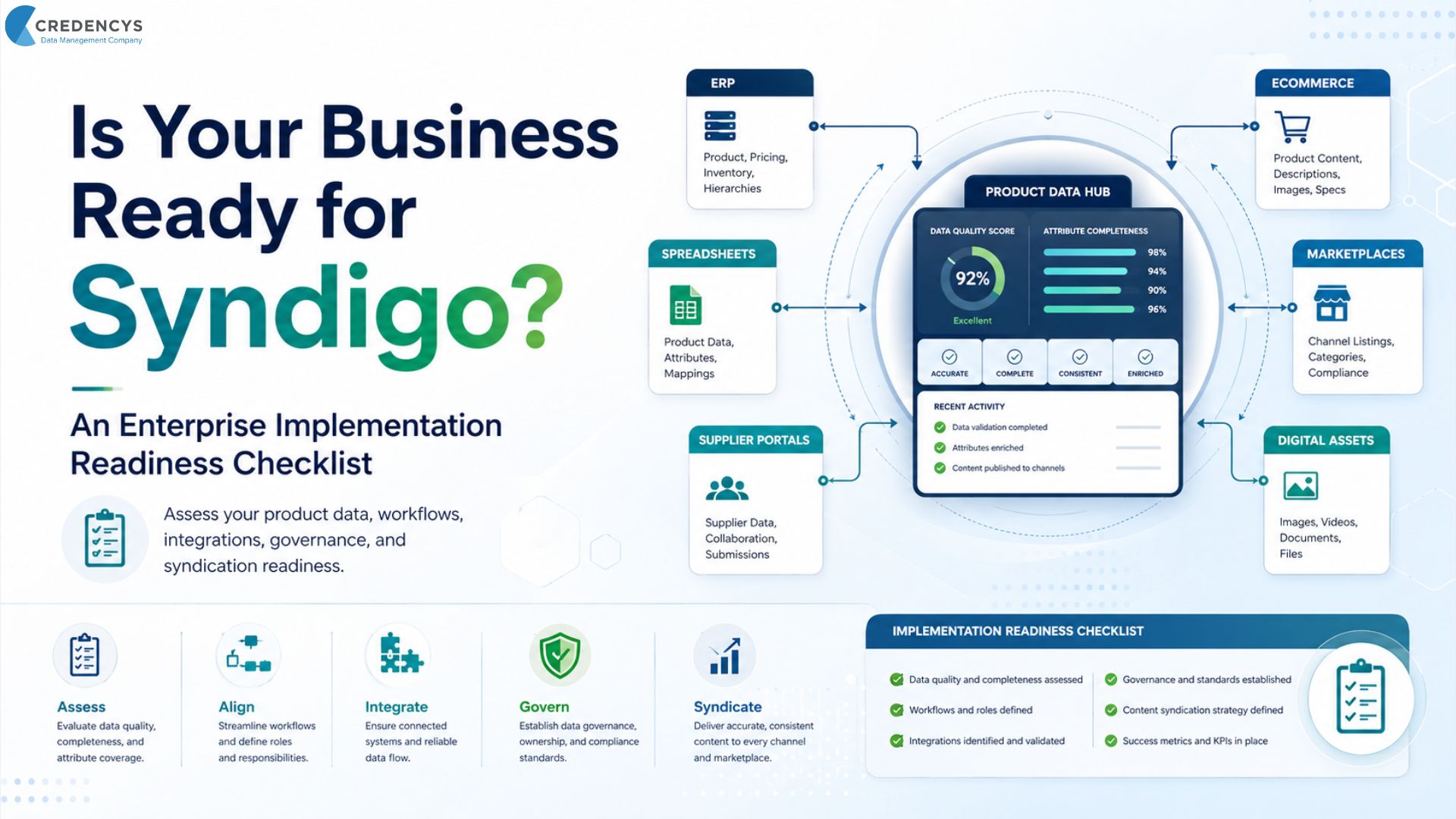
Is Your Business Ready for Syndigo? An Enterprise Implementation Readiness Checklist
Managing product data across ERP systems, spreadsheets, supplier portals, ecommerce platforms, marketplaces, and retailer networks becomes increasingly difficult as an enterprise grows.
Different teams may use different versions of the same product information. Product attributes may be incomplete. Digital assets may be stored across disconnected systems. Retailer requirements may be managed manually. Product launches may slow down because teams spend more time correcting, validating, and reformatting information than preparing products for market.
A Syndigo implementation can help enterprises centralize, govern, enrich, validate, and distribute product information across internal systems and external channels.
However, selecting the platform is only the beginning.
The success of a Syndigo implementation depends on whether your organization is prepared with the right data, processes, integrations, governance, resources, and business objectives.
This enterprise readiness checklist will help you determine:
- Whether your current product data challenges justify a Syndigo implementation
- Which Syndigo capabilities your organization may need
- Whether your data and systems are ready for migration and integration
- Which internal stakeholders should participate
- What implementation risks you should address
- When to involve a Syndigo implementation partner
Why Syndigo Implementation Readiness Matters
A PIM, MDM, or syndication platform cannot automatically fix every product data problem.
If inaccurate, duplicate, outdated, or poorly structured product data is migrated without preparation, the new platform may reproduce the same issues in a more modern environment.
Similarly, an implementation may face delays when:
- Business requirements are unclear
- Product data ownership has not been assigned
- Source systems are undocumented
- Product taxonomies are inconsistent
- Integration dependencies are discovered late
- Retailer requirements have not been mapped
- Internal teams disagree about workflows
- Data quality standards are not defined
- Implementation success cannot be measured
Readiness planning helps the organization identify these gaps before configuration and migration begin. It also helps decision-makers estimate the likely scope, effort, timeline, team structure, and implementation cost more accurately.
Signs Your Business May Need Syndigo
Your business may be ready to evaluate Syndigo if one or more of the following conditions apply.
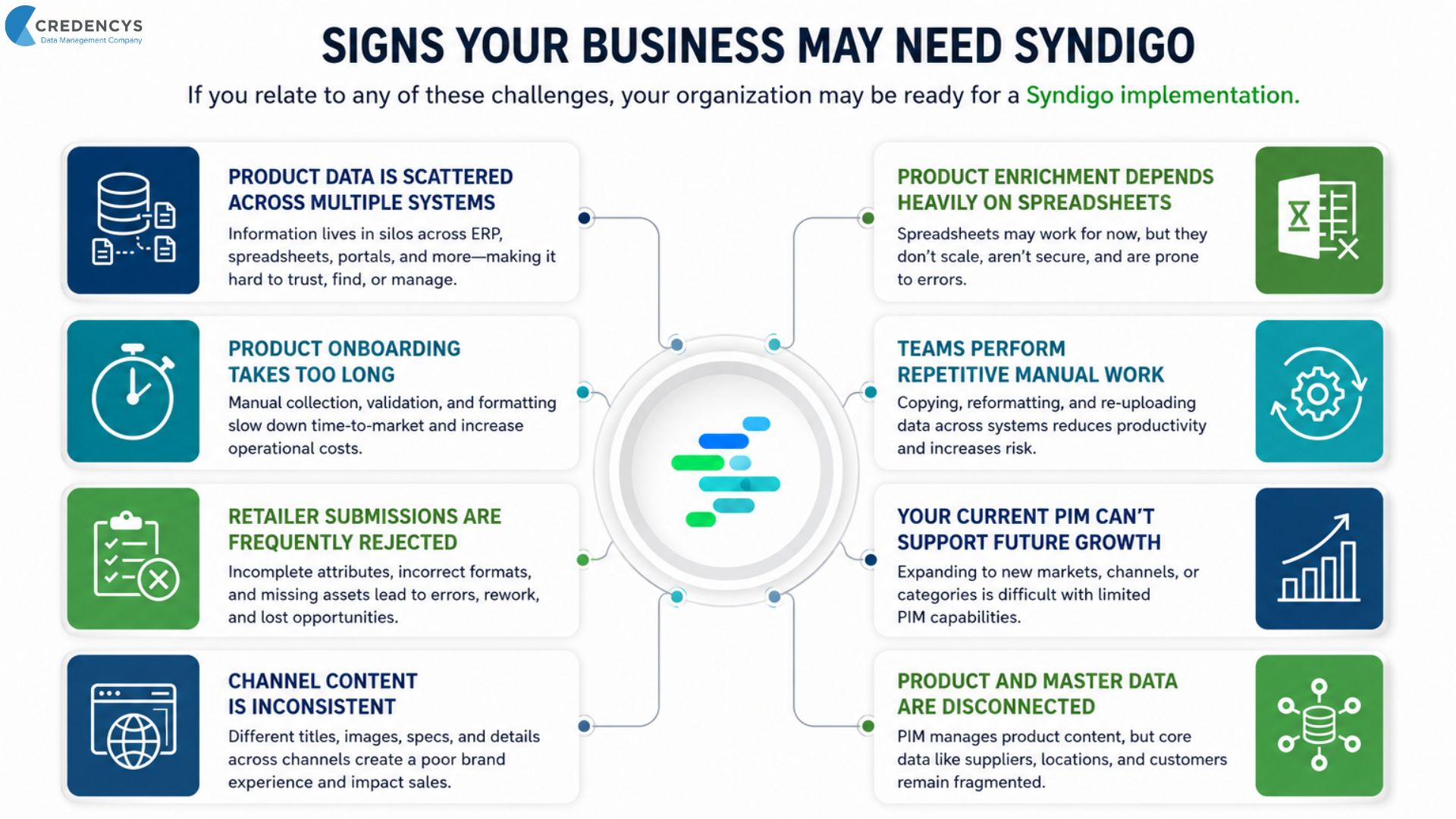
1. Product Data is Scattered Across Multiple Systems
Product information may be stored across ERP systems, supplier spreadsheets, ecommerce platforms, shared drives, PLM systems, DAM platforms, and department-specific databases.
This makes it difficult to identify which system contains the most accurate or current version.
2. Product Onboarding Takes Too Long
Your teams may spend days or weeks collecting attributes, finding assets, checking specifications, resolving errors, and adapting product information for different recipients.
Long onboarding cycles can delay product launches and reduce selling time.
3. Retailer Submissions are Frequently Rejected
Incomplete attributes, invalid values, incorrect formats, missing digital assets, or mismatched taxonomies can prevent product content from being accepted by retailers and marketplaces.
4. Channel Content is Inconsistent
A product may have different titles, descriptions, images, dimensions, compliance information, or specifications across your website, marketplaces, retail partners, and distributor portals.
5. Product Enrichment Depends Heavily on Spreadsheets
Spreadsheets may remain useful for temporary data collection, but they become difficult to govern when thousands of SKUs, attributes, variants, users, and channels are involved.
6. Teams Perform Repetitive Manual Work
Employees may repeatedly copy, reformat, validate, and upload the same product data for different channels.
7. Your Current PIM Cannot Support Future Growth
An existing PIM may not adequately support new countries, languages, product categories, retailers, marketplaces, data domains, or governance requirements.
8. Product and Master Data Are Disconnected
PIM may support channel-facing product content, while core product, supplier, customer, and location data remain fragmented across internal systems.
Enterprise Syndigo Implementation Readiness Checklist
Use the following checklist to evaluate your organization across the eight areas that most strongly influence implementation success.
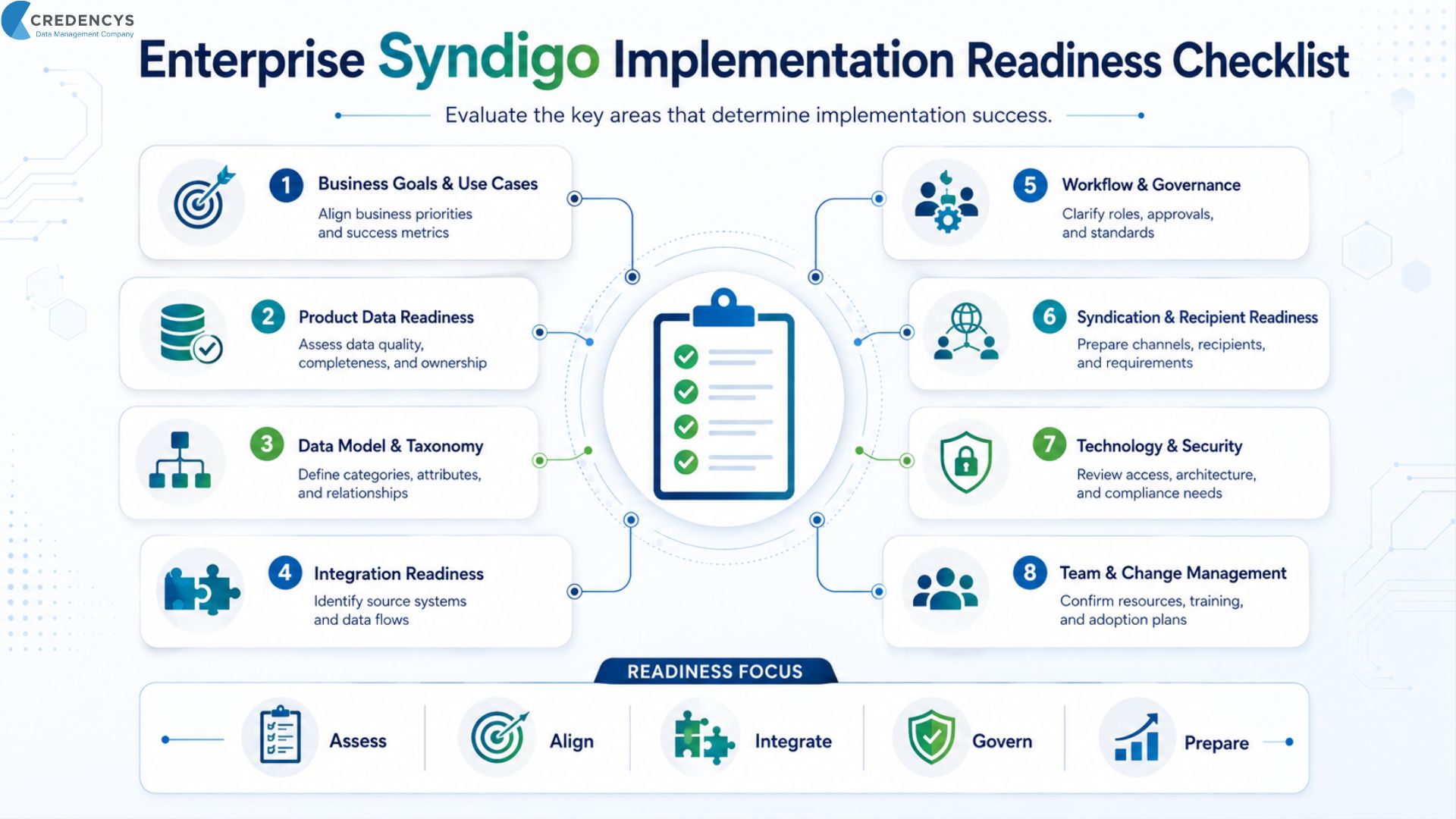
1. Business Goals and Use Cases
Before evaluating configuration requirements, define why your organization wants to implement Syndigo.
A broad objective such as “improve product data” is not enough. Your team needs clear, measurable use cases.
Readiness Questions
- What business problem should Syndigo solve first?
- Are you replacing an existing PIM or introducing one for the first time?
- Do you need PIM, MDM, syndication, GDSN, enhanced content, or a combination?
- Which product categories will be included?
- Which brands, regions, and business units are in scope?
- Which retailer and marketplace channels must be supported?
- What outcomes do executives expect?
- How will implementation success be measured?
- Is there a phased roadmap or a single enterprise-wide rollout?
Examples of Measurable Objectives
Your implementation objectives may include:
- Reducing product onboarding time
- Improving attribute completeness
- Reducing retailer submission errors
- Accelerating channel publication
- Increasing digital asset availability
- Improving governance and accountability
- Reducing manual product data work
- Supporting expansion into new marketplaces
- Creating consistent product information across channels
- Establishing a trusted product master
- Improving product page performance
Readiness Indicator
Your organization is ready when key stakeholders agree on a prioritized set of use cases, measurable outcomes, and an initial implementation scope.
2. Product Data Readiness
Data readiness is one of the most important parts of a Syndigo implementation. Migrating unstructured or unreliable product information without remediation may increase implementation complexity and reduce user trust.
Review Your Existing Product Data
Assess:
- Product names
- SKUs and identifiers
- Descriptions
- Technical specifications
- Dimensions and weights
- Categories
- Attributes
- Variants
- Packaging hierarchies
- Digital assets
- Pricing references
- Compliance data
- Ingredient and nutritional data
- Supplier information
- Retailer-specific content
- Localization data
- Channel-specific values
Readiness Questions
- Where is product data currently stored?
- Which system is the source of truth for each data element?
- How many products and variants are in scope?
- Which attributes are mandatory?
- How complete is the existing product information?
- Are duplicate records common?
- Are product identifiers consistent?
- Are units of measurement standardized?
- Are taxonomy and category structures documented?
- Are digital assets linked reliably to products?
- Is obsolete product data clearly identified?
- Are regional and language variations available?
- Do you understand the quality expectations of each recipient?
Recommended Data Preparation Activities
Before migration, enterprises should consider:
- Data profiling
- Duplicate detection
- Data cleansing
- Attribute standardization
- Unit normalization
- Taxonomy review
- Category mapping
- Digital asset inventory
- Mandatory attribute identification
- Product relationship validation
- Legacy record archiving
Readiness Indicator
Your organization is ready when it understands the volume, location, structure, ownership, completeness, and quality of the data that will enter Syndigo.
3. Data Model and Taxonomy Readiness
The data model determines how products, variants, attributes, assets, hierarchies, relationships, and reference data will be structured.
A weak data model can make enrichment, governance, search, syndication, and future scaling more difficult.
Readiness Questions
- Do you have a documented product hierarchy?
- Are categories defined consistently across business units?
- Which attributes apply globally?
- Which attributes apply only to specific categories?
- How are product families and variants represented?
- How are bundles, kits, replacement parts, and accessories handled?
- Which product relationships need to be maintained?
- Which reference data values should be controlled?
- Which attributes are channel-specific?
- Which attributes vary by country or language?
- Does the model need to support multiple brands or divisions?
Readiness Indicator
Your organization is ready when product categories, attribute groups, reference values, relationships, and hierarchy rules are sufficiently documented for solution design.
4. Integration Readiness
Syndigo rarely operates as an isolated platform. Its value depends on how effectively it exchanges information with the rest of the enterprise ecosystem. Potential systems may include:
- ERP
- PLM
- MDM
- DAM
- CRM
- Supplier portals
- Ecommerce platforms
- Data warehouses
- Marketplace systems
- Retailer portals
- Translation systems
- Analytics platforms
Readiness Questions
- Which systems will send data to Syndigo?
- Which systems will receive data from Syndigo?
- What information will move between each system?
- Which system owns each data element?
- Are APIs available?
- Are batch files or middleware currently used?
- How frequently must data be synchronized?
- Are real-time updates necessary?
- What error-handling process is required?
- How will failed transactions be monitored?
- Are security and authentication requirements documented?
- Are integration owners available from each system team?
Create a Source-to-Target Map
For every data field, define:
- Source system
- Source field
- Transformation rule
- Target field
- Synchronization direction
- Update frequency
- Validation requirement
- Error owner
Readiness Indicator
Your organization is ready when all major source and destination systems, data flows, ownership rules, interfaces, and dependencies have been identified.
5. Workflow and Governance Readiness
Technology can automate processes, but it cannot define accountability on behalf of the business. Your organization needs to establish who creates, reviews, approves, modifies, and publishes product information.
Readiness Questions
- Who owns product data?
- Who creates new product records?
- Who enriches marketing content?
- Who manages technical attributes?
- Who approves product information?
- Who manages digital assets?
- Who handles retailer requirements?
- Who resolves validation errors?
- Who controls taxonomies and reference data?
- Who can publish content?
- Who is responsible for data quality?
- How are urgent changes handled?
- How are discontinued products managed?
Common Workflow Stages
A Syndigo implementation may include workflows such as:
- Product record creation
- Data import
- Technical enrichment
- Marketing enrichment
- Digital asset upload
- Compliance review
- Data validation
- Business approval
- Channel mapping
- Syndication
- Error resolution
- Performance review
Governance Requirements
Your governance framework should define:
- Data owners
- Data stewards
- Approval authorities
- Mandatory fields
- Validation rules
- Access permissions
- Change controls
- Escalation processes
- Quality thresholds
- Audit requirements
Readiness Indicator
Your organization is ready when roles, responsibilities, approval stages, data-quality rules, and escalation paths are clearly defined.
6. Syndication and Recipient Readiness
For many brands, retailers, and manufacturers, syndication is a primary reason for adopting Syndigo. However, successful syndication requires more than connecting to a recipient.
Readiness Questions
- Which retailers, distributors, and marketplaces are in scope?
- What information does each recipient require?
- Are recipient taxonomies documented?
- Which attributes are mandatory for each destination?
- Which assets must be supplied?
- Are there different requirements by category?
- Does the organization require GDSN?
- Are GTINs and packaging hierarchies accurate?
- How are validation errors handled today?
- Who owns recipient-specific mappings?
- How frequently should content updates be published?
- How will syndication status be monitored?
- How will rejected records be corrected?
Readiness Indicator
Your organization is ready when it has a prioritized recipient list, understands channel requirements, and has assigned responsibility for mapping, validation, publication, and error management.
7. Technology and Security Readiness
Enterprise implementation must align with security, identity, access, compliance, and IT architecture standards.
Readiness Questions
- Has the IT architecture team reviewed the proposed platform?
- What authentication method will be used?
- Is single sign-on required?
- Which user roles need access?
- Are data access restrictions required by brand, region, or business unit?
- What audit information must be maintained?
- Are there data residency requirements?
- Which environments are required for development, testing, and production?
- What backup and recovery expectations apply?
- Are integration credentials and security reviews planned?
- Is sensitive product or supplier information involved?
Readiness Indicator
Your organization is ready when security, identity, permissions, access controls, environments, and compliance requirements are included in implementation planning.
8. Team and Change Management Readiness
A Syndigo implementation affects people and processes across multiple departments. The project may involve:
- Executive sponsors
- Product data teams
- Ecommerce teams
- Marketing
- Merchandising
- Supply chain
- IT
- Data governance
- Compliance
- Suppliers
- Channel managers
- Implementation consultants
Readiness Questions
- Is there an executive sponsor?
- Has a business product owner been assigned?
- Is there an internal project manager?
- Are subject matter experts available?
- Can technical teams support integration work?
- Are users prepared to participate in testing?
- Is training included in the plan?
- How will new processes be communicated?
- Is there resistance to replacing spreadsheets or legacy tools?
- How will adoption be measured after launch?
- Is post-launch support available?
Change Management Activities
A practical change management plan may include:
- Stakeholder communication
- Process documentation
- Role-based training
- User acceptance testing
- Super-user development
- Office hours
- Adoption reporting
- Post-launch support
- Feedback collection
- Continuous improvement planning
Readiness Indicator
Your organization is ready when the project has executive support, assigned business and technical resources, a training plan, and a defined approach to user adoption.
Syndigo Readiness Scorecard
Use the following simplified scorecard to assess your current readiness.
| Readiness Area | Not Ready | Partially Ready | Ready |
|---|---|---|---|
| Business Goals | Objectives are unclear | General objectives exist | Prioritized and measurable goals are approved |
| Product Data | Data location and quality are unknown | Some data has been assessed | Data sources, owners, volume, and quality are documented |
| Data Model | No common structure exists | Some categories are standardized | Hierarchies, attributes, and relationships are defined |
| Integrations | Systems and data flows are unclear | Major systems are identified | Source-to-target flows and owners are documented |
| Governance | Responsibilities are informal | Some data owners are identified | Roles, approvals, and governance rules are approved |
| Syndication | Recipient requirements are unknown | Priority recipients are identified | Channel requirements and mappings are documented |
| Technology | Security and architecture reviews have not started | Initial discussions are underway | Architecture, access, and security requirements are approved |
| Team Readiness | Project resources are not assigned | The core team is partially available | Sponsors, owners, subject matter experts, and testers are committed |
Interpreting Your Score
Mostly “Not Ready”
Your organization should complete a discovery and readiness assessment before beginning configuration.
Starting implementation immediately may lead to scope changes, rework, delays, and cost overruns.
Mostly “Partially Ready”
Your organization has a reasonable foundation but should resolve major data, integration, governance, or ownership gaps before finalizing the implementation plan.
Mostly “Ready”
Your organization is in a strong position to begin solution design, implementation planning, or partner selection.
Common Syndigo Implementation Risks
Even enterprises with a strong business case can face implementation difficulties.
1. Trying to Implement Everything at Once
A large rollout covering every product, region, channel, system, and business unit can create unnecessary complexity. A phased implementation is often easier to manage.
2. Underestimating Data Cleansing
Data migration frequently requires more cleansing, normalization, mapping, and validation than expected.
3. Treating Syndigo as Only an IT Project
Product information affects ecommerce, marketing, merchandising, compliance, supply chain, sales, and customer experience.
Business participation is essential.
4. Configuring Before Defining Processes
Automating an unclear or inefficient process may simply make the wrong process move faster.
5. Ignoring Recipient-Specific Requirements
Product information that looks complete internally may still fail retailer or marketplace validations.
6. Insufficient User Training
Users may return to spreadsheets and manual processes if they do not understand the new system or workflows.
7. Selecting an Implementation Partner Based Only on Cost
The lowest-cost provider may not have sufficient experience in data modeling, PIM, MDM, integrations, syndication, or your industry.
Should You Use an Internal Team or a Syndigo Implementation Partner?
An internal implementation may be suitable when the organization already has:
- Deep Syndigo experience
- PIM and MDM architects
- Data migration specialists
- Integration developers
- Data governance resources
- Syndication expertise
- Industry-specific data knowledge
- Adequate project capacity
A Syndigo implementation partner may be more suitable when:
- You are implementing Syndigo for the first time
- Product data is spread across many systems
- Data quality is poor
- Complex integrations are required
- Multiple retailers or markets are involved
- Your team lacks PIM or MDM expertise
- The implementation timeline is aggressive
- Business processes need redesign
- Internal resources are limited
- Migration risk is high
The implementation partner should help translate business requirements into a practical data model, governance structure, integration design, migration plan, workflow, and rollout roadmap.
Questions to Ask a Syndigo Implementation Partner
Before selecting a partner, ask:
- How many PIM, MDM, or Syndigo implementations have you completed?
- Do you have experience in our industry?
- Can you support data discovery and readiness assessment?
- How do you approach product data modeling?
- How do you manage data migration and validation?
- Can you integrate Syndigo with our ERP, ecommerce, DAM, PLM, and marketplace systems?
- How do you handle recipient mappings and syndication?
- What testing methodology do you follow?
- How will you involve our business users?
- What training and documentation are included?
- What post-launch support do you provide?
- How will project risks and scope changes be managed?
- What implementation outcomes will you measure?
- Can the implementation be delivered in phases?
- What internal resources will our organization need?
Final Thoughts
A Syndigo implementation can help enterprises create a more consistent, governed, and scalable approach to managing product and master data.
However, platform capabilities alone do not guarantee success. Your organization must be prepared with:
- Clear business objectives
- Defined implementation scope
- Assessed and cleansed data
- A scalable product data model
- Documented integrations
- Strong governance
- Recipient and syndication requirements
- Committed stakeholders
- User adoption planning
- An experienced implementation team
The earlier these areas are evaluated, the easier it becomes to identify risks, prevent rework, and build an implementation roadmap that delivers measurable value. Before beginning implementation, determine whether your business, data, systems, and teams are truly ready.
A Syndigo readiness assessment can help you make that decision with greater clarity and confidence.
FAQs – Syndigo Readiness Checklist
How do I know whether my business is ready for Syndigo?
Your business may be ready when it has clearly defined product data challenges, documented source systems, identified integration requirements, assigned data owners, and measurable implementation goals.
What should be assessed before a Syndigo implementation?
Assess product data quality, taxonomies, workflows, governance, integrations, retailer requirements, syndication channels, security needs, internal resources, and user adoption readiness.
How long does a Syndigo implementation take?
The timeline depends on data volume, data quality, number of integrations, product categories, workflows, syndication channels, and the complexity of the implementation scope.
Do I need a Syndigo implementation partner?
A partner can be valuable when your organization lacks internal Syndigo expertise, has complex integrations, needs data migration support, or must connect multiple commerce and retailer channels.
What is included in a Syndigo readiness assessment?
A readiness assessment typically reviews business goals, product data, data models, governance, systems, integrations, workflows, syndication requirements, risks, resource availability, and implementation scope.



Tags: