


Short answer: Product experience management (PXM) tailors product content to each channel, audience, and moment in the buying journey so shoppers get the information that convinces them to buy. It builds on PIM: the PIM keeps product data complete and accurate, and PXM adapts and measures how that content performs on every channel.
Shoppers cannot touch a product online. They decide from titles, descriptions, images, videos, specifications, and reviews, and they expect that content to be relevant to them and right for the channel they are on.
Product experience management is how brands and retailers make that happen at scale. This guide explains what PXM is, how it differs from PIM, its core capabilities, and how to get started.
PXM: Quick Summary
| Question | Short answer |
|---|---|
| What does PXM stand for? | Product experience management |
| What is it? | Adapting and optimizing product content for each channel, audience, and context |
| How is it different from PIM? | PIM makes product data complete and accurate; PXM makes it relevant and persuasive on each channel |
| Who uses it? | eCommerce, marketing, merchandising and brand teams |
| Key capabilities | Channel-specific content, rich media, localization, personalization, syndication, content analytics |
| Typical tools | PIM platforms with PXM features, syndication and digital shelf tools |
What Is Product Experience Management (PXM)?
Product experience management is the process of delivering product content in the context in which customers discover, compare and buy products. The same drill needs a short, keyword-rich title on Amazon, a benefit-led story on your own store, a technical data sheet for distributors and a compact listing for a mobile app.
PXM organizes and measures those variations from one source of product truth. Learn more about our product experience portal, which gives internal teams, suppliers, distributors and agencies role-based access to the right product data and assets.
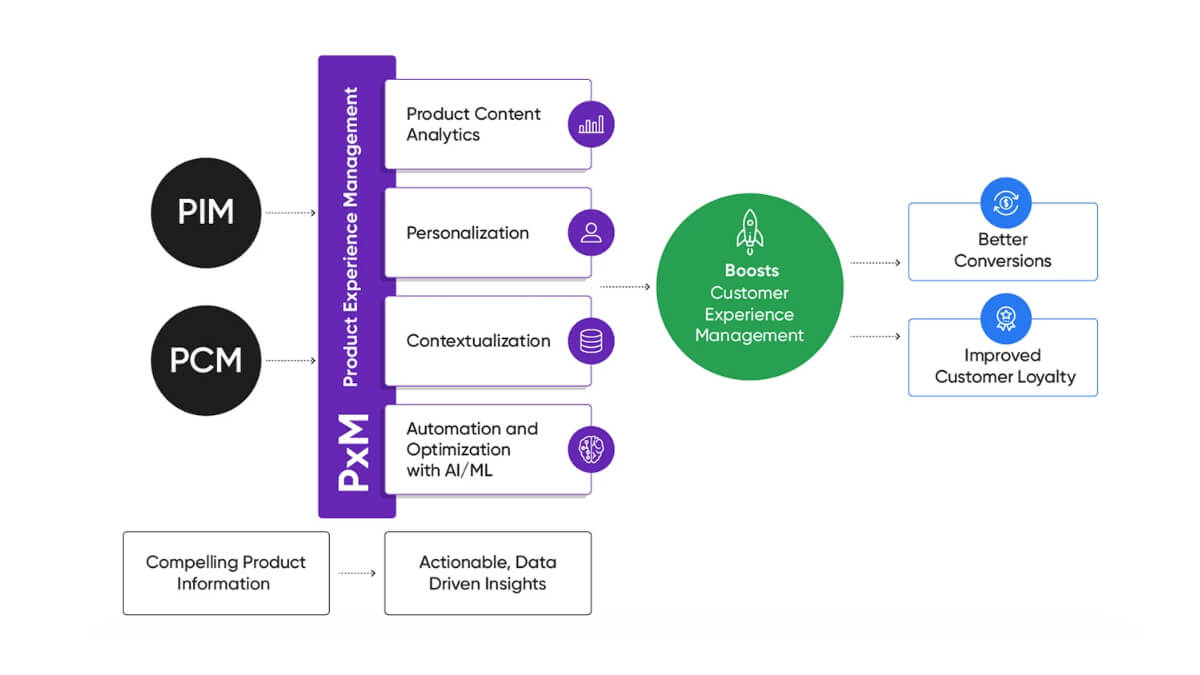
PXM vs PIM: What Is the Difference?
| PIM | PXM | |
|---|---|---|
| Main goal | Complete, accurate, consistent product data | Relevant, persuasive product experiences per channel |
| Focus | Data quality and governance | Content performance and context |
| Typical work | Modeling, importing, validating, enriching, approving | Adapting content per channel, audience and market; testing and measuring |
| Measures | Completeness, accuracy, time to market | Conversion, search visibility, returns, content score on retailer sites |
| Relationship | The foundation | Built on top of PIM data |
In practice, many PIM platforms now include PXM features, and people often use the terms interchangeably. Without a solid PIM foundation, PXM has nothing reliable to build on.
Read what is PIM for the foundation.
3 Core Ingredients of Product Experience Management
1. Context
Content that fits the channel, device, market, and stage of the journey: a marketplace listing, a comparison page, a mobile app, or a print catalog each needs something different.
2. Rich, consistent content
Complete attributes, good images and video, size guides, manuals and FAQs, consistent across every channel so shoppers trust what they see.
3. Measurement
Knowing which content drives conversion and which causes returns or questions, and feeding that back into the content.
Key Capabilities of a PXM Solution
- Channel-specific content: different titles, descriptions, images and attributes per channel, from one product record.
- Rich media management: images, video, 360 views and documents linked to the right products and variants.
- Localization: translations and market-specific content managed per attribute.
- Personalization: content variations by audience, segment or region.
- Syndication: sending content to retailers and marketplaces in their required formats.
- Content scoring and analytics: checking content against channel requirements and tracking how it performs.
- Portals: giving distributors, agencies and sales teams self-service access to approved content.
Benefits of Product Experience Management
- Higher conversion from more relevant, complete product pages
- Fewer returns caused by missing or misleading information
- Better visibility in marketplace and site search through channel-optimized content
- Faster launches on new channels and markets
- A consistent brand experience everywhere the product appears
PXM in Practice: Examples by Industry
Fashion
Each colorway gets its own images and on-model shots; size guides and fit notes reduce returns; marketplace titles follow each marketplace’s rules for brand, gender, product type, and color.
Consumer goods and grocery
Each retailer requires its own attributes, nutrition and allergen data, and enhanced content such as A+ pages. PXM keeps every retailer’s version complete and checks it against their requirements.
Industrial and B2B
Buyers need specifications they can filter on, CAD files and certificates, and distributor-specific catalogs. PXM delivers the technical depth each buyer and channel needs, not just marketing copy.
How to Measure Product Experience
| KPI | What it tells you |
|---|---|
| Content completeness per channel | Whether each product meets each channel’s requirements |
| Conversion rate by product or category | Whether content convinces shoppers to buy |
| Return rate and return reasons | Whether content sets the right expectations |
| Search visibility on marketplaces and your site | Whether titles and attributes match how shoppers search |
| Time to publish on a new channel | How quickly you can expand |
| Product questions to customer service | Which information is missing or unclear |
How to Get Started with PXM
- Fix the foundation. First, make product data complete and accurate in a PIM.
- Map your channels and audiences. List what each channel requires and what each audience needs to decide.
- Create channel-specific content. Start with your top channels and top-selling products.
- Syndicate and publish. Automate delivery to retailers and marketplaces.
- Measure and improve. Track conversions, returns, and content scores, and update underperforming content.
How Credencys Helps with PXM
We help brands, manufacturers and retailers build the PIM foundation and the product experience on top of it: platform selection, implementation, channel and syndication setup, portals and governance. See our PIM services and product content management.
For example, an eCommerce agency managing 500,000+ SKUs cut product data turnaround by 70% with an AI-powered PIM we built.
Frequently Asked Questions
What is product experience management?
Product experience management (PXM) adapts product content to each channel, audience, and context, and measures performance, so shoppers get the information they need to buy. It builds on the accurate product data held in a PIM.
What is the difference between PIM and PXM?
PIM makes product data complete, accurate, and consistent. PXM uses that data to create relevant, channel-specific product experiences and measures their performance.
PIM is the foundation; PXM is what customers experience on each channel.
Do I need a PXM tool if I have a PIM?
Not always. Many PIM platforms include PXM features such as channel-specific content, completeness scoring, and syndication. Dedicated digital shelf or syndication tools help when you sell through many retailers and need to monitor content on their sites.
What are examples of PXM?
Examples include shorter, keyword-rich titles for marketplaces; longer, benefit-led descriptions for your own store; localized content and images per market; size guides for fashion; and technical data sheets for B2B buyers, all generated from one product record.







Tags: