


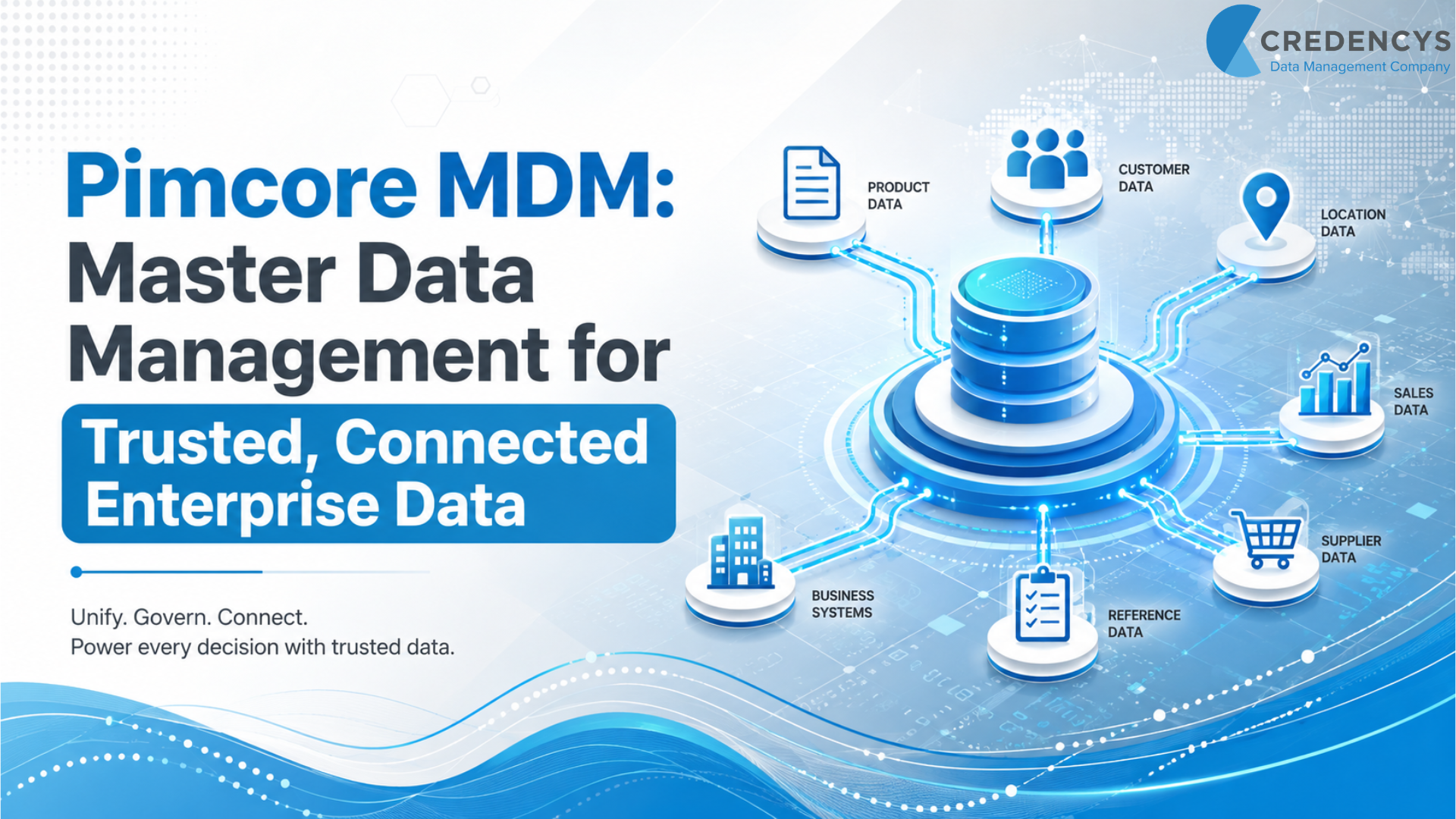
Pimcore MDM: Master Data Management for Trusted, Connected Enterprise Data
Enterprise data is growing across systems, teams, channels, and business functions. Product data may live in a PIM or ERP system.
Customer data may sit inside CRM, CDP, eCommerce platforms, or marketing tools. Supplier data may be managed through procurement systems, spreadsheets, or regional databases.
Asset, location, pricing, and reference data may exist in multiple disconnected applications. This creates a serious business challenge.
According to Gartner, poor data quality costs organizations an average of $12.9 million annually.
IBM estimates that bad data costs the U.S. economy more than $3 trillion each year.
As businesses continue to adopt more applications and digital channels, the risk of fragmented and inconsistent master data only increases. When master data is fragmented, every team works with a different version of the truth.
Reports become unreliable. Product launches slow down.
Supplier operations become inefficient. Customer experiences become inconsistent.
Business users spend more time correcting data than using it. To solve this, enterprises need a structured approach to Master Data Management consulting services that brings governance, consistency, and ownership to critical business data.
That is where Pimcore MDM helps.
Pimcore Master Data Management enables enterprises to centralize, manage, govern, enrich, and distribute trusted master data across systems and channels. It helps organizations create a single source of truth for critical business data and use it to drive better decisions, smoother operations, and more connected digital experiences.
What is Pimcore MDM?
Pimcore MDM is a master data management solution that helps businesses manage their most important enterprise data in a centralized and governed way. It allows organizations to bring together different data domains, such as:
- Product data
- Customer data
- Supplier and vendor data
- Asset data
- Location data
- Employee data
- Parts and material data
- Reference data
Instead of managing these data domains in silos, Pimcore Master Data Management enables businesses to connect them through flexible data models, workflows, validation rules, and integrations. In simple terms, Pimcore MDM helps businesses answer one critical question: Which data can we trust?
Businesses planning to implement Pimcore Master Data Management often start by evaluating the right Pimcore development services partner to design data models, workflows, integrations, and governance processes correctly.
How Pimcore MDM Helps Create Golden Records
A golden record is the most accurate, complete, and trusted version of a data entity. Pimcore Master Data Management helps businesses create golden records by consolidating data from multiple sources, identifying inconsistencies, removing duplicates, applying validation rules, and maintaining governance over time.
This is useful across multiple data domains. For product data, a golden record may include the most accurate SKU details, attributes, specifications, categories, images, documents, and compliance data.
Customer data may include verified contact details, preferences, purchase behavior, segmentation data, and relationship history. Supplier data may include legal entity details, certifications, contracts, contacts, payment information, and compliance documents.
Golden records improve data trust and reduce the operational confusion caused by duplicate, incomplete, or conflicting information.
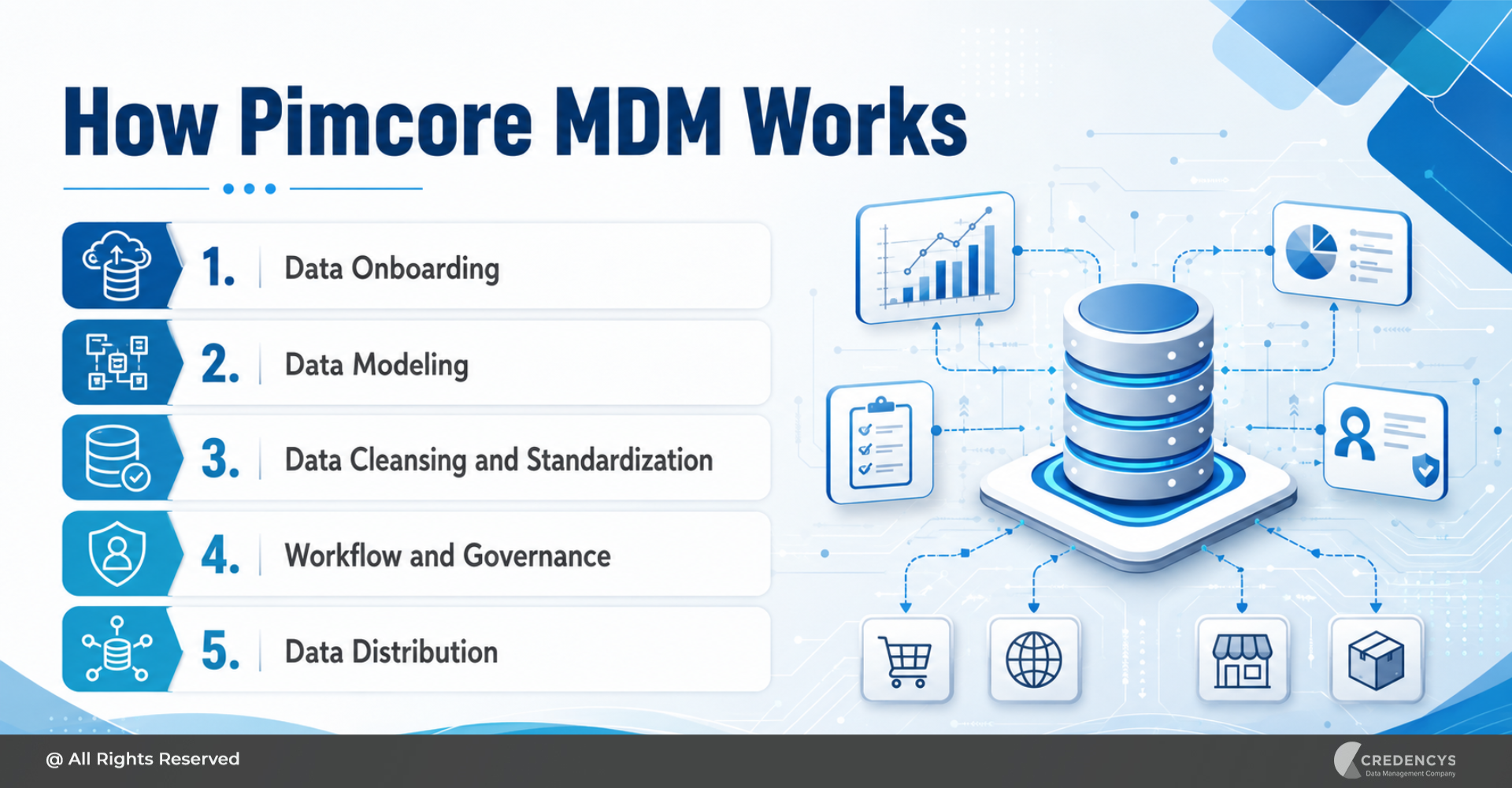
How Pimcore MDM Works
A successful Pimcore implementation follows a structured approach to master data management, starting with data onboarding and moving toward governance, golden records, and downstream distribution.
1. Data Onboarding
The first step is collecting data from different source systems. These may include ERP, CRM, eCommerce platforms, supplier portals, spreadsheets, legacy applications, data warehouses, APIs, and third-party systems.
Pimcore supports flexible data onboarding, making it easier to bring structured, unstructured, and digital data into one environment.
2. Data Modeling
Once data is onboarded, businesses can define flexible data models. These models define how each data entity should be structured.
For example, a product data model may include SKUs, categories, variants, attributes, images, documents, translations, and relationships. A supplier data model may include company details, contacts, certifications, contracts, payment terms, and compliance fields.
Pimcore allows businesses to design data models based on their industry, operations, and business rules.
3. Data Cleansing and Standardization
Before master data can be trusted, it must be cleaned and standardized. Pimcore Master Data Management helps businesses detect duplicate records, correct formatting issues, validate required fields, standardize naming conventions, and improve data completeness.
This step is important because poor-quality data cannot become a reliable master data foundation.
4. Workflow and Governance
Master data must be owned, reviewed, approved, and maintained by the right people. Pimcore MDM enables workflow-based governance, allowing data owners, stewards, and business users to create, review, approve, reject, or update records according to defined rules.
This ensures that data changes are not uncontrolled or inconsistent.
5. Data Distribution
Once master data is validated and approved, it can be distributed to downstream systems. Pimcore Master Data Management can share trusted data with ERP, CRM, eCommerce platforms, marketplaces, analytics tools, mobile apps, portals, and other enterprise applications.
This ensures that every system receives consistent, accurate, and updated data.
Core Capabilities of Pimcore MDM
Pimcore MDM offers a wide range of capabilities that help enterprises manage complex master data environments.
Advanced Data Modeling
Every business has a different data structure. Pimcore MDM allows companies to create flexible data models for products, customers, suppliers, assets, locations, and other entities.
Businesses can define attributes, classifications, hierarchies, relationships, dependencies, and validation rules based on their specific requirements.
Multi-Domain Master Data Management
Many traditional systems focus on one data domain. Pimcore Master Data Management supports multiple domains, making it suitable for enterprises that want to manage product, supplier, customer, location, asset, and reference data in a single platform.
This is useful for businesses that want to connect different data entities rather than manage them in isolation.
Data Quality Management
Pimcore MDM helps improve data quality through validation rules, completeness checks, consistency checks, standardization, and data profiling. Better data quality leads to fewer errors, less rework, more accurate reporting, and stronger operational control.
Data Onboarding and Integration
Pimcore MDM supports flexible data onboarding through APIs, ETL processes, file imports, and system integrations. This helps businesses connect Pimcore with ERP, CRM, PIM, DAM, eCommerce, supplier systems, analytics tools, and other enterprise platforms.
Workflow and Business Process Management
Pimcore MDM allows teams to define workflows for data creation, enrichment, review, approval, and publishing. These workflows improve collaboration between IT, data teams, business users, and data owners.
Analytics and Reporting
Enterprises need visibility into data quality and governance performance. Pimcore MDM supports reporting and dashboards that help teams monitor data completeness, quality, workflow status, and operational performance.
User Management and Access Control
Not every user should have the same access to master data. Pimcore MDM supports role-based permissions, secure access management, and controlled data ownership.
This helps enterprises manage governance, security, and compliance more effectively.
Extension and Customization
Pimcore’s flexible architecture allows enterprises to customize the platform to their specific data model, workflows, integrations, and business process requirements.
This makes Pimcore MDM suitable for businesses with complex and evolving data management needs.
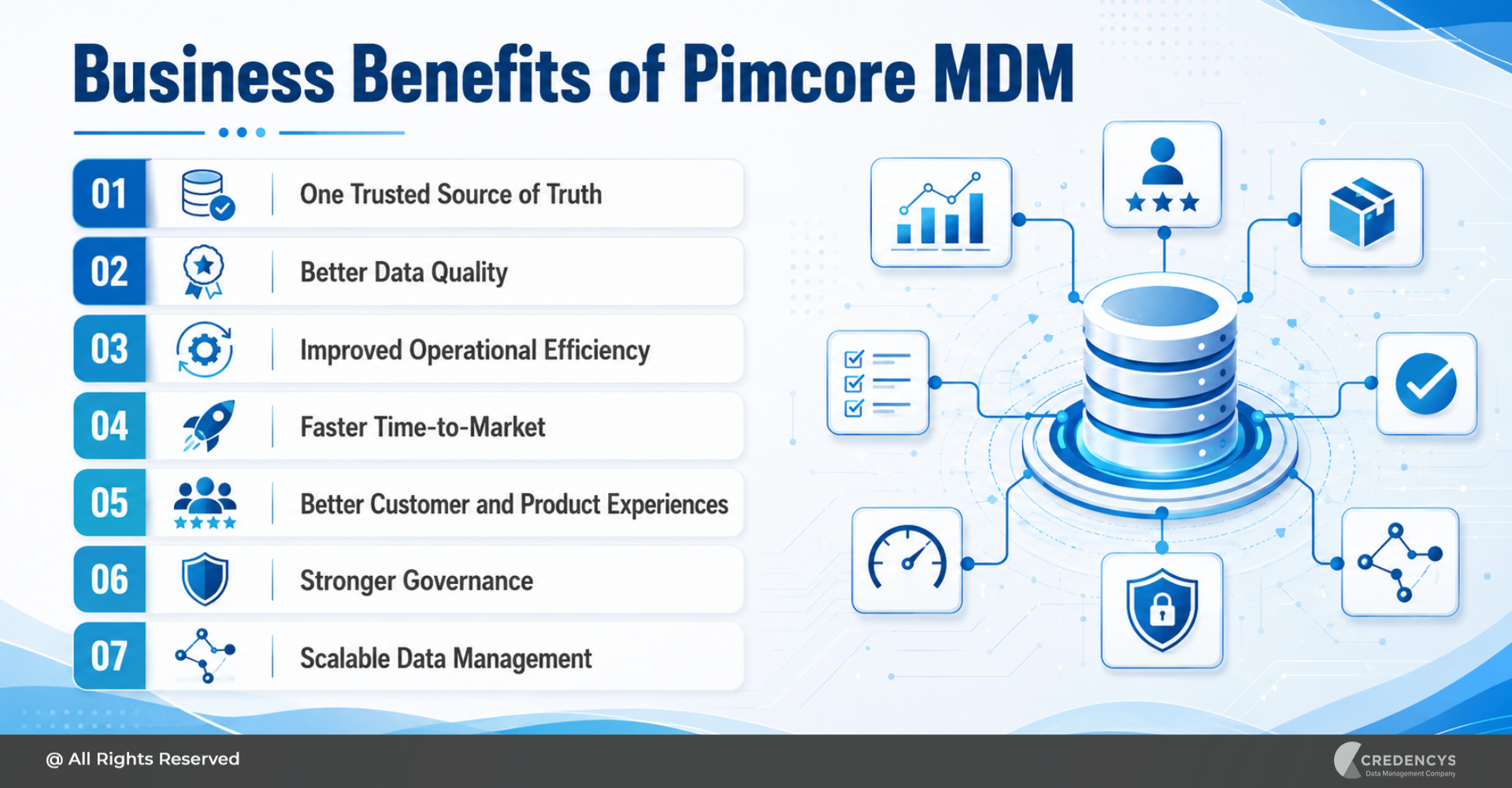
Business Benefits of Pimcore MDM
Pimcore MDM helps enterprises improve both data operations and business outcomes.
One Trusted Source of Truth
Pimcore MDM helps businesses centralize master data and create a reliable source of truth across departments, systems, and channels.
Better Data Quality
With validation, standardization, completeness checks, and governance workflows, businesses can reduce duplicate, inconsistent, and inaccurate records.
Improved Operational Efficiency
Teams spend less time correcting data manually and more time using data to support business decisions and operations.
Faster Time-to-Market
For industries such as retail, CPG, manufacturing, and eCommerce, clean and connected data can accelerate product launches, catalog updates, supplier onboarding, and channel expansion.
Better Customer and Product Experiences
Accurate product, customer, and asset data help businesses deliver consistent experiences across digital and physical touchpoints.
Stronger Governance
Pimcore MDM helps define who owns the data, who can change it, who approves it, and how changes are tracked.
Scalable Data Management
Businesses can start with one high-value data domain and gradually expand to more domains as their MDM maturity grows.
Pimcore MDM Use Cases
Product Master Data Management
Businesses can manage SKUs, product attributes, variants, categories, product relationships, specifications, images, videos, documents, and compliance information. This is especially useful for retail, manufacturing, CPG, and eCommerce businesses that manage large, complex product catalogs.
Supplier Master Data Management
Pimcore MDM helps manage supplier profiles, contact details, certifications, contracts, payment terms, compliance records, and supplier relationships. This improves procurement accuracy, vendor collaboration, and supplier governance.
Customer Master Data Management
For organizations dealing with fragmented customer profiles, Customer Master Data Management helps unify customer records and improve segmentation, personalization, and customer engagement.
Asset Master Data Management
When product or brand data is closely tied to images, videos, manuals, and documents, a connected Digital Asset Management solution can help teams manage data and assets together.
Location Master Data Management
Businesses can manage store data, warehouse data, regional hierarchies, distribution centers, service locations, and address information. This is useful for retail, logistics, manufacturing, and distribution businesses with complex location structures.
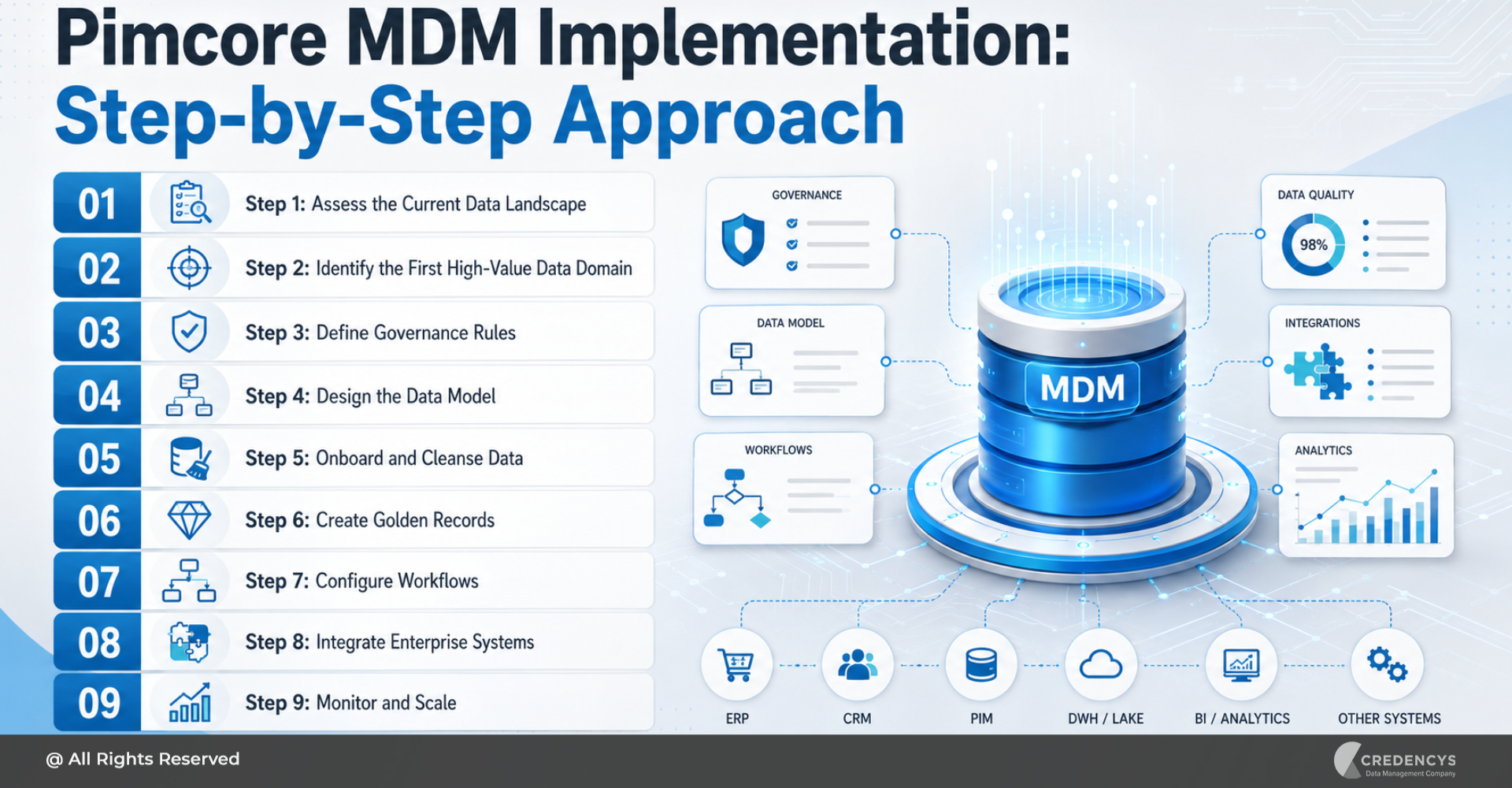
Pimcore MDM Implementation: Step-by-Step Approach
A successful Pimcore MDM implementation should be practical, phased, and business-led.
Step 1: Assess the Current Data Landscape
Start by identifying where master data currently exists, how it flows across systems, where duplicates exist, and which teams own specific data domains.
Step 2: Identify the First High-Value Data Domain
Do not try to manage every data domain at once. Start with one high-impact area, such as product, supplier, or customer data.
Step 3: Define Governance Rules
Assign data owners, approval responsibilities, quality standards, access rights, and escalation processes.
Step 4: Design the Data Model
Define entities, attributes, hierarchies, relationships, classifications, mandatory fields, and validation rules.
Step 5: Onboard and Cleanse Data
Bring data from source systems into Pimcore. Clean duplicates, correct errors, standardize formats, and improve completeness.
Step 6: Create Golden Records
Use the cleansed and validated data to create trusted master records for each entity.
Step 7: Configure Workflows
Set up review, approval, enrichment, and publishing workflows to ensure ongoing governance.
Step 8: Integrate Enterprise Systems
Connect Pimcore MDM with ERP, CRM, PIM, DAM, eCommerce, analytics, supplier portals, and other downstream systems.
Step 9: Monitor and Scale
Track data quality, workflow performance, user adoption, and business outcomes. Once the first domain is stable, expand to additional data domains.
Common Challenges in Pimcore MDM Implementation
Pimcore MDM implementation can deliver strong business value, but only when it is planned correctly. Common challenges include:
- Poor data quality in source systems
- Lack of clear data ownership
- Overcomplicated data models
- Weak governance processes
- Integration complexity
- Low business-user adoption
- Trying to manage too many domains at once
To avoid these challenges, businesses should start with a clear MDM strategy, involve both IT and business users, define measurable data quality rules, and roll out Pimcore MDM in phases.
Best Practices for Successful Pimcore MDM Implementation
To get the best results from Pimcore MDM, enterprises should follow these best practices:
- Start with one high-value data domain
- Define clear data ownership
- Keep the first data model practical and scalable
- Clean data before migration
- Set measurable data quality standards
- Use workflows for approval and governance
- Integrate Pimcore with core enterprise systems
- Train business users early
- Monitor data quality continuously
- Expand gradually to additional domains
The goal should not be to create another data repository. The goal should be to create trusted, governed, and usable master data that improves business performance.
Why Choose Pimcore for Master Data Management?
Pimcore MDM is a strong choice for enterprises that need flexible, scalable, and connected master data management. Its multi-domain capabilities help businesses manage different types of master data on a single platform.
Its flexible data modeling allows organizations to adapt the system to their industry and business processes. Its integration capabilities help connect master data with ERP, CRM, eCommerce, analytics, supplier systems, and digital experience platforms.
Pimcore also brings master data closer to the digital experience. This means businesses can use trusted data not only for internal operations but also to improve product experiences, customer engagement, omnichannel consistency, and personalization.
For enterprises seeking to modernize their data foundation, improve governance, and build connected digital ecosystems, Pimcore MDM offers a practical, scalable approach.
How Credencys Helps with Pimcore MDM Implementation
Implementing Pimcore MDM requires more than platform setup. It needs the right data strategy, data model, governance framework, integration approach, and implementation roadmap.
Credencys helps enterprises design and implement Pimcore MDM solutions aligned with their business goals, data complexity, and digital transformation priorities. Our Pimcore MDM services include:
- Pimcore MDM consulting
- Data strategy and roadmap development
- Data model design
- Pimcore implementation and customization
- PIM and MDM integration
- ERP, CRM, DAM, eCommerce, and marketplace integration
- Data migration
- Data quality and governance setup
- Workflow configuration
- Custom Pimcore development
- Ongoing support and optimization
Whether you want to centralize product data, improve supplier governance, create golden customer records, or connect master data across enterprise systems, Credencys can help you build a scalable Pimcore MDM solution.
Conclusion
Disconnected master data slows down operations, weakens decision-making, and creates inconsistent customer experiences. As enterprises grow across systems, channels, and markets, managing trusted data becomes a strategic priority.
Pimcore MDM helps businesses centralize, govern, enrich, and distribute master data across the enterprise. It enables organizations to create golden records, improve data quality, connect business domains, and build a reliable foundation for digital transformation.
With the right implementation approach, Pimcore MDM can help enterprises move from fragmented data to trusted, connected, and business-ready master data.
FAQs
What is Pimcore MDM?
Pimcore MDM is a master data management solution that helps businesses centralize, manage, govern, and distribute trusted enterprise data across systems and channels. It allows organizations to bring product, customer, supplier, asset, location, and other master data domains into one unified platform.
With Pimcore MDM, businesses can improve data quality, create golden records, define governance workflows, and ensure that teams across ERP, CRM, eCommerce, analytics, and other systems work with consistent and accurate data.
Is Pimcore an MDM platform?
Yes, Pimcore can be used as an MDM platform. It offers capabilities such as multi-domain data management, flexible data modeling, data quality management, workflow automation, access control, integrations, and data distribution.
Pimcore MDM helps businesses manage critical master data across different domains and create a single source of truth for enterprise-wide operations, reporting, digital commerce, and customer experience.
What is a Golden Record in Pimcore MDM?
A golden record in Pimcore MDM is the most accurate, complete, and trusted version of a master data entity. It is created by consolidating data from multiple systems, removing duplicates, correcting inconsistencies, applying validation rules, and maintaining governance.
What is the difference between Pimcore MDM and Pimcore PIM?
Pimcore Master Data Management focuses on managing multiple master data domains, including product, customer, supplier, asset, location, and reference data. It helps businesses create a governed, trusted, and consistent source of enterprise data.
Pimcore PIM, on the other hand, focuses specifically on product information management. It helps businesses centralize, enrich, validate, translate, and distribute product data across websites, marketplaces, catalogs, mobile apps, and other sales channels.
Which data domains can Pimcore MDM manage?
Pimcore MDM can manage multiple master data domains based on business requirements. These may include product data, customer data, supplier and vendor data, asset data, location data, employee data, parts and material data, and reference data.
This multi-domain capability makes Pimcore MDM suitable for enterprises that want to connect critical business data across departments, systems, and channels rather than managing each domain in isolation.






Tags: