


How Missing Product Attributes Weaken Ecommerce Search for Electrical Distributors
Electrical buyers rarely search for products using only a generic name. A contractor looking for a circuit breaker may also need a specific current rating, pole configuration, voltage, interrupting capacity, mounting type, and panel compatibility.
A buyer searching for cable may need conductor material, gauge, insulation, voltage rating, shielding, and packaging length. An ecommerce search engine can only work with the information available in the product record.
When essential attributes are missing, buried in PDFs, or represented inconsistently, relevant products may not appear, even when the distributor stocks them. Attribute completeness is therefore not simply a catalog-quality issue.
It is a critical part of effective product data management for electrical distributors, directly affecting discovery, filtering, comparison, and conversion.
Why Ecommerce Search is More Complex in Electrical Distribution
Electrical distributors manage product portfolios spanning circuit protection, wire and cable, lighting, wiring devices, controls, enclosures, connectors, sensors, power distribution equipment, and industrial automation components. Each category has a different selection logic.
A buyer choosing a consumer product might compare brand, size, color, and price. A buyer selecting an electrical component may need to evaluate several technical and compatibility requirements at the same time.
Electrical buyers may search using:
- An exact manufacturer part number
- A partial part number
- A product category
- A technical specification
- An application or operating environment
- An alternative or replacement product
- A compatible accessory
- A natural-language description of the requirement
These search patterns depend on structured attributes that help the platform understand what each product is, how it differs, and when it is relevant. Product attributes are therefore part of the ecommerce search infrastructure.
Which Product Attributes Power Electrical Ecommerce Search?
Not every product field has equal value for search. Well-structured product attributes help ecommerce platforms understand what a product is, how it differs, and when it should appear.
Common electrical product attributes include:
- Voltage
- Rated current
- Wattage
- Frequency
- Number of poles
- Phase
- Interrupting capacity
- Conductor size
- Wire gauge
- Material
- Dimensions
- Mounting type
- Enclosure rating
- IP or NEMA rating
- Temperature range
- Certifications
- Connection type
- Color and finish
- Compatible products
The required attributes change by category. For circuit breakers, buyers may need rated current, voltage, poles, trip characteristics, interrupting capacity, and mounting type.
For wire and cable, they may need conductor material, gauge, conductor count, insulation, shielding, voltage rating, temperature rating, and package length. For lighting products, search may depend on wattage, lumen output, color temperature, input voltage, dimming capability, fixture type, and environmental rating.
For enclosures, dimensions, material, mounting method, and NEMA or IP rating may determine whether the product is suitable. This category-specific structure is reflected in ETIM, which organizes technical products through groups, classes, synonyms, features, values, and units.
The model is designed to give technical information a consistent structure for exchange and reuse. A complete record needs the attributes that matter for its category, buyer, and channel.
How Missing Product Attributes Weaken Ecommerce Search
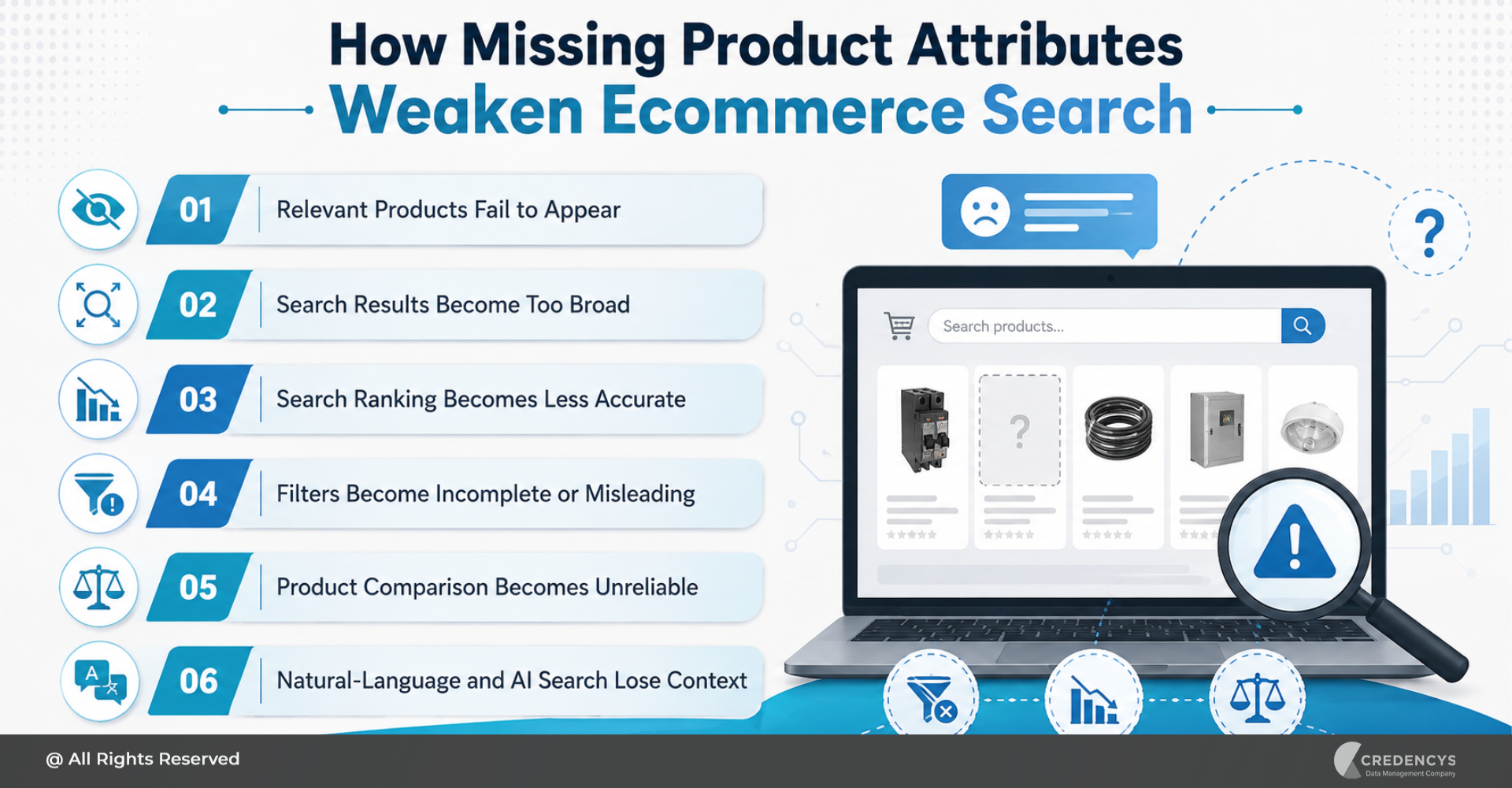
Relevant Products Fail to Appear
A product may be relevant to a query but still be excluded because a required attribute is blank. Consider a customer searching for a “30-amp three-pole breaker.”
A stocked product may have the correct current and pole configuration, but those details may exist only in a technical sheet. If they are absent from the searchable record, the ecommerce platform may not identify the product as a strong match.
The distributor has the item, but the digital experience makes it appear unavailable.
Search Results Become Too Broad
Incomplete attributes also make search results less precise. A query for an outdoor-rated enclosure may return indoor enclosures, accessories, mounting hardware, and loosely related products when the system lacks reliable environmental-rating and enclosure-type fields.
The customer must then:
- Open multiple product pages
- Read technical documents
- Compare specifications manually
- Refine the search repeatedly
- Contact a salesperson
- Leave the website for another source
Broad results may indicate that the engine lacks enough structured information to distinguish among products.
Search Ranking Becomes Less Accurate
Search platforms use available product information as relevance signals. A fully described product can match a technical query more confidently than a record containing only a part number and abbreviated description.
This can cause less suitable but more complete products to rank above the item that best meets the buyer’s need. Search tuning can improve ranking and query interpretation, but it cannot compensate for missing technical facts.
Filters Become Incomplete or Misleading
Filters depend on consistent attribute values. A lighting product may appear in the overall category but disappear when the buyer selects “4000 K” because its color-temperature field is empty.
A cable may vanish after the customer filters by voltage rating, even though the rating is present in a PDF. Customers may assume the filtered results represent the full assortment when they actually show only products with populated fields.
Product Comparison Becomes Unreliable
Comparison tools require aligned attributes. If one manufacturer supplies “rated current,” another uses “amps,” and a third includes the value only in a description, products cannot be compared cleanly.
Empty cells and mismatched labels make the comparison table less useful. Buyers must interpret the differences manually, slowing selection.
Natural-Language and AI Search Lose Context
Natural-language queries often combine product type, application, performance, and environment. For example: “Find a weather-resistant enclosure for outdoor installation.”
To respond accurately, the search experience needs structured information about enclosure type, material, application, environmental rating, dimensions, and possibly mounting method. AI can interpret the query, but it should not invent missing specifications.
Category-Specific Examples of Attribute Gaps
Circuit Protection
Circuit-protection products may require:
- Rated current
- Voltage
- Number of poles
- Interrupting capacity
- Trip curve
- Mounting type
- Panel or system compatibility
When these fields are incomplete, a contractor may be unable to narrow a large catalog to breakers suitable for the required application. Products with similar names can have different electrical characteristics, so those differences must be structured.
Wire and Cable
Wire and cable catalogs can require:
- Wire gauge
- Conductor count
- Conductor material
- Insulation
- Jacket material
- Shielding
- Voltage rating
- Temperature rating
- Length
- Packaging type
A generic title may not distinguish one cable from another. Missing attributes can return unsuitable products or force buyers to inspect data sheets.
Packaging information also matters. A buyer looking for a 1,000-foot reel should not have to open every result to determine whether it is sold by the foot, coil, spool, or reel.
Lighting and Controls
Lighting products may be selected by:
- Wattage
- Lumen output
- Color temperature
- Input voltage
- Dimming protocol
- Fixture type
- Beam angle
- Environmental rating
- Mounting method
A buyer searching for a dimmable 4000 K outdoor fixture needs several of these attributes at once. If one is missing, the result set may include products that are technically unsuitable.
Controls introduce additional requirements such as communication protocol, input and output type, operating voltage, and compatibility.
Enclosures and Automation Components
For enclosures, the buyer may need dimensions, material, mounting type, and NEMA or IP rating. For automation components, the decision may depend on signal type, communication protocol, number of inputs and outputs, operating range, and compatible controllers.
When those characteristics are not searchable, the ecommerce site becomes a digital catalog index rather than a dependable product-selection tool.
The Business Impact of Weak Electrical Product Search
Missing attributes affect more than website usability.
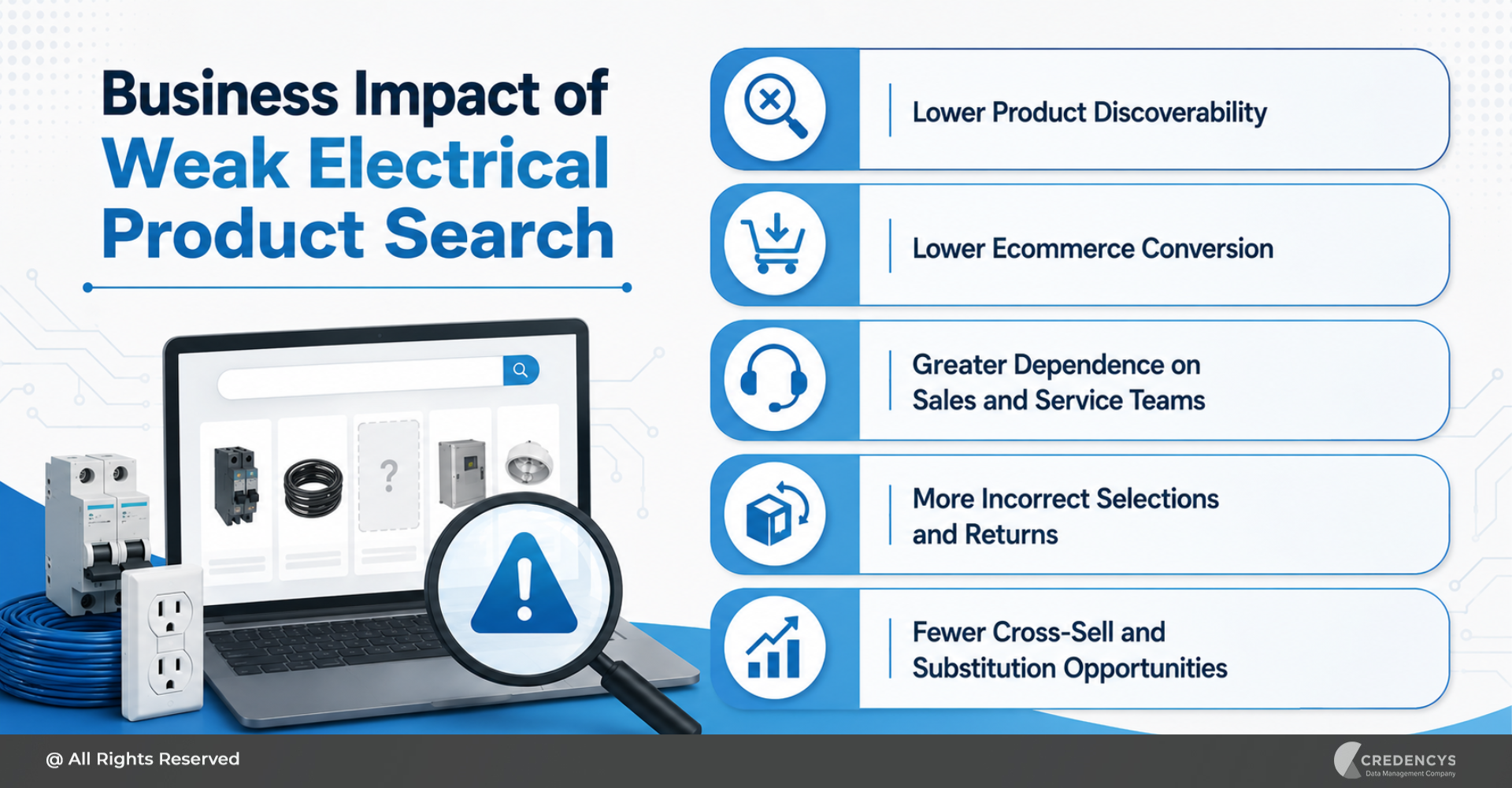
Lower Product Discoverability
Products that cannot be retrieved through relevant queries effectively become invisible inventory. The distributor has invested in stocking or listing the item, but the digital channel does not expose it to the right buyer.
Lower Ecommerce Conversion
Electrical buyers need confidence that a product meets technical and application requirements. When information is incomplete, purchasing becomes risky.
The buyer may delay the order, call for assistance, or move to a competitor with clearer product information.
Greater Dependence on Sales and Service Teams
Sales representatives and customer-service teams often answer questions that a strong digital catalog should resolve:
- Is this product compatible?
- What is the voltage rating?
- Is there an outdoor-rated version?
- Which replacement fits the discontinued item?
- Does this product meet the required certification?
Human support remains valuable, but it should not be required for routine discovery.
More Incorrect Selections and Returns
Incomplete specifications increase the likelihood of unsuitable purchases. Incorrect selections create avoidable returns, reorders, customer dissatisfaction, and operational work.
Fewer Cross-Sell and Substitution Opportunities
Search and recommendation systems need product relationships and technical attributes to suggest compatible accessories, equivalent products, replacement items, or alternative brands. Without dependable data, the system cannot make those suggestions confidently.
NAED’s product-data study reports that missing, inconsistent, and inaccurate information creates friction across manufacturers, distributors, and contractors.
Why Electrical Product Attributes Go Missing
Attribute gaps usually result from fragmented processes.
Manufacturer Data Arrives in Different Formats
Distributors may receive information through spreadsheets, portals, PDFs, APIs, ERP exports, and industry data services. Each manufacturer may use different columns, structures, naming conventions, and completeness levels.
Similar Attributes Use Different Terminology
The same concept may arrive as:
- Amperage
- Amps
- Rated current
- Current rating
- Nominal current
These labels cannot always be combined automatically without category knowledge and mapping rules.
Important Specifications Remain Trapped in Documents
Data sheets, installation guides, certificates, drawings, and product brochures often contain valuable technical information. Search platforms cannot consistently use that information when it is not extracted into structured product fields.
ERP Records Were Not Designed for Digital Discovery
ERP systems often prioritize identifiers, inventory, pricing, transactions, and abbreviated operational descriptions. Those records may be sufficient to process an order but insufficient to support technical ecommerce search.
Completeness Rules Are Too General
A catalog-wide score can hide category-specific gaps. A record may appear complete while missing the field customers use most often to select that product type.
Updates Do Not Reach Every System
Manufacturers regularly update specifications, documents, lifecycle status, and packaging information. When changes are not synchronized across PIM, ERP, ecommerce, search indexes, and sales tools, customers receive inconsistent results.
How Electrical Distributors Can Improve Attribute Completeness
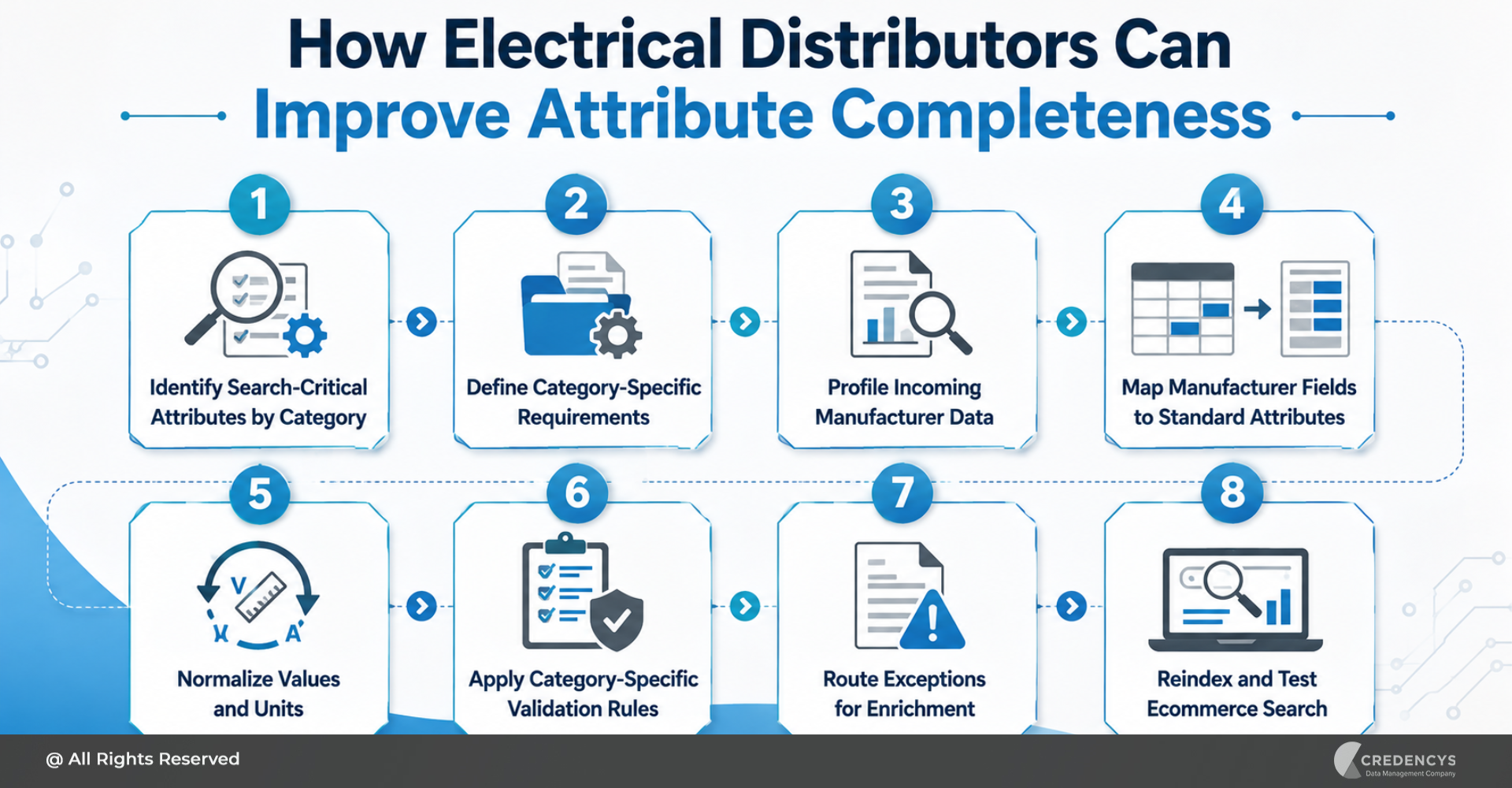
1. Identify Search-Critical Attributes by Category
Start with evidence from customer behavior. Review:
- Internal search queries
- Zero-result searches
- Filter usage
- Search refinements
- Product-comparison behavior
- Customer-service questions
- Sales-team requests
- Returned-product reasons
Use these signals to identify the selection attributes for each category.
2. Define Category-Specific Requirements
Create an attribute model for each major product category. Separate fields into:
- Mandatory search attributes
- Required commercial information
- Compliance or technical information
- Optional enrichment fields
For a breaker, the number of poles may be mandatory; for an enclosure, it may be irrelevant. Universal requirements can miss important differences.
3. Profile Incoming Manufacturer Data
Before transforming supplier files, assess:
- Available attributes
- Missing values
- Duplicate fields
- Format differences
- Unit inconsistencies
- Invalid values
- Category structures
- Technical documents
- Packaging information
This shows where automation, enrichment, or review is required.
4. Map Manufacturer Fields to Standard Attributes
Create reusable mappings such as:
- “Amps” to Rated Current
- “Pole Count” to Number of Poles
- “Ingress Protection” to IP Rating
- “CCT” to Color Temperature
Mappings should be governed by category and meaning, not label similarity alone.
5. Normalize Values and Units
Standardize equivalent representations:
- 120V, 120 V, and 120 volts
- 30A and 30 A
- Three pole, 3-pole, and 3P
Normalization improves filtering and matching, but it should preserve meaningful manufacturer specifications and source values where required.
6. Apply Category-Specific Validation Rules
Flag records when:
- A mandatory attribute is missing
- A value uses an invalid unit
- A controlled value is not recognized
- Two specifications conflict
- The category and attribute set do not align
- Search-critical information exists only in a description
Validation should identify exceptions without automatically approving uncertain technical values.
7. Route Exceptions for Enrichment
Catalog specialists should focus on records that require interpretation. A structured product information management workflow can move records through stages such as received, mapped, validated, enriched, reviewed, approved, and published.
8. Reindex and Test Ecommerce Search
Improving source data is not the end of the process. Test:
- Exact part-number searches
- Partial part-number searches
- Technical specification queries
- Synonyms and abbreviations
- Category filters
- Product comparisons
- Natural-language searches
- Zero-result queries
This verifies that improved attributes reach the search index and influence results.
How PIM Supports Better Ecommerce Search
A product information management system can centralize and govern the information that ecommerce search depends on. PIM can support:
- Multi-source manufacturer-data intake
- Attribute mapping
- Category-specific product models
- Controlled values
- Unit normalization
- Completeness scoring
- Validation rules
- Enrichment workflows
- Product relationships
- Approval processes
- Distribution to ecommerce and other channels
Learn more about the capabilities, use cases, and implementation considerations associated with PIM for electrical distributors. PIM does not replace the ecommerce search engine.
The PIM prepares, standardizes, enriches, and distributes product information. The search platform indexes that information and uses it to retrieve and rank relevant products.
Electrical distributors may also receive syndicated content through IDEA Connector. IDEA describes the platform as supporting enriched fields, specifications, images, related products, packaging, and other product content used by electrical-channel partners.
That syndicated data can reduce source-data gaps, but distributors may still need to align it with their internal taxonomy, attribute requirements, ecommerce experience, and governance processes. ETIM can further support consistent technical classification by defining common product classes, features, values, and units.
It provides a shared structure, while the PIM manages how that information is received, governed, enriched, and published within the distributor’s environment. Distributors that are unsure where their largest catalog gaps exist can begin by assessing product data readiness across completeness, consistency, standardization, governance, and accessibility.
Conclusion
Electrical ecommerce search cannot perform reliably without complete and structured technical product information. Better algorithms can interpret queries, recognize synonyms, and improve ranking.
They cannot safely invent missing voltage ratings, dimensions, certifications, compatibility details, or environmental specifications. Electrical distributors should identify the categories with the greatest search friction, define the attributes buyers need, and improve how manufacturer data is mapped, validated, enriched, and published.
When the underlying product data improves, ecommerce search becomes more precise, digital self-service becomes more dependable, and customers are more likely to find the right product without leaving the website or contacting sales.







Tags: