

Retail PIM: A Practical Guide to Retail Product Data
A retail PIM is the product information management system a retailer uses to manage product data across stores, its website, apps, and marketplaces. This guide explains how retail PIM works, which features matter, and how to roll it out.
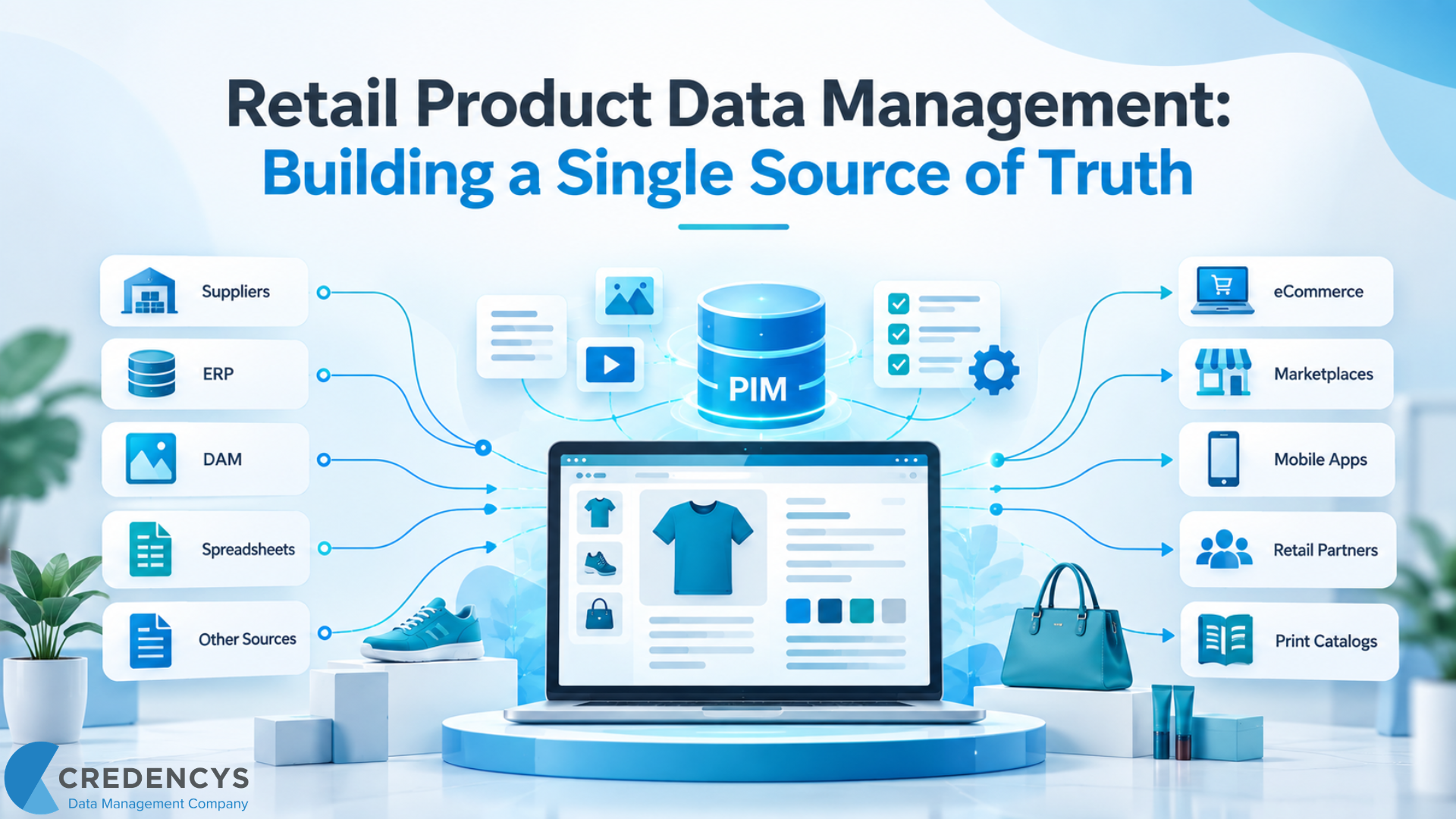
Retail product data rarely lives in one place. Supplier spreadsheets contain specifications. ERP systems hold SKUs and operational data. DAM platforms manage images and videos.
Merchandising teams maintain attributes in spreadsheets. eCommerce platforms contain customer-facing descriptions.
Marketplaces impose their own category and content requirements. As product assortments, suppliers, variants, and channels grow, keeping all of this information accurate and aligned becomes increasingly difficult.
This is where effective retail product data management becomes critical. Retailers need a structured way to collect, standardize, enrich, govern, and distribute product information without repeatedly recreating the same product record for every team and channel.
Product Information Management (PIM) provides that foundation by creating a governed source for enriched product information and connecting it with the systems that power retail operations and commerce. In this article, we explore the product-data challenges retailers face, where PIM fits within the retail technology ecosystem, how it improves product-data operations, and what retailers should consider when selecting a PIM platform.
What is Retail Product Data Management?
Retail product data management is the process of collecting, organizing, enriching, governing, and distributing the information required to describe and sell products across retail channels. Depending on the product category, this information may include:
- Product names and descriptions
- SKUs and identifiers
- Categories and taxonomy
- Product specifications
- Materials and ingredients
- Dimensions and measurements
- Colors and sizes
- Product variants
- Brands
- Digital assets
- Care and usage instructions
- Product relationships
- Marketplace attributes
- Localized product content
- Regulatory or safety information
- Channel-specific content
Managing a small assortment manually may be possible. The challenge grows considerably when a retailer manages thousands or millions of SKUs across multiple suppliers, brands, categories, variants, markets, languages, and commerce channels.
That is when spreadsheets and disconnected applications become hard to control.
Why Retail Product Data Becomes Difficult to Manage
Retail product data complexity rarely comes from a single system or process. It grows gradually as the business expands.
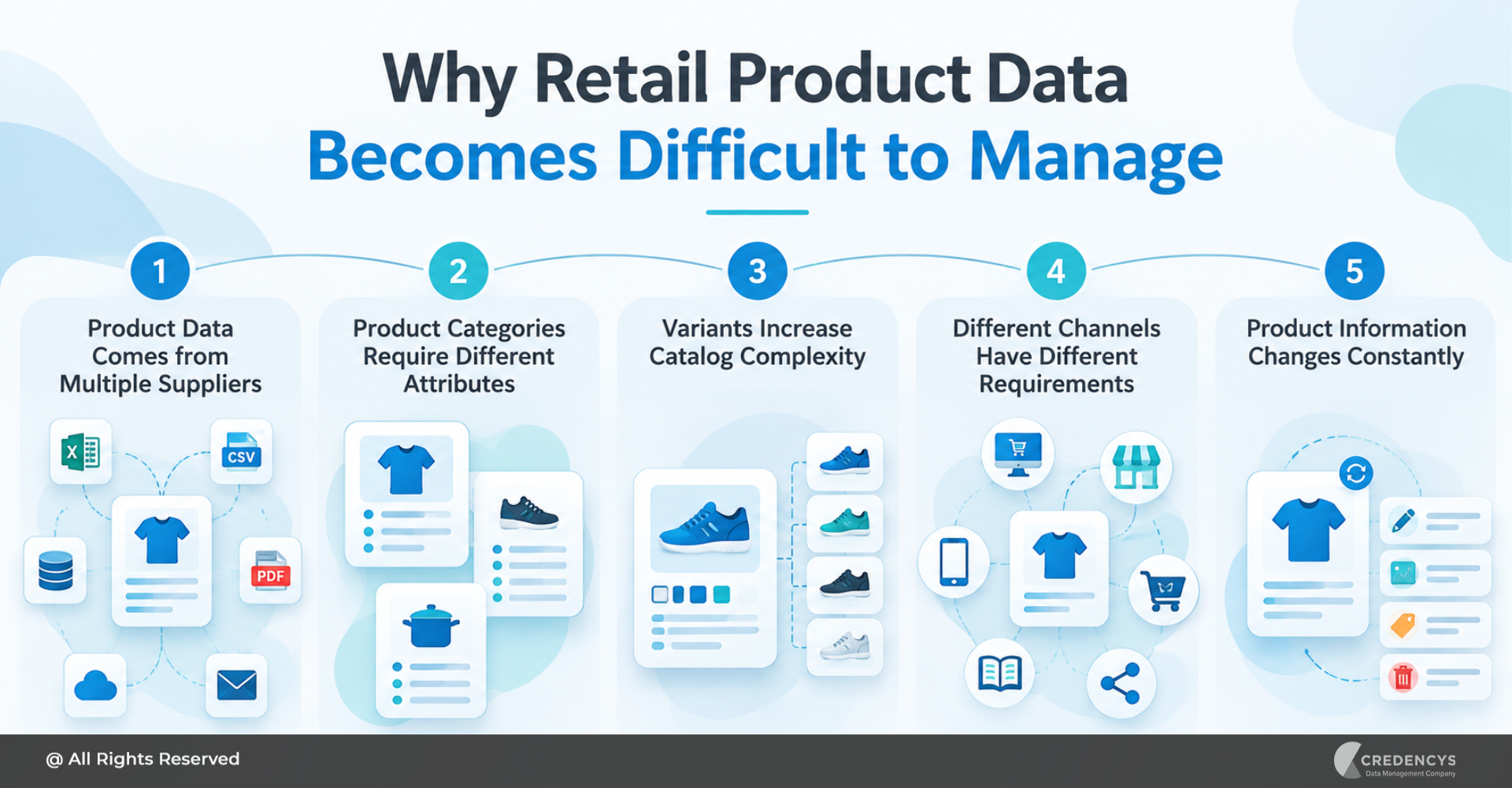
1. Product Data Comes from Multiple Suppliers
Retailers rarely create every product record themselves. Information may arrive from hundreds or thousands of suppliers through:
- Excel files
- CSV files
- PDFs
- Supplier portals
- APIs
- ERP systems
- Databases
- XML or JSON feeds
- Email attachments
Each supplier may describe similar products differently. One supplier may use “Navy Blue,” another “Navy,” and another “Dark Blue.”
Dimensions may arrive in different units. Category names may vary.
Required attributes may be missing altogether. Without standardization, this inconsistent supplier information eventually reaches customer-facing channels.
2. Product Categories Require Different Attributes
Retail products cannot all be described using the same data model. A pair of shoes may require:
- Size
- Color
- Material
- Gender
- Fit
An appliance may require:
- Dimensions
- Power rating
- Capacity
- Energy information
- Warranty
A grocery product may require:
- Ingredients
- Nutrition
- Allergens
- Pack size
- Dietary claims
Effective retail product data management therefore requires category-specific attributes and validation rules, not a single generic product template.
3. Variants Increase Catalog Complexity
Retail catalogs frequently contain parent products with dozens of variants. These may vary by:
- Size
- Color
- Material
- Style
- Pack quantity
- Capacity
- Finish
- Configuration
- Region
Each variant may also need its own SKU, image, identifier, availability information, and channel content. Without structured parent-child relationships, retailers can end up maintaining duplicate product records and inconsistent information.
4. Different Channels Have Different Requirements
A retailer’s own eCommerce site may require one set of attributes. Amazon, Walmart Marketplace, Google Merchant Center, a mobile application, a printed catalog, and a retail partner may require different:
- Categories
- Attributes
- Titles
- Descriptions
- Images
- Identifiers
- Character lengths
- Product relationships
Manually formatting the same product for every destination creates unnecessary operational effort.
5. Product Information Changes Constantly
Retail catalogs are continuously changing. New products are introduced.
Collections change. Suppliers update packaging.
Products are discontinued. Images are replaced.
Descriptions are localized. Marketplace requirements evolve.
Without centralized governance, different channels can quickly show different versions of the same product.
Where PIM Fits in the Retail Technology Ecosystem
PIM works best when its role is clearly defined. It shouldn’t try to replace every other retail platform.
Instead, PIM acts as the governed layer for enriched product information. For retailers with large assortments, supplier data, product variants, and multiple commerce channels, a well-structured PIM for Retail strategy creates the product-data foundation these operations need.
1. PIM
PIM typically manages:
- Product attributes
- Product descriptions
- Categories and taxonomy
- Product variants
- Product relationships
- Enriched specifications
- Channel-specific product content
- Localization
- Data completeness
- Product-data workflows
- Associated digital assets
2. ERP
ERP generally remains authoritative for transactional or operational information such as:
- Purchasing
- Financial information
- Supplier transactions
- Base pricing
- Inventory records
- Orders
3. DAM
A Digital Asset Management platform typically manages authoritative media assets such as:
- Product photography
- Lifestyle images
- Videos
- PDFs
- Marketing collateral
- Brand assets
PIM associates these assets with the correct products and variants.
4. eCommerce Platform
The commerce platform manages the storefront and transaction experience, including areas such as:
- Product-detail-page presentation
- Cart
- Checkout
- Promotions
- Customer accounts
- Transactions
PIM provides the enriched product information the storefront needs.
5. OMS and WMS
Order Management and Warehouse Management systems typically manage areas such as:
- Inventory availability
- Order routing
- Fulfillment
- Warehouse operations
Clearly defining these responsibilities prevents the PIM implementation from becoming unnecessarily complex.
How PIM Improves Retail Product Data Management
A PIM system creates a structured workflow between incoming product information and downstream commerce channels.
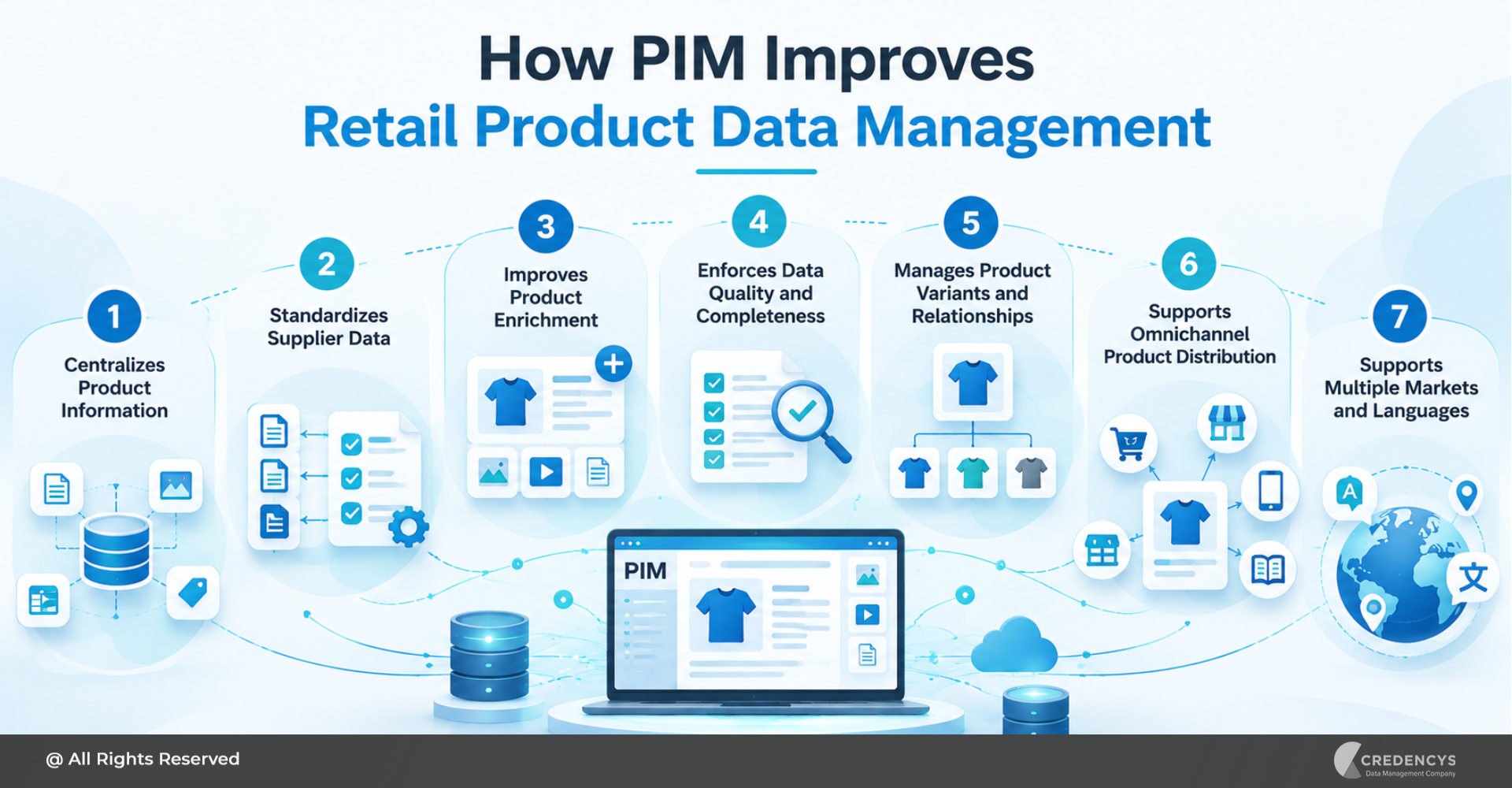
1. Centralizes Product Information
PIM brings product information from suppliers, ERP, spreadsheets, databases, and other sources into a governed environment. Instead of product teams maintaining separate versions of the same information, they can work from a single source of truth.
The result is better visibility into:
- What information exists
- Where it came from
- What is missing
- Who changed it
- Whether it has been approved
- Which channels are ready to receive it
2. Standardizes Supplier Data
Supplier terminology rarely matches a retailer’s internal product-data model perfectly. PIM can map supplier fields and values into standardized retail attributes.
For example:
Supplier values:
- Navy
- Dark blue
- Navy blue
can be mapped to an approved controlled value:
Navy
You can still retain the original supplier value when needed.
This normalization improves catalog consistency and downstream search and filtering.
3. Improves Product Enrichment
A basic supplier record may contain only:
- SKU
- Product name
- Manufacturer
- Basic specification
But an effective digital product experience may require considerably more. Retail teams can enrich products with:
- Customer-friendly descriptions
- Additional specifications
- Search attributes
- Digital assets
- Usage information
- Product relationships
- Marketing content
- Localized information
PIM provides a structured environment for that enrichment.
4. Enforces Data Quality and Completeness
Not every product should be published simply because a SKU exists. PIM can define rules such as:
- Product title required
- Primary image required
- Brand required
- Product category required
- Material required for selected categories
- GTIN required for selected channels
Completeness dashboards can then show which products are ready for publication and which still need attention. This shifts product-data quality from reactive cleanup toward proactive governance.
5. Manages Product Variants and Relationships
PIM allows retailers to create relationships between:
- Parent products and variants
- Products and accessories
- Bundles and components
- Products and replacements
- Products and complementary products
- Collections and individual products
These relationships improve both internal product management and customer-facing merchandising.
6. Supports Omnichannel Product Distribution
Once product information has been enriched and approved, it can be transformed for different destinations. A common product record may feed:
- Retail eCommerce
- Marketplaces
- Mobile applications
- Retail partners
- Social commerce
- B2B portals
- Digital catalogs
- Store applications
You can still maintain channel-specific extensions where needed without creating an entirely separate master record.
7. Supports Multiple Markets and Languages
International retailers often need common global product information alongside market-specific differences. PIM can help manage:
- Translations
- Local descriptions
- Units of measure
- Regional attributes
- Market-specific imagery
- Localized taxonomy
- Channel requirements
This allows retailers to reuse core product information instead of rebuilding catalogs market by market.
Business Impact of Better Retail Product Data Management
Better product-data management affects more than the data team.
1. Faster Product Onboarding
Standardized intake and validation reduce the manual effort of converting supplier information into channel-ready product records.
2. Faster Time-to-Market
Structured enrichment and approval workflows allow teams to identify bottlenecks before they delay product launches.
3. Better Product Discovery
Well-structured categories and attributes improve the information available to:
- Search
- Filters
- Faceted navigation
- Product comparison
- Recommendation systems
Customers can find products using the characteristics that actually matter to them.
4. More Consistent Customer Experiences
A governed product-data foundation helps reduce situations where a marketplace, website, catalog, and mobile application display conflicting product information.
5. Lower Manual Catalog Effort
Product teams spend less time repeatedly copying, formatting, validating, and correcting the same information across channels.
6. Easier Catalog Growth
As retailers add products, suppliers, brands, markets, and channels, standardized models and workflows make scaling easier than maintaining isolated spreadsheets and channel-specific databases.
What Should Retailers Look for in a PIM Platform?
Once retailers decide that product-data complexity requires a dedicated PIM, the next challenge is choosing the right platform. Base the decision on the retailer’s actual catalog, operating model, and technology ecosystem, not just feature lists.
Retailers should evaluate platforms against their catalog complexity, supplier ecosystem, data-governance requirements, integrations, and channel strategy. A purpose-built retail PIM solution should support these requirements without becoming another disconnected data silo.
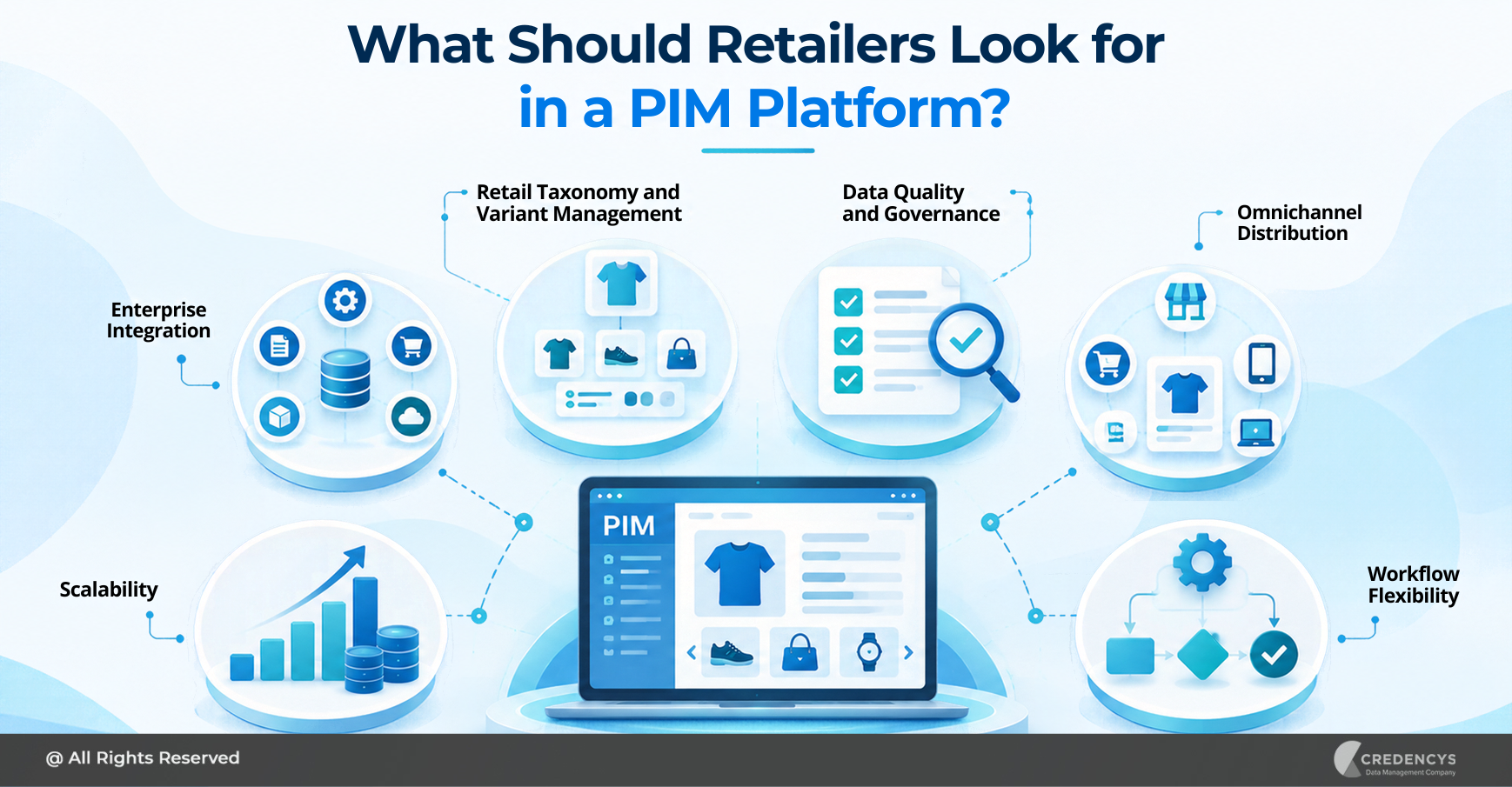
1. Enterprise Integration
A retail PIM should integrate effectively with the systems surrounding product information. Depending on the organization, this may include:
- ERP
- DAM
- eCommerce
- Supplier systems
- MDM
- Marketplaces
- CMS
- Search platforms
- Data warehouses
- APIs and middleware
The objective is not to copy every data element into PIM. It is to establish a clear flow between authoritative systems.
2. Retail Taxonomy and Variant Management
The platform should be capable of supporting:
- Multiple product categories
- Category-specific attributes
- Hierarchical taxonomy
- Parent-child relationships
- Variants
- Product families
- Bundles
- Accessories
- Related products
This becomes particularly important for retailers with large or diverse assortments.
3. Data Quality and Governance
Look for capabilities that support:
- Required attributes
- Controlled values
- Validation
- Completeness
- Data ownership
- Review workflows
- Approvals
- Auditability
- Role-based permissions
Strong governance is what turns a product repository into a trusted product-information foundation.
4. Omnichannel Distribution
The platform should support the retailer’s actual distribution model. Consider whether product information must reach:
- eCommerce platforms
- Marketplaces
- Retail partners
- Mobile apps
- B2B portals
- Social commerce
- Catalog-production systems
The key question is how easily governed product information can be transformed to meet the requirements of different destinations.
5. Scalability
Retailers should consider not only today’s catalog but also anticipated growth. Evaluate:
- Number of SKUs
- Number of variants
- Number of suppliers
- Number of users
- Number of markets
- Number of languages
- Number of channels
- Volume of digital assets
- Frequency of product updates
A PIM that works for 20,000 products may not necessarily suit an organization planning for several million SKUs.
6. Workflow Flexibility
Product onboarding rarely involves one person. Supplier teams, product managers, merchandisers, marketing teams, translators, compliance teams, and eCommerce teams may all participate.
The platform should support workflows that reflect how the organization actually operates.
Questions to Ask Before Selecting a Retail PIM
Before evaluating individual PIM vendors, retailers should answer several internal questions.
1. Who Will Use the PIM?
Identify which teams will:
- Import data
- Enrich products
- Approve content
- Manage taxonomy
- Manage assets
- Translate content
- Publish product information
- Monitor data quality
This helps define workflows, permissions, and licensing requirements.
2. Where Does Product Information Currently Live?
Map the existing ecosystem. Product information may be distributed across:
- ERP
- Supplier portals
- Spreadsheets
- DAM
- PLM
- eCommerce
- Marketplace systems
- Internal databases
This exercise helps determine integration and migration requirements.
3. Which System Should Own Which Data?
Define authoritative systems before designing integrations. For example:
- PIM: enriched product information
- ERP: transactional information
- DAM: authoritative media
- OMS/WMS: inventory and fulfillment
- Commerce: transactions and customer-facing experience
Without this clarity, implementations often create unnecessary duplication.
4. How Complex Is the Catalog?
Consider:
- Product categories
- Attribute counts
- Variants
- Relationships
- Bundles
- Supplier differences
- Digital assets
- Languages
Catalog complexity often matters more than raw SKU count.
5. What Product Data Is Required for Each Channel?
Different marketplaces and commerce channels may have different completeness requirements. Documenting these requirements early helps determine:
- Data models
- Validation rules
- Channel mappings
- Enrichment workflows
6. How Much Data Must Be Migrated?
Existing product data rarely moves cleanly into a new PIM. Migration may require:
- Cleansing
- Deduplication
- Taxonomy mapping
- Attribute mapping
- Unit standardization
- Relationship reconstruction
- Asset matching
- Validation
Consider migration effort during platform selection, not after implementation begins.
7. What Does Success Look Like?
Define measurable outcomes. Examples might include:
- Faster supplier onboarding
- Higher product completeness
- Reduced manual catalog effort
- Faster launches
- Fewer downstream data errors
- Better product-data governance
These measures help teams evaluate whether the PIM implementation is creating business value.
How AI Can Support Retail Product Data Management
AI can speed up selected product-data processes, but it works best when built on governed product information. Potential applications include:
- Attribute extraction
- Product classification
- Supplier-data mapping
- Description enrichment
- Translation assistance
- Duplicate detection
- Product matching
- Anomaly detection
- Semantic search
For example, an AI model may suggest a category or extract attributes from supplier content. The PIM workflow can then route those suggestions through appropriate validation and approval rules.
The important distinction is that AI can accelerate product-data work; governance determines whether the resulting information is trusted enough to publish.
PIM Does Not Replace Every Retail System
One of the most important decisions in a retail PIM initiative is knowing what not to put into PIM. PIM should not normally become the master system for:
- Real-time inventory
- Order management
- Checkout
- Warehouse operations
- Financial transactions
- Dynamic pricing
Those functions typically remain within ERP, OMS, WMS, pricing, or commerce systems. PIM adds value by ensuring those systems and customer-facing channels can reference complete, consistent, and governed product information.
Must-Have Retail PIM Features
- Supplier onboarding: templates, portals, and validation for supplier data.
- Flexible data model: categories, attributes and variants for every department.
- Completeness rules per channel, so nothing goes live half-finished.
- Workflows and approvals for buyers, merchandisers and content teams.
- Digital asset management for images, videos and documents.
- Localization for languages, markets and units.
- Syndication to stores, web, apps and marketplaces.
- Integrations with ERP, POS and eCommerce.
How to Roll Out a Retail PIM
- Start with one department where data problems cost the most.
- Design the data model and taxonomy with buyers and merchandisers.
- Onboard suppliers with templates and validation.
- Connect the ERP and your channels.
- Roll out department by department, measuring completeness and time to publish.
A focused first release typically takes 3 to 6 months; larger programs run in phases over 6 to 12 months or more. For a cost estimate, use the PIM cost calculator.
Retail PIM Results
SM Retail, the Philippines’ leading omnichannel retail group, made pricing updates 59% faster with a central PIM. A US party goods retailer improved product data quality by 60% and cut manual effort by 40%.
Key Takeaways
Retail product-data complexity grows as assortments, suppliers, variants, markets, and channels expand. A sustainable approach requires more than storing products in another database.
Retailers need to:
- Centralize product information from fragmented sources
- Standardize supplier data
- Establish category-specific attributes
- Manage variants and relationships
- Improve completeness and validation
- Govern enrichment and approvals
- Distribute approved product information across channels
- Clearly define the role of PIM alongside ERP, DAM, commerce, OMS, and other systems
PIM provides the product-information foundation for achieving this. But successful implementation depends on more than selecting software.
Retailers need the right data model, governance structure, integration architecture, migration strategy, and operating workflows. If your organization is evaluating PIM to manage growing supplier catalogs, complex variants, and omnichannel product information, explore how Product Information Management for Retail can be designed around your product-data ecosystem and commerce requirements.
Retail PIM: FAQ
What is a retail PIM?
A product information management system that retailers use to manage product data from suppliers through to stores, web, apps and marketplaces.
How is a retail PIM different from an ERP?
The ERP manages buying, stock, and prices. The retail PIM manages the product content customers see. Most retailers need both, connected.
Can a retail PIM onboard supplier data?
Yes. Supplier templates, portals and validation are core retail PIM features.
How long does a retail PIM rollout take?
A focused first release typically takes 3 to 6 months; larger programs run in phases over 6 to 12 months or more.
Related: PIM for retail, PIM for fashion, PIM for grocery, PIM for eCommerce.






Tags: