6 Insurance App Ideas to Enhance Operational Productivity and Streamline Processes

The insurance industry has been struggling to leverage technology for its benefit. The old paper-based processes are stoping the industry from growing at a faster rate.

The Insurance industry is already aware of the benefits that mobile apps will bring to their business. However, it is quite complex to put insurance app ideas into execution.

According to Research and Markets, The global smartphone insurance market was valued at $22.6 billion. It is predicted to grow at a CAGR of 9% during 2019-2024 and reach $38.1 billion by 2024.

Many insurance agencies are partnering with mobile app development services providers to convert their insurance app idea into reality. Mobile apps will help insurance companies to remain transparent and provide a user-friendly experience.

Insurance mobile apps can help you to eliminate the traditional customer care representative system with 24/7 assistance using a chatbot. It will not only help you reduce the cost of running a call center but also save your customers time.

Companies like China life insurance, AXA, Allianz AE, Zurich Insurance Group, etc. are one of the first insurance companies to implement insurance mobile apps.

Insurance App Ideas

In this article, we have covered the top six insurance app ideas that’ll help you deliver a fantastic customer experience and streamline your business operations.

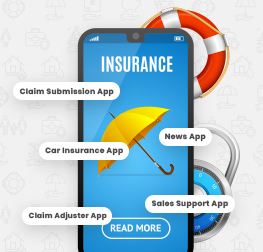
Idea 1 – Claim Adjuster App

The job of a claim adjuster is mostly a field job. They have to investigate claims and by consulting the police, interviewing the claimant, examine the damage occurred, and check hospital records to identify the company’s liability to pay the claim.

However, with the claim adjuster application, you will be able to increase the productivity of your claim adjusters. Moreover, they will also be able to provide you the documents and details about a claim faster.

To fulfill all the tasks mentioned above, you need to incorporate below-mentioned features:

  • Documents Library: The app must be capable of holding all the necessary documents and data. It should also allow them to access the uploaded documents on-the-go.
  • Up-to-date Information on Claims: Claim adjusters should be updated with all the latest and old claims data. They must have a feature to update adjusters with push notifications.
  • Photo Upload: Claim adjusters should be able to upload the pictures of damages directly to the cloud using their mobile phones.
  • Customer Communication: There should be a built-in chat feature for claim adjusters to communicate directly with their clients on-the-go.
  • Signature Capture: Claim adjusters should be able to take signatures of their customers using their smartphones or tablets. It will reduce a massive amount of paper-work, documentation, and scanning.

Customer Apps

Customers are at the center of every business. Insurance apps can genuinely elevate the customer experience. Now, customers will have all the information related to the insurance companies, their policies, etc. on their fingertips.

Mainly, there are two types of customer mobile apps for insurance. Read further to get a better understanding of each of them in detail.

Idea 2 – Claim Submission App

Claim submission has always been a significant issue among customers. This app will help customers to submit their claims quicker and deliver excellent customer experience.

With the help of the claim submission app, customers can now submit the claims flawlessly while providing every possible information using their smartphone.

It also reduced the efforts of claim adjusters as they now don’t have to spend as much time visiting the incident site in-person as earlier. It saves their time and other expenses, as well.

Finally, the app will help customers to know the progress status of their claims directly.

Idea 3 – Car Insurance App

Since today everyone is taking vehicle insurance, and especially for cars, developing a car insurance app can grab customers’ attention.

To give you a few use cases, drivers can use their smartphone camera to take pictures of the scene, take insurance details of other drivers to submit all the information to the insurance company.

Besides this, you can also include features that help customers to monitor their cars. Give them tips to drive better and reduce the chances of accidents and other risks associated with the car.

Moreover, using sensors, you can also create an IoT app that allows them to monitor the amount of petrol left and other parameters such as breaks, accelerators, and more.

Broker Apps

Idea 4 – News App

The job of a broker demands him/her to stay updated with the latest information on the environment, economics, and other aspects to give the best possible advice to his/her customers.

You can ask your analyst team from the office to send the latest information to the brokers on their smartphones. Sometimes, brokers get so busy that they are unable to read all the information and news sent to them.

Therefore, if you create a news app for your insurance company, it will help brokers only to receive the news and information, which is necessary.

You can use a broker’s calendar to identify when to send then the right information about their customers, such that it helps both the broker and the customer.

Idea 5 – Sales Support App

Since brokers mostly work on the field, they face many challenges related to capturing and accessing information.

A sales support app will help brokers to access all the marketing and sales-related documents and materials to capture and track leads and increase cross-selling.

The app must include the following features:

  • Lead Tracking: The app must have a section, which provides all the information about customers so that the brokers know everything about a customer before setting up a meeting.
  • Lead Capture: This feature will help brokers to save the successful conversions in the database that happened after every meeting. It will help them to save time transferring the information related to each lead.
  • Material Access: The app will help brokers to access every material related to sales and marketing from anywhere at any time.

Idea 6 – Training Application

Today almost any company or businesses are adopting mobility solutions that allow their employees with broker training.

A mobile app can help to-be brokers to acquire knowledge in a personalized way. It will help your employees to get acquainted with all the practices and guidelines that they must abide by to deliver amazing customer experience.

Employee training app can be extremely convenient as it can help employees to learn by audio and video lectures. Moreover, employees can recall any lecture whenever they want.

You can also include gamification features in the app to further engage the employees. For example, you can include quiz-based learning. Give points on the completion of each lesson/quiz/training session.

Moreover, you can create leaderboards to promote healthy competition among employees and motivate them to work more effectively.

Concluding Thoughts

Implementing these six insurance app ideas can help you deliver excellent customer experience, manage various workflows, and streamline business processes.

We understand the insurance sector and the critical requirements of an insurance company. We also know features that can help your company to achieve new frontiers.

If you hire mobile app developers from Credencys, we will help you from mobile app consulting to post-deployment support. Send us your requirements, and we’ll get back to you within 24 hours.

Insurance App Ideas – FAQs

1) How much does it cost to develop a health insurance app?

To develop a health insurance app for iOS and Android platforms take approximately $30,000 to $50,000. It will mostly depend on the amount and types of features you define.

2) How to develop an insurance app?

Below are the steps to develop an insurance app:

  • Identify the problem in the insurance industry
  • Perform market research
  • Think of customer problems before listing down features
  • Create a development team
  • Develop and test every feature, one at a time
  • Make relevant changes based on test results
  • Deploy the final product

3) How to make a policy holder’s life easier through insurance apps?

You can make a policy holder’s life easier by including app features that allow them to:

  • track insurance claims
  • create an insurance card (digital)
  • manage insurance policies
  • create a home insurance inventory

4) What are the must-have features of an insurance app?

  • Don’t create an app for the sake of creating it; bring value to your clients.
  • Create an app with simple navigation and an intuitive user interface.
  • App design should be responsive and should integrate well with every mobile device.
  • Deliver personalized user experience based on demographics, user location, or user behavior.
  • Do not overload your app with features; keep only the most important ones.


Why iPhone App Developers Prefer Swift for iPhone App Development?

Apple has introduced the first version of Swift during the Worldwide Developers Conference (WWDC) 2014. The objective behind the launch of this programming language was to make iOS app development faster and easier for programmers. Since then, the iPhone app developers prefer Swift to develop and deliver robust apps within the timeline and in a highly cost-effective way using the latest versions of the programming language.

Swift is a more sophisticated, safe, and modern technology compared to Objective C. Objective C is a comparatively older and highly used C language by iPhone app developers for a pretty long time. Swift provides high-level interactivity to build iPhone apps.

Here are seven reasons that prove Swift is really an advanced and simple programming language that allows programmers to build highly dynamic iPhone apps quickly.

Top 7 Reasons Why iPhone App Developers Prefer Swift

1. Advanced Programming Language

To meet the needs of modern iPhone apps, Apple has come up with Swift. It is an open-source programming language that improves the performance of applications with its advanced debugger, compilers, and framework infrastructure. The technology allows iPhone app developers to write code faster using simple syntax.

Apple has simplified memory management through Automatic Reference Counting (ARC). Programmers can use Cocoa and Foundation as a solid base of the app development framework.

Swift can be easily intermixed with Objective C by supporting the collection, modules, blocks, and literals of old technology. It reduces the friction between both the programming languages and allows iPhone app developers to switch on the go and gradually rather than replacing the entire code base.

2. Easy to Learn

While using Objective C and C languages, the beginners have to develop the app and run it in a specific programming environment. iPhone app developers need to import a separate library to develop functionality like string handling, input/output, etc. for a simple test of code each time.

Apple has reduced this process with the Playground feature that allows developers to experiment code in Xcode directly. They can see the results instantly without performing any extra activity.

3. Easy to Adopt

Swift holds a greater level of interoperability with Objective C so that the iPhone app developers can start creating applications using the Swift code, features, and functionality. Swift code can easily work with objective C files in the same project. Also, it allows developers to have complete access to the Objective C API.

It is a compact and light programming language that provides better readability and simplicity with less coding. Additionally, the technology is error-prone and prevents programmers from making mistakes. It removes the classes of unsafe code.

4. Simple to Code

Swift has a very simple coding and syntax pattern. The programming language doesn’t contain semicolon and other symbols at the end of each scripting. Thus, developers can run the code swiftly.
Moreover, Apple has developed advanced compilers for Swift. It makes iPhone app development easy to code and more object-oriented in nature by allowing to complete the complex tasks at a time using simple code.

5. Easier Maintenance

Objective C has not been evolving with the changing demand as it cannot evolve without the evolution of the C programming language. iPhone app developers need to maintain the two while they are planning to build an app using Objective C.

With Swift, programmers can use Xcode and LLVM compilers that perform the incremental build automatically by identifying dependencies within the code. The programming language combines the table of content (the header file) along with the body (implementation file). Thus, there is no requirements for creating two separate files.

As a result, programmers need to spend less time for bookkeeping as Swift eliminates boilerplate code and invest more time in creating the app logic.

6. Supports Dynamic Libraries

Dynamic libraries are the chunks of code that can be linked to iPhone apps. Actually, dynamic libraries are external elements but included in the app and available to the users when they download the app from the Apple Store.

Earlier, the iOS platform was not supporting the dynamic libraries even though they were available for Mac. Swift allows programmers to add dynamic libraries in iPhone apps and link the app against the latest version of the programming language. Using and linking the external code, Swift reduce the size of the apps.

7. Cost Viability

To build iPhone apps, programmers have to select from Objective C or Swift. They charge around 100,000 USD for Objective C based iPhone app development. On the other hand, for Swift based iPhone app development, developers charge around 95000 UDS. For large scale organizations, 5000 USD is not a large difference but for startups, it is a very crucial amount. Thus, compared to C based programming languages, Swift is an affordable technology.

Conclusion

Definitely, Swift is a promising technology for iPhone app development and has been evolving continuously to address the dynamic requirements of the iOS platform. Apple keeps updating the essential features of the technology such as expressive and cleaner syntax, easy of readability and writing, shorter development lifecycle, compatibility with different iOS devices, and more to build next-generation apps for startups and large scale organizations.

Credencys iPhone App Developers Prefer Swift to Build iPhone Apps

Credencys holds more than a decade long experience in developing iPhone apps for startups to large scale enterprises. Having exposure to working with Fortune 500 companies, we have an in-depth understanding of what the organizations are looking for while hiring iOS app developers.

Our iPhone app developers keep an eye on the latest tools and technologies launched by Apple and use them to build futuristic iPhone apps for the organizations. We keep updating our technical knowledge to meet the dynamic demands of the tech world.

Moreover, we have proven expertise to enable the clients with the competitive iPhone solution that helps them in not just generating better ROI but also delivering extremely fantastic customer value. Are you planning to migrate your legacy iPhone app on Swift or build a new application using the advanced programming language? Let’s connect to build amazing business solutions.

Frequently Asked Questions

Do iPhone apps have to be written in Swift?

To create the graphical interface of the iPhone apps, you can use Xcode. While developing features and functionality of iPhone apps you need to write the code using Swift. The programming language is only available on Mac OS so make sure you have a running OS X.

What apps are coded in Swift?

Almost all the big brands have developed and upgraded their iPhones apps using the Swift programming language such as Lyft, LinkedIn, VSCO cam, and more. Even the brands prefer the latest version of Swift to build the latest version of their app.

Is Swift the future?

Swift introduced by Apple as a programming language in WWDC 2014. Since that time, Swift is considered as a sophisticated, modern and secure programming language that allows iPhone app developers to build highly interactive iPhone apps.

Is Swift a good language?

Swift is the highly preferred programming languaged by iPhone app developers. It provides the faster performance along with improved readability and preventing errors. Swift allows developers to build the apps 2.6× faster than Objective-C.


Why you Must Hire Android App Development Company (and Not a Freelancer): 8 Good Reasons

Mobile apps are the most effective ways to reach out to your target audience in this digital economy. There are over 2 billion Android users in the world.

With over 3.3 million Android apps in the Play Store, it takes around 77% of the total mobile app market share. It is often seen that businesses who ignore building apps lose a majority of their customers to their competitors.

The market share of Android apps is growing, and so are the business opportunities for an Android app development company. Today, there is a cut-throat competition between Android apps that are similar.

There is a pressure on the heads of businesses to create the best app in their business domain. To build the best app, a business must find the right Android app development services provider.

8 Reasons to Hire Android App Development Company

1. Necessary Skillset

If you hire Android app development company, you’ll get a team of developers having a precise skillset to build Android apps.

The team that you’ll hire will have the appropriate knowledge and experience to carry out the Android app development project.

If you hire Android app developer from a development firm, you’ll receive full-stack app development services. It includes designers, developers, and testers.

2. Dedicated Effort

Unlike freelancers, mobile app development companies provide you dedicated resources, who work only on your project. It increases the chances of project success.

You’ll also be able to finish the project on-time or in some cases before time. A mobile app development services provider plans the entire development into small cycles or milestones.

3. Flexible Engagement

Creating a dedicated in-house team will probably increase your budget developing an Android app. On the contrary, if you hire Android app development company, you can get free service for a certain period.

Development firms also offer multiple hiring models. It means that you can decide how much engagement do you want from developers in your project.

You might have to pay more to your in-house team if it takes more time to finish the project. Since mobile app development companies take care of the cost, you’ll get cost-optimized app development.

4. Well-managed Project Development

Android app development is a tedious task and requires a lot of effort to manage costs, resources, and more. App development companies offer you a project manager whose job is to keep track of project progress.

Project managers manage resources, project timeline, project anomalies, testing, and deployment. He/she also does daily meetings with the team to ensure everything is in place.

5. Higher Commitment Levels

You’ll receive better commitments on the project deadlines if you hire Android app development company. On the other hand, if you hire freelancers, the chances of project incompletion are higher.

Since Android app development companies have a sufficient pool of resources, your project will not get delayed due to a lack of resource. Whereas, for some reason, if a freelancer is not able to finish the task on time, there is no other way you can meet deadlines.

If you hire Android app development company, you’ll be able to reduce the risk associated with the project. Moreover, a company can provide you ample support and maintenance to the application whenever necessary.

6. Access to Cutting-Edge Technology

The mobile app ecosystem is changing every day. The features or trends that we see is today might not stand valid tomorrow. Development companies are capable of adapting to new technologies quickly.

Freelancers, on the other hand, might not be aware of the latest advancements. Even if they are aware, they might not have enough time or resources to catch up.

Development companies can fill the technology gap by hiring new talents, whereas freelancers can not hire other freelancers to fulfill the technology gap.

Android app development companies can provide you with the latest tech and build your applications that last for years. Moreover, development companies have ways to reduce the overall cost of the app development using the latest in tech.

7. Value-added Services

A development company has access to a large pool of talent 24/7. Hence, they can pick anyone to build an app in a way that adds value to it.

Whether we talk about adding more aesthetics, intuitive designs, or future enhancements, the development company has got you covered.

While with freelancers, you might get limited support for your applications. Hence, limited opportunities for releasing an update or upgrade.

8. Non-Disclosure Agreement

Your idea is precious. And development companies know that which is why they have a well-structured non-disclosure agreement in place that helps you to protect your app idea.

If you share your app idea with a freelancer, you might put it into high risk. Freelancers don’t have a well-structured NDA in place similar to app development companies.

Conclusion

It is crystal clear that your only way towards successful app development is to hire Android app development company.

If you are a business owner who is on his way to grow the business, you’re recommended not to go with a freelancer because of the above reasons.

You’re badly mistaken if you think that hiring freelancers will save you money. Freelancers will cost you more in the long-term compared to an Android app development company.

Hire Android App Development Company – General FAQs:

1) When should I hire a freelancer rather than a company?

You must hire a freelancer only when you have an application ready and live, and you want to make a few necessary changes in the application. However, if you ever want to build an application from scratch, you must always hire Android app development company.

2) How do I hire Android app development company?

You can search for an app development company in multiple ways. First, you can search for one in popular business catalogs like Clutch, ThinkMobiles, G2Crowd, and more. Second, you can also perform an organic search on search engines like Google or Bing.

3) What are the criteria to hire an Android application development company?

Before hiring a development company, you must check what methodology do they follow to carry out projects. Then you can check the stability of the teams and knowledge of the team members.

4) Which is the best Android app development company in USA?

Headquartered in Los Angeles, California, Credencys Solutions Inc. is one of the leading Android app development companies out there. They have demonstrative experience in developing Android applications since 2008.


Top iPhone App Development Trends to Keep an Eye Out

Apple is known for tech innovations and evolutions since its establishment. The brand releases tech inventions for its different platforms during the World Wide Developers Conference (WWDC) every year. All new updates and features affect the existing iPhone app development practices as they have to be revolved in order to meet the latest trends.

Recently, Apple has released iOS 13. It is going to change earlier iPhone app development trends. To address the changing demands of the tech world, iPhone app developers also have all set to adopt new standards and implement them in the development process.

Excited to explore the top trends that are going to make remarkable changes in the iPhone app development? Let’s deep dive into right away.

Top 7 iPhone App Development Trends

#1. Swift 5.0

Swift is a widely used programing language by iOS app developers due to some of its advanced attributes such as effortlessness, scalability, security, and flexibility. Swift 5, the latest version of the technology, introduced during the WWDC summit in April 2019.

It is expected that the new version will come with more stable technology for the Application Binary Interface (ABI). It enables iPhone app developers with a better-embedded mechanism for Swift libraries on a runtime basis. Swift 5.0 will help developers to build powerful apps with seamless performance. Thus, while hiring iPhone app developers, make sure they have worked with all the different versions of Swift.

#2. Machine Learning (ML)

iOS 13 has introduced the Core ML 2. It is going to be used for the development of future-ready hardware products. It is expected the technology will empower iPhone app developers to build responsive, interactive, high-performing, and feature-rich apps for iOS platforms by integrating groundbreaking features of machine learning.

Additionally, the company is planning to introduce Apple Neural Engine to make ML and AI integrations easier and quicker. Let’s get ready to leverage the more intelligent iPhone apps with advanced ML and AI in the coming years.

#3. Siri with Advanced Artificial Intelligence (AI)

Siri, AI-based Voice Assistant of Apple, is going to be smarter with the release of new software updates. It will become more advanced than Amazon’s Alexa and Microsoft’s Cortona. According to a report from Loop Venture, “Siri gave correct answers about 70% of the questions.” It keeps improving response accuracy over time.

Apple has all set to auction its Sirikit to facilitate iPhone app developers to integrate it into the apps. With the Sirikit advancements, developers can build robust iPhone apps that open up many opportunities for the businesses.

#4. On-demand Delivery Apps

The on-demand delivery apps industry is growing like leaps and bounce as it gives next-level comfort to the customers to receive their desired products or services at the doorsteps. On-demand apps have started impacting almost all the industry domains.

New concepts of on-demand apps have transformed the way industries used to operate and the traditional business models of various organizations.

#5. App Security

App security is always a prime concern for Android and iOS developers as well as businesses. Undoubtedly, iOS wins over Android due to its high-end security features.

The tech giant has all set for implementation of Transport Layer Security (TLS) in iPhone apps to offer App Transport Security (ATS). It controls the hackers who carry out cyber attacks to damage your app code. TLS versions have been securing the Apple platforms for the last two decades. Each new release of TLS came up with robust privacy policies.

Now, the tech giant is going to introduce ATS compliance standards as a biological feature that makes it near impossible for the hackers to reach iPhone app security layers.

#6. Apple Pay

It’s an era of mCommerce where people use mobile wallets to make safer payments. There are a lot of applications on the App Store that require payment gateway integration and in-app purchase feature where the users can integrate Apple Pay as a digital wallet.

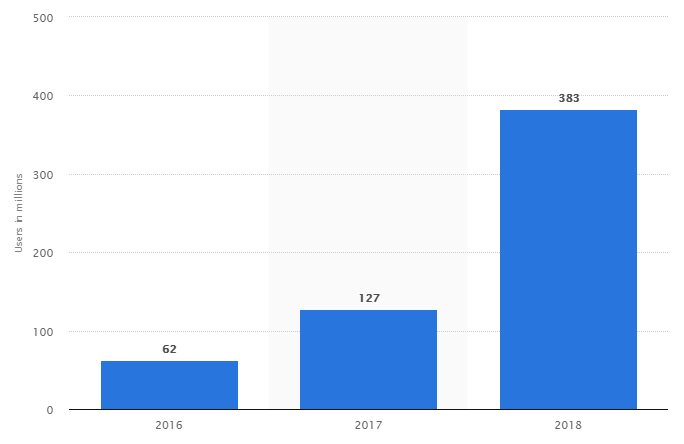
Apple Pay Usage

Image Credit: Statista

According to Statista, the global user base of Apple Pay amounted to 383 million users worldwide, up from 127 in the previous year. This number clearly depicts that Apple Pay had billions of transactions in 2018. It is estimated by Loup Ventures, the number will grow by 200% in 2019.

#7. Apple Homekit

With the Homekit, Apple becomes one of the significant players in the realm of the smart home industry. To address the varied requirements of Smart Home, iPhone app developers can use Apple Homekit. Combining Apple Homekit with IoT devices, businesses can develop hi-tech Smart Home devices & appliances and generate extraordinary results. Thus, Apple Homekit is going to be a buzzing trend in the upcoming time.

#8. Augmented Reality and Virtual Reality

Augmented Reality (AR) and Virtual Reality (VR) both the technologies have transformed the business landscape by enabling end-users with visually rich and compelling experiences. AR/VR iPhone apps help businesses in creating personalized shopping experiences for customers.

With 3D visualization, it becomes easy for the brand to communicate its message with next level clarity and effectiveness. These technologies continue to impact the iPhone app development in the upcoming time.

The updated ARKit 2 is going to spice up the user experience by improving the rendering of the AR and VR elements. It allows businesses to create a 3D art that can be viewed by other people in the same place at any time.

ARKit 2 with SceneKit allows for designing lifelike 3D graphics to build highly immersive iPhone apps.

iPhone app developers of Credencys are early adopters of the latest trends

Credencys has a team of 50+ iPhone app developers who have successfully delivered 300+ projects to clients from different industry verticals. We have proven exposure and expertise to build tailored consumer-facing apps or enterprise mobile apps for startups to large scale enterprise by following Agile and DevOps practices and considering the advanced iPhone app development trends and technologies.

iPhone app developers of Credencys have experience of dealing with the challenges that come across during the app development process. As a result, businesses can be sure of receiving reliable iPhone apps with timely delivery.

Frequently Asked Questions

What are the top iPhone app development trends?

To build the robust iPhone apps, developers integrate advanced tool and technologies in the app that includes Machine Learning, Swift, Apple Pay, Artificial Intelligence, IoT, Cloud, Augmented Reality, Virtual Reality, On-demand app development, Siri, and more.

How long does it take to develop an iPhone app?

When it comes to iPhone app development time, it depends on the complexity of the app. An iPhone app with basic features can be developed in four to five months. However, an iPhone app with highly advanced features takes more than twelve months to be developed and deployed.

Which is the best company to hire dedicated iPhone app developers in the USA?

Many options are available to you when it comes to select an iPhone app services provider. But Credencys is a reliable and experienced iPhone app development company with proven expertise in developing the iPhone apps considering the latest tools, technologies, and trends. Check out the work of the leading iPhone app development company.

How to hire the best iPhone app developers?

You can hire iPhone app developers by following the three simple steps, 1. Access the Talent Pool, 2. Interview & Select Developer(s), and  3. Kick Start.


Get Ready to Transform Your Digital Journey with Pimcore Development

A company without a digital presence, do you think it makes a remarkable success? Of course not. There is no way to build a business without going digital. The time has changed and so the conventional approaches of doing the business and the equation of success too.

Developing a digital platform, that could be a website or web application or mobile app, requires a lot of effort and integration of different systems. You need to manage different attributes of products/items, customer data, digital assets, content, e-commerce, data, and more.

I am so sure you are having a system that contains elements by combining the different software.

Don’t you tired with updating every single software to keep it up-to-the-mark in order to deliver a seamless user experience and streamline business processes.

I guess it is a tedious and time-consuming process for you. Isn’t it?

Here I come up with a consolidated technology platform Pimcore that contains all these attributes to create and deliver next-level digital experiences for you as well as your customers.

Let’s delve into exploring the Pimcore as an emerging technology and its essential attributes.

What is Pimcore?

Pimcore is an open-source software that enables companies with significant business values through effective customer experience and data management. The technology provides companies complete control over their intellectual properties, groundbreaking flexibility for data management, improved time to market of your digital platform.

What is technology stack for Pimcore development?

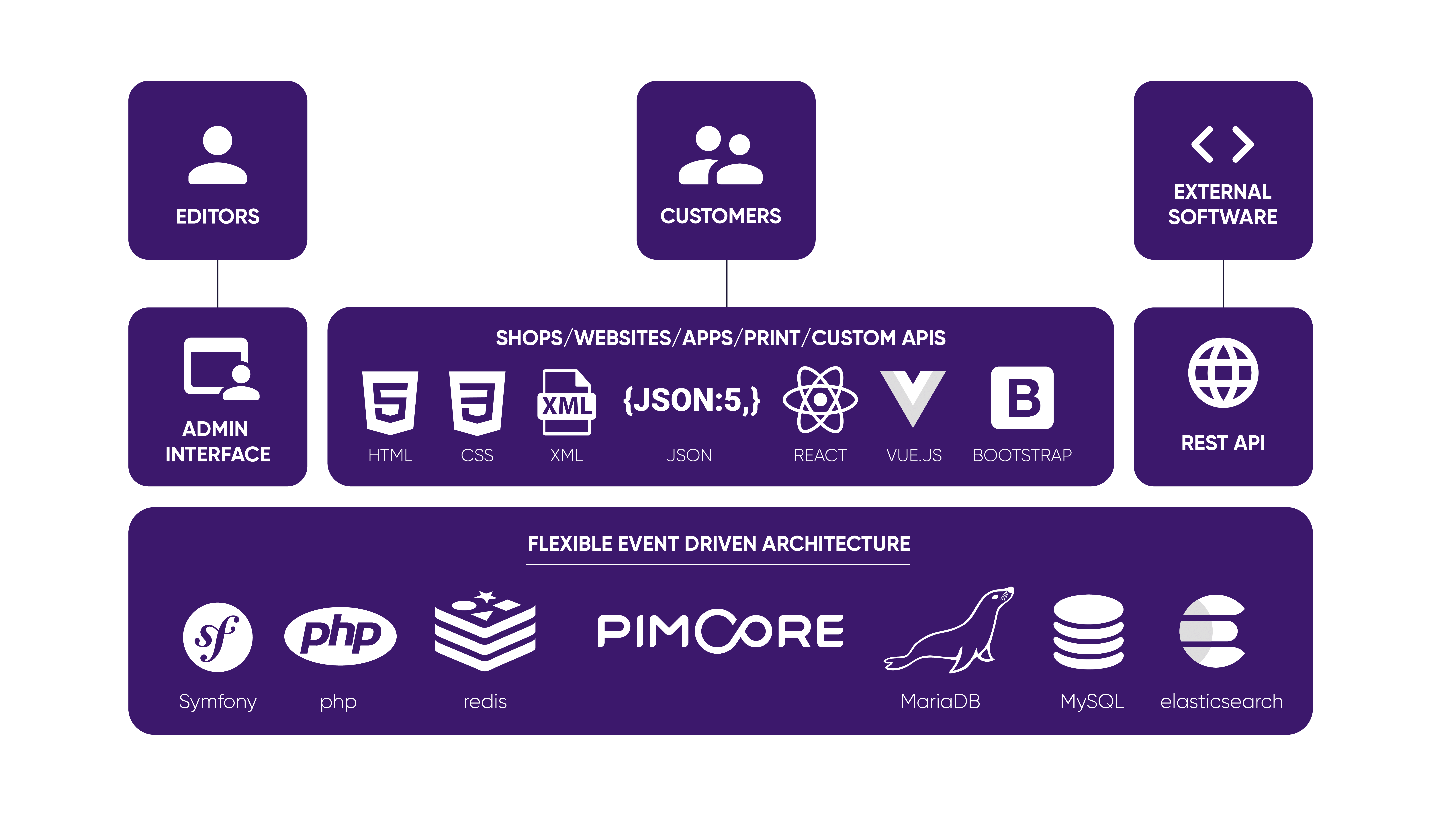
Pimcore is developed using the latest technology stack and open and service-oriented architecture. The technology is compatible with web browsers such as Chrome, Bing, Firefox, Internet Explorer, Safari, Opera, and more. Thus, Pimcore based applications can be accessed and operated on any web browser. It allows managing and working on the data and building the context-sensitive and user-friendly interface of applications.

Pimcore Technology Architecture

Infrastructure: Amazone AWS, Microsoft Azure, Google Cloud, Docker, vCloud Air, Digital Ocean

Database: MySQL, MariaDB, Parcona Server

Web Server: Apache, NGinx

Application Server: PHP, HHVM, Zend Server

Search & C: Apache, NGinx

API: Rest Webservice API, Pimcore PHP Core API

Frontend: Symfony, HTML 5, CSS3, JSON, Vue.js, Bootstrap, XML

Key Modules of Pimcore Technology

The technology covers different aspects of web development and mobile development. Pimcore allows businesses to manage data, customers, products, content, eCommerce functionality, intellectual property, etc. from a single platform.

Digital Experience Platform (DXP)

This is the only open-source platform that comes with experience management and data management capabilities. It allows businesses to deliver a better customer experience throughout their journey by offering a consolidated setup.

It integrates data, services, and content so that organizations can create and deliver a truly personalized experience to the customers. The technology also contains e-commerce, AI, and ML capabilities that too even no licensing cost.

Data Management

An organization has to manage so much information about the products and customers in a harmonized way. You might be managing customer data in a third-party CRM and product data in a 3rd party PIM software.
What if you can manage the data in a centralized platform and access it at any point in time?

Pimcore offers three different modules to manage the data of your product, customers, and content. Let’s see, which modules I am talking about.

Product Information Management (PIM)

Managing your sales, marketing, and technical product information. Companies can add, edit or remove any information about the product. This data could be about product attributes, material, appearance, cross-selling products, product-specific attributes, data quality, and base data.

All you need to take care of present the information that helps customers in making a buying decision in no time in terms of the product description, prices, images, and any other data.

Master Data Management (MDM)

Master Data Management Architecture

You must have a question of what type of data you can manage in this module. Well, I am coming to this point only.

In MDM, you can manage every aspect of each master record in a well-defined hierarchy, versioning, validation, and structure. It also manages data about product attributes translations, descriptions, documentation, and other components of the data.

Centralized data management enables organizations with reduced data redundancy, improved data reliability, boosted operational efficiency, reduced data silos, and actionable insights.

Customer Data Platform (CDP)

I can say this is the most impressive module for the business as it drives a lot of opportunities for them. More than customer data management, it contains the capabilities of customer segmentation, personalization, and ultimately marketing automation.

Get a consistent, clear, and unified view of all the activities performed by the customers in your applications from the different platforms. Undoubtedly, it’s a complete marketing package as aggregate customer profiles, link social profiles, trigger events, create an audience, deliver a personalized customer experience, execute marketing campaigns based on enriched data, and more.

Content Management

Manage your web content from a consolidated platform with advanced planning harnessing the potential of Pimcore. It helps in creating transparency across the team, individuals, processes, and tools.

The technology also accelerates task completion and makes parallel content development workflow possible. It also helps in making the content tracking seamless by standardizing the content authoring and delivery processes along with analytics. Thus, Content Management module of Pimcore improves the time-to-market of content publishing.

Pimcore web content management system allows to send the right content to the right target audience at the right time with complete personalization. Additionally, organizations can utilize the web-2-print feature to get the print of your product catalog, marketing & sales collaterals, and other content.

Digital Asset Management (DAM)

Digital Asset Management (DAM)

Whether you are developing a website or eCommerce platform, you need to use a lot of images, documents, graphics, videos, audio files, logos, and other media content. To manage all your media content in a centralized place, Pimcore offers a Digital Asset Management system where organizations can store and manage any amount and any type of digital assets.

Companies can use these assets for any channel at any point in time from the DAM. The technology helps businesses improve accuracy and consistency by using the right media file at the place to deliver a better brand experience.

Digital Commerce Platform

Digital Commerce Platform

Create an outstanding B2B and B2C eCommerce customer experiences with Pimcore. Leverage the omnichannel retail by enabling customers with personalized experiences by developing a custom eCommerce platform. You can integrate their existing software systems such as CRM, ERP, and others easily.

In the consolidated system of Pimcore, companies can manage the product images, content and media files harnessing the capabilities of CMS, DAM ad PIM. Drive more sales opportunities by enabling customers with personalized shopping experiences and delivering real-time omnichannel environment.

In Nutshell

Why consider different technology platforms when you can use one for all your requirements?

Pimcore helps you develop a website or eCommerce portal and manage all the aspects of your online platform seamlessly from a centralized system. Bring your digital experiences to the next by using Pimcore technology and architecture of the online platform.

It not only delivers unmatchable user experiences to your customers but also allows you to manage all your data effortlessly just by login into the single system.

Credencys helps businesses go digital embracing Pimcore development

Credencys is a Pimcore’s Strategic Partner and has a team of well-trained and skilled Pimcore developers. We have proven the experience of developing and delivering next-gen applications for the Fortune 500 companies. We offer end to end Pimcore development services including strategy, prototype, design, development, deployment, testing, enhancement, and support and maintenance.

Harness our potential to build a feature-rich website or application or eCommerce important that helps you to bring your business to the next level by opening up new opportunities for you. Get in touch with our Pimcore developers to utilize their capabilities of PIM, DAM, CMS, eCommerce, workflow management, personalized marketing, data modeling, and web-to-print.

Top 7 (Most Popular) Android App Development Tutorials and Courses

Today, Android is one of the most popular mobile operating systems in the world. Many aspiring developers are willing to learn to program and creating apps on Android.

This article features the list of top 7 online Android app development tutorials and courses. This tutorial will help aspiring Android developers to learn to program and develop apps for Android devices.

7 Best Android App Development Tutorials and Courses

1) The Complete Android N Developer Course [Udemy]

With 120,000+ enrolments, this is one of the most popular Android app development course. Among all the enrolments, around 22,000+ have rated it 4.4/5.0.

Two masters of web app development, Rob Percival and Marc Stock are the tutors of this amazing course. They have taught around 51K+ students.

Rob has a degree in mathematics from the University of Cambridge while Marc has an experience of over a decade to build Android apps.

USPs

  • A deeper understanding of Java, Maps, Android features, and GPS-location.
  • Learn to build clones of popular apps like Uber, Twitter, and more.
  • Android wear mini-course included.
  • 36 hours of video content, 47 Supplement, 106 articles.

2) Kotlin for Android: Beginner to Advanced [Udemy]

If you’re looking forward to a tutorial that offers you to build a fully-functional Android app in Kotlin, then this is the right place for you. Here, you’ll also learn to send your apps to the Play Store.

Trainer Mark Price helps his students through videos, quizzes, and assignments to learn to program in Android.

USPs

  • Learn to build apps in Kotlin from scratch and learn all the aspects in a step by step manner.
  • Learn concepts from beginners to advance level.
  • Learn to build award-winning apps.

3) Become an Android Developer [Udacity]

Android app development is one of the most in-demand careers in the world. Udacity’s Nano Degree program will help you to reach your full potential in the area of Android app development.

In the first step, they’ll show you how to create apps and publish them on the Play Store. Then in the next step, you’ll learn about building cloud-connected applications.

The course offers an amazing blend of theory + practical knowledge. After finishing this course, you’ll become an Android developer without any prior knowledge of Android.

USPs

  • This course is good for a developer who has prior experience in Java or any other object-oriented language.
  • You’ll be able to create a complete user experience and create a responsive UI.
  • More practice compared to other courses.
  • Additional resources are available for better understanding.

4) Android App Development Masterclass using Kotlin [Udemy]

This is one of those courses on Udemy which offers Android app development in Kotlin with the Oreo version of Android. The training mainly aims to make you an expert in Oreo Kotlin.

Trainers Jean-Paul Roberts, who is a computer programmer, teacher, and analyst and Tim Buchalka, who is an expert Python, Android, and Java developer, are renowned in teaching mobile app development.

USPs

  • This course will help you build applications in Android Oreo.
  • Trainers are known to resolve any query almost instantly.
  • 32.5 hours of video content with life-time access.

5) Full Stack Web and Multiplatform Mobile App Development Specialization [Coursera]

This specialization or course is designed for an individual to learn the art of developing end-to-end web and mobile applications. In the first phase, you’ll learn about Angular and Bootstrap 4.

Then you’ll learn about server-side language, Node JS along the implementation of NoSQL with MongoDB. To make the most out of the course, it is recommended to follow the sequence of it.

USPs

  • It is an intermediate level Android app development course; hence, it is ideal for people having experience in CSS and SQL.
  • You will be allowed to implement the knowledge gained by putting the concepts learned in developing apps.
  • The course is divided into five sections with difficulty ranging from intermediate to advance.

6) The Complete React Native + Hooks Course [Udemy]

Stephen Grinder, a web and mobile app development expert, is the tutor of this Udemy course. He has mentored and taught over 190,000 professionals so far.

After finishing this course, you’ll be able to develop apps in both iOS and Android from scratch. One of the best reasons why you should opt for his course is because he explains some of the most complex concepts in simple language.

USPs

  • After finishing this course, you’ll be able to create native-like apps in both iOS and Android.
  • You’ll also learn how to deploy these apps in both the Play Store and App Store.
  • It also teaches you to handle HTTP requests to React Native.
  • It provides you full-time access to his 16.5 hours of video content and 6 articles.

7) Java and Android Foundation [edX]

It is a formal Java and Android learning course, where you’ll learn to formulate solutions that are well defined to the problems and implement them using Java.

By the end of this course, you’ll get a step closer to become an Android app developer. Since it is a beginner level course, people with no prior knowledge in Java can also enroll for it.

USPs

  • You’ll be able to adapt to the Java Development environment quite effectively. You’ll also develop testing and debugging skills.
  • Learn to work with event-driven programming paradigm, develop GUI, and implement asynchronized tasks.
  • You’ll be able to build apps and add features to your portfolio.
  • It is rated 4.5/5.0 stars.

FAQs

1) How do I get a Google Developer certification?

To get a Google Developer certification, you need to visit the Google Developer Certification website and enroll for the exam, which costs $149. You can take the exam whenever you want. You’ll receive a certificate as soon as you pass the exam.

2) How long does it take to become Google certified?

Usually, it takes around 22 hours in total. The level 1 training takes 12 hours whereas a level 2 training takes around 10 hours. Once you’re done with both the levels you’ll become a Google certified trainer.

3) Can I learn Android without knowing Java?

No. There is no way you can learn programming in Android without the knowledge of Java.

4) Which programming language is best for Android?

Java is the oldest and most popular language for Android app development. However, nowadays, Kotlin is taking over traditional Java, which used to drive Android programming.


7 Node JS Interview Questions to Ask Before You Hire Node JS Developer

If you’re planning to hire Node JS developer for your next project, then you must also be interested in preparing a bunch of technical questions to test the skills and qualifications of candidates.

It’s what you’re here for, right?

You want to find the right Node JS interview questions to ask so that you can determine whether a candidate is qualified for the job or not.

Well, guess what? – You’ve come to the right place.

We’re a multiple Award-Winning Agile Software Development company having over a decade of experience in Node JS development and world-famous brands like Samsung, Cisco, etc. as our clients.

Now, the above paragraph might seem like a bit of showoff but rest assured that the only reason to mention our accolades here is to point out the fact that we know Node JS inside out. And in this blog, we’ll share the most important Node JS interview questions to ask before you hire Node JS developer.

7 Node JS Interview Questions to Ask When Hiring Node JS Developers

The best remote Node JS developers are those who not only have sufficient knowledge about the technology but are also creative when it comes to solving real-life problems.

That being said, here are the most important Node JS interview questions you should be asking when interviewing candidates.

1 – What is Node JS and Where It can be used?

Node JS is basically a JavaScript runtime environment that allows developers to write server-side scripts. It is built on top of Google Chrome’s V8 Engine and uses event-driven, non-blocking I/O model.

Developers and companies use Node JS to develop different kinds of applications and services such as REST APIs, web applications, real-time chat applications, and much more.

If you’re interested to get a better understanding of where exactly Node JS can be used, we’ve written a separate blog on Node JS Use Cases. Be sure to check that out.

And as long as we’re talking about getting a better understanding, we’ve also written a comprehensive article on What is Node JS. Feel free to check that out as well if you’d like to get a deeper understanding of Node JS.

2 – What is the difference between Asynchronous and Non-blocking?

Asynchronous in Node JS basically allows developers to make asynchronous HTTP requests, meaning there will be no need to wait for a server to respond. The application can continue working on other blocks and respond when the server response is received.

Non-blocking, on the other hand, is are functions that are often used with I/O operations. These functions basically respond immediately with whatever data available to keep on executing the incoming requests. And if any response couldn’t be retrieved, then the code will instantly return with an error.

3 – What is a Callback function in Node.js?

Node JS is an asynchronous JavaScript framework. Hence, it does not wait around for a file I/O to finish. – It uses Callbacks.

Callbacks are basically functions that are called at the completion of assigned tasks, which prevents blocking and allows the execution of other code parallelly.

In simple terms, Callbacks provide developers with an interface to say “once you’re done with this, do this thing next”. This, as a result, allows a Node JS application to handle numerous I/O operations running at the same time.

4 – What is package.json? What is it used for?

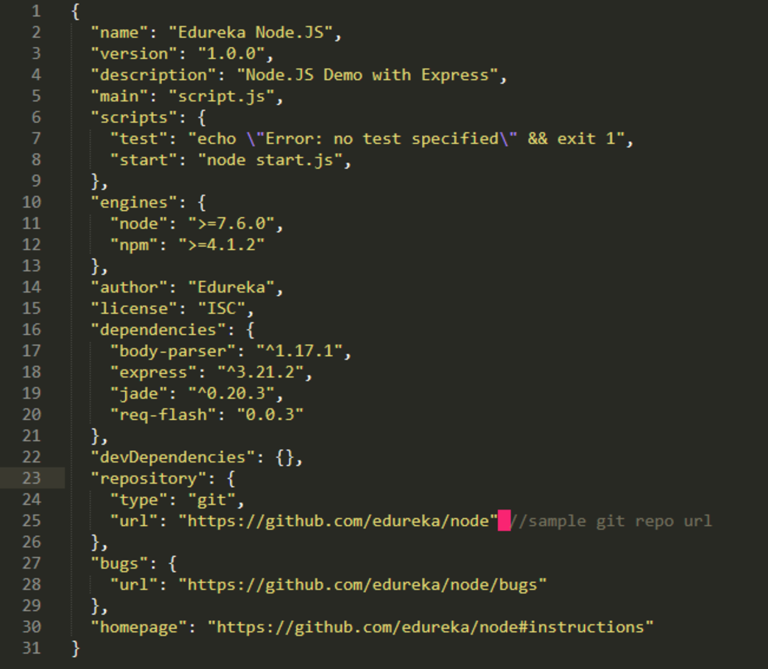
The Package.JSON is basically a file in Node JS stored at the heart of your application. It’s a manifest file that stores the metadata of your Node JS app where the properties of a package are defined.

Here’s an example:

package json

5 – What do you understand by callback hell?

Callback hell is often referred to as a pyramid of doom. It’s basically a pattern caused due to intensively nested callbacks in a Node JS application that are unwieldy and unreadable.

Simply put, a Node JS application that contains an overload of nested callback functions, which ultimately makes the code hard to read, understand, and debug. This generally happens by developers not implementing the asynchronous logic properly.

6 – What are Promises?

Promises basically give an alternate way to write asynchronous code and they can help you better handle the asynchronous functions in a Node JS application.

Although promises were first introduced in the 80s, but they became popular after the evolution of JavaScript. And today, they’re commonly found in most modern programming languages.

In simple terms, Promises can be used to either return the result or error. And similar to the old-fashioned If-else function, developers are required to use <.then()> function to implement Promises in a Node JS application.

7 – What is the Control Flow function? Explain how “Control Flow” controls functional calls

When you want to write asynchronous code in Node JS, you’ll often require to use lots of callback functions. Now, if you’re developing a complex application, there are chances that will reach the limit of writing nested callbacks, which is 63.

When that happens, you’re highly likely to experience callback hell. And the best way to avoid that from happening is to use the control flow function.

The Control Flow function helps to structure all asynchronous code so that your application doesn’t end up experiencing callback hell.

The Control Flow function will help you:

  • Collect data
  • Control the execution order
  • Integration limit
  • And call the next step in the program

As a result, this will help you to have better control over the code in your Node JS application.

Conclusion

With this, we have finally arrived at the end of important Node JS interview questions to ask before you hire Node JS developer.

The above-mentioned questions, and their answers specifically, will help you determine whether a candidate is worth hiring or not.

FAQs

Q:1 – What is Node JS?

Ans: Node JS is a cross-platform, open-source, JavaScript runtime engine that executes the JavaScript code outside of browsers.

Q:2 – What are the benefits of Node JS?

Ans: There are many benefits of Node JS such as:

  • Easy to learn
  • High performance
  • Easy scalability
  • Benefit of Full-Stack development
  • Large & active community

Q:3 – Is Node JS good for microservices?

Ans: Yes! Since Node JS is lightweight, using Node JS for creating microservices architecture is a great choice.

Q:4 – Is Node JS better than Python for building Real-Time Applications?

Ans: Yes, Node JS is better for building real-time applications mainly because it supports callbacks and is built upon Chrome’s JavaScript V8 engine, which is a reasonably powerful and fast engine.


8 Healthcare App Ideas to Launch a Successful Startup

The healthcare industry is an excellent place for aspiring entrepreneurs to launch a new startup. In fact, exploring healthcare app ideas is smart for many reasons.

For example, healthcare spending in the US alone accounts for one-third of their GDP. Yet, there is still a large gap in providing quality healthcare services.

What this means is that while people are paying huge money for relatively poor medical services.

But the good news is, you have an opportunity to revolutionize the healthcare industry through healthcare mobile app development.

Ever since mobile apps became mainstream in nearly every industry, a lot of entrepreneurs have jumped on the healthcare apps.

And in today’ blog, we’d like to share the top 6 healthcare app ideas using which you can revolutionize the healthcare sector.

Importance of Healthcare apps for doctors

For the past few years, the popularity of healthcare apps grew steep among healthcare professionals. We can simply say as the medical industry gets evolved into a new phase with the arrival of Healthcare apps. Take a look over the below listed few vital benefits offered by modern healthcare apps to the doctors.

  • Useful on managing and accessing the health record of patients
  • Handy on time management techniques
  • Serves as a communication bridge by providing a better platform to communicate with patients
  • Easy way to monitor a patient’s status
  • Pretty useful for gathering reference and other medical information
  • Easy to make a clinical decision by referring to the lab reports & disease diagnosis
  • Provides a platform where professional can take skill assessment tests along with surgical simulation

Importance of Healthcare apps for patients

Apart from providing benefits to healthcare professionals, modern healthcare apps play a vital role in improving patient experience.

The arrival of mobile healthcare apps has completely changed the way society accessed the healthcare industry so far. Take a look over the below listed few vital benefits offered by modern healthcare apps to the patients.

  • The electronic mode of storing health records will enable patients to receive centralized and improved medication service from medical professionals.
  • Healthcare apps enable patients to avail of healthcare service on-the-go.
  • Healthcare apps act as a tool which allows patients to access more medical information right from their gadget.
  • With the aid of modern healthcare apps, patients can monitor their health status of their own.
  • Easy way to get a consultation with the medical professionals with all medical records in digital form.
  • Healthcare apps simply boost the medical knowledge of the patients.

Top 8 Healthcare App Ideas

Mobile apps have greatly impacted nearly every industry and healthcare industry represents an incredible opportunity for innovation. Below are the 8 healthcare app ideas that you can steal today to launch a successful startup.

1 – Weight Loss/Diet Tracker App

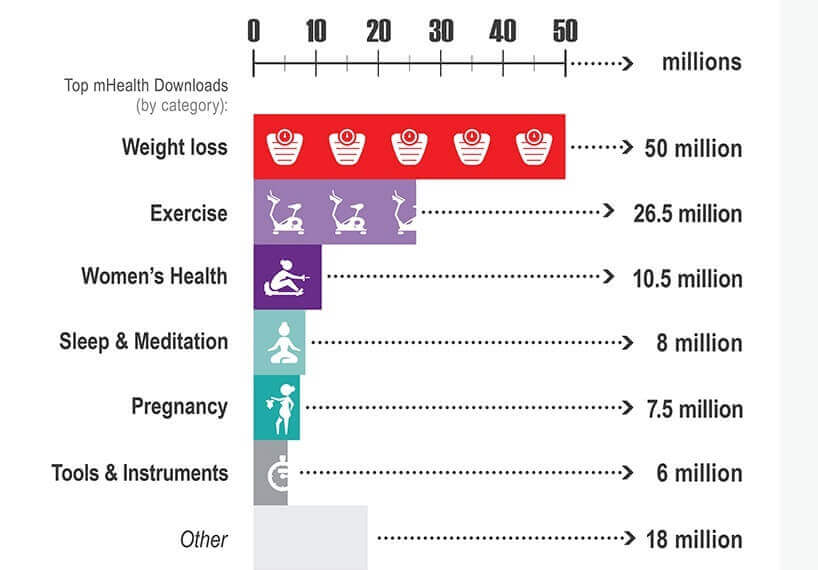
Getting fit from fat is what everybody wants nowadays. In fact, if you just look at the research in the below image, you’ll see that the weight loss apps are among the top healthcare apps that are being downloaded.

healthcare-apps

According to Polaris Market Research, the global fitness app market is anticipated to grow to a whopping $14.7 Billion dollars by 2026.

What this means is that there is a huge scope for diet tracking and weight loss apps in the near future.

Take FatSecret App for example. The app helps people stay fit and in shape with less efforts by allowing them to track their diet intake. Simply put, the app lets users keep a record of food they eat and the calories they consume. The app is equipped with features like a diet calendar, weight tracker, and a barcode scanner.

Weight Watchers’ ME App is another notable example. The health experts at Weight Watchers realized that when it comes to forming new health-related habits, weekly routines were not sufficient.

So, they developed ME app with the sole purpose to provide their clients continuous motivation and frequent goal recalling features.

2 – Doctor On Demand App

Imagine you’re on a vacation in a strange country. It’s Friday past 8 PM and you feel a stomach ache that’s nearly unbearable. What will you do?

Try out some random home remedies without knowing the actual cause of pain?

What if there was a way to connect with a local, certified doctor at any given time?

Yes, we’re talking about Doctor On Demand App.

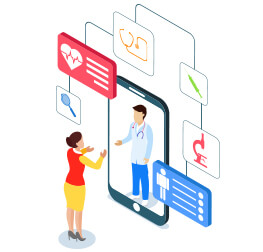
The Doctor On Demand is a concept where patients can connect with doctors 24×7 through a mobile app. To develop a doctor on demand app of your own, you will need the right mobile app development team.

But first, you’ll need a vast database of doctors who are willing to partner with your startup. These doctors should be available to attend video calls to consult patients from all around the world and provide consultation.

3 – Medication Reminder App

There are certain age-group people who have so many prescriptions to take in a day that they can hardly keep track of them. Forgetting to take medicines at a certain age can be deadly.

This represents a perfect opportunity for aspiring entrepreneurs to launch an app-based startup.

For example, you can build a medication reminder app that can be used to track medication intake, set reminders about medications, and dosage of the medications.

HCHC Healthy Living app is one such app startup that not only helps people track medications but also medical appointments and provides certain healthy living tips on a daily basis.

4 – Healthcare App for Chronic Disease Management

Chronic illness like blood pressure, diabetes, and kidney disease need medical attention and checkups on regular basis. This makes the chronic disease management app a perfect opportunity to launch a startup.

With your own CDM app, you can allow users to address these diseases and let them track their health through regular intervals and provide a list of professionals in their locality.

Furthermore, you can also collaborate with clinics and help them connect with new patients.

5 – Healthcare App for Women’s Well-Being

If you’re interested in addressing women’s common issues, a women’s well-being app idea might just be right for your startup. You can create a healthcare app for women to help them track their menstrual cycle, help them achieve inner peace, or solve a medical problem.

There are tons of healthcare app ideas for women’s well-being. For example, you can develop a healthcare app that provides a comprehensive list of sources of gynecologists, dietitians, and so on. In fact, this kind of app has the potential to become a go-to-resource among women.

In addition, you can also consider integrating access to high-quality consultations through voice and video chat. The possibilities are just endless.

6 – Mental Health App

Stress, depression, and unhappy lifestyle is among the top mental illness among millenials. You could create a healthcare app specifically for individuals who are fighting these mental illnesses.

For instance, a perfect healthcare app idea is to build a mental health monitoring app for people who feel alone and are in dire need of help. The healthcare app ideas in this category are endless.

For example, another common mental illness is the lack of sleep. Busy work schedules & excessive work pressure have made a majority of individuals sleep deprived. You can help these individuals with relaxing music therapy app or help them plan a routine for proper rest and sleep.

There are even healthcare apps that help people overcome their different fears. Like we mentioned, the ideas are just endless.

7 – Medical Training through Virtual Surgery

Medical training reaches to the next level with the Augmented Reality, Virtual Reality, and Mixed Reality based healthcare apps. Using the AR/VR hand controllers and headsets, surgeons and medical interns can experience how they will perform the surgery along with the feel of doing it in real-time.

It enables medical interns with lifelike surgical experience for ENT, MIS, laparoscopic, ophthalmology, and neurosurgery. The haptic feedback system offers a highly realistic sensational experience of using various drills or other medical instruments.

The simulator provides a detailed and granular control that enables surgeons with near to realistic, actual and identical procedures.

8 – Online Therapy Apps

With online therapy apps, therapy is accessible to everyone. Such apps help to those patients who feel hesitation to meet the doctor in-person and discuss their mental or physical health issues.

Patients can interact with doctors through the app using messaging or chatbot features. These features can be available for free and paid (if the startup will charge subscription fees). It also provides a platform to the therapists where they can connect with other medical experts and learn about the new technologies and treatments.

9 – Sleep App

Sleep apps also fall under the category of other health test apps which are mostly needed by either doctors or entrepreneurs; therefore, they will be the owners of the app. These apps act as ideal solutions for people who have deep trouble with relaxing and get them into a restful sleep.

Users of this app can keep some relaxing music to get sound sleep, thereby reducing their stress levels.

10 – Appointment Booking App

The appointment booking app is an on-demand app and is more beneficial to doctors and other healthcare professionals. This type of app is mainly used for doctors and other professionals to express their availability to patients and book appointments through app accordingly.

Since connecting through social media is on-trend, doctors would like to meet patients through online and prescribe tele-medicines, clarify their doubts on any illness, consultation, schedule a call or make a home visit.

Patients find the app more convenient than physicians since it lets them do anything from the place they are, without making an effort to go to clinics and check doctor’s availability, collecting reports, etc.

Moreover, doctors can save a patient’s history with them from the beginning and before they get into consultation, it becomes easy for them to understand the patient completely. This creates goodwill for the clinic/hospital and patients keep visiting the same physician for providing good treatment.

11 – Recovery App for Addiction

In one way or the other, all of us might be addicted to something or someone in life, and it is very natural too. But there are few things such as alcohol, drugs, caffeine, Nicotine, phones, sugar, etc. which you should not be addicted to since they can take your life away from you.

Such things make you lose everything, everyone in life around you, and take you to a different track. Therefore, an app for recovering from these addictions can help people rejuvenate their life and get back to normal.

Some of its features are Community which helps drug-addicted people through already people who have overcome it; Video to share videos showing recovery methods; Chat integration to chat with experts and discuss how to rehabilitate from the addiction.

12 – Medicine Delivery App

This is one of the most wanted and the best apps on demand. On prevailing COVID-19 conditions, ordering medicines online and delivering at the doorstep helps people extensively.

At the same time, many people do not want to take the risk of going out and getting into risk of virus spread. Though this app is in existence for many years, it has not been into complete utilization. But pharmacists who do not have an online medicine delivery app, it is the right time to get one and promote it to your existing customers.

By simply uploading the prescription, customers can get their medicines delivered at their doorstep by the pharmacy person. Even more, pharmacies in the same area do not charge any delivery fee as well. However, medicine app delivery always has a demand in the market.

Conclusion

Like any other industry, there is a lot of potential for mobile app development in the healthcare industry.

The only question that remains to be answered is, are you ready to take the plunge and gain the mobile technology advantage?

Frequently Asked Questions

How do you create a healthcare app?

To build a successful healthcare app, you need to hire an experienced mobile app development company. Share your app idea with them. They can provide you the right consultation, in terms of required technologies, features, and functionality for your healthcare app.

The skilled mobile app developers can create UI/UX design, working prototype, and then start developing the app. Along with development, they perform app testing to ensure the quality of the app. Once the app is ready to go live, they deploy it and launch it on your preferred platform Android or iOS, or both.

How much does it cost to build a healthcare app?

Costing of a healthcare app development is vary as per the complexity of the app. The simple app with basic functionality can cost around $10000-$25000. On the other hand, an app that requires the integration of emerging technologies and advanced features can costs you more than $50000.

How much time does it cost to build a health care app?

A simple healthcare app can be ready within 5 months while a highly complex app can be completed and live in the 1 year of time span. The app development time depends on the scopes and requirements shared by the client.

Do you provide the after app launch support?

Yes, we offer app enhancement services to update and upgrade your to meet the compatibility of newly launch software, tools, and technologies.


Geofencing vs Geo Targeting: What is the difference?

Now and then, for every business, ad campaigns are bread and butter to grow!

According to a survey, the potential value of the location-based service market is close to $20 billion. These geo-services have shortened the gap between customers and businesses.

Recognizing the power of these services, 90% of ad campaigns are using geofencing and geo-targeting as crucial marketing tools.

However, for an average Joe, these two are similar, but there is a thin line between the two that you must know before you plan for mobile app development.

Well, geofencing vs geo targeting, both the services are all about leveraging location services.

Geofencing vs Geo Targeting: How do they differ?

Geofencing vs Geo Targeting

Geo-Targeting

In Geo-targeting, tailored messages are triggered to users based on their location at a given time.

In the world of digital marketing, people think about geo-targeting when they consider doing paid ads on various social media platforms, search engines, social media platforms, and banner ads on websites.

Here, this is an example of a geo-targeted message sent to people in the USA and Holland by Skype in a different way.

geo-targeted message

In geo-targeting, people are targeted differently based on their different needs and interest.

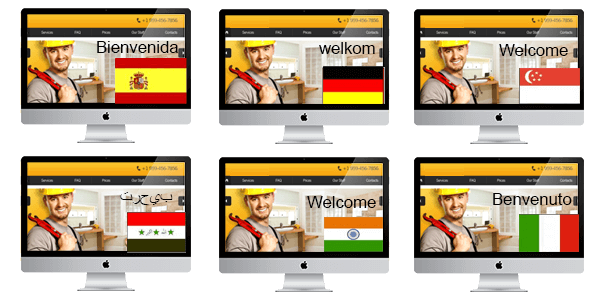
Geo-targeting ends the language barrier. With geo-targeting, brands can experiment with different languages and send messages in various local languages to entice their customers.

various local languages

Benefit:

Geo-targeting helps marketers to target a particular set of customers. Marketers can run ad campaigns by targeting customers based on their exact geo-location. It will help you to drive leads and conversions.

Geofencing

Geofencing is a bit more complicated compared to geo-targeting. It targets a customer or potential customers within a pre-defined distance or perimeter of a fixed location.

It is done via WiFi or Bluetooth for sending push notifications to customers whenever they visit the geo “fence.” push notifications to customers.

Benefit:
Geofencing helps you to generate instant leads via push notifications, SMS alerts, and more. If the geofenced offer does not provoke a customer, it will at least help marketers to understand customers and their behavior.

It will help them to gather all the necessary information so that they can change their strategy and target them in the future.

Conclusion

Geo-marketing is gaining grounds in every space. Less often, people understand the blurred line between geofencing vs geo targeting, which is of prime importance.

Businesses can stand out by combining the power of geo-targeting with geo-fencing.

For instance, via geo-targeting, you can send a message to a user regarding a sale going in the shopping mall. When the user enters the mall and purchases the item, you can retarget the user with geofencing service.

Through geofencing, you can approach a user once again, when he/she is in the shopping mall itself. When a user is done with shopping, send another message to him stating about the discount that he will get for shopping one or more items.

Isn’t it amazing?

Fuel the purchase with a clear understanding of geo-services! Contact our experts to know more.

Geofencing vs Geo Targeting – FAQs

1) Where is Geofencing used?

Geofencing is a technology that helps to identify geographical boundaries via GPS and RFID technologies. It helps you to shoot messages and content via push notifications to a group of users that come to a specific geo-location.

2) When should I go with Geofencing?

If you want to connect to customers present in a narrowly-defined geographical area or want to attract customers belonging to specific demographics, then geofencing is better.

3) When should I go with geo targetting?

If you’ve defined your target market and want to show ads to those targeted customers only, then you must go with geo targetting instead of geofencing.

4) What is the difference between beacons and geo-targeting?

geo-targeting uses GPS technology to identify customer locations. Whereas Beacons are created using Bluetooth nodes and are used when you want to notify customers when they visit a particular aisle.


Top 6 Skills to Look for in a React JS developer (before Hiring One)

React has been in the list of most popular JavaScript frameworks ever since its inception. Today, it is the most trending and used JavaScript library by many corporations.

The most significant value addition of this library is that it is also compatible to build mobile applications for both Android as well as iOS.

If you want to build a web app or a mobile app, the first thing you’ll have to do is hire React JS developer. But, how would you hire the appropriate developer for your project?

This article will help you to identify the six most essential skills that every React JS developer you hire must pursue.

Top 6 Must-have Skills for a React JS Developer

#1 HTML/CSS

HTML and CSS are must-haves for a front-end developer. The ability to not only build but “craft” user interface is essential to look for in a React JS developer.

In addition to that, a React JS developer must be able to:

  • Write semantic HTML tags
  • Write CSS selectors
  • Implement reset in CSS
  • Reset the border-box and know the box model
  • Understand flexbox
  • Implement responsive web principles including the appropriate use of media queries

#2 JSX

A developer must know the most remarkable element of the React ecosystem that is JSX. It is a syntax extension of the React ecosystem, which looks pretty similar to HTML.

We can consider it as an HTML-flavored JavaScript. Hence, if a developer knows HTML/CSS, he/she will probably know JSX as well.

JSX is a notion on top of the React.createElement() API. One of the reasons for this library to be crucial for React JS development is because the APIs are too complicated to scale.

Using this API, a developer can build an entire application. However, using the element to build the application and using HTML to build the app is the same thing.

#3 Git

Git is one of the most critical elements in any developers’ toolkit. It is used to store projects on platforms like GitHub, GitLab, and Bitbucket. A developer must know how to use these platforms, which includes:

  • Keeping track of changes with a comment, add, pull, and push.
  • Merging and branching strategies.
  • Managing merge conflicts.

#4 Node + NPM

Yes, you heard it right. The React JS developer you hire must also know Node JS in order to be a client-side React JS developer. Several other packages allow you to extend the React library.

Moreover, a React JS developer must also have a deep understanding of the npm registry. It is a place where developers can get softwares that helps them to build softwares.

Sounds funny? Well, that is the truth of npm; it is cloud storage that holds the packages we call dependencies.

Yarn v/s npm

Yarn is also a package manager that is used to leverage the npm registry. Yarn can optimize npm workflows. The aim behind introducing Yarn is to resolve problems that are accepted in the Node/npm ecosystem.

#5 JavaScript Fundamentals + ES6

Learning React without the knowledge of JavaScript is like learning calculus without the knowledge of multiplication. Along with JavaScript, you also need to learn and get skilled with ES6.

Variables and Scoping

It includes the understanding of when and where one has access to the data, which is necessary. Variables are the mechanism developed into JS that allows us to hold important data in memory and later access it whenever required.

ES6 is the new element that helps us to store variables within our applications rather than the traditional ‘var’ keyword. one can choose to live with the principle that unless it is crucial to use ‘var’ one should use ‘const’ until the linter tells us to do otherwise, then default to ‘let.’

Arrays and Objects

React suggests us a pattern that our view is the function of our state. The state is the information that we want to show to users or items in the memory that one can access to allow users to interact with the data. One should know how to mutate the objects and change the values of properties on them.

#6 Redux

Redux is the final thing that a React JS developer must know. Redux is a state management library that helps developers to manage and maintain the states in React.

The principles behind Redux are similar to functional programming and immutability. However, one should not confuse this with all in one solution. You should give extra points to the developer who is skilled with Redux.

Conclusion

While hiring a React JS developer, you must frame the interview questions in such a way that tests these six skills. It is recommended to hire a developer who has all the above skills if not at least five of them.

At Credencys, we have a team of highly trained and skilled React JS developers who can translate your complex requirements into a working prototype.

FAQ

1) What does a React JS developer do?

A React JS developer creates the interactive part of a web application by creating components that can receive and send data from the backend server.

2) Why should I use React JS?

React has the unmatched capability to create and use Re-usable components, which helps you create an application faster and more efficiently.

3) What is the future of React JS?

React was released in 2013 by Facebook. Today, it is one of the fastest-growing JS libraries in the world. Many popular companies, including Netflix, Facebook, Instagram, Airbnb, and more are using React. So yes, it does have a future, and it’s quite bright.

4) Which is better, React JS or Angular?

Both frameworks have their benefits. Angular is a full-fledge framework, whereas React is a JavaScript Library. Angular is helpful when you want to build an application from scratch, whereas React is used when you want to scale existing applications.