

Choosing a PIM Platform Is More Than a Software Decision
Most PIM platforms can demonstrate product attributes, workflows, digital assets, and channel publishing. The real question is whether the platform can support your product model, supplier ecosystem, governance, integrations, workflows, users, channels, and future scale without creating unnecessary customization or operational complexity.
Already leaning towards Akeneo? See our independent Akeneo implementation consulting.
Unclear Business and Data Requirements
Teams often begin evaluating vendors before defining product hierarchies, attributes, relationships, workflows, governance, integrations, and channel requirements. That makes platform comparisons subjective and feature-driven.
Too Many Platforms and Overlapping Capabilities
Enterprise PIM platforms increasingly overlap with DAM, MDM, syndication, workflow, AI, commerce, and data-quality capabilities. Without a structured evaluation framework, it becomes difficult to determine which capabilities are genuinely required.
Vendor Demos Do Not Reflect Real Product Complexity
Standard demonstrations may look impressive but rarely test the product structures, exceptions, relationships, supplier data, workflows, or integrations that create the most risk in your environment.
Hidden Implementation and Integration Costs
Licensing is only one part of PIM investment. Data migration, customization, integrations, syndication, DAM, localization, governance, implementation resources, training, and long-term support can significantly affect total cost.
Misalignment Across Business and Technology Teams
Product, merchandising, marketing, IT, eCommerce, engineering, data, and regional teams may all expect different outcomes from PIM. Without common evaluation criteria, vendor selection can become a stakeholder negotiation rather than an evidence-based decision.

How Much is Your Product Data Costing You?
Get Your Score + 90-day action plan in 3 minutes.
Check Your ScoreOur PIM Platform Selection & Advisory Services
Credencys helps enterprises move from a broad PIM requirement to a defendable platform decision using structured business, data, architecture, and implementation criteria.
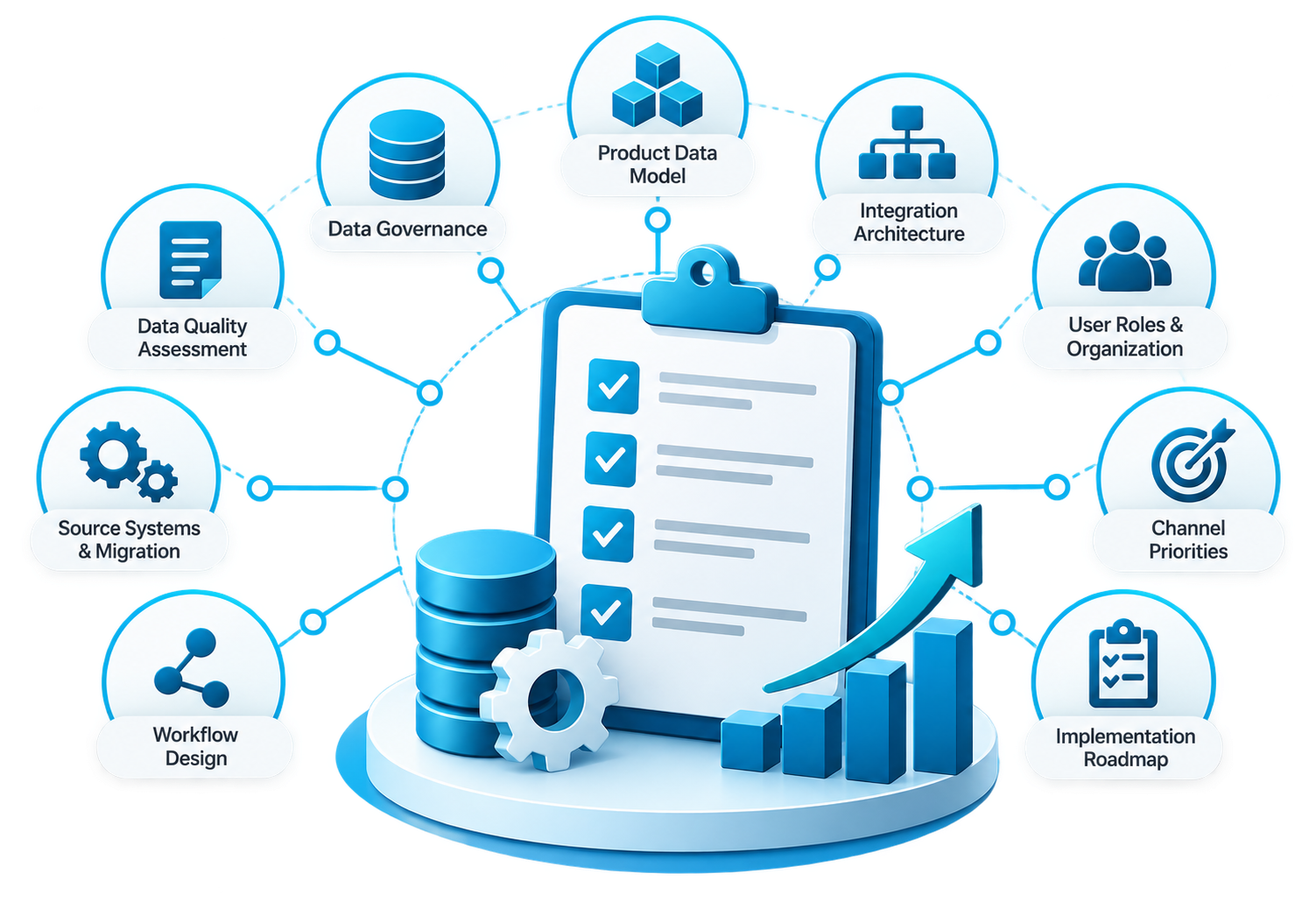
We assess:
- Product catalog size and complexity
- Product families and variants
- Attributes and taxonomy
- Product relationships
- Supplier-data sources
- Data quality
- Governance
- Workflows
- Digital assets
- Channels and markets
- Existing enterprise systems
- Integration requirements
- Internal ownership and operating model
The outcome is a clear current-state assessment and a prioritized set of PIM requirements.
Requirements can include:
- Product data modeling
- Taxonomy and hierarchy
- Variant management
- Product relationships
- Supplier onboarding
- Attribute inheritance
- Data quality and completeness
- Workflow configuration
- Role-based access
- Localization
- DAM capabilities
- Syndication
- API architecture
- ERP integration
- PLM integration
- eCommerce integration
- Marketplace connectivity
- Search enablement
- AI readiness
- Reporting
- Audit history
- Security
- Deployment model
- Scalability
Requirements are prioritized so vendors are evaluated against what matters most to the business.
We help identify a practical shortlist based on:
- Product complexity
- Business model
- Industry
- Catalog scale
- Governance requirements
- Integration landscape
- Channel strategy
- Globalization requirements
- Existing technology stack
- Internal technical capabilities
- Budget and implementation constraints
The objective is to move quickly from a broad vendor market to a manageable shortlist of platforms worth evaluating in depth.
Our advisory support can include:
- RFI development
- PIM RFP requirements
- Functional requirements
- Technical requirements
- Data and integration requirements
- Security requirements
- Service and support expectations
- Migration requirements
- Implementation expectations
- Vendor response templates
- Weighted evaluation criteria
This reduces ambiguity and makes vendor responses easier to compare.
Examples include:
- Complex product families
- Variant inheritance
- Product relationships
- Supplier-data onboarding
- Attribute normalization
- Data-quality validation
- Multi-stage approval workflows
- Regional enrichment
- Translation and localization
- Digital asset relationships
- ERP synchronization
- Commerce integration
- Marketplace syndication
- Role-based permissions
Each shortlisted vendor demonstrates the same scenarios, making comparisons more objective.
PIM Evaluation & Scoring Framework
Credencys helps stakeholders evaluate each platform using a structured scoring model rather than individual preference. The framework can assess:

What We Evaluate Across PIM Platforms
A PIM platform should be evaluated on more than the number of features available.
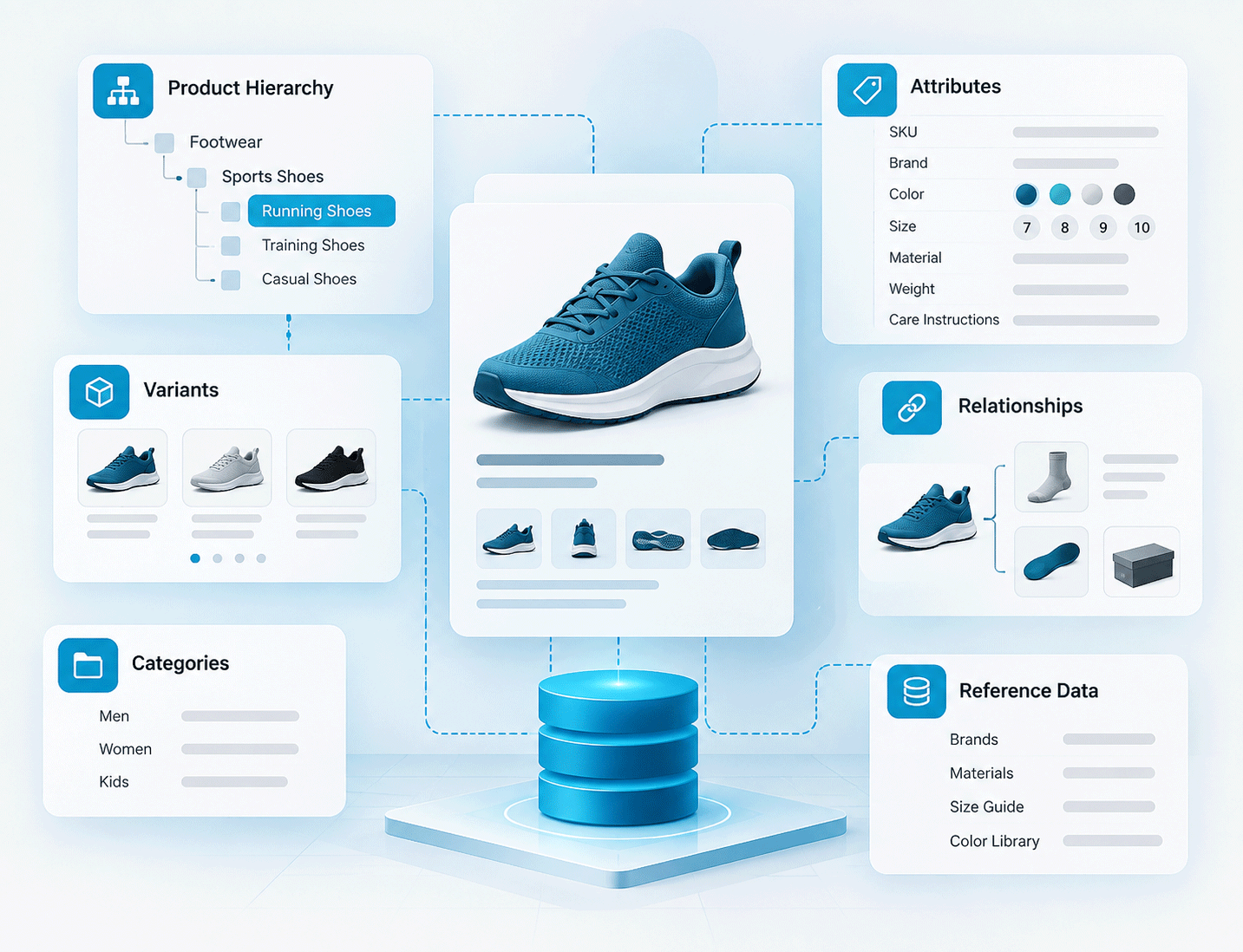
Product Data Complexity
We assess how the platform handles:
- Product families
- Variants
- Attributes
- Inheritance
- Relationships
- Bundles
- Kits
- Hierarchies
- Categories
- Reference data
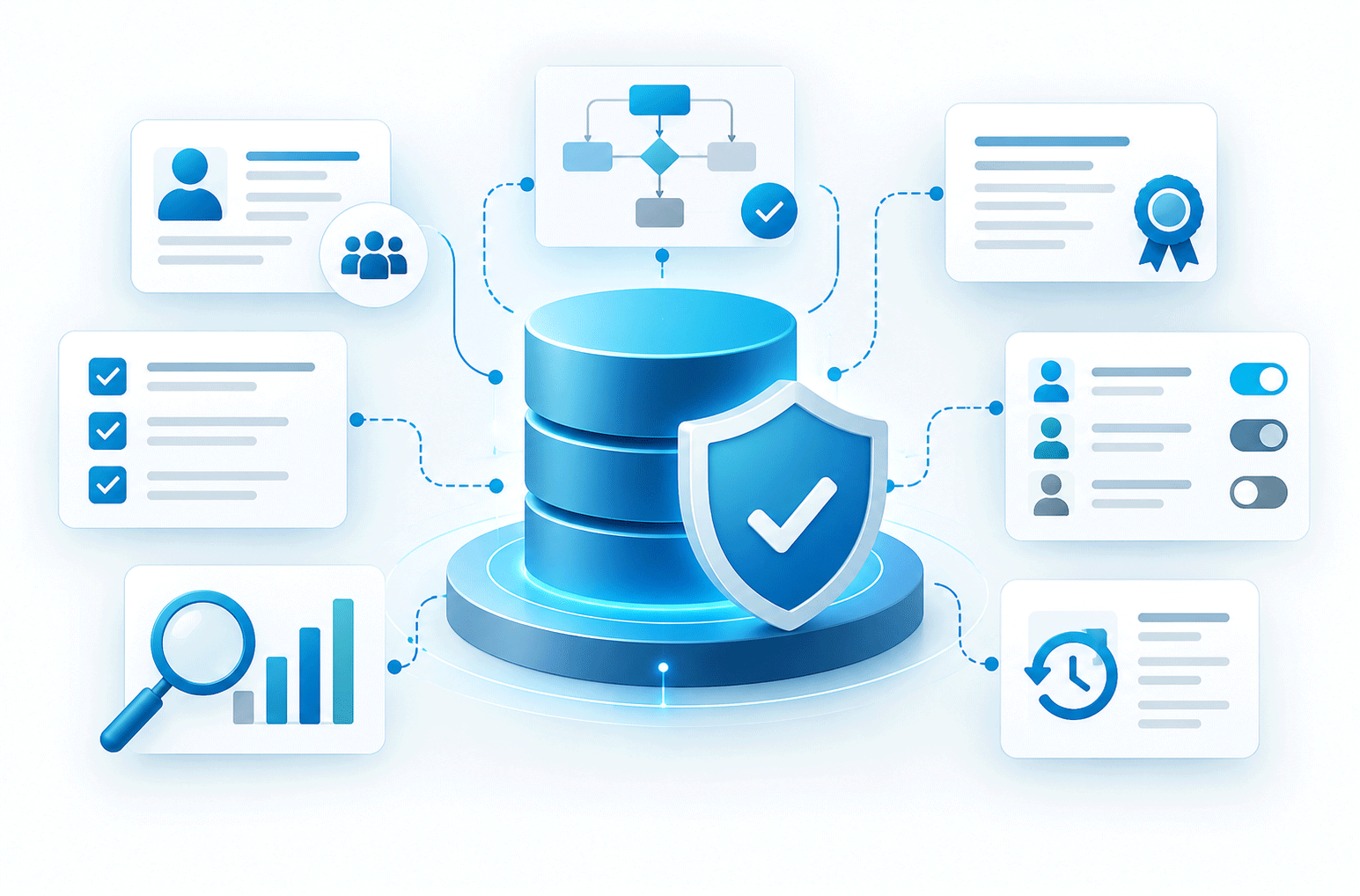
Data Governance
We evaluate:
- Data ownership
- Validation
- Completeness
- Approval workflows
- Stewardship
- Permissions
- Audit history
- Data-quality reporting
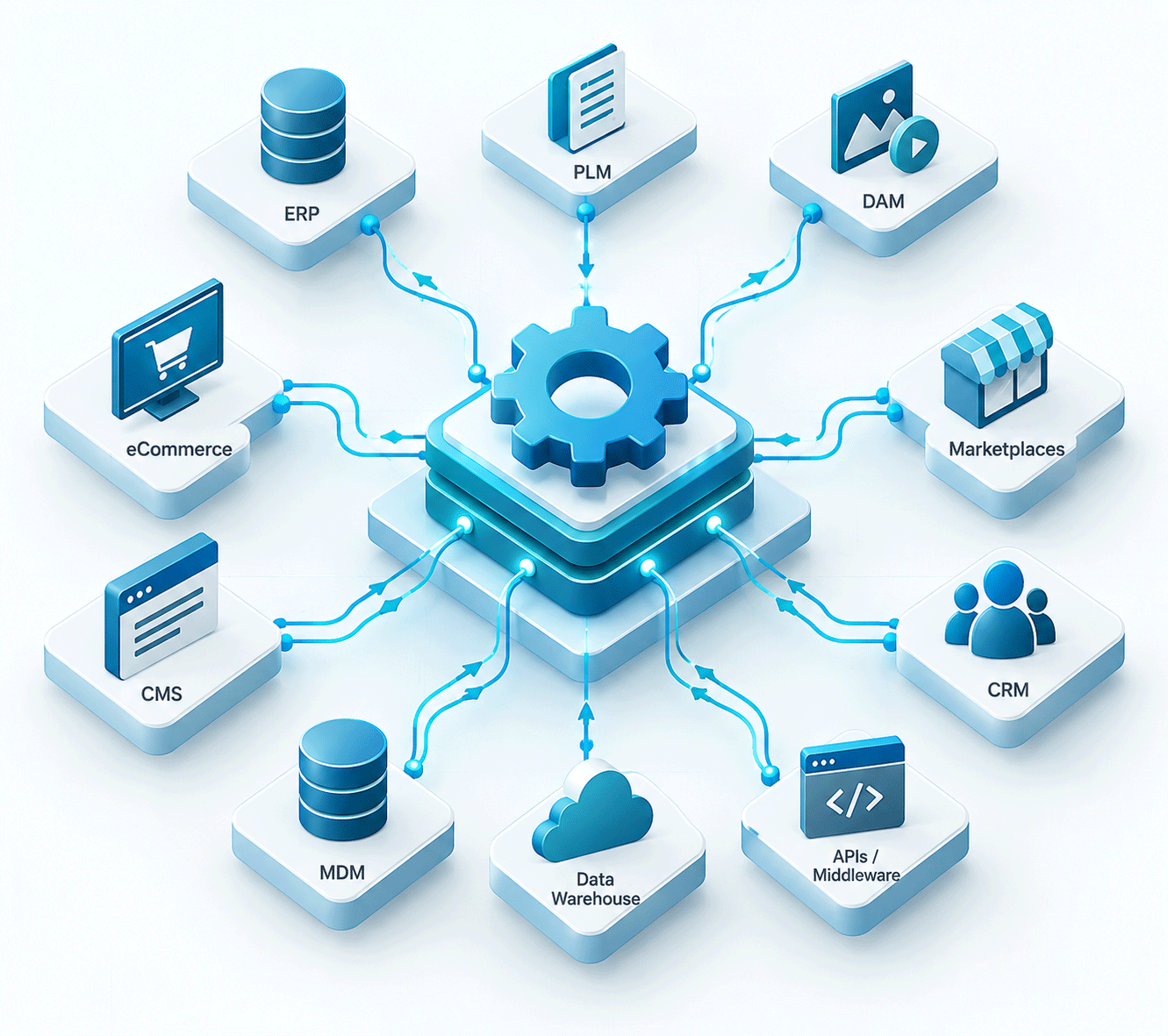
Integration Architecture
We evaluate compatibility with:
- ERP
- PLM
- DAM
- MDM
- Commerce
- CMS
- CRM
- Supplier systems
- Marketplaces
- Data warehouses
- Middleware
- APIs
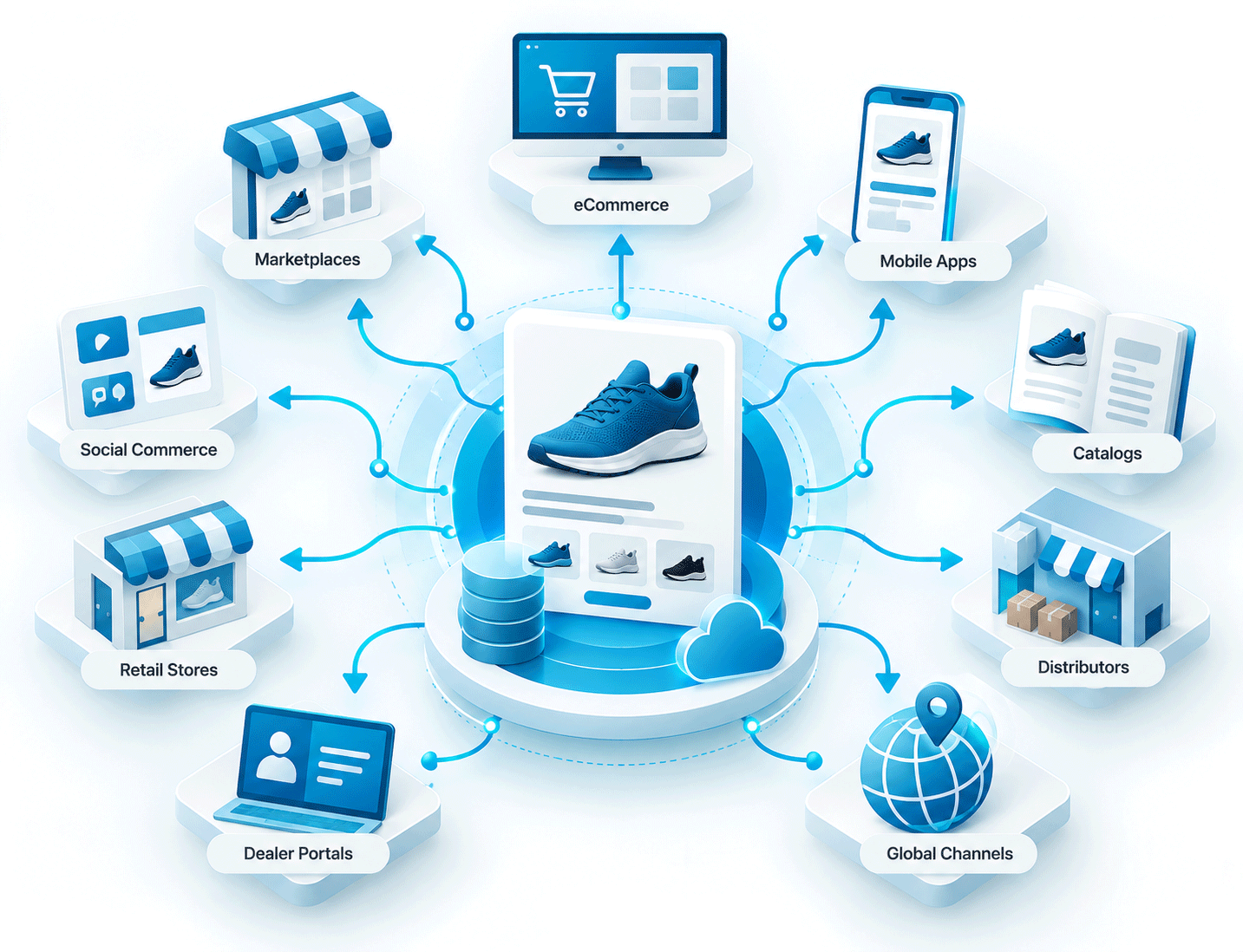
Omnichannel & Syndication
We assess how the platform supports:
- eCommerce
- Marketplaces
- Retailers
- Distributors
- Dealer portals
- B2B channels
- Catalogs
- Product feeds
- Localization
- Channel-specific content

AI & Future Readiness
We evaluate whether the platform can support:
- Attribute extraction
- Product classification
- Automated enrichment
- Content generation
- Semantic search
- Product matching
- Data-quality automation
- AI assistants
- Future agentic workflows
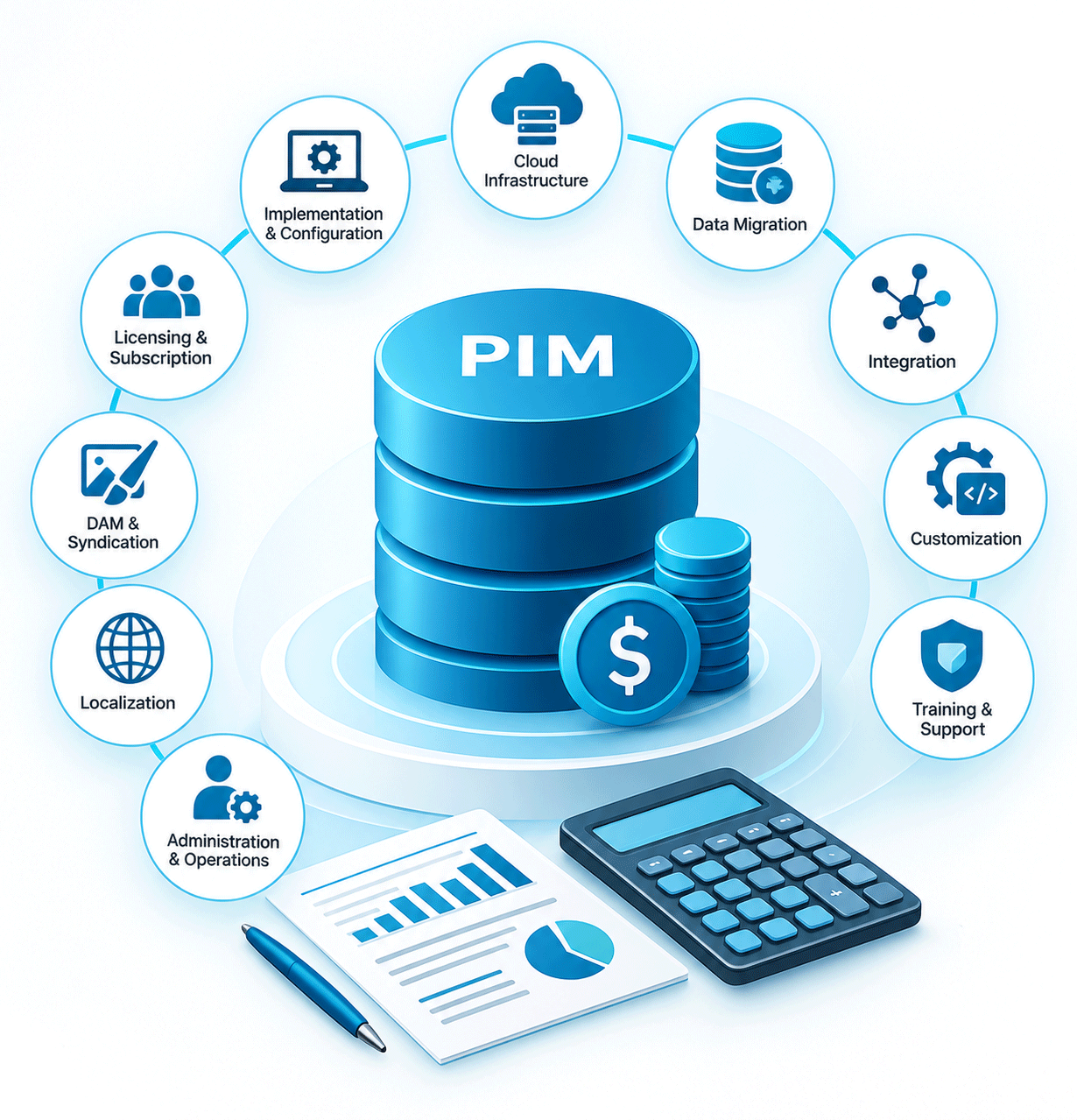
PIM Total Cost of Ownership Assessment
The lowest software license does not necessarily result in the lowest-cost PIM environment. Credencys evaluates the broader cost of platform ownership across:
- Software licensing
- Cloud infrastructure
- Implementation
- Data migration
- Integration
- Customization
- DAM requirements
- Syndication
- Localization
- Internal administration
- Training
- Support
- Upgrades
- Enhancements
- Long-term technical resources
This gives stakeholders a more realistic basis for comparing platforms beyond the initial subscription price.
Planning Your PIM Investment?
Use our PIM Cost Calculator to estimate the major factors that can influence PIM implementation cost.
Calculate Your PIM CostProof of Concept & High-Risk Use Case Validation
When platform fit cannot be confirmed through documentation and demos alone, a focused proof of concept can validate critical requirements before a larger investment is made. A PIM proof of concept may test:
- Complex product models
- Large attribute sets
- Variant inheritance
- Cross-references
- Product relationships
- Data validation
- Workflow configuration
- Supplier ingestion
- ERP integration
- DAM integration
- Commerce publishing
- Syndication
- Search performance
- User experience
The objective is not to recreate the full implementation. It is to validate the areas most likely to create implementation risk.
Our Approach to PIM Platform Selection
We use a structured four-step approach to help organizations make a clear and implementation-ready PIM decision.
01 Assess & Define
Evaluate product-data complexity, enterprise systems, business goals, workflows, channels, governance, and current-state challenges. Define the requirements the selected PIM must support.
02 Shortlist & Structure
Identify relevant platforms, develop evaluation criteria, prepare RFI/RFP documentation, and create a consistent scoring framework.
03 Validate & Compare
Run structured demos, evaluate architecture and functional fit, assess TCO, and use proof-of-concept validation where required.
04 Recommend & Prepare
Create the final recommendation, document selection rationale, identify implementation risks, and develop the transition roadmap for implementation.
Business Impact of Structured PIM Platform Selection
A structured selection process helps enterprises make a platform decision based on business and technical fit rather than presentation quality or isolated features.

Better Platform Fit
Select a PIM that aligns with real product structures, workflows, integrations, channels, and governance requirements.
More Realistic Total Cost
Compare platforms using implementation, integration, migration, operational, and support costs, not licensing alone.
Stronger Stakeholder Alignment
Give business and technology teams one common evaluation framework for comparing vendors.
Lower Implementation Rework
Identify architectural, data-model, integration, and workflow issues before implementation begins.
Better Implementation Readiness
Enter implementation with clearer requirements, data ownership, migration scope, architecture, and priorities.
Reduced Unnecessary Customization
Choose capabilities that better match existing requirements instead of compensating for platform gaps through excessive customization.
Faster Vendor Evaluation
Reduce time spent reviewing platforms that do not meet critical business or technical requirements.
Scalable Long-Term Architecture
Evaluate whether the platform can support future catalog, market, channel, integration, and AI requirements before committing.
Real Business Impact: PIM Strategy & Implementation Success Stories
Leading eCommerce Agency
70%
Faster Product Data Turnaround
Credencys implemented an AI-powered PIM environment for an eCommerce agency managing more than 500,000 active SKUs across 70+ retail partners and 20+ categories.
The solution centralized product information and digital assets, automated product onboarding and enrichment, and established structured product-data governance.
Leading Wood Manufacturer
60%
Faster Product Data Updates
Credencys modernized the PIM environment for a European manufacturer whose existing platform had become a constraint on product-data management and digital growth.
The solution centralized product and environmental information, integrated PIM with downstream systems, automated workflows, and strengthened data governance.
Leading Fashion Retailer
30%
Faster Time-to-Market
Credencys implemented an AI-powered PIM environment to centralize product information and media across a complex multi-brand retail operation.
The solution connected ERP and eCommerce systems, automated enrichment and validation, and streamlined product publishing at scale.
Ready to Choose the Right PIM Platform?
Make your PIM decision based on product-data reality, architecture, implementation requirements, and long-term business fit. Credencys can help you move from requirements to shortlist, vendor evaluation, proof of concept, final recommendation, and implementation planning.
Start Your PIM SelectionWhy Leading Enterprises Choose Credencys

Deep Product Data Expertise
We understand complex product models, taxonomies, variants, relationships, workflows, governance, and syndication requirements.

Enterprise Architecture Experience
We evaluate PIM in the context of ERP, PLM, DAM, MDM, commerce, marketplaces, APIs, cloud platforms, and enterprise data ecosystems.

Implementation Perspective
Our selection advisory considers not only what a platform can demonstrate, but what will actually be required to migrate, integrate, configure, govern, and operate it.

Platform Experience
Credencys has hands-on experience implementing enterprise PIM environments and works with platforms including Pimcore and Syndigo.
50+
Enterprise Clients
100%
Certified Consultants
15+
Years Experience
4.9/5
Client Satisfaction
Industries We Support


Frequently Asked Questions
PIM platform selection is the structured process of defining product-information requirements, evaluating relevant software vendors, comparing functional and technical fit, validating high-risk use cases, assessing total cost, and selecting the platform best aligned with an organization’s business and architecture requirements. The process should normally happen before detailed implementation design begins.
Start by defining the product-data problem rather than comparing vendor features. The evaluation should consider product complexity, attributes, variants, relationships, governance, workflows, supplier data, integrations, channels, localization, scalability, internal capabilities, and implementation cost.
Shortlisted platforms should then be evaluated against the same scenarios and scoring framework.
Important PIM selection criteria commonly include:
- Product data modeling
- Taxonomy
- Variants
- Product relationships
- Workflow
- Data quality
- Governance
- DAM
- Localization
- Integration architecture
- APIs
- Syndication
- Scalability
- Security
- Reporting
- AI capabilities
- Implementation complexity
- Total cost of ownership
The weighting should reflect your organization’s specific product-data environment.
A PIM RFP should define the business problem, product-data complexity, required capabilities, enterprise integrations, workflow requirements, governance, migration expectations, channel requirements, service expectations, security needs, scalability requirements, and implementation scope. It should also provide vendors with a consistent response structure so proposals can be compared objectively.
Not always. An RFI can be useful when the vendor landscape is still broad and the organization needs to narrow the field before issuing a detailed RFP.
If requirements and likely vendors are already well understood, the organization may move directly to a structured RFP or evaluation process.
Trusted by Best
Choosing Credencys means partnering with a team that’s deeply committed to unlocking the true value of your data. Here’s why industry leaders trust us:
Our Valued Clientele


Send us a Message
