Get the Template Close

Trusted by Best

Choosing Credencys means partnering with a team that’s deeply committed to unlocking the true value of your data. Here’s why industry leaders trust us:

ABB logo
Linde logo
Panasonic logo
Syngenta logo
Party City logo
Samsung logo
Malabar Gold & Diamonds logo
SM Retail logo
Nykaa logo
WeightWatchers logo
McDonald's logo
Taco Bell logo

Pimcore Strategic Partner · 80+ certified Pimcore experts · Syndigo partner · Semarchy partner

50+

Enterprise Clients

100%

Certified Consultants

15+

Years Experience

4.9/5

Client Satisfaction

When Teams Call Us About Their PIM Data Model

Most teams call us in one of these situations. If one sounds like yours, a 30-minute call is worth your time. Short on time? Jump to the model examples, cost and timeline or risks.

Our teams can’t agree on product families and attributes.

Engineering, sales, marketing and eCommerce each want their own fields and names. The PIM project waits while the debate goes on, and nobody has the final say.

“Every size and colour is a separate product.”

The same description, material and care copy is typed again for each variant. One style in six colours and five sizes means 30 records to keep in step.

We need to restructure our categories and classes and stop duplicates.

Categories and classes grew by habit, the same item exists twice under different codes, and nobody can say which attributes a class should have. Or the model another partner built has grown to thousands of attributes that nobody owns, and nobody dares delete one because the feeds depend on it.

“We can’t map to ETIM, GS1 or the retailer’s template.”

Distributors, retailers and marketplaces reject the data because the classes, units or required fields don’t match their standard.

“A new channel means a new spreadsheet.”

Each website, marketplace or distributor gets its own export, fixed by hand, because the model was never built for more than one channel.

We want the model settled before we choose a PIM.

You are writing an RFP and need the families, attributes and classification agreed first, so the vendors answer your requirements, not their demo. We settle it in discovery.

Results From PIM Data Modeling Projects

Apparel and luxury retail franchise · Pimcore PIM and DAMProduct data for 25 brand websites in one Pimcore, with catalogs, categories, products and their variants sent to MagentoRead the case study
US lighting products company · Pimcore PIM and DAM100K+ products from 300+ vendors mapped to standardised product structuresRead the case study
Kenmare · Pimcore PIM, attribute modelDefault and custom product attributes defined for 40K+ product records, synced both ways with SYSPRO ERPRead the case study

What You Get From the Call

In 30 minutes, a senior consultant from our PIM practice looks at your products and your current model and tells you what to do next. You need nothing prepared. Your current attribute list, or an export of one category, helps.

Your Products and Attributes Today

We look at a sample of your products and your current attributes and categories, in spreadsheets, the ERP or the PIM you run, and where they cause rework.

How the Model Should Look

The families you need, where variants and inheritance save typing, and which classification your channels expect: ETIM, ECLASS, GS1, UNSPSC or your own taxonomy.

What to Fix First

Whether your model needs a rework or a fresh start, what it depends on, and the main cost drivers to plan for. Still choosing a PIM? We cover the platform that fits too.

No Obligation

The call is free. If you later want help, we send a proposal, but the call itself is not a sales pitch.

Manish Shewaramani

Manish Shewaramani, VP Sales
Your first contact. Manish personally reviews every request and guides you through your call with a senior PIM consultant.

What Is a PIM Data Model (Product Data Model)?

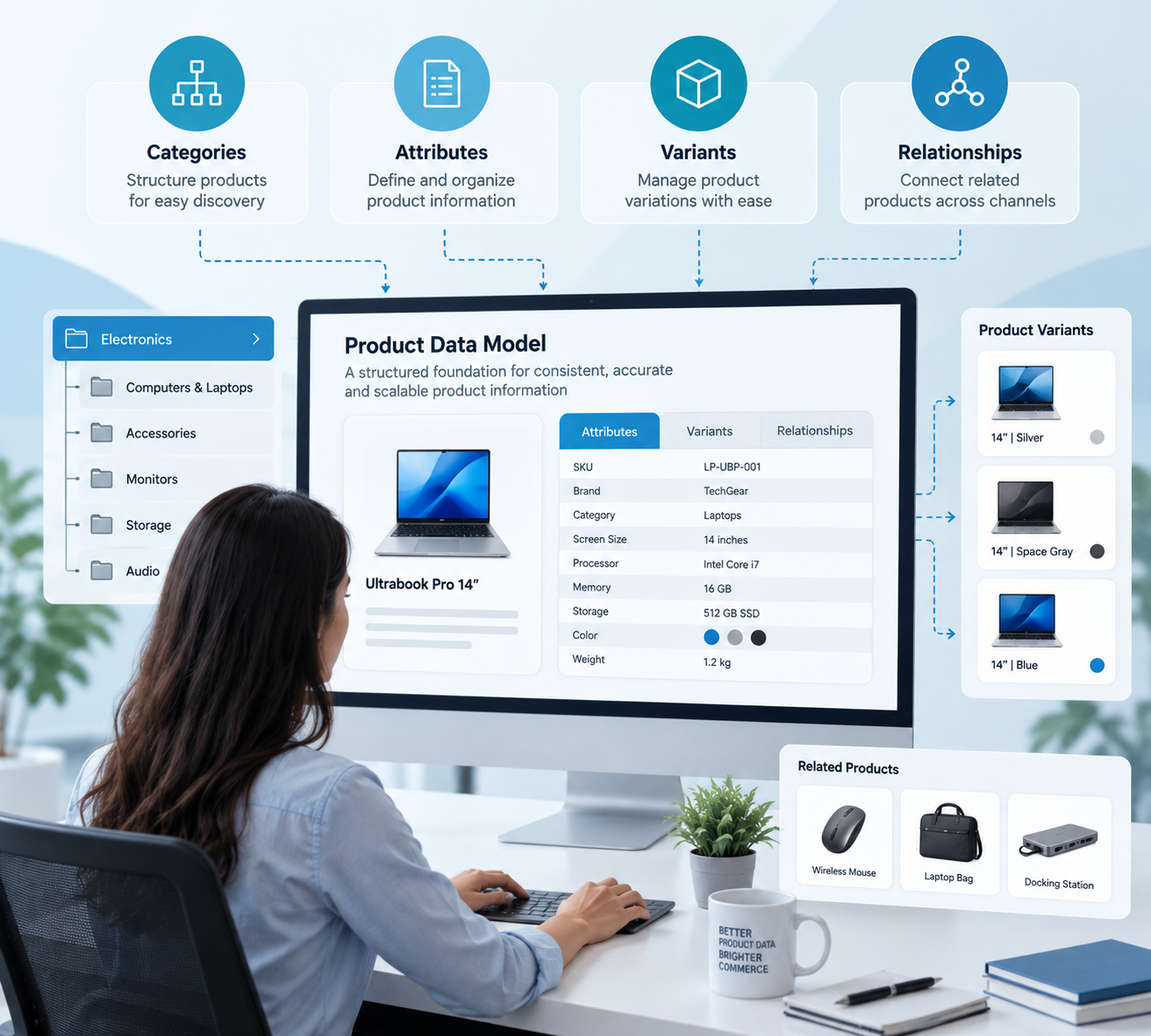
A PIM data model, also called a product information management data model or product data model, is the structure that defines how products are stored in a PIM: which product families exist, which attributes each family has (with units and allowed values), how variants inherit values from a parent, and how products relate to each other and to classification standards such as ETIM, ECLASS and GS1.

Every later step depends on it: enrichment, syndication, search and channel feeds.

Families and Classes

Groups of products that share attributes, such as ball bearings or women’s tops. Each family gets only the attributes it needs.

Attributes

Typed fields with units, allowed values and translations, so “Material” means the same thing on every product and in every language.

Variants and Inheritance

Values set once on the parent and inherited by each size or colour; only what differs is entered on the variant.

Relationships and Classification

Accessories, spare parts, bundles and replacements, and standards like ETIM, ECLASS or GS1.

The PIM shows NetSuite prices and stock where channels need them, but never edits them.
Product data modeling

PIM Data Model Example: Retail Apparel

A three-level product data model: shared content is entered once on the style and inherited by every colour and size.

Before and after: one style in six colours and five sizes is 30 separate products today. In this model it is one style, six colours and 30 SKUs, and the copy is written once.

The PIM shows ERP prices and stock (for example from NetSuite) where channels need them, but never edits them. Moving flat SKUs into a parent-child model is planned in the migration mapping: old records are grouped by style, duplicate copy is merged, and each SKU keeps its identifier. Channels that list each colour separately can still get one listing per colour from the same three levels.

More on models for retail apparel and fashion.

Style (Parent)

Brand, name, description, material, care instructions, season, category and size chart. Written once.

Colour Variant

Colour name as the supplier writes it, a colour family for filters (for example 'Blue' for navy and teal), colour images and swatch. Inherits everything else from the style.

Size Variant (SKU)

Size in its size system (US, UK or EU; letters or numbers), GTIN (the GS1 barcode number) and the link to price and stock. This is the item the channels sell.

The exact system of record depends on your existing architecture, applications, business processes, and product-data governance model. The objective is not to duplicate information between ERP and PIM.

It is to ensure that each system owns the right data and that approved information moves reliably between them.

Product Data Model Example: Industrial Part

A classification-led product data model example, typical for manufacturers and distributors.

The exact system of record depends on your existing architecture, applications, business processes, and product-data governance model. The objective is not to duplicate information between ERP and PIM. It is to ensure that each system owns the right data and that approved information moves reliably between them.

Product Family: Ball Bearings

ETIM or ECLASS class; technical attributes such as bore diameter (mm), outer diameter (mm) and dynamic load rating (kN), each stored with its unit.

Product Family: Pumps and Valves (example)

The same pattern for flow-control products: flow rate (m³/h or GPM), pressure rating (bar or psi), valve type, connection type and size, and body material, each with its unit and its class in the standard you use.

Related Products

Accessories, spare parts and replacements, linked so a buyer finds the seal kit from the pump.

Documents

Datasheets, CAD files and certificates, attached to the family or to the single item.

Our PIM Data Modeling Services

We design the model in discovery and implement it in your PIM. You can start from a blank sheet or from the model you run today.

Current-State Review

We find out what your data really looks like before we design anything.

  • Spreadsheets, ERP fields and your existing PIM, including a model another partner built
  • Which attributes are used, by which team and channel, and how full they are
  • Duplicates, near-duplicates and values copied on every variant
  • What each channel and trading partner requires

Data Model Design

A model your teams agree on, not one team’s view.

  • Families, attributes, variants, relationships and validation
  • Workshops with engineering, sales, marketing and eCommerce
  • One owner per attribute; the product owner settles disputes. If nobody has that role yet, naming one is the first decision
  • Naming, units and allowed values written down
  • The simplest model that supports your products and channels

Classification Standards

Your data fits what customers and channels expect.

  • ETIM (the open classification for technical products, used in electrical, HVAC and plumbing), ECLASS (formerly eCl@ss), GS1 and GDSN (Global Data Synchronization Network), UNSPSC (United Nations Standard Products and Services Code) or your own taxonomy
  • ACES and PIES (the Auto Care Association standards for vehicle fitment and product attributes) for the automotive aftermarket
  • Internal categories for navigation, mapped to the standard for feeds
  • Supplier data mapped into the same structure

Migration Mapping

From old fields to the new model, ready for data migration.

  • Every old field mapped, merged or retired
  • Flat SKUs grouped into parents and variants
  • Values cleaned and converted to the new units and lists
  • On a live PIM, attributes retired in stages, with each channel feed checked before the change goes live

PIM migration services

Implementation

The model built and tested in your PIM with real products.

  • Pimcore classes and Syndigo, as partners
  • Akeneo, Salsify, inRiver, Stibo STEP or your PIM, as independent consultants
  • Tested with real products from each family

See PIM implementation services, Pimcore implementation and Syndigo implementation.

Model Governance

How attributes are added or changed safely over time.

  • A request and approval process for new attributes
  • Roles: who may add, change and approve
  • Validation and completeness rules per channel
  • Regular reviews so the model does not sprawl again

See PIM workflow and product data quality management.

Where Your PIM Data Model Lives

The model is designed around your products and channels first, then built in the PIM you run or choose.

How Does a PIM Data Modeling Project Run?

Five steps: a free 30-minute assessment, a discovery of a few weeks where the core model is agreed, the build in your PIM, testing and go-live with your real products, then ongoing improvement under an agreed approval process.

What we need from you: a product owner who can make decisions, the people who know your product data from each team, and an export of your current attributes and products.

01 Free Assessment

A 30-minute call about your products, channels, systems and goals.

You get: a first view of how your model should look and what to fix first.

02 Discovery

A few weeks: current-state review, requirements and a phased plan. In workshops with each team we agree families, attributes, variants, classification and who owns what.

You get: the agreed core model (families, attributes with units and allowed values, variant levels and classification), the mapping from your old fields, and a phased plan.

03 Build

The data model built and tested in your PIM with real products.

You get: the model working in your PIM, tried on products from each family.

04 Test and Go-Live

Tested with real data and real users, then launched. Existing data moves into the model through the mapping, and channel feeds are checked against it.

You get: your products live in the new model, with feeds that still work.

05 Improve

Monitoring, training and the next set of improvements. New attributes follow the agreed request and approval process.

You get: a model that grows with new channels, markets and brands without sprawling.

PIM Data Modeling Cost and Timeline

How long does PIM data modeling take?

The core model is usually designed in discovery: a few weeks. It is refined while it is built and tested with real products during the first release. If the model is part of a full PIM implementation, a focused first release typically takes 3 to 6 months; larger programmes run in phases over 6 to 12 months or more.

What does PIM data modeling cost?

There is no fixed price. Five things set the effort: how many product families and attributes you have, whether you start from scratch or rework a live model, how many standards and channel templates it must meet (ETIM, GS1, ACES and PIES), how many teams, brands and languages must agree, and whether we also build, migrate and integrate.

Planning a PIM project and not sure of your budget yet? Book a free 30-minute PIM assessment. You leave with a view of your product data today, the platform that fits, and a rough roadmap and budget. See PIM implementation cost for the full project.

Writing an RFP? Start from our PIM RFP template and PIM requirements checklist.

  • Families and AttributesHow many product families you sell and how different their attributes are.
  • Your Starting PointA blank sheet, spreadsheets, or a live model that needs a rework and a migration of its values.
  • Standards and ChannelsHow many standards and channel templates the model must map to: ETIM, GS1, ACES and PIES, retailer templates.
  • Teams, Brands and LanguagesHow many teams must agree, and how many brands, markets and languages the model serves.
  • What Comes After the ModelWhether we also build it in the PIM, migrate your data and connect your systems.

Why Product Data Models Fail and How We Reduce the Risk

Eight ways a product data model goes wrong, and how we deal with each.

Risk

Our Approach

One team’s view becomes the model. The others work around it in spreadsheets.

Agreed in workshops. Every team is heard, each attribute gets one owner, and the product owner settles disputes. If nobody has that role yet, naming one comes first.

Old spreadsheet columns are copied into the PIM.

Review first. A field enters the model only if a team or channel uses it.

The model is too complicated to use.

As simple as it can be. The simplest model that supports your products and channels.

Values are copied on every variant.

Inheritance. Each value is set once, at the level where it belongs.

Standards are added late and do not fit.

Classification in the design. ETIM, ECLASS, GS1, UNSPSC or ACES and PIES are mapped while the model is designed.

Existing data or channel feeds break on the switch.

Mapped and tested. Every old field is mapped, the model is tested with real products, and feeds are checked before go-live.

ERP and PIM hold the same data twice.

Clear ownership. Each system owns the right data, and approved information moves between them.

The model grows out of control again.

Governance. A request and approval process for new attributes, roles, and regular reviews.

Inherited a model that went wrong, or a project that stalled? Tell us what happened, and we plan around it.

Book my free assessment

PIM Data Models by Industry

Each industry has its own attributes, standards and channel templates. Choose yours for the detail.

Pimcore Strategic Partner

Why Leading Enterprises Choose Credencys for PIM Data Modeling

What buyers check before they trust a partner with their product model. The short answer to “why not the PIM vendor’s team?”: we design the model for your products and every channel first, then build it in the platform you run or choose.

Brands logo

Product Data Expertise

150+ data experts in our data practice, working on PIM, MDM, data quality, taxonomy, data modeling, workflow and syndication for manufacturers, distributors and retailers. See the projects above.

Brands logo

Classification and Standards

We design the model so it maps to the standard your customers and channels use: ETIM, ECLASS, GS1, UNSPSC, ACES and PIES, or your own taxonomy. The standard is mapped while the model is designed, not added later.

Brands logo

End-to-End PIM Capabilities

One team from the model to implementation, migration, integration and support. Pimcore Strategic Partner and Syndigo partner, with independent advice on Akeneo, Salsify, inRiver and Stibo STEP, so the model fits your products, not one vendor.

Brands logo

Governance-First Approach

Ownership, validation rules, a request process for new attributes and approval workflows, so your product data stays clean after go-live.

How healthy is your product data?

8 questions: a score, your two weakest areas and a 30/90-day plan.

Check my product data

Frequently Asked Questions

Planning Your PIM Data Model?

Get a free 30-minute review of your products, attributes and categories. You leave knowing how your model should look and what to fix first.

Book my free assessment