
Trusted by Best
Choosing Credencys means partnering with a team that’s deeply committed to unlocking the true value of your data. Here’s why industry leaders trust us:


Pimcore Strategic Partner · 80+ certified Pimcore experts · Syndigo partner · Semarchy partner
50+
Enterprise Clients
100%
Certified Consultants
15+
Years Experience
4.9/5
Client Satisfaction
When Electrical Distributors Need a PIM
Most electrical distributors and wholesalers call us in one of these situations. If one sounds like yours, a 30-minute call is worth your time.
Short on time? Jump to results, ERP and systems, cost and timeline or risks.
Behind all six is the same fact: you resell wire and cable, circuit protection, controls, wiring devices, lighting and datacom products from hundreds of manufacturers, each with its own formats, attributes, classifications and update cycles, and your contractors expect the same complete product data at the counter, on the website and in their portal.
Related: PIM for distribution, PIM for industrial distributors and our guide to PIM for electrical distributors.
“Every manufacturer sends data in a different format.”
Spreadsheets, PDFs, portal exports, email attachments and data feeds such as IDEA Connector, each with its own attribute names, units and categories. Someone remaps every file by hand before it can go live.
“Customers filter by voltage and get blanks.”
Voltage, amperage, wire gauge, IP rating, certifications and dimensions are missing or sit in free text. Filters show half the products, searches return nothing, and customers call the branch to check the spec.
“The branch counter and the website show different data.”
The ERP, the webstore, the customer portal, branch systems and spreadsheets each hold their own version of the same product, and nobody is sure which one is right.
“We have to classify the whole catalog to ETIM.”
Each product has to fit the manufacturer’s categories, your own hierarchy, ETIM classes and every channel’s categories at the same time, and today that is done in spreadsheets.
“The changes never stop.”
New launches, discontinued items, replacements, spec updates and new revisions of spec sheets and certificates arrive every week. Without one process, the website and the branches find out late.
“The same SKU exists three times.”
Acquisitions, legacy item numbers and different manufacturer records have left duplicates and conflicting values across ERP, DAM, eCommerce and branch databases, held together by scripts and file transfers.
Still preparing? Use our PIM requirements checklist, the free PIM RFP template, the PIM data migration checklist or the PIM Cost & Business Case Builder, and read how to choose a PIM implementation partner. Implementation is one part of our end-to-end PIM services.
What You Get From the Call
In 30 minutes, a senior PIM consultant looks at how manufacturer data reaches you today, where it has to go, and what to fix first. You need nothing prepared. A sample manufacturer file and a list of your systems help.
Your Product Data Today
How manufacturer files come in, which attributes and classes are missing, which ERP and branch systems hold what, where the branches and the website disagree, and why searches return nothing.
The Platform That Fits
Keep and fix what you run, or choose a new PIM. We partner with Pimcore and Syndigo and give independent advice on Akeneo, Salsify, inRiver and Stibo Systems STEP. We show how ETIM, your own hierarchy and your channel categories would sit side by side for your catalog.
A Rough Roadmap and Budget
What to do first (often one category or manufacturer group), what it depends on, and the main cost drivers for your catalog.
No Obligation
The call is free. If you later want help, we send a proposal, but the call itself is not a sales pitch.

Manish Shewaramani, VP Sales
Your first contact. Manish personally reviews every request and guides you through your call with a senior PIM consultant.
What PIM and ETIM Classification Cover for Electrical Wholesalers
A PIM gives electrical distributors and wholesale distribution businesses one governed record per product, built from every manufacturer’s data. It maps supplier files to your attributes and units, classifies products to ETIM and your own categories, links spec sheets and certificates, and sends the same record to ERP, webstore, branches and customer portals. Five things it does for you:
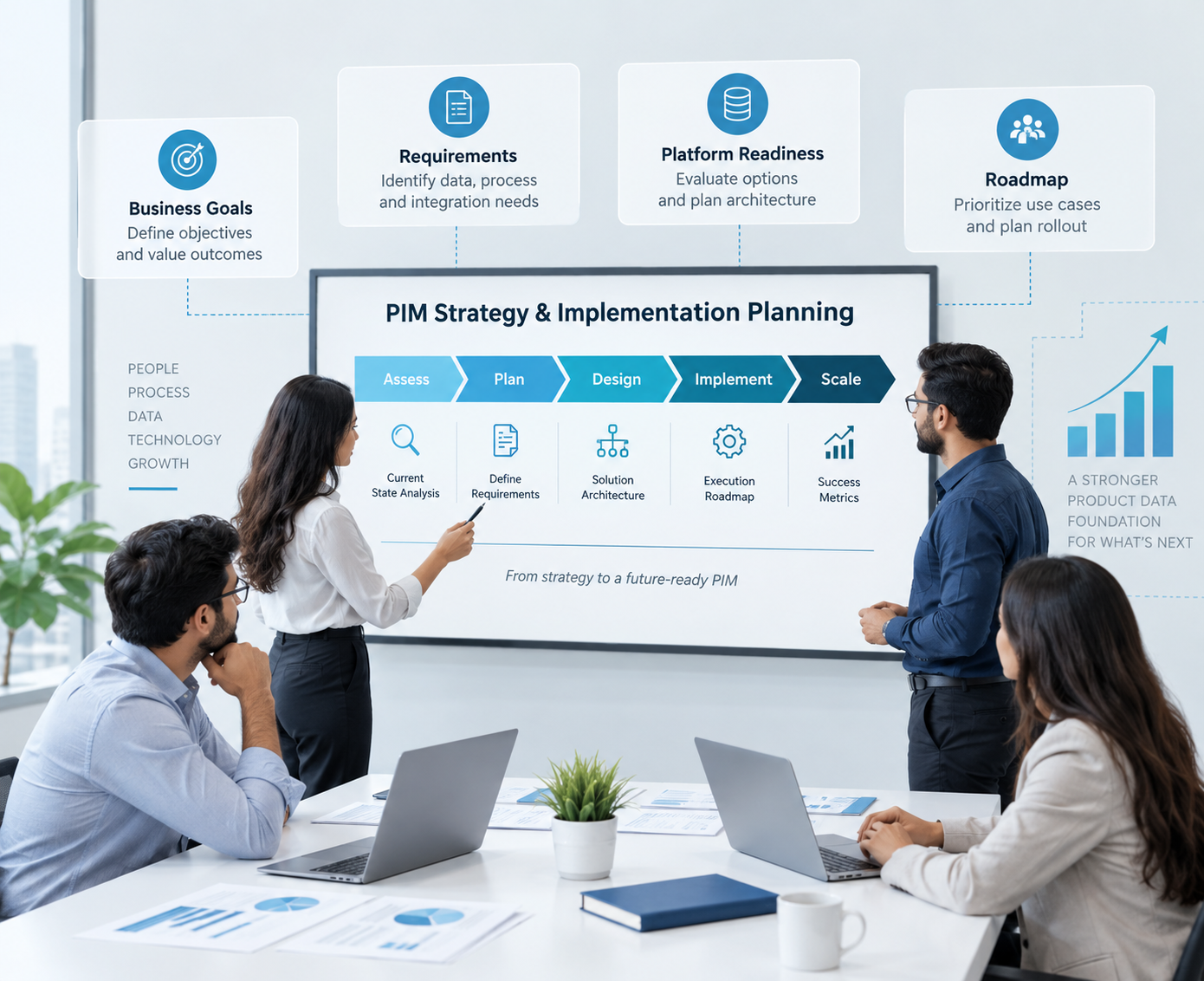
One Product Record for ERP, Webstore and Branches
Teams in catalog operations, eCommerce, sales and IT work from the same product record.
- Data from manufacturers, ERP, spreadsheets, portals and legacy applications in one place
- Duplicate and conflicting records removed
- The same product information in every channel
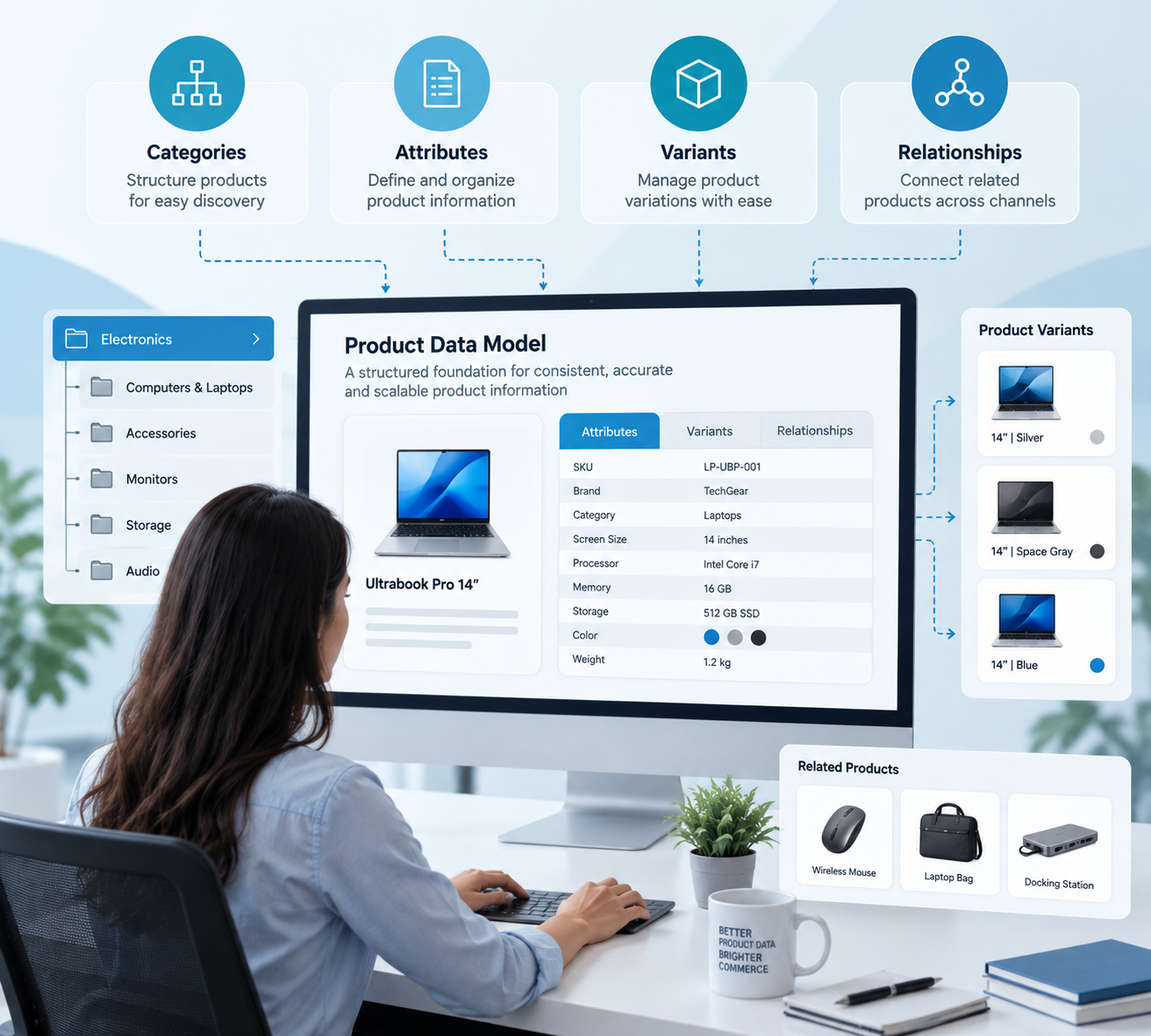
Manufacturer Data Onboarding
Manufacturer files become channel-ready product records without remapping each one by hand.
- Imports from spreadsheets, PDFs, portals, APIs, data pools and feeds
- Manufacturer attributes mapped to your product model
- Incomplete records flagged before they are published
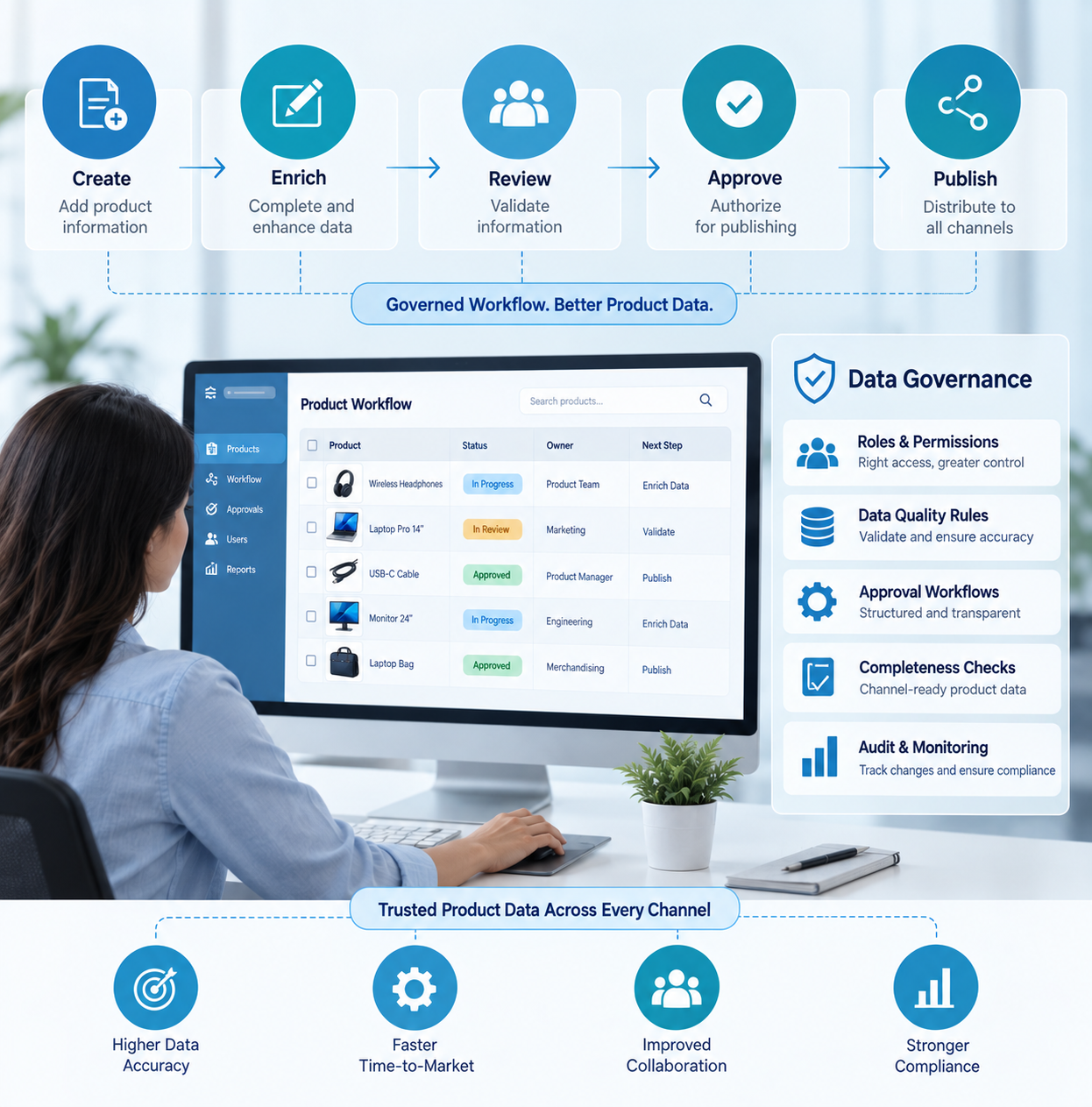
- Approval workflows for new and changed products
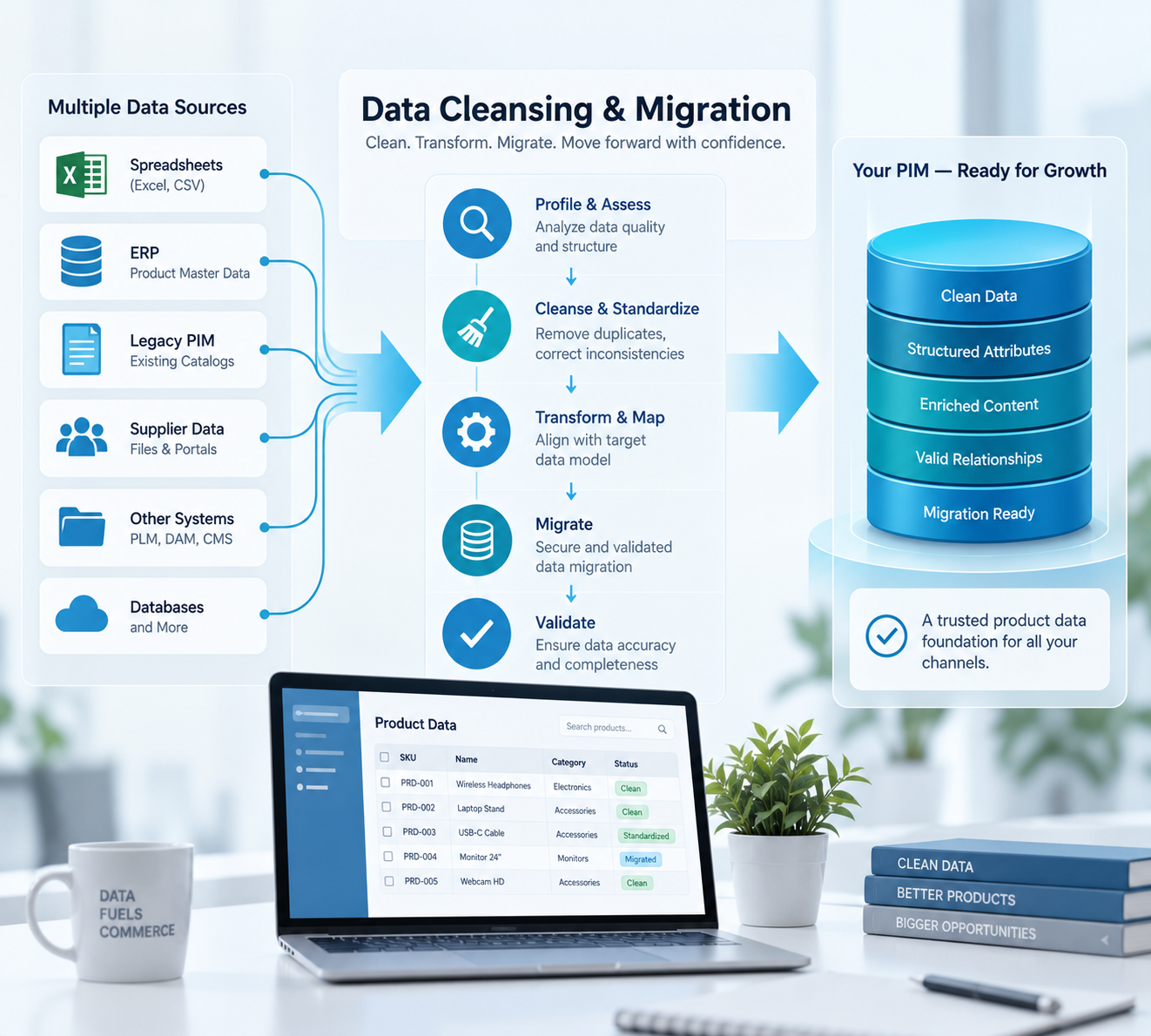
Technical Attributes and ETIM Classification
Voltage, current, wattage, dimensions, materials, certifications, environmental ratings and mounting details in one standard, so products can be filtered and compared.
- Attribute names, values and units normalized
- Internal, ETIM (ElectroTechnical Information Model) and channel-specific taxonomies maintained side by side
- Completeness and validation rules per category
Done before: classifications, attribute names, values and units standardized across 185+ manufacturers for a 240,000-SKU electrical distributor.
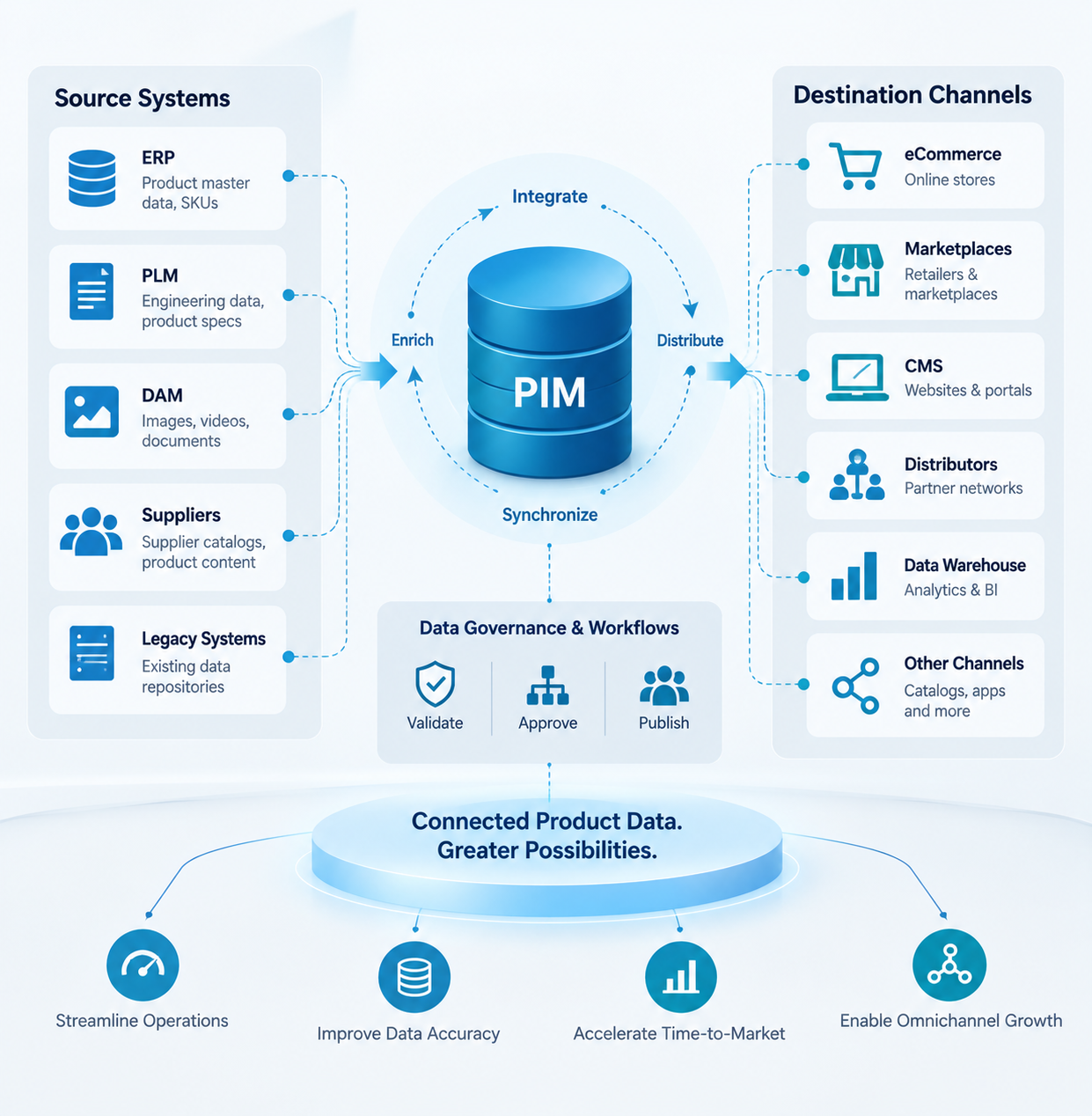
Every Channel From One Record
Each channel gets the attributes, descriptions, images and documents it needs, without a second copy of the product.
- Product information published to eCommerce, customer portals, catalogs, branches and sales tools
- Channel-specific requirements without duplicate records
- Updates kept in sync across downstream systems
Search, Recommendations and AI Readiness
Customers find products by technical requirement, compatibility and application.
- Better technical search, filtering and comparison
- Accessory, replacement and compatible-product recommendations
- Product data structured for natural-language search and AI assistants
How a PIM Fits With Your ERP, Branches and Webstore
A PIM does not replace your ERP. It sits between your manufacturers and your channels and keeps product data right on the way through. We agree which system owns what before anything is connected. More on connecting systems: PIM integration services and PIM ERP integration.
System
What it does with the PIM
Manufacturer data sources
Spreadsheets, PDFs, portals, APIs, data pools and feeds, including data received through IDEA Connector, come into the PIM, are mapped to your attributes and checked before anything is used downstream.
ERP
Stays the system of record for item numbers, suppliers, inventory, costs, pricing and orders. The PIM adds technical attributes, classes, descriptions, relationships and documents. Before anything is built we agree which system creates a new item, which fields go back to the ERP, and how often the two sync. We connect SAP, NetSuite, Microsoft Dynamics 365, Oracle and custom ERPs. A distribution ERP such as Epicor Eclipse, Infor SX.e/CSD or Prophet 21 follows the same split, connected through APIs or middleware; the assessment covers the approach and effort for yours.
Branch systems and sales applications
Branch databases, counter and sales tools read the same approved product data as the website, so the counter and the webstore no longer disagree.
Digital asset management
Images, spec sheets, installation guides, certificates, safety data sheets and drawings are linked to the right products and published with them.
Webstore and site search
Complete, structured attributes feed filters, comparison and the search engine, so customers find products by voltage, rating or part number. We connect Adobe Commerce (Magento), Salesforce Commerce Cloud, commercetools, BigCommerce, Shopify and WooCommerce. The PIM fixes the data that search reads; synonyms and ranking rules stay in your search tool.
Customer portals and catalogs
Contractors, panel builders and OEM customers see the same product data in their customer portal and print catalogs.
Search and AI applications
Structured attributes and product relationships feed recommendations and AI-powered product search, while those tools keep doing their own job.
Our Approach to PIM Implementation Services
Our PIM implementation services turn scattered manufacturer data, technical attributes, taxonomies and channel requirements into one product-data foundation, in four steps. Larger programmes run in phases, often one category or manufacturer group at a time.
What we need from your team: someone who can decide which system owns which data, the people who know your categories and manufacturers, and access to sample files and your systems.
We look at your catalog, manufacturer sources, systems, workflows, channels and goals. You get: a PIM roadmap with priorities, the platform choice and a firm plan. Discovery takes a few weeks, not months.
We design the product-data model, taxonomies (internal, ETIM and channel), technical attributes, workflows, user roles and integrations for your electrical catalog. You get: a configured PIM your catalog team has approved, category by category.
We cleanse and migrate existing product information, set validation rules, assign data ownership and configure enrichment and approval workflows. You get: clean, complete records and rules that keep new manufacturer data clean.
We launch the PIM across priority categories and channels, train your users, monitor performance and stay on for post-deployment support. You get: a live PIM your team uses, and a partner after go-live.
PIM for Electrical Distributors: Cost and Timeline
How long does a PIM project take for an electrical distributor?
Discovery takes a few weeks. A first release typically takes 3 to 6 months. Larger programmes, with many manufacturers, several systems or a legacy migration, run in phases over 6 to 12 months or more. A common way to keep the first release short is to start with one category or manufacturer group, then add the rest.
What does PIM for electrical distributors cost?
Five things change the cost most. On the free call you get the main cost drivers and a rough budget for your catalog; a sample manufacturer file makes it sharper.
Manufacturers and Formats
How many manufacturers send data, in how many formats, and whether feeds, templates or a supplier portal are needed.
Catalog Size and Attribute Depth
How many SKUs, how many attributes per category, which classification standards (internal, ETIM, channel) and how many relationships such as accessories and replacements.
Enrichment Work
How many attributes are missing today, how much has to be cleaned and de-duplicated, and who fills the gaps: your team, ours, or both.
Systems to Connect
Your ERP, webstore and search, branch systems, customer portals and DAM, and whether standard connectors are enough.
Platform and Starting Point
A new PIM, or fixing and upgrading the one you run, and the licence model of the platform you choose.
How Healthy Is Your Product Data?
8 questions: a score, your two weakest areas and a 30/90-day plan.
Check my product dataWhy PIM Projects Fail at Electrical Distributors and How We Reduce the Risk
Distributor PIM projects usually stall for one of three reasons: manufacturer data is worse than expected, the ERP and PIM disagree about who owns the item, or branches and the webstore drift apart again after go-live. We plan for nine risks like these from the first week. Here is how we deal with each.
Risk
Our Approach
Manufacturer data is worse than expected. The scope grows once the real files are opened.
Looked at first. Real manufacturer files are reviewed in discovery, and completeness rules per category are set before the scope is fixed. Bring a sample file to the free call for a first view.
The ERP and the PIM fight over the item master.
Ownership agreed first. The ERP stays the system of record for items, inventory and pricing; the PIM owns the enriched product data. Decided before anything is built.
Branch and web data drift apart again.
One publishing route. Branch applications, portals and the webstore are fed from the same approved record through API or middleware, not spreadsheets and scripts.
Filters are still blank after go-live.
Taxonomy first. Categories, attribute groups, units and allowed values are agreed and configured before the data is loaded.
The clean-up never ends. New manufacturer files arrive as messy as the old ones.
Checks at the door. Mapping templates, validation and exception workflows stop bad records before they reach the catalog.
Duplicates come back. Acquired catalogs and legacy item numbers bring them in again.
Identity matching. Records are consolidated and deduplicated, and data-quality dashboards watch duplicates and exceptions after go-live.
Go-live disturbs order entry or the webstore.
In phases. We launch across priority categories and channels first, with testing before each release.
The team goes back to spreadsheets.
Built for the people who use it. User roles, approval workflows, clear data ownership and training are part of the delivery.
The partner disappears after go-live.
Support after launch. Deployment includes monitoring and ongoing post-deployment support. PSG, a Dover company, has had our support since its Syndigo PIM went live.
Had a PIM project that stalled, or a partner who went quiet? Tell us what went wrong, and we plan around it.
Book my free assessmentBusiness Impact of PIM for Electrical Distributors
What changes once manufacturer data, attributes and channels run through one governed PIM.

Faster Manufacturer Onboarding and Time to Market
Ingestion, mapping, validation and approval are automated, so new manufacturers, categories and assortments go live sooner.
Consistent Taxonomy and ETIM Classification
Categories, attributes, values and units follow one standard across manufacturers, systems and customer-facing channels.
Accurate, Consistent Product Data
Validation rules and governance reduce duplicate records, conflicting values and costly corrections downstream.
Complete Product Records and Relationships
Products carry their specs, documents, accessories, alternatives, replacements and compatibility data.
Better Search, Discovery and AI Readiness
Structured attributes and relationships improve search, filters, comparison and recommendations, and prepare the catalog for natural-language search and future AI work.
Consistent Data at the Branch, Online and in Portals
The same governed product information reaches eCommerce, portals, branches, catalogs and sales applications without duplicate upkeep.
Results from these projects are in the stories above.
Why Electrical Distributors Choose Credencys
What electrical distributors check before they shortlist a PIM partner.

Domain-Focused Solutions
We have delivered PIM for electrical distributors starting from manufacturer onboarding, webstore search, and ERP and branch synchronization (see the stories above). We know how wire and cable, circuit protection, controls and lighting data behave.

Enterprise-Grade Partnerships
Pimcore Strategic Partner with 80+ certified Pimcore experts; Syndigo partner, Syndigo Americas Emerging Partner of the Year 2023; Semarchy partner. Independent advice on Akeneo, Salsify, inRiver and Stibo STEP. We implement, we do not sell one product, so the platform fits your catalog and systems.

End-to-End Data Expertise
A practice of 150+ data experts with 15+ years of experience: assessment, data model and taxonomy, manufacturer onboarding, enrichment, migration, integration and support after go-live, with ownership between ERP, PIM, DAM and webstore agreed first.

Product Data Ready for AI Search
Every product gets complete attributes with units, a standard class and clean relationships. AI search, recommendations and buying assistants read structured fields, not PDFs, so the work that fixes your filters also prepares your catalog for AI.
We Build PIM Solutions for
Each industry has its own data, standards and channels. Choose yours for the detail.

Frequently Asked Questions
PIM for electrical distributors is a central system that collects product data from every manufacturer, maps it to one model with standard attributes, units and ETIM (ElectroTechnical Information Model) classes, adds spec sheets, images and certificates, and publishes the same approved record to your ERP, webstore, branches, customer portals and catalogs.
Five things: manufacturers and formats, catalog size and attribute depth, enrichment work, the systems you connect, and the platform and starting point, as explained under cost and timeline. On a free PIM assessment you get the main cost drivers and a rough budget for your catalog.
Yes, and it is the most common way to keep the first release short: one category or manufacturer group first, then the rest. Typical durations are under cost and timeline.
We can do it, your team can do it in the PIM with our workflows, or both, agreed category by category in discovery. For one electrical distributor with 310,000+ products we enriched records with specifications, images, drawings, certificates and installation documents. The PIM flags incomplete records, so the work goes where it matters first.
ETIM (ElectroTechnical Information Model) is an open, international classification standard for technical products. Each ETIM class lists the features a product type must carry, with set values and units, for example a circuit breaker’s rated current in amperes. When manufacturers and wholesalers use the same classes, data moves between them without remapping, and webstore filters work.
A PIM holds ETIM classes, features, values and units next to your own hierarchy and each channel’s categories, and checks every product against its class’s required features before it is published. It can also hold other standards, such as ECLASS. More on ETIM and ECLASS classification.
Yes. Product data received through IDEA (Industry Data Exchange Association) Connector can be brought into a PIM, mapped to your attributes, validated, enriched and published to your channels. The same PIM manages ETIM classes, features, values and units next to your internal and channel taxonomies, so standard classification reaches internal systems and customer-facing channels.
The ERP keeps items, inventory and pricing; the PIM holds the approved product information and publishes it to the webstore, customer portals, branch applications and sales tools through APIs or middleware, not spreadsheets and scripts.
A PIM such as Pimcore or Syndigo, connected to your ERP, gives the most reliable manufacturer catalog integration for branches. Reliability depends on four things: import mapping per manufacturer, validation before publishing, a clear split between what the ERP and the PIM own, and one publishing route to the webstore, portals and branch systems. Akeneo, Salsify, inRiver and Stibo STEP can also fit.
We are a Pimcore Strategic Partner and a Syndigo partner; on the free assessment we compare platforms for your catalog and ERP.
Yes. PIM can integrate with ERP, DAM, eCommerce, CRM, manufacturer feeds, supplier portals, data platforms, marketplaces, customer portals and custom applications. The architecture depends on your platforms, data volumes, update needs and workflows. How the ERP and the PIM split the work is under ERP and systems; more in PIM integration services.
There is no single best PIM; the right one depends on your ERP, catalog size and ETIM needs. It has to handle data from hundreds of manufacturers: import templates per supplier, technical attributes with units, ETIM classes, product relationships such as accessories and replacements, and integration with your ERP and webstore.
We mostly implement our partner platforms, Pimcore and Syndigo. We also give independent advice on and implement Akeneo, Salsify, inRiver and Stibo STEP, and we can fix or upgrade a PIM you already run. See also PIM for distribution.
ERPs manage item numbers, suppliers, inventory, costs, pricing and orders. They are not built to hold dozens of technical attributes per product type with units, ETIM classes, spec sheets, certificates, and accessory and replacement links for every product. A PIM adds that layer and sends it back to the ERP and out to every channel.
It makes the technical attributes used by search, filters, comparison and recommendations complete and consistent. When voltage, current, dimensions, ratings, materials, certifications and mounting types are structured correctly, customers find and evaluate products faster. Many distributors start with the categories that get the most zero-result searches. More in eCommerce search for electrical distributors.
Yes. Spec sheets, installation guides, certificates and safety data sheets are linked to the right products and published with them to your website and partners.
Each supplier’s data is imported through a template, mapped to your attributes and checked against validation rules, so data from every manufacturer ends up in one consistent format. See supplier onboarding for electrical distributors.
Ready to Modernize Your Electrical Product Data?
Book a free 30-minute assessment with a senior PIM consultant. You leave with a view of your manufacturer data and attribute gaps, the platform that fits, and a rough roadmap and budget.
Book my free assessment