
Trusted by Best
Choosing Credencys means partnering with a team that’s deeply committed to unlocking the true value of your data. Here’s why industry leaders trust us:


Pimcore Strategic Partner · Syndigo partner · Semarchy partner
50+
Enterprise Clients
100%
Certified Consultants
15+
Years Experience
4.9/5
Client Satisfaction
When Companies Selling in the DACH Region Need a PIM
Customers in Germany, Austria and Switzerland expect some of the most demanding product data in Europe: BMEcat catalogs, ETIM or ECLASS classes, content in several languages and complete product safety information.
PIM Consulting and Implementation for German Companies
Product information management (PIM) is software that holds every product’s attributes, classes, texts, translations, images and documents in one place and publishes them in the format each customer, marketplace and shop requires. Credencys is a Pimcore Strategic Partner, and we plan and implement PIM for companies in Germany and the wider DACH region.
Most companies call us in one of these situations.
“Every customer wants a different catalog.”
Wholesalers and buyers ask for BMEcat files with ETIM or ECLASS classes, each with its own version and rules. Someone builds them by hand from Excel lists, and every new customer adds another file.
“Our ERP holds the article, not the product content.”
SAP or Dynamics 365 has article numbers, prices and logistics data. Descriptions, technical attributes, images, data sheets and translations sit in spreadsheets and shared drives, and nobody is sure which version is right.
“Suppliers, stores, our webshop and Amazon.de all need different data.”
Supplier data and images arrive in every format, and stores and the webshop show different details. Amazon.de, Otto and Kaufland each have their own template and checks, so your team fixes the same product in several places. Companies entering Germany from the US or UK meet all of it at once.
“GPSR data has to be complete for every product.”
Since 13 December 2024, the EU General Product Safety Regulation (GPSR, Regulation (EU) 2023/988) requires warnings and safety information in each language, manufacturer details and, for makers outside the EU, a responsible person in the EU for products sold in the EU. Spreadsheets cannot show what is missing.
“German first, then English, French and Italian.”
Texts are translated in spreadsheets, a missing translation shows up only after a product is live, and every new export market means another round of copying.
“Our PIM project has stalled.”
A platform was chosen, but releases slip and the team is back in Excel. You want an independent view of what to fix before you spend more. We have taken over and upgraded a PIM built by a previous provider.
What You Get From the Call
In 30 minutes, a senior PIM consultant looks at your products, customers, channels and systems and tells you what to do first. You need nothing prepared. A sample BMEcat file, an article export from your ERP or a marketplace template helps.
Your Product Data Today
Where your product data lives now (ERP, Excel, shared drives), which customers and channels it has to reach, and where catalogs and listings get stuck.
The Platform That Fits
Pimcore, Syndigo, or a platform we advise on and implement independently (Akeneo, Salsify, inRiver, Stibo STEP). If you already have a PIM, whether to fix it or move.
A Rough Roadmap and Budget
What to do first (often one product range, one customer catalog or one marketplace), what it depends on, and the main cost drivers.
No Obligation
The call is free. If you want help afterwards, we send a proposal, but the call itself is not a sales pitch.

Manish Shewaramani, VP Sales
Your first contact. Manish personally reviews every request and guides you through your call with a senior PIM consultant.
German Requirements We Build Into Your PIM
The local requirements we model into your PIM from day one. Not sure where to start? Take the free PIM Fit Check.
 Your challenge
 What we build into your PIM
Each customer wants a different catalog
BMEcat exports per customer, with ETIM or ECLASS (eCl@ss) classes per product group, checked before they are sent.
Supplier data in many formats
Supplier files mapped to one product model and checked on import, so new articles arrive complete.
Content in many languages
Multilingual content for DACH and EU markets, with translation workflows: who translates, who approves, and a flag for every missing translation.
Product safety (GPSR, EU 2023/988)
Fields for warnings and safety information per language, manufacturer and EU responsible person, product identifiers and documents, with review dates. A product cannot be published while a required field is empty.
Digital Product Passport
A data model that can take the extra attributes of the EU Digital Product Passport, which the Ecodesign for Sustainable Products Regulation (ESPR) introduces product group by product group.
Marketplace rules
Marketplace feeds for Amazon.de, Otto and Kaufland from the same product record.
Data protection
Access rights and hosting planned with GDPR in mind.
PIM Consulting and Implementation Services in Germany
Product information management consulting and implementation, from the first assessment to support after go-live. Our PIM consultants can run the whole programme or the parts you need.
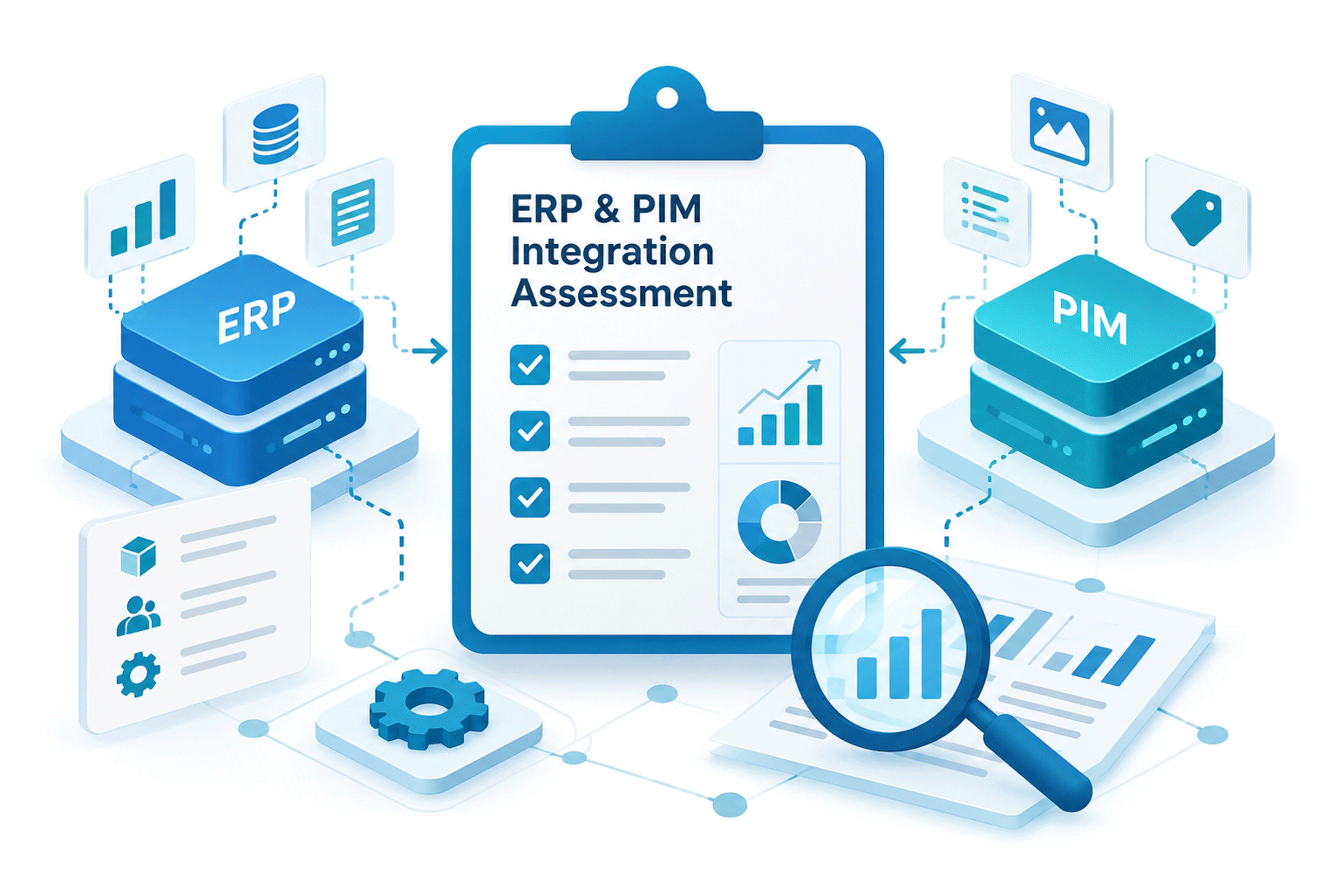
PIM Consulting
Requirements, data model and platform choice, agreed before anyone configures anything.
- Review of your product data, systems and customers’ catalog requirements
- Requirements for BMEcat, classification, languages and GPSR
- Platform comparison: Pimcore, Syndigo, Akeneo, Salsify, inRiver, Stibo STEP
- A phased roadmap and budget
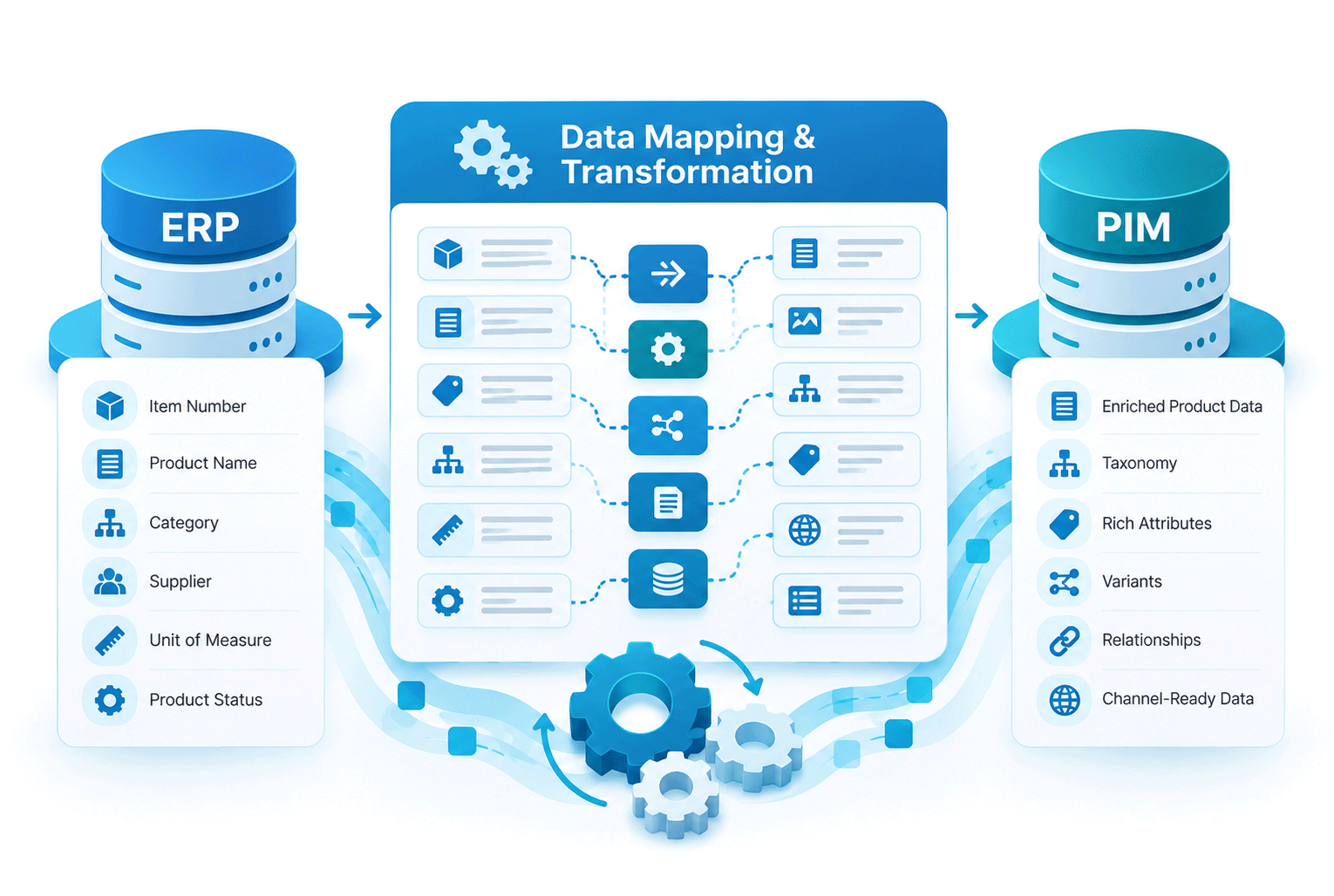
PIM Implementation
Configuration, workflows, go-live and training.
- Product model, ETIM or ECLASS classes and variants
- Enrichment, translation and approval workflows
- Completeness rules per customer and channel
- Testing with your data, training and go-live
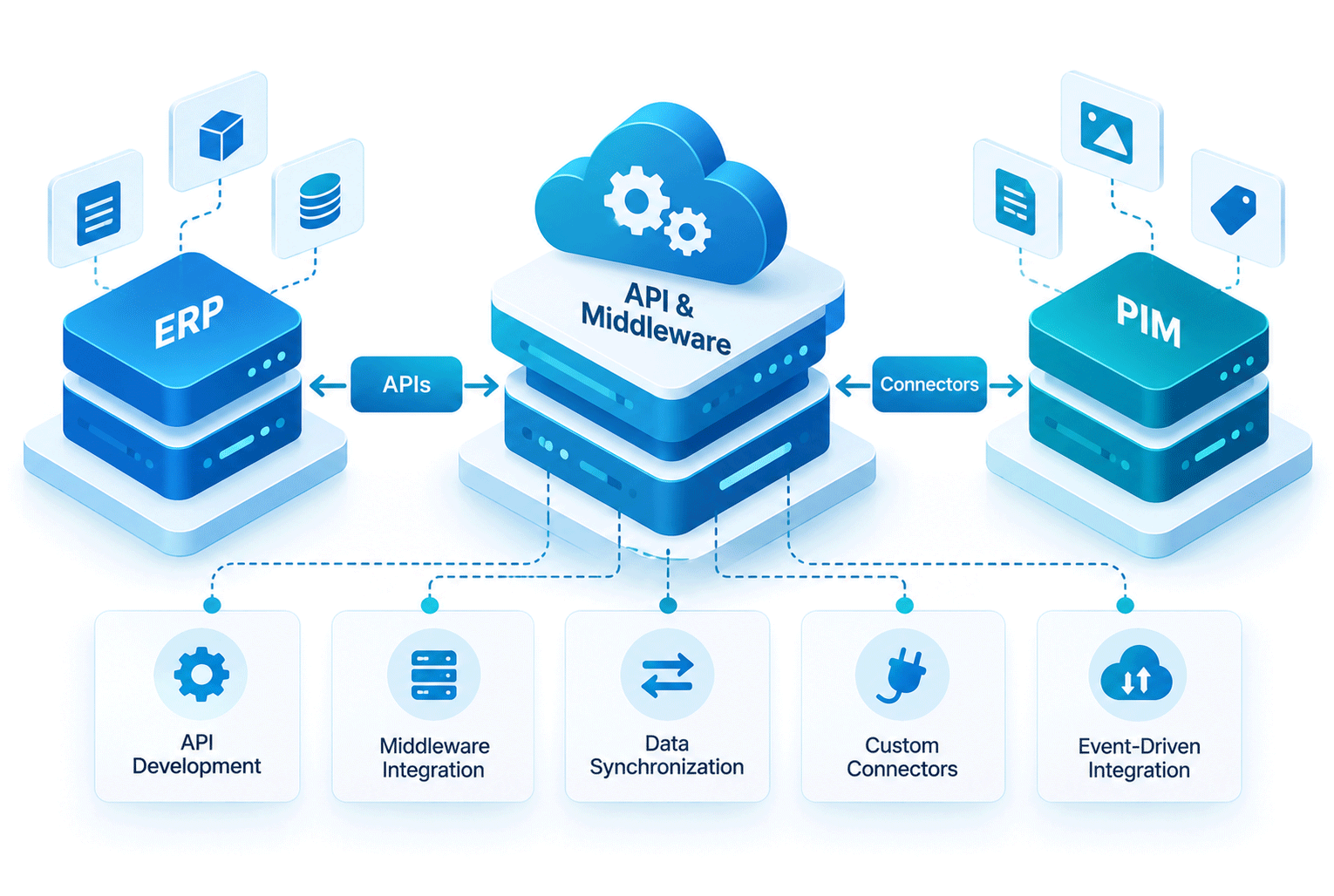
PIM Migration
Product data moved from spreadsheets, an ERP or another PIM, without moving the errors.
- Duplicates, gaps and conflicts found first
- Names, units and values standardised
- Old fields mapped to the new model
- Checked against the source before the switch
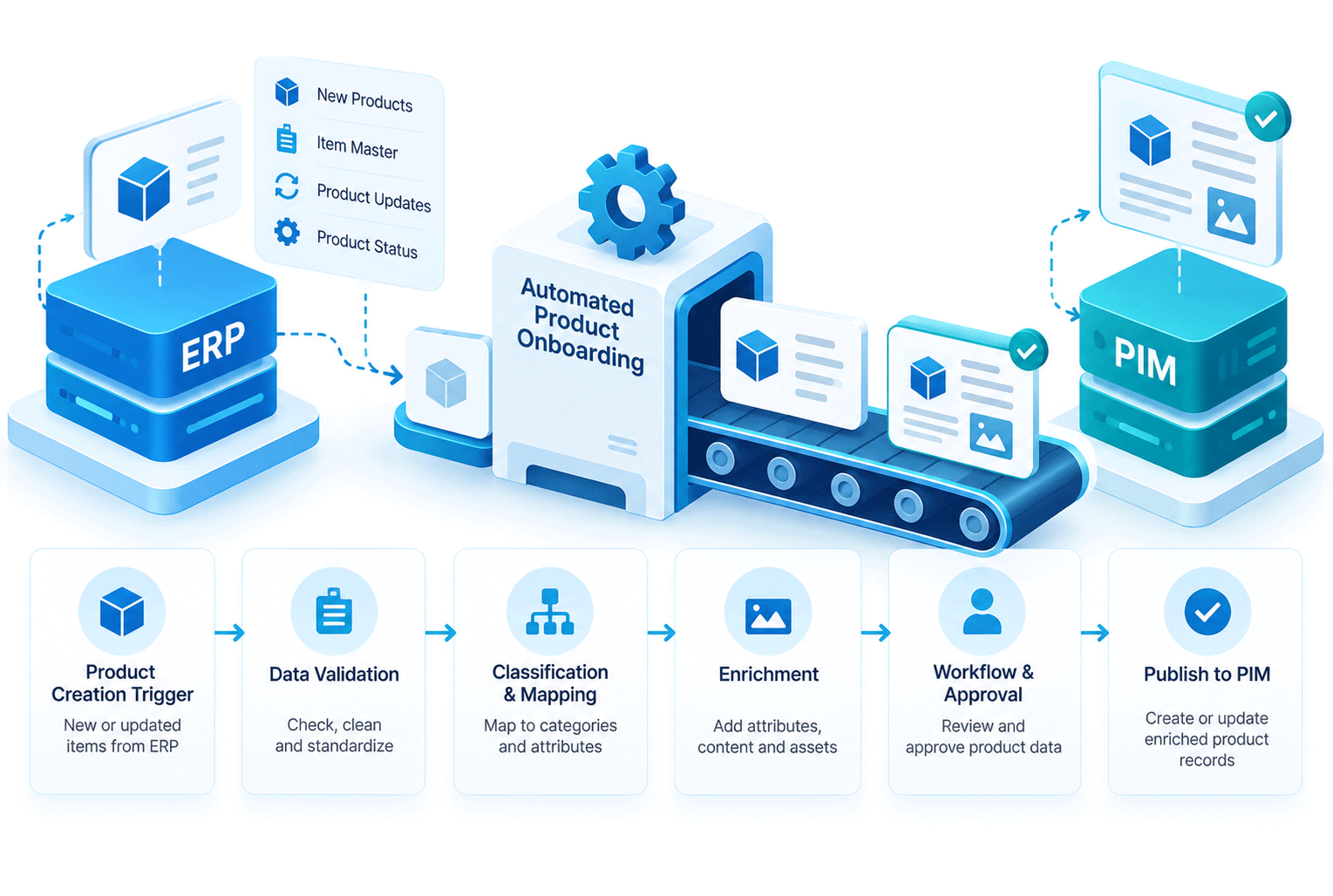
PIM Integration
Your PIM connected to the ERP, eCommerce store and marketplaces.
- ERP: SAP, Microsoft Dynamics 365, Oracle
- Shops: Shopify, Adobe Commerce, Salesforce Commerce Cloud, commercetools
- Marketplace feeds for Amazon.de, Otto and Kaufland
- BMEcat catalogs for customers, and your DAM
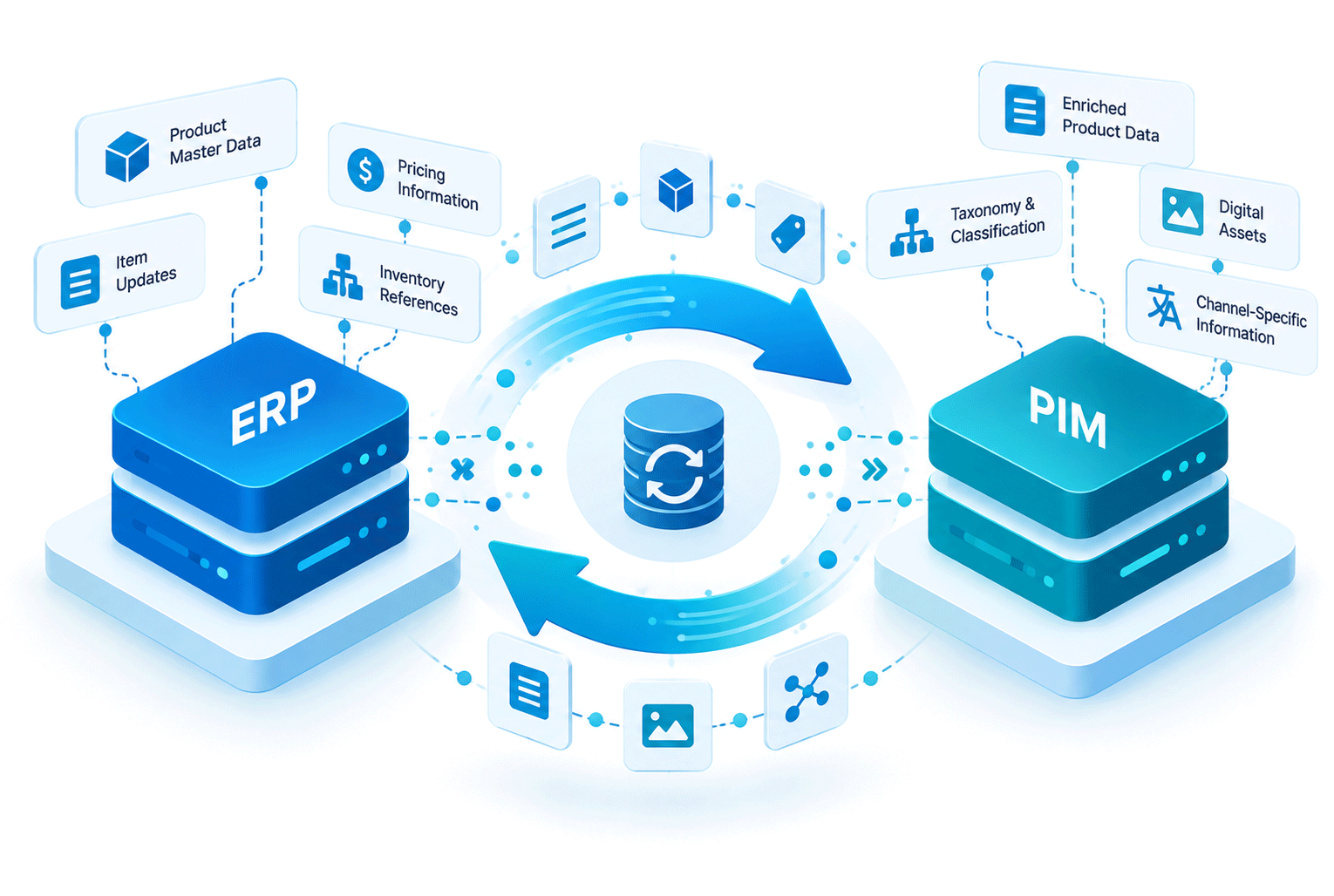
Pimcore Development
Custom data models, connectors and portals.
- Data models for technical and variant-rich catalogs
- Connectors to ERP and other systems
- Supplier and customer portals
- Upgrades of existing Pimcore installations
Dedicated PIM Developers
Certified Pimcore developers for ongoing work.
- New channels, markets and customer catalogs after go-live
- Changes and fixes by people who know your setup
- A team that grows or shrinks with the work
Which PIM Platform Fits Your Business?
There is no single best PIM system or PIM software in Germany. The right one depends on your catalog, your customers’ catalog rules, your channels and your ERP.
We are a Pimcore Strategic Partner with 80+ certified Pimcore experts and a Syndigo partner, and we advise on and implement other platforms independently. Compare them in our free PIM platform comparison matrix.
01 Pimcore
Pimcore Strategic Partner · 80+ certified Pimcore experts
Open-core and very flexible for complex catalogs, with PIM, MDM and DAM in one platform. Often the fit for manufacturers and wholesalers with technical attributes, many customer catalogs or supplier portals.
02 Syndigo
Syndigo partner · Syndigo Americas Emerging Partner of the Year 2023
SaaS PIM and MDM, strong in syndication to retailers and data pools.
03 Akeneo and Salsify
Independent advice and implementation
Popular with brands that sell on many marketplaces. We are not partners of these vendors, so our advice is independent. We also implement them, and can review or fix an Akeneo or Salsify setup you already have.
04 inRiver and Stibo STEP
Independent advice and implementation
Enterprise PIM and multidomain MDM for larger programmes.
Already running a PIM that is not delivering? We look at what you have built and tell you whether to fix it or move.
Does a PIM Replace SAP or Dynamics 365?
No. Your ERP usually stays the system of record for articles, prices and stock. The PIM owns the product content around it: attributes, classes, texts, translations, images, documents and safety data.
The exact system of record depends on your existing architecture, applications, business processes, and product-data governance model. The objective is not to duplicate information between ERP and PIM. It is to ensure that each system owns the right data and that approved information moves reliably between them. See PIM integration services.
ERP
SAP, Microsoft Dynamics 365 or Oracle. Article numbers and base data come in through the ERP’s APIs or a middleware layer; enriched data goes back where you need it. We agree the split with your ERP team or ERP partner.
Customers
BMEcat catalogs with ETIM or ECLASS classes, generated per customer from the PIM instead of built by hand.
Marketplaces and Shops
Amazon.de, Otto and Kaufland, and shops on Shopify, Adobe Commerce, Salesforce Commerce Cloud, commercetools, BigCommerce or WooCommerce.
Images, Documents and Suppliers
A DAM for images, data sheets, manuals and safety documents, kept with each product, and supplier files checked on the way in.
How a PIM Project Runs
A focused first release typically takes 3 to 6 months; larger programmes run in phases over 6 to 12 months or more.
What we need from you: a product owner who can make decisions, the people who know your product data, and access to the systems we connect.
A 30-minute call about your products, customers, channels, systems and goals.
You get: a first view of what to fix first and the platform that fits.
A few weeks: data audit, requirements (including catalog standards, languages and GPSR), data model and a phased plan.
You get: a firm plan, scope and budget.
Data model, workflows, integrations and channel feeds configured and tested.
You get: a working system you can try with your own products.
Data cleaned and migrated, users trained, first channels switched over.
You get: your real catalog in the PIM, reaching your first customers and channels.
New channels, markets and automation, in phases.
You get: the same team after go-live, adding customer catalogs, languages and marketplaces.
PIM Cost and Timeline for Companies in Germany

How Long Does a PIM Project Take?
Discovery takes a few weeks and ends in a firm plan. A focused first release typically takes 3 to 6 months; larger programmes run in phases over 6 to 12 months or more.
What Does a PIM Project Cost in Germany?
There is no fixed price. Cost depends on the five things below, and you get a rough budget on the free assessment call.
Not sure of your budget yet? Size it yourself with our free PIM Cost & Business Case Builder, or get a free 30-minute PIM assessment with a senior consultant: your product data today, the platform that fits, and a rough roadmap and budget.
- Customer Catalogs and Standards
How many customers need BMEcat files, which classification (ETIM or ECLASS) and how many product groups. - Languages and Markets
How many languages and countries, and who translates and approves. - Systems to Connect
SAP, Dynamics 365 or another ERP, your shop, marketplaces and DAM, and whether a standard connector is enough. - The State of Your Data
How much has to be cleaned, mapped and moved out of Excel or an old system. - Platform and Licence
An open-core platform such as Pimcore and a SaaS PIM are priced differently. We compare the total cost on the call.
Why PIM Projects Fail and How We Reduce the Risk
Seven risks we see in PIM projects for DACH companies, and how we deal with each.
Risk
Our Approach
The project drags on for a year.
A focused first release. Discovery in a few weeks, then a first release with one product range, customer catalog or channel; the rest follows in phases.
The platform is chosen for the partner, not for you.
Independent advice. We compare Pimcore, Syndigo and other platforms for your catalog, customers and budget before you buy, and recommend the one that fits.
ERP and PIM overwrite each other.
One owner per data type. We agree with your ERP team which system owns which data, before anything is connected.
Old errors move into the new PIM.
Checked before the switch. Data is profiled, cleaned and mapped, and what arrived is checked against the source.
Catalogs and listings still fail checks.
Rules in the PIM. Required classes, translations and GPSR fields are validated, so incomplete products cannot be published.
The team goes back to Excel.
Built with your team. Workflows follow how your product data team works, and users are trained before go-live.
The partner disappears after go-live.
Support and scale. The same team adds catalogs, languages and channels after go-live, or dedicated PIM developers stay on.
Had a PIM project or a partner that did not deliver? Tell us what went wrong, and we plan around it.
Book my free assessmentPIM for Your Industry
Each industry has its own product data, standards and channels. Choose yours for the detail.

Why Companies Choose Credencys as Their PIM Partner in Germany
As a product information management company, we are a Pimcore Strategic Partner with 80+ certified Pimcore experts, a Syndigo partner (Syndigo Americas Emerging Partner of the Year 2023) and a Semarchy partner, with independent advice and implementation on Akeneo, Salsify, inRiver and Stibo STEP.

Product Data Expertise
150+ data experts and 15+ years of product data work across PIM, MDM, data quality, taxonomy, classification, workflow and syndication. Catalog standards, languages and safety data are in the data model from day one.

Integration Experience
We connect PIM with ERP, DAM, eCommerce, marketplaces and supplier systems, and agree with your ERP team which system owns which data, so product data flows without manual work.

End-to-End, Including After Go-Live
One team from assessment and data modeling to migration, go-live and support, and the same people after go-live as you add customer catalogs, languages and marketplaces.

Governance-First Approach
Ownership, validation rules, approvals and exception handling come first, including GPSR and translation checks, so your product data stays clean after go-live.

How Healthy Is Your Product Data?
8 questions: a score, your two weakest areas and a 30/90-day plan.
Check my product dataFrequently Asked Questions
There is no fixed price. The cost of a PIM project depends on how many customer catalogs and classification standards you need, how many languages and markets, and the systems to connect (SAP, Dynamics 365, shop, marketplaces, DAM).
It also depends on how much data has to be cleaned and moved, and on the licence (open-core Pimcore or a SaaS PIM). To size it yourself, use our free PIM Cost & Business Case Builder, or book a free PIM assessment for a rough budget for your catalog.
A focused first release typically takes 3 to 6 months; larger programmes run in phases over 6 to 12 months or more. Discovery takes a few weeks and gives you a firm plan. The main factors are the number of customer catalogs and languages, the systems to connect and how much data has to be cleaned.
Yes, we work with manufacturers and retailers in Germany and the DACH region. Our European projects are in the results on this page.
Our delivery team in India is 3.5 to 4.5 hours ahead of Germany, so the whole German working morning and early afternoon overlap.
The best PIM solution in Germany for multichannel product data management is one that holds each product once and produces every channel’s format from it: BMEcat for B2B customers, feeds for Amazon.de, Otto and Kaufland, and your own shop.
Pimcore suits complex catalogs and B2B standards, Syndigo is strong in syndication to retailers and data pools, and Akeneo and Salsify are popular with brands on many marketplaces. Compare them in our PIM platform comparison matrix.
For large catalogs, look at the data model, bulk updates, import speed and how the PIM shares data with the ERP, more than at the feature list.
Pimcore, inRiver and Stibo STEP are used for large, multidomain programmes. Credencys built Pimcore for Malabar Gold & Diamonds, with more than 4 million products, and its product data now reaches every channel 40% faster. The right choice depends on your catalog, systems and budget.
One with workflows and data-quality checks that stop incomplete products before they are published, that models technical attributes and ETIM or ECLASS classes, generates BMEcat catalogs and connects to your ERP (SAP, Microsoft Dynamics 365 or Oracle).
Pimcore often fits technical, variant-rich catalogs; Syndigo suits syndication to retailers and data pools. Tractmotor, one of our clients, got 50% faster time to market and 40% less catalog creation time.
Retailers usually need supplier onboarding, images and documents with each product, and one source for stores and webshop. A PIM with DAM (Pimcore, or Syndigo PIM and DAM) covers this. A European DIY retailer with 330+ stores runs its supplier data and images on Syndigo PIM and DAM, which we implemented and still support.
Yes. BMEcat is the XML standard for electronic product catalogs from the German purchasing association BME; ETIM and ECLASS (formerly eCl@ss) are classification systems that give each product group a fixed set of technical features. We model ETIM or ECLASS classes in the PIM and generate a BMEcat catalog for each customer, checked before it is sent.
The EU General Product Safety Regulation (GPSR) has applied since 13 December 2024. We add fields for warnings and safety information in each language, manufacturer details, the EU responsible person, product identifiers and safety documents, with review dates. Completeness rules stop a product from being published to a channel while a required field is empty.
Yes. We connect PIMs to SAP, Microsoft Dynamics 365, Oracle and other ERPs, and agree with your ERP team which system owns which data. For a medical equipment manufacturer we connected Dynamics 365 and Pimcore. See PIM integration services.
We are a Pimcore Strategic Partner and a Syndigo partner, and we also advise on and implement Akeneo, Salsify, inRiver and Stibo STEP independently. We recommend the platform that fits your catalog, channels and budget.
Look for three things: experience with your catalog standards (BMEcat, ETIM or ECLASS), a certified team on the platform you choose, and results on catalogs like yours. Ask for a phased first release and support after go-live.
Credencys is a Pimcore Strategic Partner with 80+ certified Pimcore experts and a Syndigo partner, with 15+ years of product data work and 50+ enterprise clients. To compare partners on the same terms, use our free PIM RFP template, and see how to choose a PIM implementation partner.
Yes. We review what has been built, the data model, the integrations and the open releases, and tell you whether to fix it or move. We upgrade, fix and connect existing PIMs, including platforms we do not partner with, and certified developers can take over ongoing work.
For a US wholesale landscape supplies distributor we took over a Pimcore 6.9 platform with legacy code from a previous technology provider, upgraded it in stages to Pimcore 11 and made backend processing 40% faster. See the case study and hire PIM developers.
You decide where it runs. With an open-core platform such as Pimcore, that can be your own servers or a cloud region of your choice, including one in the EU; SaaS platforms have their own hosting options. Access rights and hosting are planned with GDPR in mind from the design stage.
With a free 30-minute PIM assessment. We look at your product data, channels and systems and suggest a realistic first step. Book your assessment.
Planning a PIM Project?
Book a free 30-minute assessment with a senior PIM consultant. You leave with a view of your product data today, the platform that fits and a rough roadmap and budget.
Book my free assessment