List of Master Data Management Benefits – How MDM Helps Boost Your Business

In today’s era, businesses are forced to perform data-driven analytics to tackle emerging market conditions and handle all those modern-day challenges in providing quality data. Delivering quality data started to become an enormous burden for businesses ever since they tend to handle a large volume of data.

This is where a digital solution for data management comes to play. Again, the problem of delivering consistent data quality is faced by businesses around the world. Here is where the master data management solution rises and fixes the data quality problems.

This post elaborates on the master data management benefits in deep and explains how businesses find MDM helpful for their growth in detail.

What is Master Data Management (MDM)?

Master Data Management (MDM) is a set of processes that creates uniform data with the assistance of modern technologies. The core disciplines of the MDM system ensure the business data are uniform, highly accurate, and suitable for performing stewardship by maintaining high data consistency & accountability.

With the proper deployment of a master data management system, business operations will get streamlined and data can be used for business intelligence (BI). One of the key benefits of the MDM system is allowing businesses to perform data analytics and develop more trustworthy applications.

Overall, the MDM solution allows businesses to improve data consistency and quality of their product data, product digital assets, customer data, business location data, and so. The unified data services provided by the MDM system allow all the departments and entities of an organization to access the data easily and quickly.

If you are excited to explore more about Master Data Management, don’t miss reading What is Master Data Management (MDM)? It helps you explore and understand the various aspects related to MDM.

Key Components of Master Data Management

MDM supercharges companies through mastering the data; it assists the business to gain more productivity, acts innovative to grab more attention of the target audience, and attains sustainable growth without any struggle.

With the presence of Master Data Management solutions, businesses can gain most of today’s digital revolution.

Here are the lists of a few key components of the master data management system.

  • Data discovery
  • Data acquiring
  • Data cleaning
  • Data enriching
  • Data matching
  • Data merging
  • Data relating
  • Data security
  • Data delivery

By adhering to proper data management strategies and practices, businesses can fuel their business operation by triaging data issues and by prioritizing the workflow with high data quality. This ensures seamless business operations and getting hassle-free business expansion to new marketplaces and growth through data analytics.

Get better insights into the varied aspects of master data management by visiting Master Data Management – An Ultimate Guide. It introduces the varied business and technical potential of MDM that empowers your varied business operations.

What are the essential Master Data Management benefits?

As the master data becomes a powerhouse for businesses to do successful business in the virtual world, master data management becomes the most vital function. It doesn’t matter about the business size and business reach, owning an MDM system becomes critical for all businesses.

Master Data Management solution helps businesses to handle and utilize the data optimally for growth. Master data management came to prime focus as it helps various departments and business entities to navigate accurate business data easily. This empowers businesses to develop integrated data applications with all diverse business functions efficiently.

Apart from that, here are a few attractive benefits of the Master Data Management system an organization can get.

1. Improves the quality of the business data

The ultimate aim of master data management is to streamline the data and eliminate the presence of data silos. This will eventually improve the data quality and allow businesses to utilize the power of quality data.

Apart from data silos, the presence of data duplicates will also affect the data quality. As the business stores its data among various systems there is a high chance of having repeated data in multiple systems. This will affect the data quality.

However, the Master Data Management solution offers a centralized data storage location on which all data from various systems are integrated. This will become easier to remove all the repeated data and helps businesses to function well with high efficiency and effectiveness through the presence of high-quality data.

2. Improves data accuracy

Having unstructured data across an organization will always have a negative impact on data quality. Also, having inconsistent master data will create a ripple effect on business operations. So, it is mandatory for businesses the quality of the master data level above the par score.

If an organization fails means it will lead to data inaccuracy and paves the path for the fall of the business.

However, having a good master of data management will deliver more benefits to the business in terms of data quality. Apart from reducing the risk of data accuracy by removing all siloed data and data duplication, Master Data Management provides a proper structure to the business data. This will avoid confusion while handling the data for application development.

3. Better data compliance

These days businesses around the world deal with a huge volume of data, especially customer data. Because of that, there is a high risk of breaching customer data privacy. Knowing the importance of data privacy, several governments across the globe introduced their terms and rules to strengthen data privacy.

So, it becomes essential for businesses to maintain a stick data policy to comply with all regulations and policies set by the governing bodies around the world. However, it would be a tedious and daunting task for businesses to adhere to a different set of rules and regulations set by the different governments for doing business in their region.

This is the Master Data Management that comes to the rescue, Master Data Management system offers efficient data storage and management that allows businesses to deal with any sort of data.

The system automatically optimizes the data according to the rules and regulations set by the respective governing bodies before deploying data to the specific channel making this much easier for businesses to perform well.

4. Improves trust in the data

The ability to deliver an efficient data management process by Master Data Management software makes it one of the most essential business software for all businesses.

The operations carried out by the Master Data Management software help businesses to overcome the challenges faced while undergoing manual data management, data redundancy, and data discrepancies.

Master Data Management solution breaks all the struggles faced by companies in handling a large sum of data for management. Also, it eases the process of handling data with complex structures. More importantly, the Master Data Management solution assists businesses to gain more efficiency and productivity by streamlining the business process.

Master Data Management system gathers data from various sources and stores them in a single place and enriches them as trustworthy reliable data. Thus, the MDM system acts as a single source of truth for all high-quality business data.

5. Promotes a data-driven culture

Master Data Management system helps businesses to adhere to the emerging data governance and data quality issues that are taking place all over the globe. Also, the system helps businesses to leverage the power of high-quality data to perform data analysis and meet the demands of evolving market conditions.

Furthermore, the Master Data Management system enables businesses to sustain the practices of data ownership and data accountability. This set of MDM solutions promotes businesses to build a strong data-driven culture in an organization.

6. Leverages advanced technologies

As technology keeps emerging and as well as the market condition, businesses need to adhere to the evolving rate. Business leaders should be more prominent and willing to make a change in the business process according to the latest technologies.

Advanced technologies help businesses to carry out advanced analytics. Leveraging the latest technologies will help business leaders to gain the desired foresight to predict business performance, and to judge the predictive maintenance of the business assets.

To perform accurate data analytics, businesses would need highly accurate data which can be delivered by master data management. So, with the deployment of the Master Data Management system businesses can able to get a maximum return from the investment made in advanced technologies.

7. Improves business outcomes

Well, implementing master data management brings more data inconsistency, data reliability, and high-quality data streamlines business operations, delivers better decision-making ability, and so on. All these sets of actions manifest businesses to achieve strategic goals.

With the presence of Master Data Management, businesses will get a better insightful view of the data and get the opportunity to handle the correlation data. This will eventually improve work efficiency and improve strategic sourcing.

Once business workflow gets streamlined, realizing the business goals will be much easier for the workers. Also, it will be easier for business stakeholders to drive business toward the path of achieving strategic goals.

The above-listed benefits of master data management will be helpful for those who are in dilemma on deploying a Master Data Management system. Implementation of Master Data Management plays a crucial role in improving and enhancing business outcomes.

What You Can Experience After Implementing Master Data Management?

Implementation of Master data management improves businesses in many ways in addition to those above-listed master data management benefits, especially during the digital transformation process.

As the digital transformation process mainly relies upon the data, businesses are working hard to organize, synthesize and analyze their data in such a way it can deliver more insights and value.

However, the rapid growth of data among modern businesses causes more trouble and makes the data management process a tedious and daunting task.

According to a survey, data scientists in an organization spend around 60% of their time collecting, organizing, and collating the data instead of concentrating on how to drive more insights and values with the data.

Knowing the enormous time spent on gathering data from various sources in manual data gathering, companies around the world seek a digital solution for data gathering. Because of that, the demand for data management among businesses has been rising steeply in recent years.

With effective data management practices, companies can increase their productivity, boost efficiency, provide proactive decision-making, and drive businesses toward success with sustainability.

Apart from those benefits of MDM, here are a few case studies that highlight how companies have made the most right after the implementation of master data management.

1. After implementing MDM, employers can find the right person for the job among the huge list of job seekers

In the current world, you can find more than hundreds of people applying for a single vacant post. Among the such heavy competition, picking the right person with the right qualification for the particular job is a tricky thing for employers.

However, the implementation of master data management would make things easier for employers through excellent data analysis. Let’s see how MDM really benefits in this case in detail.

In today’s digital era, job seekers around get job alerts via mail from the concerned employers. The job alerts will contain a promise of providing a good job with a good salary along with other benefits.

At the same time, the email-based job alerts will reach non-potential candidates’ inboxes too. This may result in an unfit job seeker applying for the job and will cause unwanted follow-up work until the profile gets rejected from the employer’s side.

All these happen because of the poor data management system that allows employers to send job alert emails to such non-potential job seekers.

However, with master data management employers can work on the job seeker’s data with perfection. This allows employers to engage with more potential candidates and gives them opportunities to pick the right person who can deliver the best.

Also, this enables talented job seekers to find the right job that suits their profile.

2. Implementation of MDM in healthcare businesses allows professionals to provide better treatment through AI-based data analytics

Having an efficient data management technique plays a huge role in healthcare industries. Businesses involved in health care sectors leverage a lot through MDM benefits and manage to discover, develop and offer innovative treatments to their patients.

A healthcare service provider is able to providers can reach more patients and provide the right treatment for their cause with the analytics of high-quality data by leveraging the MDM powered by AI and ML.

MDM allows healthcare centers to function based on a patient-centric approach particularly in handling cardiovascular patients. With the help of AI-powered & ML-powered MDM devices identifying people with serious cardiovascular illnesses will become easier. Also, it allows professionals to offer potential life-saving therapies.

Moreover, MDM helps improve relationships and provides a better understanding between doctors and patients. The patient-centric approach carried by healthcare providers with the help of AI-powered and ML-based MDM allows for providing preventive treatment to patients before any occurrences of health incidents.

3. Implementation of MDM offering better & positive experiences to shoppers

E-commerce businesses are now looking for innovative methods to drive the attention of their target audiences toward their business. Delivering personalized shopping experiences to their customers is one among those approaches followed by eCommerce giants all over the world.

However, to deliver a personalized shopping experience, businesses involved in eCommerce activities should perform data analysis operations among a large volume of data (customer, product, and sales). Also, they are in need of unifying all their eCommerce activities to deliver a more personalized shopping experience.

With the presence of Master Data Management and Product Information Management (PIM) solutions, eCommerce businesses can drive more efficiencies and profits by offering unique shopping experiences to their shoppers.

The master data management system helps businesses to access various format data instantly from various sources, integrating different format data, and exporting various format data to specific channels according to the desired data format after conversion.

These operations allow eCommerce businesses to drive more insights and values through integrated high-quality data. Also, Master Data Management helps businesses involved in commerce activities to meet the data compliance set by various governments.

4. Implementation of MDM helps businesses to find more opportunities with an innovative new mindset

In this digital era, businesses need to be in a new mindset and ready to adopt an innovative approach for identifying new markets & opportunities to drive business toward success path.

Modern businesses mostly prefer a data-centric approach to succeeding in today’s heavily competitive market. Having a data-centric approach becomes mandatory for all business to manage their data efficiently and minimize the workload and build more value.

With the presence of an efficient master data management solution, businesses can drive more agility and resiliency through high-quality data. Various master data management features and functionalities allow businesses to sell their products in the new marketplace with optimization of data adhering to the new market condition.

The localization features of Product Information Management (PIM) and Master Data Management solutions enable businesses to sell their products in the new marketplace with product data in their native language.

Also, the merger of PIM and Master Data Management solutions helps businesses to comply with the data compliance of the new market easily and quickly. This paves the way for business growth in the new marketplace.

Bottom Line

Well, this article has unearthed the benefit of MDM and all the things an organization can get through implementing the Master Data Management solution. To embed the Master Data Management system into your organization and to leverage all the master data management benefits, you should have the right technology platform that will assist you in achieving your business goals.

What is a PIM and Why Do You Need a PIM?

If you own an eCommerce business, you might understand the pain of managing thousands of products with hundreds of attributes.

Modern businesses that sell their products online often end up in a situation where they suffer a lot to manage their product information according to the needs of multiple channels. Having control over the product data or information is one of the key aspects for modern businesses to sustain and to proceed towards the success path. This is why Product Information Management (PIM) becomes such a crucial thing. 

PIM helps businesses to gain full control over product data and empowers businesses to manage them efficiently according to the market and consumer demand. This article briefs about PIM which every business leader should be aware of in detail. 

Do you want to get detailed insight into what is PIM? I would like to share all the information about PIM through this post.

Shall we start?

What is a PIM (Product Information Management)?

PIM (Product Information Management) is the systematic procedure of handling all the information related to products. In addition, the PIM efficiently manages the product information based on the evolving market demands and meets the requirements of the sales and marketing team as well. 

PIM is well-known for managing all types of data and distributing them across channels with the desired quality. 

Let’s dig more about PIM (Product Information Management) in the upcoming section.

PIM stands for Product Information Management. It is a centralized repository to manage your massive product data. It refers to a process that collects, enriches, and manages product data in a single place.

It allows retailers to create a product catalog and distribute it across the different eCommerce and sales channels. PIM manages all types of content that are required to promote and sell the products.

The process also ensures the data quality, whether the information is appropriate for multichannel distribution and internal use.

How does a PIM (Product Information Management) work?  

Well, this may be a billion-dollar question among business owners ‘how does a PIM work?’ 

We are in an era, where PIM becomes an integral part of the business operation. PIM helps modern businesses in many ways through its astonishing features and capabilities. The PIM tool helps businesses to leverage omnichannel consistency and better product experience by delivering accurate product data. 

Let us explain the main actions performed by PIM that can support your team.

Centralized product data in a single platform

PIM reduces a lot of manual tasks performed to storing and managing product data. It offers a centralized location to store all data related to the business products. Let’s see what operations are performed by PIM on a centralized database. 

Data gathering

It collects the entire product data together in a single place and establishes itself as a single source of truth. 

Data importing

The system transfers all the data related to products from various systems in various file formats and custom templates to the centralized location. 

Data standardizing

PIM standardizes collected product data and with the presence of a custom product editor, it builds a structure that fits well for all the available product categories.    

Enriching content related to products.

PIM allows business leaders or data managers to create great appealing product content consistently. Delivering consistent high-quality product content across multiple channels will improve the product experience among the target audience. Let’s see what operations are performed by PIM for enriching product data. 

Enriching media 

PIM keeps track of all those product media files such as images, videos, PPTs, warranty cards, catalogs, etc, and makes sure they are updated according to the market demands.   

Relating product media 

PIM identifies the media files which are related to the products through product attributes and enriches them before relating or grouping them. 

Localization

PIM sets up multiple versions of product data and translates them according to the context of overseas market conditions or country-specific scenarios.

Grouping external channels

PIM displays accurate product information everywhere a business leader or salesperson needs. This ensures high-quality and accurate product data are easily accessible to all available channels. Let’s see what actions are performed by PIM here. 

Creating custom feeds

PIM allows data admins to create custom data feeds by setting their own rules and templates. 

Exporting product feeds 

PIM plays a handy role in sharing accurate product data among workers and business partners. 

Performance tracking 

PIM can keep records of product content enrichments and also track the performance of the product accordingly. 

Offers a collaborative work environment

To run a successful business, having a collaborative workforce is essential for business leaders. PIM delivers the same, by allowing colleagues to share their expertise, and effort with co-workers and improves the work progress. Let’s see what actions are performed by PIM here. 

Commissioning tasks 

PIM allows managers to invite workers to share the enriched product information by defining roles and permission for each to create a collaborative workforce to achieve the target. 

Streamlines the communication between teams

PIM improves the workflow with its platform by enabling multiple teams to communicate easily. This ensures the right data is shared among teams in the right format at the right time. 

Shares data among suppliers

PIM allows business leaders to invite suppliers to collaborate with product data. This ensures all suppliers receive high-quality accurate products in the right format. 

Why Do You Need a PIM?

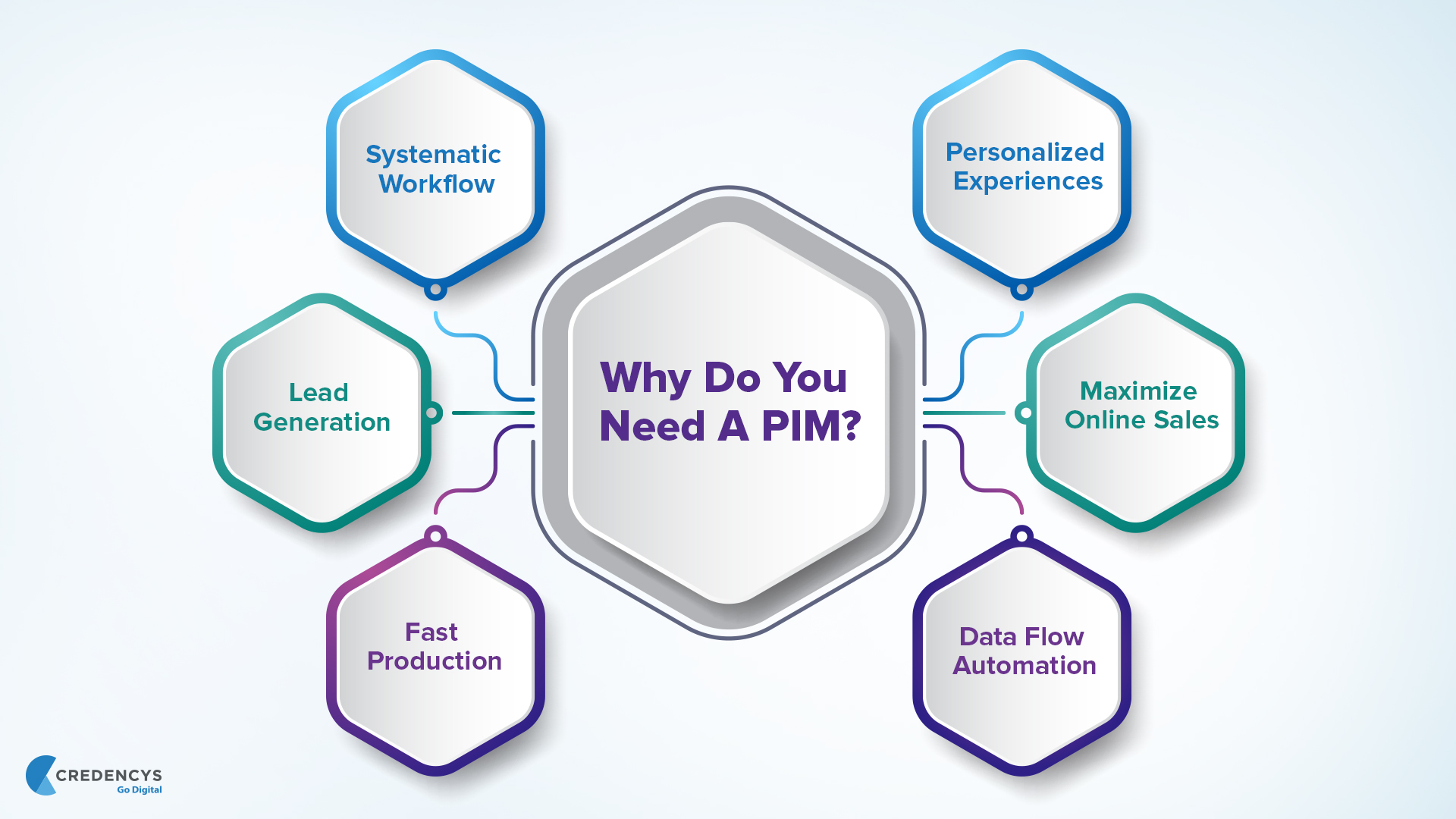
Why Do You Need A PIM

Systematic Workflow

PIM helps manufacturers or retailers or brands to manage miscellaneous products effectively. It allows for defining the products as per their categories. Proper categorizing simplified the navigation flow and helps customers to reach their desired items quickly.

Leveraging PIM, you can display the product information in a highly systematic way that drives better opportunities for your business and amplifies the conversion rate.

Lead Generation

Finding potential prospects is a very crucial aspect of any business. It’s a process of attracting more customers and converting them into potential clients and eventually establishing a long-term relationship with the customers.

To increase the conversion rate, you have to improve customer satisfaction. And, one of the easy and effective ways to boost customer satisfaction is to enable them with precise, accurate, and complete information about the product they are planning to purchase.

With the PIM, you can easily control and enrich your product information. Using images, videos, accurate content, attributes, comments, and other advanced features. Harnessing all these capabilities of PIM, it becomes easy for you to improve sales.

Fast Production

To run the business smoothly, manufacturers need to operate their production-related jobs effectively. Faster production of the products is highly important for any business to gain the best outcome.

PIM allows manufacturers to store and manage the production data in the software and access every single detail of their product whenever needed. Moreover, you can spread your product information across all the different channels.

Personalized Experiences

According to McKinsey, 35% of Amazon’s revenue is due to product recommendations.

Almost all the leading eCommerce platforms and marketplaces recommend products to customers. They analyze the customers’ buying behavior to suggest the products of their interests.

PIM services help you to create and deliver personalized experiences for your customers by allowing you to offer product recommendations.

To offer personalized recommendations, it is very essential to specific product attributes.

Getting insights about the buying behavior of your target audience and understanding what they exactly want is the first step of personalization. The next step is to match the buyer’s data with the relevant products. To recommend the right product, you need to structure all the information about your products in a range.

You can perform both of these steps using PIM. It allows sourcing product data and referencing it with the Pim eCommerce and marketplace data on buyers’ behavior so you can recommend the relevant products to the buyers.

By suggesting the products that your customers have already seen the chances are higher that they make buying decisions about recommended products.

With structured product information, you can suggest and display products that have similar features and fulfill the same purpose.

Maximize Online Sales

Product relationships play a vital role in increasing online sales. When a customer visits a physical store, the objective of the storekeeper is to make sure he/she leaves the shop with the best option of the product in their mind.

Your web store also needs to work in the same way. Moreover, using the digitized product information available in the PIM, the online store performs this job in a far better way.

Data Flow Automation

Management of massive product information cannot be handled cost-effectively and properly without the support of the right technology.

PIM automates the flow of data from purchases and ensures having a single source of truth got your products throughout the organization. Moreover, PIM can be integrated with your existing ERP system and distribution channels to make effective exports and imports of your product information.

Goals of PIM (Product Information Management)

In product-driven organizations, the marketing team receives an insurmountable thicket of information from the product team to promote and sell the products. They need to distribute the product information in multiple versions to different distributors, sales channels, teams, retailers, and so on.

Product Data Management with Spreadsheets

There was a time when companies used to manage product data in papers. But, with the emergence of the digital world, companies have started managing product information in spreadsheets.

Undoubtedly, spreadsheets are a far better option than papers, but not an effective one. Your data is still scattered. Data merging, data matching, and data mapping become a headache when your data are dispersed in different sheets.

Product Data Management with PIM

PIM allows the marketing team to store, manage, and update the product information in their product catalog. Being a cloud-based repository, the PIM system offers centralization and improves productivity.

Additionally, it ensures the information reaches the right people at the right time through the appropriate channels.
These days, the cloud-based SaaS Model of PIM is gaining tremendous popularity as a cutting-edge technology across online marketplace sellers and eCommerce platforms.

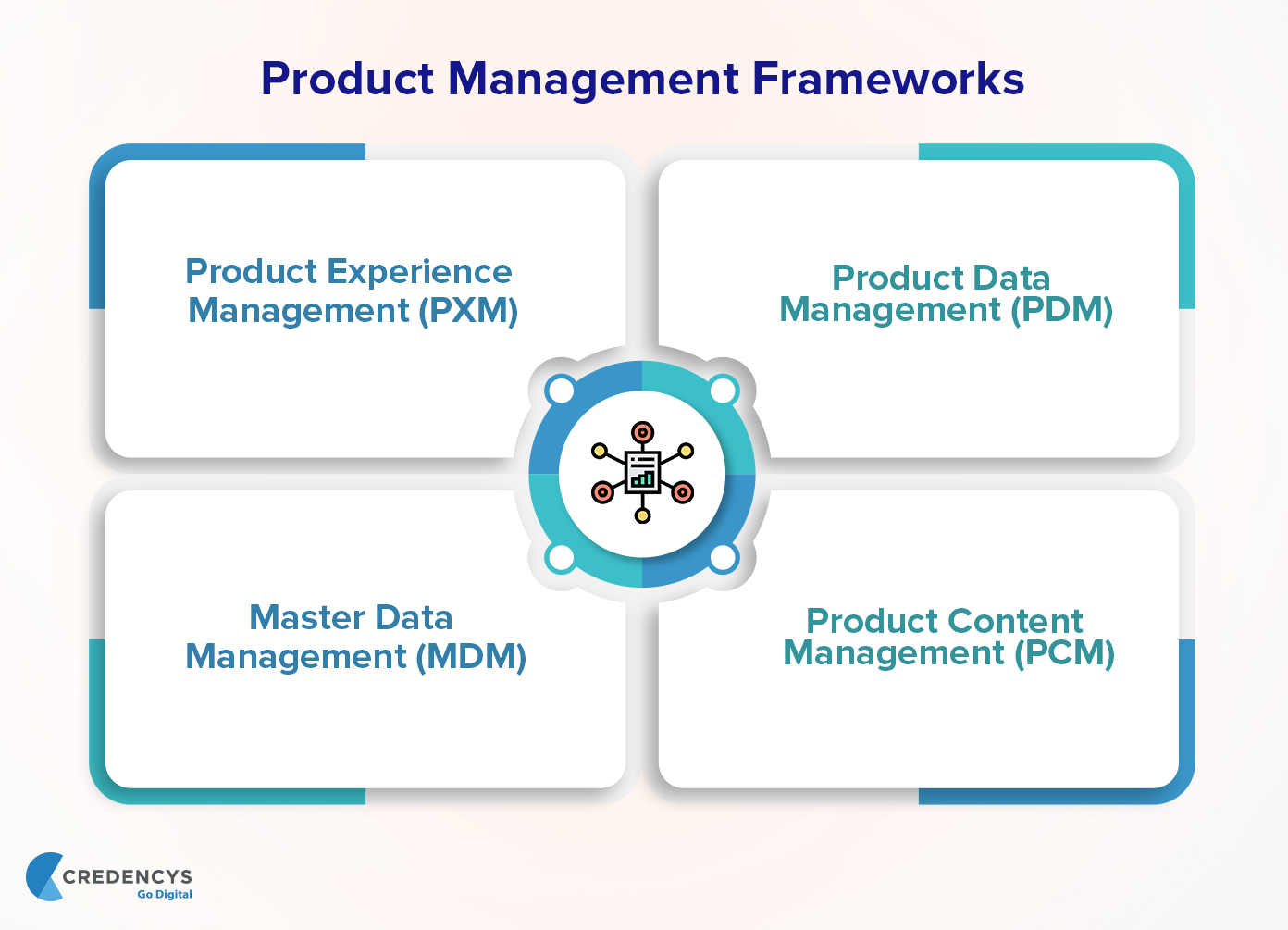
4 Product Management Frameworks that You Can Integrate with PIM

Product Management Frameworks

Product Information Management serves different purposes by combining with different product management frameworks. Let’s understand each of them.

1. Product Experience Management (PXM)

The purpose of centralized product information is to improve the user experience of end customers. As the end users buy the product online, they cannot touch them. So, they need to know all about the product.

Product Experience Management helps end customers understand

  • What product they are buying?
  • Will the product satisfy their needs and expectations?
  • Will the product deliver value for money?

2. Product Data Management (PDM)

Product Data Management allows sharing of internal product data. The information available on PDM is mostly useful for product designers and engineers.

3. Master Data Management (MDM)

MDM is a centralized data repository for every organization. Businesses can manage data related to products, customers, vendors, suppliers, distributors, production, machinery, finance, human resource, employees, and more in it.

On the other hand, PIM is used to manage product data and promote and sell the product.

MDM is a larger solution than PIM so it costs higher than a Product Information Management solution. If you are a large-scale organization that has to manage tons of data from different departments, then you have to consider MDM for effective data management.

4. Product Content Management (PCM)

PCM and PIM are very much similar but there are a few differences too.

Product Content Management is an add-on to your eCommerce platform. Enrichment of the product and taxonomies becomes easy using it.

Unlike Product Information Management, it doesn’t aggregate information from different sources. You can use PCM as a part of your PIM. However, it cannot replace the PIM.

PIM offers bigger benefits to you by handling massive product information in multiple formats and syncing it across multiple channels from a single source of truth.

What are the PIM (Product Information Management) benefits?

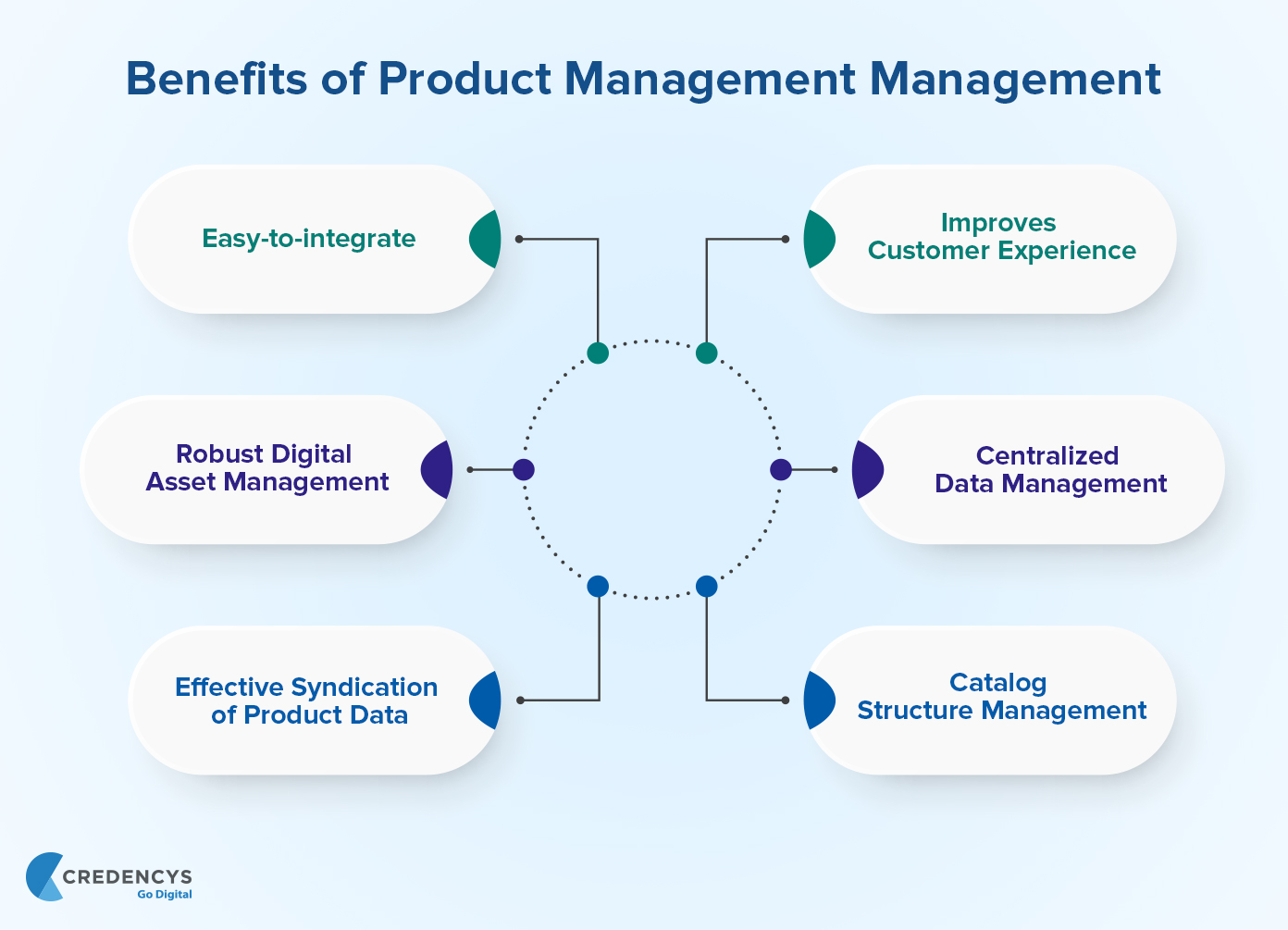
PIM system offers a wide range of benefits apart from offering complete product data management. This section illustrates some key benefits an organization can leverage through PIM. 

Benefits of Product Management Management

Easy-to-integrate

Modern PIM systems are 100% API-driven which allows businesses to integrate various handy business software & tools like ERPs, CRMs, data systems, BI software, and so. This effective integration of PIM delivers operational efficiency and paves a path for dramatically improved business workflow. 

Robust digital asset management

PIM offers a robust DAM functionality that enables businesses to manage all their product digital assets in a single location. This makes data onboarding, data enriching, and data syndicating of the product’s digital assets so effortless. It adds more fuel to achieve a better product experience. 

Effective syndication of product data

PIM can connect multiple external channels and delivers or publish product data instantly. The most highlighting part is PIM publishes data to multiple external channels in the desired formats of each channel. This enables audiences to receive optimized product data at all times. 

Improves customer experience

PIM plays a major role in improving customer experience by delivering accurate high quality product content consistently. Once, customers are satisfied with the brand approach, eventually, it will boost product sales and the company’s ROI. 

In addition to those, here are the lists of a few fascinating advantages businesses can gain through a PIM solution. 

  • Establish a more consistent brand image 
  • Detect errors quickly and enrich product data sheets 
  • Reduce cart abandonment and improve the conversion rate 
  • Pick up all the material and channel it to the right places 
  • Ensure access to all product information from a single source of truth 
  • Content validation before releasing it to public channels 
  • Synchronize product descriptions, videos, and images across all the channels where you promote your products 
  • Create a better impression for online buyers 
  • Optimize SEO using keywords associated with each product page 
  • Automatic product updates that improve the shopping experience before catalog renewal and product launches 

Centralized Data Management

Product Information Management Services not only manages your massive data but also classifies and organizes the products according to the desired data field and categories. It also allows your team to update any associated data.

PIM allows you to send your product data to the connected channels and auto-populates the fields.

Using PIM, you can eliminate the discrepancies between digital and physical catalogs by enabling companies with design connectors and catalog printing. Thus, you can display the products of the same collection with the same information regardless of the product catalog or web-based eCommerce store.

A centralized data management facility of PIM allows you to translate your catalog content into different languages. Thus, it becomes quite easy for you to penetrate international markets as well as launch your products on globally renowned and used marketplaces.

With the PIM, you can be sure to publish precise and complete product information across all your sales channels. Customers and all the stakeholders of your company can view the product data in real time regardless of location.

Catalog Structure Management

If you want to know about the outstanding ability of PIM, then it is an aggregation of product information in various formats.

To deliver a consistent customer experience and maintain the branding, many eCommerce portals demand strict adherence to submitting product information in their catalog format.

Once you integrate your desired platforms with PIM, the product information management system sends different data to multiple channels automatically in their respective formats.

Additionally, PIM keeps your marketing team in sync. It generates insightful reports on any updates to the data and the content. It keeps a history of medications and changes done by each user. It is very helpful to the marketing manager to track edits and changes in the catalog.

What Information Does a PIM System Manage? 

A product Information Management (PIM) system is specifically designed to manage all the information or data which are related to product and product SKUs. Here are the lists of cross-functional product information which are efficiently managed through the PIM solution. 

Basic product data

PIM collects data directly from the product such as product name, titles, basic description, SKUs and so. All this information is handy and allows businesses to suggest product usage to buyers. 

Product digital assets

PIM manages all digital assets of a product like an image, video, PPT, document, catalog, description, 3D view and so in a single place. This enables a business to deliver a perfect view or understanding of the product to the consumers. 

Product technical details

Managing technical information about a product like size, color, fabric, material, dimensions, weight, warranty, etc, is essential for businesses to drive more attention to the viewers. PIM manages all those data in all formats together. 

Product marketing details

PIM manages all the product data which are essential to do effective marketing campaigns. Data like target customers, product keywords, SEO data, product category, Metadata and so. 

Product sales details

PIM can store all the pricing details along with customer reviews and testimonials. This allows businesses to overview the sales process at any time and to take necessary action to promote product sales. 

Product localization details

PIM manages product data in the house as a multilingual copy, so that it can easily translate them according to the demands of various markets cited locally, regionally, and globally. This empowers businesses to deliver custom-tailored product data as per the specific market condition. 

Product taxonomy

PIM manages data that are essential to building product catalogs and the company’s product structure such as product variations, relationships, and product categories. 

What You Can Do With PIM?

What You Can Do With PIM

PIM helps organizations to gather, enrich, and distribute product data efficiently in their omnichannel environment. Explore what jobs PIM performs to allow you to manage your complete, and accurate product data holistically.

Product Information Variance

The product information is not just a name, article, or description color and size. Each product has thousands of attributes and these attributes vary from product to product. So the marketing team needs to create different content for each product as well.

For example; you cannot have the same attributes for trousers and TV. A customer that wants to buy a TV is more concerned about resolution. On the other hand, when making the buying decisions about trousers, the type of fiber and instructions matters more to the buyers.

For some items, product details will be the same for all channels, brands, and languages. But, if we talk about the product description, it varies for each channel, brand, and language. Thus, there is a lot of complexity in managing different content effectively.

PIM helps you in managing all your product content seamlessly across different channels, languages, brands, and more.

Internationalization

All eCommerce business wants to expand globally. To do so, they have to collaborate effectively with suppliers and retailers in the international market. A strong relationship with your partners helps you to achieve an international standard like GS1.

Along with classifying the products as per their respective hierarchies for the local market of the organization, PIM classifies them in the international market too. It enriches product information with more specific attributes.

Through such classification, you allow decision-makers to access complete and accurate information about a product which directly impacts the conversion rate.

If you are considering internationalization extensively, then you have to go for PIM as it supports the translation process through a workflow for proper product data management with the help of an external translation agency.

Product References and Structure

Product structuring is always related to grouping similar products with comparable product content. Offering assortment functionality PIM allows organizations to group products to target the right products to the right markets. To facilitate customers with added value, you can suggest to them product combinations.

For example; if we talk about clothes, you can advise them to buy a combination of pants, shirts, and shoes. By offering references to the products, you can improve the conversion rate. It also improves the cross-sell and up-sell for your business too.

Another way to boost customer conversions is to allow them to replace the product if the customer doesn’t find it as expected or receive a damaged product.

Whether you want to enrich your product information by classifying or referencing products, PIM is capable to maintain it in both ways for you.

Product Data Quality

As the essence of product content is continuously growing in your omnichannel environment, product data quality becomes a serious business in today’s competitive era.

Product information managed in the PIM should be seen as a single source of truth to increase the data quality. A reliable PIM system ensures product data quality.

PIM allows for analysis of the data quality and generates reports, facilitates the process to improve data quality, and applies business rules. The objective of PIM for performing so many activities to improve data quality is to increase conversions across all channels.

Multimedia

Would you prefer to buy a product without viewing its pictures and just by reading its description?

Sounds crazy. Right?

A product without an image is quite tough to sell as customers want to see what they are going to buy at the very initial stage of the purchase.

And, one or two pictures of the product are not enough. They want to see the product from different angles to get a better understanding of the product’s size, features, color, etc. So, if you count, you need 5 to 15 images for each product.

You need a robust repository to store and manage such massive data of images and videos of products. This brings the urge to Digital Asset Management (DAM).

PIM comes with DAM capabilities and facilitates a digital asset process in a workflow. DAM is a module of the product information management system that manages the multi-format images, videos, and documents related to the products.

A mature PIM platform contains more capabilities such as automatic conversions, formatting, data export, and cross-referencing for adding value to the customers on the eCommerce platform, searching, and more.

Product Onboarding

While talking about PIM, “onboarding” is a very common and widely used term. In the context of PIM, onboarding is about getting product content forms diffident channels and storing and managing them in a PIM.

For example; PIM allows you to import data from your excel, ERP, directly from the suppliers’ portal, or other product content sources.

An advanced PIM is capable of merging and mapping the data by importing and combining them from different sources.

Omnichannel Publication

As we discussed previously, it’s an era of creating and delivering omnichannel experiences. With the increasing adoption of omnichannel, every channel required its own set of product information.

For example; an excel sheet manages the product information in a completely different format than the web store or mobile app where you are going to promote and seamless the product.

A reliable PIM solution effortlessly addresses the different needs in exports to varied eCommerce platforms or marketplaces.

What Types of Companies Should Consider PIM?

PIM is a highly popular solution across all sizes of businesses. There was a time when only large-scale businesses afford this software. However, today small and mid-sized businesses have started using the software to streamline product information management flow.

PIM enables retailers, manufacturers, brands, distributors, suppliers, and vendors with product updates, information documents, and channels to see their improved performance.

Are you looking for whether PIM would help your business?

Check out the blow points. If your origination has any of the following pain points or requirements, PIM is for you.

  • Gathers data from multiple suppliers
  • Manages complex product relationships and content
  • Sells products through multiple channels
  • Having too many manual processes
  • Has a high volume of SKUs in its offering
  • Require accurate product information available for multiple teams
  • Sells products through multiple channels
  • Transitions or expands product offering multiple times a year

Who Needs PIM in Your Organization?

PIM is a widely used software across the large-scale eCommerce organization as it allows businesses to

  • Manage a high number of SKUs
  • Host complex content
  • Collect product data from multiple touchpoints
  • Host constantly changing or shifting products
  • Automated formatting of product data
  • Define workflows
  • Control and manage product data
  • Define business rules

Apart from managing product-related data, PIM helps businesses collect data virtually in an effortless way. It automated manual data processes that directly impact the productivity of the employees.

Also, PIM allows you to share information quickly amongst your multiple teams and push product information across different channels.

PIM helps your different teams work independently by accessing the data of their use.

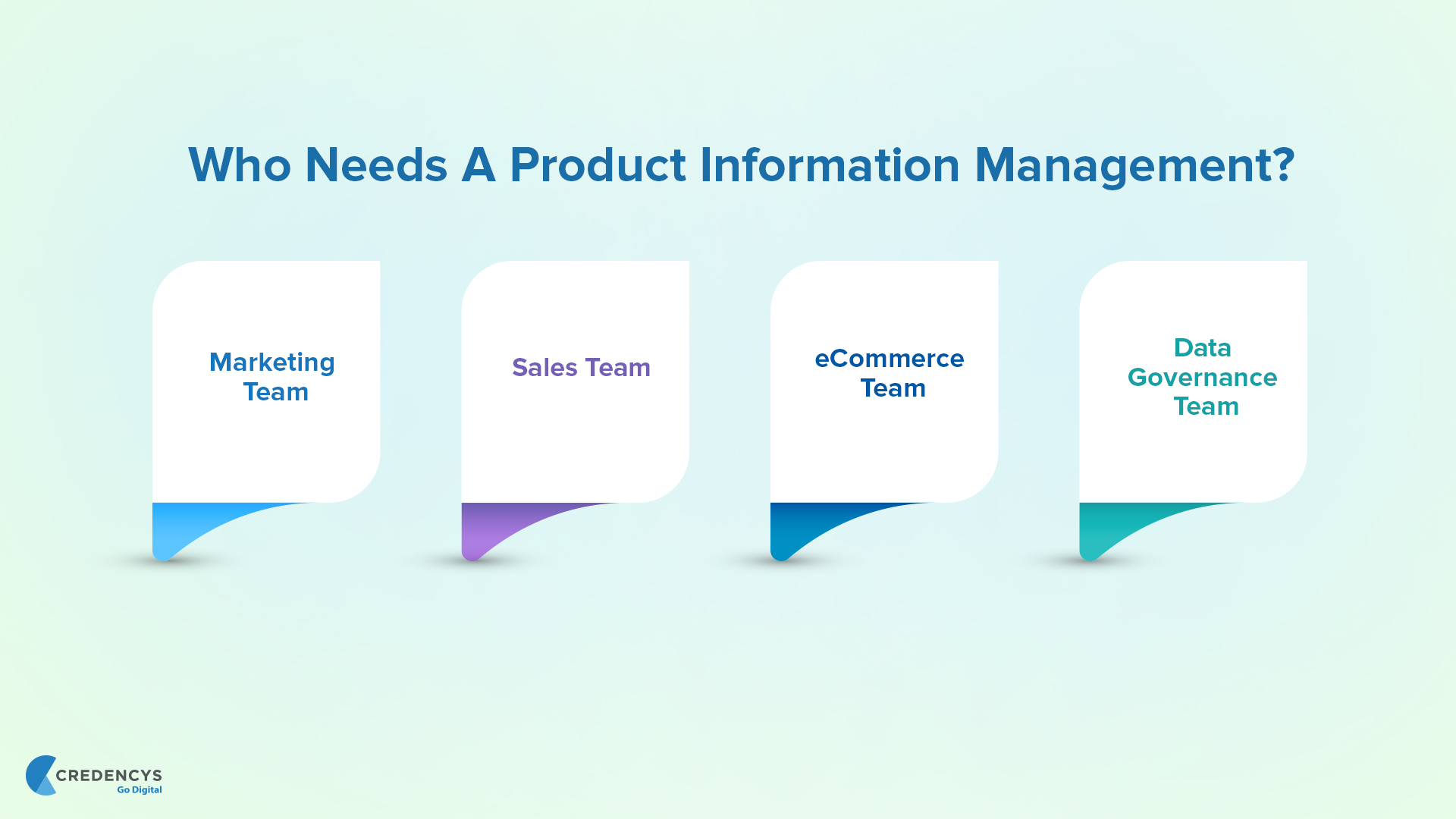
Who Needs A Product Information Management

Marketing Team

The team runs multiple marketing campaigns to promote the products. They need to create and modify a lot of content ongoing basis as per the requirement of campaigns.

PIM helps your marketing team not only manage the content seamlessly but also push the content across multiple channels in the local language of your targeted users.

Sales Team

The sales team needs access to updated and accurate product data to present it to the prospects. They also need quick access to digital content related to the product such as brochures, flyers, whitepapers, eBooks, and more.

Implementation of PIM enables your sales team with access to all the required product information and digital content.

eCommerce Team

Your eCommerce team needs to update the product content regularly to improve user experience and conversion rates.

PIM allows your team to add, edit, or delete any of the product content. Not only that, but it also pushes the updated content on the different marketplaces and other channels where you have published your product.

Data Governance Team

When there is a lot of data, the security of that data is very essential. Moreover, everybody doesn’t need access to every data.

PIM allows your data governance team to define the rules and enable each user with the role and permission-based access to the product data. It helps your team to track and meet your compliance needs.

Which PIM System I Should Consider for My Business?

There are many Product Information Management solutions available in the market these days. It’s quite tough to make the right choice for your needs. Learn about the top 11 PIM systems that you can consider for your business.

Explore the advanced PIM solutions along with their features and benefits.

Verdict

Having a PIM solution will be beneficial for any brand; especially for those owning a huge volume of products and selling products online. The PIM system democratizes the product information suitable for businesses to improve the efficiency of their business operations. Also, businesses can utilize the PIM solution to improve customer interaction and boost the sales ratio. 

It allows you to collect, manage, enrich, and district the information across different sales channels. Leveraging end-to-end Pimcore development services, you can build a robust PIM solution that helps you achieve digital transformation for your business.

Overall, if your business is looking to achieve its goal and looks to improve its ROI in today’s competitive virtual market, then making use of the PIM solution becomes inevitable. 

Do you want to simplify and automate your product information management using a PIM system? Connect with our experts.

Frequently Asked Questions on PIM

What are the latest Product Information Management Trends?

With the emergence of advanced technologies, the trends of product information management are constantly evolving. The following top trends are currently getting tremendous hype for PIM solutions.

  • AI & ML improve the quality of Product information
  • Product data sharing and distribution become smoother
  • AR transforms the product information user experience
  • Completeness of product data empowers customers
  • PIM helps in making effective strategic decisions
  • Information enrichment through different users
  • Omnichannel experiences will lead the market
  • Audio & Video based product information
  • Reach out to the global market with marketplace integration

What are the most important features of Product Information Management?

While considering the PIM solution, you have to consider varied features for effective product data management. But, make sure your PIM software consists of the following features.

  • Bulk Editing
  • Catalog Management
  • Product Content Localization
  • Product Data Modeling
  • Data Distribution & Syndication
  • Digital Asset Management
  • Collaborative Workflow
  • User and Right-based Management

How to know my business needs PIM?

If you are the one who is struggling to figure out whether your business needs PIM, you need to analyze the product data relates challenges your business faces. Here are the most common challenges that your business faces in the absence of a robust PIM system.

  • Lack of transparency amongst internal teams and departments
  • Dealing with multiple sales channels becomes tough
  • Managing a massive amount of product data
  • Disorganized product catalog
  • Manual tasks and spreadsheets will be error-prone
  • Handling cluttered digital assets
  • Lack of supplier communication
  • Product launch cycle delays

What should I consider for effective product information management from PIM and MDM?

MDM is a quite large solution for you if you want to manage your product information only. While PIM is a very specific and cost-effective solution to address your product information management needs. To select the right one, you need to learn about the difference between PIM and MDM.

What are PIM (Product Information Management) Services?

PIM services are professional services offered by PIM vendors. Often these services from vendors help organizations to deploy and optimize their PIM solution. An expert from PIM vendors delivers consultation, training, and assistance on implementing PIM and providing excellent support under the PIM services. Overall, PIM services from PIM vendors help an organization improve business operations by getting the most out of the PIM solution.

What is PIM (Product Information Management) Solution?

PIM solution includes various tools, technologies, and processes by which an organization can manage and distribute its product information effectively across the platforms and channels to drive more sales. With the presence of a PIM solution, an organization ensures its shares accurate, high-quality product information consistently.

What is a PIM (Product Information Management) System?

PIM system includes various tools & latest technology along with the PIM solution, PIM software, and PIM services. PIM system enables an organization to manage and distribute product data effectively and efficiently. The main purpose of the PIM system is to streamline product data, boost data quality, and enhance the customer experience.

What is a PIM (Product Information Management) Software?

Product Information Management (PIM) Software is an application that was specifically designed to deliver effective PIM solutions. The PIM software acts as a centralized data repository for storing all product information including images, videos, descriptions, attributes, technical details, pricing, and so. Overall, PIM software plays a handy role for organizations in managing product details.

Product Information Management Architecture – A Brief

Product Information Management architecture understands various business approaches that can enhance the performance of the organization by analyzing and evaluating the organization’s structure, which includes various business processes, employees working in the organization, and the technologies used.

The enterprising Product Information Management (PIM) architecture also deals with various business policies, data and information stored, and a set of tasks and applications. The system is defined to manage the products, and the technology is defined by mapping them, planning the designs, orchestrating the functions, and formalizing the business operations.

What is Pimcore? Why is it important?

Pimcore is an open-source platform that can manage various touchpoints of the business by working as a single source in business management. Pimcore can be defined in terms of data management modules and experience management modules.

Visit What is Pimcore and the Benefits of Pimcore to explore more about Pimcore and its powerful modules that help business to streamline their operations and drive better operational efficiency and productivity.

Data management modules of Pimcore

Product Information Management

Product Information Management (PIM) manages any type and any amount of information easily. It can integrate and manage data and information.

If you are excited to explore Product Information Management in detail, read What is PIM and Product Information Management – An Exclusive Guide. Get an in-depth understanding of Product Information Management capabilities and effectiveness by visiting these posts.

Master Data Management

Master Data Management (MDM) allows for the integration of product information, analysis of the data quality, and management of assets.

Are you interested in exploring more about Master Data Management and how it helps businesses drive success and growth, you must read What is Master Data Management (MDM)? Moreover, to get insights into the different aspects of MDM, read Master Data Management – An Ultimate Guide.

Digital Asset Management

Digital Asset Management (DAM) manages digital assets by optimizing the data. It simplifies the source operation.

Read What Is Digital Asset Management (DAM)? to learn about the hidden potential of a DAM implementation. Additionally, to unveil every aspect of Digital Asset Management, don’t miss visiting An Ultimate Guide to Digital Asset Management (DAM).

Customer Data Platform

Customer Data Platform (CDP) keeps track of customer data, which is simply located. It manages personalization and marketing automation.

Go through Customer Data Platform: The Ultimate Guide to explore the hidden potential of CDP. Create & deliver personalized experiences to the customers and drive better customer engagement and conversions along with increased sales and revenue with the help of CDP.

Experience management modules of Pimcore

Digital Commerce Platform

Digital Commerce Platform is mainly involved in complex computations, agile products, and their needs, complicated pricing, and product structure. It also manages multiple catalog price lists, front pages, and applications.

Do you want to empower your online presence and operations with a feature-rich eCommerce platform? Read Digital Commerce Platform – An Ultimate Guide that introduces advanced capabilities, features, and functionality of Pimcore’s digital commerce platform.

Digital Experience Platform

Digital Experience Platform (DXP) is highly scalable for all types of content management. It can manage social media channels, IoT devices, mobile apps, and kiosks. It can manage various activities from a single place easily. It can easily manage the content and the information stored by using easier editing applications. It can easily manage headless content with the help of Content-as-a-Service (CaaS).

Make sure to read Digital Experience Platform – An Ultimate Guide to have detailed insight into the DXP and its excellent capabilities of managing online content in creating superior omnichannel and multi-channel experiences effortlessly.

These models have an API-driven approach that enables the use of Pimcore technology with the help of an e-commerce framework.

These models will make the system highly flexible and allow for effective communication while dealing with customers. It does not allow you to remain dependent on a single channel, but it can offer various options and multiple channels to be used while managing the business.

It certainly offers a memorable experience while managing the business using Pimcore technology, which is part of your business operation. The use of Pimcore technology can become one of the highest priorities in business management today.

Do you want to discuss Pimcore and its modules in detail to get better clarity on how each module helps you in developing a powerful digital platform? – Talk to an expert

Overview of Pimcore Technology and Architecture

PIM architecture is a modular platform that offers higher flexibility. It offers a business system that can be customized according to your business needs by offering a stand-alone solution or a combination of services that includes six modules.

The Pimcore system is one of the useful functionalities that offer complete support to commerce, marketing, and other business services with the help of the digital experience platform.

1. Microservices

The microservices-based architecture can process your business better with its higher extensibility. It offers predictive data and building blocks for experience management. These services have a “no code” approach with higher scale agility. This service can evolve in the IT framework and can help in generating faster revenue.

2. API First

The product information management architecture is a customer-centric digital system that can be useful for current and future digital issues. It can make use of innovative techniques using modern APIs. It can be further used with low-temperature development practices.

It can extract and load the information and transform it into a remote location with the help of API endpoints. It makes use of various formats and can integrate with the existing system or third-party apps.

3. Cloud Native

It is a scalable platform that supports on-premises deployment and also provides 24×7 global access using cloud computing technology. The Pimcore system manages on-premises activities with the help of local servers that work behind the firewalls.

Offers complete security for the data. It is also possible to sync the data between private and public cloud systems as part of a hybrid scenario. The cloud edition offered by AWS can be the most useful service. Cloud hosting services can be provided by Microsoft Azure, Google Cloud, and many other providers.

4. Headless

The system allows different types of front ends, also called heads, to be involved without any issues regarding data and information. It offers complete flexibility to companies that offer complete freedom to create and collate various contents. It can offer consistent, predictable data that can be managed on multiple online and offline channels.

Pimcore is a highly flexible service having a monolithic and decoupled style, which is also called “headless.” The headless architecture keeps track of customer touchpoints while working on the front end and managing the data on the back end.

5. Open Source

The Pimcore works as a part of the enterprise edition and also as the community edition, which are parts of the development framework. These frameworks have a higher degree of customizability that meets the requirements of the developers. They make use of the most popular technology, which is up-to-date.

Pimcore’s Product Information Management makes use of PHP, Symphony, MySQL, Elasticsearch, Redis, and Varnish. It can make use of sophisticated web applications that can remain faster when offering services. Additional modules can also be a part of the system to boost the development process and can become part of GitHub, which is a global community.

6. Smart marketing campaigns

The product information management architecture offers client success services that can be exclusively useful for cloud edition and enterprise edition customers. The customized success services for cloud and enterprise editions can be available in multiple languages. It can be considered a part of a smart marketing campaign.

Effective communication with a land success manager is carried out using email services or the help desk ticket system. These systems are available on the “loud edition” plan of Pimcore services.

It also promotes various client success packages that are mainly dependent on the needs and support required by the clients. Help is also provided to the clients with regards to lowering the development cost and making the project implementation and development faster.

The project manager can work along with the clients and understand their specific needs and particular requirements, which is best for cloud-based data management.

7. High level of flexibility

The Pimcore system offers higher flexibility in data modeling, which can be most suitable for all types of data, including structured and unstructured data. It offers specific needs to upgrade the data sets as a part of business growth and management. The intersystem can be highly flexible, and it can be customized according to customer needs, business requirements, and industry trends.

The entire setup of the system can be easily added to another data source, or it can be allowed to make changes to Product Information Management interactions. PIM integration and modification can be part of a restructuring of the entire business model, which can make the business grow faster and make more profit in the market.

These are the points that make product information management architecture powerful, useful, and flexible as a part of business management. It offers several benefits to the businessman who has a small, medium, or large business. Pimcore technology has become highly prevalent in the business arena today.

Modern Product Information Management architecture for modern e-commerce

The PIM architecture can offer an advanced architecture that can be a part of digital transformation and can support e-commerce at every level.

1. Product catalog management

It is a useful system for managing product information. The use of ERP systems is not only a registered product as per record but it also keeps track of the logistics of the products. It offers detailed information about the products.

It makes use of inventory management and order-picking systems that are part of online product management. The rich media content of the product along with its photo and attributes become part of the product management model.

2. Use of a stand-alone platform

E-commerce has become part of business management, and it has been growing rapidly as online business has expanded. The Pimcore system offers open-source solutions that can become part of stand-alone platform systems.

The various systems, such as Magneto, WooCommerce, and PrestaShop, offer the best services in the online business world and have become market leaders today. Companies with a large set of products need monolithic system architecture. Without having any large investments, it is not easy for organizations to manage unexpected sales.

3. Changing commerce era

Online business has increased business remarkably. E-commerce has become not only a single channel but a whole set of marketing activities including online shopping, which includes social media online stores and stationery stores with interactive product catalogs.

A monolithic E-Commerce platform can build useful mechanisms to handle business processes but remain reliable.

But specialized teams can be created for managing E-Commerce marketing, sales, and customer care services, along with risk management and product management services. The e-commerce department can look after the entire organization’s online transactions and sales.

Pimcore offers a microservices architecture that can be used to better decompose the ecosystem of various E-Commerce tools and applications.

4. Modern open-source Product Information Management architecture

Like PIM, the Ergonode architecture consists of modular applications, which are useful for additional extensions. Ergonode PIM database application offers a high-quality PHP framework called Symphony that can work with a PostgreSQL database.

The autonomous application can be a part of the administrative panel, which is based on the Vue.js and Nuxt.js frameworks. The applications can offer useful solutions with the help of modules, which are called “micro frontends.”

The approach of the architecture allows for Product Information Management solutions, which can be useful for various business needs and scenarios.

Case 1: External suppliers and PIM

Mini companies have business structures of extensive types that are useful in multiple markets. A product catalog with different divisions can be part of a single global structure, and work for suppliers and partners of the companies by offering specific product categories in a central database.

Different administration panel interfaces are required to manage the various business requirements of these specially selected customers. The admin panels can make use of UX and UI terms as a part of external applications with the help of Ergonode’s global API.

Case 2: PIM without the admin panel

The customers make use of the Ergonode platform as a part of the automatic cycle system, which can exchange product data between the platforms. Ergonode PIM architecture makes use of data exchange algorithms as a part of organizational processes, and it can be updated regularly.

The Ergonode PIM architecture was used unusually and does not offer solutions for the administration panel. It makes use of the back end of the platform to be used while managing the ecosystem of product data exchange.

Case 3: E-commerce ecosystem and central product information hub

With the help of high-dynamic movement, product catalog management can be associated with data processing.

Ergonode can extend applications with the help of model-specific microservices. It can calculate and prepare data while displaying further processing without having to overload the main database application.

Case 4: Adding data to the external platform

In Ergonode, the modules can be built using headless applications as part of the administration panel. The data can be directly displayed from one system into the database system without overloading. It is also part of a model that can be downloaded, and Kansas would like data related to the conversion from Poplar analytical solutions.

It can make use of Google Analytics, Mouseflow, or Hotjar applications. It displays the data in real-time, which can be downloaded with the help of a dedicated tab that is a part of the Ergonode admin panel and is available on the product card.

The architecture can be decomposed at Ergonode. It allows the entire system to remain strong and to offer solutions to the customers. It also offers flexible cloud plans that can manage customized product information.

How does Pimcore’s PIM help businesses scale their digital platforms?

Product information management (PIM) offers unified product data that remains consistent, accurate, and shareable. It offers a better experience to the customers, which keeps improving every day. It also focuses more on the digital transformation of the business and can manage various new channels and touch points efficiently.

1. Translation and localization

These are the crucial processes that can help expand new markets in e-commerce. Leverage the enterprise translation management capabilities of a PIM platform for faster, accurate, and easy translation. It is a process of ensuring the product description is translated in the most correct format and can be used at the local level.

Manually translating and localizing the products is a very painful task, but the Product Information Management system can simplify the process of translation and localization. It can manage the process without consuming much time and by offering accurate results.

2. Data quality

PIM architecture can offer various advantages in managing data and one of them is product data quality management. The collected data can be analyzed carefully. Duplicate data can be reduced by eliminating waste. Product Information Management enhances data accuracy by keeping the data quality high using a data quality.

It makes the data highly accurate and consistent when used in business operations. High data quality reduces product returns and also reduces time to market.

3. Digital asset management (DAM)

The Product Information Management system offers effective and useful techniques that can simplify digital assets that can be used along with cloud technology. It also makes digital teams work across geographical regions and collaborate effectively.

It can also enhance the productivity of the organization and the individual performance of the employees; it also maps and manages assets related to the products. It can reduce manual work and simplify workflows.

4. Multi-channel publication and syndication

The PIM system offers useful marketing techniques that can help in managing the business. The use of multiple channels has become highly significant in business enterprises. The use of multiple channels offers an additional advantage in commerce activities while managing the business.

PIM is the most suitable software for e-commerce. It offers high-end, integrated, and personalized data that is of high quality. It helps in offering tailor-made information about the products that can become a part of sales and marketing techniques. It allows the data to be published on various platforms and multiple channels.

The product information management architecture can be added to the catalog, which is useful for publishing product information among the customers, and in the market, high-quality product information brings a positive change.

The marketing teams find it easy to market their products according to well-planned targets and customized campaigning. It certainly helps in increasing sales conversions and enhancing marketing performance.

Product Information Management software allows various systems to be integrated while interacting with customers and engaging in marketing activities. Multichannel marketing offers a collaborative effect in the business, and mixed-business management is highly flexible and efficient.

These are the main advantages of the product information management system that has become highly popular in the business world today.

Conclusion

Product information management PIM architecture has become one of the most preferred business management techniques in business and industry.

The product information management architecture has offered useful business solutions that can help manage the data, maintain the products, and offer clear and accurate information about the products that can help the business grow rapidly. The business management techniques will become highly effective by offering positive results.

How to Select An Effective PIM Solution for Business?

As the business world keeps evolving continuously, time and data have become the most precious commodities. Effective management of those two vital business commodities becomes inevitable for modern businesses. Having an effective PIM solution for business will help perform well in the competitive marketplace. Without proper data management, your business goes nowhere in today’s market condition.

Data regulates everything in today’s modern businesses right from creating effective marketing strategies to making important business decisions. Moreover, data becomes the key to achieving better customer experience and overall brand experience.

This article briefs about Product Information Management solutions and provides you with valuable points to consider for picking the right PIM solution for your business.

What is the PIM Solution?

Product Information Management solution is one of the typical business software that allows businesses to collect, manage and optimize product data in a single place. The PIM solution helps you to manage the data and enhance the quality of the data shared across the selling platforms.

The ultimate goal of the PIM solution is to increase the product selling performance across the multichannel touchpoints and omnichannel. With the presence of the right PIM solution, businesses can deliver a whistling and compelling product experience to their target audience and increase product sales.

If you are interested in exploring more about Product Information Management and its capabilities, don’t miss visiting What is PIM. Don’t miss reading Product Information Management – An Exclusive Guide to get exclusive insights into all the aspects of PIM.

Why You Should Have a PIM Solution for Business?

The demand for PIM solutions is rising steeply after knowing the benefits it offers. With the presence of the PIM system, small businesses can able to manage their product content much easier. Also, the PIM system enables businesses to deliver accurate product content to consumers, collaborators, and other entity stakeholders.

Moreover, the product information management system streamlines the entire product data lifecycle and keeps them stored in a single location. Even digital assets like product images, videos, descriptions, specifications, SKUs, and so on are stored and shared for the benefit of online sales.

In addition to that, here are the lists of a few fascinating things your business can get through PIM solution.

  • Provides a centralized data storage repository for storing all product digital assets
  • Introduce automation to perform all manual tasks without errors
  • Enables businesses to create content according to marketplace standards
  • Easier to do product data syndication across all the available channels instantly
  • Make things easier for data managers to update product information
  • Data management becomes much easier along with the data change tracking features
  • Helps businesses to avoid data breaches and prevent data loss

Most eCommerce businesses are using a robust Product Information Management platform to manage product data centrally and deliver excellent product experiences to the target audience. To explore the essence of PIM for eCommerce business, don’t miss visiting Why You Should Consider Implementing PIM For eCommerce Business?

Benefits of Having PIM Solution for Business

1. Complete management of product data

If you are thinking that the PIM system is pure data management software then you are wrong. PIM system does more than just data management. Apart from managing data, the PIM system ensures that product data is accurate and consistent.

PIM system ensures the product data can be easily edited, managed upon user rights, validating data, customized data view, and publishing & versioning of data in a controlled way.

In addition to that, the PIM solution empowers enterprises to construct flexible and highly-scalable data models. Along with offering the capability of conducting data audits, the PIM system quite literally accounts for data quality completely and enriches them according to the requirements/market condition.

Having the right PIM system helps an organization to carry out efficient management of product data lifecycle by tracking the data modification carried on data at any time.

2. Seamless Integration

The integration capability of the PIM system is considered one of the primary benefits of PIM to enterprises. A collaborative workforce is key to running a successful business. To have a collaborative workforce, existing enterprise systems need to be integrated.

PIM system helps enterprises to create a collaborative workforce by integrating all the existing enterprise software. With such seamless integration features, enterprises can easily mingle their various business software like ERPs, CRMs, CMS, logistical systems, business intelligence (BI) software, and so on a single platform.

Modern PIM solution comes with 100% API-driven capability allowing businesses to integrate existing or new technology and enabling real-time interaction between the systems at any moment. This creates an efficient way of data import or export operation between systems.

3. Efficient management of the digital asset

Modern PIM solution comes with a digital asset management (DAM) platform that enables enterprises to manage all their digital assets efficiently. PIM system with robust DAM functionality allows businesses to manage a vast assortment of digital product assets like videos, audio, animation, graphics, product catalogs, and so.

The presence of DAM in the PIM system helps businesses to perform effortless data onboarding, data enrichment, and data syndication operation. Therefore, enterprises do not need to invest in DAM separating instead simply choose the right PIM solution and leverage the DAM capabilities.

Apart from that, the DAM functionalities of the PIM system help businesses to gain better customer experience by delighting the target audience with the eye-catching digital assets of the products. This strengthens the brand experience among the target audiences and fuels a better sales ratio.

4. Supporting vendors and suppliers

Another key benefit of having a PIM solution is, it not only supports enterprises instead it creates a suitable ecosystem where enterprises or businesses can leverage it. The ecosystem created by PIM solution includes vendors and suppliers allowing them to ingest accurate product information.

Both suppliers and vendors will get an accurate and efficient data management process that streamlines the product data. This will be built a mutual relationship and smoother relationship between the enterprises, suppliers, and vendors.

With the help of PIM solutions, suppliers and vendors can realize the strategic objectives of an enterprise and can accomplish their common goals. The PIM system contributes a lot to the supplier and vendors through its consolidated supply chain process, enhanced forecasting of market demands, improved operational efficiency, and minimized overheads.

5. Builds customer experience and boosts ROI

Consolidation of the product data in a single data repository is the primary job of a PIM system. Once the consolidation process is complete, the system carries out the data management and data enrichment and streamlines the data.

All those set of actions performed by the PIM system lays a strong foundation for achieving an excellent experience that can yield higher ROI for enterprises. Optimizing and streamlining the messy and unstructured data in any format through the PIM system will be helpful for marketing and sales departments to improve their operational efficiency.

Making amendments to the existing promotions through the streamlined product data from the PIM system will fulfill customer experience. Moreover, it will improve the ROI of an enterprise dramatically.

6. Quick and easy to launch new products

The data delivery operation performed by the PIM solution is not only accurate, but it is also pretty quick. Because of that, operations like data hierarchy creation, structuring data, and validating data can be done in a remarkably shorter time.

Also, the PIM system creates quicker collaboration of various enterprise functions which will speed up the workflow and provide better operational efficiency. This will make things much easier for the sales and marketing team to do their job.

The multi-channel product delivery along with seamless data distribution allows businesses to reach the product to the target audience quickly through the preferred channels. This enables enterprises to launch their new products to the market much quicker than before.

Once the product reaches the market quicker, it will increase the chance of improving user engagement and increasing product sales.

To explore more benefits of the Product Information Management platform, don’t miss visiting What Are the Benefits of PIM (Product Information Management) Systems?

What to Look for in PIM Solution for Business?

In today’s market, there are a lot of PIM options available among those picking the right one is a bit daunting task. However, if you are familiar with the PIM features and functions along with your business needs then it will be much easier.

Here are the lists of a few characteristics you need to look out for while picking the right PIM solution for your business.

1. Easiness to handle

The PIM tool has become one of the essential business tools and it will be used by almost everybody in an organization. So, while picking a PIM solution make sure it is simple and easy to handle.

Moreover, the learning curve of the PIM system should be easy allowing anyone to learn quickly. So that, your team members or third-party vendors’ can learn how to operate the PIM system and make use of it.

Having a simple PIM system for your business will ease many employees’ workloads and improve productivity a lot. Moreover, easy operation on the PIM system will help businesses to manage their data easily in a single place and make things easier for workers to search and navigate data like never before.

2. Highly flexible and easy to customize

Considering the flexibility of the PIM solution is one of the valiant things for you when picking the right one for your business. The flexibility of the PIM system determines how easily you can make changes and additions to the PIM operations.

Every business has its unique requirements, so picking the PIM solution will the capability of custom-tailored features will be highly beneficial. Picking the PIM system based on the essential features and functional requirements of your business will fit well and save a lot of cost & time.

Moreover, having a tailored PIM solution for your business will be a big plus in achieving operational excellence without spending a lot.

3. In-built workflow

To run a successful business, stakeholders must manage more than a single team at a time. But managing multiple teams would be a hectic task in case if you are running a small business.

To avoid this, you would need an effective workflow management module. The module will ease the process of coordinating teams through enhanced communication and accountability.

The built-in workflow module of the PIM system helps business leaders to automate all those tedious tasks and allows them to focus on other vital aspects by saving a lot of time. The PIM workflow allows you to communicate with the team members, assign tasks instantly, and track the ongoing work.

This set of procedures will enable team members to complete tasks without delays and not waste resources.

4. Marketplace integrations

Marketplace integration is vital for any business to succeed in today’s competitive world. Integrating your business with popular marketplaces will allow you to reach your business among the target audience.

With enhanced exposure, you can easily improve your product sales and grab more loyal customers around the world.

Choosing the right PIM solution will enable you to integrate all popular marketplaces instantly. In addition, the system also provides you the option to add the marketplaces where you like to sell your products.

Also, the product syndication features and bulk data upload allows you to share product content to multiple channels at a time as per individual market standards. This ensures your product reaches the marketplace in time.

5. Budget-friendly PIM solution

It doesn’t matter whether you are running a small, medium, or large-scale business every penny you invest in your business counts. In today’s market, you can find numerous PIM solutions available at different prices. Among those choosing the right and affordable PIM solution that provides you more value to your business is more important.

Opting for a budget-friendly PIM solution with all the essential features will make things easy for you. Also, it will meet your business needs. Modern businesses can go for custom-tailored PIM solutions that would give much-needed affordability and help you to focus on your business goals.

To explore the cost of a Product Information Management platform, you must go through PIM Solution- How Much Does it Cost? It helps you get a clear idea about the e approx. costing of a PIM solution. The cost of the PIM solution varies from project to project. So, to get the exact amount of development, you need to share the exact project requirements.

In order to get clarity on the required features and capabilities of a robust Product Information Management solution, don’t miss visiting Must Have Features of Product Information Management System.

How To Choose the Right PIM Solution for Business?

1. What do you want to achieve with the PIM system?

When you are about to pick the PIM solution for your business then you should be straightforward with all your needs and requirements. Do should have your homework done properly before stepping into the product demo.

You can find a wide range of PIM solutions with a variety of features and functionalities available in the market. Among those picking the right one that suits your business is essential, for that you need to list all those needs of your business and search for the PIM solution.

2. Whether the PIM system has the capability of handling complex product information?

Almost every product information management (PIM) system can handle tons of product information. However, the real issue would be around whether the PIM solution can handle complex data.

Here is the set of questionnaires you need to get clarified for selecting a PIM solution.

  • Whether your product has a high amount of information?
  • Whether product information structure is important to be maintained?
  • Whether those products are highly configurable?

The complexity of your product information determines how careful you should be in picking the right PIM solution.

3. Whether the PIM system supports cloud technology?

As the number of online shoppers keeps on increasing, your eCommerce business should have enough scalability to handle such increased traffic during peak sales hours. Your chosen PIM system of yours must have the ability to tackle the growing number of SKUs and high amount of traffic.

When it comes to scalability in the virtual world, you can’t ignore the power of cloud computing. Cloud computing helps your eCommerce business in many ways.

So, preferring the PIM solution that supports cloud premises would be the right choice. PIM solution with cloud-native allows businesses to perform automated updates and leverage the power of unlimited scalability.

4. Check whether the PIM system comes with seamless integration capability?

Integration features have become the most essential for all modern-day business software. As the business world was taken by the digital economy, every business model should be carried out based on the API economy.

APIs (Application Programming Interfaces) are the perfect solution for businesses that experience slow syncing of their product data.

A product information management (PIM) system comes with integration ability by default. The system offers a seamless integration platform where you can easily connect your PIM system with any other useful business software like ERP, CRM and so.

However, before making the purchase decision, make sure the PIM solution supports open APIs which deliver lightning-fast APIs for delivering product content in real-time.

5. Whether the PIM system comes with standard or customizable data export options?

In earlier days, businesses followed standard data exports among the interconnected systems. The standard data export module helps businesses to share data with the distribution channels according to the required specifications.

This restricts companies and businesses to share data in specific formats. If your company uses unique conventional fields for data, then you need to pick the PIM solution supporting the custom data export option.

Modern PIM solution comes with a customizable exporting option. This offers more flexibility and control on data exporting, allowing businesses to adapt to the desired format and export product information accordingly.

Bottom Line

There are so many options to consider when it comes to picking a PIM solution from the market. However, you need to understand the uniqueness of your business along with its need for picking the right PIM solution.

So that it will ease the life of business leaders. Always prefer a PIM system that can deliver a support custom-tailored solution for your business.

How to Create the Right Master Data Management Roadmap?

The roadmap for Master Data Management (MDM) is an important governance strategy that helps you define master data management and other processes that make your business more efficient and profitable. The roadmap should help get the master data management roadmap initiatives off the ground and help you implement the master data management system successfully in the organization.

It will definitely help you achieve your goals and satisfy your customers. Master data management system is highly suitable for various business management applications and can be fruitful in offering higher profits at every stage.

What is Master Data Management (MDM)?

Master Data Management (MDM) is a set of practices that can be implemented by managing the architecture. Master data management systems are governed by high-quality data standards and can be designed to manage the business.

Master data management can be allowed to run various departments in the organization by utilizing the data. It can perform the following operations:

  • To plan camping trips for business promotion activities
  • To keep track of sales and marketing performance
  • To finalize the budget and to forecast future trends in business
  • To manage people, processes, and places
  • To monitor business opportunities and product launches
  • To involve new customers for better business prospects

Master data is high-quality data that remains accurate and consistent. It can be a part of assets, suppliers, products, customers, and business prospects. Master Data can be divided into four domains, such as customers, products, locations, and business prospects. Master data management system offers useful business management techniques.

Visit What is Master Data Management (MDM)? To get exclusive insights into the different aspects associated with master data management that contributes in creating centralized, complete, and accurate.

Master Data Management Tasks & Activities

If you look in general, the role of master data management is to consolidate the data and to provide a golden record or act as a single source of truth for data. However, master data management is capable of doing more than that.

Well, creating data consolidation and being a single source of truth for data by combining clean master data with various data sources is the big picture of master data management. But here are a few key tasks and activities performed by a good master data management system.

  • Identifying the relevant sources having master data that needs to be consolidated.
  • Master data management plays a handy role in creating a target or expected view of the master data for a particular selected model.
  • Master data management act as a tool for pulling essential data from multiple sources.
  • Master data management does the job of data cleansing and data profiling among the collected master data.
  • Master data management plays a key role in merging relevant data by developing merging rules based on key attributes.
  • Data redundancy and data duplication can be eliminated with the help of master data management.
  • A master data index can be created using master data management, with that identifying entities and taking vital business resolutions can be done.
  • Loading of consolidated master data to the master repository can be done through the master data management system.

To explore the advanced capabilities of master data management, don’t miss vising Essential Features of a Robust Master Data Management (MDM) Solution that helps you attain your business objectives seamlessly.

Pain Points Involved in Planning Master Data Management Roadmap

Here are the lists of pain points enterprises may consider in their master data management plans. If they fail to address those issues at the right time, then there might be a significant failure in their master data management initiative.

  • Enterprises may face challenges in their data quality.
  • Picking the master data management solution which is not agile.
  • Having no proper data governance policy and improper business rules.
  • Having isolated master data management activities with no proper coordination.
  • Unable to scope business definition and no proper planning of the business process.
  • Losing support from the C-level workers, due to no knowledge of master data management initiatives.
  • Unable to predict the exact costs by failing to identify the hidden costs.
  • Poor leadership without knowledge of the master data management tasks and activities.
  • Failure to identify the basic risk management protocols.
  • Data loss during the data sync or merging operation.
  • Meaningless data consolidation by isolating IT staff.
  • Taking business decisions without understanding business scope.
  • Unable to address the 3rd party connections with the internal systems.

All those above-mentioned pain points and challenges can be overcome with the perfect data management strategy. Having a good data management strategy will help organizations or enterprises pave the path to leverage the power of data quality and achieve business goals quickly.

The roadmap to the activities of data management through effective strategy delivers more work efficiency, easy to govern data, and achieves business goals without any challenges & hassles.

Creating A Successful Strategy for Master Data Management Roadmap

Every organization today needs to make use of data that is of high quality. Data is available in abundance, but to have higher consistency in the business, organizations need to create a successful master data management roadmap strategy.

The set of steps defined in creating a successful master data management strategy is well-planned, thoughtfully implemented, and perfectly managed while offering the results effectively.

To create a master data management strategy that suits the business requirements, the following steps should be taken into consideration:

1. C-level execution is required

C-level executives are the best decision-makers when it comes to managing data.

The business should be started with a small pilot project. Pilot projects enhance business understanding. It is also required to involve the stakeholder groups in the business. Business managers understand master data management strategies better.

Master data management initiatives are based on business values, and they can use KPIs for better business applications. It helps in improving customer experience, conversion rates of marketing campaigns, and organizational efficiency. The regulatory reporting can be automated and offers consistency in the customer experience.

2. A master data management roadmap should be planned

To implement master data management initiatives, you have to test the following:

  • How to manage and capture the collected data?
  • How many data sources are connected to the database?
  • Have you implemented the standards of data governance for the available data?
  • Have you separated structurally unstructured and semi-structured data from each other?
  • Which data-fixing procedures do you prefer? Manual fixing or automated data management.

3. Define roles and responsibilities

The master data management system does not only manage the business operations, but the process also involves managing the data. The data is owned by the business owners, and it is required to assign roles.

CRM data can be assigned to the users according to their authority and seniority. The department should be given master ID access, and other users should be given restricted access. Retail stores and banks need to have better data management services to interact with a large number of users.

4. Choosing the master data management services

For choosing the right master data management services, you need to make sure you have clear answers to the below-listed questions.

  • What are the main features required to make use of specific data management services?
  • Will the master data management tool make the work easier or will it require extensive learning?
  • Will the master data management system be easier to use and achieve results faster?
  • Will it be required to consult the team members for longer to achieve the outcome?
  • Does the data management process involve data cleaning, profiling, and duplication and allow for the use of software?
  • Does the cost of the system depend on the size of the business?

5. Decide milestones and set KPIs

The entire business process should be tracked while it is managed with the help of a master data management system. Milestones should be defined, and key project indicators (KPIs) should be decided.

These are the five steps required to implement the master data management initiative. These five given steps will help you to create a strategy for the master data management roadmap and to manage the business operations, achieve the goals, and earn a profit. The master data management roadmap can definitely help you to reach your destination.

Do you want to create a successful master data management strategy? How to Create Master Data Management Strategy in 2023 helps you design the right and effective master data management strategy for your business.

If you are interested to dig more into strategy designing, visit Master Data Management Strategy: Explained with Example! It helps you understand master data management in real-time scenarios.

Master Data Management Roadmap – A Brief

The roadmap for a master data management strategy can be based on a set of principles and systematic procedures. It can be useful in managing various processes and data governance.

master data management procedures are involved in activities such as the maintenance of data by accumulating, consolidating, and standardizing. It also makes use of de-duplication methods that are useful in planning a master data management strategy.

The other important feature of a master data management roadmap is a definite time frame. It can be either a long-term or a short-term time frame, but it can be dependent on several factors.

Every factor involved in the process is related to the vision, mission, and objectives of the business enterprise. It certainly helps to evaluate the roadmap of the master data management strategy, and it will be implemented successfully.

The gap analysis will help in finding various gaps in the system and preventing further damage while planning and executing the processes. To monetize the data sets, the master data management system should offer effective leadership and planning skills to the business.

It should manage project development and execution successfully. It also keeps track of cultural readiness which can change attitudes, behaviors, skills, and processes while implementing the latest business techniques.

Read All You Need to Know About Master Data Management (MDM) [Steps & Roadmap to Create Strategic MDM] to get better clarity on the different aspects related master data management along with detailed insights into master data management roadmap.

When Is the Right Time to Plan a Master Data Management Roadmap?

The master data management roadmap has to be implemented immediately by planning the required data strategies and tactics. It is highly important to plan the master data strategies and implement the governor processes by deciding data quality rules and also by enabling the required technology that can address the dependencies.

It is always recommended to clients have the foresight that can help in deciding the road map at an early stage. The recommendations made are useful in designing a consistent product and managing the processes at the organizational level.

The inter-process should involve diverse brand teams that work independently of each other, as well as globally diverse functional teams that are a part of the entire process.

The entire flow of work remains critical and needs definition and a set of information as per the present context. It also makes maximum use of data profiling methods along with process mapping. It also makes use of the rationalization of various data definitions and processes.

It also offers meaningful ways to understand change management efforts. It also takes care of many other responsibilities, such as data governance, and the requirements of data design, which include managing data qualities, and monitoring master data management technology.

A road map is designed to manage already planned business initiatives at a critical level. The processes will be managed one after the other according to the time frame.

The inter-organizational work should be accelerated by getting external help and managing the expenses of real engagements from the functional stakeholders. The risk factor is mainly defined by the requirements of the technology rather than the requirements of business processes.

The recommendations for the road maps can be part of the process. This process should be measurable and can be useful in delivering business values to organizations. The road map journey is the most useful and committed process.

What Are the Steps to Create the Master Data Management Roadmap?

Step 1: Readiness assessment

This is the first step that can help us in our assessment of the data management roadmap process. In this step, we have to review the overall workings of the organization, including the people and processes. It helps us understand the data management and governors’ features in Pro.

It is also required to review every business process technology used and the information available. It also helps us to find out the maturity model of the organization and the scale of the maturity level between 1 and 5.

Step 2: Define the desired state

The step involves several available workshops and a group of people selected from various parts of the business processes and also working in the information technology field. When is the best time for the master data management roadmap to be planned and implemented? The time required can be short-term (1–2) years or long-term (3–5) years.

It is also required to find out more about the master data management roadmap that involves data integration, data quality, data enrichment, and data governance.

It is required to identify the strategic objectives of the organization, and it can be decided to implement the master data management strategy with the help of corporate objectives.

Step 3: Managing Gap Analysis

It is a step required to analyze the gaps in the processes. It is a process that takes you from who you are to what you want to become. Gap-closing strategies can be developed, and they can help move from the present state to the desired future state.

The gap-closing strategies can be grouped into four domains, such as business applications, information, and technology. The JAB group closure strategy can manage the list of gaps as per the group type. This type is mainly used to find the gaps between the processes and analyze and group them for better management of the system.

Step 4: Sequences and priorities

Each group closure strategy will be assigned a priority. The priority can be high, medium, or low. It helps cover high-priority items. The natural predecessor and successor items can be utilized sequentially.

The sequential order is logical and in the form of the first a, second b, third c, and so on. The high-level gantt chart can be used as a resulting deliverable. It can illustrate the projected program schedule according to its duration. It can be either a short-term duration of 1 to 2 years or a long-term duration of 3 to 5 years.

The entry process is divided into defined work streams such as:

  • Governance and managing the processes
  • Organization and change in management
  • Use of technology and information
  • Disturbing will make the road map clear and ready.

Step 5: Development of a master data management roadmap

The roadmap consists of four steps. Make it to the final step, which is based on the recommendations of the current state assessment and can summarize the issues that need to be solved. The time frame can be defined in the future state definition document and vision to define how factually the master data management strategy can support the overall corporate strategy.

It can also define various values and the benefits of the program as defined. It also defines several gaps and the gap reduction strategies that are part of the entire process. The Gantt chart can easily define the overall progress for the next 5 years.

These are the well-defined steps that can be useful in building organizational commitment as per the requirements of the master data management program. These five steps will help in completing a socialization process, and they can be applied to a definite region that helps in better implementation and execution.

Conclusion

To build organizational procedures that can help in mastering data management programs. master data management roadmap not only offers a strong vision but also communicates messages to the stakeholders strongly.

The master data management roadmap significantly enhances the probability of success even while managing complex situations and huge data. The master data management roadmap should be embedded using the master data management roadmap, strategy, and methodology.

The strategic road map not only manages the processes from one stage to another but also manages the people who are involved in various activities of the business.

How to Calculate ROI of A PIM System?

Product Information Management (PIM) is part of a growing market globally. The PIM market is growing by 25.1% from 2019 to 2027. PIM solutions offer better business techniques by managing the products in systematic formats. Thus, it is very essential to measure the ROI of PIM system for your business.

The ROI of PIM systems can be worthwhile only when the return on investment is higher than expected. The PIM system can offer several benefits to the business, including data accuracy and consistency. It will improve the figures for ROI. The number displayed by the PIM ROI calculator will represent a higher increase in revenue by reducing costs.

Product Information Management Value

Product Information Management (PIM) offers benefits to the business. The value of PIM can be calculated by the advantages that it offers in terms of accurate data with higher consistency. Accurate product information will enhance the business by offering the most required information about products to the customers.

Incorrect and incomplete information about the products may allow a customer to cancel the order, even if you have to pay an extra amount for the return of the product and the cost of shipping. But the exact information about the products given in a systematic format will make a customer interested in the business, and the organization will have higher profits.

How to measure the ROI of PIM system?

A product information management (PIM) system helps businesses to generate more net returns in several ways when compared with the amount of investment business stakeholders did. Well, let’s see how PIM generates better ROI and how you can able to achieve measurable ROI with your PIM system briefly below.

For achieving better and measurable PIM ROI, first, you need to make your team more efficient and should develop an environment where you can able to manage all your product-related information in a centralized single location.

By doing so, you can cut the operational cost significantly and ensure all your consumers get a positive experience with your businesses. In addition, it will improve your business sales volume and increase your brand loyalty among the target audience.

A good PIM system plays a key role in enhancing the up-selling and cross-selling operation of your business by creating new opportunities.

According to the recent survey conducted by the Yankee group which is a US-based leading independent technology research and consulting firm, figures companies can able to save a minimum of 25% of the cost with the influence of PIM solutions across 18 various business functions.

More importantly, the implementation of the PIM system reduces the workload of the employees significantly across the departments.

Let’s take a closer view of how PIM delivers measurable ROI to an organization/business.

1. Increases Efficiency & Improves Business Processes

PIM system helps businesses to streamline their business operation through its various benefits like eliminating data duplications, improving data accuracy, better inventory management, and so.

By improving the work efficiency of the workers and improving the quality of product information, PIM reduces the product return rate significantly. Once consumers manage to get complete and accurate information about their products than what else would they wait for? They simply purchase it.

Having a good PIM will reduce the time taken by the new product to reach the market. And also, the expansion of businesses across overseas markets becomes much easier with the presence of the PIM system.

2. Increases Product Sales

Just mentioned early, PIM delivers more accurate and complete product information which triggers viewers to turn customers and increase product sales. Moreover, PIM helps businesses to create more appealing product details like placing attractive images, videos, digital assets and so.

All these digital initiatives taken with quality product data help businesses to improve their business sales.

3. Reduces Stockouts

Having an effective PIM system will never let your brand down in front of your customers with the message of ‘No Stocks’. Instead, the system understands the needs and what buyers are looking for and displays the alternate or relevant products which will prevent sale loss and customer attrition.

Moreover, PIM integrates suppliers with the brand inventory system and creates a more collaborative work environment. This helps suppliers to identify the out-of-stock products well before and refill them.

What is the ROI of PIM system?

After implementing a product information management system, your business offers useful product information to the customers. It will help in getting a return on investment for the product information management system. ROI of PIM can be of two types: quantitative and qualitative.

The quantitative return on investment mainly defines

  • The increasing investment
  • Reduced rate of return
  • Increases conversion rates
  • Advantages of PIM processes over manual processes

The qualitative return on investment mainly defines

  • Improves user experience significantly
  • Enhancing the quality of data and
  • Its impact on business and customer management
  • The usefulness of product information and the efficiency of operations

Quantitative ROI of PIM System

Faster delivery

An organization can trade more items because of faster product delivery.

Reduced cost of returns

The rate of returns gets reduced, which helps reduce the cost of returns for the business.

Increases productivity

High-quality data helps increase productivity, and manual processing will be stopped.

Enhances conversion rate

Accurate product information helps increase purchases and buying processes.

Qualitative ROI of PIM System

Improve customer experience

Personalized information and scalable product data drive brand loyalty.

Enhances data quality

It offers various digital tools to enhance data accuracy & data consistency in the product information.

Effective product information

The inter-process of analyzing and managing the data allows effective product information to be reached the customers.

Highly efficient operational processes

Every business process will be streamlined by offering higher productivity and effective communication. It reduces manual work completely.

Return on investment plays a very vital role in the planning, implementation, and execution of product information management system management. The increasing rate of investment always offers higher business deals, higher investments, and higher profits to the business at every level. ROI keeps track of the investment of PIM.

How do you measure the ROI of PIM system?

Before investing in a PIM system, it is required to determine the PIM ROI and get success as per the measurable plan.

There are several problems that the organization can face while implementing the PIM solution. It may disorganize the product management process and also result in time waste.

The factors involved in the measurement of the ROI of PIM can be defined, and they help in determining sales and growth. It also helps in measuring cost savings.

Return rate

To determine the return rate, consideration should be given to the percentage of products returned due to product data that is below standard or of poor quality. The data with an accurate product description will be returned.

Data integrity

The consistency of the data can be useful in understanding the completeness of the products as well as their quality. It defines the higher the data integrity, the better the quality of the data.

Error frequency

PIM ROI indicates the usefulness of PIM, which not only eliminates mistakes but also saves time by offering low-cost debugging methods.

Advanced product search

PIM can make the search operation highly advanced with the help of advanced product search capabilities. It offers consumers advanced features that can help in searching for the requirements in the fastest and easier way.

Product catalog development

It also allows for product enrichment by offering a list of the most affordable products. PIM allows for storing information regarding the products in a catalog that can be easily accessed by the consumers.

Leverage the catalog management capabilities of a PIM solution for the effective management of accurate and updated catalogs.

Localize global products

PIM can keep track of the product data as per the market’s requirements, and it also allows for faster delivery of the products to increase sales volume. The products can be localized, which allows them to reach a global audience at local expenses.

Targeting individual expenses

It is one of the advantages of the PIM system to target audiences individually with the help of personalized products. The products can be defined by creating personal product content that remains highly effective.

Limited data processing

The PIM system can support data in numerous formats and offer easier import and export operations of the data inside the system. PIM not only reduces business expenses but also decreases data processing time. Data can be processed easily in a limited period by offering better results.

The sales growth can also be measured using PIM KPIs. It can manage the total turnover and conversion rate. KPIs can also measure the ROI of PIM, a product information management system.

PIM software helps you reach new customers who have the potential to buy your products and grow your business. PIM also offers various routine processes and helps in integrating the data within a limited period. PIM, with its done value, is a part of expenses but not involved in the product data.

Most businesses work according to the product data quality issues that may affect the business and lower sales. But so far, certain operations cannot comprehend the related processes. PIM solutions can be utilized in an effective way to enhance reliability and product quality.

It is not only the next repetition of the brand but also the operation’s efficiency. It helps in managing the business by keeping costs low.

These processes help manage the value of the ROI of PIM.

To measure the ROI of the PIM system, you have to make use of the following formula.

ROI = (Net profit – Investment Costs) / Investment Costs x 100

To analyze half-yearly or annual profits, you have to make use of specific metrics.

The impact of a PIM on your ROI

The PIM system can offer civil advantages to the organization. According to a recent study, it has been observed that PIM can generate 10 times more growth and 5 times more profit in an organization.

1. Enhances productivity

Productivity can be increased by reducing the time used in storing the data, revising the procedures, and updating the requests using manual processes. The repetition of this task will be reduced, and efforts will be made to improve the brand and sales activities.

The superior-quality products will help the organization increase productivity by offering well-defined products with the most systematic marketing approach.

2. Launching the products faster

The catalog can be generated by displacing the product information. It will help during the launch of new products. This product will be delivered to the market and can become a part of changing trends and increasing demands in the market.

The PIM system not only offers reproduction in a well-designed format for catalogs, but it also has a well-managed distribution system that can help in publishing product information across various platforms. It helps the customers get the delivery of products as per their requirements and according to their schedule.

3. Keeps track of management costs

The cloud-based PIM system remains central and can manage every product according to its cost and required maintenance. It manages multiple systems on various computers. It also manages to have personal reviews regularly.

It also offers training for the workers and helps them learn quickly. It certainly reduces the maintenance cost. PIM technology keeps track of every management process and also maintains the entire database according to business requirements.

4. Higher data quality

The PIM system offers the most useful benefit that makes product information management the most effective. It not only manages the data by reducing the inconsistencies but also by removing the errors completely.

The quality of the data will be enhanced, and it will have a positive impact on the entire processing process. It can also manage different languages to be used as per business requirements.

PIM systems announce that the quality of the data remains high. It has a positive impact on the customer experience and also leads to better business understanding.

5. Better shopping and a higher customer experience

PIM software offers higher influence while promoting the products into the market. It certainly helps in building the brand’s value, and it also offers product information to customers at all levels.

The services it offers can help in the faster delivery of the products as per the requirements of customers. The customers get the highest satisfaction.

6. Loyalty helps in business operations

The PIM system offers products with suitable content and trustworthy products. Most of the customers who do not want to spend time searching for products can directly choose the products from the product catalog by trusting the brand.

The loyalty program plays a very important role in the business’s development and also makes the customers happy. The customers will keep repeating the orders in the future.

7. Increasing average spending

The customers who feel happy about the set of products available and the trusted brand value of the products. It will help the customers to spend more while purchasing the products from the product catalogs available.

Customers who feel satisfied with having higher-quality products and reliable services will spend more and keep offering better business opportunities. It will help in increasing the average spending of the customers, which is a bigger benefit for the business.

8. Limited returns make better business

The PIM system offers a systematic business technique that helps in offering high-quality products with complete details to interested customers. It helps reduce product returns. The products will offer accurate information with a higher level of content. PIM makes sure that the customers get faster delivery of the products that are in demand in the market.

PIM with a positive ROI is a part of an organization that offers excellent quality products to its customers. The brand value of the products will become part of a reliable service and a trustworthy brand.

It will offer an exceptional shopping experience to customers across the globe. PIM helps generate a positive impact on the workings of the organization and also on the team of employees. It will help in enhancing the performance of the employees and the overall productivity of the organization.

PIM software offers some of the best business techniques that can help an organization not only sell its products but also have a better relationship with its customers across local and global markets.

PIM will work expertly in analyzing the data from the lower level and enhancing the product quality at the higher level. PIM also builds strong customer relationships by offering high-quality products of brand value that customers can trust for generations.

Conclusion

PIM solutions require a significant investment. But the calculation of the ROI of PIM is one of the most critical procedures. The adoption of PIM ROI can mainly offer short-term or long-term benefits to the business.

Most of the organizations that adopt PIM solutions are getting the required assistance in managing digitization processes.

The usefulness of PIM procedures will make the business successful by using product information as a bigger influence. PIM has become one of the most popular ways of managing the business, maintaining the products, and building strong relationships with customers.

Provider Data Management – How to Manage Provider Data into Master Data Management?

The provider data management distributed application develops a shared infrastructure that offers better features and facilities to the payers and providers. It helps in offering impact on the work processes, and activities by providing member experience.

Provider data can offer mixed results that help in utilizing the provided data for consumers and can establish an effective network. The data provided remains accurate and consistent and it helps in managing the services better.

What Is Provider Data Management?

Provided data management is a service offered by the Council for Affordable Quality Healthcare (CAQH). The services are based on high-quality data that can manage a wide range of businesses. You can also offer information in the form of credentials, and directories, and monitor the sanctions.

Managing provider data is a process based on various health plans. Provider data management is a process that eliminates redundant data and makes it highly accurate. Consistent data helps in controlling administrative activities and also reduces unwanted expenses. It can streamline the business processes by overcoming the risk factor and the issues involved.

The provider data management can be effectively utilized in the following ways:

  • Collecting full and accurate information from the professionals and managing activities by maintaining and distributing the information.
  • An improved form of high-quality data remains accurate and consistent and can be used to learn how to different business processes that deal with CAQH.
  • The multi-state information related to the health care system remained comprehensive and can be used for disciplinary actions.
  • It enhances the quality of the directory with the help of reviews, and we update reports based on professional data. The health plan directory remains of high quality.

This is how provider data management works and brings changes to the entire workings of the business.

What Is A Master Data Management System?

Master Data Management (MDM) is one of the most essential activities for businesses to improve. The entire business can be managed based on the availability of the data collected from various sources. Consistent and accurate data is the key to business achievements and success.

Don’t miss visiting What is Master Data Management (MDM)? to understand the role and essence of master data management for your business.

What are The Core Disciplines of Master Data Management?

The six disciplines of Master Data Management are:

Governance

The rules and regulations define the workings of the organization. It also defines the roles and responsibilities of the people working in the organization and the objectives to be achieved. To Ensure following the proven and effective master data governance practices for better data management.

Improvement

The quality of the data should be measured, and it is mainly best to improve the data in terms of accuracy and consistency.

Organization

MDM offers powerful techniques to manage, monitor, and maintain the organization in the right direction. It helps in managing people, processes, and places. An organization has two things to manage: employees and time.

Policies defined

The organization should run on well-defined policies that guide the employees so they can perform their duties and achieve their goals. A policy can define targets for every stage and objectives at the end of processes.

Process

The entire work of the organization depends best on the defined processes and activities with the help of master data management. The entire workings of the organization can be managed by a well-defined plan and by monitoring every procedure.

Use of technology

MDM supports advanced technology and the latest techniques that can help in managing the people and processing the procedures to achieve the set of goals and objectives as per the plan.

These are the six disciplines of master data management (MDM). And these disciplines will definitely bring about a positive change in the organization while managing every business process by using high-quality data with the highest consistency.

The Benefits of Master Data Management

Master Data Management (MDM) is a program that leads your business in the right direction by utilizing and sharing high-quality information.

MDM offers several benefits, such as:

Increases profits and revenue

It is one of the most important benefits of MDM because it can easily increase the business profits and revenue growth of the organization. The use of accurate data helps in managing and sharing the information with the highest consistency.

Enhancing productivity

Master Data Management (MDM) is a process that keeps track of every business activity and process. It allows for improving the vision and mission of the organization. It helps in extending customer relations and achieving higher productivity.

Managing supply chain processes

MDM can monitor and maintain the data from the central location. It helps with inventory management and forecasting procedures. The timely offered information manages customer requirements and optimizes supply chain services.

Identify ups and downs

Every business process faces issues and problems while managing the business. MDM keeps track of every activity that takes place and offers solutions to overcome minor or major issues.

Offers complete customer satisfaction

Master Data Management is an ongoing process that keeps improving the data and integrating systems to offer the best services to customers at all levels. It helps in improving customer relations, which helps the business the most.

Compliance processes

By managing the data and using it in every business process according to the business requirements, every business operation complies. The entry procedure keeps the suppliers and the customers satisfied while successfully managing the business. And it helps in expanding the business operation and extending the customer network.

These are the benefits that the Master Data Management system offers to the business while managing every procedure perfectly, earning profits, and offering customer satisfaction.

Visit Master Data Management – An Ultimate Guide to get exclusive insights into the benefits of master data management along with the essential aspects that empower your business by managing multi-domain business data in a single platform.

Key Capabilities of Good Master Data Management

Master Data Management (MDM) offers key capabilities that make it highly powerful in managing data, customers, and businesses.

Multi-domain relationship

Master Data is a part of flexible data that can manage centralized structures. It helps in having a multi-domain relationship while distributing the data to different domains.

Real-time data

MDM offers the best business solutions that are based on high-quality data and support real-time procedures. It manages the data without compromising its security. It helps the user make faster decisions and has more effective results.

Data visualization

The MDM system can easily identify the flaws and issues in the data available from different resources. It can easily integrate the data and enhance the quality. The capability to monitor the data and to keep improving it makes the business process faster and more result-oriented.

Business-friendly interface

MDM solutions allow drag-and-drop options to develop custom UIs. It can make this design of the system highly flexible with a user-friendly interface, which can be most useful while managing all types of business problems easily.

These are some of the key capabilities of good Master Data Management. This will definitely help in managing the business and expanding it globally.

To explore more capabilities of MDM, don’t miss visiting Essential Features of a Robust Master Data Management (MDM) Solution that streamlines and automates your organizational data from a single platform.

Challenges Associated with Provider Data Management for the Medical Industry

Data plays a critical role in the operational performance offered by healthcare providers to get customer satisfaction. Most of the data providers are facing several issues regarding incorrect information, which has become a part of erroneous procedures.

Challenges of Provider Data Management

If the provider data management is used in an erroneous way to plan and publish the data for business advantages, then it can be treated as an additional liability. Incorrect data can lead to an erroneous plan. An incorrect plan can offer poor services and poor healthcare facilities.

The proactively managed high-quality data can help improve directory accuracy. It can also allow adjudication and reimbursement, which can help offer satisfaction to the members. The excellent working procedure can provide useful information for better engagement and collaboration and also reduce the cost of various wellness facilities.

According to the rules introduced by the Center for Medicare and Medicaid Services (CMS), which are useful for RS 44 directory accuracy due to the transformations in the healthcare industry.

According to the rules defined by CMS, it is required to publish an accurate and up-to-date provider directory that includes details of the provider in terms of contact information, location, medical group specialties, and affiliations with the institutes. It should also provide the patient’s acceptance status.

These are the instructions given by CMS, along with a stern warning of stiff penalties. The penalty in the form of $100 per day from the individuals will be made to pay against the complaint and as a part of the Qualified Health Plan (QHP) or any other medical health plan. The medical advantage beneficiary can receive up to $25,000 per day.

According to the study launched by CMS in the year 2016, the entire process was based on beneficiary complaints and congressional inquiries. It has also been found that more than 11,000 provider locations defined in the study were wrongly mentioned and contained errors.

The online directories published by 54 organizations are inaccurate. Nearly 20–60% of directories remained inaccurate.

The study conducted by Optum should also yield similar inaccurate results. Such problems have arisen due to biased data management and failed data integration procedures. Due to such damages, payers do not have any ability to differentiate the data in the marketplace. Data integrity lacks in combining the data to eliminate errors and improve data quality.

These are the challenges that providers of data to the medical industry face. These challenges are serious and can be managed with the help of the most effective.

How Do Master Data Management (MDM) Offer Effective Solutions?

In order to discuss the modern approach of the data management system and the set of practices offered that are highly useful in managing such problems related to provider data.

Solutions offered by MDM systems

The set of functionalities offered can be combined with the adoption and deployment of high-class technology to maximize functionalities and the ability to remain flexible as per the changing needs of businesses and priorities.

Here are the areas where master data management techniques highlight and provide a better solution to the challenges of provider data.

  • Integration of resource data provided from various resources
  • It can be defined as a provider of relationships between healthcare providers (HCP) or healthcare organizations (HCO) and their affiliations.
  • Services offered to the end users and getting business value depending on the services provided.
  • The operational process of data pipelining is provided as a part of data management. It can also be part of improvement processes.
  • The use of suitable technology can help in managing every activity effectively and efficiently. Advanced technology brings useful changes to processing.
  • The set of practices offered can be utilized to manage various tasks such as the adoption of procedures, deployment of the data as per requirement, and maintenance.

In addition, MDM helps the healthcare sector to overcome challenges through the below-given operations.

1. Integrating resource data

The provider data management is mainly combined with various external resources. These resources include a national database, data collected from different departments under a defined plan, data gadgets from medical associations, and data collected from third-party data providers, including commercial data providers.

It also includes the data collected directly from the provider’s office. Most of the data elements are similar when collected from multiple sources. Data needed to be analyzed and studied.

It helps in identifying the data, matching the data, eliminating redundant data, removing useless data, and reconciling the data. The analyzed data can be merged to form a single source that is highly reliable and has accurate information.

2. Manages data relationships & affiliations

Modern data management techniques help you to identify potential matches in the data and also help you to compare and contrast the data based on its attributes. The rules of survivorship can be applied to identify the most appropriate and operational data. The data is easy to understand and can be useful in decision-making.

In the healthcare sector, managing relationships and reliable data interaction held between healthcare professionals and patients can be used for analytics & to form various data-driven applications.

The gathering of scattered reliable data from healthcare professionals and patients can also be useful in managing relationships between healthcare facilities and patients. The high-quality data managed through the MDM system makes clinics easy to adopt, deploy, and sustain in the market and also for easy business operations.

How to Get More from Master Data Management Solution?

To leverage the full benefits of master data, you need to utilize the master data management effectively. For better management, you need to follow the best practices by doing so you can experience powerful business transformation along with improving customer experience.

Here are the few best practices you need to follow for getting more out of the master data management system.

Include More Master Data / Multi-Domain

By bringing more business data together, you can able to find the hidden connections between the master data. With the such strong interconnection of master data, you can able to resolve numerous issues easily and quickly.

Effective Data Governance

Having effective data governance and maintaining consistent data quality will determine the brand experience among potential consumers. For better data governance, you would need a system with a better workflow.

In addition, data accuracy and no possibility of data redundancy are vital for better data governance. Also, making data governance the internal part of the business operation will make wonders, particularly in improving the data management process.

Achieving Business Goals Through MDM

For better data management, businesses should have a better data management strategy. Also, while narrating MDM strategy enterprises and organizations should give importance to creating strategies related to business objectives & goals.

Having your business goal in mind and keeping the MDM in the business context will help you evolve your business operation according to the market condition and to achieve goals easily and quickly.

Proper Organization of Master Data

The best practices of a lot of MDM system allows business to start with a small subset of data, organize it, and leverage its benefits. However, once your business starts witnessing growth, MDM will fail if it does not support scaling features.

But a modern MDM solution comes with a scalable architecture that allows businesses to scale their operation at any time. This enables businesses to organize the master data in a simple and scalable way.

Frequent Updates on Privacy & Security

As modern technology incorporates more and more customer data for better services, more regulations are implemented by governing authorities to safeguard customer privacy.

The rules and regulations for protecting customer privacy vary from government to government, for global enterprises need to have flexible and easy-to-update privacy management along with security protocols.

The legacy of MDM allows enterprises to do such operations effortlessly. By doing so, businesses can easily get involved in oversea trading.

Conclusion

MDM is a proactive strategy that not only provides the data for business purposes but also manages the quality of the data by enhancing its accuracy and consistency.

Master Data Management provides complete support to all types of businesses by integrating the collected data and improving it by eliminating flaws. It offers complete satisfaction to the customers and helps achieve every business goal.

Master Data Modelling: What Is It & Why Does It Matter for Enterprises?

Data becomes vital for businesses. The dependency on data for enterprises keeps on rising as the business processes and business decisions on being taken based on the data. So, managing such data in a highly secure way becomes inevitable for businesses. This is where master data modelling and master data management come to play.

This article provides you with a holistic view of how master data modelling and MDM system benefits your business.

What is Master Data Modelling?

Master Data Management (MDM) is a familiar aspect to all. But what is Master Data Modelling? Many might not be aware of this.

Master data modelling is nothing but just an information model that is used to portray the business concept and dependency. Also, the data model helps point out how business entities interact with each other. In simple words, a master data model is to serve the business interest and assists businesses to achieve its goal and objective in a short time.

Why Master Data Modelling is Important?

Here are a few aspects that give you a holistic view of why master data modelling is considered an important thing for modern businesses.

  • The master data model acts as a component that helps businesses to solve many problems related to data quality.
  • The data model gathers multiple data which are related to the same logical object from multiple systems together. This helps businesses to make difficult decisions easily and quickly.
  • Master data modelling relies more on real-time data consolidation which allows businesses to predict the complex rules and difficulties in implementing data models.

Essential Technological Assistance Needed for Master Data Modelling

After knowing what is master data modelling? you have a curiosity of knowing what kind of assistance you need in terms of technology for master data modelling.

If you are looking to have an effective master data modelling for your business, then make sure you have the upcoming tech stacks. Master data models are living documents that are supposed to evolve according to market conditions and business needs.

Moreover, the master data models need to be shared between vendors, partners, and other business entities for better business workflow.

Ideally, master data models play a crucial role in providing essential support to the business process, planning IT architecture, and also creating an effective business strategy. Your business tech stack should support a data model to perform all these operations seamlessly.

Here are the vital 3 technology solutions which are essential for businesses to perform master data modelling.

1. Master Data Modelling Hub

Master data modelling hub is nothing but a simple computing device that comes with an API for seamless integrations with multiple systems. The computing device, the master data model hub performs various operations like machine learning, aggregates, sharing/transmitting data, displaying routes, and so.

Here are the 3 types of master data modelling hubs you need to know.

Persistent Hub

It is a device that collects crucial and critical business data from various source systems and stores them in a hub.

Registry Hub

It is a device carry out the identification process of spotting information and key records and copies them into a registry.

Hybrid Hub

It is a device that performs the same operations as a persistent and registry hub. However, it combines the elements & filters and by using those, it allows administrators to gain fine control over the data hub.

2. Data Integrations/Middleware

For better data management and to leverage the full benefits of high data quality, the presence of scattered data across multiple systems needs to be synchronized. Also, with such synchronization data quality can be improved significantly by eliminating data duplicity.

The stack structure of a typical master data modelling comes with various interfacing and workflow-type techniques that ensure seamless data synchronization.

3. Data Quality Tool

Data quality tools are one of the essentials that every enterprise shouldn’t ignore. As data becomes the prime weapon for businesses to beat the competition and to succeed in the market, owning data quality tools becomes mandatory.

Here are the lists of categories where data quality tools fall, pick the one based on the category for your organization and leverage its benefits.

  • Data Auditing
  • Data Parsing/Standardisation
  • Data Cleansing
  • Data hybrid

Master Data Management in Data Modelling

Master Data Management (MDM) is a set of essential information management techniques that utilizes technology and processes to manage the lifespan of important data pieces and the documentation that goes with them for an organization’s main financial and operational systems.

MDM works to ensure that every component of a company’s master data is correct, standardized, and consistent. It is a crucial IT procedure that seeks to improve the consistency and caliber of critical data assets.

By lowering the administrative expenses incurred by faulty or incomplete data entry, inaccurate records, and inaccurate reports, a well-executed MDM strategy contributes to an improvement in company efficiency.

A strong MDM deployment may help businesses in several ways. The upcoming section dives deep into this established practice involving various business processes, particularly on master data modelling boosted through effective master data management strategy.

What is a Master Data Management Strategy?

With the use of MDM techniques, businesses may unify all data pieces inside an organization under a single master record, independent of their ownership or point of origin. Enabling organized data access across many systems facilitates clients to receive the same data where they choose to source their information, lowering costs and streamlining processes.

To make it simple to exchange and communicate information with other systems, MDM aims to guarantee that all processes are compatible with one another. Every firm needs master data management because it enables them to better manage their business operations and increase productivity by utilizing reusable data parts.

It is just a process of managing data in a consistent and coordinated way across the entire enterprise. The Master Data Management strategy is to create one single point of truth for all enterprise data that can be easily accessed by all departments. The department that needs access to the data will be given permission and will have access to the data for as long as they need it.

Why is a Master Data Management Strategy Necessary?

The benefits of MDM to an organization include improved IT governance through effective information management and a reduction of costs associated with maintaining key data. Businesses spend $2 billion annually on duplicate business processes, mainly in customer relationship management and ERP systems.

Moreover, 29 percent of small businesses miss out on revenue opportunities due to inaccurate information. MDM can be useful in this situation. Any organization’s data management strategy is built on the MDM strategy plan.

A collection of business procedures known as MDM (Master Data Management) makes sure that all data related to an entity is maintained uniformly, effectively, and in line with the organization’s expectations.

Additionally, it guarantees that almost all data is recorded, saved, accessed, and kept safely. The MDM strategy needs to be in line with your company’s objectives. You may accomplish these objectives with the aid of a solid MDM strategy by:

  • Providing accurate master data over different channels (like vendors and customers)
  • Improving customer experience through faster access to data-rich content.
  • Minimizing costs by automating repetitive tasks (such as cleansing duplicate records)

Phases Involved in Master Data Management Strategy

The benefits of MDM to an organization include improved IT governance through effective information management, as well as a reduction of costs associated with maintaining key data. Businesses spend $2 billion annually on duplicate business processes, mainly in customer relationship management and ERP systems.

Moreover, 29 percent of small businesses miss out on revenue opportunities due to inaccurate data. This is where MDM comes into play. The MDM strategy plan is the foundation for any organization’s data management strategy.

Master Data Management strategy is the process of collecting and organizing data that is used by multiple departments in an organization. It’s a cross-functional, cross-departmental effort that spans the entire life cycle of data from its creation to its use. The key phrases in the Master Data Management strategy are:

Planning

The first step in the master data management strategy process is to plan for the project. This includes determining what information needs to be collected, how it will be collected, and who will be responsible for collecting it.

Project management

Once the planning phase has been completed, project management can start. This involves managing the project timeline and making sure that all deadlines are met.

Data collection

The next step in a master data management strategy is to collect all of the necessary data from various sources within an organization.

Quality assurance

The quality assurance stage checks whether or not all of the collected data meets certain criteria, such as accuracy and completeness.

Data integration

The last stage of a Master Data Management Strategy process is integrating collected data into its respective databases or systems where it can be stored and accessed more efficiently.

Who Should be Involved in The Master Data Management Strategy?

Master Data Management Strategy is a complex process that requires a lot of expertise from different departments. It is crucial for the success of a Master Data Management Strategy that all the stakeholders are involved in its planning and implementation process.

This will ensure that the strategy will be implemented successfully and provide more accurate results. The Master Data Management Strategy process should be initiated by the stakeholders themselves.

They should start with a brainstorming and evaluation process, which includes all the key stakeholder groups. All of their ideas need to be considered during this phase. After evaluating the input, they will then create a plan that has a list of objectives and details what resources are needed to complete it successfully.

They should also include how they will measure success in completing all the tasks outlined in the plan.

Information Technology (IT)

Naturally, the IT division comes first. Given that they are in charge of monitoring and maintaining the system, they must play a significant role in the formulation and management of any MDM solution.

Business Users

The business users are the next to follow. They will be the ones utilizing the platform regularly; thus, their feedback must be taken into account while designing it. They should also be involved in testing and training to ensure that they are comfortable using it.

Data Managers

The data managers should be responsible for data governance and security, while network admins should take care of the infrastructure and IT operations. Different departments have different needs and responsibilities when it comes to data management.

The risk of not involving them in the planning process is that they may end up feeling like they don’t have any ownership over the project and will not be committed to it.

Project Management Team

Finally, the project management team is responsible for planning, budgeting, and executing the MDM strategy. The IT department is responsible for implementing the system. The data managers are responsible for managing and storing the data.

And finally, network admins are responsible for providing connectivity between different departments and techniques to make sure that information can be shared with everyone who needs it.

MDM is a useful technique for contemporary enterprises. A variety of MDM techniques may be implemented inside a company; however, each can be chosen depending on the unique demands and requirements of the business.

However, with all such effective MDM strategies still, enterprises may face challenges in master data modelling. Let’s see those challenges in brief.

Challenges of Master Data Modelling

The process of Master data modelling is not easy to process to do. Though you up-skill yourself to handle data models efficiently, you are supposed to face a lot of challenges. Here are the lists of a few common challenges you may face during the master data modelling process.

Complexity

As mentioned earlier, it is not easy for enterprises or organizations to do data modelling on their own. It is a complex process that leads to experiencing data quality issues while dealing with master data.

Particularly, when enterprises deal with a large volume of customer data, multiple product-related SKUs, details of customer location from legacy systems, and so.

Modelling

Defining primary master data, secondary master data, and slaves for master data is vital for efficient master data modelling.

Organizations and enterprises which fail to provide proper information regarding primary, secondary, and slaves of master data often struggle with the data mastering model. Due to this master data integration process becomes more complicated.

Standards

Defining data quality standards becomes an issue for an organization or enterprise when are stores data or domain values across multiple systems. To avoid this complexity, it is highly advised to store data in a centralized and structured manner, particularly product data.

Data Governance

Having an unstructured data storage process will create more trouble in data governance. Such poor data governance on master data will create more chaos in entire organizational operations.

Data Overlap

Storing a large volume of data like customer information across multiple systems of an organization will create a risk of getting data overlapping. Such a high degree of overlap in master data will significantly delay the business operation and also deliver inaccurate results due to data duplication.

How to Enhance Your Master Data Modelling?

If you are looking to enhance your master data modelling process, well this section would be the right spot. Here are some excellent resources by using which you can improve your data modelling process.

Up-skilling By Learning Via Online Portals

If you are about to handle the data modelling process, then you need to master certain skills.

Up-skilling yourself for better handling various applications like Data Quality Pro Virtual Summit, Data management channel, TDWI MDM portal, and so on is essential. There are so many online portals available, where you can easily up-skill your ability.

Expert’s Help Via Online Communities/Forums

In today’s virtual world, you can find so many online communities and forums on social media platforms like LinkedIn, Facebook, and so. By using those platforms efficiently, you can easily improve your master data modelling journey through the assistance of various experts around the world via the community.

Seeking Assistance from Master Data Modelling/Management Books

Though we are in the digital era, still we can get enough assistance via reading books. For effective master data modelling, you can find numerous books which possess in-depth information about data management and data modelling.

Moreover, seeking information via books will allow you to learn and improve your skills by yourself without anyone’s help.

Conclusion

Master data modelling is vital thing for every organization and business. Having an efficient master data model will represent the business core concept/aim/objective and entities.

Moreover, having a well-organized master data model will define how a brand interacts with its consumers. With a good master data management strategy, handling the master data model will be much easier and more efficient.

CDP Integration: Why It Is Important?

CDP integration has become an important part of business organizations. Customer data integration can be a process that combines and organizes customer data from different databases.

Customer Data Platform Integration can also include Customer Data Platforms (CDP) and customer relationship management (CRM), and the data is available in many different formats. Various tools can be utilized to store the data from different websites, emails, and other resources. The data can be integrated and presented as a part of a data management strategy in the form of a critical component.

What is Customer Data Platform (CDP) Integration?

Customer Data Platform Integration is the process of combining customer data from different forms. Data can be used for business purposes by employees, customers, and stakeholders holders. The availability of a huge amount of high-quality data will help make the business successful, and it can help take the right decisions at the right time.

It can make use of business intelligence to offer a complete view of the business to the management, employees, stakeholders, and customers. Customer data integration is highly beneficial to the organization to make use of information for better business opportunities and to deal with potential customers.

Benefits of CDP Integration

Having a good CDP will offer a wide range of benefits to an organization; here are the lists of a few key benefits your business can avail through customer data integration.

1. Salesforce ROI

Customer Data Platform Integration (CDI) is one of the outstanding ways to deal with customers. It helps in enhancing customer relationships along with Microsoft Dynamics, which can manage the accounts. It clearly shows that eating offers additional opportunities by making use of direct resources to facilitate growth factors.

Also, the advantage of data integration allows businesses to integrate with various systems. It makes use of Salesforce ROI for financial reporting purposes. The CDP integration offers useful options for accessing the required information as and when required. It also increases efficiency significantly and helps increase sales and profit.

2. More advantages with fewer resources

Most small companies, having limited resources, always find it difficult to manage their business. The entire way of working is vulnerable to mistakes. The forceful information can be used, but it always remains full of errors and time-consuming.

But the data integration techniques are useful in integrating Microsoft Dynamics with the sales force and can easily manage sales by using the available data.

Moreover, it gets rid of the hassles involved in reworking or extra work. It allows the business, even with limited resources, to be operated efficiently and effectively according to its potential.

3.  Increases competitiveness

Most growing businesses always find it difficult to maintain a large volume of sales and invoices. Businesses that operate without data integration can always find it difficult to manage two different systems.

But the use of automated systems will help in managing the business and monitoring customer relationships. The ERM and CRM systems can easily streamline processes, including every step of the customer interaction process. it certainly helps us effectively make use of limited resources.

4. Improves relationships between customers and partners

Since force and Microsoft Dynamics can offer complete benefits to the system integration. Manual processes are always difficult to manage and remain stressful for account executives. To build better relationships in the organization and get the benefits of customer data integration, the executives are asked to use the numbers instead of entering them.

The process allows data to be automatically exchanged between the systems and can also take advantage of the benefits of history and options. It offers the benefits of better working opportunities, stronger relationships, and increased profits in business operations.

5. Better decision-making

The data that can be entered manually into the systems may not give accurate research and always remain slow. Customer Data Platform Integration software can be a part of market-leading software that can help in integrating the data from different resources together. The integrated data can also be utilized using sales force automation with Microsoft Dynamics.

The sales team of the organization can make positive use of the data to make decisions. These decisions can be called high-quality decisions because we can bring about changes in the working of the system and also in the business structures of the organization.

It not only saves time and money, but it also means a lot of effort that could have been wasted uselessly if data integration was not used.

6. Adoption of systems

By introducing Salesforce, the business could get highly valuable tools that can be used for improving the processes related to sales. Organizations have to make it mandatory to use business-related tools in the offices.

The pre-configured templates can also be used by the sales team. It can help in accessing useful and important data related to the customers, and it also includes details of items, prices, and supplier data. The imported reminders can also be checked by the finance team as part of their procedural work.

Types of CDP Integration

Data integration has become a part of business processes, and it can be utilized as per business requirements. There are five types of data integrations available, and we will discuss them one by one.

1. Data consolidation

It is a process of consolidating data in physical form by bringing it from various sources, such as separate systems. Extract, Transform, and Load technology can be used in data consolidation.

ETL technology also makes use of data from various sources and transforms it into useful formats. The systematically formatted data can be stored in a database or a data warehouse which remains a part of Customer Data Platform Integration.

2. Data propagation

Data propagation can make use of where applications are and be used to copy the data from one place to any other place. It is event-driven and can be done in both synchronous and asynchronous ways.

It makes use of various integration methods, such as enterprise application integration (EAI) and enterprise data replication (EDR). These methods will help capture and disseminate data.

3. Data Visualization

The “visualization” is a process that makes use of an interface to have a real-time unified view of data from multiple sources with different data models. You can get the data from one location, but it cannot be stored in a single location.

The process of data normalization can access the data and integrate it. It does not allow for uniform formatting of the data, and it also cannot allow for data to be accessed from a single point. The date of reservation is a very important part of managing integration as per the specific requirements of Customer Data Platform Integration.

4. Data federation

Data visualization can also be a part of data federation. Data federation remains a technically advanced process of data virtualization. Data can be viewed from a single point of access. Enterprise information integration (EII) can be a technology that works along with data federation.

It can make use of data abstraction to have a unified view of data that is available from different resources. The collected data can be properly aligned and analyzed according to the new methods of available applications. Visualization and federation are useful in managing situations when data consolidation is needed to be handled without many security issues.

5. Data warehousing

Warehousing is the most commonly used term in business operations. Data warehousing is the most generic than other methods which are mentioned previously. Data warehousing is mainly your facility that allows for the safest place to store the data in storage repositories.

Data warehousing can also be employed as a process of analyzing the data, reformatting the data into standard formats, and systematically storing the information. The process of taking care of the data and managing it in a standard format is called Customer Data Platform Integration.

These are the five types of data integrations that can be used in standard formats. Every data integration type can be defined according to the specific formats and can be used to work as per the defined procedures and the definite formats.

These five types of data integration can be the most effective ones and can make the data integration process highly influential in defining the data and storing it.

CDP Integration Methods

Five data integration methods can have an impact on the use of data integration advancements.

1. Manual data integration

CDP integration offers a procedure for combining data that is available from different sources and also allows data managers and executive analysts to work smartly. The entire process can make a person involved in the various activities of locating the system, retrieving the data, analyzing and cleansing the data, and finally presenting the data in a standard format.

Manual data integration can help manage the data integration process manually. The inter-processes can be possible at a reduced cost and with greater freedom. The limitations of the system can be low access, scaling difficulties, and a higher rate of errors.

2. Middleware data integration

It is software that can be utilized with the help of various applications and can transfer data easily between databases. The application is handy and can be used to integrate various legacy systems that are stubborn.

The number of benefits it can offer can include superior data streaming that can automatically integrate the data within a specific time limit. Customer Data Platform Integration allows access between the systems by offering effective communication as a part of the system network.

The system can also have limitations, such as the fact that it offers limited access and needs higher maintenance. Overall, the system will offer limited functionality while in use.

3. Application-based integration

Software applications can be used to manage all the functionalities. The winter procedure involves locating the data, retrieving it, and cleaning it. It also integrates the data that is available from disparate sources. Data can be moved from one source to another by having effective compatibility.

The number of benefits CDP integration offers, which can be defined as simplified processes, can help the applications work automatically. Customer Data Platform Integration should exchange information between various systems and departments in the easiest ways possible.

Limited resources can be utilized, which can be a part of automated services.

Uniform access integration

This technique is highly effective in managing the data from disparate sources and informing it as per the requirements. CDP integration allows the data to remain in the original storage area without any changes in the location.

The number of benefits offered can be defined as limited storage requirements that can store the data systematically at the original location. Data can be accessed easily by offering multiple systems and data sources.

Data can be viewed in a very simple format. Limitations can be defined as data integrity facing complexities. The host systems needed more time to handle the volume and frequency of the data requests.

Common storage integration

This is one of the most common and similar uniform access methods that can be similar to data warehousing. It can easily create and maintain the data in the form of additional copies in the data warehouse. CDP integration helps reduce the overall burden of the system.

It can access data from multiple sources and in disparate ways. Customer Data Platform Integration can offer a higher level of integrity for the data. It can also enhance data analytics by managing sophisticated queries.

These are the main 5 data integration methods and strategies that can play a vital role in managing and maintaining the data. These integration methods are useful in business management and can be used per the business’s needs and requirements.

Top 5 CDP Integration Tools

The data integration tools can help in increasing the productivity of the organization by reducing costs and expenses. Here are the top 5 integration tools are discussed one by one below:

Boomi

CDP integration is a data integration tool, which is built using cloud technology. It is one of the best tools to be used with iPaaS (integration platform as a service). The tourist is highly compatible with organizations of all sizes. Boomi services can be quickly connected to any combination of on-premises applications and cloud technology.

MuleSoft

MuleSoft provides a platform for data integration that can help all types of businesses. It can allow for various data applications and devices to be connected for use using cloud computing and on-premises environments.

Celigo

It is a tool that supports the iPaaS technique and can provide effective solutions for data integration using client systems. It offers flawless integration solutions with robust coherence. The tool is designed by professionals and can be highly popular among all types of business users.

Jitterbit

Jitterbit is a company that provides cloud integration solutions to connect with applications, data, and systems. It can deliver integrated solutions that are highly flexible and powerful. It offers consulting services and also helps with implementation and management. CDP integration is considered to be one of the best software integrations to be used.

Zapier

It is a tool for easy automation for busy people. It is a platform that is well-established, with hundreds of application integrations ready to be used. Zapier is an online platform that offers ultimate workflows that can be connected directly to the applications and offer useful services.

It is an automation tool that can automate certain corridors for various workflows to be controlled and managed. Zapier can support 3000+ apps and other software can be integrated using Google Cloud, Facebook, and YouTube, along with Salesforce and Shopify services.

CDP Integration Best Services

Data integration is a highly flexible service that can be performed in multiple ways and using multiple methods. Latest discuss some of the best data integration practices:

Do not allow data to become a mess

With the help of multiple data sources, a large volume of data can be collected and used for business purposes. The data is required to be tested and analyzed. Unwanted and redundant parts of the data should be eliminated. The meaningful data with the required information is highly effective and very useful.

Keep control of the data at one point

Managing the data by collecting it from different resources and storing it in one place is an important operation. Make sure that there is only one person in charge of the data who can look after it and be responsible for its reuse and maintenance.

Audit data regularly

The data should be audited regularly after collecting and storing it systematically. So that you can make sure your business data is free from all kinds of silos. Also, ensuring your business data maintains quality means it will drive more customer experience.

Conclusion

The Customer Data Platform Integration mainly works with the support of data integration services. The integration services help manage the data efficiently for effective usage and a better understanding of customer requirements. Data integration services are highly capable of managing all types of businesses, whether they are small or large.

The customer data platform can be enhanced with the support of useful data integration services. The integration of the data can make the customer data platform become more powerful to manage all types of business operations while making the customers happy and satisfied.

DXP Integration: Why Do You Need It?

In today’s evolving digital world, companies around the world can’t afford to lose out on DXP integration. The digital experience platform (DXP) supports companies and businesses in many ways.

Among those vital, it enables businesses to leverage customer data and to deliver a more personalized digital experience to their target & potential consumers through advanced technologies.

The data insights business gained through Digital Experience Platform integration allows business stakeholders to take vital business decisions for driving business towards success. This article covers the digital experience platform in detail along with a complete analysis of why your business should have DXP integrations.

If you are looking for a perfect digital solution to take your online business to the next level, then investing in the right digital experience platform would be the right thing to do.

Understanding Digital Experience Platform (DXP)

A Digital Experience Platform (DXP) is a collection of tools, systems, and software specifically designed to help businesses to create meaningful relationships with their customers. The DXP platform allows businesses to list and interact with their consumers through their buying journey.

When a business integrates a DXP solution with its operation, it will work across all the available digital channels and touchpoints wherever consumers interact with the brand.

Just like the content management system (CMS), the digital experience platform (DXP) also manages and delivers content across the channel. In addition, the platform allows business stakeholders to track the content used to interact with consumers through their customer lifecycle.

Here are the lists of a few key features you can find in a DXP solution:

  • Serves content across channels consistently.
  • Maintains the brand image and brand experience among the customer throughout their customer journey.
  • Optimizes the content and shares them according to the specific channel formats.
  • Creates more personalized content for individual customers.
  • Delivers customer-specific data based on customer behavior and purchase history.

Here are the lists of components you can find in a fully-featured digital experience platform:

  • Central repository for storing data/information
  • Seamless content management system (CMS)
  • Digital asset management (DAM) for managing all digital assets like product images, videos, audio files, and so
  • Payment processing system
  • Order tracking and management system
  • Managing commerce activities
  • Customer relationship management (CRM)
  • Data Insights and analytics system
  • Real-time channel monitoring system
  • Automation system
  • Personalization for delivering custom customer experience
  • Content optimization
  • APIs and integration services
  • Sharing digital assets among the integrated systems/websites/devices

With the right DXP integration, your business can encompass all the advanced technologies and conduct seamless communication among them which is essential for driving better customer experience.

The cohesive piece digital technology platform (DXP) is designed to deliver a sophisticated solution to the consumers to access optimized and accurate content throughout their journey.

Furthermore, the digital experience platform (DXP) allows marketers to deploy a successful and effective marketing campaign by utilizing the latest tech stack and by using data insights.

Almost all the available DXP solutions in today’s market come with a set of tools and software that allows businesses to easily integrate with third-party platforms or software. This helps business intelligence to extract valuable business insights for predicting the business future and to take necessary business decisions accordingly.

If you are excited to explore more about what is Digital Experience Platform what are its outstanding capabilities, don’t miss visiting Digital Experience Platform – An Ultimate Guide. It provides you with all the necessary information that helps you understand the essence of DXP for your business.

Benefits of Using Digital Experience Platform

The primary goal of digital experience platform integration is to provide a seamless improvement in the digital experience to the consumers. In addition to that, the platform offers a plethora of benefits to businesses in the form of direct and indirect.

This section covers all the key benefits delivered by the Digital Experience platform to businesses.

Improves customer touchpoints

Integrating digital experience platforms with businesses enables business stakeholders to provide more personalized experiences to consumers through high-quality content and custom digital experience.

Also, the platform streamlines every possible interaction a customer can do with the brand/business. With all these, the platform manages to eliminate the presence of data duplicates.

Improves business architecture

With the presence of microservice architecture, the DXP platform offers the business incredible flexibility and agility. Because of the microservice architecture, businesses can make their team work independently and make updates or changes in the projects whenever it’s needed.

More importantly, the agility offered by the DXP architecture allows businesses to make changes without affecting any other modules of the project.

Seamless Integrations

Having DXP integrated with the business operation allows the business to integrate all systems including both internal and external entities. With such seamless integrations, the presence of data among various systems gets synced.

Through that, businesses can achieve more efficiency in its operation. The digital platform offered by DXP act as the one-stop solution for businesses to improve work efficiency in a budget-friendly way.

Increases customer loyalty through automation

As already mentioned, the DXP solution empowers businesses to deliver a more personalized solution to their consumers. This can be done through optimized content or by integrating useful third-party software/tools.

Once businesses manage to deliver a contextual personalized experience to their consumers in a consistent way across channels. Automatically it drives more loyalty among consumers regardless of customer touchpoints.

Brings innovative and future-proof solution

DXP integration allows businesses to work seamlessly with the existing system and as well integrate with the new technologies. The ability of the platform to adapt to emerging technology acts as an excellent future-proof solution for businesses across the industry.

Furthermore, the platform enables a business to take an innovative approach to achieve its goal.

Enhances marketer’s ability

The ability to deliver high-quality content consistently through the DXP platform empowers the marketing team to deliver exceptional service. Marketers can push their boundaries to deliver more effective marketing campaigns through the data provided by the digital platform DXP.

Also, the platform brings automation and a complete 360-degree of the product data to the marketing team.

Bring omnichannel experience

Marketers benefit a lot through DXP integration. Apart from providing a complete 360-degree view of the customer data, the platform supports omnichannel content delivery. This enables the marketing team to track every customer at every stage of their buying journey regardless of their channels and provide more personalized content.

Are you eager to explore how the Digital Experience Platform empowers omnichannel experience for your customer? Read How A Digital Experience Platform Helps Businesses to Deliver Omnichannel Experiences? and get exposure to the strong connection between DXP and omnichannel experience.

Brings more content intelligence

Having a good DXP solution will always enable businesses to utilize the power of built-in analytical tools. With the presence of such tools, data managers can be able to drive better data insights and drive businesses toward a successful path with a better digital experience.

Steps to Follow for Effortless DXP Integration

The rate of digital experience platform integration happening among worldwide companies continues to grow at a rapid pace. The DXP solution offers an excellent and speedy resolution for companies for enhancing their brand and customer experience. Also, the digital platform acts as a clean getaway for success for businesses in today’s digital world.

Here are the lists of a few key takeaways of DXP integration that companies can’t afford to lose in today’s digital world.

  • The digital experience platform (DXP) enables enterprises to utilize the content management system properly.
  • With the digital experience platform integration all companies to deliver a personalized digital experience to their consumers through AI and machine learning (ML).
  • Through DXP integration, an organization can easily get rid of the risk of having siloed data and produce high-quality reliable data for making better decision-making sense.
  • Having a good DXP solution will enhance your digital maturity level.

After choosing the right DXP solution for your business, you need to create a perfect roadmap with an MVP in order to take your business to the next level. If you are wondering how to create a roadmap for DXP integration, then this section will guide you on the right path.

STEP 1: Determine your business maturity level

Having a clear mindset over your business maturity level will give you clear thoughts on your digital needs and capability. To determine the digital maturity of your business, you need to be aware of these 4 levels which are given below.

Nascent

This is level 1 maturity, which determines the needed data quality level for connecting data silos between departments, having strong leadership, and creating better engagement between stakeholders.

Emerging 

This is level 2 maturity, which is highly focused on improving digital experiences. Organizations can improve their digital experience by deploying the latest technologies and innovative strategies.

Connect 

This is level 3 maturity, which is used to improve business productivity through data-driven methods. This level of maturity determines how an organization uses its offline and online information to drive better sales and provide better support services to its consumers.

Multi-Moment

This is the level 4 maturity, which is used to scale how the organization uses the digital solution to utilize data-driven integrations and optimizes the digital assets across the available channels/touch points/departments.

Once you have a clear mindset on determining the maturity level of your business, then you need to be aware of finding the position at which your business is in those digital maturity models. To find it, here are the sets of questionnaires for which you need to find answers.

  • Whether you can identify the customer’s behavior and how they engage with business across multiple digital channels?
  • Whether your marketing team, sales team, and support service team can access the unified customer data easily?
  • Whether your business manages to integrate with the new technologies effortlessly?
  • Are you witnessing notable improvement in your business operation after those integrations?
  • Do you need to assess the impact of integrating new technologies into your business frequently?
  • Whether your team manages to adapt quickly to the evolving business intelligence?

The number of answers to those questions pointing to ‘YES’ will determine the digital maturity level of your business. With this level, you can easily map out how and where your business needs DXP integration.

STEP 2: Creating a roadmap for DXP integration along with MVP

A roadmap is nothing but setting a project goal and breaking down the project progressing mode into small stages according to the goal. While setting the business goals, business leaders should choose the minimum viable product (MVP).

Well, MVP is the term pointing to how the products meet customers’ needs and expectations with the least amount of effort. By doing so, the DXP solution can able to eliminate the presence of data silos accordingly and incorporates new technologies.

Just like that, business leaders or administrators can work on one aspect at a time while creating a roadmap for digital experience integrating. This allows employees to provide feedback and administrators to optimize the platform accordingly.

STEP 3: Choosing the right DXP solution vendors

Selecting the right player for your DXP solution would be key to its success. Because the right DXP provider will deliver the ideal platform that suits well for your business’s digital maturity based on the roadmap you have created along with understanding the technologies requirements of your business.

Here are the lists of a few considerations every business should focus on while choosing the right DXP solution provider.

  • The business operation differs from business to business. On understanding the fact, DXP provides an ideal platform that is tailored according to the business needs. Also, they should have in-depth knowledge of their products to pick and customize them accordingly.
  • DXP solution providers should have an appealing and robust portfolio of successful DXP integration.
  • Always get a quote for the DXP solution provided by the provider, based on the quote to examine whether the vendor offers the same as mentioned. Here are the few things you need to cross-check with the vendors, deliverable details, scope of the project, compare the price for the solution along with the quality of work promised to deliver by the vendors.

If you are interested in exploring more criteria that you need to look for while selecting a Digital Experience Platform for your business, visit Things to Consider When Choosing Digital Experience Platform.

Consideration for Building DXP Solution

The essence of the digital experience platform integration truly depends upon where your business is positioned. In today’s rapidly evolving digital technology, businesses around the world must undergo a proper digital transformation to sustain and succeed.

Depending upon the digital presence and digital maturity of the company, customer engagement and experience will get enhanced.

To meet the demands of digital expansion and to survive in the constant evolution of technologies, companies around the world should adapt to digital solutions. The digital experience platform does exactly the same for businesses allowing them to easily adapt to emerging tech.

In addition, the DXP offers seamless integration with other systems and offers end-to-end excellent CMS. However, when you are building a digital experience platform for your company you need to consider a few aspects. Take a look.

  • Before looking out to build a DXP solution for your business, you need to map all your requirements to your business goals. In addition, you need to list out all the features and functions you would be in need for meeting your business requirements from the DXP platform. By doing so, you can set up a realistic target for achieving your business goal.
  • The next important thing would be validating the terms and aspects of the chosen DXP solution. In today’s online platform, you can easily spot numerous tech analysts among those who pick the prominent ones like Gartner, and Forrester, and so where you can find legitimate reviews, ratings, and rankings of the players offering DXP solutions.
  • The next thing you are supposed to do is to seek references from reliable resources and find meaningful case studies of the players offering DXP solutions. If possible you can contact fellow businesses who had DXP integration with their operation already and get a review from them direct.
  • After spotting all those reviews, ratings, rankings, and referrals by reliable partners you need to make sure the vendors are offering future-proof digital experience platforms. So that you don’t need to worry about the ability of the platform to do integrations through APIs.
  • Finally, you should make sure that your chosen digital experience platform has all the basic features your business may need to experience success in today’s digital market. Some of the basic and essential features you need to look at CMS, data analytics, cost, flexibility, commerce content integrations, user-friendly back-end, high security, and compliance.

In addition, to all those above-listed factors you need to ensure whether the vendors offering DXP solutions provide post-deployment support at what cost. Because deploying the DXP solution will have a significant impact on your customer experience.

Bottom Line

As the entire world is getting transformed digitally, digital transformation becomes inevitable for modern-day businesses. Companies around the world are now focusing more on improving the digital experience and digital transformation by doing so; they are looking to attain great experiences.

Having a perfect DXP integration with your business system will guide you to find several opportunities to boost customer experience and deliver a better digital experience to customers consistently.

Building and deploying the right DXP solution for your business will allow your consumers to experience seamless digital experiences across channels through their journey with the brand.