Open Source PIM (Product Information Management) – A Brief

PIM (Product Information Management) system plays an important role in an organization. It helps companies to manage a large volume of complex product information without any mess. Most organization prefers Open source PIM to improve their operational efficiency.

Data management becomes one of the tedious tasks for modern-day smaller companies and also for enterprises. Choosing the right PIM solution will make things easier for managing and enriching product information.

When choosing an open-source PIM system, organizations find it easy to merge with their existing IT infrastructure. However, you should be very cautious about picking the right open-source product information management according to your business need will help to achieve more efficiency.

This article elaborates on the product information management (PIM) solution offered in an open source platform in detail.

What is an Open Source PIM (Product Information Management) Software?

A Product Information Management system designed for public access without any code restriction is called open source PIM. Users can easily make changes or alter the source code of the PIM system according to their needs in an open source product information management system. An Open source product information management system requires a specialist IT person to handle it more effectively and to manage large volumes of data.

Open-source PIM software gives you the freedom of modifying its source code according to your business needs. Open-source product information management solutions can be downloaded free of cost, allowing you to do all the basic data management activities and more.

Here are the lists of some key aspects you can do with the help of open source Product Information Management

  • Maintaining data accuracy and consistency across all the existing channels
  • Easy to improve the product data accuracy
  • Supports Omnichannel experience for faster and easier marketing and sales operations
  • Reduces product’s time-to-market
  • Acts like a communication platform between manufacturers and suppliers
  • Cost-effective product data management

Open Source PIM: Pros & Cons Explained in Detail!

Open source product information management system has both pros & cons. Enterprises that gain benefits through an open source product information management system will suffer a few disadvantages because of the same open source product information management software. Unlike proprietary product information management software, open source product information management software requires the presence of a developer or coder for implementing and managing it efficiently.

Well, it may sound good for many enterprises, however, for small companies or retailers, it may sound a tedious task. For companies involved in small business, the operation doesn’t have the appropriate infrastructure to provide such a large pool of resources for the development or implementation of the Open source product information management software.

Here are the lists of a few pros and cons enterprises can experience through open source product information management software.

Pros of Open Source PIM

Easy to Configure 

Free open source product information management easily adapts to the existing IT infrastructure of an organization. This enables organizations to configure the best open source PIM easily and quickly.

Source Code Modification

PIM system open source allows you to edit the source code of the PIM according to your business need. So that it will be easy for you to build a product catalog easily and quickly.

Unlimited API Connectors

Best open source product information management software allows data managers or administrative people to connect multiple systems with your PIM system through unlimited API connectors.

No Permanence 

With PIM open source software you are free to make any changes at any time. There will be no limitation for making changes to your product information management system.

More Affordability

Open source product information management solutions enable you to enjoy the power of the product information management system free of cost. This gives you more affordability in terms of budget and also ownership rights.

Cons of Open Source PIM

Require IT Experts

For configuring or modifying  open-source product information management, you would need an IT expert. It won’t be easy to carry out the implementation and customization process through the DIY method.

Hard to Find Right Extensions & Connectors

With open source product information management systems, it is hard to find the appropriate extension and connectors in the market. You to need carefully check and try by yourself before employing them on your open source product information management system.

No Complementary Plugins

Open source product information management software won’t come with complementary plug-ins or functions just like paid version.

Need Professional Training

To leverage more from the open-source PIM solution, you would be in need to hire a professional for training.

No Customer Support

If you are new to the PIM solution, then it would be hard for you to utilize open source product information management systems. Because there won’t be any customer support services, you are on your own to find a solution for the problems you face with the open source product information management system.

Why do Enterprises Choose Open Source PIM Software?

In recent years, the implementation of the Open-source PIM system has dramatically increased. When it comes to handling mission-critical applications enterprises prefer Open-source PIM software rather than opting for closed source product information management software. According to the study reports, almost 90% of enterprises have open-source software for supporting their IT infrastructure.

Well, this section elaborates on why enterprises give importance to open-source PIM software for effective data management.

1. Flexibility & Adaptability

Unlike the commercial development of proprietary software, an open-source product information management system is highly flexible and fully accessible easily. Proprietary development of the PIM system allows only the vendors to access the source code of the software, however, the open-source model of PIM software comes with individual adaptations which allow consultant teams to access the source code at any time and do necessary changes for making needed integrations.

This highly flexible and easy-to-adapt nature of open-source PIM software allows an enterprise to take instant business decisions when it comes to integrations and extensions of existing applications.

2. Vendor Independence

Open-source PIM software is fully free from vendor dependence. Unlike the proprietary PIM software, enterprises using open-source PIM give full freedom from the software manufacturer. Software manufacturing vendors usually bind enterprises through their proprietary PIM software for a long time and make lock-in changes now and then.

This set of operations leads to high exchange costs or in-app purchase mode and drags enterprises back from adaptations, and integrations to carry out innovative developments. However, all these sets of hassles were eliminated with the usage of open-source PIM software.

3. High-Level Security & Software Quality

The open-source development of PIM software allows enterprises to enjoy a wide range of benefits which includes stable source code, high performance, and so. In addition, open source development allows the software to get the real advantage of getting assistance from global communities. Enterprises using open-source PIM software get assistance from the global communities which ensures standard development of PIM systems with a high level of innovation.

Also, the participation of the global community in PIM software development fills all those security gaps by identifying the loopholes through the scrutiny of many eyes.

4. Uniform Interactions

Stable source code used for the development of the open source PIM software gives uniform standards of interoperability for enterprises. This enables enterprises to avail high performance from their PIM system and also get a high level of compatibility with other systems.

The power of open-source coding gives a strong API feature to the open-source PIM software that enables the PIM system to integrate with any future system easily. In addition, whenever the global community releases new APIs, the open-source PIM system is updated quickly and connects & exchanges data with other systems seamlessly.

5. Cost-Effective

Unlike the typical commercial proprietary software, the open-source PIM system doesn’t license the fee for use. Because of that, enterprises save a huge sum of money in terms of the PIM system’s license fee. Also, enterprises can hire an IT service provider or by making use of their developers to modify the source code of open-source PIM software and enjoy ownership of their PIM system.

When compared with proprietary PIM software, the TCO (Total Cost of Ownership) of the open-source PIM system comes much lower if you prefer to hire an IT service vendor to alter the source code; else it will be completely free of cost.

6. Lay Foundation For Innovation

The power of open-source technology allows the global community to interact and to improve the efficiency of the PIM system at any time. Moreover, enterprises can gain access to hundreds and thousands of open-source software products which do a vital role in an organization’s growth through the PIM system.

By integrating vital open-source software products with the PIM system allows an enterprise to resolve various critical business problems. Many enterprises using the open-source PIM system say 90% of their organization’s operational speed has improved through innovative handling of product information.

7. High Speed

Well, open source PIM product information management software doesn’t have any restrictions or limitations from the manufacturers. So, enterprises can utilize the PIM software at full to leverage more. An open source PIM system allows enterprises to seek help from the large community for solving their problem.

This enables enterprises to solve PIM-oriented problems quickly and easily. Implementing enterprise-grade open-source PIM solutions gives the needed flexibility, and agility along with the ability to mature to a large scale. This keeps the license PIM solution out of the equation.

8 Work With Talented Professionals

Having Open source PIM solutions gives the enterprise advantage of working with talented professionals. Open source PIM requires professional knowledge for better implementation and customization according to the requirements of your business. This allows enterprises to find a highly talented pool of experts to handle the open source PIM solutions.

Working with professional technologists gives a lot of advantages to enterprises in terms of getting ahead of the competitors in today’s competitive market. In addition, open source software solutions give real freedom and flexibility in their work.

9. Open Source Is The Future

Open source software is considered revolutionary and dominated in certain verticals in the past. Now things are getting changed, open source software solutions create a strong impact on the internet economy.

PIM solution is not an exception to it. Open source revolution hits product information management systems as well. The power of an open source system accelerates the business process and gives a competitive edge to companies or organizations to take over their competitors. With such network effects on connectors and developers, open source surely will be the future of the PIM system.

10. Better Data & Analytical Solutions

Open source has stepped into all the verticals of the Internet economy. Open source has become the future. Open source infrastructures have predominantly occupied almost all the verticals on the Internet such as web solutions, mobile solutions, and cloud solutions. As the advantages of open source technology empower companies and organizations to leverage more, the growth of open source continues to rise steeply.

Implementing open source PIM solutions for your organization will allow you to utilize more advanced tools and software that will drive towards achieving more efficiency. Also, data and analytic solutions are now available in open source.

6 Open Source PIM Software

You may find numerous commercial Product Information Management (PIM) software in today’s market. However, when it comes to an open-source solution there are only 3 PIM software solutions you can find.

This section will illustrate those 3 Open-source PIM solutions in brief along with a comparison.

1. PIMCore

PIMCore PIM solution comes with multiple capabilities like MDM and DAM. Enterprises or companies can position PIMCore PIM as a platform for conducting digital commerce business and also for maintaining customer data.

PIMCore PIM solution has two versions, commercial and free community versions. You can find the difference between those two versions here https://pimcore.com/en/platform/subscription.

Take a look over the PIMCore free community version in detail below

  • Data Model: PIM Solution offered by PIMCore has all the necessary capabilities to manage the attributes which are attached to the products. PIMCore supports object classes for defining product attributes along with the user interface layout. Hierarchies: PIMCore PIM solution is more flexible than the Akeneo. The use of object classes for defining product attributes helps to build data hierarchies along with the data structures.
  • Data Relations: Again usage of object classes not only helps product data to define attributes & build data hierarchies, but it also helps to build proper data structure and builds all the necessary logical connections of your data and with that relationship, you can link with other objects as well.
  • Assets: Apart from just offering a PIM solution, PIMCore stands as a full-featured DAM (Digital Asset Management) solution.
  • Data Export/Import: Just like Akeneo, PIMCore free community PIM software’s capabilities of data imports and exports are limited. However, the mapping features provided in PIMCore’s PIM on CSV or XSL column data make it far better than Akeneo’s PIM data export/import capabilities.
  • Data Quality & Product Completeness: Though PIMCore’s PIM solution doesn’t have any built-in features for assisting product completeness still you can easily implement your calculation fields by using PHP codes. Also, the data quality feature of PIMCore’s PIM solution is good.

2. Akeneo

Akeneo is one of the popular PIM solutions in today’s market; it has both commercial and free community versions in it. You can find the difference between both versions on their official website https://www.akeneo.com/compare-editions.

Here we have briefed the free community version since our core topic is about free open-source PIM solutions.

  • Data Model: Akeneo collects and stores product information as an ‘entity.’ In General, a PIM system should be designed to maintain a different set of attributes for a product based on the product types. Akeneo maintains the product attributes as families because each product refers to a set of specific families.
  • Hierarchies: In Akeneo, products are categorized based on their hierarchy. In Akeneo, you can have as many hierarchies; however, when it comes to product categories Akeneo has it simple. The functions of Akeneo are implemented as a custom PHP development.
  • Data Relations: Data relationships in PIM point out that data stored in the system has some dependencies. Akeneo supports enterprises or companies to link product data based on their simple ‘Association Type’.
  • Assets: The free version of the Akeneo PIM solution allows you to have limited product assets. Product images, product catalogs, videos, and tutorials are often referred to as product assets and they are considered very important for marketing people.
  • Data Export/Import: Akeneo PIM solution has a pre-defined configuration for data import and export. Users can export or import product data either in CSV, or XML file format in Akeneo. However, you need to provide the correct column names while uploading or downloading the data from Akeneo PIM software.
  • Data Quality & Product Completeness: Akeneo open-source PIM system comes with good supporting features for indicating product completeness and product data quality. However, when compared to the commercial version of Akeneo PIM, rule engines are pretty low in the free community version.

3. OpenPIM

Unlike the other two PIM solutions, OpenPIM is completely free and it doesn’t have any other paid version at all. However, the manufacturer is ready to offer commercial support to the needed enterprises for better management of their free PIM solution, for more details visit http://www.openpim.org.

Take a look over the PIM Solution offered by OpenPIM in detail.

  • Data Model: The data model of OpenPIM is almost similar to PIMCore’s system and it offers pretty good support when it comes to defining products and their different types of attributes.
  • Hierarchies: OpenPIM solution follows the same path as the PIMCore system where it requires defining data types and making use of those for building data hierarchies. However, the PIMCore system requires PHP coding for configuring data levels, but in the OpenPIM system, you can configure your data levels without using any programming languages.
  • Data Relations: When it comes to data relations, OpenPIM uses product attributes to related data and other objects. This is far better than the other two types of Open-source PIM solutions.
  • Assets: Unlike PIMCore’s solution where you can enjoy a full-featured data asset Management solution, the OpenPIM system provides standard and average DAM solutions.
  • Data Export/Import: OpenPIM system uses the full-featured free ETL (Extract, Transform, and Load) tool ‘Talend’ because of that, data exporting and importing features are excellent and perfect.
  • Data Quality & Product Completeness: Just like PIMCore’s solution, the OpenPIM system too doesn’t have any built-in features for assisting product completeness but it can be done through the easy implementation of third-party plug-ins. Also, features like including attribute types, and setting attribute action ensure the data quality capabilities of the OpenPIM system are good enough.

4. Syndigo

Syndigo PIM is a powerful product information management open-source system that stands out among its peers by supporting the complete GS1 product data model. Its simple user interface makes managing product data effortless while ensuring that the right data is available to the right person at the right time, resulting in better experiences.

Being multi-domain and cloud-native, Syndigo offers a fast return on investment and a smart long-term investment with product and customer experience management on an infinitely scalable MDM foundation.

Whether it’s enterprise-level builds or selected PIM capabilities for product management and syndication, Syndigo provides the most user-centric data, syndication, analytics, and product engagement platform for commerce.

5. Semarchy

Semarchy is a leading provider of master data management solutions and was recently recognized as a Leader in Gartner’s 2021 Magic Quadrant. Their Intelligent Data Hub™ empowers business users to take control of their data and become data champions.

Semarchy’s cloud-based xDM platform makes it easy for organizations of any size to improve their data management and quickly combine critical information scattered across applications into a single data hub.

With Semarchy, you can quickly achieve fast time-to-value and build trusted data applications. The xDM platform enables you to discover, master, govern, and centrally manage your data in a non-intrusive way.

Semarchy xDM, a reliable open-source PIM product information management, is available natively on popular cloud marketplaces, such as Microsoft Azure and Amazon Web Services, making it easy to manage your business data. Whether enhancing your master data management, product information management, data integration, or more, Semarchy has covered you.

6. Informatica

Previously known as PIM, Product 360, or Heiler, Informatica’s MDM-Product 360 is a comprehensive product information management (PIM) system fueled by master data. It empowers business users to more effectively manage and collaborate on product content, ensuring that all sales channels are fueled with consistent, rich, and accurate product data for an informed and engaging customer experience.

By delivering clean, consistent, and trusted product data, Product 360 accelerates customer engagement and a company’s digital transformation by increasing speed, agility, and time to market.

Bottom Line

There is no doubt; the PIM (Product Information Management) system drives more efficiency in business operations. Implementing open source PIM software will give additional benefits which include lowering the total ownership cost of the software.

The ability of an open-source data management system to safely leverage open-source technologies leads enterprises to be innovative and to implement innovative ideas through effective management of their product data/information.

Moreover, Open source PIM solution enables businesses to work with talented professional technologists who can be vital for your business growth.

As a result, enterprises around the world prefer open-source management systems for better management of their business operation and also to drive their business toward successful transformation to achieve goals.

PIM vs MDM: What is the Difference Between PIM and MDM?

Are you in a dilemma, from PIM and MDM, which one is the best suit for your business?

Don’t worry. You are not the only one.

A lot of product-driven businesses out there are facing the same challenge as you.

One view information, a single data repository, omnichannel experience, operational efficiency, integrated data applications, data governance, and automation: all these elements are connected with PIM and MDM both. Thus, a cloud of confusion often hangs over for the many decision-makers.

During my interaction with the clients, I observed that they are not able to decide which solution they should go for Product Information Management (PIM) or Master Data Management (MDM).

This encouraged me to create a post on “PIM vs. MDM” that covers every aspect of PIM and MDM with a detailed comparison. I would like to enable organizations with profound insights into both types of solutions so that they can make the right choice before approaching any technology partner.

Let’s get started!

PIM (Product Information Management) – A Brief

PIM Definition

PIM is the abbreviation of Product Information Management. It allows organizations to manage all the product-related data in a centralized repository. It’s a single source of truth for your all product data.

The core functionality of Product Information Management is to collect, store, manage, enrich, aggregate, syndicate, and distribute the product data on different sales channels from a single platform.

Product Information Management allows organizations to deliver accurate and consistent product descriptions and images in the scalable multichannel marketing environment.

Implementing the right PIM, it becomes easy for brands to enrich products, manage images and make sure product data and relevant media assets look appealing on different output channels including website, eCommerce store, marketplaces, product catalogs, mobile, retail Point of Sales (PoS), etc.

Read What is PIM? – An ultimate guide for Product Information Management to understand the PIM with all its essential aspects.

What Does A PIM Do?

Centralized Management of Product Data

Most of the startups to medium scale tend to manage the product data in spreadsheets, ERP, PDF, and other formats. Thus, the product data is available in a scattered way that is quite difficult to aggregate and get a complete view of product information.

PIM allows you to enrich product descriptions and other information effectively. Also, it reduces the tedious and mundane tasks of managing product data manually.

Multi-channel Product Data Management

Product Information Management makes the product data and images ready to use across multiple platforms and accessible to millions of users. The product content can be used on websites, eCommerce stores, printed catalogs, etc.

To stay competitive, every business needs to utilize maximum sales and marketing channels to promote and sell its products. Usually, you create marketing packages for each of the distribution channels separately.

It’s not required anymore!

Yes, PIM allows you to manage all the product-related information in a single platform and use them conveniently. It allows you to push any product information and assets on any sales channel regardless of the retail store, direct sales, online marketplaces, or wholesale sales from a single location.

Product Data Enrichment

When you need to add or update product information, you need to make the required changes in the master record of product data. PIM pushes the updated data to multiple channels automatically to ensure that product data consistency is maintained across every touchpoint.

Adding New Sales Channels

If you want to add new sales channels to promote and sell your product, then it becomes hassle-free with the PIM. All you need to do is integrate the new sales channels with the PIM, select the intended information from the existing product data, and push the information on the new sales channels.

Are you planning to implement a PIM solution? Before making a solution, do not miss to go through Product Information Management: The Ultimate Buyer’s Guide.

Benefits of Product Information Management (PIM)

  • Improved product time-to-market
  • Centralized product management and catalog generation
  • Enhanced business efficiency and productivity
  • Boost collaboration and eliminate redundant work
  • Superior product data management
  • Improved brand consistency
  • Enriched customer experience
  • Improved data quality
  • Increased sales conversions
  • Reduced returns
  • Cost Saving

To know more about the benefits of PIM, read What Are the Benefits of PIM (Product Information Management) Systems?

What is Product Information Management (PIM), but not MDM?

As we have already discussed earlier, PIM is all about managing product data in a single location.

The core objectives of the PIM are:

Product Data Collection

PIM collects data from every possible data source including media systems, ERPs, databases, supplier portals, flat files, etc., and centralizes them in a single platform. It allows eCommerce and catalog managers to prioritize the data sources to integrate accurate product information into the catalog.

Product Data Enrichment

After the collection of product information, product data enrichment is the immediate step.

Here, the eCommerce and marketing teams optimize the product data with customized product descriptions, classifications, specifications, translations, usage data, and media files. Enriched product information enables companies with complete, accurate, consistent, and trustworthy datasets.

PIM provides a consolidated view of each product that helps the teams to understand which product has all the required information and which one needs to be optimized with more data.

Product Data Publishing

Last but not least job of PIM is to distribute enriched product data across different sales channels like websites, eCommerce sites, marketplaces, mobile, social networks, etc.

By implementing a reliable Product Information Management system, companies can create beautiful product catalogs with just a click.

Omnichannel Selling

PIM syndicates and scales the product information simultaneously and quickly across the different customer touchpoints. It allows organizations the benefits of improved product time-to-market and outstanding omnichannel selling.

Moreover, with PIM, you can carry out product customization and improve customer experience.

Are you looking for a solution to manage your product information only?

If your reply is “Yes”, then PIM is the right fit for you, and not Master Data Management (MDM).

MDM manages a much broader range of data. It allows you to centralize all your critical enterprise data including customers, suppliers, vendors, retailers, locations, and more.

What are the Popular Product Information Management (PIM) Platforms?

  • Pimcore
  • Akeneo
  • EnterWorks
  • Agility Multichannel
  • PIMworks
  • Salsify
  • inRiver
  • Informatica
  • Plytix
  • Stibo Systems
  • Syndigo PIM

To get better insights about each of the above-listed platforms, read the top 11 Product Information Management (PIM) platforms to consider in 2020 & beyond.

MDM (Master Data Management) – A Brief

MDM Definition

Master Data Management is the solution that allows you to manage high-value and critical business data in a single platform securely. You can manage the data related to customers, vendors, suppliers, SKUs, employees, assets, location, cost, and more.

MDM is used to manage all the critical data in a harmonized way that helps you drive efficiency to your business operations. It allows businesses to collect, store, manage, match, aggregate, clean, and distribute accurate and consistent master data to analytical and operational systems.

Being a master record of all organizational data enables your teams with easy and quick access to all the updated data silos.

What Does an MDM Do?

Multi-domain data management becomes faster and simpler than ever before using MDM. Due to the wider usage, Master Data Management solutions are quite broad in scope and require considerable time, effort, and investment too to get built, implemented, and maintained.

It enables companies with product categorization and pricing, employee payroll, staff strength, growth trends, customer details, customer segmentation, and other information.

An error in the entries of the master data creates a negative impact on the organization in terms of company performance and strategic business decisions.

Additionally, the use cases of MDM are not just limited to one single department or element. It impacts the different functional departments across the organization and serves multiple business objectives.

If you want to implement an MDM solution, then how to get started with master data management? 9 steps to consider is the must-read post for you.

Benefits of Master Data Management (MDM)

  • Reduced data inconsistencies
  • Helps to meet compliance regulations
  • Access to accurate, clean, and meaningful data for analysis
  • Decreased complexity for business expansion and globalization
  • Supports data consistency across multiple platforms and software
  • Allows to make edits to data in a particular area and ensures the modifications are reflected in all the appropriate areas
  • Override values from source systems

Are you exploring more benefits? Visit What is Master Data Management & How Can It Benefit Your Business? to unveil the advantages of MDM.

What is Master Data Management (MDM), but not PIM?

The very basic difference between MDM and PIM is, MDM manages company-wide data while PIM specifically manages product data.

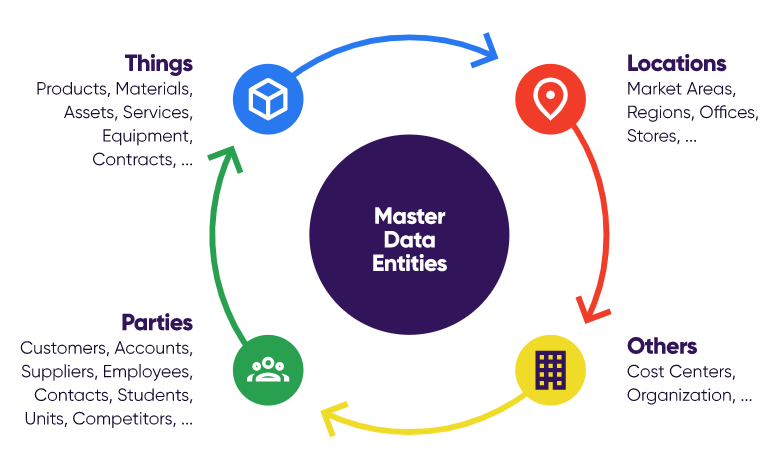
It is an IT-led initiative that centralizes all the organizational data entities in a “Golden Record” and makes the data available across the company by maintaining data consistency at the same time.

MDM manages essential business entities associated with the transactional and analytical operations within the company. Being a master record, MDM allows you to manage a wide range of attributes, associations, descriptions, taxonomies, metadata, roles, etc.

Master-Data-Management-Manages-Wide-Range-of-Business-Entities

Image Credit: Pimcore

Role of Master Data Management

  • It consists of stakeholders, business clients, partners, applications, and technologies
  • It centralizes, syncs, and cleans up the master record to execute workflows, operations, and processes
  • MDM offers master data governance that is defined by the enterprise Data Governance Council
  • It allows for establishing a plan for data access rights, implementation policies, definitions, procedures, and controls

While compared with PIM, MDM is a quite bigger scale solution that helps companies to serve bigger purposes and contributes to the overall business growth. Master Data Management focuses on

  • Enhance agility
  • Accelerate decision making
  • Improve business intelligence
  • Boost the outcome of processes
  • Provide smarter data governance
  • Improve operational efficiencies

What Are the Popular Master Data Management (MDM) Platforms?

  • Pimcore
  • Informatica
  • Profisee
  • Ataccama
  • Stibo Systems
  • Tibco
  • SAS
  • Teradata
  • Oracle
  • NetWeaver
  • InfoSphere

Want to learn about the existing features and benefits of each of the above-listed platforms? Read 11 best Master Data Management tools you should consider.

PIM vs MDM: Core Differences Between PIM and MDM

If you are looking for the core PIM MDM difference then you should know that Product Information Management (PIM) is the branch of the MDM process that plays a key role in delivering high-quality product content to all existing marketing and sales channels.

To know the real difference between PIM and MDM, you need to analyze the primary difference these two systems possess in the following terms.

1. Product vs. Enterprise

  • PIM mainly focuses on product data. However, MDM is specially designed to manage enterprise-wide data.
  • PIM is designed to manage large product catalogs along with the associated data. On the other hand, MDM manages the entire set of master data of an enterprise.
  • Companies mainly use PIM solutions to merge with the eCommerce platform to ensure product data are accurate and up-to-date. Meanwhile, MDM is used to merge with the ERP systems for maintaining data consistency and integrity across the systems.
  • PIM system focused on collecting, organizing, and enriching the product data. An MDM system focused on all enterprise-wide data including product data, supplier data, customer data, employee data, and so.
  • PIM system plays a crucial role in delivering a seamless customer experience through improving product data quality. MDM is designed to improve organizational efficiency based on the data.

Both PIM and MDM systems are pretty vital for an organization for effective management of the product and master data. Having both systems will help enterprises to achieve better operational efficiency, accuracy, and competitive edge.

2. External vs. Internal Product Data Management

  • The data managed by the PIM tool are mainly used on external systems, as the product data is published on various channels where end customers receive it. On the other hand, MDM works with internal and private business data, so data handled by the MDM tool can be used in both internal and external systems.
  • PIM provides a single source of truth for the product data. However, MDM provides a single source of truth for enterprise-wide data.
  • The PIM system is for creating and managing the accuracy of the product data. MDM system is for making business entities or departments understand the product data and make decisions accordingly.
  • The goal of the PIM system is to ensure product data are managed efficiently and enriched according to the evolving market condition. On the other hand, MDM’s goal is to manage enterprise-wide data and help organizations rely on it for making better decisions.

Both PIM and MDM are vital for product data management. However, having an excellent PIM system will facilitate internal management. This helps an organization to analyze product data and customer behavior. So, the PIM tool also plays a vital role in internal data management in terms of product data.

3. Agility vs. Complexity

  • PIM systems can be used by any sized company, team, or professional. However, the MDM system is designed to assist large companies or enterprises.
  • The price of a PIM system varies depending on the requirements; even you can go for an open-source PIM solution which is free of cost. On the other hand, the MDM system costs high as it is designed to deal with large office networks cited in various locations.
  • Installation and configuring the PIM system doesn’t require complex technical knowledge. However, the MDM system requires high technical expertise for installation and configuration.

The simplicity, agility, and customized onboarding of the PIM system help an organization to start working with the system instantly and improve the efficiency rate.

PIM vs MDM: Essential Differences Between PIM and MDM

PIM vs MDM: Capabilities

Product Information Management Capabilities

  • Manage product data in a centralized repository in an effective way
  • Integrate third-party tools, software, and database seamlessly
  • Integrate existing enterprise systems
  • Manage product information in a logical and structured way
  • Eliminate data duplication
  • A single view of consolidated and aggregated view of product data
  • Manage and share the available quantity of products
  • Update the product quantity on the go
  • Different teams can access the updated product information
  • Allows for data cleaning, data cleaning, and data merging

Master Data Management Capabilities

  • Cleansing and correction of erroneous data
  • Easy to integrate with third-party tools or software and existing enterprise systems
  • Extends current data governance tools and programs
  • Deduplication and data matching
  • Business hierarchy and taxonomy management
  • Allows to build interfaces for task delegation and approval workflows
  • Data quality reporting and monitoring
  • Enables privacy regulatory compliance and data obfuscation
  • Provides well-organized data structure for network and relationship analysis

PIM vs MDM: Features

PIM Features

  • Data Modeling
  • Bulk Editing
  • Data Management
  • Catalog Management
  • Data Integration and Delivery
  • Product Content Localization
  • Data Quality/Semantics
  • Data Distribution & Syndication
  • Workflow Management
  • Digital Asset Management

Do you want to get more insights into the existing features of PIM? Visit 8 Must-Have Features of Product Information Management System.

MDM Features

  • Hierarchy Management
  • Data Localization
  • Workflow Management
  • Master Data Linking and Matching
  • Audit Trail
  • Data Enrichment
  • Data Quality/Semantics
  • Data Governance
  • Rich Content Integration
  • Data Security

Want to know about the features in detail? Read 5 Essential Features of a Robust Master Data Management (MDM) Solution to learn more about some of the features listed above.

PIM vs MDM: How Product Information Management Strategy Differs from Master Data Management Strategy

How to Define PIM Strategy

How to Define MDM Strategy

PIM requires managing product data in an excellent way that helps organizations to improve customer experience and accelerate product time-to-market which eventually ends up with increased ROI.If you want to have an MDM then the first thing you need to do is have a vision of the MDM. That means getting clarity on what you want to achieve through the MDM solution.
PIM is mainly designed to help your sales, marketing, and eCommerce teams. Apart from them, it helps your other stakeholders associated with the product information such as the R&D department, suppliers, customer care, and procurements.MDM is designed mainly for decision-makers, stakeholders, and C-suite executives.
PIM allows you to collect, consolidate, and enrich product data.Once you define the vision, share it across the board, and define how to utilize MDM capabilities for your organization.
PIM allows for easy integration with your homegrown or legacy enterprise systems using APIs.Connect your vision for MDM with your business objective to attain desired business growth.
PIM addresses the omnichannel needs of enterprises by delivering a delightful customer experience across multiple output channels.Manage n number of attributes related to products, suppliers, customers, employees, locations, services, and more.
It automates various manual efforts to drive efficiency to your operations.It enables you with a collaboration-based approach where you can create and maintain high-quality data, avoid legacy practices, and break up the information in silos.
 Analyze and define your operational and analytical MDM needs.

Would like to explore more about the MDM strategy with in-depth information? Don’t miss reading how to create a Master Data Management strategy.

PIM vs MDM: How PIM Implementation Differs from MDM Implementation

How to Implement PIM

How to Implement MDM

Analyze the existing product data management process.Decide whether you want to go for multi-domain and single-domain MDM as per your priority.
Prioritize essential output channels for your business including marketplaces, physical stores, social platforms, mobile devices, call centers, or websites.Develop MDM based on what your use cases are, and decide on analytical and/or operational MDM.
Design the right data model for business growth and scalability.You can use any of the implementation systems from registry, centralized, consolidated, and co-existence.
Create user interfaces to export and import product data from different source systems. 
Consolidate and retrieve the data into a centralized repository. 
Integrate the different third-party software and existing enterprise. 
Build business-centric functions and workflows.

Do you want to learn about the MDM implementation in detail? Read How to Implement Master Data Management? [7 Best Practices].

PIM vs MDM: Which is Right for Your Business?

If you are about to decide on the best one from PIM vs MDM, then you need to consider a lot of aspects into account. First and foremost, you need to be conscious of the specific goals of your organization and what you are going to achieve with those tools.

Both the PIM and MDM system helps organizations to streamline the data management process when handling a large volume of data. But it is upon your business objectives to choose both or none or anyone.

MDM system assists enterprises to carry out the cleansing and organizing processes of the master and ensure data governance. PIM system is specially designed to meet the needs of an organization in all aspects of product data.

Having an excellent modern PIM system will help you enhance your product data in all existing channels like mobile apps, pricelists, product catalogs, POS materials, factsheets, and more. Apart from that it assists data managers in the effective management of internal data related to product information. Also, there will be enhanced efficiency and cooperation between the various departments of an organization like product development, marketing, and sales

PIM and MDM: How this Combination Benefits Your Business?

Despite the difference between PIM and MDM, both systems are complementary. If you are looking for a perfect system for getting a complete and centralized view of the product data, then consider having an MDM solution along with a PIM system.

Having an MDM solution with a PIM system will help your organization to gain the ability to manage all product-related information effectively across the departments and systems. Also, it enables you to manage the product data in a centralized location allowing all departments to access it easily.

A combination of MDM and PIM helps businesses to store, view, edit and share all data from a centralized data repository. This enables businesses to reduce the occurrences of data errors and make sure the accurate, up-to-date data are being shared within departments and also with the end customers through an omnichannel experience.

The presence of MDM solutions helps businesses to have a better understanding of their customers and to deliver personalized service. In addition, here are the benefits an organization can achieve with the MDM system.

  • Much easier to implement in the marketing and sales department
  • Enables businesses to deliver high-quality product data through omnichannel strategies
  • Enhances overall business productivity

PIM vs. MDM: How You Can Select the Right One? [Based on Use Cases]

Which one is right for your business PIM or MDM?

The answer lies in your requirements. Thus, I am going to share a few most common business scenarios that enable you with better insights and help you make the right choice in different situations.

Use Case 1

Scenario: When you require accurate business analytics and reporting

Solution: A definite case for MDM

MDM is the master record of all your organizational data and contains the features of analytics and reporting as well. It helps you with reporting, better resource management, and prediction. Eventually, organizations can plan strategies and attain business growth.

Use Case 2

Scenario: When you want to create a product catalog on the go

Solution: PIM is the right fit in this scenario

To create a product catalog, you need quick access to the centralized product repository where all the exclusive information about the products is available. PIM allows your sales and marketing teams to create the catalog instantly by accessing the updated product information in real time.

A Product Information Management system helps you improve product time-to-market, offer a single product data view, enable quick updates, and provide simplified management of your product attributes.

Use Case 3

Scenario: When you want to sell more products within the least time span

Solution: PIM is the right solution

PIM allows the brands to leverage omnichannel engagement by creating persuasive buying experiences for the customers. At the same time, it maintains the consistency of product data across all the different customer touchpoints.

Additionally, PIM allows companies to create price rules in no time for particular target markets, locations, and time durations.

Use Case 4

Scenario: When you want to set up guidelines and policies for data usage

Solution: Undoubtedly, it’s the case of MDM

MDM enables you with data governance where you can decide roles, responsibilities, data ownership, stakeholders, access rights, controls, and clearances across the organization.

Use Case 5

Scenario: When you want to expand into a new location

Solution: PIM is the right solution for this situation

While expanding into the new market, you need marketing and sales collaterals, ready-to-use catalogs, and multilingual support for digital assets. PIM facilitates you with all these capabilities.

PIM allows you to accelerate product onboarding in multiple storefronts, marketplaces, and regions.

Product MDM: An Amazing Functional Amalgamation of PIM and MDM

What is Product MDM?

Managing the product information in PIM, you can support the sales, marketing, and eCommerce teams. While Product MDM serves a broader purpose by connecting all the dots that are associated with products. MDM systems address the varied needs of your supply chain, inventory, and operational departments too.

What Makes Product MDM Different from PIM and MDM?

Before getting into the difference between PIM and Product MDM, let us explain what product MDM is first.

Well, product MDM is nothing but an MDM system that manages the product data just as all their essential business master data. The goal of the product MDM is to assist businesses to get real-time knowledge through product-to-product associations and also by associating the product data with several other existing data domains.

Unlike the PIM (Product Information Management) system, the scope of the Product MDM is broader apart from providing seamless support to specific departments such as marketing and sales. Product MDM is one of the most rated systems by the IT staff as it offers supportive roles to various departments like inventory, operational, supply chain and so.

Okay, let’s focus on how PIM differs from the product MDM.

A Product Information Management system is developed using a data management platform. It allows you to manage and collaborate on product content. A robust PIM solution consists of features like data modeling, data semantics, data integration & delivery, and workflow management along with user-friendly UI.

Implementation of PIM enables you with the benefits of omnichannel enablement, digitization, consolidating data from silos, and automation. The ultimate aim of a PIM solution is to improve product time-to-market, boost revenue, and create compelling product experiences.

Both PIM and Product MDM comes with a similar set of capabilities when it comes to product data management and offering a single source of information. Organizations having both PIM and product MDM can easily unlock the product ecosystem.

PIM offers consolidated product data and distributes it across the existing channels. However, the master data managed by the MDM system is used to develop a strong relationship between end users, products, and suppliers. In addition, product MDM offers numerous benefits such as better reporting, data analytics, and inventory forecasting for effective supply chain management.

At the same time, an organization must note that there may be chances of product data remaining outside the product MDM. So having only the product MDM would be insufficient for businesses to provide seamless support to their marketing and sales departments.

Apart from that, product MDM performs well in other aspects, such as data handling speed, data accuracy, and data control over the product that truly matches the PIM system.

PIM and Product MDM: A Compelling Combo to Manage Product Data

By implementing both solutions for your enterprise, you can access the features of both platforms that enable you maximum benefits. Using PIM, your teams can consolidate the product data and distribute the information on multiple touchpoints.

On the other hand, by implementing Product MDM, you can establish relationships between products, customers, and vendors. Additionally, MDM enables you with several advantages like better forecasting, analytics, and reporting to bring efficiency to your supply chain.

So, you can address your PIM requirements with Product MDM and vice versa as product data management is not the core objective of MDM. Thus, it won’t be able to address the needs of your sales and marketing department where accuracy, speed, and control over the product data are highly essential.

5 Misconceptions about PIM and MDM

1. If you have an ERP, you do not need PIM and MDM

ERP (Enterprise Resource Planning) is a centralized repository to manage front-office, back-office, and financial business data. It serves the needs of different systems such as Supply Chain Management, Business Intelligence (BI), Customer Relationship Management (CRM), etc.

ERP cannot manage the product data like PIM and set up a relationship between the different business entities like MDM to help organizations to make insightful business decisions. Compared to PIM and MDM, ERP lacks in terms of capabilities as well.

For example; ERP cannot support the data workflow, enterprise master data governance, data enrichment, and doesn’t provide updated data all the time. Moreover, it cannot manage media assets.

2. Do not need to develop MDM if you have PIM

PIM and MDM are designed to serve different purposes.

PIM solely focuses on managing product data. And, MDM manages a large amount of data related to customers, vendors, suppliers, distributors, partners, locations, employees, etc.

3. MDM manages product data, then why implement PIM

It is so true that MDM manages the product data. But, it performs different functions than PIM.

As discussed above, PIM collects, manages, syndicates, aggregates, enriches, and distributes product data across multiple sales channels. While MDM establishes the relation among products and other related business entities.

Unlike PIM, MDM cannot create an exclusive repository of product data.

4. MDM required a one-time implementation. And, that’s all!

Rather than considering MDM as a solution, you should consider it as a business philosophy. As the business grows, new requirements, business processes, mergers, and acquisitions take place.

To meet the changing business scopes, it is very essential to implement an adaptive MDM. A reliable MDM always supports cross-functional and cross-departmental analysis and collaboration.

5. All the MDM solutions allow for multi-domain data management

When it comes to “MDM”, we assume that Master Data Management solutions allow us to manage multi-domain data by default.

Well, that’s not true. Both single-domain and multi-domain MDM are available in the market.

Let’s see how they are different from each other so you can make the right choice.

Single-domain MDM

By implementing the single-domain MDM, you can manage the data related to a single business entity such as products or customers. Such solutions work with a set of domain-specific features and predefined data model templates.

Management of a single domain like customer or product in an MDM, don’t you think it is quite costly for you? Add to that, it won’t help you to attain your other organizational objectives such as data enrichment, data governance, data integration, and more.

Multi-domain MDM

A multi-domain MDM helps organizations make the right business decision by enabling them with appropriate business intelligence. Considering a multi-vector MDM, you can have a solution that is flexible enough to adjust your industry, organizational structure, and implementation style.

Why Choose Credencys to Build Robust PIM & MDM Solutions?

Credencys uses Pimcore, an open-source platform, to build the next-generation PIM and MDM solutions. To enable you with the advanced solution, Pimcore enables you with features like Data Quality, Workflow Management, Data Integration, Data Modeling, Data Management, etc.

Using Pimcore development services, Credencys builds Product Information Management and Master Data Management solutions that allow you to manage any type, format, and any size of digital data for organizations of any belonging or size to any industry domain.

  • Developing PIM and MDM solutions, we help clients with
  • Increased operational efficiency
  • Improved sales and marketing performance
  • Reduced time-to-market
  • Leverage greater flexibility for internal teams
  • Improved data quality
  • Accelerated new product onboarding
  • Simplified the management of media assets globally
  • Improved customer experience
  • Automated workflow reduces manual efforts, and more…

Let’s work together to build a digital platform for your organization that drives value to your business customers cost-effectively.

Master Data Management in Supply Chain: How MDM Revolutionizes the Supply Chain Management

Data quality and data consistency has become the most important aspects for businesses involved in supply chain activities. Modern-day supply chain leaders pay more attention to acquiring a good Master Data Management in Supply Chain Management.

The Master Data Management solution plays a key role for professionals who try their best to cope with the evolving business imperatives in terms of data.

This article briefs the importance of having a Master Data Management solution for Supply Chain Management and how it revamps the supply chain function in detail.

Supply Chain – A Brief

Before diving deep into the core topic, let’s discuss some of the basic aspects of the supply chain.

A supply chain is a network with a mixture of logistical systems and individuals to facilitate the movement of completed products from manufacturers to consumers or end-users. The entire supply chain entity may link directly or indirectly with the consumers to ensure the supply of goods in the most efficient manner.

Challenges of Supply Chain Management

Despite having a wide range of tools and software for the effective management of the supply chain process, still, companies involved in supply chain activities face a lot of challenges. Challenges faced by the SCM companies act as a barrier to achieving a smoother supply process.

Here are the few most common challenges an SCM company may face, take a look.

Order fulfillment

Without having a proper or standard data definition apart from having basic information like price, size, and so, it is a bit challenging for users to order items. Because that basic information may be entered incorrectly by individuals.

Mismatched data

Often SCM businesses experience a lot of loss due to the product return because of poor product descriptions and mismatched product information. Shipping charges will be expensive for companies as the products need to be shipped back to warehouses or distributors.

Poor inventory management

Without proper management of your inventory, running a successful supply chain business is never going to happen. Having no stocks or excessive stock will lead to significant losses to the supply chain business, this clearly indicated poor supply chain planning.

All those above-listed common challenges faced by Supply Chain Management companies can be easily tackled with the perfected supply chain master data management system. The upcoming sections elaborate on how Master Data Management revamps the supply chain process in detail.

Master Data Management in Supply Chain Management

Master Data Management solution helps supply-chain managers in many ways. Particularly in achieving more efficiency in handling data, suppliers can enjoy complete, accurate, compatible, and coherent data in a consistent manner.

Focusing on supply chain master data management has gained a lot of attention in recent times. This is mainly because the supply chain process is responsible for producing master data related to customers, products, suppliers, locations, and vendors.

Moreover, the entire supply chain process is highly data-dependent and plays a key role in turning the success charts in both ways.

Companies that fail to maintain their supply chain management properly will lack the ability to make efficient and informed decisions during a critical situation. In addition to that, here are the lists of aspects that elaborate on the importance of having a Master Data Management in supply chain.

  • As the organization starts growing, often they struggle to maintain the quality of data because their business data starts growing tremendously. This creates a serious negative impact on their business efficiency level.
  • A good master data management solution comes with various useful tools that coordinate the data cited across the business in a centralized platform. This helps all the departments to access accurate and up-to-date information.
  • MDM solution helps businesses to manage the critical portion of the data effectively. Also, with the seamless data integration feature, MDM consolidates all the scattered data into a single source.
  • Master data management helps businesses to access high-quality data to carry out various functions from its single and centralized data repository.
  • Supply chain master data management act as a bridge connecting various supplier systems and provides a homogeneity and transparent data policy.
  • With the data transparency offered by the MDM solution, a business can access quality data easily and it helps to cut the operational cost significantly. Also, it leads to enhancing the revenue generation process.
  • MDM in the supply chain process helps businesses to deliver reliable and accurate data through cross-organizational data alignment.
  • Despite increasing the data quality, the master data management system makes the business data more securable by offering a centralized repository with limited access to the users according to their roles.

Overall, master data management stays at the core process of the supply chain and plays a vital role in improving its value. As supply chain businesses are keen to experience consistent data performance, having a good MDM has become the primary factor to achieve better data consistency.

How Does Master Data Management in Supply Chain Simplify Various Operations?

Supply chain master data management is the perfect mixture of data consolidation, data governance, data standards, and data quality functionalities. It helps the Supply Chain Management to handle the sheer volume of a variety of data efficiently and effectively.

In supply chain management, a range of data may originate from various data sources such as ERPs, CRMs, online forms, employee profiles, customer profiles, fleet transit details, vendors, suppliers, and so.

Having a good Master Data Management strategy for your supply chain business would encourage employees when they start witnessing better supply chain results.

Moreover, implementing  Master Data Management in supply chain solutions will ease the data integration from the internal and external systems and ensure the data quality is maintained uniformly across the business.

To be frank, the benefits of having a master data management vary from business to business according to its need and functionalities. The solution offers a unique data architecture and provides insightful value on customer data which plays a huge role in the sales & marketing perspective.

Apart from that, here are a few additional ways by which a Master Data Management solution simplifies Supply Chain Management.

Centralized data architecture

The advanced architecture of the Master Data Management platform allows anyone from any department in an organization to access quality data to improve their work efficiency. To explore more about MDM architecture, read out A Brief on Master Data Management Architecture.

Drives optimization and efficiency

The data consolidation process of a Master Data Management solution helps businesses to reduce the data errors a lot mainly occurred because of humans. Also, it offers better data visibility and optimization of end-to-data that helps businesses to achieve better efficiency in the supply chain process.

Customer Engagement

By providing accurate and consistent high-quality data, businesses involved in supply chain processes can get more opportunities to get connect with the customer and improve their engagement activities.

Data reliability and backup

As the data collection, managing, and sharing process are done automatically the possibility of data errors gets reduced, and improves data reliability. Also, the Master Data Management solution offers a data backup option that allows businesses to recover their business data if any data damage or data loss occurred.

Why Master Data Management in Supply Chain is Essential for Your Supply Chain Ecosystem?

When it comes to managing and defining business data, Master Data Management would be the comprehensive solution. The Master Data Management solution offers a single, trusted, and complete view of the master across the company.

Moreover, leaders who manage the supply chain process can easily remove the presence of bad data and play a key part in digitizing the business process.

Apart from that, here are the lists of key aspects of Master Data Management solutions that can enhance the supply chain procedure.

1. Master Data Management acts as an SSoT (Single Source of Truth)

As businesses these days handle more data daily, it is hard for them to make sure they are handling the right insightful data.

Also, data becomes much more important to run businesses smoothly businesses need to have a consolidated platform to manage their data effectively. This is where Master Data Management comes into play.

Master Data Management in supply chain escalates the complexity of handling the sheer volume of data and provides well-synchronized data in a centralized location that acts as a single source of truth for data. This helps suppliers carry out data cleansing and data validation processes easily and quickly.

In addition, having a good Master Data Management solution in your supply chain environment will provide you with an all-inclusive depiction of data related to customers, products, and business partners.

Also, suppliers can easily access information like barcodes, product information, product price, and product size/color which are essential to increase the value of the supply chain.

2. Offers more transparency

Managing siloed departments in the supply chain environment is one of the biggest concerns for suppliers. Having an unmanaged siloed department will hurt data visibility.

However, this problem can be easily managed with the presence of a good MDM solution. The supply chain master data management brings all the possible systems where data can be collected together in a consolidated platform.

This data merging activity carried out by the master data management in supply chain environment will pave a path for transparency. In addition, the MDM system acts as a communication bridge between various systems like ERPs, CRM, and so.

This ensures all the systems can access reliable end-to-end data consistently. With such high transparency in the supply chain system, it helps businesses to gain more revenue and to create more opportunities to grab new customers.

3. Helps to predict and manage inventory management accurately

Inventory management and forecasting business operations are pretty vital things for any business. If you are running a business involved in supply chain management, then both inventorying and business forecasting go hand in hand.

Having a Master Data Management solution in your supply chain management will improve the efficiency of managing the inventory system and provides accurate business data; this helps the business to accelerate its business operation across available distribution channels.

4. Helps businesses to expand globally

Expanding business globally will create more opportunities to reach more potential customers. At the same time, it brings more challenges in terms of managing and delivering product data according to the new market condition and meeting the regulatory compliances of various governments.

With the presence of master data management in supply chain, suppliers can have data standardization and bring more collaboration among the existing systems of internal and external entities.

This facilitates a smoother exchange of data between systems. Also, MDM helps businesses to deliver data across the channels according to the desired formats, ensuring the data or information is passed as per the regulatory norms.

5. Enables smart management and offers more sustainability to the supply chain.

To carry out effective management of the modern supply chain business, you would need a consolidated platform that needs to interconnect the business units for having a fragmented approach throughout the supplier lifecycle.

Master Data Management solution acts like a consolidated platform and assists supply chain businesses to function on a process-driven workflow that will push businesses to overcome operational complexities and costs.

Apart from offering a smart management system with process-driven workflow, Master Data Management in supply chain addresses the rising challenges of supply chain management through its trusted data, holistic data governance, and real-time data analytics.

Considerations to Ensure Effective Implementation of Master Data Management in Supply Chain

Supply chain master data management eases the hassles involved in managing the supplier’s core data assets like product details and customer data. The MDM solution offers a centralized data repository for storing and optimizing data consistently.

However, implementing a master data management system in a supply chain environment isn’t an easy task to do. It requires a lot of determination and best practices to follow to ensure your business leverages high-quality data from the Master Data Management system.

Here are the lists of key considerations every supplier should be aware of for effective implementation of the Master Data Management system.

Spotting the master data domains of your business

Master data domains are the core data assets for your supply chain business. They are essential for the supply chain process efficiently. In general, product data/details/information along with the information regarding the suppliers would be the master data domain for supply chain businesses.

Establishing governance policy and regulated data processes

For any business, it is important to have regulated and clear data processes to maintain and manage the master data efficiently.

In addition, suppliers should follow data validation and standardization rules to carry out the data governance processes. So, that your business can get the most out of the data managed on the MDM system.

Pick the right tech stack

In today’s market, you can easily spot a wide range of Master Data Management solutions offering a variety of features and functions.

However, suppliers need to engage with the MDM service vendor who offers a Master Data Management solution with perfectly packed features that matches your business needs.

Proper Training

If you wish to get the most out of your Master Data Management solution, then you must train your workers and users who going to handle the system. This will make them understand the platform well and act potentially to achieve the goal.

By following the above-mentioned aspects, you can implement the supply chain master data management system effectively and efficiently in your business. Furthermore, this will drive more value to your supply chain business.

Master Data Management is the Future of Supply Chain Management

For better supply chain management, experts often suggest the implementation of multiple systems like ERP (Enterprise Resource Planning), CRM (Customer Relationship Management), and other systems performing financial and warehouse operations.

All these systems utilize the business data and grab every possible opportunity to improve business operations. Well, this may sound good but, it is hard to achieve what is mentioned by implementing those systems.

Without any consolidated platform, the possibility of those systems getting disconnected is high and once it gets disconnected achieving the desired data quality through the above-enlisted systems will become much more difficult. Delivering unclean data will lead to the efficiency of the entire supply chain process.

This is where MDM in supply chain comes to the rescue. Having an efficient supply chain master data management solution at your business will help the business to recover and improve the quality of the data set which gets siloed in numerous ways.

Furthermore, with the improved data quality the Master Data Management solution helps businesses to speed up the process of reaching their new products to the market.

Also, the clean, accurate data offered by the master data management solution improves the communications between the departments and lets them access high-quality data from the centralized data repository. This will significantly improve the work efficiency of each department and helps businesses to achieve operational excellence.

Conclusion

The supply chain Master Data Management helps business leaders involved in supply chain business to share high-quality data across the organization through a centralized single location; it eliminates the complexity of viewing accurate data within internal and external systems. This contributes a lot for businesses to achieve better efficiency and continues business expansion over time.

Master Data Governance: 21 Best Master Data Governance Practices

Every company has to manage the organizational data from different departments such as operations, marketing, sales, eCommerce, account, and human resources as well as individual employees and customers in more or less quantity. Explore how master data governance practices help companies manage all the organizational data accurately in a single platform.

How do you manage all of this organizational data?

You might be managing all the data in disparate systems.

If it is so, then let me ask you one more question.

Do you find that approach time and cost-efficient?

If your answer is YES, then I am sure you are not aware of the capabilities and benefits of centralized management of your organizational data. It saves a lot of time, money, and effort for your team in managing the data across multiple systems. Thus, it is highly recommended to mid-scale to large-scale organizations implement a Master Data Management system.

While developing and implementing an MDM solution, don’t miss to consider advanced security and compliance standards to protect your valuable data.

Most of the platforms available in the market come with the best security standards. But, if you want, you can add extra layers of compliance to avoid the risk of a data breach.

Before moving towards master data governance practices, let’s get an overview of master data management. Understanding MDM enables you to better clarify further in this post.

What is Master Data Management (MDM)?

Master Data Management creates a single master record of all the essential business data from external and internal data applications and sources. It involves the organization with a consistent and uniform set of extended identified attributes that present all the core business entities.

In MDM, companies can manage the data of their products, customers, employees, accounting, operations, partners, websites, and more.

To get better insights about MDM, read What is Master Data Management & How Can It Benefit Your Business?

What is Master Data Governance?

Master Data Governance is an application for data governance and compliance that helps brands improve the management of a subset of master data. Master data allows for managing all types of data that every entrepreneur needs to run an organization or business.

MDM helps companies to manage various operations too through centralized data management.

For example; you purchase the material from the suppliers to create products that you want to sell to your customers and deliver the products to partners.

The consistent and accurate material, product, supplier, partner, and customer data help you to boost the accuracy and efficiency of your various business processes such as record to report, procure to pay, and order to cash.

Now, it’s time to learn about the core topic. Yes, let’s explore the best practices of master data governance.

Why Master Data Governance is Important to Businesses?

Master data governance framework can be briefed as a system that involves business people, business processes, and the latest technologies for effective & efficient master data management. Well, this will give you a clear picture of the essence of MDM.

However, here are the lists of some key aspects that highlight the importance of having Master data governance at your business.

  • Master data governance defines who can access the master data and offers roles & responsibilities to the users accessing the master data.
  • Master data governance framework helps organizations to extract information from the master data easily and efficiently.
  • It helps businesses to share the right data with the right users at the right time.
  • The master data governance system offers optimized master data in a transparent, standard, and fully harmonized way all over the enterprise.
  • The system will act as a reliable source where all departments can share high-quality data and ensure uniform communication being shared within an organization.

21 Best Master Data Governance Practices

1. Definitions

Master data governance presents the core set of attributes that are part of the main master data definition and these attributes are consistent across the company.

For example; you want to create a master record of customer data in MDM. For that, MDM allows you to manage all the data that are relevant to your customer base such as

  • Name (full name of the business and customers you are selling the product)
  • Address (billing and shipping address to deliver the products)
  • Email
  • Mobile number
  • Payment terms, and many other attributes

In short, you can cover all the attributes that are essential for your business processes.

Here, the critical job is to define which attribute is important for your business. Otherwise, you will end up focusing on the least important attributes that negatively impact the success and agility of your master data management operations.

2. Data Quality Management

Data quality requirements differ from company to company. Thus, organizations need to consider tools and techniques to support data monitoring and validation processes. The data quality management processes include

  • Enabling effective reporting and quality monitoring
  • Creating control for validation
  • Data incident tracking
  • Enabling recommendation and root cause analysis
  • Supporting the triage process for assessing the level of incident severity

The right process for data quality management enables you with trustworthy data for analysis.

3. Data Access Management

For data access security, two aspects are considered under master data governance practices.

1. Provision of access to available assets

It is essential to provide data services that allow organizations to access their respective data. The companies need surety that apart from the company, no other individual or company can access their data. Most of the cloud platform providers offer varied methods for developing data services.

2. Prevention of unauthorized or improper access

You need to develop a Master Data Management solution that allows you to define roles, groups, and identities in order to assign access rights to establish a level of managed access rights.

Data access management is the best practice to manage the master data access services and interoperating with the cloud provider’s access and identity management services by allocating and managing access keys, defining roles, and specifying access rights for ensuring that authenticated and authorized systems and individuals are able to access data assets according to determined rules.

4. Policies

Master Data Governance practices makes sure that external regulations and internal policies are taken care of as a part of master data management. These policies should be relevant to many aspects of the master data governance such as privacy and protection, risk management, data quality, and retention and deletion.

To address the regulation and policies, it is important for you to separate the duty in terms of

  • Who can create the master data for the cost center in a general ledger system
  • Who is allowed to approve the creation of cost centers (it is a risk control policy in order to prevent accounting fraud)

5. Rules

You might be thinking, we have already discussed the policies then why do we need to talk about rules? It’s indirectly a part of the policy.

Well, it’s not so.

Policies are supposed to define what you want to do. On the other hand, rules define how to enforce and execute policies.

Want to understand this difference in detail? And, how do policy and rules work hand in hand? Let’s look into it.

Policy: Before you use the personal information of a customer, you must obtain approval for processing.

Rule 1: Define the consent attributes that need to be a part of customers’ master data definition such as marketing, third-party sharing, and billing.

Rule 2: Before the customer record is created and approved, enforce the collection of those consent attributes.

Rule 3: Check out all the marketing consent attributes before the custom data can be used in a marketing automation system.

This example makes it clear to you that it is quite normal if you define multiple rules to address the requirements of a single policy.

6. People

By creating the documentation of master data governance practices, you can provide visibility to your different teams across the organization who are continuously working towards the success of MDM activities. These people from your team could be:

IT team

Your network team is responsible for the architecture and management of various business processes, applications, and databases.

Subject matter experts

Subject matter experts are mainly responsible to define both standardized master data definitions along with the levels for the business and types of the quality threshold needed for varied business processes.

Data steward staff

They are responsible for remediating data quality problems for specific master data domains.

Legal and security team

This team is responsible for data protection and privacy.

Cross-functional leaders

Cross-functional leaders, who comprise the council or the governing board, are responsible for solving disputes amongst varied functions within the business.

7. Workflow

Once you determine the core team who are going to utilize the master data management. You also need to define the workflow in the document that allows your teams to collaborate effectively. With the help of workflow, you can

  • Define a mechanism for creating the request for master data creation requests.
  • Allow multiple people from different organizations who need to be involved with parallel approval, workflows, go-live distribution, and activation of applications.
  • Determine which master data steward the request is routed to, based on domain responsibility.

8. Catalog

By implementing a robust Master Data Management system with the right Master Data Governance practices, you can get access to several cataloging capabilities.

  • Assuring the quality (completeness and accuracy) of master data across every single source
  • Verifying the consistency of master data definition across different sources
  • Exploring and documenting which master data domains are available across different systems, applications, and other sources such as lakes, data warehouses, and more.

The Master Data Management system understands the master records you have, knows where the required data is located, and clarifies how it conforms to your policies and definitions.

Mergers and acquisitions are very common strategies that businesses adopt to expand and grow in a new market. You need to understand the master data available in the source systems of the company you acquired. Also, you need to map that company’s data with your master data definition. By performing these activities, you can reduce financial reporting risks, reduce integration costs, and accelerate business value.

9. Process Mapping

Process mapping provides visibility on how the master data flows between different sources as a part of business activities. It is more or less similar to the catalog documents where the master data resides. Knowing how the master data flow through processes or understanding the source helps you to better visualize the varied things like

  • Where rules require to be introduced into the process to enforce the policies
  • Compliance risk exposure
  • How the master data is being used

In the process of mapping, you need to understand from where the master data is collected, which systems the data flows to, and what third-party systems the data is shared. Thus, you can enforce policies and standards for clinical data submissions and acquisitions.

10. Auditing

To ensure that the systems are working as they are designed to act, companies need to access their systems. Data auditing, monitoring, and tracking (who has made what changes and when and with what information) helps your data security teams to collect data, identify risks, and act on them before any data damage or data loss occurs.

To avoid any data security threats, it is important to perform regular audits for your master data where you check the effectiveness of the security controls by analyzing overall security health and mitigating threats quickly.

11. Data Protection

Most companies have Perimeter security that is not enough to protect your sensitive business data. There is a risk of data leak as the users with limited access to your data cannot access all of your data but some of your data can be exposed by that user anyhow.

You need to adopt advanced data protection methodologies to make sure that exposed data cannot be read. Here you can consider various methods like

  • Encryption in transit
  • Permanent deletion
  • Encryption at rest
  • Data masking

12. Data Literacy

Ensuring the success of data governance relies on training, education, and a true understanding of what can’t and can be done with your data.

But the adoption of technology alone is not enough. It takes policies, people, and processes to drive the organization-level change and enables users to protect and see the value of their data as a business asset.

13. Metrics

When it comes to managing and measuring the master data, master data governance practices allows businesses to define matrices. It contains varied technical metrics such as the completion and accuracy of master data, how many personal data attributes are masked or encrypted, and the number of duplicate records in an application.

These types of metrics help you in the technical management of master data, leading companies will frequently also try to future determine how consistency and quality of supplier and material master data help you mitigate supply disruption risk, reduce inventory carrying risks, and negotiate better procurement terms.

14. Focus on your scope of data governance

For better data governance, you need to focus mainly on the master data entities. Often for a business master data entities like cash, reporting records, payment procedures, and hiring to retire are the most critical processes. Those entities may differ from business to business in terms of attributes.

Defining the master data entities with a minimum set of attributes is essential for businesses to maintain data governance consistent across the systems. Once you manage to maintain the consistency of your master data entities you can ensure your business process is carried out efficiently and effectively.

Also, governing master data with too many attributes is not an easy job and it will be a daunting task for business leaders and stakeholders. Master data entities with too many attributes will get delayed for implementation because of that reason.

15. Create a better business policy with the help of experts

To run a business successfully and also smoothly, you need to have a better business policy that needs to satisfy the regulatory requirements. Many top-level businesses around the world have separate policies for meeting the requirements of national, state, and industry regulators.

Here are the lists of policies and regulators to which businesses need to pay attention for running a smooth and successful business.

  • Privacy regulation from the European GDPR (General Data Protection Regulation) & CCPA (California Consumer Privacy Act).
  • Financial regulations from the IFRS (International Financial Reporting Standards) and GAAP (Generally Accepted Accounting Principles).
  • Industry Regulations like BCBS 239 in banking and Sunshine Act in healthcare.

Apart from that, people from the verticals like legal, and finance will require expertise and knowledge to meet the needs of the regulators.

16. Defining ownership and accountability

When it comes to master data governance practices, governing the operation of master data can be approached in two different parts, such as.

  • The first and foremost part is defining the rules. These rules’ definitions should be subjected to the matters involved by businesses.
  • The second part would be creating executable codes for enforcing the defined rules. Just like performing an API call to verify the postal address.

Both parts play a crucial role in master data governance practices. The second part which involves the creation of executable codes must be handled by the IT department and deployed in business applications and tools which perform management operations.

17. Automating master data lineage and data mapping process

In today’s virtual business world, almost all businesses are experiencing potential growth of their business data and it has become a tedious job for data managers to do data management operations.

In addition to the exponential growth of the master data, a business may witness a lot of data integration operations and date movements around the entity. To tackle such things, modern-day businesses create a lot of jobs for performing data integration and data movement operations.

Data managers prefer modern tools that use AI (Artificial Intelligence) & metadata for scaling their operational efficiency. Often tool drives more efficiency by introducing automation in the data lineage mapping process.

This helps businesses to identify the data movement processes easily. In addition, the automated lineage mapping facilitates a greater collaboration among the relative master data that paves the path for productivity increase.

18. Deploying auto function on data discovery and cataloging

For a successful business, data identification is an important process. Once you can identify the right data you need to work on your data catalog for leveraging the benefits of quality data.

In general, an organization utilizing the data catalogs will have the opportunity to improve their overall ROI, customer base, streamlined business operation and so.

Once your business starts experiencing exponential growth of business data, you would need technological assistance through tools using AI (Artificial Intelligence) and metadata. With such tools, you can easily automate the process of data discovery and cataloging of the master data which plays a key role in improving business efficiency.

In addition, modern data management tools come with advanced data-sharing capabilities and full audibility access. So, the person who is responsible to access the tool can have the power to share data and conduct data auditing operations with ease.

19. Defining roles and requirements properly

When it comes to driving a business towards the success path, as a business stakeholder you need to design roles and responsibilities for the sake of business benefits. The roles and responsibilities should be defined according to the person who holds the position.

This enables you to identify and hire a potential person for the post according to the defined roles and responsibilities of that particular post.

Instead, you can define the desired technical skills and management skills along with business knowledge. By doing so, you can ensure hiring a desired and successful person for performing that role efficiently.

Once you hired all people for all the posts, then determine about training the hired people with the right knowledgeable people from your business house. This gives you a perfect ideology for hiring the right people for your business and pinpointing whether you need to source a workforce externally for completing the project.

20. Streamlining and optimizing your business workflows

Data managers or an organization should work along with the business stakeholders so that they can understand how effectively they need to manage the master data. Often business activities are performed by different groups which are connected together.

With a proper understanding between data managers and business stakeholders, data managers can design a highly structured workflow.

Once, the business workflow gets optimized and streamlined, business stakeholders can focus on automating task prioritization that will pave the path for productivity increase and brings more efficiency to work.

At the same time, you need to make sure on conducting a proper full audit trail on every step performed for workflow optimization. So that, if any issues occurred you can easily roll back to the previous version.

21. Measuring business value accurately

When it comes to master data management, technical data metrics are a pretty important role in managing your business processes efficiently. So, if you really want to predict your accurate business value, then you need to focus on your technical data metrics.

You need to design a metrics hierarchy by linking all the data responsible for the business process which also includes shipping data, delivery data, order invoice data, accurate tax details, and so.

All those above-enlisted data metrics play a crucial impact on days sales outstanding (DSO). The DSO (Days Sales Outstanding) proves your business efficacy and value. Having a better master of data management will help any organization to drive better data efficiency in the long run in today’s competitive market.

Benefits of Having Master Data Governance

Still, thinking about why master data governance needs to be implemented in your business? Well, this section will force you to deploy master data governance by explaining its business benefits.

1. Workload reduction

To handle and manage all the business data, almost all the departments of an organization should play a major role. However, with the master data management system the workload of departments on handling and managing the data gets reduced dramatically.

Having an MDM system will completely get rid of the work of data collection from all departments, also the system eliminates the presence of data duplications among the departments.

Master data management is specifically designed to carry out the data management and data governance process. This makes the departments free from the work of collecting, storing, and managing business data.

2. Improves the quality of data

As the ultimate goal of the master data management system is to streamline and regulate the data management process in an organization, the MDM system takes all the necessary steps to improve the master data quality.

At first, the MDM system provides a proper structure to the business data through a centralized data management system.

The centralized data system acts as a single source of truth for data which helps businesses to eradicate all the problems in data reporting and handling data on cross-functional processes.

In addition, the centralized data repository reduces the risk of data errors and improves the data quality significantly.

Quality data becomes the ultimate weapon for businesses to succeed in the competitive market, this makes the master data management system an integral part of the modern-day business which delivers supreme data quality.

3. Data governance and data compliance

As mentioned above, the master data management system offers a centralized system for the effective management of data. This makes all the existing master data of an organization accumulated in a single place.

Having all master data in a single place will be helpful for business stakeholders or data managers to easily manage and define structured responsibilities. This allows businesses to set up a dedicated data compliance team to satisfy all the terms of the regulators.

Above all, the structured data provided by the MDM with responsibilities allows data managers to optimize it easily and quickly according to the evolving market condition.

Conclusively, having a good master data management system will help data managers and businesses to improve their master data quality through which businesses can attain their goals and objectives quicker.

4. Reduces new product’s time-to-market

With the presence of a centralized master data system, launching a new system becomes much easier for businesses. In general, launching a new business product will take a lot of setup efforts if it is handled manually.

Now, with the arrival of an automatic data management system, the new products will get the required master data directly and instantly from the system. This reduces a lot of time and allows the team to initiate the product launch much before the deadline.

Apart from that, with the master data management system the sales and marketing team gets accurate data on the new products well before the launch. This allows them to imitate their work in time and helps to enhance the product reach to the more potential audience quickly.

5. Enhances the efficiency of business processes

The centralized data processing system offered by the master data management system acts as a perfect single source of truth for data which supports business processes in many ways.

The accurate and up-to-date data provided by the master data management system helps data managers to utilize them wisely on various applications and devices.

This ensures high-quality data are being served to the end-users at the right time. Also, employees accessing the right data will improve their work efficiency as they don’t need to rework or alter the data to improve its quality. Thus, it improves the efficiency of the business processes.

6. Helps business leaders to take impactful business decisions

Master Data Management offers a holistic, comprehensive, and complete view of the business or master data which can be accessed all across an organization. This results in the enhancement of organizational-wide improvement in work efficiency because almost all the work processes rely on quality master data.

With the high quality, accurate, and up-to-date master data, business stakeholders, executives, senior level management professionals along with all level employees will have a complete awareness of the project. This helps business leaders or stakeholders to make impactful business decisions during crunching times.

7. Bring automation by eliminating manual processing

Companies opting for manual tasks for managing all their master data will face the huge risk of data loss during data handling and manual errors while entering data. Yes! You may have few benefits but when compared with the risk factors manual process of managing master data is just a nightmare for businesses looking to gain a competitive edge in today’s evolving market.

Having a good master data management system will help businesses to manage their master data without any hassles.

In addition, the MDM system allows data managers to easily share the data among the systems easily and quickly. Instead, the system offers easy data governance processes along with an easy-to-use interface.

Make Salability Your Core Focus for Master Data Governance Technologies

Master data governance technology is all about determining the types of capabilities that need to enhance master data governance. It’s not about implementing the MDM. These technologies involve metadata scanners and connectivity to help the catalog master data across different sources. Moreover, process management and linage capabilities assist with workflow and process mapping.

Pimcore’s MDM Enables You with Better Master Data Governance Practices

Pimcore is an advanced platform that allows you to build a Master Data Management system that contains advanced master data governance technologies to ensure the security and protection of your organizational data.

Whether you need policy and rule management, data quality, data integration, data protection, privacy, or data cataloging, Pimcore MDM enables you with incredible capabilities for master data management and governance.

Credencys enables you with end-to-end master data management capabilities integrated into a modular or comprehensive Pimcore platform that is powered by advanced technologies as well as powerful in-built frameworks. To understand the Pimcore master data governance, feel free to get in touch with our experts.

Master Data Management Frameworks – Explained in Detail!

For almost all modern businesses, improving and maintaining their data quality through data management solutions has become the topmost priority. The imperative for master data solutions continues to grow as it maintains consistency in delivering quality data reporting, meeting the demands of regulatory compliance, and so by offering robust master data management frameworks.

To leverage more from your master data solution, you need to ensure your master data management frameworks, Master Data Management strategy, and business objectives are synced perfectly.

This article briefs the master data management frameworks along with the benefits your business can get through it.

What is Master Data Management (MDM)?

Before getting into the core, let’s brush up with some basics on master data management.

Master Data Management (MDM) is a set of pre-defined processes specially designed to manage, organize and share business data from a centralized location.

The ultimate goal of the Master Data Management solution is to optimize the stored data according to the evolving market condition and to achieve better operational efficiency.

If you are excited to explore more about the master data management technology platform, don’t miss visiting What is Master Data Management (MDM)? to understand the different aspects related to master data management. Also, read Master Data Management – An Ultimate Guide that helps organizations to understand how master data management contributes to business success.

Master Data Management – How Does It Work?

Master data solutions could have numerous functionalities that depend upon the needs and requirements of the businesses. However, the root management system revolves around 5 functions which are listed below, take a look.

Content Access

Accessing the content is the uttermost priority when it comes to data management. The MDM system connects everything that may have a potential data source in a system.

Relationship Hierarchy

It is another vital functionality that every Master Data Management should have. MDM systems should have some relationship hierarchy among the existing systems of an organization on accessing data.

Accessing rights

It clarifies what kind of data types are needed and the details of who can access them. MDM solutions must come with an option of setting rules and accessing rights for the users to safeguard the content quality.

Change management

This enables the system to keep ready the essential or needed data readily. So that if any changes are introduced in the regulations they can be managed efficiently and quickly.

Data Processing

This empowers businesses to access the data or inject the data smoothly during the data processing time. By doing so, businesses can easily measure the quality of data and take essential measures to maintain consistent data quality.

To know more features of a master data management platform that helps businesses streamline and automate varied data-driven processes, visit Essential Features of a Robust Master Data Management (MDM) Solution.

Master Data Management Frameworks

Master data management follows 3 frameworks, which are listed below. Take a look.

Registry Architecture

It is a kind of framework that allows users to have read-only permission. This prevents unwanted users from modifying and affects the data quality.

Hybrid Architecture

This framework permits making a change to the stored data.

Repository Architecture

This framework stores all the enterprise-level data in a centralized location and allows all applications to make use of it.

After having an overview of master data management frameworks, if you are eager to get detailed exposure to the Master Data Management architecture, check out A Brief on Master Data Management Architecture.

Benefits of Considering Master Data Management Frameworks

Master data management framework designed to handle a large volume of data. More importantly, the role played by Master Data Management in bridging the gap between customers and companies through high-quality accurate data is crucial for the success of the business.

Apart from that, here are the lists of some key advantages offered by Master Data Management to run a smooth and successful business.

1. Master Data Management Frameworks Benefits for Enterprises

  • When it comes to managing a big company, it is essential to have complete control over the internal processes and system. By doing so, they can able to drive better performance and more consistency. Having a good master data management will ease the process of controlling internal processes and systems by delivering quality accurate data which tells a single variant of truth everywhere across the company.
  • A Master Data Management system helps business authorities to handle all kinds of risk effectively and make sure the company processes are improved notably. Moreover, the functionality of Master Data Management makes sure all the company’s products are up-to-date and manages data privacy effectively. Also, it reduces labor costs by helping business stakeholders with process optimization, complying with regulatory rules, and executing a better customer care program.
  • A Master Data Management system helps organizations to push their internal system boundaries to achieve better operational efficiency and paves the path toward attaining more profits. In addition, the functionality of a good Master Data Management optimizes the product data/information according to the regulations and in such a way that decreases its time to the market dramatically. This ensures all departments work as a collaborative workforce to drive better efficiency.

2. Master Data Management Frameworks Benefits for Customers

  • To run a successful business, satisfying clients through selling quality products or by delivering top-notch services. Is essential to keep this as the ultimate goal of your business strategy, having a good Master Data Management solution delivers exactly the same. Master Data Management solution helps businesses to deliver up-to-date, accurate data that can give a complete view of your products to clients. This ensures clients/customers get a universal view of the data despite their location.
  • Having a good Master Data Management solution will significantly improve the communication between your business and client. Details like customer purchases, product exchanges, and product return details due to bad data are perfectly handled by the Master Data Management system. Moreover, it automates the processes which are done manually by the business and improves efficiency.
  • Despite filing the communication between the brand and customers, an effective Master Data Management system carries integrated outside sources of data which are essential for business partners. Having a customer-centric Master Data Management program for your business will decrease the marketing expenses significantly along with improving the company-client relationship.

3. Master Data Management Frameworks Benefits for Suppliers

  • By having a good master data management system, suppliers can gain a competitive edge over their competitors by streamlining their functions and by optimizing the supply chain process. Apart from that, a good Master Data Management system removes all the hurdles involved in mapping the internal products with the external ones. It is easily done by the Master Data Management system by providing a mixed perspective of all the products which are purchased.
  • Master data management ensures the presence of not more than a single product variant among the products supplied to the companies. This helps companies to have clarity in managing the details regarding what products belong to what companies.

Apart from those, here are a few additional benefits suppliers can get by having a prolific master data management system.

  • Master Data Management benefits suppliers by offering an optimized and consistent workflow that can eliminate data redundancy errors.
  • Master Data Management helps suppliers to prepare a better business model with respect to the information being managed for the benefit of the business.
  • With the presence of Master Data Management solutions, businesses can able to run on multiple platforms. Also, it gives the option of managing business data in the cloud.
  • Master Data Management removes data loss or data corruption problems during disasters or any unfortunate incidents among the suppliers, as it comes with efficient backup options.
  • Apart from boosting data quality, the Master Data Management solution helps suppliers to secure their data and make this accessed only from a single point.
  • By using cutting-edge methods, Master Data Management solution helps suppliers to manage their organization’s crucial data at best by removing all the inaccessible and unwanted data.
  • MDM helps larger companies and suppliers to manage their large volume of data by storing them in a single source. Accessing data from a single source strengthens data security.

4. Master Data Management Frameworks Benefits for All Businesses

Well, the above-listed are the Master Data Management benefits that enterprises, clients, and suppliers can enjoy. In addition, there are a few more common benefits a Master Data Management system can offer. Take a look,

  • Master Data Management solution is the best and most economical way of gaining ownership of existing and also new data.
  • Master Data Management solution helps businesses to easily adapt to the evolving market condition by providing the necessary agility according to their business needs.
  • Businesses are able to reuse high-quality data for better internal and external operations. This helps businesses in many ways, particularly in improving the efficiency of business workflow.
  • Master Data Management solution helps businesses to create and manage better contact with the end-user of customers. This helps businesses to know more about their end-user and makes them familiar with deals.
  • Creating, and managing the internal and external reports of an organization is much easier with the Master Data Management solution. Moreover, it helps businesses to keep their data according to the compliances.
  • Businesses can easily shift to a Data-as-a-service model with the presence of a good Master Data Management solution. Also, the solution allows business stakeholders to take a more precious decision during a critical situation with reliable and accurate data.
  • Having a good Master Data Management system with an efficient master data management framework helps businesses to modernize their data operations and to improve their data structure.

Are you interested in exploring more benefits of Master Data Management, read out List of Master Data Management Benefits – How MDM Helps Boost The Business that provides you with more benefits of implementing Master Data Management solution for your business.

How Master Data Management Frameworks Help Develop a Successful MDM Strategy?

Creating an efficient master data management strategy is a mandate for any business to achieve its data management goals and objectives.

At the same time, you need to make sure on developing your Master Data Management strategy according to your business need and goals, so that you can able leverage more from the master data management framework.

Here are the 6 steps to follow for creating a better master data management strategy for your business.

Step 1: Setting priorities

For running a successful business, you need to have perfectly defined hierarchies for your business system. Defining roles for people who hold the position of business leaders, IT staff and data stewards are important for a business, they should be well-defined roles while developing a Master Data Management solution. So that, businesses can able to leverage more from their Master Data Management solution.

Roles played by the people who create a strong Master Data Management program

Governance Committee (Business leaders)

Generally, the master data governance committee headed by the business leaders performs the operations of establishing rules, creating policies, and carries the document verification process.

Administrators (IT Staff)

Administrators often IT staff hold the post responsible for deploying and configuring the Master Data Management solution.

Data Stewards

Data stewards also known as data managers hold the responsibility of maintaining and managing the overall data handled inside the Master Data Management solution.

In addition, defining the hierarchies of your business will help them to unify your business workflow and to make unified decision-making when there is a crucial situation. Also, it ensures your overall business operations are carried out according to online governance regulations.

Step 2: Have a broad mindset

Configuring and deploying the master data solution effectively can’t be done overnight. It takes a significant amount of time and analysis depending upon the workflow of a business and the business hierarchies followed.

Implementing an enterprise-wide Master Data Management Solution is not going to be a piece of cake for business leaders. As it will have an impact on the entire business operation, it needs to be done carefully and partially over a set period.

This ensures your business will have lower risks if any unexpected changes or mishaps occur due to Master Data Management implementation. Also, business leaders should make sure the existing channels of their business receive the right resources before completing the projects. This allows all your efforts to be placed right to deliver better results.

According to the experts, it will take around 6 months on average for a company to have a successful configuration and deployment of the Master Data Management solution.

Step 3: Establishing better data governance

Many might confuse data governance and data management as similar and possess the same set of actions regarding data handling. They are closely related but that doesn’t mean data governance and data management are synonymous. Both may term as twins but does different works.

Modern businesses are experiencing a lot of regulations and compliance policies set by government bodies. So, businesses need to integrate all their business operations and requirements along with the process of data collection, organizing, and data optimizing. This ensures the business runs smoothly and effectively.

Step 4: Always be customer-centric

These days customer data keep evolving, so to keep up with the phase your MDM strategy should be narrated accordingly. Your Master Data Management solution should integrate with consumer data seamlessly to build a strong customer relationship.

Once you build a strong relationship with customers, you can easily improve your product sales rate and speed up your business growth. Here are the few vital aspects you need to concrete for building effective master data management frameworks for your business.

  • Whether all my customer profiles are consolidated?
  • Whether all the customer profiles are perfectly incorporated with support inquiries, payment details, product warranty details and so?
  • Whether customer activities are their interest reflects on their social media.

Step 5: Select and configure the right Master Data Management solution

Having the right Master Data Management solution for your business is essential for leveraging more quality data and achieving better efficiency and effectiveness in the business process. To make sure you have picked the right Master Data Management software for your business, you need to ensure you follow the right approach in Master Data Management selection.

Before selecting make sure the below-listed factors are accomplished by the chosen Master Data Management software.

  • MDM solutions should offer a ready-to-run platform where business leaders can carry out master data governance easily and effectively across channels, platforms, and so on.
  • It should allow its users to access the master data easily and to carry out the data updating process effectively across the enterprise landscape.
  • The MDM solution should support seamless integration to 3rd party products and services. Also, make sure the solution empowers businesses to reuse the data models to achieve better efficiency.
  • The software should enable its users to carry out complex data analysis operations with ease.
  • The solution must be agile and scalable. So that it will comply with the growth of your business.

Step 6: Train your employees

To run a successful business by complying with the rules and terms of regulation, you need to stay focused and train all your workers on how customer data is handled and how it can be shared safely without overshadowing privacy policy.

For better training, you can conduct a workshop or seminars for your workforce at regular intervals. This allows your team and company to accelerate the digital revolution and also exceed the expectation of beating your business data-driven digital competitors.

Step 7: Monitoring & updating after deploying the Master Data Management solution

Many business leaders think deploying a Master Data Management solution with an effective master data management framework is enough. But it’s not like that, a master data management solution is not a singular event. To leverage more from the Master Data Management system, your strategy should have a regular and more synchronized update.

This ensures your business receives more accurate and up-to-date information. Also, you can avoid data discrepancies and maintain your data quality consistently.

If you want to define the right Master Data Management strategy for your critical business data, read out How to Create Master Data Management Strategy in 2023.

Conclusion

An organization that sticks with the best Master Data Management practices along with effective Master Data Management strategies can maximize the outcome of having high-quality data. Having a good master data management solution is like having a fundamental element in your enterprise structure.

Master Data Management solution acts as a key decision-maker for any business that consistently focuses on improving its business value. Overall, having a good Master Data Management solution helps businesses to achieve operational excellence.

Enterprise Master Data Management Solutions – Helps to Fuel Personalization

In recent times, business leaders are facing immense pressure on deploying the enterprise master data management solution. The main reason behind such pressure is to make use of the master data for improving business operations by making it easily accessible to all departments.

Now you may question what is enterprise master data management.

Well, this article answers your question and briefs more about the enterprise master data management operations & the benefits it offers to an organization by fuelling personalization.

What is Enterprise Master Data Management?

Enterprise master data management ensures master data of an enterprise is synched with the business operation/workflow with the help of technology, tools, and a set of systematic processes.

The enterprise Master Data Management solution provides a unified master data service that ensures accurate, up-to-date, consistent, and complete master data synched across the enterprise systems and with the business entities.

Hope, you may get a clear picture of what is enterprise master data management. Let’s dig deeper into enterprise Master Data Management solutions in future sections.

Before exploring details about enterprise MDM, if you are interested to understand master data management, don’t miss visiting What is Master Data Management (MDM)? and Master Data Management – An Ultimate Guide.

Enterprise Master Data Management Essential Components

Data governance

It refers to how an organization ensures their business data are governed according to their rules by whom, when, and how. Also, the term data governance closely relates to data stewardship which encompasses the guidance of creating data policy for maintaining data integrity, quality, and data security.

Data integration

It means moving and merging related data together to get a consolidated view of the business data in a single place. It is a key component that makes business data accessible easily.

Master data management

It’s about reconciling the business data from the various scattered sources of an organization. MDM helps businesses to create a master version of the business data.

Data security

It refers to the safety and precautionary measures an organization needs to take for protecting its data throughout its lifecycle. Data security maintains data integrity and prevents data corruption & destruction.

How Does Master Data Management Enter the Personalization Picture?

Modern businesses are willing to take any action to engage and get connected with their target audiences. Many leading companies and organizations prefer enterprise master data management to meet the rising demands of modern consumers and to engage with them by offering personalized services & offers.

Enterprise MDM helps businesses to break down internal data silos and to manage all the vital business data including customer data. The ultimate goal of the Enterprise MDM solution is to offer a better customer experience by providing accurate and up-to-date data.

Here are the lists of aspects that make enterprise master data management differ from other data management solutions.

  • Enterprise MDM empowers marketers to link customer records with other records easily.
  • It helps data managers and marketers to create a complete picture of the customers and their interaction details made with the company.
  • Multidomain enterprise MDM solutions enable an organization to identify the customer at any point of contact.
  • Enterprise master data management creates a consolidated “golden record” view of complete customer data all over the enterprise. Mapping customer data with other domains will help businesses to create real-time personalization services.

Benefits of Enterprise Master Data Management

Enterprise master data management solution offers a wide range of benefits to an organization; the upcoming lists illustrate the key benefits. Take a look.

1. Drives efficiencies through data management

Enterprise Master Data management solution offers a single place for storing and viewing all types of business data or information, this helps a lot for an organization in managing & handling data. Enterprises can avoid spending a lot on managing scattered data across the organization with the help of enterprise MDM.

Also, having a centralized data repository from enterprise MDM will help businesses to avoid using siloed data or multiple versions of the same data. This brings more efficiency to the sales and marketing efforts taken by an organization.

2. Improves Data Quality

Perfect management of data will always improve data quality. With the enterprise master data management solution an organization can able to access the data in better quality which plays a key role in doing analytics.

In addition to that, the principle of enterprise master data management solution makes the business data stored and managed in uniform data format consistently. This allows businesses to utilize the business data more efficiently and for various business processes in a simplified way.

3. Boost business revenue through better customer experience

Having better quality data will always help businesses to improve their customer experience level since it manages to satisfy the needs of customers sufficiently.

The enterprise master data management offers a centralized storage location for storing all the customer-related information, this helps businesses and marketers to understand the needs of a customer and to deliver more personalized services to improve customer satisfaction.

In addition, enterprise MDM solution allows business stakeholders to carry out more personalized up-sell and cross-sell activities to attract the right audience. This will help to reduce the marketing efforts and money being spent on involving unnecessary customer acquisition methods.

Once the customer gets fully satisfied with the services offered by an organization, they will keep visiting back and purchasing more. This will eventually improve the overall business ROI.

4. Easy data backup

An organization with a perfect data backup plan can avoid unexpected data loss by recovering business-critical data much easier.

In addition, maintaining a regular data backup will help businesses to roll back to the previous data version in case any hiccups occurs in business operation due to the new or modified version of business data.

Enterprise master data management provides a centralized copy of all the business’s most critical data; this allows data managers of an enterprise to create a data backup much easier. Moreover, the centralized data storage option helps businesses to reduce the cost of data backup operation of an organization.

In addition, with the help of MDM solutions recovering business data will be much easier and simpler which will allow businesses to manage the disaster or data loss effortlessly.

5. Accelerates new product launch

For an enterprise it is key to accelerate their new products to reach the marketplace much quicker, this helps an organization beat competitors and to reach more potential audiences.

Moreover, reaching the new products to the marketplace much quicker within the deadline will always improve the trust factor among the target audience group. This will enhance the brand experience.

With the presence of an enterprise master data management solution, an organization can easily reach its new products to the market well within the time frame. The principles of the MDM solution will help businesses to carry out data cleansing and data enrichment activities at the supply chain level much more quickly and efficiently.

This helps businesses to create product information accurately and also by meeting all the requirements of the market condition quickly, allowing new products to reach the marketplace much faster.

6. Complying with regulators

Enterprise master data management strategy helps businesses to handle customer data in a much-simplified way. With efficient data management practices organizations can easily comply with the terms and conditions set by the regulators. The centralized data storage provision provided by the MDM helps an organization meet the conditions of local privacy laws.

The MDM solution allows businesses to carry out data management practices as per the rules of GDPR (General Data Protection Regulation). This empowers customers to utilize the option to manage their own data which an organization has.

Challenges of Enterprise Master Data Management

As data becomes the ultimate weapon for businesses to gain a better position in today’s competitive market, enterprises/organizations that have a better position to mobilize their data assets will have the advantage.

In addition, businesses that are capable of taking the right decision on important and powerful mission-critical initiatives for their business growth because of their data management policy will have a definite edge in coming years. On the other hand, businesses that fail to revamp their data management policies will face a struggle in managing their pool of old data and new business data.

Here are the lists of some common challenges businesses may encounter when they have no proper data management solution.

  • Operational failure due to inefficiency and inaccuracy of data.
  • Declination of customer trust due to poor data quality.
  • Inconsistency reporting with errors.
  • Wastage of time and effort on data reconciliation.
  • Losing partner’s trust.
  • Frustration among employees on working with low-quality data.

If companies start feeling data management is a daunting task, then they need to experience the above-listed challenges. However, with the enterprise data management solution an organization is able to get the appropriate support from the latest technology on managing their business data with the right strategies. It will help businesses to overcome all the challenges a business can face due to data quality.

Best Practices for Successful Enterprise Master Data Management

For every business data management is crucial for driving a standardized way of running a smooth operation. Effective data management is a key factor for businesses to create and deploy the right processes, this will ensure end users have high confidence that the data they are accessing are highly reliable and accurate.

Here are the best 7 practices to consider for business to make sure the enterprise master data management process is carried out effectively and efficiently.

1. Use strong file names and conventional cataloging

When you are collecting, storing, and managing data in a single location, you need to find it easily and quickly for better utilization when it is needed. For that, the file system needs to be named in a user-friendly and also in descriptive way, so that it can be easily identified when it is needed.

The file name and name format should be found easily when it is searched, so keeping all those aspects in mind the file should be named accordingly.

Here are the lists of standard sets you need to keep in mind while naming the file system.

  • For listing dates, the format should be like YYYY-MM-DD or YYYYMMDD.
  • For listing times, the format should be like HH:MM:SS. Also, you can prefer either a UNIX time frame or a standard 24-hour notation for storing times.

2. Consider naming metadata for data sets carefully

In general, metadata is a descriptive way of referring to the data information which you are going to use. Efficient metadata should have detailed information on data which includes content, structure, and permissions. With all that information stored in metadata, a user can easily discover the data in the future.

Here are the lists of top catalog items used in the metadata.

  • Information about the author of the data.
  • Set contains what kind of data.
  • Data descriptions.
  • Information regarding data creation.
  • Details of why, when, and how the data was created.

All the above-enlisted data in the Metadata or data set will user to understand the data presented in it. Also, guides users to create and path for the data set to reach its destination by documenting its data relationship.

3. Data storage with a backup option

Having a sufficient data storage plan is necessary for any business. Also, it is one of the essential processes for a business to access the data stored efficiently. Storage location or plan differs from business to business.

Here are the lists of various storage plan options to consider

  • Desktops/Laptops.
  • Storage drives connected in networks.
  • External hard drives.
  • Devices using optical storage.
  • Storages from cloud technology.
  • Simple flash drives.

Apart from the above-listed storage option, businesses can even consider a 3-2-1 methodology as the storage system. Here are the strategies followed in the 3-2-1 methodology.

  • Business data is stored as three copies.
  • Data is stored by using 2 different types of storage methods.
  • One set of data copies is stored offsite.

By using this 3-2-1 method, businesses can access their data smartly and make sure they have safe data backups in case of any hiccups that occur in the storage location.

4. Multiple levels of documentation

When it comes to data management best practices, we can’t ignore the documentation process. Having a smart multi-level of documentation for data management solutions will always provide you with the full information about the data’s existence including why and how the data can be utilized.

Here are the lists of documentation levels you can make use of in your data management solution.

  • Project level of documenting.
  • File-level documenting.
  • Software level documenting (In general, the software level document contains the details of the versions and how it differs from other versions.)
  • Context level documenting (In general, the context level of the document contains the details of why data was created and so.)

5. Considering data culture for perfect management

For better data management, an enterprise should consider the data culture for making any kind of data experimentations or data analytics. To do so, data management practices must have the proper acknowledgment from the departments or the company’s leadership members.

Commitment to data culture requires budget and time for conducting proper training among the workers. This will create strong data collaboration across the team members from various departments of your organization.

6. Trust in data quality, data security, and data privacy

To create a strong trust bond among the customers over the quality of data being offered, an organization must commit to creating a secure environment for data handling with strong privacy standards.

While working in a culture where many people can access the business data, you need to have strong security features to protect the data quality from being breached.

The enterprise master data management solution must be providing a safe and secure environment where your employees can understand the nature and importance of data privacy.

In today’s virtual market, data privacy is the biggest concern for top-level companies. So, make sure you have enough measures and precautionary actions that will create a strong impact on customers to make a buying decision.

7. Make sure you invest in the right enterprise master data management software

In general, data management software works in both internal and external data assets of an organization. So, it is important to invest in the right quality data management solution that offers a manageable business tool for creating the right data sets and scheduling data-related works according to the business need.

Having the right enterprise master data management solution will help data managers to retrieve all the essential information related to the data they are looking for from the centralized data repository.

Having a reliable data management solution will enable businesses to leverage the best practices of data management and build a strong trust bond over data quality.

Bottom Line

In today’s business world, data management has become inevitable for all types of businesses. Investing in the right enterprise master data management solution will help businesses leverage personalized individual touch points across the available channels and devices.

Personalization has a significant impact on driving customers to make positive purchase decisions. Moreover, delivering personalized services will be a win-win scenario for both businesses and customers.

How Master Data Cleansing Improves Businesses Efficiency?

Data cleansing is an essential step in any business’ data management process. By removing inaccurate, outdated, or unnecessary data, businesses can streamline their operations and improve their efficiency. Master data cleansing helps to clean and organize your data so that it can be used more effectively for decision-making, analysis, and marketing. By removing the wrong data from your system, you can free up valuable resources that can be put to better use.

When it comes to data management, data quality is the foundation. Employing data cleansing tactics in master data management services will help businesses to improve their efficiency in master data management.

This article, elaborates on what is data cleansing, why is it important, and how master data cleansing can help businesses more effectively manage their data in detail.

In addition, you can find useful tips on how to implement master data cleansing tactics systematically and maximize their benefits for your business.

What is Data Cleansing and Why It is Important?

Data cleansing is the process of removing inaccurate, outdated, or unnecessary data from master data management systems. By ensuring that all data is accurate and up-to-date, businesses can improve their efficiency and accuracy in various operations. This can be done to improve the efficiency and accuracy of your business operations.

Why Should You Consider Master Data Cleansing?

There are many reasons why you should consider data cleansing in your business. Data cleansing can help to improve the efficiency and accuracy of your business operations. By ensuring that all data is accurate, you can reduce the time needed to complete certain tasks.

This can be especially beneficial in areas such as scheduling, inventory management, and customer relations. In addition, by keeping your data up-to-date, you will avoid potential fallacies or inaccuracies which could adversely affect your business’ reputation or bottom line.

I Hope, now readers can understand what is master data cleansing and why it is important.

Top 9 Reasons You Should Do Master Data Cleansing

Well, data cleansing will be beneficial to businesses in many ways especially in improving customer satisfaction and achieving operational efficiency. Moreover, data cleansing has become an integral part of modern business operations. Because having quality and accurate data will pave the path to business success in today’s competitive market.

Apart from that, here are the lists of some key aspects that will illustrate the reasons you should employ data-cleansing operations in your business.

1. Avoid costly errors

Incorrect data can lead to costly errors in your business. For example, if you’re using customer information for marketing purposes and the data is inaccurate, you could end up sending out wrong messages to customers or advertising campaigns that are based on incorrect information. This can ultimately have a negative impact on your business’s bottom line.

2. Improve efficiency

By cleansing your data properly, you can improve the efficiency of your business operations overall. This includes tasks such as managing customer relationships more effectively and accurately tracking inventory levels. Overall, by cleansing up your data properly, you’ll help streamline many aspects of your business operations.

3. Make data work across different channels

By ensuring that your data is accurate and up-to-date, you can ensure it works across all your business channels. This includes both digital and physical products/services.

4. Improve customer relationships

By ensuring that your data is accurate and up-to-date, you can build stronger customer relationships. This includes providing customers with the information they need to make informed decisions and engaging them on a more personal level.

5. Improve communication

By ensuring that your data is accurate and up-to-date, you can improve your ability to communicate with customers. This includes providing them with the information they need on time and using effective communication tools.

6. Reduce business risks

By cleansing your data properly, you can reduce the risk of making costly mistakes. This includes ensuring that your data is accurate and up-to-date, as well as preventing fraud and other illegal activity from taking place.

7. Maximize profits

By ensuring that your data is accurate and up-to-date, you can maximize profits. This includes providing customers with the information they need to make informed decisions, as well as reducing the cost of goods or services sold.

8. Ease the decision-making process

By ensuring that your data is accurate and up-to-date, you can make the decision-making process easier for yourself and your team. This includes providing customers with the information they need on time, as well as reducing the amount of research required.

9. Increase productivity of internal teams

By ensuring that your data is accurate and up-to-date, you can increase the productivity of your internal teams. This includes reducing the amount of time required to gather relevant information, as well as improving communication between different departments within the business.

How to Perform Master Data Cleansing?

There is no one-size-fits-all answer to this question, as the best way to perform master data cleansing will depend on the specifics of your business and its data. In addition, the data cleansing process can be easily predicted on the volume of essential data that a business requires to achieve operational efficiency.

Here are the lists of some basic and key tips that may help to do data cleansing operations:

1. Remove Irrelevant Values

If you have data fields that are only used for reporting or administrative purposes, it may be best to remove them from your dataset. This will help improve the accuracy and usefulness of your data while also reducing the amount of effort required to access it.

2. Get Rid of Duplicate Values

Duplicate values can lead to confusion and chaos when trying to make decisions or analyze results. If you find that there are a lot of duplicate values in your data, it’s important to remove them as quickly as possible to improve its accuracy and clarity.

3. Making sure all data is entered correctly and accurately

Data inconsistency can lead to problems when trying to make decisions or analyze results. All data must be accurate and up-to-date to avoid any headaches down the line.

4. Purging outdated or inaccurate information

If you have old or inaccurate information floating around your system, it can be a big burden to try and clean it up. It’s best to get rid of this information as soon as possible to make your data more accurate and useful.

5. Identifying relationships between different pieces of data

When you have multiple pieces of data that are related, it can be difficult to determine which one should be used first when making a decision or analyzing results. Identifying these relationships can help simplify the process and make better use of your data resources.

6. Regularly testing new methods on small parts of your dataset

Before you implement any cleansing tactics wholesale onto your entire system, it’s important to try them out on a small part of your data first. This way, you can make sure that the changes you’re making will have a positive impact on your overall data management strategy.

7. Filter Data

Filtering data can help reduce the amount of noise in your dataset while also allowing you to focus on specific areas of interest. This is an essential step if you want to get any meaningful insights from your data resources.

8. Avoid Typos (and similar errors)

A common mistake that data analysts make is accidentally including wrong values in their datasets. This can lead to inaccurate analyses and dangerous conclusions. Be sure to proofread your data carefully before sharing it with anyone else.

9. Convert Data Types

One of the first things you’ll want to do when purging data is to convert any types of data that are no longer needed or accurate. This includes converting character fields into dates, numbers into dates, and text fields into dropdowns or lists.

10. Delete Unnecessary Records

You should also routinely delete records that are no longer needed as part of your database schema. This can include invalid entries, old records that have been deleted from other sources, or disconnected accounts.

11. Take Care of Missing Values

If data is missing from a field, it’s often best to fill in the blank with a default value. This way, you can ensure that all fields are up-to-date and accurate without having to manually enter information into each one.

12. Check for Incorrect Data Trends-

It’s also important to review your data for trends and patterns that may be indicative of errors or inaccuracies. This includes checking cross-tabulations and comparing values between different tables in your database.

13. Review Fields That Are Frequently Used

Similarly, you’ll want to make sure that your most-used fields are correctly populated and accurate. This includes checking for typos and other inaccuracies in your address, telephone numbers, or other common fields.

14. Clean Up Non-Data Fields

Finally, it would help if you also cleaned up any non-data fields that may contain unnecessary information or could be prone to error. This can include removing unneeded characters from string values, cleansing up column names and data types, and ensuring that field labels are properly formatted and concise.

15. Uniformity of Language

When creating and maintaining your database, you should also take care of the consistency of your language. This includes ensuring that field names, data types, and other syntax are applied consistently throughout your schema.

16. Maintain a Regular Database Structure

It’s also important to keep track of the structure and layout of your database as it evolves over time. This can help data workers to access and understand the data easily so that they can utilize the data more efficiently in the future.

How Often You Should Perform Master Data Cleansing Process?

Modern business has been forced to deal with a large amount of data in this digital era. Owing to that, many businesses perform the data cleansing process all at once. Also, the data cleansing operation will take a significant amount of time to complete.

Spending much time on data cleansing processes in today the heavily competitive business world is nearly impossible for any business.

At the same time, data experts often point out that the frequency of data cleansing operations should be determined depending on various factors. More importantly, the volume of data that an organization holds is the key to determining the frequency of the data cleansing process.

Businesses should note that performing a data cleansing process often will lead to resource wastage, so it’s better to keep the frequency of performing data cleansing once for a month or two depending upon the data volume they hold.

Data Cleansing in Master Data Management Improves Efficiency – Here’s How?

In today’s business world, data plays a vital role in determining the success of a business. As digital transformation is happening vigorously the importance of data cleansing has become more and more salient.

The digital transformation process has generated oceans of data and some businesses are witnessing quintillions of data on a daily basis. Managing and cleansing data has become a major challenge for contemporary business.

Without proper, quality, or reliable data the chances for a business to face pitfalls are high. So, data cleansing is inevitable for modern data businesses, and employing the data cleansing operation in master data management (MDM) will improve data management efficiency dramatically.

Benefits of Doing Master Data Cleansing in Master Data Management

Here are the lists of some fascinating benefits an organization can get through employing a data cleansing process on their master data management strategy.

1. Improved Accuracy and Compliance

Data cleansing can improve the accuracy and compliance of your Master Data Management system by identifying and correcting common errors in data entry. This can help ensure that critical information is maintained accurately, up-to-date, and consistently across all systems in your organization.

2. Reduced Time and Effort Required

By making sure that your data is clean, organized, and compliant with standards, you’ll reduce the amount of time required to maintain your Master Data Management system overall. Additionally, improved accuracy will lead to fewer unhappy customers who may cry foul when incorrect information surfaces later on.

3. Improved Data Integrity

By ensuring that your data is free of errors and inconsistencies, you can protect it from damage and loss. In the event of a data breach or other incident, flawed or inaccurate data may be more likely to cause serious damage to your organization’s reputation and bottom line. 4. Increased Efficiency and Productivity-

Data cleansing can also lead to increased efficiency and productivity within your Master Data Management system. By reducing the amount of time spent on data entry, editing, or maintenance tasks, you’ll be able to focus more energy on developing new features or enhancements for your platform.

4. Improved Security

Data cleansing can also improve the security of your Master Data Management system by identifying and correcting common errors in data entry. By ensuring that all data is correct and accurate, you can reduce the risk of data breaches or other incidents that could compromise your organization’s confidential information.

5. Increased Customer Satisfaction

By ensuring that your data is clean, organized, and compliant with standards, you’ll likely see a rise in customer satisfaction. In the event of an incident or data breach, customers will be less likely to complain if their information was properly maintained throughout the process.

6. Improved Risk Management

By reducing the risk of data breaches and other incidents, you can reduce your overall financial exposure. By improving the accuracy and integrity of your data, you’re also less likely to suffer costly litigation or regulatory penalties.

7. Promote agility and adaptability

Many Master Data Management systems are designed to be highly agile and responsive. By reducing the amount of time required to make updates or changes to your data, you can more easily adapt your platform to changing needs and requirements.

8. Reduced Costs

Data cleansing may also save you money in the long run by reducing the need for hardware or software upgrades, support services, or other related expenses. By minimizing the number of errors in your data, you can reduce maintenance costs and extend system life expectancy overall.

9. Enhance data visibility and accessibility

Data cleansing can also improve the visibility and accessibility of your data by removing unnecessary formatting, duplicates, or other irrelevant information. By making your data more easily searchable and manageable, you can make it easier for employees to find the information they need and reduce frustrating delays in processing requests.

Conclusion

Master data management (MDM) is a critical piece of any business’ data governance puzzle. It’s responsible for helping to ensure that all the data that’s relevant to a company’s operations are captured, stored, and properly managed.

Data cleansing is one of the key tasks that Master Data Management services can help with. By removing irrelevant data, businesses can make more informed decisions and improve their overall performance. In addition, by ensuring that all data is properly captured, Master Data Management services can help prevent costly mistakes and chaos down the line.

If you’re looking for ways to improve your company’s data governance capabilities, consider seeking out a Master Data Management service provider. They will be able to help you clean up your data and ensure that it’s properly captured and managed.

Why Does Business Need Master Data Management?

Businesses need a Master Data Management (MDM) system to ensure that their data is accurate, up-to-date, and easily accessible. Master data management helps businesses manage the data of their employees, customers, and other important stakeholders.

It helps to understand why a business needs master data management, their customer relationships, identify customer trends, and make better decisions based on customer information. In short, master data management is essential for businesses of all sizes. So, if you’re not already taking steps to implement it, now is the time to start.

What is Master Data Management (MDM) and why is it important?

Master Data Management (MDM) is a process and set of practices that organize, control, and manage the data about a system or entity. It helps organizations to identify the right information for making decisions, understand their customer relationships better, and optimize performance based on customer insights.

If you want to know more about master data management with better insights, read What is Master Data Management (MDM)? It helps you understand master data management. Also, visit Master Data Management – An Ultimate Guide to explore different aspects of master data management in detail.

Master data represents the most important type of database in an organization- it holds all of the critical information related to your company’s products, services, customers, and employees – everything you need to successfully operate your business.

Master Data Management gives you control over this vital intel so you can make informed decisions quickly and efficiently. It’s one of the most important steps you can take to ensure your business’s growth and success.

The benefits of Master Data Management go well beyond just improved decision-making. By properly managing master data, companies can reduce risk, save time and money, improve customer experience, and boost their bottom line.

So, if you’re serious about succeeding in today’s market – whether that means expanding your current operations or starting from scratch – make sure you invest in a solid master data management strategy!

Why is Master Data Management Important?

1. Master data improves decision-making

By properly organizing and managing your company’s master data, you can make better decisions quickly and efficiently. This includes things like faster product development, more accurate marketing efforts, and improved customer service. Simply put: without proper MDM, it can be difficult to get the information you need to run your business effectively.

2. Master data reduces risk

Organizing and managing master data accurately helps reduce the risks associated with doing business in today’s competitive marketplaces. Accurate info means fewer mistakes – both big (like lost sales or damaged reputation) and small (like mistakenly entering customer contact information).

3. Master data saves time and money

Properly managing your company’s master data can save you time and money both in the short term (by streamlining processes) and long term (by reducing costs associated with lost sales or incorrect information).

Bottom line: a well-managed Master Data Management strategy is key to ensuring success in today’s business world!

If you are new to master data management and exploring it thoroughly to get insights into its potential and capabilities of master data, read Master Data Management for Beginners – Explain with Example!! It helps you to consume the master data management information quickly by providing real-time examples of master data management implementation.

Key Components of Master Data Management

Many key components make up an effective MDM strategy. Some of these include:

Clear and accurate data definitions

Without clear, reliable data definitions, it can be difficult to track or manage your company’s master data

Strong governance and control mechanisms

Properly implemented governance and control mechanisms help ensure that all users have access to the correct information and use it properly

Automated tracking & reporting

Providing regular reports on your company’s master data allows you to monitor progress and make necessary updates

Appropriate security measures

Maintaining appropriate security measures helps protect your master data against unauthorized access, use, or disclosure.

Data duplication

Data duplication can be a costly and time-consuming process, so it’s important to reduce the amount of data you need to manage. Data deduplication technologies can help you achieve this goal.

Golden Records

Ensuring that all your company’s data is “golden” can significantly reduce the time and costs associated with retrieving and converting older data into a modern format.

Relevance

Properly defining the relevance of your company’s master data can help ensure that it is used properly and provides the information you need.

Quality Control

Ensuring high-quality control standards for your company’s master data can help ensure that it meets customer expectations.

Integrated Solutions

Implementing an MDM solution that is integrated with other company systems can save you time and resources.

Data loss Prevention (DLP)

Protecting your company’s data is essential, but protecting it from unauthorized access, use or disclosure is even more important. Data loss prevention technologies can help you achieve this goal by identifying and preventing the accidental or intentional destruction of your company’s data.

What are the critical capabilities of effective Master Data Management?

There are many features to look for when investing in master data management software. These include:

Supporting data privacy and security

The master data management software should support data privacy and security issues. The solution should allow businesses to protect customer information from unauthorized access, theft, or misuse.

Supporting the integration of different systems

The master data management software should be able to integrate with other business systems for better tracking and analysis of customer interactions.

Tracking changes over time

The master data management solution should track changes over time so that businesses can understand how their customers are changing and what actions need to be taken as a result.

Automated data management: The master data management solution should be able to manage and update customer information automatically. This prevents errors and helps to keep the data accurate and up-to-date.

Ability to export data

The master data management solution should be able to export customer information in a variety of formats for use by other systems. This helps businesses to share and compare customer data easily.

Affordable

The master data management solution should be affordable, with features that are tailored to businesses needs.

Suitable for small businesses

The master data management solution should be suitable for small businesses, with features that are tailored to their needs.

Robust software

The master data management solution should be robust and able to handle many changes and updates without issue.

Easy to use

The master data management solution should be easy to use, with features that are tailored to businesses needs.

Scalability

A master data management solution must be able to grow with your company, allowing you to add new data and applications as your business needs change.

Data integration

An MDM solution should allow you to easily integrate your company’s data with other systems and databases, reducing the need for multiple copies of information.

Data Governance

Ensuring that all users have access to the appropriate level of permissions is a key part of managing master data effectively.

Visit Master Data Management: 13 Best Practices for Effective Master Data Governance to gain better insights into the proven master data governance practices for secured and effective data management.

Accuracy and completeness

The quality of your company’s master data is critical for accurate decision-making and efficient business operations.

Security

Protecting your company’s master data from unauthorized access, use, or disclosure is essential to its success.

Reports and dashboards

MDM solutions provide you with the ability to generate reports and dashboards that help you manage your company’s data more effectively.

Data quality assurance

MDM solutions should provide you with tools to ensure the accuracy and completeness of your company’s data.

Automated data management

Automated data management technologies can help you manage your company’s master data more efficiently, reducing the need for manual input.

Extensible architecture

A truly extensible MDM solution should allow you to add new capabilities as your business needs change.

Applying master data business rules

MDM solutions should allow you to automatically apply business rules to your company’s master data, ensuring that it is accurate and consistent.

Are you excited to explore more advanced features of master data management? Don’t miss reading Essential Features of a Robust Master Data Management (MDM) Solution. It explains the cutting-edge functionality of master data management and how it helps your business to bloom.

Benefits of employing Master Data Management in your business

Master data management offers a wide range of benefits to an organization. Starting from providing data insights to revenue generation MDM plays a handy role for businesses to succeed in today’s competitive market. Take a look over some highlighting things that an MDM offers,

  • Improved management of customer data by tracking and understanding changes in customer behavior, businesses can react quickly to any problems.
  • Streamlined processes with automated data management, businesses can automate many tasks related to customer processing, reducing the time needed for these activities.
  • Greater oversight and control over your business operations by improving access to relevant information and tracking changes over time, you can better manage your business finances and operations overall.

In addition to those, deploying MDM will create a strong impact across business operations. The upcoming section will illustrate those in detail.

1. Benefits on Business operational & activities

Having an MDM strategy will help businesses to improve their operational efficiency. Especially on enriching and optimizing data according to regulatory compliance. Take a look at how an MDM initiative helps in business operations.

Improved Accuracy and Timeliness of Processes

With accurate data in hand, business processes can move more quickly and accurately.

Improved Efficiency & Output

Better management of customer data results in reduced processing time and better use of resources, leading to increased efficiency and output for your business overall.

Improved Security

Better data management safeguards your business against losses or theft of customer information.

Increased Productivity

Improved data management improves the flow of information to and from your business, leading to increased productivity.

Reduced Costs

With accurate data available, business processes will get streamlined and improved, reducing the need for resources or costly errors.

Increased Revenue

Improved customer management strategies can result in increased revenue from sales activities related to your customers’ data.

Improved Customer Loyalty

By better understanding and managing the data of your customers, you can build stronger customer relationships that result in increased loyalty.

2. Benefits of improving data processes

Master data management initiatives will improve your business data infrastructure. Here are the key data processing benefits an organization can get through MDM implementation.

Reduced Processing Time

Better data management can reduce the time needed for routine business operations, improving efficiency and output.

Reduced Costs

By streamlining processes and using more efficient methods, you can reduce the costs associated with carrying out 6your business activities.

Increased Accuracy & Reliability of Data

Improved data management results in more reliable information that is easier to use and understand.

Greater Control over Business Operations

By tracking changes over time, you have increased oversight and control over your business operations.

Increased Customer Satisfaction

Improved customer data management can lead to increased customer satisfaction and loyalty, which in turn drives more business activity.

More Accurate Forecasting

By understanding customer behavior and preferences, you can make more accurate predictions about future trends, which leads to increased profits.

Increased Visibility of Business Performance

Better data management allows you to see your business performance in a broader context, providing valuable insights for improvement.

3. Benefits of improving organizational efficiency

Having a good MDM system contributes a lot to improving an organization’s efficiency and success with its excellent data architecture and efficient data infrastructure. Take a look at the organizational benefits offered by the master data management system.

Reduced Costs

By utilizing better data management practices, you can reduce the costs associated with running your business.

Improved Quality of Output

Better data management results in improved quality output, both internally and externally.

Greater Efficient Use of Resources

Better utilization of resources means that businesses can focus on more important tasks, reducing waste and improving efficiency overall.

Increased Productivity & Accuracy

Through effective data management processes, employees can produce work at a greater rate with less error.

Faster Response Times to Change & New Requirements

By being proactive in data management, companies can respond more quickly and accurately to change and new requirements.

Read List of Master Data Management Benefits – How MDM Helps Boost Your Business to explore more benefits of considering master data management for your business that is a result of streamlined and automated management of complex and critical business data.

How to get the most out of your Master Data Management?

There are a few things you can do to get the most out of your master data management program:

1. Define Your Master Data Model

Knowing what data constitutes your master’s is essential for effective management. Make sure all pertinent information is captured, such as customer name, contact info, and product preferences. This will help you create accurate profiles that reflect the behavior of your customers and employees.

2. Inventory Your Database

Once you have a good understanding of what’s in your database, it’s important to track changes so that you’re always accurate and up-to-date. This includes creating change management processes and ensuring that you have accurate data capture tools.

3. Govern Your Data

Ensuring that your data is properly governed means controlling access to it, tracking changes, and maintaining accuracy over time. This will help protect your business from fraud and other damage caused by inaccurate or unauthorized information.

4. Leverage Analytics for Insight

Using the right analytics tools can provide you with valuable insights into how your customers interact with your products and services. By understanding customer behavior, you can create more effective marketing campaigns, tailor product offerings to meet customer needs, and more!

5. Enable Predictive Analytics for Future Planning

Predicting future customer behavior is increasingly important for businesses of all sizes. By using predictive analytics, you can identify trends and make predictions about how customers will behave in the future. This gives you valuable insights that can help improve your overall business operation!

6. Stay Ahead of the Competition with Effective Data Management

Poor data management can have damaging consequences for your business. By understanding the basics of effective data management, you’ll be able to prevent problems before they occur and advantage yourself in the marketplace.

7. Take Advantage of the Latest Data Technologies

The latest data technologies can help you improve your data management practices. By using these tools, you can boost your productivity and ensure that you’re always up-to-date on the latest trends in the industry.

8. Stay Vigilant for Data Security Threats

Data security threats can have serious consequences for your business. By understanding the basics of data security, you can protect yourself from harm and maintain accurate records that will support your business operations.

9. Use Predictive Analytics to Improve Customer Experience

Customers are increasingly demanding high-quality customer experiences. By using predictive analytics, you can identify problems before they occur and ensure that your customers have a positive experience with your products and services.

10. Always include more master data or multi-domain.

Master data or multi-domain is an increasingly important element of modern business management. By properly incorporating master data into your systems, you can improve efficiency and ensure that your operations are consistent across all domains of the enterprise.

Are you ready to implement master data management for your business? For a successful master data management implementation, you should go through How to Get Started with Master Data Management? 9 Steps to Consider. It helps you set up the master data management platform effectively.

Wrapping Up

Master data management (MDM) is a vital process that helps organizations manage and govern the data that affects their business operations. By implementing MDM, businesses can ensure that data is accurately captured and stored, making it easier to track and manage.

This can help to improve efficiency and accuracy in all aspects of business operations, from customer interactions to internal processes. By understanding the importance of MDM and implementing a system that meets your specific needs, you can safeguard your business against potential risks and enhance its overall performance.

What is Pimcore and the Benefits of Pimcore

Nowadays, a lot of enterprise companies and international brands are experiencing the challenge of “Digital Disappointment”.

Digital Disappointment is a feeling that you experience when you want your business systems and tools to be more compatible, sophisticated, and user-friendly.

For instance, let’s say you run a Smartphone eCommerce Store and there is a model X that the manufacturer has discontinued, but it’s still showing on your marketing website.

Also, the new model Y is live on your eCommerce store, but it is listed with the wrong information or with the product data of the previous model. There is also a new ad copy for the Australian market waiting for approval from the legal department, and at the same time, all updates related to the new Model Y need to be rolled out to the eCommerce store in all languages.

To tackle all these pending tasks, you need to juggle between 3-6 different systems and applications to update the data of the new product.

Now, if you can relate to this scenario, then we’re sure that you also must be wishing for a better workflow to manage everything in your business.

So, Let’s begin with ‘What is Pimcore?’

What is Pimcore?

Pimcore is an open-source digital platform that helps businesses to centralize all their data in one, user-friendly system.

Let’s understand ‘What is Pimcore’ in layman’s terms, Pimcore is a multi-tool swiss-knife that enables businesses for digital transformation through its data management and experience management modules.

This combination of data management and experience management modules can enable organizations to increase operational efficiency, boost their business performance as a result, and have unlimited connectivity to external software.

Below, we’ve listed and briefly explained each of these data management and experience management modules below.

Data Management Frameworks of Pimcore

Data Management has the following 4 modules:

  • Pimcore PIM
  • Pimcore DAM
  • Pimcore MDM
  • Pimcore CDP

Let’s quickly overview each data management module in brief.

1. PIM – Product Information Management

If you are managing the product data offline manually or in different digital files, then you might not be aware of what is PIM.

With Pimcore PIM, businesses can easily integrate, manage, and consolidate any kind and volume of product-specific data across the organization. PIM stores different types of product information and works as a single source of truth for all product data.

Create amazing product experiences by leveraging the advanced features of product information management. The robust features of PIM are:

Harnessing the potential of all the above features of Pimcore’s PIM brands can build avant-garde PIM solutions that meet their specific business needs and achieve organizational goals effectively. Hire PIM developers who have proven experience in developing tailored PIM systems for versatile industry domains such as retail, manufacturing, eCommerce, distribution, automotive, wine and spirit, and more.

Ensure the effective product information management implementation that helps you streamline product-driven business processes, increase productivity, improve customer experience, boost sales, and more.

To gain the maximum benefits out of the PIM platform, don’t miss reading an exclusive guide on product information management that unveils very technical and business aspects of the PIM.

2. Digital Asset Management

The Digital Asset Management module of Pimcore helps you put your customers at the heart of your business. You might be exploring what is digital asset management. Let’s have an overview of it.

Manage any type and size of media assets in the digital asset management system. Manage different media files such as pictures, videos, animations, graphics, illustrations, graphics, infographics, and more in a centralized repository.

Businesses can also leverage Pimcore DAM to improve their brand consistency, eliminate unnecessary efforts, govern media files, save time, and more. An enterprise-grade digital asset management platform consists of a wide variety of features such as

  • File management
  • Metadata management
  • Image and video conversion
  • Support 200+ files
  • Workflow management
  • Digital asset delivery
  • Asset experience portal
  • Microsoft & Adobe integration
  • Pimcore direct edit
  • Enterprise print publishing
  • Enterprise metadata

Brands can build varied digital solutions such as websites, B2C solutions, B2B portals, marketplaces, eCommerce platforms, social media, catalog management solutions, and more by leveraging effective digital asset management implementation.

Following the right digital asset management practices, companies can create a unified brand experience across all the output channels. Selecting the right digital asset management system is quite challenging as multiple digital asset management platforms are available in the market. Consider Pimcore’s digital asset management to streamline and automate varied processes related to media file management.

To explore more about the platform, one should go through a knowledge-driven digital asset management guide.

3. MDM – Master Data Management

You might have come across the term master data management. If not, then you should visit what is master data management to explore MDM and its benefits in detail.

Pimcore MDM (Master Data Management)  helps in managing all business-critical data including products, vendors, and customers data to name just a few by offering robust features that involve:

  • Data modeling
  • Data management
  • Quality management
  • Workflow management
  • Digital asset management
  • Omnichannel publishing
  • Apps and data integration
  • Product experience portal
  • Product data syndication
  • Marketplace integration
  • Product feed management
  • Enterprise translation management
  • Microsoft and Adobe integration
  • Enterprise print publishing

Build advanced digital platforms using the advanced features of master data management. Drive efficiency in your business operations by managing all the organizational data in a centralized repository and sharing complete, accurate, and updated data with internal and external stakeholders.

Executing the right Master Data Management strategies and following effective Master Data Management implementation practices build a solution that enables the brands with the benefits of reduced time-to-market, cost saving, and digital acceleration.

Apart from this, you can also expand to new data domains at minimum, recurring costs.

Using MDM, businesses can also dump their data silos and easily manage and control various versions of their data efficiently. To get exclusive insights into the MDM and its hidden potential, don’t miss referring to a guide on master data management.

Lastly, you can connect MDM with most enterprise systems like BI, ERP, CRM, etc.

Get started with master data management by taking a few simple steps and boosting your bottom line by making a well-informed decision based on access to accurate data.

4. CDP – Customer Data Platform

The Pimcore CDP module helps businesses to collect all their customer data in one place.

Customer Data Platform basically, allows businesses to collect, store, and manage every single record of customers. To ensure the effective management of customer data, CDP offers a set of powerful features that consist of

  • Customer data integration
  • Profile unification
  • Customer data modeling
  • Real-time personalization
  • Automation

And once you’ve every data of each customer in one place, you can then easily do data personalization, data segmentation, and marketing automation. To discover the essential aspects of CDP, you must go through a guide on customer data platforms.

eCommerce companies can take maximum benefits of a customer data platform that helps them to skyrocket their business by delivering personalized experiences, offering engaging customer experiences, increasing sales, and boosting revenue. Moreover, CDP transforms businesses by automating varied processes for customer data management.

Experience Management Frameworks of Pimcore

Experience Management has the following 2 modules:

  • Pimcore DXP
  • Pimcore Digital Commerce Platform

1. DXP – Digital Experience Portal

The Digital Experience Platform of Pimcore is the best in the industry because it is scalable for any type of business or content.

For instance, DXP can power multiple information platforms, complex solutions, collaboration platforms, large-scale content hubs, and customer portals easily by offering advanced features and functionality such as below.

  • Web content management
  • Headless content management
  • Multi-channel delivery
  • Personalization & Analytics
  • Print Publishing
  • Product Information Management (PIM) integration

With its simple-to-use drag-and-drop feature, DXP allows businesses to create, modify, and maintain information efficiently through its content editors.

Many digital experience platforms are available in the market. However, select of the right digital experience platform becomes challenging for the brands. Pimcore offers CaaS-based DXP that drives enormous success and growth for your business.

Apart from this, DXP also provides bricks using which all landing pages of your website can be easily personalized for any type of promotion, event, and more. If you are interested in getting exclusive insights into DXP and its potential, refer to a guide on the digital experience platform.

2. Digital Commerce Platform

If you run an eCommerce business, then integrating the Digital Commerce Platform of Pimcore could help you a lot in growing your conversions and taking your business to the next level.

Using the Pimcore eCommerce framework of Pimcore, eCommerce businesses can easily aggregate and maintain hundreds of products with their corresponding categories. Harnessing the capabilities of Pimcore’s digital commerce platform, companies build avant-garde B2B and B2C solutions.

In eCommerce solutions, we utilized the features that make online buying and selling smoother and quicker by integrating features like

  • Customized storefronts
  • Filters & Sorting
  • Product Pages
  • Price Management
  • Shopping Cart
  • Checkout
  • Payment
  • Order Management
  • Support Order Management
  • Direct to Customer (D2C)
  • Complex pricing rules
  • Order Workflow
  • B2B Punchout
  • Individual checkouts

Not only that but with Pimcore, you can also easily develop every component of your eCommerce business at a significantly lower time-to-market while growing your ROI.

So, now that you know about all modules of Pimcore, let’s quickly move forward and see how Pimcore is better than its competitors. The Digital Commerce Development guide helps you understand how to choose the perfect eCommerce platform that ensures your online business.

How Does Pimcore Help Businesses?

Modern business stakeholders are well aware of what is Pimcore, what is Pimcore development, and other basic information related to Pimcore.

Pimcore open source platform helps businesses to deliver a lot more personalized experience to their potential customers. Various Pimcore tools such as Pimcore CDP, Pimcore DXP, Pimcore DAM, Pimcore eCommerce, Pimcore MDM, Pimcore Product Information Management, and so help all business units (marketing team, sales team, development team, and so) to act as a single unit. This paves the path for productivity increase and better growth.

Apart from that, here are the lists of key aspects businesses can achieve through the Pimcore platform.

  • Make sure all existing channels and devices receive consistent product data from its centralized data repository.
  • Offers better master data control to the data managers.
  • Offers a centralized data location for storing digital assets for creating better brand/product stories.
  • To deliver a more attractive and smart personalized digital experience to customers.
  • To predict customer behavior, and to analyze customer emotions.
  • To deliver exceptional shopping experiences to the buyers.

Top 7 benefits of Pimcore

Many digital platforms like Pimcore are out there in the market. However, Pimcore stands out from the other platforms by empowering the digital transformation process of businesses. The platform supports automation, smart technologies, and business intelligence and helps brands to skyrocket their business.

Pimcore helps multiple industries including retail, manufacturing, distribution, eCommerce, and more by enhancing their collaboration, carrying out the operational processes smoothly, creating an astonishing customer experience, and eventually increasing the revenue stream. Thus, experience several lucrative benefits of Pimcore by implementing a digital solution based on the technology.

Let’s have a detailed discussion over the benefits of Pimcore technology that businesses can avail of Pimcore development.

1. End-to-end product data management

Pimcore facilitates the brands with enhanced PIM systems that allows the brands to access consistent and accurate data through easy editing, data validation, controlling versioning and publishing, managing user rights, custom views, and so on.

Offering data modeling, Pimcore’s PIM allows companies to establish a correct relationship amongst the different product data. Create intelligent connections between varied product families and lines by connecting different data sets and creating data hierarchy, categorization, and classification. Pimcore provides scalable and flexible data models for different ranges of product data.

Improve product data quality by using complete, quality-driven, and enriched product data. Perform product data audit from Pimcore’s PIM to maintain data quality standards.

Manage the product life cycle effectively and make the required modifications in the data easily at any point in time through complete product information management platforms.

2. Seamless integration with other systems

One of the most crucial benefits of Pimcore is companies can integrate it with any of the existing enterprise systems and third-party applications and software regardless of the homegrown or legacy one.

Integrate PIM with your ERP, CRM, relational database, logistic and tracking systems, existing product catalogs, partner data system, business intelligence (BI) software, transactional data apps, application server technologies, mainframe legacy system, and electric data interface.

Pimcore’s PIM can easily be integrated with new and existing technologies and provides real-time two-way integration across different systems. Through effective integration, Pimcore helps brands to have easy data import and makes data retrieval and search quicker.

3. Open-source platform

Being an open-source platform, Pimcore allows for accessing the source code of the solution for free. Start using the community edition of Pimcore and gradually start building a custom solution with advanced features as your online business grows.

Get access to all the advanced features of Pimcore such as connectors, and localization, from different editions. It reduces the total cost of ownership for the digital solution as access to the source code is available at zero cost.

4. Customer experiences

This is the most essential benefit amongst that every size of business wants to experience. With the effective Pimcore implementation, companies can have a single repository to collect, manage, enrich, and distribute complete, accurate, and updated data with greater consistency across different internal systems, partner portals, and output channels effectively.

Pimcore’s core competence is to create stunning customer experiences and enable the brands to attain better ROI. Design customer-centric product experiences with Pimcore technology.

Companies can import cluttered and unstructured data into the Pimcore-based digital platform and turn the data into accurate, well-structured, consistent, and streamlined data that can be easily shared across different internal and external platforms.

It drives ample opportunities to sales and marketing departments through the data, launches new products quickly, creates astonishing customer experiences, runs attractive campaigns, and makes amendments to ongoing promotions on the fly. Pimcore offers fulfilling customer experiences that create an exceptionally positive effect that leads brands to earn higher ROI.

5. Faster time-to-market

Pimcore solutions make data delivery accurate and quicker. Companies can create data structures and hierarchy in the solutions as well as track and validate varied versions in less time.

It allows for faster enrichment of data that facilitates companies with the benefits of establishing transparent collaboration across versatile organizational functions, improved operational efficiency, and enhanced workflow. By offering these benefits, companies make life easier for different teams.

Brands can gain a competitive edge by launching new products faster in the market through websites, eCommerce stores, marketplaces, and more. Leverage the feature of multichannel product delivery and distribution that allows companies to reach the target audience through their preferred channels in no time.

6. Helps Businesses Keep Their Products Up-to-date

Pimcore software is mainly used by companies that handle numerous products and distribute mass information about their products across multiple channels and devices. The omnichannel experience supported by Pimcore plays a key role for businesses to keep their product up-to-date across their channels and devices.

In addition to that, the Pimcore PIM and Pimcore Customer Data Platform help businesses create a better connection with their customers. This increases the confidence among the consumers in the brand and leads to an increase in sales.

7. Greater Flexibility

The Pimcore platform offers high flexibility that enables businesses to pull all the existing data models together and build a great base to work. The flexible environment created by Pimcore PIM allows data managers to send quality and accurate data to all channels including websites, apps, portals, shops and so.

More importantly, the flexible framework of Pimcore empowers businesses to create personalized workflows and processes to run a business smoothly and effectively.

Leveraging all the benefits of Pimcore by developing advanced solutions.

What Companies use Pimcore as their Software Solution?

In today’s business world, many top-level companies use Pimcore software as their software solution. Though every business differs from each along with the challenges they face, still the range of functionalities like the Pimcore e-commerce platform, Pimcore customer data platform, Pimcore MDM, Pimcore DXP, Pimcore DAM, and so delivered by Pimcore help businesses to manage their challenges and grow.

Pimcore Real-time Use Cases

Case-Study 1 – IKEA

IKEA, as you might already know, is the biggest furniture and home accessories retailer in the world.

IKEA recently adopted Pimcore as IKEA was looking for a solution to help them in informing their customers about new products and special offers with the ultimate goal of increasing their sales.

The strategy was to offer free WiFi to all customers that visited IKEA stores and as soon as these customers connect with IKEA’s WiFi, they would automatically see a landing page with special offers about their products.

But, to easily display and change this content, IKEA needed to deploy a CMS using which the marketing team easily edit or upload new content.

Also, the CMS needed to be easy to learn and use as it would mostly be used by non-technical marketing people.

So, IKEA ended up choosing Pimcore to display its in-store landing page and asked customers to leave their personal information.

As a result, IKEA’s marketing team was able to collect useful information to perform market research and identify products that the majority of customers were interested in.

Using this strategy and deploying the Pimcore solution, IKEA was able to increase its sales by reaching out to customers better.

Case-Study 2 – Burger King

We’ve closely witnessed Burger King gain many benefits from Pimcore as Burger King is one of our clients.

Burger King decided to adopt Pimcore because it was looking for a modern solution to help the brand with managing its website content and have a better way to update its official website with new products, promotions, and images.

One of the goals of Burger King was to increase user engagement, and they also wanted to build a custom mobile application that automatically sends out push notifications to inform their millions of users about special offers and discounts.

Now, since Burger King is an international food chain, the brand needed a website that could send out separate discounts and offers for every region.

After careful consideration, Burger King decided to go with Pimcore to efficiently manage and update the content of their website and regularly update relevant discount offers and product updates for each region.

With the mobile app, Burger King wanted to send out push notifications to inform their app users about current and upcoming offers and coupons.

Now, Pimcore was the perfect solution for Burger King because Pimcore allowed Burger King to manage both in one place.

Apart from this, Pimcore also comes with well-organized sections and easy navigation which nearly eliminated the need for help from developers.

And as a result, Burger King’s team was able to easily update existing content and upload new content with minimal effort and they were also able to show every upcoming discount and coupon appropriately.

This ultimately helped Burger King to boost its sales in all regions and increase its total revenue.

Case-Study 3 – T-Mobile

T-Mobile was looking for a solution that would allow them to quickly manage their projects with minimum work and help from developers.

T-Mobile also needed a platform that can be easily integrated with other platforms like Youtube and SoundCloud on their website so that they can easily display news from social media platforms in a couple of seconds.

Considering all these requirements, T-Mobile deployed Pimcore mainly due to its well-thought navigation.

After the deployment of Pimcore, T-Mobile instantly realized how easy and convenient it is to change the content on its website, and within a short period, traffic to its website shot up, reaching nearly 340,000 unique visitors.

What Does Pimcore Do Better Than Competitors?

First of all, Pimcore is the only digital platform that allows you to fully customize it according to your business’s unique processes, attributes, and relationships.

But, that’s not the only reason why Pimcore is better than its competition. Pimcore is better because, unlike other DXP platforms, Pimcore also helps businesses to create brand consistency.

Using Pimcore, it is extremely easy to integrate all data, information, and media assets in a webpage, email, print catalog, or any other output channel.

Apart from this, Pimcore also lets businesses deliver a more streamlined experience, create dynamic templates, and do customer personalization. It is, in fact, very easy to export all your business data from Pimcore as easy as it is to enter it, meaning you can opt-in or opt out of Pimcore without having to be worried about being locked down in the Pimcore platform.

This is not all, by the way! There are many more reasons why Pimcore is better than its competition.

For example, Pimcore is very focused on helping businesses improve their internal workflows.

It uses GitHub to monitor and track down all bugs and they also closely monitor all contributions made by its community and make sure that each contribution is vetted carefully to maintain its platform’s quality and performance.

Credencys would like to help you make the right decision by offering a comprehensive comparison of Pimcore and its competitors. Amplify your business potential with improved productivity, increased ROI, and boosted revenue.

Pimcore Pricing – How Much Does It Cost to Build a Pimcore Solution?

Pimcore has released its product information management (PIM) in 3 different editions such as community edition, Enterprise edition, and Cloud-based edition. Let’s see how much companies need to pay as Pimcore pricing for building a Pimcore solution in those 3 editions.

1. Community edition

It is an open-source basic free edition that has some limited features. However, it is more than sufficient for a small-scale business to run a business smoothly and successfully. This open-source free edition comes with a wide range of features and numerous supports from Pimcore’s large community which is sufficient for any business environment.

2. Enterprise edition

Pimcore’s enterprise subscription edition was launched in the year 2021; it is the commercial version of the Pimcore platform. The cost of this edition starts at $ 1800 per month. This enterprise subscription edition includes certain enterprise-only features like enterprise print publishing, complete access to the service level agreement (SLA), long-term support (LTS), expert consultation, etc.

3. The Cloud edition

There is an additional edition of the Pimcore system which can also be termed a custom edition of the Pimcore platform. In this cloud edition of the Pimcore platform, an organization can ask for customized features and other functionalities. The cost of this edition truly depends on the in-demand features and functions.

Pimcore Review

As far as the experts conducted a thorough analysis of the Pimcore platform, the Pimcore review seems to be positive. The Pimcore platform plays a key role in developing a business in the virtual market. The extensible data model supported by the Pimcore software helps businesses to create a more complex data model for their business easily and quickly.

The flexibility and support offered by the Pimcore e-commerce platform help many businesses to meet the demanding needs of rich digital and personalized experiences for their customers. Moreover, the easy-to-integrate feature is one of the key aspects of Pimcore which can’t be seen in the majority of the other platforms.

Apart from that, Pimcore’s scalable PIM and CMS have helped several businesses to meet their customer-specific requirements without too much effort. Furthermore, the Pimcore platform is very simple to use which allows non-IT users to access and control the implementation of various Pimcore tools with various basic training.

Excited to take a tour of the Pimcore platform? – Book a Pimcore Demo

Excited about owning a Pimcore solution for your business, and wanted to know our Pimcore platform development works?

Try our Pimcore demo package which is specifically designed to teach Pimcore newcomers to learn more about the Pimcore platform. The demo includes an overview of Pimcore’s PIM, CMS, DAM, and Ecommerce functionality.

To know more, don’t hesitate to connect with our PIM experts. They will guide you on how to access our Pimcore demo promptly.

Final Thoughts…

Pimcore has changed the way businesses operate by enabling brands to manage their multiple operations from a single platform.

Credencys helps brands manage their thousands of products, content, customer data, digital assets, and end-to-end eCommerce operations seamlessly by offering Pimcore development services.

Developing Pimcore-based business solutions, we help brands save a lot of IT infrastructure costs for managing multiple systems and integrating them to generate effective output. Harnessing the potential of Pimcore technology, we allow companies to boost productivity by developing a consolidated platform.

FAQs related to What is Pimcore?

Q:1 – How Product Information Management Module helps in my business?

Ans: If you own a website or an e-commerce store to promote your wide range of products, you can use the PIM module Pimcore. It allows you to manage all the product information including images, product descriptions, prices, different product attributes, and more.

Q:2 – Can I integrate my existing business systems with Pimcore?

Ans: Yes. Pimcore allows you to integrate any number of business systems you have in your IT infrastructure such as BI, ERP, CRM, and more. It can also interact with your systems to process synchronize and process any data.

Q:3 – Does Pimcore software contain any licensing costs?

Ans: No. Pimcore is an open-source platform, so it is free to use at zero licensing cost. All you need to pay is for custom solution development costs that you want to build using the Pimcore platform.

Q:4 – How does Pimcore help me in delivering a personalized experience to the customers?

Ans: Pimcore allows brands with customer profiling, behavioral targeting, and data collection, with the help of inbuilt analytics and business intelligence. The technology gives you profound insights into the customers’ interests and preferences about the products. It helps companies to promote relevant products to their respective customers

What is Digital Asset Management (DAM)?

Digital Asset Management (DAM) is an important technology that business owners should consider to protect their digital assets. In this post, we will provide a brief overview of what is Digital Asset Management and how it can help you protect your digital assets.

We will also discuss the digital asset management definition and some of the different types of DAM solutions available and how they can benefit your business. So, if you’re looking for a way to safeguard your digital assets, be sure to read on.

What Is Digital Asset Management (DAM)?

Optimize customer experiences by distributing consistent media files effectively across all your intended output channels. Improve brand integrity by creating a single repository for all the branding elements and other essential media assets.

IBM’s digital asset management definition is, “A digital asset management solution is a software and systems solution that provides a systematic approach to efficiently storing, organizing, managing, retrieving, and distributing an organization’s digital assets.”

Digital Asset Management solutions can include tools to help manage and secure files, emails, photos, and other digital content.

Digital assets are important because they can provide valuable information about your business. For example, if you have employee files containing personal information like addresses and phone numbers, protecting those files protects your company’s privacy as well as the data of its employees.

Likewise, if you store customer data online or on servers in your possession, safeguarding that information also protects your company’s reputation and potential business relationships.

There are a variety of digital asset management functions available, each with its own advantages and disadvantages. Some common types of DAM solutions include file storage, email security, photo management, document management, and video surveillance.

If you are excited to explore the different aspects of digital asset management platforms, don’t miss reading An Ultimate Guide to Digital Asset Management (DAM). Get exclusive insights into digital asset management and unveils each aspect of the platform.

What is a Digital Asset Management system?

Streamline your media asset management process by implementing an advanced Digital asset management platform that allows you to manage, organize, distribute, and share digital assets in a centralized library. A digital asset management solution helps businesses be more customer-centric, leverage time to market, and reduce the media design lifecycle process.

Along with storing and managing media files, Digital asset management development facilitates businesses with collaborative editing and sharing and ensures the protection of creative content. Empower your internal processes by allowing your teams to modify, compare and distribute images, documents, and other digital files seamlessly.

What Does a Digital Asset Management System Do?

A digital asset management system (DAMS) helps business owners protect their digital assets by providing tools to manage and secure files, emails, photos, and other digital content.

A DAM can include the following tools that will be helpful for your business:

Storage

A DAM can store your files in one or more locations, including on your own computer or servers, a cloud storage service like Dropbox or Box.net, or an external hard drive. Depending on the type of solution you choose, you may also be able to access your files from anywhere with an internet connection.

Email Security

Your DAM can help you protect your email against cyber-attacks by encrypting your messages and storing them in a secure location.

Photo Management

A DAM can keep track of all the photos that are stored on your computer, whether they’re stored locally or in an online photo album. You can also manage which photos are publicly viewable and which are private.

Document Management

A DAM can help you organize all the documents that you use regularly, whether they’re Word files, PDFs, or Excel sheets. You can also create custom folders to store specific types of documents.

Easy to share & access Files

Sharing files among workers and business partners becomes easier. You can share files easily without having to send them a copy of the file. And if you need to access a file from outside your office, a DAM can make it easy to do so.

Simple & straightforward organization

An enterprise digital asset management doesn’t require any special software or training to use. You can start using it right away, and then simply add new files as they become available.

Create, collaborate, and share company content from one place

A DAM can help you easily share company content with your employees, customers, and other partners. You can even use it to manage files that are shared between different locations in your business.

Find files fast

A DAM can help you search for specific files quickly and easily. You can also use filters to specify the type of file that you’re looking for or the location from which you want to find it.

Rich media asset management

A DAM can help you manage rich media assets such as videos, photos, and documents. You can use it to create galleries, add captions and text descriptions, and track which users have access to which files.

Manage your brand the right way

A DAM can help you create and manage a brand identity, including a logo, color scheme, and Web page design. You can also use it to track which users have access to which pieces of your brand’s content.

19 Essential Digital Asset Management Features

There are many features of a digital asset management system that make DAM beneficial for businesses. Moreover, when it comes to picking the right DAM solution for your business you need to make sure the DAM system has desired features to meet your business needs.

Here are the lists of a few must-have DAM features you need to look out:

1. Centralized Asset Library

This allows you to store and manage your assets from a single location, making it easier to search for and access them.

2. Share Assets

This allows you to easily share files with other individuals or teams within your business.

3. Metadata Management

This allows you to manage and extract metadata from your files, which can help you better understand their content.

4. Lightning Fast Search

This allows you to quickly and easily find the files that you are looking for, regardless of their location.

5. AI Keyword Tagging

These digital asset management services allow you to automatically tag files using specific keywords, making it easier to find the assets that you are looking for.

6. Custom Welcome Page

A custom welcome page gives your visitors a unique first impression of your site. It can feature images, text, and even user accounts that let them get started right away.

7. Lightbox Collections

A lightbox collection is a feature that allows you to group together images, videos, and other files into a single place. You can use them to show off your latest work or highlight important sections of your site.

8. Transform Assets

A transform asset lets you change the appearance, structure, and content of a file without having to re-upload it. This can be useful if you want to create a custom template or update an existing one.

9. Bulk Upload + Download

A bulk upload lets you quickly and easily share large files with other people or organizations. You can also use the download feature to save copies of files for later use.

10. Save time with easy-to-use Drag and Drop

Drag and drop interface makes it easy to move files around the screen, delete them, or change their properties. This makes it quick and easy to get the job done without having to use complicated commands or menus.

11. Creative Templates

A DAM solution can include a range of creative templates that make it easy to create and manage your site. You can find designs that are perfect for business, education, or personal use.

12. Asset Relationships

Asset relationships are a powerful feature that lets you logically manage files and folders. This can help you keep track of where each file is located, and it can make it easy to share or move them between different locations on your computer.

13. Asset Review Dates

You can use asset review dates to keep track of when changes need to be made to your files. This will help you avoid possible conflicts or problems down the road, and it will make sure that all of your files comply with the latest industry standards.

14. Workflow Approvals

Workflow approvals allow you to easily approve or disapprove changes to files and folders. This can help ensure that all of the necessary steps have been followed, and it can help prevent any potential mistakes from happening.

15. Proofing & Markups

Proofing and markup tools can help you to proofread your files for accuracy, and they can also be used to make small changes or additions before you submit them for approval.

16. Version Control

Version control systems help you to keep track of the changes that have been made to your files, and they can be used to provide a backup plan in case something goes wrong. This can help you to avoid any potential data problems or losses.

17. Custom URL

A custom URL allows you to create a unique web address for your site. This can help you differentiate yourself from other businesses, and it can also help you to attract new customers.

18. Main Admin Panel

The main admin panel is the most important part of any asset management system, and it provides you with access to all of your files and folders. This allows you to quickly and easily manage your files, regardless of where they are located on your computer.

19. Asset Reporting

Asset reporting tools allow you to quickly and easily generate reports on your asset management system. This can help you to track all of the changes that have been made, and it can also help you to identify any potential problems or issues.

12 Core Capabilities of Digital Asset Management Software

1. Workflow management

Many DAM solutions allow users to create and manage complex workflows for managing digital assets. This can help reduce the time needed to process and use the content.

2. Content indexing

Many DAM solutions offer sophisticated content indexing digital asset management capabilities that can help users find specific information quickly and easily. This is important when trying to make effective use of digital assets, as oftentimes there are numerous pieces of information that need access simultaneously.

3. Barcode scans

Many DAM solutions also offer powerful barcode scanning abilities that can be used to automate tasks such as tracking file versions or delivering documents online automatically.

4. File formats and handling

Many DAM solutions allow users to save and manage files in a variety of formats, making it easy to share or store content across disparate systems.

5. Security and privacy

Many DAM solutions offer advanced security and privacy features that can help protect sensitive information from being accessed by unauthorized individuals.

6. Project management

Many DAM solutions also offer robust project management capabilities that can help avoid potential data loss or chaos should user requirements change unexpectedly.

7. Distribution and user permissions management

Many DAM solutions allow users to manage who has access to specific content and settings. This can help ensure that only authorized individuals can use the digital assets as intended.

8. Reporting and analytics

Many DAM solutions offer various reporting and analytic capabilities that can help administrators understand how the organization is using its digital assets. This can help identify areas of improvement or potential problems before they become serious issues.

9. Search and metadata

Many DAM solutions offer powerful search and metadata capabilities that allow users to easily find specific data items or properties. This can be helpful when trying to assemble large sets of information quickly and efficiently.

10. Digital rights and corporate governance management

Many DAM solutions offer features that help administrators manage digital rights and permissions for users. This can help ensure that content is used responsibly and does not violate copyright laws or other legal restrictions.

11. Integrations

Many DAM solutions offer integrations with other software applications or online services, allowing users to more easily access and use the digital assets stored within the system.

12. Scalability

Many DAM solutions offer scalable capabilities that can help accommodate growing demands from organizations as they grow in size and complexity.

Digital asset management (DAM) software provides a way to manage digital content across multiple systems. This can include tools that allow users to search for and access files, create and edit documents, and track changes over time. DAM systems also offer features that allow organizations to share content securely with other businesses or individuals.

Visit Digital Asset Management (DAM): An Ultimate Buyer’s Guide 2023 to understand your needs in digital asset management and how to make the right choice of digital asset management that helps you attain your ultimate business goals.

Top 8 Digital Asset Management Use Cases

1. Patent office’s

A DAM solution can be used to manage patent files, including information about the patents themselves, patent applications filed, and any litigation related to the patents.

2. Technology companies

Large technology companies have a high volume of digital assets, including customer data, product information, and intellectual property. Managing these assets can be difficult and time-consuming while ensuring compliance with various regulations.

DAM can help organizations manage their digital assets more efficiently by automating the process of how digital asset management works, tracking and managing these assets.

3. Law enforcement

A DAM solution can be used to store case files for law enforcement officials, along with evidence collected during investigations. This information can include notes from interviews, witness testimonies, and court records.

4. Human resources

A DAM solution can be used to keep track of employee data such as salary history, social media accounts, and other personal information. This data could also include copies of resumes or reference letters.

5. Schools

A DAM solution can be used to manage files related to student records, such as transcripts, test scores, and coursework. This information could also include photos and videos of students.

6. Small businesses

A DAM solution can be used to store important documents for a small business, such as contracts with customers or employee files.

7. Businesses in the finance industry

Many businesses in the finance industry rely on digitized financial documents such as contracts and accounting reports. These documents are often updated or modified frequently which can create confusion for employees who need to access them quickly.

By using DAM tools, businesses can automate the process of managing and tracking these documents, preventing errors and ensuring compliance with regulations.

8. Traditional retailers

Retailers are constantly digitizing their inventory to keep up with shifting consumer preferences. Managing digital assets can be difficult and time-consuming, which can lead to lost sales and increased waste.

By using DAM tools, retailers can manage their inventory more efficiently by automating the process of identifying, tracking, and storing assets such as product images or pricing information.

Let’s Wrap It Up

Digital Asset Management (DAM) is a technology that allows for the safe and efficient storage of digital assets. By implementing a DAM solution, organizations can protect their digital assets from cyber-attacks and data breaches, as well as ensure compliance with regulatory requirements.

By understanding what is the best digital asset management software, and the benefits of DAM, you can better assess the importance of this technology in your business and make informed decisions about how to best implement it.

If you found this blog helpful, please share it on your social media to help others learn about the benefits of digital asset management. Together, we can help spread awareness about this important technology and its many benefits.

Frequently Asked Questions for Digital Asset Management Solutions

1. What is enterprise digital asset management?

Enterprise digital asset management (DAM) is a system specially designed to manage the digital assets of bigger brands or enterprise-level businesses. Enterprise digital asset management software helps bigger businesses or corporations store, manage, optimize, and share their business digital assets.

2. Do you want to know digital asset management pricing?

You can choose an open-source DAM system free of cost. If you need a customized DAM solution for your business, then you need to prefer a proprietary DAM system. The proprietary digital asset management pricing differs according to the vendor’s plan.

The cost of the DAM system truly depends upon the features, functions, and some other key factors. Here are a few factors that play a vital role in determining DAM software cost.

  • Features
  • Number of users
  • Data storage capacity
  • Hosted or non-hosted DAM solution

3. What are the essential digital asset management services?

Implementation of digital asset management services should meet your business requirements rather than forcing you to change the business requirements. DAM services are categorized into 3 types: Implementation, Training, and Customer care.

Here are the lists of essential DAM services or DAM capabilities you need to look at while picking the right DAM solution for your business.

  • Supporting the entire product asset lifecycle
  • Offering role-based permission to users for accessing assets
  • Easy integration
  • Data importing & exporting
  • Flexible & agile
  • Efficient file transfer
  • Stable storage

4. What are the qualities of the best Digital Asset Management software?

Here are the lists of some best qualities you can look for while picking the best DAM software for your business.

  • Creating a Unique ID for every asset
  • Improves Workflow efficiency
  • Ability to have version control
  • Ability to build metadata and categories for assets
  • Offers advanced search option
  • Easy sharing of product’s digital assets
  • Supports bulk actions on assets (like downloading, modifying metadata, etc)
  • Ability to handle various file/data types
  • Numerous administrative capabilities
  • Supporting multiple-user access

5. How does digital asset management work?

Digital asset management works by creating workflows that enable the team members to identify, collect, store, and share product data and digital assets efficiently. Digital asset management software improves the team’s work efficiency by offering rule-driven workflows, task & process automation, and so.

6. What are the benefits of digital asset management solutions?

Having a good DAM system will help businesses to achieve goals and objectives much faster and more efficiently. Here are the lists of key benefits your business can get from the DAM solution.

  • Improves brand consistency
  • Organizing digital assets
  • Collaboration between internal and external colleagues
  • Minimize the legal risk
  • Better customer experience
  • Easy to integrate 3 party business tools & software

7. Who uses digital asset management software?

DAM software becomes essential to anyone within an organization who looks to optimize the product’s digital assets and utilize the assets for improving business workflow. Here are the lists of key players who use the DAM solution for running a successful business.

  • Marketers
  • Designers
  • Sales team
  • IT department
  • Business entities
  • Distributors